

Journalist

Chang SeongWon
-
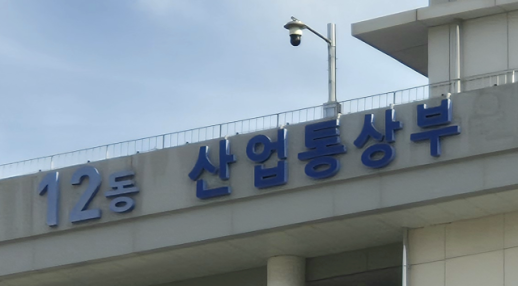 South Korea Eases Requirements for Companies Returning from Overseas 정부가 해외로 나간 기업들의 국내 복귀를 촉진하기 위해 '유턴기업'의 인정 요청을 대폭 개선한다. 동일성 요건을 완화하고 해외 사업장 구조조정 요건에 대한 면제 범위도 확대하는 것이 핵심이다. 보조금 지원체계도 국내 투자 확대에 더 직접적을 연동되도록 개편한다. The South Korean government is significantly improving the recognition process for companies returning from overseas, known as "returning companies." Key changes include relaxing the requirements for product similarity and expanding exemptions for restructuring overseas operations. The subsidy support system will also be restructured to more directly encourage domestic investment. On May 29, the Ministry of Trade, Industry and Energy presented these plans during an economic ministers' meeting, outlining a strategy for promoting domestic returns. Previously, to be recognized as a returning company, firms had to liquidate or transfer their overseas operations and reduce their overseas production by a certain level before making new investments in South Korea. However, there have been ongoing criticisms that the existing policies do not align with the realities faced by businesses. Companies wishing to maintain their global production networks while also investing domestically found themselves outside the support framework, as they were required to completely reduce or restructure their overseas operations. This was particularly challenging for advanced industries, where maintaining overseas bases is crucial for responding to local markets and managing supply chains. Thus, using overseas production reduction as the sole criterion for determining domestic return was seen as inadequate. The Korea Development Institute (KDI) raised concerns about the effectiveness of reshoring policies in a report published in 2023. The report noted that reshoring companies in South Korea tend to be smaller, labor-intensive, and less productive compared to multinational corporations. Additionally, the employment effects of their domestic investments were found to be lower than those of purely domestic firms, despite receiving more government support. In response, the government plans to focus on several key areas through this new initiative: redesigning the recognition criteria for returning companies, restructuring the subsidy support system, enhancing evaluation and management, and providing close support for strategic attraction and investment implementation. The government will broaden the narrow definition of returning companies. Major countries like the United States and Japan are prioritizing investment support based on securing production capabilities in advanced strategic sectors rather than merely formal requirements. The government aims to revise relevant laws related to returning companies this year and implement them starting next year. The requirement for product and service similarity between overseas operations and domestic return projects will be relaxed. The government will adopt a more flexible approach to similarity assessments to support investments aimed at entering new industries and enhancing business structures. An official from the Ministry of Trade, Industry and Energy explained, "If a traditional auto parts company transitions to producing electric vehicle parts, it previously could not be recognized for returning. We will now acknowledge such companies transitioning to new industries as returning companies, although sudden shifts in industry will still be challenging." Additionally, the scope of exemptions for restructuring overseas operations will be expanded. Exemptions will apply to investments recognized as core production facilities in advanced industries and supply chain sectors. This aims to actively promote the domestic acquisition of advanced manufacturing and innovation capabilities beyond mere formal requirements. The subsidy support system for returning companies will also be restructured. The previous system applied uniform subsidy rates based on a set criteria, which limited the attraction of excellent returning companies, particularly in regional areas. To promote local investment and encourage returning in advanced strategic sectors, the government will overhaul the subsidy system to a negotiation-based approach. This negotiation method will draw on cash support policies for foreign investment companies, determining the scale of support through discussions between the government and companies based on economic impact or strategic sectors. Factors such as non-capital area investments, youth employment creation, advanced strategic technologies, and mother factory status will be comprehensively considered. To actively encourage local investment and the introduction of advanced strategic technologies, the criteria will shift from fixed limits to focusing on subsidy rate ceilings. While general sectors and small-scale investments will continue under the current system, the basic subsidy rate will be adjusted to align with local investment promotion levels. To strengthen investment implementation, the evaluation of domestic investment plans and implementation capabilities will be enhanced from the selection stage of returning companies. A new Domestic Return Practical Committee will be established through amendments to the enforcement decree to systematically manage the selection evaluation and subsidy review processes. Detailed procedures supporting the negotiation-based subsidy system will also be developed. To ensure closer monitoring of investment implementation by returning companies receiving subsidies, the implementation period will be extended from the current three years based on the scale of support. The requirements for implementation will also be improved to reflect trends in manufacturing automation and changes in industrial structure. Potential returning companies with core capabilities in advanced industries, manufacturing AI transitions, and supply chain sectors will be proactively identified and attracted. Dedicated project managers will be assigned to provide close support throughout the investment review and implementation process. Kim Jeong-kwan, Minister of Trade, Industry and Energy, stated, "Returning is becoming a strategic choice about where to center technology development, production, and supply chains, beyond just relocating factories. We will redefine the concept of returning based on feedback from the field and boldly restructure and expand our support methods."* This article has been translated by AI. 2026-05-29 08:04:00
 -
 Samsung's Bonus Disparities Spark Debate Among South Korean Firms "I should have raised ducks instead of getting a PhD," said HB Lee, a 33-year-old employee in the LSI division of a major South Korean conglomerate. Such self-deprecating remarks have recently circulated in employee communities. While some support staff in the memory division, benefiting from the AI semiconductor boom, receive bonuses in the tens of millions of won, PhD-level researchers in the loss-making system LSI and foundry divisions receive significantly lower compensation. Lee noted, "These days, there’s talk that even someone raising ducks in the semiconductor division is getting bonuses of 400 to 500 million won. It’s laughable that compensation depends more on which division you belong to than on actual performance." South Korea's export-driven economy has traditionally operated on a trickle-down economics model, where profits from large corporations flow down to subcontractors and small manufacturers. However, there are growing concerns that the current performance bonus conflicts in the AI era are creating a new form of trickle-down effect, exacerbating wage disparities, relative deprivation, and labor disputes across the industrial ecosystem. The competition for performance bonuses, which began in the memory semiconductor sector, is now shaking the distribution standards across South Korean corporate society. The compensation debate sparked by Samsung Electronics and SK Hynix is spreading to the platform, ICT, manufacturing, and bio industries, leading to polarization in the labor market, internal divisions within organizations, and conflicts throughout the supply chain. Professor Park Byeong-jin of Hanyang University’s Business School stated, "The precedent set by Samsung Electronics regarding performance bonuses is likely to have a domino effect on the entire South Korean labor market and the compensation systems of major corporations. The unlimited bonus structure of the country’s top company is becoming a benchmark that raises the compensation expectations of other corporate unions." He added, "If this trend continues, it could lead to performance bonus inflation across the industry, increasing the cost burden on companies." The demand for performance bonuses is intensifying across the industrial sector. The Hyundai Motor and Kia unions are demanding bonuses equivalent to 30% of their net profits this year, while the HD Hyundai Heavy Industries union has included a proposal for sharing 30% of operating profits in this year's negotiations. The Kakao union has raised the possibility of a strike for the first time since its founding, demanding bonuses of 13-14% of operating profits, and LG Uplus is also continuing to demand bonuses at the 30% level. The Doosan Enerbility union, benefiting from a boom in power equipment, has reportedly included a request for a revision of the bonus calculation method in this year's negotiations. SM, a 33-year-old manager at a domestic automotive company, remarked, "Ultimately, it’s a matter of how to distribute limited resources. There can’t be a win-win structure. If one person takes more, someone else has to take less. In the end, one side has to concede, but realistically, who is going to give up money?" Within Samsung Electronics, there is growing backlash over the extreme disparities in performance bonuses between divisions. The joint negotiation team of the Samsung Electronics union announced that a tentative agreement was approved with 73.7% support (46,142 votes) in a vote that closed at 10 a.m. on May 27. The turnout was 95.5%. As a result, Samsung Electronics has temporarily avoided the previously anticipated strike. The agreement includes an average wage increase of 6.2% and the establishment of a "special management performance bonus" for the DS division. This special bonus will be funded by 10.5% of business performance and will be paid in the form of restricted stock units (RSUs). The distribution ratio for the bonus fund is set at 40% for common divisions and 60% for business units. This structure is similar to the bonus system already implemented by SK Hynix, which provides bonuses equivalent to 10% of operating profits. Under the tentative agreement, employees in the memory division are expected to receive a total bonus of up to 600 million won based on an annual salary of 100 million won, combining the special management performance bonus and the existing excess profit incentive (OPI). In contrast, employees in the loss-making system LSI and foundry divisions are expected to receive around 210 million won. Some employees in the DX division, responsible for smartphones and home appliances, are reported to receive about 6 million won. The nearly 100-fold disparity has led to unprecedented "intra-company conflict" within Samsung Electronics. Internal dissent among employees in the non-memory and DX divisions continues even after the approval of the tentative agreement. The number of members in the Donghaeng union, primarily composed of DX division employees, surged from about 2,200 to around 12,800 following the announcement of the tentative agreement. This internal backlash highlights the structural dilemma faced by South Korean companies in the AI boom. They must reward successful divisions while also managing relative deprivation, distrust, and divisions within the organization. SM stated, "In the past, the company would explain that it was difficult due to public sentiment, but employees no longer accept such explanations. The disparities between divisions have become so pronounced that they begin to question the fairness of the structure itself." He added, "One side claims, 'We made money through good sales,' while the other side argues, 'If we hadn’t supported them, that business wouldn’t have operated at all.' When we start to scrutinize contributions, it ultimately leads to everyone feeling wronged." The conflict over performance bonuses has evolved beyond simple labor disputes to encompass competition between divisions, conflicts between job categories, tensions between regular employees and subcontractors, and clashes between primary and secondary contractors, as well as conflicts of interest between shareholders and employees. Particularly within platform and ICT companies, the difficulty of quantifying contributions to revenue generation among developers, marketing, sales, support teams, and management is complicating the conflict. The atmosphere is similar in booming industrial sectors. Samsung Biologics faced its first strike after negotiations broke down earlier this month, and the Doosan Enerbility union is also demanding changes to the bonus calculation method. The repercussions have already extended beyond large corporations. According to a survey on labor costs released by the Ministry of Employment and Labor in September 2025, performance bonuses have emerged as a key variable exacerbating labor market polarization in South Korea. In 2024, bonuses and performance incentives accounted for approximately 24.7% of total wages in large corporations with over 1,000 employees, while small businesses accounted for only about 8%. The widening gap is attributed to performance bonuses. While the gap in fixed salaries, such as base pay, was 4.71 million won for large corporations and 3.99 million won for small businesses, the average monthly performance bonus and incentive was 1.33 million won for large corporations, nearly four times that of small businesses (340,000 won). David Song, a 35-year-old employee at a small IT company in Gangnam, expressed, "For some, it’s tough to make ends meet for a month, while conflicts over bonuses in the tens of millions of won feel like a story from another world. Employees in small businesses can’t raise their voices like those in large corporations." The conflict is also spilling over to subcontractors. The domestic manufacturing sector relies heavily on numerous subcontractors and outsourced labor. As the scale of performance bonuses grows due to the AI boom, debates are intensifying over whether to extend bonuses to employees of subcontractors in areas such as cafeteria services, cleaning, and security. JW Kim, a 28-year-old employee in manufacturing, questioned, "Is it reasonable to pay subcontractor employees 80% of the performance bonus just because they work in the same facility?" He added, "Ultimately, this only breeds resentment toward subcontractors." Concerns are growing that the amendments to the Labor Union Act, which expanded the scope of primary contractors' responsibilities, could lead to demands for negotiations, strikes, and lawsuits from subcontractor unions throughout the supply chain. In fact, the logistics subcontractor union of SK Hynix has demanded collective bargaining to address performance bonus disparities, and the cafeteria union at Hanwha Ocean has also raised the issue of expanding bonuses. The debate over performance bonuses has also led to clashes between shareholders and employees. Some investors worry that when corporate performance declines, shareholders bear the losses, while employees may excessively allocate profits during boom periods to bonuses. In response, Professor Park suggested a realistic alternative: "Instead of simply distributing a percentage of operating profits, it would be better to first reflect the minimum capital costs and dividend resources that should go to shareholders, and then calculate the performance bonus fund based on the remaining economic value added (EVA)." He also proposed increasing the proportion of long-term stock compensation, such as RSUs, instead of excessive cash bonuses. Bonuses above a certain level should be paid in stock that can be disposed of after 3-5 years, encouraging employees to have a greater stake in the company’s value and stock price appreciation rather than focusing on short-term rewards. The conflict over compensation is beginning to change the internal atmosphere of companies. Employees are now constantly comparing compensation not only between companies but also within the same company across divisions, job categories, and organizational affiliations. Engineers in loss-making semiconductor divisions are publicly expressing dissatisfaction online, stating that support staff are receiving higher bonuses simply because they belong to the same organization. Analysts suggest that the community identity that once supported South Korean conglomerates is now being shaken. Hyun Mo, a 32-year-old employee who struggled to secure a position at a refinery, lamented, "In the past, it was considered an 'elite course' to go to a refinery or automotive company based on an electrical engineering degree, but these days, seeing the semiconductor bonus news makes many employees feel like they’re going crazy." Ultimately, South Korean companies find themselves at a crossroads between 'organizational stability' and 'performance differentiation' in the AI era. Professor Park analyzed that Samsung's current performance bonus (OPI) structure has a strong collective reward nature, where if a specific division is profitable, all members within that division receive high compensation together. He stated, "This structure imposes a tremendous burden on companies, as they have to reward 10,000 people equally to retain one key talent." He continued, "In the future, companies should reduce the proportion of collective performance bonuses and convert some of the saved resources into targeted bonuses (Retention Bonuses) directly awarded to irreplaceable key engineers and high performers to alleviate the overall cost burden and prevent the loss of key talent." This trend is partially reflected in Samsung Electronics' tentative agreement, which includes provisions for some of the special bonuses to be paid in restricted stock units (RSUs), indicating a shift from a short-term cash compensation structure to a long-term stock-linked compensation system.* This article has been translated by AI. 2026-05-29 08:02:00
 -
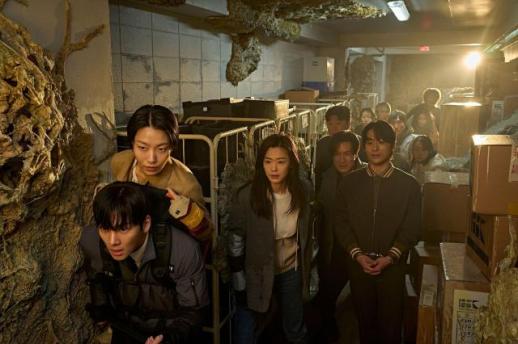 Korean Zombie Film 'Gunch' Redefines Horror Genre Amid Early Summer Release SEOUL, May 28 (AJP) - This year, the horror season has arrived earlier than usual, coinciding with the onset of summer. When thinking of K-horror, zombies have become synonymous over time. South Korea's unique interpretation of the Asian zombie, which began with the traditional Jiangshi, has evolved once again this year. This time, the zombies are equipped with the ability to 'think,' fitting for the AI era. Director Yeon Sang-ho's new zombie thriller 'Gunch' has surpassed 2.1 million viewers just six days after its release, making it a strong early summer box office hit. This pace is one day faster than the record set by the highest-grossing Korean film of 2025, 'Zombie Daughter,' which also crossed the 2 million mark. 'Gunch' is currently showing on 1,858 screens nationwide and has a reservation rate of 39.9%. Comparisons to 'Train to Busan,' which attracted 11.5 million viewers in 2016 and left a significant mark on the global zombie film market, are naturally emerging. However, Director Yeon describes 'Gunch' not as a continuation of 'Train to Busan,' but as a work that fundamentally changes the way we view the zombie genre. During a press conference at CGV Yongsan I-Park Mall, Yeon stated, "'Seoul Station,' 'Train to Busan,' and 'Peninsula' started from placing classic zombies in new settings. 'Gunch' is a film about zombies themselves. In a sense, it can be seen as my first film featuring a zombie protagonist." This shift in perspective leads to a change in the film's premise. In 'Gunch,' the infected mutate rapidly and act as a collective rather than individually. Yeon explained, "It's a confrontation between zombies with collective intelligence and humans. The zombies evolve quickly from a primitive state, while humans regress from civilization to barbarism. What remains at the end of that regression could be the essence of humanity." While 'Train to Busan' established the 'speed' of Korean zombies, 'Gunch' shifts the horror into the realms of 'connection' and 'collective intelligence.' Zombies are no longer just mindless flesh-eaters; they form a network. From Vengeful Spirits to Systemic Collapse Korean horror films have long been rooted in themes of vengeful spirits and the emotion of Han (grief). Unresolved resentment, unjust deaths, white-clad female ghosts, and settings like closed schools and broken family spaces have been central to Korean horror. Although director Kang Bum-gu's 'The Evil Dead' is often cited as Korea's first zombie film from the early 1980s, the zombie genre remained peripheral for a long time. The crises and anxieties experienced by Korean society have since become fertile ground for zombie narratives. Following the 1997 financial crisis, rising unemployment and distrust in institutions shifted public fears in popular culture from individual grievances to collective collapse and systemic failure. Recently, Korean horror has increasingly focused on themes of infection, isolation, social panic, and the disintegration of communities rather than supernatural revenge. 'Gunch' aligns with this trend. Set in a confined building beset by a mysterious infection, the film depicts survivors confronting infected individuals who evolve in unpredictable ways. The title 'Gunch' evokes a biological concept, suggesting a group of individual organisms functioning as a single unit. The provocative aspect of the film lies in the fact that these infected individuals are not 'thoughtless monsters.' “Zombies Resembling AI” — Audience Reactions Aaron Kim, a 20-year-old university student from Edinburgh visiting Seoul, initially had no plans to watch a Korean zombie film but was persuaded by a Korean friend to go to the theater. Kim remarked, "In most zombie films I've seen, zombies are thoughtless beings that indiscriminately kill people. In 'Gunch,' the zombies have intelligence. I felt how unsettling and frightening that could be." He found the film fresher compared to overseas zombie movies. Kim noted, "Overseas zombie films generally follow similar patterns. Korean zombies are new. They run fast and are not simple. I would rate the film 8 out of 10." He particularly connected the film's core concept to artificial intelligence. He explained, "As people use AI more, more data enters a single system, and that system becomes increasingly powerful. The zombies in 'Gunch' felt like part of a larger circuit that continuously learns." Jiyoon Lee, a 20-year-old university student living in New York, also evaluated 'Gunch' as taking a different direction from 'Train to Busan' and 'Kingdom.' Lee said, "In previous works, people became zombies due to a virus and charged aggressively, but they didn't appear to be thinking beings. The zombies in 'Gunch' seem to have a clear purpose to spread the virus. Their ability to create collective intelligence and move together through their own communication network is chilling." What Sets Korean Zombies Apart? The reactions from both audience members resonate with the image that Korean zombie films have built since 'Train to Busan': fast, intense, and physically overwhelming zombies. However, speed alone cannot explain the allure of Korean zombie films. Korean zombie narratives typically embed infection within densely populated social spaces. Settings like trains, schools, apartment complexes, and closed buildings serve as the main stages, reflecting the high density of life in Korean society. The fear of having nowhere to escape arises not just from the closed spaces themselves but from the social relationships and institutions that trap individuals even in crises. In this regard, Korean zombie films pose different questions than those shaped by George A. Romero's tradition in Western zombie films. While Western zombie narratives ask, 'What remains after civilization collapses?' Korean zombie films inquire, 'How quickly can society collapse while everyone is still trapped within the system?' Film critic Lee Ji-hye believes the strength of Korean zombie narratives comes from the 'relationships' that infection disrupts rather than the infection itself. Lee stated, "Korean zombie films often center around the premise that a beloved family member or friend has become a monster. The existing relationships are intricately woven into the narrative, significantly enhancing audience immersion." He explained that sadness and guilt often accompany the narrative of infection in Korean zombie films. Lee noted, "The fact that someone has become a zombie tends to bring about collective guilt or mourning. The two films show that Korean zombie cinema is no longer confined to a single genre." This sentiment is evident in many key works of Korean zombie cinema. 'Train to Busan' intertwined themes of family sacrifice and class conflict, while 'Kingdom' placed infection against the backdrop of royal politics, famine, and systemic failure. 'All of Us Are Dead' transformed schools into theaters of bullying and survival, and 'Happiness' dissected fear, hierarchy, and selfishness through a quarantined apartment complex. 'Zombie Daughter' embraced the zombie theme within a family comedy, opening a new spectrum for K-zombies. Lee also pointed out that the collapse of institutions is a core element of Korean zombie narratives. He remarked, "Korean zombie films do not merely tell stories of zombies chasing people; they also address how social systems collapse in crises, how ineffectively governments and bureaucracies operate, and how human selfishness manifests." While the hopping corpses of 1980s Hong Kong films combined Taoist folklore, Korean zombies are closer to modern disaster forms born from infection, institutions, and urban overcrowding. 'Gunch' pushes this genre a step further. Now, fear lies not only in the speed of the dead but also in the existence that learns, connects, and evolves collectively, targeting the vulnerabilities of human society.* This article has been translated by AI. 2026-05-29 08:02:00
 -
 Samsung Electronics Unveils AI Healthcare Vision at VivaTech 2026 Samsung Electronics will showcase its vision for AI-based healthcare at VivaTech 2026, Europe’s largest tech and startup event. The company emphasizes a "Connected Care" experience that manages health at home through a network of mobile devices, wearables, and home appliances. According to industry sources, Samsung will participate in VivaTech 2026, taking place from June 17 to 20 in Paris, France. This year's exhibition theme is "An Invitation to a Healthier Tomorrow." VivaTech is a major European technology fair featuring global big tech companies and startups. This year, the event will focus on the practical applications of AI across various sectors, including productivity, AI ethics, green technology, cybersecurity, health, and longevity. At the event, Samsung will introduce an integrated health management service centered around Samsung Health. This service will connect sleep and health status analysis with family and pet care. The company plans to unveil services related to aging management and pet health care in collaboration with partners. Additionally, VivaTech has highlighted "Health and Longevity" as one of its key themes this year, focusing on digital health technologies such as AI-based drug development, brain-computer interfaces, and bioprinting. Samsung aims to present a proactive approach to health management through its ecosystem of mobile devices, wearables, and home appliances. New features of Samsung Health will also be revealed at the event. On June 19, a panel discussion will focus on AI-based personalized health and wellness experiences. Samsung plans to explain the role of connected device ecosystems in health management services during this session. An industry insider noted, "Digital healthcare is evolving beyond simple exercise tracking to encompass sleep, lifestyle habits, and home care. Given its extensive device distribution, Samsung will focus on expanding healthcare services into everyday living spaces."* This article has been translated by AI. 2026-05-29 08:02:00
 -
 South Korean Government Increases Tax-Free Fuel Subsidy for Farmers and Fishermen In response to rising international oil prices that have increased fuel costs for farmers and fishermen, the South Korean government has decided to raise the tax-free fuel subsidy to 176.2 won per liter. On May 29, during a meeting at the Government Seoul Building led by Deputy Prime Minister and Minister of Economy and Finance Ku Yun-cheol, officials announced a plan to expand support for fuel costs for farmers and fishermen. The government has been providing a fuel subsidy of up to 70% of the excess price above a set standard for tax-free fuel, funded by an additional budget of 118.8 billion won, to assist farmers and fishermen who are vulnerable to rising production costs due to the increase in oil prices stemming from the Middle East conflict. However, the ongoing high oil prices have made it impossible to support the increases that exceed the subsidy limit. As of May 26, the prices for tax-free diesel and kerosene were 1,512 won and 1,424 won per liter, respectively, marking increases of 34.7% and 27.7% compared to pre-war levels. Additionally, the subsidy limit for fuel price adjustments for freight and passenger vehicles has risen from 183.2 won to 280 won per liter, raising concerns about fairness. To address these issues ahead of the busy farming and fishing seasons, the government has decided to increase the subsidy limit from 138.4 won to 176.2 won per liter. A government official stated, "We plan to implement the increased subsidy limit immediately for purchases made from today." * This article has been translated by AI. 2026-05-29 08:02:00
 -
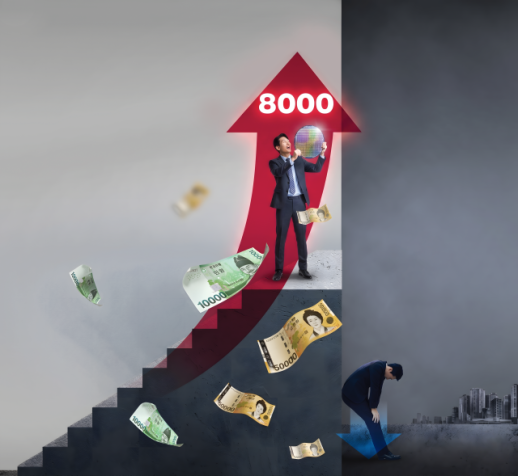 KOSPI Hits Record 8,228.70, But Many Stocks Remain Stagnant On May 27, the KOSPI index reached a record high of 8,228.70. Despite this unprecedented bull market, only 75 stocks saw gains that day, while 826 stocks either fell or remained unchanged. This means that 92% of the listed companies on the KOSDAQ were left behind, leading to complaints from investors like, "The KOSPI is at 8,000, but my stocks aren't rising." Since last year, there has been a noticeable concentration of funds in specific stocks, creating distortions and illusions in the market. While the index continues to set new records, many investors do not feel the upward momentum. This concentration also leads to a 'bandwagon' effect, where funds rapidly flow into certain stocks, such as semiconductors, exacerbating market volatility. "Index at 8,000, My Stocks in the Red" According to the Korea Exchange, the KOSPI surpassed the 8,200 mark on May 28, setting a new all-time high. Just earlier this month, the index was below 7,000, but it surged over 1,600 points in just a month, driven by gains in semiconductor and artificial intelligence (AI) stocks. However, the overall performance of the market remained lackluster. Statistics reveal the disparity. On May 27, when the KOSPI hit its peak, only 75 stocks recorded gains. This indicates that a small number of stocks were responsible for the index's rise. The increase in prices of major stocks like Samsung Electronics and SK Hynix gave the illusion of a booming market. Expanding the timeframe, from May 4 to May 27, the KOSPI rose from 6,598.87 to 8,228.70, yet only 140 stocks increased in value, while 778 stocks declined. The average gain for the rising stocks was 21.7%, while the average loss for the declining stocks was 13.87%. Since the outbreak of the Middle East conflict in March until May 27, only 171 stocks had increased in value. The trend of concentration is evident when examining the KOSPI index's performance across different sectors. Among 24 sectors, only six recorded gains: electrical and electronics (44.69%), manufacturing (30.63%), insurance (25.42%), retail (12.40%), IT services (10.09%), and finance (10.02%). Notably, the electrical and electronics sector's growth rate was 1.8 times higher than the KOSPI's overall increase of 24.70%. In contrast, 18 sectors, including construction (-18.06%), paper and wood (-16.67%), and machinery and equipment (-13.29%), experienced declines. Additionally, the KOSPI 50 (36.58%), KOSPI 100 (33.04%), and KOSPI 200 (30.91%) showed higher growth rates, indicating that the upward trend is primarily concentrated in large-cap stocks. Market analysts suggest that excessive capital concentration in leading stocks, such as Samsung Electronics and SK Hynix, particularly in AI semiconductors and power infrastructure, is distorting the overall market. The recent surge in global AI investments and expectations for increased demand for high-bandwidth memory (HBM) have led to a concentration of investor funds in large-cap semiconductor stocks. Since the outbreak of the Middle East conflict in March, funds have increasingly flowed into globally competitive large technology stocks, while small and mid-cap growth stocks and domestic stocks have been relatively neglected, widening the gap between perceived market conditions and the index. "Concentration is a Typical Phenomenon in the Later Stages of a Bubble" Interpretations of this concentration phenomenon vary. Some analysts believe that the surge in AI-related semiconductors will last for 2 to 3 years, making the concentration of funds in specific sectors a natural occurrence. A securities industry insider explained, "Since half of the KOSPI market capitalization is made up of large-cap semiconductor stocks, it is natural for their prices to rise and for funds to follow." However, others argue that the current concentration resembles typical patterns seen in the later stages of a bubble. Lee Eun-taek, a researcher at KB Securities, recently noted in a report that the current semiconductor-driven market is showing trends similar to past bubble phases. According to the report, during the 1929 U.S. stock market bubble, funds were concentrated in new technology consumer goods companies like aviation, telephony, and radio. Similar concentration was observed in the early 1970s with the 'Nifty Fifty' and during the 2000 dot-com bubble, where a few key growth stocks accounted for most of the market returns. Particularly, just before the collapse of the dot-com bubble in 1999, the U.S. stock market exhibited extreme polarization, with funds heavily concentrated in the information technology (IT) sector. The researcher stated, "In the later stages of a bubble rally, the concentration of leading stocks tends to strengthen, and a reduction in concentration may signal not a 'welcome spread' but rather a precursor to a bubble collapse." Applying this analysis to the second quarter of this year, concerns about the Korean stock market are growing. An analysis of relative returns compared to the KOSPI revealed that the IT sector has surged 31 percentage points above the market average, solidifying its dominance. In contrast, most other industries, excluding IT, remained in negative territory. The healthcare sector recorded a -61 percentage point performance compared to the KOSPI average, while utilities (-57 percentage points), telecommunications services (-54 percentage points), and consumer staples (-46 percentage points) also faced significant declines.* This article has been translated by AI. 2026-05-29 07:54:00
 -
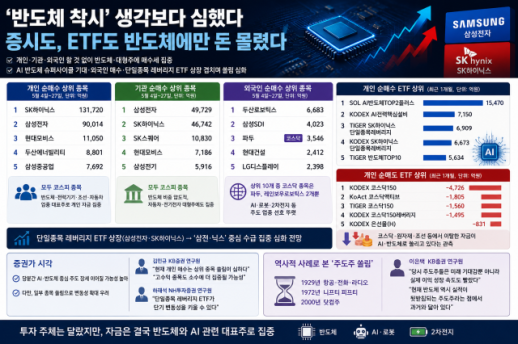 Market Focus on Semiconductors Creates Illusion of Broader Gains The flow of funds in the stock market this year can be summarized as a "semiconductor black hole." Analysts suggest that the buying frenzy for semiconductors among individual, institutional, and foreign investors has intensified the phenomenon of "semiconductor illusion," making the overall market gains appear larger than they are. According to the financial investment industry on May 28, the trading volume of Samsung Electronics and SK Hynix has rapidly increased, now accounting for nearly half of the total trading volume on the KOSPI. The expectation of a supercycle in AI semiconductors, combined with foreign buying, has led to a concentration of funds in specific stocks. The listing of single-stock leveraged ETFs for Samsung Electronics and SK Hynix has further intensified this trend of concentration around these two companies. The Korea Exchange reported that both individual and institutional investors have focused their funds on large-cap stocks in the semiconductor sector. From May 4 to May 27, SK Hynix topped the list of net purchases by individuals with 13.172 trillion won, followed by Samsung Electronics with 9.014 trillion won. Other notable stocks included Hyundai Mobis (1.105 trillion won), Doosan Enerbility (880.1 billion won), and Samsung Heavy Industries (769.2 billion won). During the same period, institutional investors also heavily purchased Samsung Electronics (4.9729 trillion won) and SK Hynix (4.6742 trillion won), with SK Square (1.083 trillion won), Hyundai Mobis (718.6 billion won), and Samsung Electro-Mechanics (591.6 billion won) following. While foreign capital showed some diversification with investments in Doosan Robotics (668.3 billion won), Samsung SDI (402.3 billion won), and Pado (354.6 billion won), a clear preference for leading sectors such as AI, robotics, and secondary batteries was evident. Analysts noted that despite differing investment entities, funds ultimately concentrated on semiconductor and AI-related stocks. The ETF market also reflects a severe concentration on AI and semiconductor themes. According to Koscom ETF CHECK, the top net purchase by individuals in the past month was the SOL AI Semiconductor TOP2 Plus, which attracted 1.547 trillion won. Other top performers included KODEX AI Power Core Facilities (3rd, 715 billion won), TIGER SK Hynix Single Stock Leverage (4th, 690.9 billion won), KODEX SK Hynix Single Stock Leverage (5th, 667.3 billion won), and TIGER Semiconductor TOP10 (7th, 563.4 billion won). More than half of the top 10 ETFs were semiconductor-related products. In contrast, there was a noticeable outflow of funds from KOSDAQ and commodity-related ETFs. KODEX KOSDAQ 150 (472.6 billion won), KoAct KOSDAQ Active (180.5 billion won), TIGER KOSDAQ 150 (156 billion won), and KODEX KOSDAQ 150 Leverage (149.5 billion won) were among the top net sales by individuals. Additionally, selling pressure was observed in ETFs related to silver futures, gold bullion, and shipbuilding. Market analysts believe that the dominance of AI and semiconductor stocks is likely to continue for the foreseeable future. There are concerns that the concentration of funds in a few stocks like Samsung Electronics and SK Hynix could increase market volatility. Kim Min-kyu, a researcher at KB Securities, stated, "Currently, individual buying is heavily concentrated on top stocks," adding that high-return stocks are also likely to become concentrated among a few. NH Investment & Securities researcher Ha Jae-seok also predicted, "Single-stock leveraged ETFs could amplify short-term volatility."* This article has been translated by AI. 2026-05-29 07:50:00
 -
 Anthropic Valuation Reaches $965 Billion, Surpassing OpenAI The valuation of the U.S. artificial intelligence startup Anthropic has soared to $965 billion, surpassing that of OpenAI among private AI companies. On May 28, local time, Reuters and The Wall Street Journal reported that Anthropic secured $65 billion in a Series H funding round. Following this investment, its valuation was recognized at $965 billion, marking a more than 2.5-fold increase from $380 billion just three months earlier when it raised $30 billion in February. The key driver behind this valuation surge is rapid growth in revenue. According to Reuters, Anthropic's annualized revenue has exceeded $47 billion. The Wall Street Journal anticipates that the company's second-quarter revenue will more than double to $10.9 billion compared to the previous quarter, with a possibility of posting its first quarterly operating profit. This growth has been fueled by demand for enterprise services and coding tools. Anthropic's model, Claude, is utilized for task automation and as a support tool for developers. Notably, the rapid adoption of Claude Code, a tool for developers, has allowed Anthropic to expand its customer base among businesses. Domestic companies have also participated in this investment. Samsung Electronics and SK Hynix have joined Micron as strategic infrastructure partners, although individual investment amounts have not been disclosed. This move is seen as a strategy to secure memory and semiconductor supply chains necessary for large-scale AI facilities. The competition for computing resources has intensified as well. Anthropic has committed to spending over $100 billion on Amazon Web Services (AWS) technology over the next decade. Amazon has also announced plans to invest up to $25 billion in Anthropic. According to Reuters, citing The Information, Anthropic is set to spend $200 billion over five years on Google Cloud and chips. However, costs remain a variable. Continued investments in semiconductors, power, and data centers are necessary for model development. Even as revenue grows rapidly, computing expenses are expected to increase concurrently. The fact that Anthropic's valuation has surpassed that of OpenAI signals strong market expectations. Industry insiders interpret this as an indication that the company must demonstrate profitability while managing its expenditure burdens.* This article has been translated by AI. 2026-05-29 07:44:00
 -
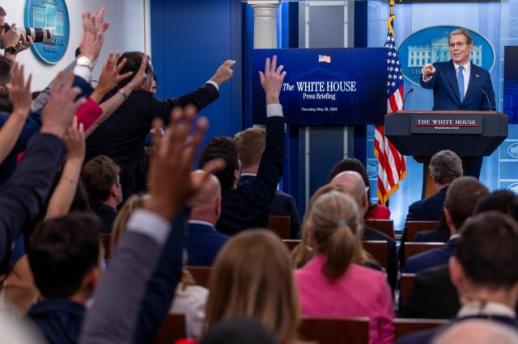 U.S. and Iran are "within reach" of a deal, news that may uplift Asian markets SEOUL, May 29 (AJP) -The United States and Iran are “within reach” of an agreement to end the three-month war that has rattled global energy markets, and the prospect of a reopening of the Strait of Hormuz may help lift Asian stocks Friday after a broad retreat the previous session. U.S. Treasury Secretary Scott Bessent said Washington and Tehran “perhaps have the makings of a deal,” with negotiations centering on a 60-day framework that would gradually unwind blockades in the Strait of Hormuz, reopen one of the world’s most critical oil chokepoints and set the stage for broader nuclear negotiations. Asian markets had pulled back Thursday amid renewed military exchanges between the two sides and uncertainty over whether President Donald Trump would approve the framework. But investors are expected to welcome any sign that Gulf energy flows may stabilize after nearly three months of disruption. The prospect of easing oil prices and lower geopolitical risk helped Wall Street benchmarks return to record highs overnight, led again by AI and technology shares. That may lift the market sentiment in Seoul, dampened by rate hike signal from the central bank. In addition, Nvidia CEO Jensen Huang is expected to visit South Korea next week after attending GTC Taipei 2026, sparking expectations of another round of high-level talks with Samsung Electronics, SK hynix and major Korean conglomerates over high-bandwidth memory (HBM), AI accelerators, foundry cooperation and physical AI ecosystems. The visit comes at a critical moment for Korea’s semiconductor sector as Nvidia’s AI dominance increasingly shapes the fortunes of Asian chipmakers. SK hynix, currently Nvidia’s key HBM supplier, has emerged as one of the biggest beneficiaries of the global AI boom, and chasing closely Samsung Electronics in top market valuation after joining the $1 trillion club earlier this week. Huang is also expected to meet LG Group Chairman Koo Kwang-mo to discuss expanding cooperation in physical AI, cloud infrastructure and robotics, while possible meetings with Samsung Chairman Lee Jae-yong, SK Group Chairman Chey Tae-won and Hyundai Motor Group Chairman Chung Euisun are drawing attention from investors seeking new AI partnerships. The upside from the Gulf remains fragile. Iran and the United States exchanged strikes again this week, including Tehran’s ballistic missile launch toward Kuwait and fresh U.S. attacks on Iranian drone infrastructure. 2026-05-29 07:36:12
 -
 Kiwoom Securities Enters Retirement Pension Market with No-Fee Policy for Low Returns ◆ Ajou Economic News ▷ Kiwoom Securities announces entry into retirement pension market... "No fees if returns are low" - Kiwoom Securities held a press conference on May 28 at TP Tower in Yeouido, Seoul, to unveil its roadmap for entering the retirement pension market. - The company will begin its retirement pension business on June 1. It plans to implement a policy where it will not charge management fees if returns do not meet its own benchmarks, which are currently being set slightly above deposit interest rates. - Additionally, it will waive management and asset management fees for the first year across all retirement pension systems, including defined benefit (DB) and defined contribution (DC) plans, in line with the government's efforts to reduce fee burdens and to accelerate the acquisition of initial subscribers. - Kiwoom Securities will also be the first retirement pension provider to offer foreign RP products to all clients, including individuals and corporations. The company plans to introduce a variety of products, starting with foreign RP, followed by bonds and ELS based on the size of contributions, leveraging the fact that foreign products are permissible under retirement pension regulations. ◆ Major Reports ▷ Market fluctuations and shifts in the KOSPI - The KOSPI and KOSDAQ fell by 0.5% and 2.5%, respectively, the previous day. In the U.S., the three major indices reached all-time highs despite a pause in semiconductor stocks. - Under pressure from discount rates, the KOSDAQ, which is centered on growth stocks, saw a decline of around 6%. However, IT leaders like SK Hynix (+2.1%) and Samsung Electro-Mechanics (+13.4%) performed well, helping the KOSPI recover to the 8,100-point range in the afternoon. - The KOSPI is showing signs of significant shifts amid volatility. Recently, as investor sentiment has been dampened by noise surrounding Samsung Electronics' strikes and profit distribution, SK Hynix has been closing the gap. Even on a day when large-cap stocks generally struggled, SK Hynix rose, nearing 93% of Samsung Electronics' market capitalization. - Samsung Electronics, benefiting from a boom in multi-layer ceramic capacitors (MLCC) and high-value flip-chip ball grid arrays (FC-BGA), has surged 623% year-to-date, surpassing Hyundai Motor to become the fourth-largest company by market cap during trading hours. ◆ Major Announcements After Market Close (May 28) ▷ Lotte Group reports 181% increase in operating profit for Q1 amid portfolio restructuring. ▷ Samsung Securities resolves to acquire 4% stake in SDS and Card and Dunamu. ▷ Samsung Securities announces acquisition of 306.4 billion won in Dunamu shares, representing a 2% stake. ◆ Fund Trends (as of May 27, excluding ETFs) ▷ Domestic equity funds: -1.594 trillion won ▷ Foreign equity funds: +152 billion won ◆ Key Schedule for Today (May 29) ▷ South Korea: Industrial Production (April), Retail Sales (April) ▷ Japan: Tokyo Core Consumer Price Index (May), Industrial Production (April), Retail Sales (April) ▷ United States: Chicago Fed Index (May)* This article has been translated by AI. 2026-05-29 07:34:00