

Journalist

Chang SeongWon
-
 POSCO Expands Tactile Exhibits Using Steel-Based 'PosArt' for Visitors With Visual Impairments POSCO Group is combining steel technology with art and giving to expand access for visitors, including people with visual impairments. Industry officials said April 23 that the group is producing tactile exhibits using PosArt to help people with disabilities and other underserved visitors experience museum displays. PosArt is POSCO Group's premium color steel sheet made by applying high-resolution inkjet printing to specialized steel. Using 3D layering that builds ink in stacked layers, it delivers image quality more than four times sharper than conventional color steel sheets, the company said. In February, the POSCO 1% Sharing Foundation produced tactile exhibits using PosArt and donated them to the National Museum of Korea. The foundation said applying PosArt to artworks allows delicate raised textures, enabling visitors with visual impairments to feel details by hand. POSCO Humans, a POSCO Group social enterprise and a standard workplace for people with disabilities, handled production to help link steel technology with art and support a broader culture of giving. The donated items fall into three categories: a large feature wall at the entrance to the calligraphy and painting gallery; a tactile table that lets visitors explore representative calligraphy and paintings with their fingertips; and four showcases designed to store artifacts safely. Separately, POSCO Art Museum is running exhibitions where visitors can experience PosArt. The shows, titled 'Spirits of Water' and 'Recorders of Nature,' examine the value of the Korean Peninsula's disappearing natural ecosystems as artistic records and run through May 3. The exhibitions include a hands-on area featuring PosArt works made with POSCO Group's steel technology, allowing visitors with visual limitations to explore the shapes of fish, insects and plants through touch.* This article has been translated by AI. 2026-04-24 05:03:21
 -
 Actor Jung Woo Revisits ‘Jjanggu’ Character in New Film, Drawing on His Own Youth Actor Jung Woo is bringing back the face of youth with the film 'Jjanggu,' returning to a character now nearing the end of his 20s and confronting reality while chasing an acting dream in Seoul. By reviving the name Jjanggu from the film 'The Wind,' Jung Woo said he aimed to portray endurance and a youthfulness that does not break easily, with an autobiographical undercurrent. "If you ask why now, I didn’t start this thinking I had to do it at this exact time," he said. "It flowed naturally and felt more like a project I met by fate. That made me even more grateful — and I was thankful to work with good staff and actors." For 'Jjanggu,' Jung Woo went beyond acting, taking part in the screenplay and serving as a co-director. He said being involved throughout the process gave him a closer look at how a film is completed. "Actors sometimes don’t realize how much energy and care goes into postproduction," he said. "Experiencing it myself was fun, but it also reminded me how much effort it takes to finish a film." Jung Woo said he does not consider 'Jjanggu' a sequel to 'The Wind,' even though the character returns. "Strictly speaking, I don’t think it’s 'The Wind 2,'" he said. "It’s hard to call it that. If anything, since that character comes back, it can feel like a spinoff or a character movie. But it’s different from the kind of series people usually think of — it’s definitely not like 'The Roundup' 1 and 2, where it continues in that way." In the film, Jjanggu’s friends — including Jang-jae (played by Shin Seung-ho) and Kkangnaengi (played by Jo Beom-gyu) — are grounded characters with a lifelike feel. Jung Woo said they were not created from pure fiction but grew out of people he has known and observed. "Like with 'The Wind,' because I wrote this myself, I kept thinking of unusual friends I’d seen in real life," he said. "Jang-jae and Kkangnaengi look ordinary on the surface, but if you look closely, they’re not. I thought that sense of real life would be fun. I have even more unusual friends around me, and I’m a little disappointed I couldn’t fit them all into this film." Jung Woo also recalled how 'The Wind' built a reputation beyond its theatrical run. He said it achieved meaningful results as an independent film and later gained wider, longer-lasting attention through IPTV and VOD, earning the label of an "unofficial 10 million" film. "Back then, I didn’t even know what the break-even point was — how many people it was," he said. "To us, it was just a meaningful step. Once we went to Jeju for stage greetings and there were only four people sitting there. There were fewer audience members than us, so theater staff even filled seats. We still went around doing those greetings." He said the routine was exhausting at the time, including taking selfies and signing for each audience member after screenings. "Honestly, it was hard," he said. "I didn’t really know the idea of fan service, and I didn’t know how to enjoy that time. But now it’s different. This time in Busan, taking photos and making memories with people felt really fun and I was grateful. I can’t control the numbers, so I see it as a process of thanking each person." If 'The Wind' was based on Jung Woo’s story and turned into a screenplay by director Lee Seong-han, Jung Woo said 'Jjanggu' was a more direct effort to write out his own time. He said it began from the same autobiographical starting point, but this time he revised and refined the story more as a writer. "Putting my story into writing isn’t easy," he said. "'The Wind' had the autobiographical label, but I felt it was closer to a series of episodes. Still, because my real experiences — including my father’s story — were in it, I think it had its own arc. This film also started from my story, but I adapted it more. I rewrote it five or six times, and as many as seven, getting help from people around me as I polished it." Asked what changed most through the rewrites, Jung Woo said the process ultimately brought him back to the original direction. "It’s not that it changed a lot from the first draft — in the end, I went back to the beginning," he said. "Even after about six rounds of adaptation, I returned to that first draft. The production company heads said, 'We knew this would happen.' But you can’t just do nothing and jump in. Going through the process made what was rough at first feel smoother." Though he is credited as a co-director, Jung Woo said he is not treating directing as a firm plan or goal. "I don’t have a specific plan for directing," he said. "I just keep writing scripts. I don’t know which script will become a film, but I write when I can and enjoy it. I really enjoyed being on set. It was tough and I could have gotten hurt, but thankfully I didn’t." He said filming stayed within set hours, noting the importance of both cast and crew condition, and added that shooting in his hometown of Busan gave him more time with staff and actors. "So I think we filmed with a grateful heart," he said. 2026-04-24 00:05:44
 -
 South Korea Moves to Overhaul Decades-Old Tourism Laws as Industry Pushes Reform In the first quarter of 2026, inbound tourism to South Korea topped 4.76 million visitors, setting a record, as the government, academics and the private sector moved to modernize tourism laws written decades ago. The Ministry of Culture, Sports and Tourism held a policy forum on the afternoon of April 23 in central Seoul to discuss a broad overhaul of the Tourism Framework Act and the Tourism Promotion Act. The forum followed up on the 10th National Tourism Strategy Meeting held in September. Officials said the goal is to move beyond laws enacted in the 1970s and 1980s that no longer reflect rapid changes, and to present a concrete roadmap for what the ministry called a major shift in the legal framework. ◆ Patchwork revisions hit limits; full overhaul urged South Korea’s tourism legal framework consists of six laws, four enforcement decrees and three enforcement rules. The Tourism Promotion Development Fund Act and the Tourism Framework Act were enacted in the 1970s, and the Tourism Promotion Act and the Korea Tourism Organization Act were enacted in the 1980s and 1990s. Because the system has been revised only in parts, it has grown sprawling and unclear, critics have said, limiting long-term responses needed to develop the tourism industry. The ministry said it has prepared a systematic reform plan — including a full revision of the Tourism Framework Act and a full revision and possible split of the Tourism Promotion Act — based on research conducted with the Korea Culture and Tourism Institute. ◆ From declarations to execution: Framework Act to spell out responsibilities Jeong Gwang-min, a research fellow at the institute, said the Tourism Framework Act is being fully revised for the first time since it was enacted in 1975. “If the existing framework act remained largely declarative — ‘what we will do’ — the new law’s core is to clearly define who will execute policy, how, and on what legal basis,” Jeong said. He said inbound tourism hit a record about 18.7 million visitors last year and reached 4.76 million in the first quarter of this year, but 78.4% of inbound visitors remain concentrated in Seoul. “With the capital-area concentration, there are limits to the extent that regions as a whole can feel the benefits of growth,” he said. He called for the revised law to firmly establish local governments’ legal authority and administrative and financial support so they can plan and carry out region-specific tourism policies. Under the proposal, the current 16-article law would expand to five chapters and 27 articles. The four main directions are strengthening tourism’s guiding principles and core values; defining the roles and responsibilities of the central government, local governments and businesses; reorganizing the policy implementation system; and specifying legal grounds to promote tourism and build an industry base. A key element is reorganizing the “policy formulation and implementation system” that serves as a control tower. Jeong said the proposal would elevate the existing five-year plan to a 10-year “National Tourism Master Plan” and reinforce the legal basis for the National Tourism Strategy Meeting, which was elevated in March to a presidential body, to strengthen policy execution. The proposal also adds new sections on “promotion and facilitation of tourism” and “building the foundation for the tourism industry,” and spells out legal grounds for policies that lacked clear support. It would include provisions to guarantee the public’s right to enjoy tourism and support tourism welfare for vulnerable groups; ensure tourism safety in disasters and other emergencies; protect tourists’ rights; and establish fair trade practices. In the discussion, Cho Gwang-ik, senior vice president of the Korea Tourism Sciences Society, said it could be the biggest comprehensive overhaul since 1986, but warned that universal values such as inclusive tourism and the public’s right to enjoy tourism should not be diminished as the law is made more detailed. Kim Jin, a senior expert adviser at Shin & Kim, said the framework act should reflect a shift from central-government-led tourism policy to a model in which local governments take the lead and the central government supports them. ◆ Proposal would split Tourism Promotion Act into industry and regional tracks The second session focused on splitting the expanded Tourism Promotion Act by function to increase specialization. Ryu Gwang-hun, a senior research fellow at the institute, proposed dividing it into a tentatively named “Tourism Industry Promotion Act,” focused on industry development, and a tentatively named “Regional Tourism Development Act,” aligned with a stronger local-government era. On the industry law, Ryu said the system should move beyond the traditional classification centered on seven major sectors and adopt a “service-attribute-based” structure that actively accommodates digital transformation such as AI and platforms. He cited support to expand an AI-based industry ecosystem; promotion of tourism data collection and use; building broader support for startups, investment and finance; and stronger consumer protections suited to changing transaction environments. He said a separate, stand-alone law for the casino and lodging sectors was also discussed, given their institutional characteristics. On the regional law, Ryu said the approach should shift from development-centered policy to regional community growth and sustainability. He said legal grounds are needed for dedicated local tourism organizations and that legal options should be reviewed to secure local finances, such as a tourism lodging tax or room tax. He also proposed bold regulatory exemptions for small-scale, dispersed development and a one-stop system for handling related agendas. In the second-session discussion, Lee Hoon, a professor at Hanyang University, said that if the law is divided into industry and regional parts, a tight linkage system is needed so overlapping areas — such as festivals that are both industry activity and local events — are not neglected. Jeong Ji-ha, CEO of Tripbtoz, said tourism’s share of South Korea’s gross domestic product has long been stuck in the 3% range. “To raise it to 10%, we can’t remain an analog industry. We urgently need a legal framework centered on the next generation that fosters innovative companies able to compete head-on with global services in the digital world,” he said. In an open discussion, participants also raised a shortage of tourist interpreters and guides for less common languages; the need for clear legal status and certification standards for small and midsize tourism venture companies; a regulatory fast track for new services to keep up with rapidly changing trends; and support measures for local creators to energize regional tourism. Kang Jeong-won, the ministry’s director general for tourism policy, said the overhaul is not simply revising a thick statute book but “a difficult task of designing a new framework that opens an era of 30 million tourists and properly reflects the wide range of industries today.” He pledged to incorporate feedback from the forum and push for legislation through a National Assembly bill in the second half of the year. * This article has been translated by AI. 2026-04-24 00:03:49
 -
 Blue House policy chief says Samsung strike talks not at breaking point Kim Yong-bum, the Blue House policy chief, said April 23 (local time) that he hoped talks would resolve the possibility of a strike by Samsung Electronics’ labor union. Speaking at a press center briefing in Hanoi, Kim was asked whether the government could step in to mediate if Samsung workers strike. “I hope it will be resolved wisely through dialogue,” he said. Kim added that he did not yet see it as a special problem, saying labor and management were “not at the stage of heading to extremes” and that he expected the issue to be settled. Asked whether President Lee had been briefed, Kim said he had reviewed what was reported at a meeting, but that the president did not separately comment on it. Earlier, the Samsung Electronics union held a rally of about 40,000 people demanding the abolition of a cap on performance bonuses and warned of a general strike. Kim also addressed the recent death of a union member at a rally by the Cargo Truckers Solidarity, saying he was concerned and was looking into it. He said it was “a great relief” that the Labor Ministry was communicating with the site.* This article has been translated by AI. 2026-04-23 22:36:21
 -
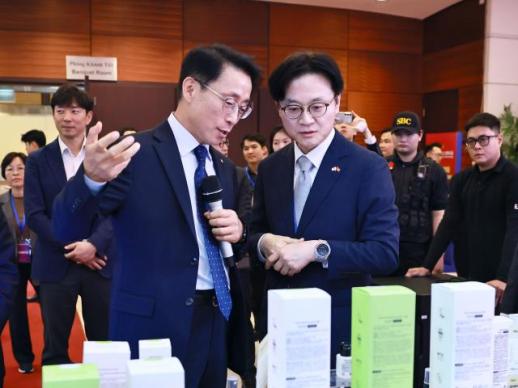 South Korea-Vietnam Forum Spurs Deals on Nuclear Power, AI and Energy Infrastructure South Korean and Vietnamese business leaders gathered in Hanoi to expand economic cooperation, with talks and agreements spanning artificial intelligence, energy and other future industries. The Korea Chamber of Commerce and Industry said it sent an economic delegation to Vietnam and held a South Korea-Vietnam business forum on April 23 (local time), timed to President Lee Jae-myung’s state visit. About 500 government and business figures from both countries attended. Lee and Vietnamese Prime Minister Le Minh Hung appeared together, underscoring their commitment to closer economic ties. Attendees included Chey Tae-won, chairman of SK Group and the chamber; Samsung Electronics Chairman Lee Jae-yong; LG Group Chairman Koo Kwang-mo; Lotte Group Chairman Shin Dong-bin; POSCO Holdings Chairman Chang In-hwa; HD Hyundai Group Vice Chairman Chung Ki-sun; GS Group Chairman Huh Tae-soo; Doosan Enerbility Chairman Park Jie-won; Hyosung Group Chairman Cho Hyun-joon; Daewoo Engineering & Construction Chairman Jung Won-ju; Hyundai Motor President Sung Kim; and Naver CEO Choi Soo-yeon, along with other business group leaders. The delegation, involving 109 companies, sought to move beyond manufacturing-centered cooperation toward AI, advanced technology and energy, the chamber said. In welcoming remarks, Chey called Vietnam “Korean companies’ most important global partner,” and said cooperation should go beyond expanding trade to higher value-added areas such as advanced manufacturing, services and digital industries. “Through cooperation in AI and advanced technology, Korea’s technology and Vietnam’s young, dynamic talent can create tremendous synergy,” Chey said, adding that Vietnam is “no longer just a land of opportunity,” but a partner in building the future. The forum, held under the theme of advancing industrial, investment and science-and-technology partnerships, discussed concrete tasks in four areas: training advanced talent, energy, AI transformation and science and technology. Na Ki-hong, head of Samsung Electronics’ Vietnam strategic cooperation office, introduced manufacturing innovation consulting and smart factory support cases and outlined plans to expand “youth future technology education” to develop next-generation talent. SK Innovation CEO Choo Hyung-wook highlighted the importance of power infrastructure for building an AI ecosystem and shared a roadmap for ongoing cooperation projects, including the Quynh Lap LNG power project. KIST President Oh Sang-rok presented a vision linking talent, technology and industry and proposed a cooperation strategy combining Korea’s maturity with Vietnam’s dynamism. Vietnamese presenter Nguyen Trung Chinh, chairman of CMC, shared strategies for advanced-industry innovation based on AI and science and technology, calling for stronger technology partnerships. The chamber said the forum produced about 70 MOUs and contracts. Key areas included AI data centers and digital infrastructure; energy projects such as nuclear power and power-grid construction; production bases for secondary batteries and advanced materials; smart cities and infrastructure development; and finance and investment. SK Innovation and SK Telecom signed MOUs with Vietnam’s National Innovation Center on building AI data centers and an ecosystem, and with Nghe An province on AI infrastructure, expanding cooperation on future infrastructure, the chamber said. Daewoo Engineering & Construction signed an MOU with Vietnam’s SaigonTel to jointly develop a data center business and participate in construction. POSCO Future M said it completed approval procedures with Thai Nguyen province to build a plant for artificial graphite anode materials, a key secondary-battery material, and began building a supply chain for battery materials. Doosan Enerbility signed MOUs with Vietnamese companies PTSC and PETROCONs on cooperation including Vietnam’s new nuclear power projects. Taihan Cable & Solution signed an MOU with Vietnam’s Newtecons on power-grid upgrades and extra-high-voltage cable business cooperation, moving to expand technology partnerships for local energy infrastructure.* This article has been translated by AI. 2026-04-23 22:30:15
 -
 Samsung’s Lee, LG’s Koo urge results, higher-quality growth at Korea-Vietnam forum President Lee Jae-myung’s state visit to Vietnam brought a large contingent of South Korean business leaders to a Korea-Vietnam business forum, underscoring efforts to deepen economic cooperation. The forum, hosted by Lee and Vietnamese Prime Minister Le Minh Hung, was held April 23 (local time) at a hotel in Hanoi. It drew key officials from both governments, an economic delegation of 109 South Korean companies, and about 500 participants from public institutions and the private sector. Attendees included Samsung Electronics Executive Chairman Lee Jae-yong; SK Group Chairman Chey Tae-won, who also heads the Korea Chamber of Commerce and Industry; LG Group Chairman Koo Kwang-mo; Lotte Group Chairman Shin Dong-bin; POSCO Holdings Chairman Chang In-hwa; HD Hyundai Vice Chairman Chung Ki-sun; GS Chairman Huh Tae-soo; Hyosung Chairman Cho Hyun-joon; Doosan Enerbility Chairman Park Ji-won; Daewoo Engineering & Construction Vice Chairman Jung Won-ju; Hyundai Motor Group President Sung Kim; and Naver CEO Choi Soo-yeon. Leaders of major business groups also attended, including Yoon Jin-sik of the Korea International Trade Association and Kim Ki-moon of the Korea Federation of SMEs. Before a closed-door session, Lee Jae-yong told reporters that “businesspeople should speak through results.” Koo said LG has operations in India and expressed hope that the trip would help business move forward. He noted that exchanges and corporate activity between South Korea and Vietnam are already extensive, adding that he hoped cooperation would advance “not only in quantity but also in quality.” Park of Doosan Enerbility said Vietnam is seeking to build nuclear power plants and that he came prepared to introduce his company. He said he planned to focus on the company’s track record during the forum. At the forum, Samsung Electronics, SK Innovation, the Korea Institute of Science and Technology and the Korea Institute for International Economic Policy discussed ways to upgrade an “industry, investment and science-and-technology partnership.” The talks focused on four areas: nurturing advanced talent, energy, AI transformation and science and technology. On talent development, Na Ki-hong, head of Samsung Vietnam’s strategic cooperation office, introduced cases of manufacturing-innovation consulting and smart-factory support. He also outlined plans to expand “future technology education for youth” to cultivate next-generation talent. Cooperation in AI transformation and energy infrastructure was also discussed. SK Innovation CEO Choo Hyung-wook stressed the importance of power infrastructure for building an AI ecosystem and shared a roadmap for ongoing cooperation projects, including the Quynh Lap LNG power project. Science-and-technology cooperation to support future industries also drew attention. KIST President Oh Sang-rok presented a vision linking talent, technology and industry and proposed a strategy combining South Korea’s maturity with Vietnam’s dynamism. Vietnamese presenter Nguyen Trung Chinh, chairman of CMC, also shared strategies for innovation in advanced industries based on AI and science and technology, calling for stronger technology partnerships. In opening remarks at a prior meeting, President Lee said economic cooperation between South Korea and Vietnam was increasingly important amid rising global uncertainty. He highlighted the need to strengthen supply-chain links in energy-related areas, including rare earths and urea solution, which are essential for advanced industries. Lee said Vietnam needs efficient power distribution networks, including LNG power plants and nuclear power, to support a stable industrial environment. He urged the business leaders gathered to serve as a cornerstone for opening new horizons of cooperation. In a speech, Lee again emphasized the need for closer economic ties, laying out visions for future advanced industries, supply-chain and energy cooperation, and science-and-technology collaboration. “Because we have firm trust and friendship, South Korea and Vietnam can grow together without wavering in the face of any crisis and design the future,” Lee said. “Just as Vietnam’s leap was South Korea’s growth, Vietnam’s future will now be South Korea’s future.” Citing a saying by Vietnam’s late leader Ho Chi Minh — “respond to all changes with what does not change” — Lee said the unchanging friendship built over more than 30 years is the surest answer to complex changes ahead. He pledged that the South Korean government would serve as a “reliable compass and support” so companies in both countries can navigate challenges and write a new era of prosperity. The Korea Chamber of Commerce and Industry said 74 memorandums of understanding were signed at the forum between companies from the two countries in areas including advanced technology, consumer goods, infrastructure, energy and finance. Key areas included AI data centers and digital infrastructure; energy such as nuclear power and power-grid construction; production bases for secondary batteries and advanced materials; smart cities and infrastructure development; and finance and investment. SK Innovation and SK Telecom signed MOUs with Vietnam’s National Innovation Center on building an “AI data center and ecosystem,” and separately with Nghe An province on “AI infrastructure,” expanding cooperation on future infrastructure. Daewoo Engineering & Construction also signed an MOU with Vietnam’s SaigonTel to jointly develop a data center project and participate in construction. Cooperation on secondary batteries and advanced materials also advanced. POSCO Future M said it completed approval procedures with Thai Nguyen province to build a plant for artificial graphite anode material, a key secondary-battery material, and moved to build a supply chain. In energy, cooperation drew on South Korea’s nuclear technology and experience building power grids. Doosan Enerbility signed agreements with Vietnamese companies PTSC and PETROCONs on cooperation related to new nuclear power plants in Vietnam. Taihan Cable & Solution signed an MOU with Vietnam’s Newtecons on upgrading power grids and cooperating on extra-high-voltage cable projects, aiming to expand technical partnerships for local energy infrastructure. 2026-04-23 22:27:19
 -
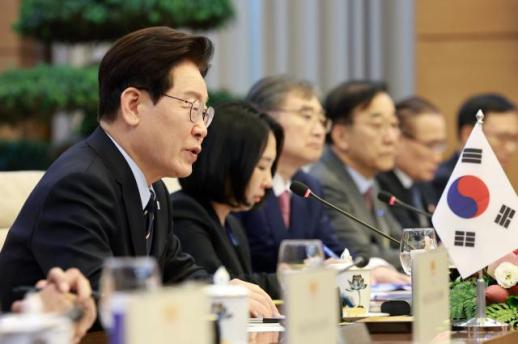 South Korea Bets on Vietnam as Hub for Nuclear, Infrastructure and Energy Deals President Lee Jae-myung’s state visit to Vietnam, joined by a business delegation led by heads of major conglomerates, is expected to accelerate South Korean corporate cooperation and investment in nuclear power, transport infrastructure and energy in Vietnam, a key “Global South” emerging economy. Business officials said a Korea-Vietnam business forum was held in Hanoi on April 23 (local time) with Lee and leading executives from both countries in attendance. On the South Korean side, about 250 people attended, including SK Group and Korea Chamber of Commerce and Industry Chairman Chey Tae-won, Samsung Electronics Chairman Lee Jae-yong, LG Group Chairman Koo Kwang-mo, Lotte Group Chairman Shin Dong-bin, POSCO Group Chairman Chang In-hwa, HD Hyundai Vice Chairman Chung Ki-sun, GS Group Chairman Huh Tae-soo and Doosan Enerbility Chairman Park Ji-won. About 250 Vietnamese business leaders also participated, including PVN Chairman Le Ngoc Son, EVN Chairman Dang Hoang An, Sun Group Chairman Dang Minh Truong, THACO Group Chairman Tran Ba Duong and FPT Group Chairman Truong Gia Binh, underscoring interest in expanding bilateral economic ties. More than 70 memorandums of understanding were signed across sectors including advanced technology, consumer goods, infrastructure, energy and finance. Nuclear power drew particular attention. Doosan Enerbility signed MOUs with PTSC and PETROCONs, subsidiaries of Vietnam’s PVN, on cooperation for new nuclear power projects and supply-chain development. PVN plans to build two nuclear reactors in Ninh Thuan province in central Vietnam, and the agreements were described as laying groundwork for participation in the No. 2 reactor project. In infrastructure, Hyundai Rotem signed a contract with THACO Group to supply rolling stock and signaling systems for Ho Chi Minh City’s Metro Line 2, marking its first order in Vietnam’s rail market. The deal is worth about 491 billion won. The contract is significant because Japanese and Chinese companies have dominated the market. With THACO pursuing an urban rail project in Da Nang valued at about 14 trillion won, Hyundai Rotem could win additional orders in vehicles and signaling, the business community said. GS Engineering & Construction is reported to be moving ahead with partners including FPT Group on artificial intelligence data centers and smart-city construction in Vietnam. Huh is also expected to discuss broader cooperation with local companies and institutions, including convenience stores and energy businesses. SK Innovation E&S, under Chey’s leadership, said it will focus on ensuring the success of a large-scale liquefied natural gas power project in Nghe An province in north-central Vietnam, targeted for completion in 2030 and valued at about 3.3 trillion won. The project includes a 1,500-megawatt combined-cycle gas power plant, a 250,000-cubic-meter LNG terminal and a dedicated port.* This article has been translated by AI. 2026-04-23 22:16:51
 -
 Doosan Enerbility Seeks Foothold for Vietnam Nuclear Project, Led by Chairman Park Ji-won Doosan Enerbility said it is expanding its global push by securing a foothold to take part in Vietnam’s planned new nuclear power projects, led by Chairman Park Ji-won. The company said Thursday that Park and other top executives joined President Lee Jae-myung’s business delegation during his visit to Vietnam and discussed cooperation on new nuclear power plants with Vietnamese government officials and key figures in the energy industry. Park attended a business roundtable and business forum in person, the company said. Vietnam plans to build Ninh Thuan nuclear power plant units 1 and 2 by 2035. Russia has won the contract for Unit 1, while bidding for Unit 2 is still underway. The combined project is valued at about 30 trillion won. Vietnam also plans to secure an additional 8 gigawatts of nuclear capacity by 2050. The company said “Team Korea” — made up of the Ministry of Trade, Industry and Energy, Korea Electric Power Corp. and Doosan Enerbility — is widely seen as a strong contender for Ninh Thuan Unit 2. South Korea and Vietnam signed a memorandum of understanding on nuclear cooperation following the summit, it said. Yoon Yo-han, head of Doosan Enerbility’s marketing division, attended a business forum in Hanoi and signed separate agreements with local firms PTSC and PETROCONs on cooperation for new nuclear projects and supply chain development, the company said. Both firms are subsidiaries of Vietnam National Oil and Gas Group, or PVN, which is leading the Ninh Thuan project. Doosan said the agreements help lay the groundwork for a local supply chain in nuclear equipment and construction, strengthening its position for participation in the Ninh Thuan Unit 2 project. “Cooperation between the two countries, expanded through joint public-private efforts to participate in Vietnam’s new nuclear power projects, will lead to meaningful results,” Park said. “Doosan Enerbility will do its utmost in its role so that Team Korea, which has already proven its competitiveness in the UAE and the Czech Republic, can achieve results in Vietnam as well,” he said.* This article has been translated by AI. 2026-04-23 22:16:00
 -
 OCI Holdings Q1 Operating Profit Falls 77.7% to 10.8 Billion Won OCI Holdings said in a regulatory filing on the 23rd that it posted first-quarter consolidated revenue of 892.4 billion won, operating profit of 10.8 billion won and net profit of 8.8 billion won. Revenue fell about 77% from a year earlier. The company said it has continued a recovery trend after returning to the black in the fourth quarter of last year. The company said higher sales at key units helped drive the profit, excluding Malaysia-based OCI TerraSus, which underwent legal restructuring in the first quarter. The units cited were OCI Enterprises, a U.S. solar holding company; OCI SE, which operates the Saemangeum combined heat and power plant; and operating company OCI. OCI Energy, a unit of OCI Enterprises, contributed to the operating profit increase as remaining proceeds from the sale of the Sun Roper project last year were recognized as revenue, the company said. OCI Energy is pursuing the sale of a large-scale 500-megawatt project. If related procedures are completed within the second quarter, the company said, it expects to recognize new revenue and profit. Chairman Lee Woo-hyun said silicon-based technology is increasingly seen as extending beyond terrestrial and space applications into next-generation semiconductors and data infrastructure. “OCI Holdings will take this trend as an opportunity for future new businesses and will continue to enhance product competitiveness so we can meet customers’ next-generation technology shifts, including silicon photonics,” he said. In the fourth quarter of last year, OCI Holdings reported revenue of 810.6 billion won, operating profit of 27.3 billion won and net profit of 26.6 billion won.* This article has been translated by AI. 2026-04-23 22:15:17
 -
 Nikkei briefly tops 60,000 for first time, then falls on profit-taking and oil worries Japan’s Nikkei stock average briefly crossed 60,000 for the first time on April 23 but reversed to finish lower, as profit-taking after a sharp run-up combined with renewed worries over Middle East-driven oil volatility. The Nikkei fell for the first time in four sessions, closing down 445 points, or 0.75%, at 59,140.23 in Tokyo. It climbed as high as 60,013.98 intraday to set a record, then selling intensified and losses at one point neared 900 points. Nikkei reported the market opened higher on overseas short-term investors’ futures buying and strength in major semiconductor-related shares, helped by continued gains in U.S. tech stocks the previous session. Risk appetite also carried over after the Nasdaq and S&P 500 hit record highs on expectations of an extended cease-fire following U.S. and Israeli strikes on Iran. The Nikkei quickly cleared 60,000 early in the session. Analysts said money was increasingly concentrated in artificial intelligence and semiconductor names, while only about 20% of stocks on the Tokyo Stock Exchange’s Prime Market rose. The rally did not hold. Concerns about an overheated market and the burden of the recent surge triggered broad selling. Higher crude prices tied to Middle East tensions also weighed on sentiment. Reports that the U.S. Defense Department assessed it could take up to six months to clear mines in the Strait of Hormuz helped keep oil prices elevated, raising worries about pressure on corporate earnings. Losses narrowed late in the day after the Nikkei slipped below 59,000, prompting bargain hunting by overseas short-term funds and individual investors. The broader Topix index, which tracks all Tokyo Stock Exchange issues, fell 28.61 points, or 0.76%, to 3,716.38 for a third straight decline. Investors are increasingly viewing Japanese stocks as overheated in the short term, with the risk of bigger swings tied to oil and geopolitical factors.* This article has been translated by AI. 2026-04-23 21:52:38