

Journalist

Chang SeongWon
-
 BOK ups 2026 estimates for GDP growth to 2.6%, inflation to 2.7% SEOUL, May 28 (AJP) - The Bank of Korea (BOK) expects the economy to grow 2.6 percent this year, which would be the strongest in four years, and inflation to rise at the fastest post-pandemic pace due to energy shocks from the prolonged Gulf crisis. The central bank on Thursday hiked its annual GDP growth projection from the previous 2.0 percent to 2.6 percent, marking the second consecutive upgrade following the BOK's move in February, when it revised the growth outlook upward from 1.8 percent to 2.0 percent. The BOK projected the nation's economy to grow by 2.1 percent in 2027, indicating a normalization of growth trends after the current year's semiconductor-led spike. Its inflation forecast was also sharply upped to 2.7 percent from 2 percent for 2026, reflecting the intensifying impact of the Strait of Hormuz blockade. The upward revision is widely interpreted as a direct reflection of unexpectedly strong economic growth during the first quarter. Backed by a stellar performance in the semiconductor sector, Korea’s first-quarter GDP growth registered 1.7 percent, nearly doubling the initial market consensus of 0.9 percent. For the following year, the central bank expects inflationary pressures to cool down slightly, forecasting an annual consumer price increase of 2.3 percent as supply-chain disruptions gradually stabilize. When achieved, the growth this year would be the strongest since the post-pandemic year of 2022 and the inflation, the fastest since 3.6 percent in 2023. Although the BOK held its benchmark interest rate steady at 2.5 percent on the same day, market analysts evaluate that the latest macroeconomic projections have substantially heightened the probability of monetary tightening in the latter half of the year. 2026-05-28 10:01:38
 -
 Melon Launches Global K-Chart with Chinese and Japanese Platforms to Reflect Fan Engagement Kakao Entertainment is set to unveil a new chart that reflects the global K-pop fandom, collaborating with music platforms in China and Japan. This initiative aims to showcase the global influence of K-pop artists by incorporating not only streaming data but also actual fan engagement metrics. On May 28, Kakao Entertainment announced the criteria for the upcoming 'Global K-Chart,' which will be jointly launched in June by its music platform Melon, Tencent Music Entertainment from China, and Line Music from Japan. The Global K-Chart will compile data from major music platforms in Korea, China, and Japan to measure the global impact of K-pop artists. It will be updated simultaneously on Melon, Tencent Music, and Line Music, featuring both an integrated global chart and detailed charts for each platform. A key feature of the chart is its inclusion of fan activity metrics, in addition to music streaming figures. Melon will account for user numbers related to streaming and downloads, as well as fan interactions such as likes and follows. Each platform will adapt certain metrics to fit their specific service environments. Kakao Entertainment aims to establish a new K-pop metric that goes beyond simple popularity rankings, reflecting the actual responses and engagement levels of fandoms. Given that Korea, China, and Japan are critical regions in the global K-pop market, the comprehensive data from local fans is expected to provide a more nuanced view of global trends. A Melon representative stated, "The Global K-Chart goes beyond merely counting artists with high streaming numbers; it captures various traces of fan reactions and actions towards artists' activities. We hope that the chart, which directly reflects the genuine sentiments of fans in Korea, China, and Japan, will serve as a meaningful platform for K-pop artists to engage more deeply with their global fandoms and expand their reach."* This article has been translated by AI. 2026-05-28 09:55:53
 -
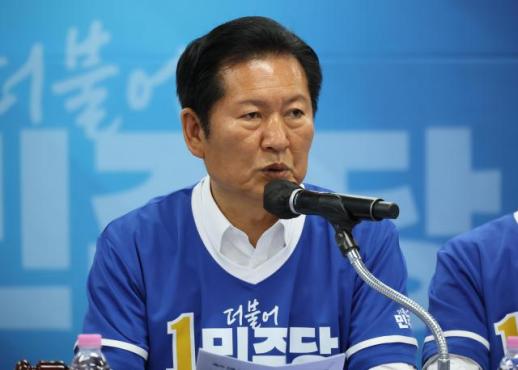 Jung Cheong-rae: Conservative Unity May Spark Progressive Mobilization Jung Cheong-rae, the chairman of the Democratic Party, expressed confidence in achieving victory through progressive mobilization, despite signs of conservative unity as the local elections approach in one week. During an appearance on Kim Eo-jun's "Humility is Difficult" news program, Jung stated, "This local election is an opportunity to support President Lee Jae-myung's stable governance." He noted that the conservative camp is rallying support through campaigns like "Yoon Again" and "Park Geun-hye Again." He added, "While the conservative camp is uniting, there is often a counter-reaction, which could lead to a progressive mobilization. I believe that having supporters of the president come out in large numbers to vote is the key to winning this local election." Jung emphasized the importance of aligning local government leadership with the presidency, stating, "The remaining four years of President Lee's term coincide with the four-year term of the newly elected local governments. For regional development, we must work together with the president. Both the president and the heads of local governments should be from the Democratic Party to ensure consistency." He also provided insights into key battlegrounds, particularly in Busan's Buk-gap district, where he remarked, "There is a kind of optical illusion regarding the independent candidate Han Dong-hoon. While many people are gathering and buying things, they do not have voting rights. Ultimately, Ha Jung-woo will follow Jeon Jae-soo and develop Busan's Buk-gu, ensuring that the benefits of the marine capital construction, following the relocation of the Ministry of Oceans and Fisheries, are felt." Regarding Kim Kwan-young, an independent candidate in the North Jeolla gubernatorial race facing allegations of cash distribution, Jung stated, "The scene of cash distribution was filmed and broadcasted, and there was nothing we could do about it. Conversely, if no action had been taken, the national election would have fallen into a black hole, so it was unavoidable." When asked about the possibility of Kim returning to the party after winning, Jung replied, "According to party rules, individuals who leave the party and run as independents after contesting in primaries cannot return permanently. However, I sincerely apologize as party leader for not fully understanding the sentiments of the people of North Jeolla during this process."* This article has been translated by AI. 2026-05-28 09:55:01
 -
 BOK holds rate steady for year, keeps July move in play SEOUL, May 28 (AJP) — As widely expected, the Bank of Korea (BOK) on Thursday kept its benchmark interest rate unchanged at 2.5 percent for a full year, deferring a possible rate move to its next meeting in July as it judged the chip boom strong enough to offset the fallout from months-long Gulf disruptions and support stronger-than-expected economic growth. The first post-meeting briefing by new Governor Shin Hyun-song will be closely watched. The former BIS economist has long emphasized price stability and warned that a weak won could pose broader economic risks. Price pressures have re-emerged as a dominant concern, amplified by prolonged maritime disruptions in the Middle East, a crucial trade artery handling nearly 70 percent of South Korea’s crude oil imports. Consumer prices rose 2.6 percent year-on-year in April, while producer prices jumped 6.9 percent, signaling a sharp return of energy-driven inflationary momentum. Given the lagged impact of global oil benchmarks, higher input costs are expected to ripple through the domestic economy in the coming months, complicating the BOK’s inflation-targeting path. During this session, BOK Deputy Governor Ryoo Sang-dai and monetary board member Jang Yong-seong cast dissenting votes, calling for a rate hike to 2.75 percent. This marks the first time in 18 months that two or more dissenting votes were registered since the central bank cut the key rate by 25 basis points from 3.25 percent to 3.0 percent in November 2024, a meeting where both Ryoo and Jang had also notably broken consensus by voting to freeze the rate. 2026-05-28 09:50:42
 -
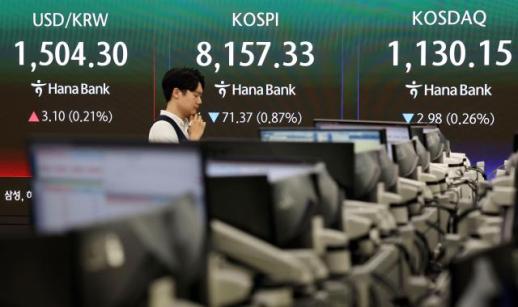 Dollar-Won Exchange Rate Fluctuates Amid U.S.-Iran Negotiation Uncertainty The won-dollar exchange rate is fluctuating in the low 1500s amid uncertainty surrounding negotiations between the U.S. and Iran. As of 9:35 a.m. on the 28th in the Seoul foreign exchange market, the exchange rate is trading at 1504.7 won per dollar. The rate opened at 1504.0 won, up 2.8 won from the previous trading day, and is fluctuating within a narrow range. Negotiations have shown signs of strain as the U.S. and Iran differ on issues such as the blockade of the Strait of Hormuz and the easing of sanctions. On the 27th, U.S. President Donald Trump stated regarding the peace negotiations with Iran, "So far, they have not reached a level that satisfies us." The dollar is showing renewed strength. Market participants are paying attention to the potential for increased dollar buying sentiment ahead of the release of the U.S. Personal Consumption Expenditures (PCE) price index for April, scheduled for later that evening. The Bank of Korea's monetary policy committee meeting taking place today is also a key variable. While the market leans toward the possibility of keeping the benchmark interest rate unchanged at 2.50%, there is heightened interest in the comments from Governor Lee Ju-yeol during the press conference. Considering recent inflationary pressures and signs of economic recovery, any hawkish messages suggesting future interest rate hikes could strengthen the won. Min Kyung-won, an economist at Woori Bank, noted, "With the exchange rate rising back to the 1500 won level, there will be sufficient incentive for profit-taking on high prices. In a situation where risk appetite remains intact, a shift to net foreign buying in the domestic stock market could lead to increased dollar supply through custody sales."* This article has been translated by AI. 2026-05-28 09:46:36
 -
 Nota Shares Surge Following Invitation to NVIDIA Event Nota's shares soared to the daily limit after the company was invited to an event hosted by NVIDIA. As expectations grow for NVIDIA's expansion in the physical AI ecosystem, investor sentiment has sharply increased due to the highlighted partnership. According to the Korea Exchange, at 9:40 a.m. on May 28, Nota's stock was trading at 34,600 won, up 7,950 won (29.83%) from the previous trading day. The stock hit the upper limit shortly after the market opened. Before the regular market opened, Nota also reached the upper limit in the NXT pre-market, indicating strong buying interest. Market analysts believe that the official invitation to the NVIDIA event, announced the previous day, has driven up the stock price. Nota has been officially invited to NVIDIA's 'Jetson Partners Day' taking place on May 30 in Taipei, Taiwan. This event is part of NVIDIA's annual developer conference, 'GTC Taipei 2026,' and is expected to feature key partners in the 'Jetson' platform ecosystem, which is utilized in physical AI applications such as robotics, drones, and autonomous vehicles. Nota's executives, including Chief Technology Officer Kim Tae-ho and Chief Strategy Officer Steven Kim, are set to attend the event. Nota provides a lightweight AI model platform called 'Netspresso' that is compatible with NVIDIA's Jetson platform. The company has also expanded the application of NVIDIA GPU-based AI solutions through its real-time video analysis solution, 'NVA,' which is based on video language models (VLM). As expectations for the growth of the physical AI market increase, analysts note that the partnership with NVIDIA is gaining renewed attention. Physical AI refers to technology where AI is integrated into actual devices such as robots, cars, and drones to operate in real-world environments. In December of last year, Nota was also included in NVIDIA's global partner program, 'Connect.' Connect partners receive priority access to NVIDIA's latest AI frameworks, technical consulting, and joint marketing support. Recent trends in the domestic stock market indicate a growing investment sentiment towards NVIDIA partners and AI infrastructure-related stocks. There is increasing optimism that the physical AI market, centered on robotics and autonomous driving, will emerge as the next growth driver beyond AI data centers.* This article has been translated by AI. 2026-05-28 09:45:47
 -
 Starbucks Boycott Sparks Debate Over Senior Employment Program A boycott of Starbucks Korea, triggered by controversy over the May 18 Democratic Uprising, has extended to government-supported initiatives. The Ministry of Health and Welfare has decided to temporarily suspend a senior employment program in collaboration with Starbucks, leading to ongoing debates online about the decision. According to a report by Segye Ilbo on June 26, the Ministry has paused the 'Senior Barista Professional Skills Enhancement Training' program, which was conducted in partnership with Starbucks Korea and the Korea Senior Club Association. This initiative, which began in 2019, has been operating at the 'Starbucks Cooperative Training Center' within the Gunpo Senior Club. Current Starbucks baristas have volunteered their time to provide training in barista skills. The program has continued for seven years, with approximately 2,500 seniors completing the training. Participants who finished the program have found employment in cafes at dementia care centers or senior welfare facilities. However, the Ministry has decided to proceed with the second cohort of trainees as scheduled but will put the third and fourth cohorts on hold after recruitment has already been completed. A Ministry official told Segye Ilbo, "We judged that there could be negative perceptions due to the recent controversy, leading to the temporary suspension of the training. We will monitor the situation and consider whether to resume it in the future." This decision is seen as closely related to the recent online boycott movement against Starbucks. The controversy surrounding the company's comments about the May 18 Democratic Uprising has led some consumers to advocate for a boycott, which has been compounded by discussions regarding discounts for military personnel, sparking debates in both political circles and online communities. Following the news, reactions online have been mixed. Some users criticized the decision, asking, "Why should the responsibility for the controversy fall on senior employment and frontline staff?" and argued that halting social contribution programs is an excessive response. Others suggested that if a company has made mistakes, it should be encouraged to enhance its social contributions rather than withdraw them. Conversely, some users defended the Ministry's decision, stating, "It is natural for public institutions to distance themselves from controversial companies," and suggested that the Ministry could collaborate with other businesses instead. They emphasized the importance of sending a clear social message during this opportunity. This situation highlights how political and social controversies are beginning to impact public-private welfare collaborations. There is growing concern that senior employment initiatives and social contribution programs may be suspended in response to shifts in public opinion, raising the possibility of similar cases in the future.* This article has been translated by AI. 2026-05-28 09:42:59
 -
 Samsung Electronics poised to join US$2 trillion club on memory upcycle, KB Securities forecasts SEOUL, May 28 (AJP) - Samsung Electronics is poised to reach a US$2 trillion market capitalization, KB Securities said Thursday, citing an intensifying memory upcycle, the chipmaker's leverage to Nvidia's next-generation Vera Rubin platform, and an emerging humanoid robotics strategy anchored by ties to Hyundai Motor Group. The brokerage raised its target price on Samsung to 530,000 won from 450,000 won, its second upgrade in two weeks following a 15 May revision. With the stock closing at 313,500 won on Wednesday, the new target implies roughly 69 percent upside — a move that would carry Samsung's market value into a tier currently inhabited only by the largest US technology names and place it among the small group of non-American companies ever to reach the threshold. The analytical core is Nvidia's Vera Rubin platform, slated for launch in the second half of this year. Kim Dong-won, head of research at KB Securities, wrote that memory will account for around 25 percent of total Vera Rubin platform cost — more than five times its share in the current Blackwell generation. That shift, Kim argued, makes Samsung a direct beneficiary as it expands supply of next-generation memory categories including SOCAMM, a new low-power memory module standard for AI servers, and sixth-generation high-bandwidth memory, known as HBM4. Samsung has lagged rival SK Hynix in supplying high-bandwidth memory to Nvidia through the current cycle, and KB's call is, in effect, a bet that the HBM4 transition resets the competitive board. Kim's broader argument rests on a tightening supply picture. "The memory market next year will be better than this year," he wrote, pointing to deeper shortages and stronger pricing momentum. The structural driver is Samsung's Pyeongtaek P4 fab, where new capacity is being concentrated on specific HBM lines. That dedication means additional commodity DRAM output can come only through process conversion of existing lines — squeezing supply across the broader memory market and lifting prices for general-purpose chips alongside the AI-specific ones. A second leg of the bull case is humanoid robotics. Kim expects Samsung to begin deploying intelligent humanoid robots on its semiconductor production lines in the second half of this year, and described the company's strategy as a two-track approach combining strategic equity investments in global humanoid players with internal development. He singled out cooperation with Boston Dynamics — the robotics affiliate of Hyundai Motor Group, with which Samsung maintains close ties — as the most realistic option, given Nvidia's and Google's appetite for the behavioral data that humanoid deployments generate. For now, the load-bearing assumption is HBM4. Samsung's failure to qualify earlier HBM generations into Nvidia's flagship platforms on schedule cost it ground that SK Hynix has yet to surrender, and the entire Vera Rubin thesis depends on Samsung closing that gap before the platform ramps. That means the $2 trillion framing — roughly 3,000 trillion won, and treated by KB as a starting line rather than a ceiling — is best read as a directional argument about where the cycle and the product mix are pointing, conditional on Samsung executing where it has previously stumbled. The tape has not yet validated it. 2026-05-28 09:42:42
 -
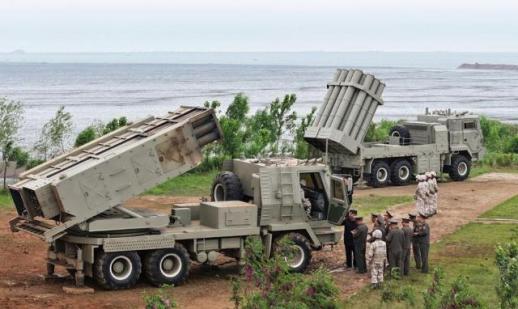 North Korea snubs Quad's call for denuclearization SEOUL, May 28 (AJP) - North Korea said Thursday it will "never give up its nuclear weapons," denouncing a joint statement by the foreign ministers of Australia, India, Japan and the U.S. earlier this week that called for the North's complete denuclearization. In a statement carried by the state-run Korean Central News Agency, a spokesperson for the country's Foreign Ministry said the denuclearization of North Korea will "never happen." North Korea's defiant stance on its nuclear arsenal came after the four countries, members of the U.S.-led multilateral security grouping collectively known as the Quad, reaffirmed their commitment to the complete denuclearization of North Korea after a meeting in New Delhi earlier this week. The spokesperson also condemned the Quad for what it called its "hostile policy" toward North Korea and other countries in the region, urging it to stop pursuing confrontations that undermine regional peace and stability. 2026-05-28 09:31:17
 -
 Retail money floods leveraged chip ETFs as Korea's chip rally finds new outlet SEOUL, May 28 (AJP) - South Korea's red-hot semiconductor rally spilled into the exchange-traded fund market Wednesday, as the country's first single-stock leveraged ETFs tied to Samsung Electronics and SK hynix drew explosive trading on their debut, giving retail investors a leveraged route into an already crowded chip trade. Sixteen leveraged and inverse ETFs linked to Samsung Electronics and SK hynix were listed simultaneously, generating a combined trading value of about 10.4 trillion won on their first trading day, according to Yonhap Infomax data. Their combined market capitalization reached nearly 5 trillion won. The strongest demand centered on products linked to SK hynix, the memory-chip maker that has become one of the biggest beneficiaries of global artificial intelligence investment. Samsung Asset Management's KODEX SK hynix Single Stock Leverage ETF posted the largest trading value among all domestic ETFs at 4.39 trillion won, rising 18.44 percent. Mirae Asset Global Investments' TIGER SK hynix Single Stock Leverage ETF followed with 2.07 trillion won in trading and a gain of 18.56 percent. Leveraged ETFs tied to Samsung Electronics also attracted heavy demand. Samsung Asset Management's KODEX Samsung Electronics Single Stock Leverage ETF logged 1.95 trillion won in trading, while Mirae Asset's competing TIGER product recorded 1.02 trillion won. The debut highlights a broader shift in Korea's equity market. Semiconductor heavyweights have already driven the benchmark KOSPI to record highs, leaving many investors wary of entering the trade directly after sharp gains and widening intraday swings. The new ETFs effectively opened another channel for investors seeking amplified exposure to the same stocks, allowing them to ride the chip rally through listed products rather than direct share purchases alone. The launch came as the KOSPI extended its record-breaking rally. The benchmark closed up 2.25 percent at 8,228.70 on Wednesday after briefly touching an intraday record of 8,450.26. Market participants said demand for the new leveraged products appeared to intensify the already heavy concentration of retail money in leading semiconductor shares. "Samsung Electronics and SK hynix, the underlying assets for the single-stock leveraged products, have recently shown daily price swings of around plus or minus 5 to 6 percent," Han Ji-young, an analyst at Kiwoom Securities, was quoted as saying. "As they are both market leaders and stocks with concentrated retail flows, the launch could amplify short-term money concentration." The new products drew immediate demand from retail investors who had watched from the sidelines as chip stocks surged, with some market participants pointing to fear-of-missing-out demand as one factor behind the rush into leveraged ETFs. The surge also pushed Korea's ETF industry past a major milestone. The combined market capitalization of locally listed ETFs exceeded 500 trillion won for the first time since ETFs were introduced in Korea in 2002, reaching 506.1 trillion won as of late Wednesday morning, according to the Korea Exchange. But the boom has also raised questions about whether speculative money is building too quickly around a narrow group of semiconductor-linked assets. On the same day, allegations surfaced that some liquidity providers may have engaged in wash trading to boost trading volume in the newly listed products. Securities firms and the broader financial investment industry denied the claims, while the Korea Exchange said trading volume alone was insufficient to determine whether wash trading had occurred. An exchange official said the credibility of the allegations was low based solely on execution volume, adding that account-level trading data from liquidity providers is recorded in the exchange database and monitored by its market surveillance division. SK Securities said wash trading was structurally impossible under its system because such orders are automatically blocked. Yuanta Securities also said it had merely carried out normal liquidity provision duties by narrowing bid-ask spreads and supporting investor protection during the listing process. The Korea Financial Investment Association said liquidity providers typically hedge opposite positions to manage losses that can arise while supplying liquidity. It also said incentives for liquidity providers were not large enough to create a strong motive for artificial trading. The intense ETF demand comes as investors are simultaneously parking record amounts of money in money market funds, suggesting that optimism over further stock gains is being matched by caution over extreme volatility. According to the Korea Financial Investment Association, MMF assets stood at 258.65 trillion won as of May 21, after hitting a record 262.01 trillion won on May 19. Corporate money accounted for more than 90 percent of the total. MMFs, which invest in short-term instruments such as Treasury bills, commercial paper and certificates of deposit, are widely used as cash parking vehicles because they allow flexible withdrawals and generate interest even over short holding periods. In a highly volatile market, they often function as waiting rooms for capital that has not yet committed to risk assets. That pattern is now visible in ETF form as well. Over the past month, money market ETFs collectively drew more than 430 billion won in net inflows, led by ACE Money Market Active and KODEX Money Market Active. The broader appetite for retail investment products was also visible in a separate government-backed fund. The National Growth Fund, which offers tax benefits and carries a government backstop covering up to 20 percent of sub-fund losses, had sold roughly 99.5 percent of its 600 billion won offering by Wednesday afternoon, according to the Financial Services Commission. Together, the flows show the unusual psychology of Korea's market. Investors are chasing upside through leveraged semiconductor ETFs, parking record amounts of money in cash-like funds and rushing into state-supported investment products at the same time. The pattern suggests that expectations for further gains, including fear-of-missing-out demand, are coexisting with deep caution over extreme volatility. Volatility remains elevated. The KOSPI recently saw an intraday swing of 675 points on May 15 and surged by 606 points in a single day on May 21. The VKOSPI, Korea's equivalent of the VIX and a widely watched measure of expected market volatility, remained at historically high levels, falling below 70 only after eight consecutive sessions above that threshold. A reading above 50 is generally regarded by market participants as a panic-level signal. Still, several brokerages have raised their KOSPI targets, with some projecting the index could reach 10,000 or higher this year. Nomura recently lifted its target range to 10,000–11,000, citing improving earnings and return on equity. Hyundai Motor Securities, KB Securities and Hana Securities have also presented bullish scenarios above the 10,000 level. Wednesday's debut made one thing clear: Korea's chip trade is no longer confined to the stock market. The same rally that has driven the KOSPI to record highs is now reshaping the country's ETF industry, cash management flows and retail investment behavior — drawing in investors who had stayed on the sidelines, even as large pools of short-term money remain on standby amid extreme volatility. 2026-05-28 09:30:05