

Journalist

Chang SeongWon
-
 China resumes direct flights to Pyongyang after six-year halt SEOUL, March 30 (AJP) - Chinese flagship carrier Air China has resumed direct flights to Pyongyang after a six-year hiatus, state media reported on Monday. According to state-run Xinhua News Agency, Air China has begun operating a weekly round-trip flight between Beijing Capital International Airport and Pyongyang Sunan International Airport. The resumption comes for the first time since the airline halted all flights to North Korea in January 2020, when the coronavirus pandemic began to spread, and follows the restart of passenger train service between the two countries earlier this month. At a regular briefing, Foreign Ministry spokesperson Mao Ning said the resumption of passenger flights between Beijing and Pyongyang would help promote exchanges between the "friendly neighboring countries." North Korea's Air Koryo has resumed its route from Pyongyang to Beijing since 2023, flying twice a week, but Chinese airlines had not operated regular flights to Pyongyang. Chinese Ambassador to North Korea Wang Yajun reportedly greeted the first passengers arriving from Beijing and said that friendly exchanges between the two countries will be "further boosted," with road, rail, and air services now fully resumed. 2026-03-30 17:48:53
 -
 Houthi entry into Gulf conflict adds to Seoul shipping woes SEOUL, March 30 (AJP) - South Korea is closely watching the developments in the Gulf in fear of losing another core chokepoint after Yemen’s Iran-backed Houthi rebels declared that they had joined with Iran against America and Israel. Analysts warn that any renewed blockade in the Red Sea or escalation in attacks could send shockwaves through global supply chains and deepen existing logistics disruptions. Houthis carried out their “first military operation” targeting Israeli military objectives using missiles, group spokesman Yahya Saree said, adding that the operation was coordinated with Iranian forces and Lebanon’s Hezbollah. The Houthis, part of Iran’s so-called “Axis of Resistance,” previously launched dozens of attacks on commercial vessels transiting the critical Bab el-Mandeb Strait during the Gaza war in 2023, targeting ships linked to Israel and its allies. The Bab el-Mandeb Strait a 29-32 km wide chokepoint separating Yemen and Djibouti and Eritrea in the Horn of Africa, connecting the Red Sea to the Gulf of Aden and the Indian Ocean. Roughly 15 percent of global seaborne oil trade passes through the corridor. If the terrorist group deploys missiles, drones, or naval mines again against vessels in the strait, global shipping disruptions could worsen significantly. Such developments would complicate access to the Suez Canal and potentially disrupt oil shipments, including flows through Saudi Arabia’s Yanbu port, which has recently been viewed as an alternative route to bypass the Strait of Hormuz. Shipping in the region was already under strain from late 2023, when Houthi attacks prompted major container lines and tanker operators to divert vessels away from the Red Sea and Suez Canal, rerouting them around the Cape of Good Hope at the southern tip of Africa. Despite tentative plans by some carriers to resume Red Sea operations in recent months, analysts warn that renewed hostilities could halt those efforts. “The repercussions of the joint military operation will see the further weaponization of trade and shatter hopes of a large-scale return of container shipping to the Red Sea in 2026,” said Peter Sand, chief analyst at freight intelligence platform Xeneta, through Lloyd's of London. The Red Sea and Suez Canal together handle roughly 15 percent of global maritime trade and nearly 30 percent of container traffic, making the route a critical artery for Asia-Europe shipping. As vessels reroute around Africa, the impact on Korean exporters is becoming increasingly pronounced. A typical voyage from Busan to Rotterdam via the Suez Canal spans roughly 20,000 kilometers and takes three to four weeks. The Cape route adds 3,000 to 4,000 nautical miles, extending transit times by 10 to 14 days. War-risk insurance premiums have also surged from around 0.1 percent to as high as 1 percent. Freight rates are already reflecting the strain. As of late March 2026, the Shanghai Containerized Freight Index (SCFI) rose 7 percent to 1,826.77, driven by continued Red Sea disruptions and rerouting around the Cape of Good Hope. Asia-Europe and Mediterranean routes saw particularly sharp increases. Adding to the pressure, 2026 marks the first year of full implementation of the European Union’s Emissions Trading System (EU ETS) for maritime transport. Following a phased rollout — 40 percent in 2024 and 70 percent in 2025 — shipping lines must now cover 100 percent of verified emissions, with voyages from non-EU ports such as Busan to Europe subject to carbon costs for 50 percent of total emissions. The longer detour routes increase fuel consumption by 30 to 40 percent, while many carriers have adopted high-speed “full steaming” to mitigate delays, further driving up emissions. The combined effect of longer voyages and full ETS obligations is creating a new wave of carbon-related surcharges. Industry experts warn that these additional costs could weigh heavily on South Korea’s key export sectors, including automobiles and batteries, potentially eroding their price competitiveness in the European market and adding further uncertainty to global trade already strained by geopolitical tensions. 2026-03-30 17:48:34
 -
 Korean stocks tumble as oil surge rattles markets; Shanghai stands out as rare gainer SEOUL, March 30 (AJP) - Korean stocks tumbled Monday as surging oil prices and escalating geopolitical tensions triggered a broad selloff across Asia, while China's Shanghai Composite stood out as the only major regional index to close higher. The benchmark KOSPI fell 2.97 percent to close at 5,277.30, after plunging as much as 5.3 percent in early trading. The index pared some losses toward the close as retail and institutional buying emerged, but remained under pressure throughout the session. Foreign investors dumped 2.13 trillion won ($1.40 billion) worth of shares, exerting strong downward pressure. Retail and institutional investors bought 894.4 billion won and 881.5 billion won, respectively, cushioning the decline. Most large-cap stocks ended lower. Samsung Electronics fell 1.9 percent to 176,300 won, while Hyundai Motor dropped 5.2 percent and Kia declined 2.8 percent. Doosan Enerbility fell 4 percent, while Samsung Biologics slid 4.7 percent and Hanwha Aerospace lost 2 percent. Selective buying emerged in a handful of names backed by clear catalysts, even as the broader market remained under pressure. Samchundang Pharm jumped 6.6 percent after announcing a U.S. licensing deal for generic versions of oral diabetes and obesity treatments, providing a rare stock-specific driver in an otherwise macro-driven session. LG Energy Solution rose 4 percent, supported by defensive positioning and continued expectations around battery demand, while Hanwha Solutions gained 2.7 percent on policy-driven momentum linked to energy and clean technology. The KOSDAQ also closed sharply lower, reflecting broader risk aversion in growth-oriented sectors. The tech-heavy index fell 3.02 percent to 1,107.10, with both foreign and institutional investors turning heavy sellers. Retail investors bought 300.4 billion won, partially offsetting the decline. Across the region, markets largely tracked the global risk-off tone, but with notable divergence. Japan’s Nikkei 225 fell 2.8 percent and Hong Kong's Hang Seng dropped 0.9 percent. In contrast, China’s Shanghai Composite edged up 0.24 percent, emerging as a rare outlier. The divergence comes as China continues to absorb Iranian crude flows despite disruptions around the Strait of Hormuz, where supply risks have intensified following escalating conflict involving Iran, Israel and, as of Friday, Yemen's Houthi forces. Brent crude rose 2.9 percent to $115.8 per barrel, while U.S. West Texas Intermediate gained 2 percent to $101.5, extending a rally driven by fears of prolonged supply disruption. Market sentiment was further shaken by remarks from Donald Trump, who raised the possibility of U.S. control over Iranian oil infrastructure and potential ground operations. Although Trump later suggested negotiations with Iran were progressing, investors remained cautious as policy signals continued to shift. The Korean won weakened sharply to 1,518.1 per dollar, reflecting sustained foreign outflows and heightened volatility. 2026-03-30 17:40:29
 -
 S. Korea braces for rain as spring temperature swings disrupt peninsula SEOUL, March 30 (AJP) - Morning air across the Korean Peninsula remained crisp Monday even as the state weather administration warned that a significant frontal system will bring heavy rain and volatile conditions through Tuesday. While Seoul and inland regions recorded morning lows as low as 4 degrees Celsius, daytime highs are expected to surge to 22 degrees, creating a 15-degree thermal gap that officials say poses a legitimate risk to public health and agricultural stability. The disruption marks a sharp transition from the dry, clear conditions of recent days, with clouds expected to thicken by the evening as a weather system strikes Jeju Island and the southern coast with the greatest intensity. The southern resort island of Jeju sits in the direct path of the most severe rainfall, with projections reaching 80 mm across the province and more than 120 mm in high-altitude mountainous regions. Further north, Jeolla and Gyeongsang provinces are bracing for 20 to 50 mm of rain, though coastal hubs including Busan and Ulsan could see totals exceeding 60 mm. Beyond the immediate precipitation, the primary concern for the interior remains the persistence of massive temperature fluctuations. Officials advised the public to take specific precautions to protect their health, noting that such 15-degree swings are particularly taxing on the respiratory system. 2026-03-30 17:37:32
 -
 Seoul Theater Company’s ‘Big Mother’ Puts Algorithm-Driven Transparency on Stage "In a society where everything is transparently exposed, you gain things, but don’t you also lose things?" The Seoul Theater Company’s production “Big Mother” is staged with screens and transparent glass. The audience can see not only the actors’ gestures and voices, but also real-time projections of political developments. With nothing hidden, the play pushes viewers to consider what “transparency” means, from private backstories to power brokers who dream of creating a “Big Mother.” Director Lee Jun-woo said after a press call on the 30th that he wanted audiences “to sense and experience the media environment around us and the algorithms of the data age.” “Big Mother,” a widely discussed work by French playwright Melodie Mourey, presents a thriller about a modern society where politics, media and big data are intertwined. Through journalists fighting to expose a powerful conspiracy, it tracks how truth functions in a world where control disguised as transparency, data surveillance and manipulation of public opinion have become routine. Lee said he reduced the original’s French-style humor and sharpened its focus on algorithms. “What we search for and buy gets recommended back to us, and I felt like even our desires could be pulled along,” he said. He added that what people see, think and dream “may not be what we truly want, but what an algorithm has led us to,” and warned that algorithm-driven media can leave people believing only what they want and make it harder to encounter those with different views. The play includes scenes that evoke U.S. President Donald Trump, Elon Musk and Jeffrey Epstein. Lee said he did not set out to deliberately unpack politics, but pointed to characters absorbed in dramas with plots stranger than political news and others who appeal to tears over reason. He said he hopes audiences examine why emotion-driven media can feel more persuasive than truth. As the story progresses, the focus shifts from algorithms to journalism. Lee said that was unavoidable. He described four reporters: Owen, a pragmatic editor-in-chief; Cook, who writes to win his father’s approval; Julia, who works like a machine after losing her boyfriend; and Kate, who is more focused on the climate crisis than politics. “They flounder in their family ties and personal stories,” he said, adding that only after the midpoint do they confront the case and begin their work. “I thought it had to end as a story about journalism.” The production runs March 30 to April 25 at Sejong Center’s M Theater. * This article has been translated by AI. 2026-03-30 17:33:16
 -
 Red Velvet's Irene to roll out first solo studio album 'Biggest Fan' SEOUL, March 30 (AJP) -Irene, the leader of K-pop girl group Red Velvet, will release her first full-length solo album "Biggest Fan" on Monday, her agency SM Entertainment said. The album will be released at 6 p.m. (0900 GMT) through major music platforms, along with the music video for the title track of the same name. Red Velvet is a five-member South Korean girl group that debuted in 2014 under SM Entertainment. The dance-pop band is widely regarded as one of the leading acts of K-pop’s third generation. Red Velvet gained mainstream popularity with songs such as "Russian Roulette," "Psycho," "Feel My Rhythm," and "Cosmic." Irene, born March 29, 1991, is the leader, eldest member, and main rapper of the group. The 10-track album is led by the title song "Biggest Fan," alongside tracks including "Don’t Wanna Get Up," "Wasteland," "Black Halo," and "Million Miles Away." Irene described the album as a statement of self-belief, saying, "I am my biggest fan." Ahead of the release, Irene will host a special live broadcast at 5 p.m. through her official YouTube and TikTok channels. 2026-03-30 17:31:28
 -
 World Cup Rights Talks Stall in South Korea, Raising Concerns Over Public Access With about 70 days left until the 2026 North America World Cup, South Korea’s three terrestrial broadcasters and JTBC held talks over broadcast rights but failed to narrow their differences. The meeting on March 30 was chaired by Kim Jong-cheol, chairman of the Broadcasting Media Communications Commission, and attended by KBS President Park Jang-beom, MBC President Ahn Hyeong-jun, SBS President Bang Moon-shin and JTBC President Jeon Jin-bae. The two sides did not reach an agreement. JTBC said it had presented a final proposal on March 23, suggesting that the remaining rights fee — after subtracting revenue from digital resales — be split evenly between JungAng Group, which includes JTBC, and the three broadcasters. JTBC added that the three broadcasters’ “Korea Pool” has previously shared international sports rights costs at the same ratio, and said its proposal was a last offer made despite the prospect of “a large deficit,” citing concerns about universal viewing rights. A terrestrial broadcaster official who attended the March 30 meeting said there was “no progress” in negotiations for the 2026 World Cup rights. The official said the three broadcasters’ CEOs are demanding a “responsible position statement” from JTBC, which they say triggered the dispute. JTBC secured exclusive rights to the 2026-2032 Summer and Winter Olympics and the 2025-2030 World Cups in 2019, the report said, bypassing the Korea Pool consortium of MBC, KBS and SBS. It later sought to resell the rights to the three broadcasters, but the effort fell through. As a result, JTBC exclusively aired the 2026 Milan-Cortina Winter Olympics, but drew low ratings due to limited channels, fueling controversy over whether it infringed on the public’s universal right to watch major events. To protect that right, Democratic Party lawmaker Han Jeong-ae introduced an amendment to the Broadcasting Act on March 16 to guarantee universal viewing rights for events including the Olympics and the World Cup. The commission has also tried to mediate as negotiations have repeatedly stalled, including by holding an open public forum under the theme, “2026 North America World Cup broadcasts, listening to the public,” but has struggled to break the deadlock. While the March 30 meeting failed to bridge the gap, the terrestrial broadcaster official said working-level talks would continue, leaving open the possibility of a final deal. 2026-03-30 17:21:00
 -
 Global love for K-content hits new highs, but fatigue also on the rise SEOUL, March 30 (AJP) - That K-content is widely loved is no longer in doubt. With K-pop-themed animation sweeping the Grammys and Oscars, and Netflix livestreaming BTS’ comeback, the latest data only puts a number to the momentum: nearly 70 percent approval worldwide. According to data released Monday by the Ministry of Culture, Sports and Tourism and the Korea Foundation for International Cultural Exchange, 69.7 percent of respondents expressed favorable views toward Korean content in the 2026 Overseas Hallyu Survey. The halo effect extends beyond entertainment. South Korea’s national image drew positive responses from 82.3 percent of global respondents — the highest since the survey began in 2012. The surge is not just cultural, but economic. Content exports reached a record $14.08 billion in 2024, while inbound tourism rose to 18.9 million visitors in 2025, underscoring Hallyu’s growing weight as an export engine. Momentum remains strongest in Southeast Asia, with the Philippines, India, Indonesia and Thailand leading in favorability. But the more telling shift is in the West, where gains have been sharper in markets such as the United Kingdom, the United States and Spain — a sign that Hallyu is still expanding its geographic footprint. The wave itself has also broadened. While K-pop remains the core driver, consumption has spread across dramas, films, food and beauty — embedding Korean culture into everyday life rather than keeping it confined to entertainment. That deeper penetration, however, is beginning to invite pushback. Negative perceptions, unchanged at 37.5 percent, have risen steadily over the past five years, pointing to growing polarization as Hallyu becomes more visible — and harder to ignore. Kim Hyung-jun, a professor of cultural anthropology at Kangwon National University, said the backlash is no longer driven by content alone but by the breadth of Hallyu’s reach. “It is no longer confined to entertainment — it touches politics, the economy and social behavior,” he said. He noted that criticism now cuts across multiple fronts. “Concerns arise that young people are becoming less interested in local culture, while others point to excessive fan spending or changing social behaviors linked to fandom culture,” he said. Because these concerns span everyday life, they are easily amplified by different groups — from politicians and religious leaders to parents — allowing negative sentiment to spread beyond those directly engaged with Korean content, Kim added. Regional dynamics differ. In Southeast Asia, resistance is often tied to religious sensitivities and the financial burden of fandom consumption. In Western markets, it tends to center more on cultural influence and questions of relevance within established norms. At the same time, the industry faces a more structural challenge: fatigue. Im Jin-mo, a music critic and pop columnist, said K-pop may be approaching a turning point after more than a decade of global exposure. “K-pop has not shown enough variety or newness,” he said. “The style has become more predictable.” He warned that the genre may be entering a phase where it feels less fresh and less compelling to global audiences, with fewer new acts emerging to sustain momentum. “This year could be a decisive moment,” he said. “The quality of new releases will matter more than ever.” He also offered a blunt assessment of recent output from major acts. “The album felt somewhat boring — it lacked a strong hook,” he said, adding that some see it as an early sign of a broader slowdown. For now, Hallyu remains firmly in expansion mode. But as its reach widens, so too does the test of whether it can sustain not just scale, but staying power. 2026-03-30 17:18:07
 -
 HMM pushes ahead with move to Busan despite union protest SEOUL, March 30 (AJP) - South Korea's largest container shipping line HMM reportedly said its board of directors approved a charter amendment to relocate the company's headquarters from Seoul to the southeastern port city of Busan, setting the stage for a shareholder vote on May 8 that is all but certain to pass. The board convened an extraordinary session to endorse the revision to Article 3 of HMM's articles of incorporation, which currently designates Seoul as the registered seat. An extraordinary general meeting of shareholders will follow on May 8, where approval requires a special resolution backed by two-thirds of attending shareholders. With state-affiliated entities holding more than 70 percent of HMM shares — Korea Development Bank at 35.42 percent, Korea Ocean Business Corporation at 35.08 percent and the National Pension Service at 5.62 percent — passage is widely considered a foregone conclusion. The move is a centerpiece of President Lee Jae Myung's drive to transform Busan into a maritime capital, consolidating shipping administration, judicial functions and corporate headquarters in a city that already hosts the world's second-largest container transshipment port. Industry officials expect HMM to begin scouting office sites near Busan New Port in the second half of the year and to unveil relocation support packages for Seoul-based staff shortly after the vote. HMM's onshore labor union, however, struck a defiant tone. The union declared bargaining with management collapsed after the board acted without prior consultation and said it would move to secure the right to stage industrial action, raising the specter of a general strike before the May meeting. The union has argued the transfer could hollow out operational efficiency and trigger an exodus of seasoned employees whose work is embedded in Seoul's financial and logistics networks. Analysts say the Busan relocation could also accelerate the long-delayed privatization of HMM, as KDB seeks to shore up its capital adequacy by divesting its stake in the carrier. The headquarters shift follows the Ministry of Oceans and Fisheries' own relocation from the administrative capital of Sejong to Busan in December 2025, a move that prompted mid-sized bulk carriers SK Shipping and H-Line Shipping — both controlled by private equity firm Hahn & Company — to begin relocating to the port city earlier this year. 2026-03-30 17:08:02
 -
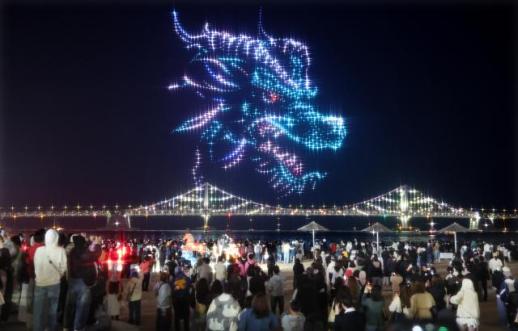 Drone spectacle lights up Busan's Gwangalli Beach SEOUL, March 30 (AJP) - A spectacular drone show lit up the sky above Gwangalli Beach in the southern port city of Busan last Saturday. The 12-minute show featured mythical creatures and legendary guardians including dragons, white tigers, xuanwu (black tortoise), and vermillion birds, painting the night sky with a thousand lights, creating a stunning spectacle. The year-round show, which first began in 2022, takes place every Saturday evening twice per night — at 7 p.m. and 9 p.m. during the winter season (October to February) and at 8 p.m. and 10 p.m. during the summer months (March to September). 2026-03-30 16:57:56