
Journalist

Elizabeth Englezos
-
 Yakitori Tanju Expands Jazz Yakitori Izakaya Concept With Standardized Franchise System Assist Kitchen, which operates the live-jazz yakitori izakaya brand Yakitori Tanju, said it has overhauled its franchise framework and is moving to expand its store network. The company aims to scale a hybrid model that combines dining and performance content by building a standardized operating system. Yakitori Tanju centers on charcoal-grilled chicken skewers, paired with alcoholic drinks and live jazz performances. The brand positions its venues as places where customers stay longer, rather than quick meal-only restaurants, aligning with growing demand for “experience-based” dining that blends food and cultural content. Assist Kitchen, a franchise company that develops and operates restaurant brands, said it has built its own supply and operating infrastructure for expansion. Headquarters produces key ingredients in-house through a sauce plant and a HACCP-certified meat-processing facility, then supplies the same items to all stores. HACCP certification indicates hygiene controls meet standards across the full process from raw materials to manufacturing and distribution. The company applies a cold-chain system to transport and store ingredients at low temperatures, aiming to maintain freshness, stabilize delivery schedules and reduce differences in ingredient management by location. The centralized supply structure is also expected to ease franchisees’ burden of managing raw materials and reduce cost volatility. In the restaurant franchise industry, centralized supply systems and standardized logistics are widely seen as key to brand expansion, with analysts noting they can minimize quality variation and simplify cooking processes, reducing the operational burden for new owners. “Yakitori Tanju is a hybrid dining model that combines food, music and space,” an Assist Kitchen official said. “Based on our production infrastructure and logistics system, we are building an environment where franchisees can focus on service operations.” The company said it plans to keep improving its logistics network and manuals to support franchise growth, while also strengthening store operating standards and service-quality controls to maintain the brand’s identity.* This article has been translated by AI. 2026-04-24 09:03:00
 -
 Daewoo E&C Chairman Jung Won-ju promotes Vietnam cooperation during economic mission Daewoo Engineering & Construction Chairman Jung Won-ju visited Vietnam as part of an economic delegation timed to President Lee Jae-myung’s trip, the company said April 24. During the April 21-24 visit, Jung joined official events and highlighted the company’s track record and experience in Vietnam. Jung attended a completion ceremony for the B3CC1 mixed-use development in Hanoi’s Starlake City. The project consists of two towers ranging from three basement levels to 35 stories above ground, combining offices, a hotel and commercial facilities. It was completed with a total floor area of 211,462 square meters, with South Korean companies involved across development, investment and construction. At the ceremony, Jung said the project has become a symbolic example of economic cooperation between the two countries. He said support from the Vietnamese government, the Hanoi city government, the South Korean government and related agencies played an important role in completing the project. On the same day, Jung visited the headquarters of the Bank for Investment and Development of Vietnam to outline future plans and seek expanded cooperation. The bank is known as a key financial partner that has participated in major development projects, including Starlake City. Jung also took part in the delegation’s official schedule, attending a state banquet as well as a Korea-Vietnam business roundtable and forum. He presented ideas for smart cities and large arena developments, proposing an urban model that combines culture and industry, and expressed willingness to contribute to digital infrastructure through data center construction. He also signaled interest in expanding into large infrastructure projects such as nuclear power generation and high-speed rail, indicating a broader scope beyond the company’s existing focus on urban development. A Daewoo E&C official said, “Vietnam is one of Daewoo E&C’s key strategic markets and a trusted partner, and we plan to continue expanding investment and cooperation across areas including nuclear power plants and high-speed rail, urban development and data centers.” The official added, “Through this, we will contribute to Vietnam’s economic development while doing our utmost to further strengthen friendly and cooperative ties between the two countries.” Separately, Daewoo E&C signed a memorandum of understanding with Vietnamese IT and infrastructure company SaigonTel to cooperate on data center projects. The companies plan to pursue projects together through data center EPC and joint investment. Daewoo E&C said it expects the partnership to create synergy as policy changes in Vietnam expand the related market.* This article has been translated by AI. 2026-04-24 09:01:44
 -
 NCSoft CEO Kim Taek-jin says insight is key in AI era, urges games built on instinctive fun NCSoft CEO Kim Taek-jin told newly hired employees that “insight” will be a core competitive edge in the age of artificial intelligence. NCSoft said it held a “Conversation with the CEO” event on April 23 at its Pangyo R&D center in Seongnam, Gyeonggi province, where Kim and this year’s new hires discussed competitiveness in the AI era and the direction of game development. “As AI technology advances rapidly, the human role moves further into more essential areas,” Kim said. “To stay competitive in the AI era, you need the insight to see through the essence and meaning of the work you are responsible for.” On game development, Kim stressed what he called “instinctive fun.” “The most ideal game delivers pure fun that is hard to explain in words,” he said. “Beyond logical explanations, we must create fun that stimulates users’ instincts.” Kim also urged new hires to grow quickly. “The new employees who were here 10 years ago are now at the center of the company,” he said. “I hope you grow even faster and lead NCSoft to the next stage.” NCSoft said it has used the “Conversation with the CEO” onboarding program since introducing open recruitment in 2006 to share the company’s philosophy and vision. 2026-04-24 09:00:11
 -
 Taihan Cable & Solution Signs MOU With Vietnam’s Newtecons to Expand Energy Infrastructure Taihan Cable & Solution said it is accelerating its push into Vietnam’s energy infrastructure market through a partnership with a local company. The company said April 24 it signed a memorandum of understanding with Newtecons, a Vietnamese EPC and construction infrastructure firm, to cooperate on power cable supply and infrastructure projects. Taihan said the MOU is aimed at building a cooperation framework to strengthen competitiveness across energy infrastructure projects in Vietnam. The signing took place April 23 at the Korea-Vietnam Business Forum, an official event of an economic delegation held on the occasion of President Lee Jae-myung’s visit to Vietnam. The forum, held at a hotel in Hanoi, was attended by government officials from South Korea’s Ministry of Trade, Industry and Energy and Vietnam’s Ministry of Finance, as well as Taihan Vice Chairman Song Jong-min and Newtecons CEO Nguyen Quang Thuy, among others. Newtecons is a major Vietnamese EPC and construction infrastructure company that has carried out large projects including Long Thanh International Airport, industrial complexes and high-rise mixed-use developments, Taihan said. Under the MOU, the two companies plan to combine Taihan’s power cable manufacturing capabilities with Newtecons’ construction and installation capacity to strengthen competitiveness in energy infrastructure projects and build a stable supply and execution base. They also plan to seek joint business opportunities to meet local infrastructure demand and expand cooperation through technical advice and information sharing. “This agreement, signed during the economic delegation’s schedule in Vietnam, is expected to contribute to stronger bilateral cooperation in energy infrastructure and to supply chain stability,” Song said. He added that working with Newtecons, “a leading local EPC company,” would be an important opportunity to expand business in Vietnam’s fast-growing energy infrastructure market. Ahead of the forum, Taihan visited the headquarters of Vietnam Electricity (EVN) in Hanoi on April 22 to discuss mid- to long-term cooperation. Song, along with the head of Taihan Vina, met EVN CEO Nguyen Anh Tuan and other executives to share updates on an HVDC grid project and on a 400-kilovolt EHV cable plant currently under construction in Vietnam. The two sides also held in-depth talks on technical exchanges and potential business cooperation in extra-high-voltage power grids and agreed to continue expanding cooperation. Taihan said it has designated Vietnam as a second global production base and is continuing to expand investment in production infrastructure. Taihan Vina is a key hub, and it is building Vietnam’s first 400-kilovolt EHV cable plant, with completion targeted for 2027. * This article has been translated by AI. 2026-04-24 08:57:49
 -
 Mirae Asset Raises OCI Holdings Target Price on Expected SpaceX Partnership Mirae Asset Securities on Thursday raised its target price for OCI Holdings to 400,000 won from 270,000 won, citing expectations of a partnership with SpaceX and higher earnings estimates. It maintained a “buy” rating. Analyst Lee Jin-ho said rising U.S. power demand is expected to lift the value of generation assets and power purchase agreement, or PPA, prices, supporting higher expected sale prices for OCI Energy assets while also reflecting improvement in the company’s core business. He said the company’s medium- to long-term growth outlook and valuation appeal are becoming more prominent. Lee said the company’s polysilicon capacity expansion plan signals that cooperation with SpaceX is progressing smoothly, adding that its low production costs and ability to expand are strengths as non-China supply chains are needed. He said whether the company can secure cooperation with key customers in the U.S. solar market will shape the stock’s direction, and that OCI Holdings is in a favorable position as it scales up its business. Lee said results fell short of market expectations in the short term due to lower utilization at its polysilicon plant, but he expects earnings improvement to continue over the medium to long term on expansion and demand growth. He said the stock should remain his top pick in the sector.* This article has been translated by AI. 2026-04-24 08:57:17
 -
 Pope Leo XIV Says He Can’t Support War, Urges U.S. and Iran to Return to Talks Pope Leo XIV urged the United States and Iran to return to dialogue over the Iran war, saying preventing the deaths of innocent civilians must come before questions of regime change. According to AP, Reuters and Vatican News, Leo spoke to reporters aboard the papal plane on the 23rd local time as he flew back to Rome from Malabo, Equatorial Guinea. “As a pastor, I cannot support war,” he said, calling on all sides to seek solutions rooted in “a culture of peace,” not “hatred and division.” Asked whether he supports regime change in Iran, the pope avoided a direct answer. “The issue is not whether there is regime change or not, but how we can promote the values we believe in without the deaths of so many innocent people,” he said. He added that since the first day of Israeli and U.S. attacks, “it is not even clear what regime exists now.” Leo described the situation in Iran as “very complex.” On U.S.-Iran negotiations, he said one day Iran says yes and the United States says no, and the next day the reverse happens. “We don’t know where it is headed,” he said. He said the war is causing direct suffering for Iranian civilians. “There is an entire innocent people of Iran suffering because of this war,” he said, urging all parties to promote peace, remove the threat of war and respect international law. Protecting innocent people is crucial, he said, but “in many places that has not happened.” Reuters reported that Leo also condemned the killing of protesters in Iran and questions about recent executions. “I condemn every unjust act,” he said. “I condemn taking human life.” He added that if a regime or a state unjustly decides to take others’ lives, it should be condemned. The pope also cited the death of a child on the Lebanon front. He said he keeps a photo of a Muslim child who welcomed him during a visit to Lebanon, and that the child recently died amid the war. AP reported the child was killed during the recent war between Israel and Hezbollah. “We must be able to think about these human situations,” Leo said, again urging a dialogue-based solution and calling on countries to remove the threat of war and respect international law.* This article has been translated by AI. 2026-04-24 08:54:15
 -
 Trump Orders U.S. Forces to Sink Iranian Boats Laying Mines, Extends Israel-Hezbollah Truce U.S. President Donald Trump is managing two Middle East fronts in different ways, tightening military pressure on Iran while pressing for a longer ceasefire between Israel and Hezbollah in Lebanon. The Associated Press reported that on April 23 (local time), Trump ordered U.S. forces to sink small Iranian boats trying to lay mines in the Strait of Hormuz. He also said the United States would expand mine-clearing operations. The strait is a vital route for global energy trade, with about 20% of the world’s seaborne oil and natural gas passing through it. The U.S. is also keeping up maritime pressure. AP said U.S. forces in the Indian Ocean additionally detained a tanker suspected of carrying Iranian crude. The United States is maintaining its blockade of Iranian ports. Iran has said it will not enter further talks until the blockade is lifted. Negotiations remain stalled. Iran, referring to possible follow-up talks in Islamabad, Pakistan, said it would not negotiate “under threat” and made lifting the blockade a precondition. While Trump has mentioned a ceasefire and negotiations, Iran views the continued maritime pressure as military coercion even after any ceasefire. Tensions in the Strait of Hormuz have also spilled into ship seizures. Reuters reported that Iran’s Revolutionary Guard detained two vessels passing through the strait on April 22 and was reported to have fired on the two detained ships and another vessel. Iran has underscored its leverage over passage through the strait, while the United States is pairing mine-clearing efforts with the port blockade. On the Lebanon-Israel front, Trump has pointed to a ceasefire extension as a result. AP reported that after White House talks, Trump said Israel and Lebanon agreed to extend the Israel-Hezbollah ceasefire by three weeks. The sides had previously entered a 10-day truce under U.S. mediation, and the new agreement lengthens that period. The two fronts are linked. Iran and Hezbollah are both aligned with the pro-Iran camp, and rising tension in the Strait of Hormuz could shake the Lebanon ceasefire, a factor behind Trump’s effort to manage both at once. A key variable is the possibility of further Israeli strikes. Israeli Defense Minister Israel Katz said he is “ready to resume the war with Iran” and is “waiting for a ‘green light’ from the United States.” Israel signaled it could again target Iran’s energy and economic base and its leadership. The Lebanon front also remains unsettled. While the ceasefire was extended by three weeks, reports said Hezbollah rocket launches and Israeli responses continued. Israel views Hezbollah’s disarmament as a condition for lasting peace. Lebanon wants negotiations to include an Israeli troop withdrawal, prisoner releases and reconstruction. Analysts say the region could become unstable again depending on the level of U.S. pressure and whether Israel takes additional action. Michael Young, a senior editor at the Carnegie Middle East Center, told Reuters that the Israel-Lebanon ceasefire “is very fragile for now.”* This article has been translated by AI. 2026-04-24 08:45:19
 -
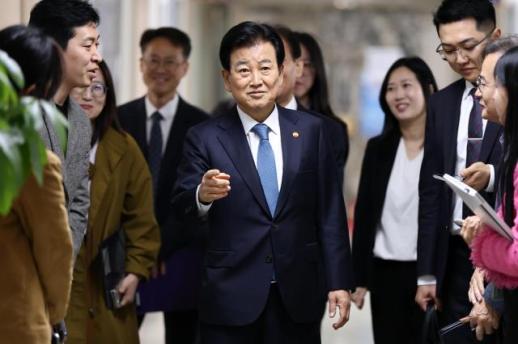 Security Debate Erupts Over Minister Jeong Dong-young's Mention of North Korean Uranium Enrichment Facility The mention of a uranium enrichment facility in North Korea's Guseong by Minister of Unification Jeong Dong-young has plunged South Korean politics back into a security debate. Opposition parties have accused the government of leaking classified information and called for Jeong's dismissal, while the ruling party has countered that the information was already public and that the criticism is politically motivated. However, as is often the case with national security issues, facts take precedence over emotions, and national interests outweigh party politics. A closer examination of the matter reveals a more complex middle ground rather than a simple black-and-white scenario. First, it is essential to confirm whether the name "Guseong" was first disclosed to the world by Minister Jeong. The answer is no. The area around Guseong, located in North Pyongan Province, along with the nearby Banghyeon Aircraft Factory and Banghyeon base, has long been discussed as a suspected site for uranium enrichment by international security research institutions and U.S. think tanks. In 2016, the Institute for Science and International Security (ISIS) suggested that the Banghyeon Aircraft Factory area could potentially house an early small-scale centrifuge research and development facility, estimating it could accommodate around 200 to 300 centrifuges. Subsequently, international media, including Reuters, treated this region as a potential hub for North Korea's nuclear development. In 2024, Bruce Bennett, a researcher at the RAND Corporation, mentioned in an interview with Radio Free Asia the possibility of a large underground facility in the Guseong Yongdeok-dong area being linked to uranium enrichment. In 2025 and 2026, researchers from the Center for Strategic and International Studies (CSIS) continued to raise concerns about the expansion of North Korea's undisclosed nuclear facilities through satellite imagery analysis. In other words, the name Guseong itself cannot be definitively classified as entirely new secret information. In this regard, Minister Jeong's claims do have some factual basis. His assertion that "this name has been mentioned in U.S. research institutions, congressional reports, and media for over a decade, so why has it suddenly become classified?" is not entirely incorrect. In fact, President Lee Jae-myung also defended the issue, stating that it was already known through various research reports and media. However, what is crucial here is not just the existence of the information but who said it, from what position, and in what context. An analysis by a private research institution based on satellite images, defector testimonies, and public data categorizing a site as "suspected" carries a different weight than a sitting Minister of Unification mentioning a specific location in a public forum or the National Assembly. Just because information is publicly available does not automatically make every statement safe. Conversely, it is excessive to immediately label any public trace as "leaking U.S. secrets." In fact, military intelligence authorities have made a different assessment. The Defense Intelligence Agency has stated that the specific location of North Korea's uranium enrichment facilities is classified as a joint secret between South Korea and the U.S. This indicates that publicly available information and actual allied-level information classification can differ significantly. Even if the same name is mentioned, the official confirmation from the government is an entirely different matter. Therefore, Minister Jeong's remarks cannot be conclusively labeled as "an unprecedented leak of classified information," but they also cannot be dismissed as "completely harmless public statements." Ultimately, the essence of this controversy lies more in the pathological structure of South Korean politics than in the information itself. We have become too accustomed to consuming security issues as weapons of party politics rather than from the perspective of national interest. Conservatives easily label the progressive government's approach to North Korea as a security risk, while progressives quickly dismiss conservative criticisms as Cold War tactics. In the process, the truly important questions vanish: How advanced is North Korea's nuclear capability? How will South Korea-U.S. intelligence cooperation be maintained? What should be the strategy for simultaneously deterring North Korea's nuclear threat and engaging in dialogue? The essence is lost, leaving only slogans. Minister Jeong's metaphor that "the moon is the urgency of the North Korean nuclear issue, and the finger is the controversy over the name" holds some persuasive power in this context. North Korea's uranium enrichment capability is not just a matter of Yongbyon. The capacity for nuclear material production is steadily advancing across multiple sites, including Gangseon, Yongbyon, Banghyeon, and suspected facilities in Guseong. The International Atomic Energy Agency (IAEA) has consistently expressed concerns about undeclared enrichment facilities in Yongbyon and Gangseon, while U.S. satellite intelligence agencies continue to track the expansion of new suspected facilities. The real threat lies not in whether a name was mentioned but in the fact that North Korea's nuclear capabilities are growing into a reality. This conflict is not unique to South Korea. The boundary between public and classified information has always been at the center of political clashes in major countries worldwide. A prominent example is the 2003 U.S. controversy over weapons of mass destruction (WMD) in Iraq. The U.S. claimed that Saddam Hussein possessed WMDs and went to war based on satellite images, intelligence reports, and testimonies from defectors. However, no actual WMDs were found after the war. Information became a weapon of politics, and the cost was the U.S.'s credibility and chaos in the Middle East. The government of Tony Blair in the U.K. justified its involvement in Iraq with a document claiming that Iraq could use WMDs within 45 minutes, but much of this was later revealed to be exaggerated or inaccurate. The politicization of information may benefit a regime in the short term, but it ultimately undermines the nation's trust capital in the long run. Israel has also seen clashes between the Prime Minister and opposition whenever assessments from Mossad and military intelligence regarding the potential strike on Iranian nuclear facilities leak to the media. During Netanyahu's tenure, the Iranian nuclear threat was both a security issue and an electoral strategy. However, Israeli security experts have consistently warned that national security is not a party asset but an asset for the entire nation. Japan thoroughly separates publicly available information from classified information at the alliance level regarding North Korean missile and nuclear facility issues. Germany has strengthened parliamentary oversight and multi-layered verification to prevent the misuse of intelligence assessments as political propaganda since the Cold War. All these examples lead to the same conclusion: trust comes from restraint, not speed. South Korea must learn this lesson. First, there must be a strengthened pre-release information review process for public statements made by high-ranking officials at the ministerial level and above. Even if the information is public, if it intersects with South Korea-U.S. joint secrets, coordination with the Ministry of National Defense, the Ministry of Foreign Affairs, and intelligence authorities is necessary. Second, the National Assembly should also undergo a minimum verification process to distinguish between public and classified information when raising security issues. Third, when problems arise, the government should not simply rebut claims as "political tactics" but calmly explain to the public what constitutes public information and what falls into unverifiable areas. Fourth, the media should prioritize presenting the layers of facts over partisan framing. Most importantly, security should be addressed in a language of responsibility rather than excitement. The Book of Proverbs states, "The wise man listens and adds to his learning, and the discerning man acquires wise counsel." National security must also begin with listening. Listening to the facts, to the signals from allies, and to the concerns of others. Politics that shouts without listening ultimately tires the nation. Minister Jeong's remarks about Guseong have become a test of the level of South Korean politics, transcending whether a minister made a gaffe. Will we consume this as yet another partisan battle, or will we use it as an opportunity to establish mature standards for national security? The real danger is not only North Korea's nuclear facilities but also internal divisions and reckless language that could pose a greater threat. National interests are not protected by shouting. They are safeguarded through restraint, trust, and dignity. Security is greater than political tactics, and truth lasts longer than anger. That is the ultimate strength that protects a nation. 2026-04-24 08:42:23
 -
 BLACKPINK’s Jisoo’s Sister Kim Ji-yoon to Make TV Debut on tvN Survival Show BLACKPINK member Jisoo’s older sister will make her broadcast debut on a survival variety show set to air in May. The official social media account for tvN’s “Kill It: Style Creator War” recently announced that influencer Kim Ji-yoon, Jisoo’s sister, will appear on the program. A teaser video released with the post shows Kim, who has 550,000 followers and is known by the nickname “Gunpo Han Hyo-joo.” Kim’s casting comes as attention has focused on a separate controversy involving Jisoo’s older brother. He has faced allegations including illegal filming of sexual activity, an attempted sexual assault case involving a Gangnam-area BJ, and domestic violence. In the attempted sexual assault case, a court rejected a request for an arrest warrant, citing insufficient grounds to support the allegations. As the controversy grew, attorney Eun Hyun-ho of Kim & Chang, legal representative for Jisoo’s one-person agency Blissoo, said the matter “has absolutely nothing to do with the artist or Blissoo.” He said the artist received only limited advice from family members during preparations to establish the agency, adding that no family member has been paid by Blissoo or taken part in decision-making, and that the company “has since been run completely independently.” Some online commenters have questioned that statement, noting that the older brother’s name appears in the production credits for Netflix’s “Monthly Boyfriend,” in which Jisoo appeared. They also pointed to last year’s “Newtopia,” where his name was listed as “Jisoo manager,” keeping the dispute alive. 2026-04-24 08:39:20
 -
 Bitcoin Holds Near $78,000 as Oil Jumps on Renewed U.S.-Iran Tensions Bitcoin held above $78,000 as military tensions between the United States and Iran flared again and global oil prices extended a four-day surge. According to CoinMarketCap, bitcoin was trading at $78,266 as of 8 a.m. on the 24th, down 0.43% from a day earlier. Major altcoins also weakened. Solana fell 1.37% to $86.20, and ether slid 2.72% to $2,333.09. XRP edged up 0.03% to $1.43. Market participants said the standoff around the Strait of Hormuz capped gains. President Donald Trump wrote on Truth Social on the 23rd that he had ordered any vessel laying mines in the strait to be sunk without hesitation. Oil prices jumped 3.1% from the previous day, and the broader geopolitical risk weighed on sentiment, limiting bitcoin’s upside, the report said. Still, bitcoin stayed near the $78,000 level after Strategy, the publicly listed company that holds the most bitcoin, bought about $2.5 billion worth from the 12th to the 19th, local time. In South Korea, bitcoin was trading at about 116.30 million won ($78,395) on Bithumb at the same time, up 0.19% from a day earlier. The so-called kimchi premium, when domestic prices exceed overseas prices, stood at 0.304%. * This article has been translated by AI. 2026-04-24 08:33:20