Japanese colonial rule is one. The democratization movement is another.
For decades, anti-communism and North Korea defined the country’s ideological fault lines. But modern South Korea has undergone a profound political inversion.
Under the dominance of liberal President Lee Jae Myung and the ruling Democratic Party of Korea — the sanctity of the democratization movement has become one of the defining moral pillars of public life.
Anything perceived as mocking or distorting that legacy can trigger overwhelming public condemnation, economic retaliation and even criminal prosecution under laws such as the May 18 Distortion Punishment Act.
What began as a Starbucks Korea marketing blunder therefore escalated into something far larger than a failed promotion.
It became a national ideological confrontation. The controversy erupted after Starbucks Korea promoted “Tank Day” tumblers on May 18 — the anniversary of the 1980 Gwangju Democratization Movement — while another phrase, “Tak! on the desk,” evoked the infamous cover story surrounding the 1987 torture death of student activist Park Jong-chul. Critics viewed the combination as a grotesque trivialization of two defining traumas from South Korea’s authoritarian era.

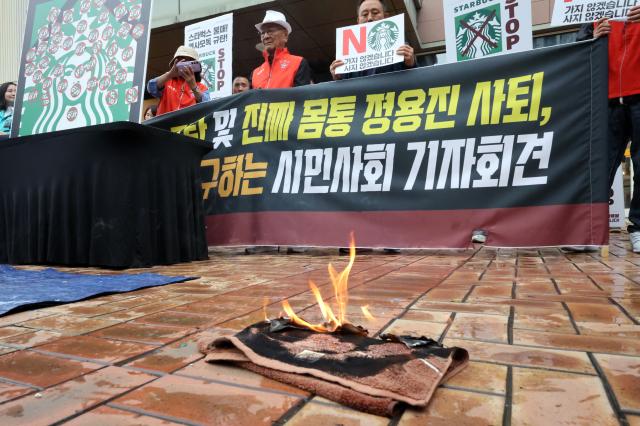
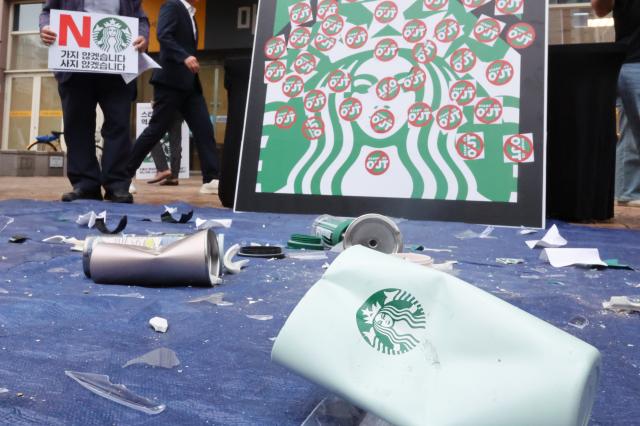
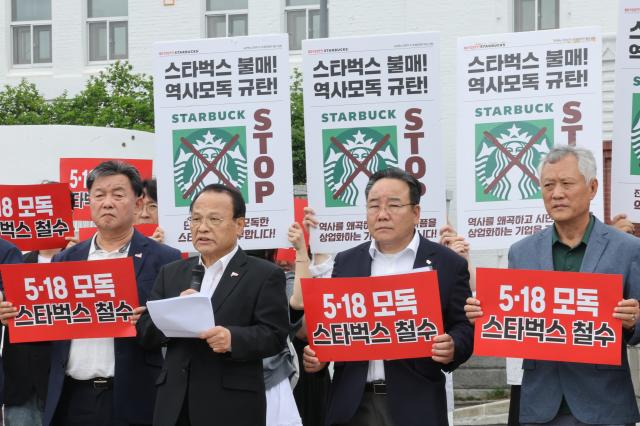
Boycott campaigns flooded social media. Government agencies suspended cooperation projects. Police investigations expanded. President Lee himself publicly condemned the campaign in unusually emotional language, accusing the company of mocking national tragedy.
Local elections that were supposed to revolve around regional administration suddenly transformed into another ideological battlefield.
The ruling bloc framed the controversy as historical desecration.
The conservative People Power Party, meanwhile, accused the government of orchestrating political hysteria and taming corporations through ideological intimidation.
The conservatives, already struggling to recover after the collapse of former President Yoon Suk Yeol following his failed martial law declaration in late 2024, seized on the Starbucks controversy as proof that the ruling camp had become punitive and intolerant.
Opposition politicians described the government-led boycott atmosphere as “state violence,” “witch-hunting” and even a form of “cultural revolution.” They argued that liberal forces were weaponizing historical memory ahead of local elections to consolidate their political base while diverting attention from economic hardship and weak domestic consumption.
But the political momentum shifted on Tuesday.
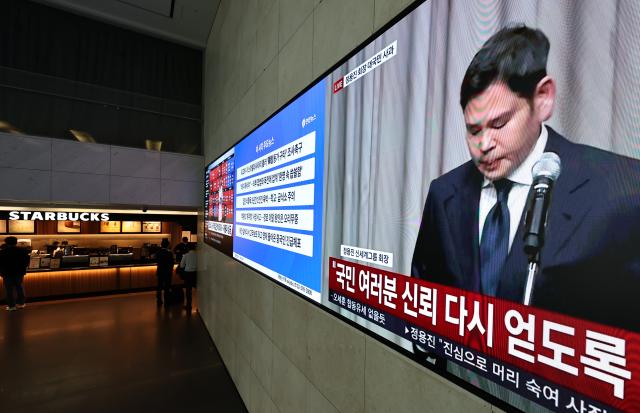
“First, to the bereaved families of the May 18 Democratization Movement, the family of Park Jong-chul, the citizens of Gwangju and the Korean public, I sincerely bow my head in apology and ask for your forgiveness,” Chung said.
“I will not make any excuses. This is my fault.”
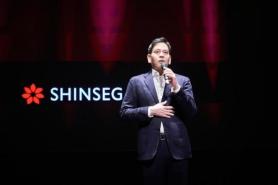
The Shinsegae chairman bowed three times during the five-minute televised apology. “Today’s apology will not be the end, but a beginning,” he said. “We will regain public trust not through words, but through actions.”
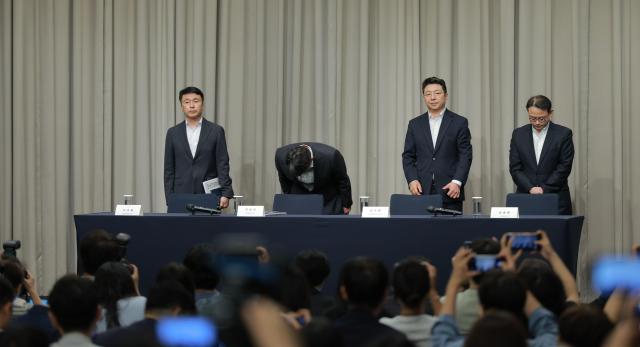
His top executives followed with deep bows of their own and offered an unusually detailed account of the internal investigation, alongside blunt admissions that the company’s marketing oversight system had grown lax and overly fixated on speed and sales.
Kim Su-wan, vice president and head of external affairs, described the controversy as the product of a corporate culture that prioritized rapid promotions and commercial performance over historical awareness and social sensitivity. “This case showed that speed and sales considerations had taken priority over historical awareness and social sensitivity,” Kim said.
According to Kim, the promotion was handled by a small e-commerce team largely composed of younger employees, including two staff members in their early 20s. Internal reviews conducted after the backlash suggested that some employees did not fully understand the historical weight associated with May 18 or the wording used in the campaign.
“The task now is to create programs that can strengthen historical awareness across generations, from younger employees to senior staff,” Kim said.
In South Korea’s chaebol culture — historically associated with hierarchy, opacity and executive distance — such a public act of submission remains extraordinary. More remarkable still was Shinsegae’s decision to publicly disclose details of its internal forensic investigation, including reviews of emails, laptops and internal messenger records involving executives and marketing staff.
Executives admitted the company’s internal safeguards had failed. They acknowledged that speed, sales performance and social media competitiveness had overtaken historical sensitivity inside an organization increasingly driven by ultra-fast consumer marketing cycles.
The company also openly recognized a widening generational disconnect. According to executives, several younger employees involved in the promotion did not fully understand the historical implications associated with phrases tied to May 18 or Park Jong-chul. That admission touched a deeper nerve in South Korea’s evolving social landscape.
Many South Koreans now in their 20s and early 30s grew up in one of the world’s wealthiest and most technologically advanced societies. They did not personally experience war, military dictatorship or democratization protests. To them, events like the Gwangju uprising or the June Democracy Movement can feel less like lived memory and more like inherited civic doctrine.
That creates not necessarily malice — but detachment. And in a hyper-accelerated retail environment dominated by ultra-fast deliveries, viral marketing and algorithm-driven consumer engagement, detachment itself can become dangerous.
Modern Korean retailers now compete not merely on products, but on speed, emotional resonance and social media visibility. Campaigns are designed for instant reaction. Historical awareness often struggles to survive in that environment.
Yet Chung’s rapid and overwhelming humbling also demonstrated something else: how quickly South Korea’s conglomerates now yield when social outrage reaches critical mass.
Within hours, the tone from the ruling Democratic Party softened noticeably. “We believe Chairman Chung’s apology was sincere,” Democratic Party chief spokesperson Kang Jun-hyun told reporters, adding that Shinsegae had “made considerable efforts” to investigate the matter and prevent recurrence.
Another party spokesperson, Park Ji-hye, said the company had “spent time and effort to establish the facts” and acknowledged sympathy for frontline Starbucks employees caught in the backlash.
The de-escalation was politically significant. The ruling camp appeared satisfied once the chaebol visibly surrendered, apologized and pledged reform. That will likely mute conservative counterattacks accusing the government of weaponizing historical morality for electoral advantage.
The fire, at least politically, was partially extinguished. The controversy illustrated the shrinking margin for cultural miscalculation in South Korea’s hyperconnected public sphere.
For corporations, historical awareness is no longer a matter of image management alone. It has become a core governance issue — one capable of triggering consumer backlash, political intervention and institutional crisis within days.
*The author is the managing editor of AJP
Copyright ⓒ Aju Press All rights reserved.