

Journalist

Jack L. Rozdilsky
-
 PHOTOS:Crowds flock to ice festival in Hwacheon Hwacheon, January 14 (AJP) - On a white canvas of snow-covered ice, hundreds of people hunched over holes drilled into the frozen river, their fishing lines disappearing into the dark waters below. Despite temperatures plunging to -14 degrees Celsius and heavy snowfall, crowds gathered from early morning last Monday, just days after the annual mountain trout-themed Sancheoneo Ice Festival kicked off last weekend. Around 10 a.m., parking lots near the entrance to the festival site were already packed. Visitors from all over the country, armed with thermos flasks and hand warmers stuffed into bags and bundled in heavy winter gear, took their spots on the ice. The sprawling fishing area, covering about 30,000 square meters, features more than 20,000 fishing holes drilled through ice more than 30 centimeters thick. People clutched fishing rods in one hand while holding plastic bags for their catch in the other. Around noon, large snowflakes began to fall, and visibility dropped suddenly, but many of the visitors endured it, with their eyes fixed on their fishing lines. Another fishing area for bare-hand fishing also greeted visitors. Inside a circular pool filled with water, sancheoneo swam in circles. Participants changed into short-sleeved shirts and shorts provided by festival organizers, then waited for their turn. The sight of people lined up in summer clothing in -15-degree weather was enough to make onlookers shiver. Without hesitation, they plunged into the icy water, thrusting their arms deep as they chased the quick-moving fish. Minutes later, shivering but triumphant, they hurried to nearby foot baths, sinking their frozen feet into the hot water and feeling relief wash over them. Various other amusements like sledding also await visitors. They can look at massive ice sculptures while participating in hands-on activities like making traditional snacks. There are also food stalls offering various preparations of sancheoneo - grilled, raw, or fried, providing savory delights for weary visitors after a long day of fishing. As the sun set, most visitors packed up and left, but hundreds of others arrived late, eager to compete for gold prizes awarded to those with the largest catch. Unlike the family-friendly atmosphere of the morning and afternoon fishing hours, the competition, which kicked off at 7 p.m., attracted what seemed to be seasoned anglers equipped with specialized rods, lighting, and various professional gear. The festival, now in its 21st year, runs until the first day of February and continues to attract hundreds of visitors each year. 2026-01-14 18:05:59
 -
 Philosophy and AI mix in Korea? Too early to tell SEOUL, January 14 (AJP) - Peter Thiel and Alex Karp, co-founders of Palantir — one of the world’s most prominent artificial intelligence data analytics companies, now valued at more than $426 billion — share an unusual academic background for Silicon Valley: both studied law and philosophy as undergraduates. Karp went further. He earned a Ph.D. in classical social theory under renowned German philosopher Jürgen Habermas at Goethe University in Frankfurt, grounding his thinking in traditions that probe the nature of reason, power and social systems. The renewed attention to philosophy in tech circles reflects a broader question facing the AI era. Philosophy, long focused on the human mind and modes of reasoning once thought exclusive to humans, is increasingly invoked as AI systems grow capable of mimicking — and sometimes surpassing — human cognitive tasks. As AI spreads rapidly from classrooms to workplaces, concerns over ethics, values and human agency have moved to the foreground. That shift is visible inside AI companies themselves. Amanda Askell, who holds a Ph.D. in philosophy from New York University, works as an in-house philosopher at Anthropic. Appearing recently on CBS’s 60 Minutes, she answered host Anderson Cooper’s question — “What is somebody with a PhD in philosophy doing working at a tech company?” — by saying, “I spend a lot of time trying to teach the models to be good, and trying to teach them ethics, and to have good character.” Philosophy’s surprise resurgence in Korea Against this backdrop, philosophy — long regarded as an impractical or declining field — has seen a surge in popularity at some South Korean universities, where AI adoption is among the fastest in the world. At Seoul National University, the early-admission competition rate for the philosophy department rose from 9.92-to-1 in the 2020 academic year to 15.56-to-1 in 2026. Over the same period, linguistics climbed from 6.9-to-1 to 9-to-1, aesthetics from 7.2-to-1 to 12.56-to-1, and religious studies from 6.7-to-1 to 15.33-to-1. At Korea University, regular-admission competition for philosophy increased from 3.73-to-1 in 2020 to 5.27-to-1 in 2026, while linguistics rose from 4.57-to-1 to 6.5-to-1. At Kyungpook National University in Daegu, the philosophy department recorded a 15.6-to-1 competition rate for regular admissions in 2026 — the highest among all departments. Some analysts attribute the trend partly to tech companies showing greater openness to hiring graduates from disciplines such as philosophy and linguistics, valuing skills related to reasoning, language and abstraction. Baek Do-hyung, a philosophy professor at Soongsil University, said the AI era is reshaping how students view career risk. “Unlike when the internet or smartphones first emerged, students aspiring to become IT developers may now worry about job security,” Baek said. “Education increasingly requires the ability to think beyond memorizing established knowledge, which makes philosophical training more relevant.” He added that the AI transition “could become an opportunity to reverse the neoliberal trend that has marginalized foundational disciplines like philosophy within universities.” Moon Sung-hoon, a philosophy professor at Seoul Women’s University, framed the issue more fundamentally. “With the universal adoption of artificial intelligence, we are entering a society where machines use machines — something unprecedented,” Moon said. “This inevitably raises basic questions: What does it mean to be human? What are the signs of humanity? How should people live, and how should society be organized if AI replaces human activity?” Skepticism remains Still, not everyone agrees that philosophy’s rising admissions numbers reflect a genuine AI-driven revival. Some scholars argue the connection is overstated, noting that philosophy has long been a popular major among students preparing for law school, where logical reasoning and analytical writing are heavily tested. Kim Joon-sung, a professor in the Department of Youth Education and Leadership at Myongji University, called recent media coverage “somewhat exaggerated.” “In reality, philosophy departments have been closing at many universities for a long time,” Kim said. Kim, who taught in Myongji University’s philosophy department until 2024, now works in another department after the university stopped recruiting new philosophy majors in 2025. “Even though the department had high enrollment and solid employment outcomes, it was still abolished,” he said. Other universities have followed similar paths. Wonkwang University closed its philosophy department in 2022. Kyungnam University halted new admissions in 2014 and shut the department entirely after its final students graduated in 2021. Daejin University merged philosophy with history in 2016, while Hannam University replaced its philosophy department with a philosophy counseling program in 2014. Kim argued that the recent surge in applicants at elite institutions such as Seoul National and Korea University “appears to be driven more by law school preparation than by a structural link between philosophy and artificial intelligence.” For now, philosophy’s renewed visibility in the AI era may reflect aspiration as much as reality — a sign of changing anxieties about technology, rather than a clear transformation in how universities or labor markets value the discipline. 2026-01-14 17:46:56
 -
 Hanwha restructuring lifts Korean stocks as Asian shares end mixed SEOUL, January 14 (AJP) - Asian equities ended mixed on Wednesday, with South Korea's benchmark index closing at a record high, while markets elsewhere in the region showed divergent performances. South Korea’s KOSPI rose 0.65 percent to close at 4,723.10. The tech-heavy KOSDAQ fell 0.72 percent to 942.18, as investors rotated selectively between sectors. Market attention centered on Hanwha Group after it unveiled plans to split its businesses, separating defense, energy and financial units from its technology and lifestyle operations. The announcement triggered sharp moves across Hanwha affiliates. Hanwha Galleria jumped 30 percent to 1,622 won, hitting its daily upper limit, while Hanwha Life Insurance climbed 10.4 percent to 3,385 won. Among large-cap stocks, Samsung Electronics gained 1.96 percent to 140,300 won, while SK hynix rose 0.54 percent to 742,000 won. Hyundai Motor added 1.35 percent to 411,500 won, and Doosan Enerbility advanced 2.99 percent to 89,600 won. Losses were seen in LG Energy Solution, which fell 1.1 percent to 389,500 won, and HD Hyundai Heavy Industries, which slid 4.7 percent to 615,000 won. In currency markets, the South Korean won weakened to around 1,475 per dollar. Elsewhere in Asia, Japan’s Nikkei 225 rose 1.48 percent to end at 54,341.23, supported by speculation that Prime Minister Sanae Takaichi could call a snap general election as early as next month, a move investors see as raising the likelihood of more expansionary fiscal policy. In China, the Shanghai Composite Index slipped 0.3 percent to 4,125.94, retreating in afternoon trade after earlier gains. Hong Kong stocks were little changed, with the Hang Seng Index edging up about 0.1 percent. 2026-01-14 17:37:52
 -
 SK hynix determined to defend lead through talent and HBM investment SEOUL, January 14 (AJP) - Over the past year, South Korea’s memory chipmaker SK hynix has nearly quadrupled its market value and overtaken Intel in sales to become the world’s third-largest semiconductor company after behind Nvidia and Samsung Electronics. The turning point came in 2025, a decisive year for the AI-driven chip upcycle. Global semiconductor sales jumped 21 percent to $793 billion, led by AI processors, high-bandwidth memory (HBM) and networking chips, according to preliminary data released by Gartner on Tuesday. “AI semiconductors — including processors, high-bandwidth memory and networking components — continued to drive unprecedented growth in the semiconductor market, accounting for nearly one-third of total sales in 2025,” said Rajeev Rajput, senior principal analyst at Gartner. The momentum is set to intensify. “AI infrastructure spending is forecast to surpass $1.3 trillion in 2026,” he added. HBM propels SK hynix past Intel SK hynix climbed to third place as its global revenue surged 37 percent on year to about $61 billion in 2025, powered by explosive demand for HBM used in Nvidia’s AI accelerators. Intel slipped to fourth, with its market share falling to around 6 percent — roughly half the level it commanded in 2021. Kim Duk-ki, a professor of semiconductor systems engineering at Sejong University, said Intel’s long-standing dominance has steadily eroded. “Intel once sat firmly on the throne, but its competitiveness has weakened in recent years,” Kim said. “Even with strong backing from the U.S. government and renewed efforts to rebuild its foundry business, its long-term direction remains uncertain.” By contrast, he said, SK hynix’s rise reflects more than a cyclical rebound. “Given the structural shift driven by AI, this should not be viewed as a temporary phenomenon,” Kim said. “The gap between SK hynix and Intel could persist for some time.” From memory supplier to “full-stack AI” player To cement its lead, SK hynix has decided to invest 19 trillion won ($14 billion) to build an advanced AI memory packaging plant in Cheongju, North Chungcheong Province. HBM lies at the heart of the strategy. The technology stacks multiple DRAM layers and integrates them with graphics processing units (GPUs) into a single package. Taiwan Semiconductor Manufacturing Co. (TSMC) currently leads advanced packaging, combining SK hynix’s HBM with Nvidia GPUs using its proprietary Chip-on-Wafer-on-Substrate (CoWoS) process — now a standard for high-end AI chips. SK hynix’s decision to build large-scale packaging facilities is widely seen as an attempt to move beyond the role of a component supplier and realize its vision of becoming a “full-stack AI memory creator.” Its local competitor Samsung Electronics has been pitching its turnkey solution that combines foundry manufacturing, HBM supply and advanced packaging under one roof. The investment is also set to elevate the strategic value of SK hynix’s Cheongju campus as an AI semiconductor production hub. The site already hosts NAND fabs M11, M12 and M15, as well as the P&T3 facility handling back-end processes. To secure next-generation DRAM capacity, SK hynix has committed nearly 20 trillion won to its M15X fab. Originally scheduled for later completion, the facility opened its cleanroom last October and is now installing equipment, with mass production expected to begin as early as the second half of this year. Talent war intensifies As SK hynix climbs the global rankings, it is also investing heavily to secure future growth by retaining and attracting talent. The AI-driven memory supercycle has translated into record performance bonuses, intensifying competition across South Korea’s semiconductor industry. SK hynix recently revamped its profit-sharing system, linking employee bonuses more directly to operating profit and removing caps that previously limited payouts. Industry estimates suggest that if current earnings momentum holds, average bonuses could exceed 100 million won ($75,000) per employee this year, with some projections pointing even higher next year if profits continue to surge. The widening compensation gap is already being felt at rival Samsung Electronics, where employees in the memory division have raised concerns over disparities in rewards despite sharing in the same industry upcycle. The issue has added to labor tensions and renewed calls for changes to performance-based pay structures. The effects are visible upstream as well. Competition ratios for semiconductor majors at universities with recruitment agreements with SK hynix — including Hanyang, Chung-Ang, Sogang and Korea University — have climbed to between 9:1 and 11.8:1, sharply above the average 5.31:1 ratio across 11 elite Seoul-based universities. With AI processors generating more than $200 billion in sales last year and HBM accounting for nearly a quarter of the global DRAM market, Gartner forecasts that AI-related chips could represent more than half of total semiconductor revenue by 2029. 2026-01-14 17:09:29
 -
 After EV slowdown, Korea's battery giants pivot to robots via solid-state cells SEOUL, January 14 (AJP) - After years of EV-led expansion, South Korea's battery makers are confronting a harsher reality as global electric-vehicle sales cool and clean-energy strategies fragment across regions. In response, the industry is doubling down on solid-state batteries — betting that humanoid robots, rather than cars, may offer an earlier and more reliable route to commercialization. POSCO Future M, the battery materials arm of POSCO Group, said this week it has begun R&D on solid-state battery materials specifically targeting humanoid robots and industrial robotics. Testing of the materials is now under way, with commercialization planned between 2028 and 2030. Solid-state batteries replace liquid electrolytes with solid materials, improving safety, energy density and charging speed compared with conventional lithium-ion cells. By eliminating risks such as electrolyte leakage, thermal runaway and dendrite penetration, the technology also allows for lighter battery packs — features increasingly critical for mobile robots operating for extended periods. The global solid-state battery market was valued at $98.96 million in 2024 and is projected to surge to $1.36 billion by 2032, reflecting a compound annual growth rate of 41.6 percent, according to Fortune Business Insights. Asia-Pacific accounted for 43.8 percent of the market last year. Samsung SDI leads commercialization push Among sulfide-based solid-state battery developers, Samsung SDI is widely seen as leading the commercialization race. The company aims to bring solid-state cells with energy density of 900 watt-hours per liter (Wh/L) to market by 2027 and is currently supplying samples produced at its Suwon pilot line to customers for performance verification. "Samsung SDI's earnings appear to be passing through their weakest phase," said Kwon Joon-soo, an analyst at Kiwoom Securities. "Short-term momentum remains intact, supported by expectations for energy storage system orders and solid-state battery investment." Last October, Samsung SDI signed a tripartite agreement with Germany's BMW and U.S.-based Solid Power to jointly validate automotive solid-state battery technology. The partners plan to install the cells in BMW's next-generation test vehicles as a final verification step. SK On has set its commercialization target for 2029 — one year ahead of LG Energy Solution's 2030 goal. The company completed a solid-state battery pilot plant at its Daejeon R&D center last year and is now accelerating development. The facility will produce prototype cells for customer supply while evaluating performance and quality. SK On is developing solid-state batteries with energy density of 800 Wh/L, with a long-term target of reaching 1,000 Wh/L. EV headwinds force strategic reset The pivot comes as the EV sector — once the industry's primary growth engine — faces mounting headwinds. LG Energy Solution, Samsung SDI and SK On are all projected to post operating losses in the fourth quarter of 2025 as automakers scale back electrification plans and cancel battery orders. The combined value of terminated contracts in late 2025 alone exceeded 17 trillion won ($11.5 billion). Ford Motor canceled a 9.6 trillion won battery supply agreement with LG Energy Solution in December, followed days later by the termination of a separate 3.9 trillion won deal with Freudenberg Battery Power Systems. Cathode materials maker L&F disclosed that a 3.83 trillion won high-nickel cathode supply contract signed with Tesla in February 2023 had been reduced to just 9.73 million won — effectively nullifying the deal — amid shifting EV market conditions. Robots emerge as early solid-state adopters By contrast, humanoid robotics is rapidly evolving from a speculative concept into a commercial market. At CES 2026 in Las Vegas this month, Chinese firms accounted for 21 of the 38 exhibitors in the humanoid robotics category. Shanghai-based AgiBot led global shipments with an estimated 5,168 units in 2025, while Unitree Robotics now produces more than 10,000 units per month of its Go2 quadruped robot. Chinese EV maker XPeng's next-generation IRON humanoid robot is equipped with an all-solid-state battery, while Shenzhen-based Engine AI's T800 model features what the company describes as the industry's first dedicated high-performance solid-state cell, capable of four to five hours of continuous operation. As both technologies mature, the convergence of solid-state batteries and humanoid robotics is accelerating toward commercial deployment. Korea joins race via alliance strategy Hyundai Motor Group unveiled production plans for its Atlas humanoid robot, developed by subsidiary Boston Dynamics, at the same exhibition. The automaker aims to produce 30,000 units annually by 2028, with initial deployment focused on parts sequencing at its Metaplant America facility in Georgia. LG Electronics introduced CLOiD, a home-assistant robot with articulated arms and five-fingered hands, outlining its vision for a "Zero Labor Home." Doosan Group and HL Group also showcased robotics platforms at the event. Amid surging demand, all three Korean battery makers have joined the K-Humanoid Alliance, a government-backed consortium launched in April to develop high-density, long-life and high-safety batteries tailored for humanoid robots. The alliance plans to invest 1 trillion won by 2030, with LG Energy Solution, Samsung SDI and SK On leading battery development alongside AI chipmakers Rebellions and DeepX. For Korea's battery giants, solid-state technology represents both a hedge and a necessity. As China tightens its grip on conventional batteries through scale and cost advantages, the race to commercialize next-generation cells for emerging applications may determine which players remain relevant in the post-EV era. 2026-01-14 17:02:05
 -
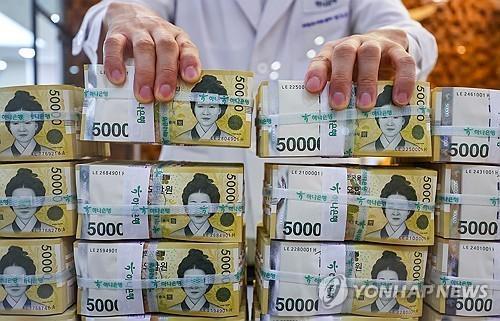 Korea's M2 growth moderates as investors favor short-term returns SEOUL, January 14 (AJP) - South Korea’s broad money growth stalled in November under a revised definition of M2, reflecting both a statistical adjustment and a deeper shift in investor behavior toward short-term, high-return assets. According to data released Wednesday by the Bank of Korea (BOK), the M2 money supply stood at 4,057.5 trillion won ($2.77 trillion) in November 2025, little changed from the previous month and marking a second consecutive month of flat growth. The figure represents a slight decline from October’s 4,059.5 trillion won. Beginning in January, the BOK revised its M2 methodology in line with International Monetary Fund (IMF) standards, excluding beneficiary certificates — including exchange-traded fund (ETF) units — from the broad money total due to their high price volatility. Under the previous definition, November M2 would have amounted to 4,498.6 trillion won, showing a modest month-on-month increase. Even after accounting for the revision, the data point to heightened liquidity volatility, driven by investor preference for fast-turnover assets such as equities and short-term bonds. On a year-on-year basis, M2 rose 4.8 percent in November, slowing from October’s 5.2 percent increase. While moderating, Korea’s monetary expansion continues to outpace that of major reserve-currency economies, exceeding the United States’ 4.3 percent growth and Japan’s 1.8 percent. Liquidity levels also remain elevated relative to economic output. Data submitted by the BOK to Rep. Park Sung-hoon of the ruling People Power Party show Korea’s M2-to-GDP ratio at 153.8 percent — more than double the 71.4 percent recorded in the United States. The composition of money holdings highlights a growing bias toward liquidity. Financial bonds with maturities of less than two years increased by 4.2 trillion won, while marketable instruments rose by 2.5 trillion won, reflecting a shift away from longer-term financial products amid a buoyant securities market and rising demand for overseas equities. The trend has carried into the new year. Recent data released Tuesday show demand deposits at the country’s five major banks fell by about 27 trillion won from end-December levels, while investor deposits climbed to a record high exceeding 90 trillion won as of Jan. 8 — signaling an accelerating flow of funds from bank accounts into equity markets. By sector, corporations increased their M2 holdings by 11 trillion won in November, while “other financial institutions,” including brokerages and asset managers, added 8.7 trillion won. In contrast, money holdings by households and non-profit organizations declined by 12.3 trillion won, underscoring the rapid shift by individual investors toward riskier assets. 2026-01-14 16:48:28
 -
 Overseas investing reshaping Korea's FX market: BOK SEOUL, January 14 (AJP) - A sharp rise in overseas securities investment by South Koreans led to nearly $20 billion in net foreign-exchange outflows last year, the Bank of Korea said in a report Wednesday, underscoring why the won weakened despite large current-account surpluses. Net foreign-currency outflows linked to residents’ overseas securities purchases and overseas investment by pension funds totaled $19.6 billion from January through October last year. The findings were presented by Kwon Yong-oh, head of the Bank of Korea’s international finance research team, at a policy symposium in Seoul. Kwon said exchange-rate movements since the global financial crisis have been closely tied to shifts in foreign-exchange supply and demand. Prior to the 2020s, current-account surpluses typically exceeded demand created by residents’ overseas investment, resulting in an excess supply of foreign currency and a stronger won. That dynamic has since changed, he said. Despite sustained current-account surpluses since 2024, the won has weakened rapidly. Kwon suggested that export-related dollar inflows may not be fully entering the market as some exporters delay currency conversion, while growing overseas investment by residents has tightened dollar supply and demand. From January through October last year, South Korea’s current-account surplus generated $89.6 billion in net inflows, while foreign investors’ purchases of domestic securities added $31.9 billion, according to the central bank. Those inflows were more than offset by a surge in residents’ overseas securities investment and overseas investment by the National Pension Service, resulting in a net foreign-exchange outflow of $19.6 billion, or roughly 29 trillion won at current exchange rates. The outflow marked a sharp increase from the same period a year earlier, when net outflows totaled about $500 million. Residents’ overseas securities investment jumped to $117.1 billion from $71.0 billion a year earlier. “Residents’ behavior is driving the shift in foreign-exchange supply and demand,” Kwon said. Kwon also pointed to a widening growth gap between South Korea and the U.S., as well as differences in expected stock-market returns, as contributing factors to the won’s recent weakness. Addressing claims that excessive liquidity expansion has weakened the won, Kwon said a long-term channel linking money-supply growth to higher inflation and currency depreciation is theoretically possible, but noted that empirical evidence remains inconclusive. 2026-01-14 16:19:56
 -
 Railway passenger numbers hit record due to surge in high-speed train usage SEOUL, January 14 (AJP) - South Korea saw a record number of railway passengers last year, as more people used high-speed trains not only for travel but also for daily commutes, the Ministry of Land, Infrastructure and Transport said on Wednesday. The total number of railway passengers reached 172.22 million as of the end of las year, up 0.6 percent from the previous year and the highest on record. Among them, passengers on high-speed bullet trains KTX and SRT totaled 93 million and 26 million, averaging 254,000 and 71,000 per day, respectively. The ministry said the increase is partly due to a new railway line connecting Jecheon in North Chungcheong Province and Wonju in Gangwon Province and other southern areas, which opened in December 2024, carrying about 2.75 million passengers so far. Passengers on conventional slower trains with frequent stops fell 3.6 percent from a year earlier to 53 million, indicating a shift toward high-speed trains. By destination, trains to the southern port city of Busan carried the most passengers, totaling 83.60 million. Of these, 61.40 million traveled on high-speed trains and 20.22 million on conventional trains. Seoul Station in the capital was the busiest, with 43.90 million passengers, followed by Busan (26.10 million), Dongdaegu (20.50 million), Daejeon (19.60 million) and Yongsan (15.10 million). To meet growing demand, the ministry expanded discount programs for the elderly, people with disabilities, families with multiple children, and pregnant women. It also installed around 300 new ticketing machines, offering various services including remote consultations and other assistance. Some 385,000 families with multiple children and 699,000 pregnant women benefited from substantial discounts for their fares. The ministry also said it will come up with tour programs aimed at revitalizing local tourism in areas facing population decline by attracting visitors. Kim Tae-byeong from the ministry said, "We will ensure the safety of passengers while continuing to improve services." 2026-01-14 16:15:32
 -
 Contrary to long-held belief, kimchi and traditional Korean diets may not be as healthy as assumed SEOUL, January 14 (AJP) - Kimchi, South Korea's fermented staple, has been included in U.S. government dietary guidelines for its potential benefits to gut health. Yet a new Korean study suggests that high salt intake from kimchi and other traditional foods may contribute to cancer risk — challenging the widely held view that the Korean diet is inherently healthy. The study, led by researchers from Seoul National University and published in the government-funded journal Epidemiology and Health, estimates that 6.08 percent of cancer cases and 5.70 percent of cancer deaths in Korea are attributable to dietary factors. The findings, indexed in PubMed at the U.S. National Library of Medicine, raise fresh questions about the long-term health impact of salt-heavy eating patterns. Using national health and nutrition survey data and large Korean cohort studies, the research team calculated population-attributable fractions (PAFs) for diet-related cancers between 2015 and 2030. Korea's diet-attributable cancer incidence exceeds that of the United States (5.2 percent) and France (5.4 percent), though it remains lower than that of the United Kingdom (9.2 percent) and Germany (7.8 percent). Among dietary factors, salted vegetables — including kimchi, salted cabbage, radish and cucumber — emerged as the single largest contributor to cancer burden. In 2020, salted vegetables accounted for an estimated 2.12 percent of all cancer cases and 1.78 percent of cancer deaths, with a particularly strong association with stomach cancer. More than 44 percent of diet-related cancer cases were stomach cancers, which also made up over 37 percent of diet-related cancer deaths. The PAFs for diet-related stomach cancer reached 24.61 percent for incidence and 24.27 percent for mortality, suggesting that roughly one in four stomach cancer cases in Korea may be linked to dietary factors. "The findings quantify how a salt-heavy diet structurally drives the burden of stomach cancer in Korea," the authors wrote. The dietary impact was notably higher among men than women. For men, 8.43 percent of cancer cases and 7.93 percent of cancer deaths were linked to diet, compared with 3.45 percent and 2.08 percent, respectively, for women. The researchers attributed the gap to higher consumption of salted vegetables, red and processed meat, and lower intake of vegetables and fruit among men. Salted vegetable consumption has been gradually declining, driven by sodium-reduction policies and changing eating habits. Even so, the study projects that salted vegetables will remain Korea's largest dietary cancer risk factor through 2030, underscoring the need to reduce both portion size and salt content. The researchers also warned that cutting back on salty foods alone will have limited impact unless accompanied by broader dietary changes. Low intake of non-starchy vegetables and fruit was identified as another major driver of cancer risk. Koreans consume an average of 340.5 grams of vegetables and fruit per day — well below the internationally recommended range of 490 to 730 grams. The shortfall increases the risk of stomach and colorectal cancers, as well as certain respiratory and digestive cancers. The cancer burden linked to insufficient produce intake is expected to remain largely unchanged through 2030. Red and processed meat showed relatively low PAFs in Korea — accounting in 2020 for just 0.10 percent and 0.02 percent of cancer cases, respectively — largely because consumption remains lower than in many Western countries. However, the study warned that steadily rising intake since the mid-2000s could raise the PAF for processed meat to 0.08 percent by 2030, amplifying its impact over time. "Diet-based cancer prevention in Korea must go beyond reducing salted vegetables," the authors wrote. "It is essential to increase the consumption of fresh vegetables, fruit and dietary fiber at the same time." For Koreans, kimchi is more than a side dish. It anchors daily meals and symbolizes warmth and hospitality at the table. Sharing kimchi is often a way of sharing affection — whether passed to a neighbor or sent to family living far away. Each winter, families and communities gather for gimjang, the traditional kimchi-making season, salting and seasoning cabbage in large batches to last through the cold months. Even as Korean kimchi gains global popularity, domestic consumption has been gradually declining, reflecting rising incomes and the steady westernization of diets. 2026-01-14 16:08:56
 -
 EXO, BTS, BIGBANG and BLACKPINK set to reclaim the real K-pop stage in 2026 SEOUL, January 14 (AJP) -After a year when a Netflix-born fictional idol group soaked up global buzz, K-pop’s original hitmakers are ready to retake the spotlight in 2026 — not through novelty, but through craft, catalog and command. EXO, BTS, BIGBANG and BLACKPINK — each more than a decade into their careers — are lining up comebacks or group activities that point back to what made K-pop a global force in the first place: precision rhythm, unmistakable stage presence and intellectual property built to endure. EXO: the blueprint for performance-driven K-pop EXO opens the 2026 calendar with its eighth full-length album REVERXE, set for release on Jan. 19 — the group’s first full comeback in over two years. All nine tracks will drop simultaneously, followed by a showcase at Kyung Hee University’s Peace Hall in Seoul. The return leans into EXO’s defining strength: scale. The pre-release track “Back It Up,” first unveiled at the MMA 2025 awards in December, arrived with a 40-dancer stage setup — a reminder of the group’s reputation for turning studio tracks into arena-ready spectacles. Their MMA setlist — spanning “Monster,” “Growl,” “Love Shot” and “The Eve” — didn’t just energize longtime EXO-Ls. It sparked fresh interest among younger artists and new listeners, with clips circulating widely across social platforms. A decade on, EXO’s stage-first identity is still recruiting new fans. BTS: a full-team return, nearly four years in the making BTS returns as a complete seven-member group on March 20 with its fifth studio album, nearly four years after its last group release. The 14-track record is expected to reflect the musical evolution forged during an extended solo era. The group’s staying power is already measurable. According to Melon, BTS’ 2017 track “Spring Day” has appeared on the platform’s annual chart for nine consecutive years — the longest run in its history and a rare marker of sustained listening demand. Rather than diluting the brand, the hiatus expanded it. Solo albums and global tours pushed each member’s reach further, transforming BTS from a release-cycle-driven act into something closer to a long-term cultural franchise. BIGBANG and BLACKPINK: scarcity, scale and global pull BIGBANG remains one of K-pop’s rarest forces — a group whose limited activity only amplifies its impact. While concrete release plans remain unconfirmed, the group is set to mark its 20th anniversary with a group activity in April, an appearance alone enough to reset expectations across the industry. Following the release of “Still Life,” T.O.P formally stepped away, leaving G-Dragon, Taeyang and Daesung as the current lineup. With reports pointing to T.O.P’s solo return in 2026, fan speculation about future collaborations among the original members has resurfaced. G-Dragon’s standing as a cross-generational icon remains unshaken. His third full-length solo album Übermensch capped a dominant awards season across South Korea and China, reaffirming both his artistic authority and commercial pull more than a decade into his career. BLACKPINK continues to operate on a different plane entirely. Through blockbuster world tours and parallel solo careers, the group has shown that female acts can function as enduring global IPs with diversified revenue streams. A full-member comeback is confirmed for 2026, with album and tour details still under wraps — and anticipation already building. Jennie reinforced her solo stature at the 40th Golden Disc Awards in 2026, taking both the Digital Song Main Prize and the Grand Prize (Record of the Year). In 2025, she also became the first K-pop soloist to receive the Global Force Award at Billboard Women in Music in the United States. Rosé has posted her own run of milestones. Her collaboration with Bruno Mars, “APT.,” won Song of the Year at the 2025 MTV Video Music Awards, making her the first K-pop artist to claim a top-tier VMA category. Her solo album Rosie reached No. 3 on the Billboard 200 — the highest placement ever achieved by a female K-pop solo artist. "APT" is shortlisted for both the Song of the Year and Record of the Year at the upcoming Grammy Awards. A reset moment for K-pop’s live economy What unites these four acts is not nostalgia, but durability. Their catalogs, stagecraft and global fan bases arrive at a moment when K-pop faces criticism for creative stagnation and a shortage of true blockbuster hits. The timing also carries financial weight. HYBE’s profitability dipped in 2025 amid heavy investment in new IPs and overseas restructuring, but analysts see a sharp rebound ahead. “With BTS returning, HYBE’s earnings trajectory is expected to turn decisively upward in 2026,” said Jang Ji-hye, an analyst at DS Investment & Securities. Add growing speculation about a reopening of China’s concert market, and veteran acts with proven touring power may be uniquely positioned to benefit. In 2026, K-pop’s legacy names aren’t chasing trends — they’re reminding the industry where the standard was set. 2026-01-14 16:06:37