
Journalist

Joshua Elves-Powell
-
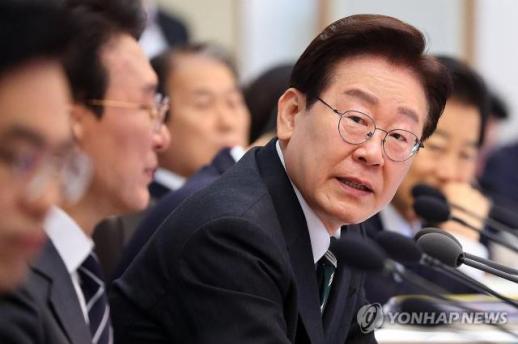 President Lee Vows to Recover All Profits from Price Collusion President Lee Jae-myung has issued a strong warning to the business community, stating that the government will recover all profits gained from collusion and market disruption. This declaration makes it clear that practices such as price collusion, self-dealing by conglomerate families, and unfair internal transactions will no longer be tolerated as mere customs or compromises. The Fair Trade Commission is also working to significantly strengthen its penalties for collusion and increase sanctions against repeat offenders. This move is being interpreted in the market as a signal for the new government's commitment to 'reestablishing fair economic order.' The government's stance goes beyond mere regulatory tightening. It directly targets long-standing issues that must be addressed for the South Korean economy to achieve sustainable growth. During its rapid development, South Korea's industry established a supply chain and market structure centered around large corporations, securing global competitiveness. However, this growth has also led to the accumulation of problems such as closed trading practices, repeated collusion, internal transactions among affiliates, and abuse of market dominance. In particular, in some sectors, there have been repeated instances where the timing and extent of price increases move in tandem, prioritizing market order maintenance over competition among leading companies. This situation inevitably reduces consumer choice and increases price burdens. Small and new businesses find it increasingly difficult to enter the market. Ultimately, the collapse of fair competition slows down innovation across the entire industry. A recent collusion case in the sugar industry sanctioned by the Fair Trade Commission symbolically illustrates this reality. Evidence emerged that major companies were sharing price information and effectively controlling transaction structures, leading to significant fines. The occurrence of collusion in essential items like sugar is particularly serious as it directly impacts the cost of living for citizens. Businesses must now confront the changing times. In the past, a company's role could be justified solely by growth, investment, and job creation. However, the global market is beginning to view trust as a more critical competitive factor than size. Major companies in the U.S. and Europe are managing antitrust regulations, compliance systems, and ESG standards as core elements of their operations. There are numerous cases where a single instance of unfair trading has shaken a company's value, brand trust, and global trading relationships. Strengthening internal compliance systems within companies has become an urgent task. Issues such as closed decision-making structures centered around family owners, preferential treatment for affiliates, and abuse of superior status over partner companies are increasingly unacceptable by global standards. Methods that disrupt market order for short-term results or internal benefits are likely to undermine the trust that companies have built. The government also bears significant responsibility. Fair trade policies must be implemented consistently based on clear principles. A predictable system must be established where law-abiding companies are protected, and those engaging in repeated and organized unfair practices are held accountable. This will encourage companies to prioritize long-term trust over short-term profits. Ultimately, the economy operates on trust. A structure where collusion, self-dealing, and market distortion are repeated cannot guarantee the future competitiveness of the South Korean economy. Fair economy is not a concept to pressure companies; rather, it is about ensuring that companies competing in good faith are fairly evaluated and that consumers and partner companies can trust the market order together. It is hoped that the strong principles of fair economy put forth by the Lee Jae-myung administration will serve as a turning point for a more transparent and healthy industrial structure in South Korea. 2026-05-11 09:56:21
 -
 KB Kookmin Bank Selects Director Jang Hang-jun and Writer Kim Eun-hee as New Models KB Kookmin Bank announced on May 11 that it has selected film director Jang Hang-jun and television writer Kim Eun-hee as its new models.Director Jang is recognized as a national filmmaker, having surpassed 16 million viewers with his film "The King and the Man," which was released in February.His wife, Kim, has been praised for opening new horizons in Korean genre dramas with works like "Signal" and "Kingdom."The couple shares their lively and relatable daily life, resonating with a wide range of audiences.Through this model selection, KB Kookmin Bank aims to present its financial services in a friendly manner that aligns with customers' perspectives, addressing the complexities often associated with banking. The bank plans to leverage the couple's popularity and chemistry to bridge the gap between everyday life and finance.A representative from KB Kookmin Bank stated, "Director Jang and Writer Kim are gaining broad empathy through their expertise and genuine portrayal as a couple. We will continue to enhance communication with our customers in various ways."Additionally, KB Kookmin Bank has established a trustworthy brand image by hiring models such as the K-pop group aespa (2021), Hearts to Hearts (August 2025), actress Park Eun-bin (since March 2023 as a holding model), and Choo Young-woo (March 2025).* This article has been translated by AI. 2026-05-11 09:48:17
 -
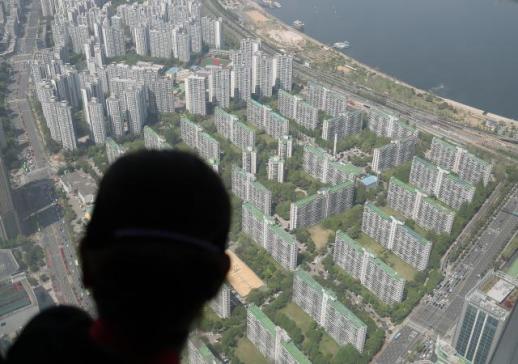 Jeonse Prices Surpass Sale Prices in Seoul, Raising Concerns of Rental Crisis This year, the nationwide increase in apartment jeonse prices has outpaced the rise in sale prices, signaling renewed instability in the rental market. Both metropolitan and non-metropolitan areas have experienced a surge in jeonse prices, with Seoul also nearing a point where jeonse prices could surpass sale prices. According to the Korea Real Estate Agency on May 11, the cumulative increase in nationwide apartment jeonse prices reached 1.56% as of the first week of May. In comparison, the increase in sale prices was 0.98%, indicating that jeonse prices are 0.58 percentage points higher. In the metropolitan area, jeonse prices rose by 2.20% this year, exceeding the sale price increase of 1.79% by 0.41 percentage points. Non-metropolitan areas also saw jeonse prices rise by 0.94%, which is 0.74 percentage points higher than the sale price increase of 0.20%. In Seoul, while the sale price increase of 2.81% still exceeds the jeonse price increase of 2.61%, the gap has narrowed to just 0.20 percentage points. Notably, in the first week of May, jeonse prices in Seoul rose by 0.23%, marking the highest increase since the third week of November 2015, when it was 0.26%. Regions with the highest cumulative increases in jeonse prices include Suwon Yeongtong-gu (4.57%), Anyang Dongan-gu (4.53%), Muan-gun in Jeollanam-do (4.39%), Seongbuk-gu in Seoul (4.20%), Giheung-gu in Yongin (4.16%), Gwangmyeong City (4.08%), and Nowon-gu in Seoul (4.06%). The trend of jeonse prices surpassing sale prices is attributed to changes in the supply structure. With stricter lending regulations and increased taxation on multiple homeowners, the number of landlords holding properties with jeonse has decreased, while actual demand has shifted towards jeonse rather than sales, leading to a widening supply-demand imbalance. In the Gangnam area of Seoul, the sales market has slowed due to the expiration of the tax exemption for multiple homeowners, while the jeonse market has remained relatively strong. In Seocho-gu, sale prices increased by 1.00% this year, while jeonse prices surged by 3.65%, creating a gap of 2.65 percentage points. In Gangnam-gu, sale prices fell by 0.38%, but jeonse prices rose by 0.84%, and in Songpa-gu, sale prices increased by 1.37% while jeonse prices rose by 2.09%, indicating a larger increase in jeonse. In Yongsan-gu, the increase in jeonse prices (2.36%) also outpaced the sale price increase (1.13%), while in Nowon-gu, jeonse prices rose by 4.06% amid a strong sale price increase of 3.48%. Experts warn that if the trend of rising jeonse prices continues, it could trigger a 'price transfer' effect that stimulates sale prices again. There are concerns that the rising jeonse rates could reignite a rental crisis similar to past situations, where increased jeonse prices led to higher sale prices. Seojin Hyung, a professor at Kwangwoon University’s Department of Real Estate, stated, "The government's one-household, one-home policy, supply shortages, and a lack of non-apartment housing are major causes of the rental crisis. The ongoing reduction in rental supply will inevitably exacerbate the rental crisis." He added, "As tenants unable to cope with rising jeonse prices move to the monthly rental market, the trend towards monthly rentals will accelerate. Policy responses, such as expanding public rental supply, are necessary." 2026-05-11 09:43:44
 -
 Half of Female Drivers Report Driving Five or More Times a Week Nearly half of female drivers, or 49.8%, reported that they drive five or more times a week, indicating a trend toward becoming more routine drivers. While driving has expanded to include commuting, childcare, shopping, and leisure activities, many still face significant challenges due to a lack of information regarding vehicle maintenance, insurance, and selling used cars. Hanwha General Insurance released the results of its "2026 Female Driver Survey" on May 11, which included responses from 4,922 female auto insurance customers. The survey found that 23.9% of respondents drive one to two days a week, while 20.4% drive three to four days. Only 5.9% reported that they rarely drive. Additionally, 90% of respondents owned a vehicle in their name. The most stressful driving situation for respondents was adverse weather conditions, with 82.9% identifying rain or snow as particularly challenging. Notably, drivers with over ten years of experience reported feeling more burdened by driving in bad weather compared to novice drivers. This may be attributed to their heightened awareness of potential risks associated with sudden weather changes, even as they become more accustomed to parking and lane changes. There was also a significant information gap in vehicle maintenance. About 54.5% of respondents found it difficult to determine when to replace consumables, and 52.1% struggled to assess the appropriateness of maintenance costs. Among those who felt inconvenienced during the insurance application and renewal process, 71.4% cited the overwhelming number of policy options as a burden. Additionally, 49.6% found it challenging to choose an insurance company, while 47.4% had difficulty understanding the scope of coverage. When it comes to selling used cars, price negotiation emerged as the most significant source of stress. Among those who had experience replacing vehicles, 85% reported that negotiating prices for used cars was difficult, and 44% expressed distrust toward dealers. The primary reason for vehicle replacement was aging, with 75.6% citing this as their motivation.* This article has been translated by AI. 2026-05-11 09:42:23
 -
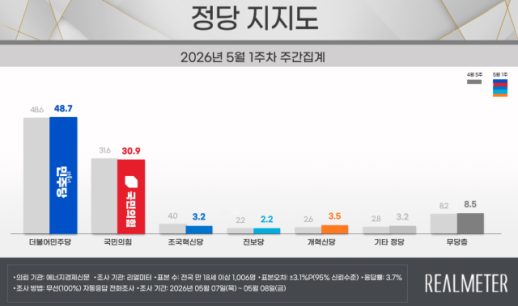 Democratic Party Leads with 48.7% Support, Gap Widens with People Power Party A recent poll indicates that the gap in support between the Democratic Party and the People Power Party has widened. According to a survey conducted by Realmeter on May 7-8, commissioned by Energy Economy Newspaper, the Democratic Party garnered 48.7% support, while the People Power Party received 30.9%. The Democratic Party's support increased by 0.1 percentage points from the previous week, while the People Power Party's support decreased by 0.7 percentage points. This resulted in a gap of 17.8 percentage points, marking the 14th consecutive week that the difference has remained outside the margin of error. Following the two major parties, the Reform Party received 3.5%, the Justice Party 3.2%, and other parties collectively received 3.2%. The percentage of undecided voters was recorded at 8.5%. Regionally, the Democratic Party's support was highest in Gwangju, Jeonnam, and Jeonbuk at 71.5%, followed by Daejeon, Chungcheong, and Sejong at 53.2%, Busan, Ulsan, and Gyeongnam at 39.8%, and Daegu and Gyeongbuk at 30.4%. In terms of age demographics, the Democratic Party found its strongest support among voters in their 50s (61.8%), followed by those in their 40s (58.4%), those aged 70 and older (45.7%), those in their 30s (40.3%), and those in their 20s (31.4%). Conversely, the People Power Party's highest support was in Daegu and Gyeongbuk at 49.7%, followed by Busan, Ulsan, and Gyeongnam at 35.1%, Seoul at 32.8%, Daejeon, Chungcheong, and Sejong at 31.4%, and Gyeonggi and Incheon at 26.8%. Among age groups, the People Power Party attracted support from voters in their 20s (43.7%), followed by those in their 50s (24.7%), those in their 30s (25.4%), and those in their 40s (18.6%). The survey attempted to contact 27,189 voters aged 18 and older, with 1,006 responding, resulting in a response rate of 3.7%. The margin of error is ±3.1 percentage points at a 95% confidence level. The poll was conducted using a 100% automated response method, employing a random sampling framework for telephone calls. For more details, please refer to the website of the National Election Survey Deliberation Commission.* This article has been translated by AI. 2026-05-11 09:38:02
 -
 Coway Reports Record Quarterly Earnings, Shares Surge Over 10% Coway's shares surged over 10% in early trading following the announcement of record earnings for the first quarter. As of 9:12 a.m. on May 11, Coway's stock was trading at 97,100 won, up 9,500 won (10.84%) from the previous trading day. The company has seen a three-day streak of gains, with increases of 4.45% and 0.81% on May 7 and 8, respectively. Analysts attribute the stock's rise to strong earnings and expectations for stable cash flow-based shareholder returns. Coway reported on May 8 that its consolidated revenue for the first quarter reached 1.33 trillion won, a 13.2% increase from the same period last year. Operating profit rose by 18.8% to 250.9 billion won, while net profit increased by 31.1% to 182 billion won, marking the highest quarterly performance in the company's history. The growth of Coway's domestic business was particularly notable. Domestic revenue reached 742.8 billion won, up 9.5% year-on-year, with rental revenue increasing by 10.5% to 715.3 billion won. The net increase in domestic rental accounts was 188,000, an 81.8% rise compared to the previous year, driven by expanded new rental sales and strong performance in key product categories like Birex. Internationally, Coway's business also showed growth across all regions. The Malaysian subsidiary saw a 23.5% increase in revenue year-on-year, benefiting from strong sales of existing products and the successful introduction of new categories, which also improved operating profit margins. Although revenue for the U.S. subsidiary slightly decreased due to a high base effect, operating profit surged by 70.7% due to cost efficiencies. Thailand recorded a remarkable 29% growth in revenue. Market analysts believe that the combination of earnings growth and expanded shareholder returns is likely to lead to a reassessment of the company's value. Cho Sang-hoon, a researcher at Shinhan Investment Corp., noted, "It is important to focus on the business model that generates stable cash flow, the high proportion of overseas sales, and the attractive valuation. The increase in the major shareholder's stake and the introduction of quarterly dividends are also factors supporting the stock price. He added, "The strong performance is part of a virtuous cycle leading to an active shareholder return policy, targeting a total shareholder return rate of 40% from 2025 to 2027."* This article has been translated by AI. 2026-05-11 09:36:39
 -
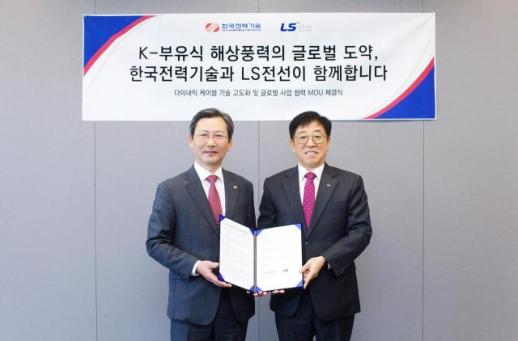 LS Cable & System and Korea Electric Power Technology Collaborate on Floating Offshore Wind Power LS Cable & System is partnering with Korea Electric Power Technology to secure a foothold in the floating offshore wind power market. The collaboration aims to enhance competitiveness from the initial design phase by integrating submarine cable technology with power system design capabilities. On May 11, LS Cable & System announced it has signed a memorandum of understanding (MOU) with Korea Electric Power Technology for cooperation in floating offshore wind power. The agreement focuses on establishing a "design-linked cooperation model" that combines LS Cable & System's submarine cable technology with Korea Electric Power Technology's engineering, procurement, and construction (EPC) capabilities. The two companies plan to jointly participate in the early engineering stages to optimize the power system and cable specifications. Floating offshore wind power involves wind turbines and their supporting structures floating on the sea. This method allows for installation in deeper waters and farther offshore than fixed offshore wind farms, reducing site constraints. However, it also presents challenges as wind turbines and cables must operate in an environment subject to waves and currents, necessitating a complex design that considers both electrical performance and mechanical loads. LS Cable & System has developed the country's first "dynamic submarine cable" to address these challenges. Dynamic cables are essential components that connect floating offshore wind facilities to the underwater transmission network. They must withstand repeated bending and changes in tension, creating a high technical barrier to entry. Currently, only a few companies, including LS Cable & System and select firms in Europe, possess technology for high-voltage dynamic cables. Korea Electric Power Technology has accumulated expertise in power system design and marine environmental analysis through its EPC projects for land-based power plants. The two companies aim to leverage this expertise to enhance their competitive edge in the integrated mechanical and electrical design required for dynamic cables. An LS Cable & System official stated, "Participation in the design phase of floating offshore wind power is crucial for securing contracts. Together with our subsidiary LS Marine Solutions, we will strengthen our global competitiveness by integrating design, manufacturing, construction, and operation and maintenance capabilities into a turnkey solution."* This article has been translated by AI. 2026-05-11 09:32:21
 -
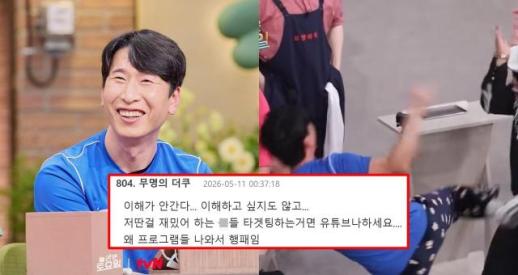 Comedian Yang Sang-guk Faces Criticism for Attitude on TV Show Comedian Yang Sang-guk is once again under fire for his attitude during a recent broadcast. In the latest episode of tvN's "Amazing Saturday," Yang appeared in his alter ego character, Sang-pil. When fellow cast member Kim Hae-jun mentioned a two-letter initial hint, Yang insisted on sticking to a one-letter hint. He stated, "I think one letter would be fine. Two initials seem too easy, and one letter might spark more conversation." Kim Hae-jun responded, "Wouldn't two initials be a bit easier?" However, Yang raised his voice, saying, "Go to YouTube, then. That would make the show boring." Yang then abruptly changed his stance, saying, "I suggested the initials, didn't I?" which angered Kim Hae-jun. During a second attempt, when Kim Dong-hyun offered a different opinion, Yang retorted, "You just saw 'A.' You're foolish," adding, "Foolish people with pride are the scariest. If you're foolish, you should be kind. Those kinds of people are the most frightening." This comment shocked viewers. Additionally, Yang was seen pretending to hit fellow comedian Kim Hae-jun and even attempted to kick him, further escalating the situation. Following the broadcast, numerous posts criticizing Yang's behavior flooded an online community. Netizens commented, "If he wants to return to the spotlight, shouldn't he hide his poor character? I felt uncomfortable watching him being rude throughout the show," and "If this is targeting people who enjoy that kind of behavior, he should stick to YouTube." Other comments included, "Why does he keep appearing? Is there demand for him? It's really exhausting," and "A character that gets angry like that should maintain some level of decency, but it seems he doesn't." Many expressed a desire to see him disappear from television, with comments like, "I hope he disappears from TV" and "He should not come back." Comments on the program's YouTube channel also reflected this sentiment, with remarks such as, "Why is there so much annoyance and anger in weekend entertainment? Is something wrong?" and "He's digging his own grave." Others questioned, "Why was he invited?" and criticized his style of humor, saying, "Making jokes at the expense of others is the worst; please don't come back," and "He's the worst guest. It's hard to listen to someone who keeps getting angry." Many speculated that he might not be invited back to the network again.* This article has been translated by AI. 2026-05-11 09:30:35
 -
 KOSPI Surges Past 7800 Mark as Samsung and SK Hynix Lead Gains The KOSPI continues its upward trend, surpassing the 7800 mark shortly after the market opened and consistently breaking previous records. The index is being driven by strong performances from semiconductor giants Samsung Electronics and SK Hynix. According to the Korea Exchange, as of 9:09 a.m., the KOSPI was up 307.33 points (4.10%) at 7805.33. The index started at 7775.31, an increase of 277.31 points (3.70%) from the previous trading day, and has continued to rise. In the securities market, foreign and institutional investors sold a net 420.7 billion won and 132.5 billion won, respectively, while individual investors purchased a net 526.4 billion won. Among the top market capitalization stocks, Samsung Electronics (up 6.15%), SK Hynix (up 9.43%), SK Square (up 6.02%), Hyundai Motor (up 0.98%), Samsung C&T (up 14.79%), HD Hyundai Heavy Industries (up 4.41%), and Hanwha Aerospace (up 3.90%) are all experiencing gains. Conversely, LG Energy Solution (down 1.78%), Doosan Enerbility (down 0.46%), and Samsung Biologics (down 0.54%) are seeing declines. On this day, Samsung Electronics and SK Hynix both saw significant increases of 7-8% in pre-market trading, continuing their trend of reaching record highs, with their combined market capitalization nearing 300 trillion won. At the same time, the KOSDAQ index fell by 1.84 points (0.15%) to 1205.88. The index opened at 1212.88, up 5.16 points (0.43%) from the previous trading day, but turned downward due to selling pressure from foreign and institutional investors. In the KOSDAQ market, foreign and institutional investors sold a net 162.5 billion won and 51.9 billion won, respectively, while individual investors bought a net 216.7 billion won. Among the top KOSDAQ stocks, EcoPro BM (down 2.53%), EcoPro (down 2.39%), Alteogen (down 2.35%), Rainbow Robotics (down 1.40%), Kolon TissueGene (down 3.83%), Samchundang Pharm (down 2.72%), and HLB (down 4.12%) are all declining, while Wonik IPS (up 11.21%) and JUSUNG Engineering (up 9.07%) are rising. Han Ji-young, a researcher at Kiwoom Securities, stated, "The KOSPI is likely to continue its unprecedented rally amid ongoing market dynamics. This week, external events such as the April CPI and the U.S.-China summit are on the horizon, but the sustainability of the semiconductor rally that began last week will be a more critical factor." He added, "Currently, there is a desire for profit-taking among all market participants, which may lead to increased short-term volatility during trading hours."* This article has been translated by AI. 2026-05-11 09:28:51
 -
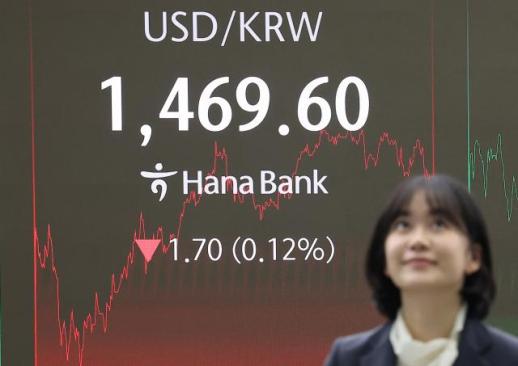 US-Iran Negotiation Uncertainty Leads to Drop in Won-Dollar Exchange Rate Despite growing uncertainty surrounding negotiations between the United States and Iran, the won-dollar exchange rate opened lower. On May 11, in the Seoul foreign exchange market, the exchange rate for the Korean won against the US dollar was trading at 1,467.9 won as of 9:15 a.m. The rate opened at 1,466.0 won, down 5.7 won, and has shown a steady trend since. On May 11 (local time), Iran delivered a proposal to the US through Pakistan, the mediator, which included an immediate ceasefire on all fronts, a halt to US maritime blockades, and guarantees against further attacks. However, President Donald Trump publicly rejected the proposal, stating on his social media platform Truth Social, "I read the response from the so-called representatives of Iran, and I am not pleased at all." Previously, the US had proposed a peace plan stating that if Iran allowed passage through the Strait of Hormuz, the US would lift the blockade on Iranian ports within a month. Despite concerns over the failure of negotiations between the US and Iran, the exchange rate is expected to decline, buoyed by the spillover effects of the stock market's AI rally. Min Kyung-won, an economist at Woori Bank, explained, "The dollar is showing strength in the Sydney market, and in the early Asian market, speculative long positions on the dollar and adjustments in morning stock prices are likely to lead to a weakening of the won, yuan, and Singapore dollar." He added, "As the day progresses, risk appetite is expected to recover, and the won may widen its intraday losses in line with a rebound in stock prices. Given that the stock market continued its AI-driven rally despite last week's military clashes between US forces and Iran in the Strait of Hormuz, the domestic market is likely to maintain an upward trend centered around semiconductors."* This article has been translated by AI. 2026-05-11 09:27:34