
Journalist

Jun sungmin
-
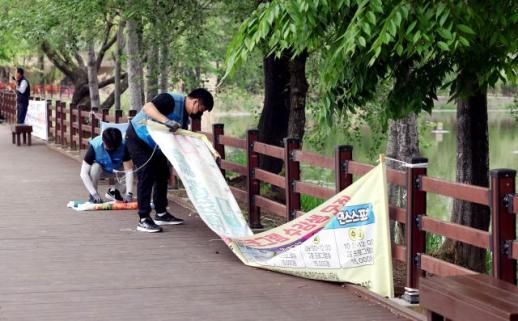 Increase in Banner Installation Ahead of Local Elections; Labor Ministry Urges Safety Compliance As the nationwide local elections approach in two weeks, labor authorities are urging candidates to take precautions against accidents that may occur during the installation and removal of campaign banners. According to the Ministry of Employment and Labor on May 18, a surge in banner work is expected ahead of the June 3 local elections, the ninth of its kind. Each candidate is allowed to post banners up to twice the number of administrative districts they represent. In cases where electoral districts overlap, the total number of banners must be allocated according to the established regulations for each election. This means that with 7,829 candidates registered for this election, there could be a significant number of banners displayed. Particularly, the installation and removal of banners often involve working from rooftops, ladders, or aerial work platforms, which increases the risk of falls. Given that these activities are concentrated and competitive during the election campaign period, thorough preparations are essential. In fact, following the eighth nationwide local elections in 2022, there were a total of 350 industrial accidents related to banner work, with fall-related incidents accounting for 49.4% (173 cases) of the total. In response, the Labor Ministry has urged candidates to pay special attention to preventing accidents during banner installation and removal. They have posted key accident cases and a safety checklist on their website and sent guidance text messages to registered candidates. The ministry emphasized the importance of adhering to basic safety measures, including: wearing protective gear such as helmets during work, conducting pre-checks on equipment like ladders and aerial work platforms, securely stabilizing ladders to prevent falls, prohibiting movement while on elevated platforms, and deploying traffic controllers during road work. Oh Young-min, Director of the Safety and Health Supervision Bureau at the Labor Ministry, stated, "The installation and removal of banners carry a high risk of falls, and a moment of negligence can lead to serious accidents. It is crucial that basic safety rules are followed during the election campaign to prevent accidents."* This article has been translated by AI. 2026-05-18 13:52:00
 -
 South Korea to Revamp Battery Recycling Certification System Ahead of 2027 Launch The South Korean government is set to improve its battery recycling standards and regulations ahead of the introduction of a certification system for recycled battery materials in 2027. This initiative will include not only waste batteries but also byproducts and defective products from manufacturing processes as eligible for certification. The aim is to enhance the competitiveness of the critical mineral supply chain by updating the recycling standards for black mass. The Climate Energy Environment Ministry announced that it will hold a briefing on May 19 at the LW Convention Center in Jung-gu, Seoul, to explain the operational plan for the 'Battery Recycled Material Production Certification System' and the proposed improvements to recycling standards. In April, the National Assembly passed the 'Act on the Management and Industrial Promotion of Used Batteries,' paving the way for the certification system to be fully implemented starting in May 2027. Under this system, the Climate Ministry will certify the production of recycled materials, while the Ministry of Trade, Industry and Energy will verify the use of recycled materials in batteries. To expand the scope of recyclable resources, the Climate Ministry plans to include not only waste batteries but also byproducts and defective products from manufacturing processes in the certification criteria. The ministry also aims to ensure the objectivity and credibility of the certification process through document reviews and on-site inspections. A pilot project will begin in June to refine the certification methodology, with operational guidelines expected to be established by December to facilitate the early implementation of the system. A key focus of the improvements will be strengthening the management system for black mass, an intermediate product made from crushing waste batteries and manufacturing scraps. Black mass contains high concentrations of valuable metals such as nickel, cobalt, and manganese. Currently, black mass is recognized as a metal raw material rather than waste if it meets certain recycling standards. However, the growing demand for various raw materials due to the increased use of batteries in small electronic devices like laptops and smartphones has led to calls for system improvements. The National Institute of Environmental Research has analyzed various black mass samples used by domestic recycling companies to assess the content of valuable metals and impurities, as well as quality control practices, and has developed improvement proposals based on these findings. The proposals include changing the existing 'nickel content-focused' standard to a 'combined nickel and cobalt standard.' This change is expected to broaden the economic value recognition of various waste battery resources, including those from small electronic devices. Additionally, a new 'fluoride item' will be introduced to indirectly verify the removal of unnecessary byproducts, such as binders and electrolytes, enhancing administrative transparency in the import and distribution processes of raw materials. The Climate Ministry also plans to encourage the domestic priority use of black mass and allow essential processing steps such as sintering and drying to support stable raw material procurement and operational flexibility for recycling companies. Industry experts anticipate that the certification system will play a positive role in enhancing the international competitiveness of domestic recycling companies, especially as the European Union's battery regulations come into effect. With the stability of the battery raw material supply chain emerging as a key factor in global industrial competitiveness, the expanded use of recycled materials is expected to contribute to the sustainability of South Korea's battery industry. Kim Go-eung, Director of the Resource Circulation Bureau at the Climate Ministry, stated, "The recycled material certification system and the rationalization of recycling standards will help strengthen the critical mineral supply chain and promote the development of the recycling industry. We will continue to improve the system by reflecting the voices of companies engaged in the recycling of waste batteries."* This article has been translated by AI. 2026-05-18 13:48:05
 -
 Korea's Fair Trade Commission Fines Top 5 Delivery Companies $30.8 Million for Unfair Practices The top five delivery companies in South Korea have been penalized by the Fair Trade Commission (FTC) for repeatedly abusing their power over subcontractors. With these companies controlling over 90% of the domestic delivery market, the sanctions are seen as a significant step toward addressing unfair practices across the industry. On May 18, the FTC announced that it would impose a total fine of 3.08 billion won (approximately $30.8 million) on five delivery firms—Coupang Logistics Service, CJ Logistics, Lotte Global Logistics, Hanjin, and Logen—for establishing unfair contract terms and failing to issue written contracts when outsourcing services. The FTC, in collaboration with the Ministry of Employment and Labor and the Ministry of Land, Infrastructure and Transport, conducted surprise inspections last August due to concerns that unfair subcontracting practices in the delivery sector were contributing to safety incidents, including heat-related illnesses among workers. The current investigation is based on findings from those inspections. According to the FTC, the five delivery companies hold a combined market share of 90.5%. They leveraged their dominant position to impose unfair subcontracting conditions, including clauses that shifted liability for safety incidents to subcontractors, retained interest earnings during cash collateral periods, and required subcontractors to compensate for damages resulting from disputes. The number of identified unfair contract clauses included 1,155 cases for Coupang, 2,306 for CJ, 3,609 for Lotte, 1,664 for Hanjin, and 452 for Logen. The fines related to these unfair clauses were 567 million won for Coupang, 540 million won for CJ, 483 million won for Lotte, 546 million won for Hanjin, and 378 million won for Logen. Kim Dong-myung, head of the FTC's New Business Subcontracting Investigation Division, noted that Coupang's failure to adequately amend contracts after being flagged contributed to its penalty. In contrast, Lotte cooperated during the investigation and made necessary corrections, resulting in a reduction of its fine. The investigation also revealed that the five delivery companies failed to comply with the requirement to issue written contracts. The FTC explained that issuing written contracts detailing subcontracting terms is essential to prevent unnecessary disputes between contracting parties. These companies did not issue written contracts for a total of 2,055 agreements related to collection, delivery, and logistics terminal operations until the start of service. In some cases, such as Lotte, contracts were issued only after 761 days. As a result, the FTC decided to impose a fine of 600 million won for violations related to the failure to issue written contracts, excluding Logen. The fines for non-issuance of contracts were 192 million won for Coupang, 108 million won for CJ, 150 million won for Lotte, and 150 million won for Hanjin. Kim stated, "Subcontractors had no choice but to comply with unreasonable clauses to meet performance targets. This decision is expected to improve the unfair practices faced by subcontractors and alleviate their workload." 2026-05-18 13:42:28
 -
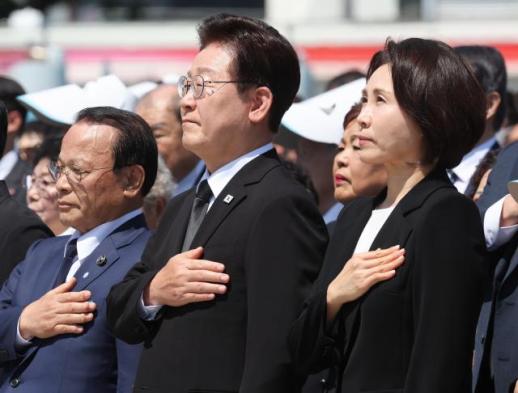 President Lee: We Will Boldly Uphold the Spirit of May 18 President Lee Jae-myung stated on May 18, "The government of the people will boldly carry forward the spirit of May 18, striving for the 'country where the people are the masters' that Gwangju has long yearned for."In his commemorative speech at the 46th anniversary of the May 18 Democratic Movement held at the May 18 Democratic Square in front of the former Jeonnam Provincial Office in Gwangju, President Lee emphasized, "With the freedom, equality, and unity that May Gwangju has left us, I will do my utmost to overcome the current crisis and pass on a glorious and brighter future."He promised that the government would continuously document, remember, compensate, and honor the May 18 movement, stating, "The Gwangju of 1980 saved today's Republic of Korea and will continue to save its future. We will include the May 18 movement in the preamble of the Constitution, designate the Jeonnam Provincial Office as a 'living shrine of K-Democracy,' and establish a system for the official registration of May 18 democratic activists."President Lee remarked, "It was on the solid foundation of the May 18 spirit, which ultimately preserved human dignity in the face of horrific violence, that the Republic of Korea has walked the path of democracy and prosperity. It is because of you that our democracy did not collapse at the crossroads of our tumultuous modern history and could rise again."He continued, "Just as the citizens of Gwangju rose up against the martial law troops in May 1980, the great people of Korea in 2024 also stood against the armed martial law forces with bare hands. The 'great world of unity' that Gwangju created with all its strength in that fleeting moment when unjust power withdrew in 1980 has been reborn as the 'Revolution of Light,' where we protect democracy with each other's warmth on those harsh winter nights in 2024."President Lee concluded, "The shining spirit of May 18 has led the Republic of Korea down new paths of change and hope throughout history, and it now presents a new challenge of integration between Gwangju and Jeonnam. The united hands of Gwangju and Jeonnam will stand tall as a new milestone of coexistence and mutual prosperity, rewriting the history of balanced development."* This article has been translated by AI. 2026-05-18 13:38:29
 -
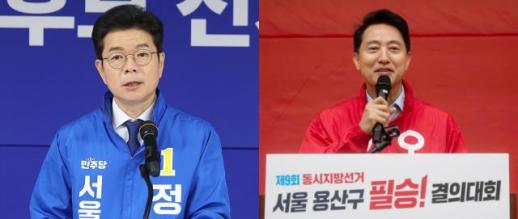 Jung Won-oh Vows to Uphold May 18 Spirit Amid Criticism from Oh Se-hoon Camp On the anniversary of the May 18 Democratic Movement, Jung Won-oh, the Democratic Party candidate for Seoul mayor, emphasized the need to restore democracy and constitutional order. Meanwhile, the camp of Oh Se-hoon, the People Power Party candidate, continued its attacks on Jung regarding a past assault incident. On May 18, Jung posted on Facebook, stating, "We have recently experienced another precarious time when democracy is shaken. The nights of martial law and insurrection are not merely a thing of the past. If we remember the history of May, we must completely overcome those dark times." He criticized those who speak of the May 18 spirit while opposing constitutional amendments that sought to incorporate that spirit into the constitution, saying, "Politics that embraces forces denying constitutional order and democracy cannot protect the future of South Korea." Jung pledged, "I will carry on the spirit of May in today’s democracy and in the lives of citizens. I will respond with governance that protects citizens' lives, not politics for power, and with administration of solidarity and responsibility, not privilege and exclusion." In response, Oh Se-hoon’s camp intensified its criticism of Jung regarding May 18. Shin Joo-ho, a youth spokesperson for Oh's campaign, stated on Facebook, "Jung is not qualified to invoke the May 18 spirit," referencing Jung's past controversies surrounding May 18 and a drunken assault incident. Shin also directed his remarks at the Democratic Party, asserting, "The May 18 spirit is the spiritual and political root of the Democratic Party. The party should be the first to demand the truth from Jung. Shouldn't they immediately discipline someone like Jung, who is suspected of trivializing and misusing May 18?" He further criticized, "Jung's attendance at the May 18 commemoration itself is an insult to the May 18 spirit," adding, "Jung and the Democratic Party will not escape the fierce judgment of public sentiment on June 3." Meanwhile, both candidates attended the 46th anniversary commemoration of May 18 at Seoul City Hall on the morning of May 18 as invited guests.* This article has been translated by AI. 2026-05-18 13:36:35
 -
 Seoul Exports Water Management Technology, Achieving $11 Million in International Projects The city of Seoul is sharing its advanced water supply technology, known as 'Arisu,' with developing countries, leading to actual improvements in overseas water facilities. Once a city that sought to learn from advanced nations, Seoul is now recognized as an 'administrative export city' where global cities come to learn its techniques. From May 18 to 28, Seoul is hosting 15 officials from 10 cities across eight countries, including East Timor, Laos, and Mozambique, to share its Arisu policies and technologies through a training program. This training goes beyond mere observation. It is a hands-on program where Seoul shares decades of expertise in water supply policies, purification technology, water quality management systems, and water loss management with overseas city managers. Participants will visit the Arisu Field Training Center, the first of its kind established by a local government in South Korea, as well as the Arisu Purification Centers in northern Seoul. They will experience the entire water supply operation, from purification and production to water quality management. Following this, they will discuss local water supply issues and develop action plans tailored to their countries' needs. Notably, this technology exchange is leading to actual overseas projects. Since 2012, Seoul has conducted 24 training sessions for 305 water supply experts from 95 cities in 40 countries. The collaborative networks formed during these sessions have evolved into tangible improvements in overseas water facilities. Prominent examples include projects in Tanzania and Laos. In Tanzania's Dodoma, Seoul is collaborating with KOICA (Korea International Cooperation Agency) on a project worth 5.1 billion won to upgrade aging water facilities and establish a management system, which began in 2023. In Laos's Vientiane Province, a project worth 8.1 billion won for water purification and distribution system upgrades has been underway since March of this year. Together, these projects total approximately 13.2 billion won. Seoul's water supply management experience is also expanding to projects in Hue, Vietnam, and Tegucigalpa, Honduras. Observers see this as a model of 'administrative technology export' that goes beyond simple official development assistance (ODA). Seoul first shares its policies and technologies, which then connect with KOICA projects and local water-related businesses and technologies in infrastructure initiatives. This marks a stark contrast to the past when Seoul sought to learn from advanced cities about water supply and urban management systems. Now, officials from overseas cities come to Seoul to learn about its water management systems, and Seoul's technologies and policies are being applied to local projects. CityNet, an Asia-Pacific urban cooperation organization, is also participating in this training to expand cooperation among cities. Seoul plans to leverage the CityNet network to strengthen connections between overseas cities and water-related institutions and businesses, as well as to explore follow-up cooperation projects. A KOICA official stated, "Seoul's water supply policies and operational experience are providing practical solutions to local urban issues. The significance lies in the fact that this is not just training but leads to actual field projects." Joo Yong-tae, head of the Seoul Arisu Headquarters, remarked, "Seoul's water supply policies and technologies are already recognized for their global competitiveness. We will continue to expand cooperation and technology exchange tailored to the conditions of each city." 2026-05-18 13:34:29
 -
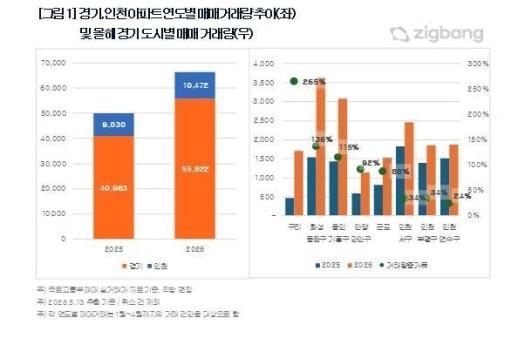 Apartment Transactions Surge 265% in Guri as Buyers Shift from Seoul As regulations in Seoul tightened this year, demand has shifted to the Gyeonggi and Incheon apartment markets, resulting in a more than 30% increase in transaction volume compared to last year. According to Zigbang, from January to April 2026, the number of apartment transactions in Gyeonggi and Incheon reached 66,294, a 33% increase from 50,013 during the same period last year. This surge is attributed to buyers dispersing to areas with relatively fewer regulations as land transaction permission zones were expanded across Seoul. In Gyeonggi Province, apartment transactions rose from 40,983 in the first four months of 2025 to 55,822 in the same period this year, marking a 36% increase. Notably, Guri City saw the largest increase, with transactions soaring 265% from 486 last year to 1,708 this year. Industry experts believe that the anticipated GTX-B line and the extension of Subway Line 6, along with expectations for redevelopment, have driven this increase. The exclusion of certain areas from land transaction permission zones and regulatory regions has also played a role. In particular, transaction volume in Inchang-dong, Guri City, jumped more than fourfold from 186 last year to 778 this year. The Inchang Jugong Complex 2 and Inchang Jugong Complex 6, both with redevelopment potential, recorded 64 transactions each, reflecting the most active trading. Other areas also showed significant increases, including Dongtan in Hwaseong (136%), Giheung in Yongin (115%), and Manan in Anyang (92%). Analysts suggest that the expansion of transportation networks, the establishment of semiconductor industrial complexes, and ongoing redevelopment projects have stimulated buyer interest. This trend indicates a clear movement toward areas like Guri and Anyang, which offer improved living conditions and proximity to workplaces. According to the real estate platform Asil, the Inchang 4 Complex in Guri City recorded a new high of 678 million won last month. Additionally, the Daelim Hansup in Su-taek-dong, Guri City, also set a new record at 694 million won in April. In contrast, the transaction volumes in Bundang, Seongnam, and Gwacheon, both designated as land transaction permission zones and regulatory areas, decreased by 30% and 77%, respectively, during the same period. Incheon also experienced an increase in transactions. From January to April 2026, the number of apartment transactions in Incheon reached 10,472, up 16% from 9,030 last year. Seo-gu and Bupyeong-gu saw increases of 34% each, while Yeonsu-gu rose by 24%, leading the transaction growth. Kim Eun-sun, head of Zigbang's Big Data Lab, stated, "Amid recent instability in the rental market, some demand for leases is shifting toward purchases. With relatively lower loan thresholds and the ability to buy with jeonse (key money), demand is dispersing to Gyeonggi areas. Transactions are notably increasing in complexes with development prospects, such as improved transportation and redevelopment projects."* This article has been translated by AI. 2026-05-18 13:32:29
 -
 Woori Financial Launches Loan Program for Low-Credit Borrowers with Maximum Rate of 7% Woori Financial Group announced on May 18 that it will launch a dedicated refinancing loan product for low-credit customers by the end of this month, allowing them to switch to loans with lower interest rates.The announcement came during the 'May Advanced Strategic Industry Finance Council' held on May 15 at the group's headquarters in Jung-gu, Seoul, chaired by Chairman Im Jong-ryong. The council discussed the implementation tasks and achievements of inclusive finance.Since establishing productive and inclusive finance as a core long-term strategy in September of last year, Woori Financial has held monthly meetings chaired by the chairman to review progress. This month's meeting included 19 participants, including CEOs of subsidiaries and heads of divisions, who discussed ways to expand financial support for youth and low-credit borrowers.The new integrated 'Woori One Dream Refinancing Loan' will be available by the end of this month, enabling low-credit customers who have been using credit cards, capital loans, and savings bank loans to transition to lower-rate bank loans.The maximum interest rate will be set at 7% per year, with a repayment period of up to 10 years in installment payments. The program will utilize alternative credit assessment models to assist individuals such as homemakers and freelancers, who may have difficulty providing income verification, in accessing formal financial services.Additionally, Woori Financial plans to launch an integrated platform called '36.5 Degrees' by the end of this month, which will consolidate inclusive finance products from its subsidiaries. The group aims to expand its inclusive finance initiatives to 7.2 trillion won, accelerating its commitment to cooperative finance.Im Jong-ryong, Chairman of Woori Financial, stated during the meeting, "Youth are a key generation that will lead our future, and we must continue to provide substantial financial support to ensure they do not lose hope. Financial support for low-credit borrowers should also be pursued as a means to eliminate financial blind spots and protect socially vulnerable groups as part of a financial safety net." 2026-05-18 13:30:47
 -
 Samsung Workers Threaten to Leak Technology Amid Labor Dispute As negotiations between Samsung Electronics and its labor union intensify, some employees have sparked controversy by suggesting they would leave for a Chinese semiconductor company to leak technology. According to industry sources, a post titled "Samsung Internal Opinion" appeared on the anonymous workplace community Blind on May 17. The author wrote, "If negotiations fail, everyone will move to CXMT and leak technology." CXMT is the largest DRAM manufacturer in China, Changxin Memory Technologies. Critics argue that the potential for technology leaks is a serious issue that directly impacts the nation’s key industries, making such comments inappropriate during wage and performance bonus negotiations. Notably, there have been past incidents where former Samsung employees faced legal action for leaking technology to Chinese firms, making these remarks difficult to dismiss as mere provocations. Another employee reportedly stated that if the government invokes emergency mediation powers, they would respond with mass resignations, similar to doctors during strikes. This has raised concerns that such extreme statements from some employees could exacerbate tensions between labor and management as the government and the Central Labor Relations Commission seek to prevent the strike from spreading. Meanwhile, the largest union at Samsung Electronics, the National Samsung Electronics Labor Union, is demanding the elimination of performance bonus caps and the allocation of 15% of operating profit for performance bonuses. Industry observers believe that the controversial remarks from some union members could undermine the union's negotiating position and negatively affect public sentiment regarding the strike.* This article has been translated by AI. 2026-05-18 13:29:38
 -
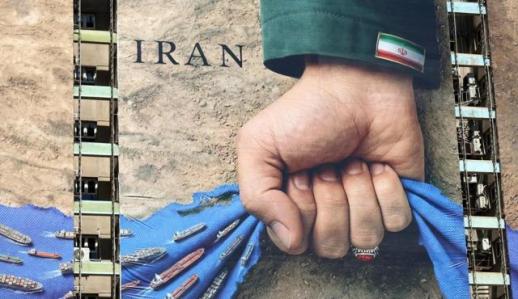 Iran Threatens to Charge Fees for Undersea Cables in Hormuz Strait Concerns are growing that Iran may target undersea communication networks in addition to energy transport routes in the Strait of Hormuz. On May 17, CNN reported that Brigadier General Ebrahim Zolfaqari, spokesperson for Iran's Central Military Command, stated on X (formerly Twitter) last week, "We will impose fees on internet cables in the Strait of Hormuz." Media outlets linked to the Islamic Revolutionary Guard Corps (IRGC) reported that the Iranian government is pursuing ways to generate revenue from undersea cables in the Strait of Hormuz and plans to demand compliance from major U.S. tech companies such as Google, Microsoft, Meta, and Amazon. Iranian media indicated that undersea cable companies would need to pay permit fees for passage through the Strait of Hormuz, and future rights for cable repairs and maintenance would be exclusively granted to Iranian firms. CNN also noted that the Iranian parliament discussed plans to impose fees on undersea cable usage last week. There are concerns that Iran could use small submarines and underwater drones to damage these cables. The seabed of the Strait of Hormuz is home to major intercontinental undersea cables that connect Europe, Asia, and the Persian Gulf, transmitting significant internet traffic. If Iran were to attack undersea cables, the repercussions could extend beyond mere internet speed reductions, potentially impacting critical digital infrastructure, including banking systems, military communications, and artificial intelligence (AI) cloud infrastructure. Mustafa Ahmed, a senior researcher at the Hamptur Institute based in the United Arab Emirates, told CNN, "Any attack on undersea cables could trigger a cascading 'digital disaster' across multiple continents." The damage could escalate if Iranian-backed proxy forces launch additional attacks on cables in the Red Sea. According to Hong Kong-based HGC Global Communications, three undersea cables were severed following an attack by Iranian-linked Houthi rebels in Yemen in 2024, disrupting about 25% of internet traffic in the region at that time. However, it remains uncertain whether Iran's strategy will serve as a significant leverage point in negotiations with the United States. Some of these major U.S. tech companies have reportedly invested in undersea cable projects that pass through the Strait of Hormuz and the Persian Gulf, but it is unclear whether these cables actually traverse Iranian territorial waters. Moreover, international telecommunications operators have historically avoided laying cables through Iranian waters due to security concerns, leading to a concentration of Gulf region undersea communication infrastructure in Omani waters. According to telecommunications market research firm TeleGeography, only two undersea cables pass through Iranian waters: Falcon and Gulf Bridge International (GBI). Additionally, as of last year, cables traversing the Strait of Hormuz accounted for less than 1% of global international bandwidth. Dina Espandiar, head of the Middle East team at Bloomberg Economics, stated, "Iran's threats are part of a strategy to showcase leverage over the Strait of Hormuz and ensure regime survival, aiming to impose significant costs on the global economy to deter any future attacks on Iran."* This article has been translated by AI. 2026-05-18 13:28:01