

Journalist

Jung Sung-chun
-
 Sooja from 'I Am Solo' Surpasses 160,000 Followers on Social Media Sooja, a participant in the 31st season of 'I Am Solo,' has seen her social media follower count exceed 160,000 as of June 8. This achievement appears to make her the most followed participant from the SBS Plus and ENA reality show. In comparison, Ok-soon, known for her resemblance to BLACKPINK's Jisoo from season 22, has 131,000 followers. Currently, Kyungsoo, who is married to Sooja, supports her influencer activities. On June 6, Sooja posted several photos on her social media account, sharing a quote from poet Jin Eun-young: "Days that remind me of a lover as lovely as green." In the photos, Sooja is seen wearing a white blouse paired with a skirt, while Kyungsoo is dressed in all black, both surrounded by flowers and looking happy, evoking envy among viewers. The couple met while filming 'I Am Solo' season 31. During the show, Sooja faced bullying allegations from fellow female contestants, including Ok-soon, Young-sook, and Jung-hee, which sparked public outrage. Young-sook competed with Sooja for Kyungsoo's affection, but ultimately, Sooja and Kyungsoo chose each other, forming a couple. Netizens have expressed their support for the couple, especially considering the emotional distress Sooja experienced, including a hospital visit during filming. Kyungsoo drew attention by posting supportive messages for Sooja following the controversy. On June 3, he shared on his social media, "From the moment I received the call to join 'Solo Country' until the moment I left, I spent five days and six nights immersed in the experience. I realized many shortcomings about myself while reflecting on my appearance through the broadcast and thought I needed to become a better person. "Of course, there were edited scenes for entertainment and many moments I wanted to clarify, but I believe that every moment, whether disappointing or joyful, ultimately represented who I am. I sincerely thank the viewers who believed in me and watched over me with warm eyes despite the numerous misunderstandings surrounding season 31. "Sooja, I’m embarrassed, but thank you for believing in me from start to finish, and I’m sorry. You worked hard during the show. Let’s meet more beautifully in the future."* This article has been translated by AI. 2026-06-08 16:15:00
 -
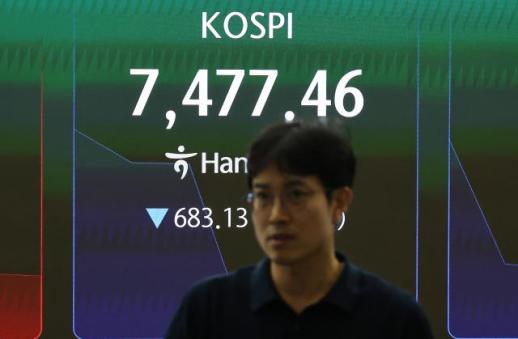 Have Semiconductor Stocks Peaked? Is This a Buying Opportunity? The fallout from the 'Broadcom shock' continued on June 8, as major players in the KOSPI, Samsung Electronics and SK Hynix, experienced significant declines for the second consecutive trading day. Investors are increasingly concerned, but analysts suggest that interpreting the recent downturn as a sign of worsening market conditions may be premature, emphasizing that this could be a buying opportunity. According to the Korea Exchange, Samsung Electronics closed at 295,500 won, down 10.18% from the previous trading day, while SK Hynix finished at 1,911,000 won, a decrease of 7.68%. Both stocks have seen declines for three and four consecutive trading days, respectively. Market attention is focused on whether the recent adjustments indicate a peak in the semiconductor sector or if they represent a temporary pause in an upward trend. Experts generally believe that it is too early to worry about a downturn in the industry. Han Ji-young, an analyst at Kiwoom Securities, stated, "The sharp drop in U.S. semiconductor stocks cannot be attributed to a peak-out in memory cycles or a slowdown in AI demand. Instead, it appears to be a correction prompted by accumulated fatigue and supply-demand pressures following the significant price increases in these sectors, combined with rising U.S. market interest rates due to employment surprises." There are also opinions in the securities industry suggesting that this correction should be viewed as a buying opportunity. On the same day, SK Securities assessed the recent stock adjustments as a chance to buy, maintaining target prices for Samsung Electronics and SK Hynix at 610,000 won and 4,000,000 won, respectively. NH Investment & Securities also raised its target price for Samsung Electronics from 490,000 won to 530,000 won and for SK Hynix from 3,100,000 won to 3,200,000 won. Han Dong-hee, an analyst at SK Securities, emphasized, "The structural bottlenecks in memory during the AI era and the strong performance of memory companies are not values that change quickly. This correction is an opportunity." Ryu Young-ho, an analyst at NH Investment & Securities, noted, "As AI spreads, various components are experiencing bottlenecks, particularly in semiconductors, where demand is growing faster than supply." Jensen Huang, CEO of NVIDIA, also commented during a briefing with SK Group, stating, "We are witnessing tremendous demand globally for more AI factories, and our business is thriving. We are just at the beginning stages of building AI infrastructure, and the future looks very bright." However, there are warnings about the potential for increased short-term volatility. Kim Ji-hyun, an analyst at Daol Investment & Securities, cautioned, "Given the high valuation pressures in semiconductors and concerns about rising oil and intermediate goods prices, it is essential to be vigilant about volatility in June and July."* This article has been translated by AI. 2026-06-08 16:15:00
 -
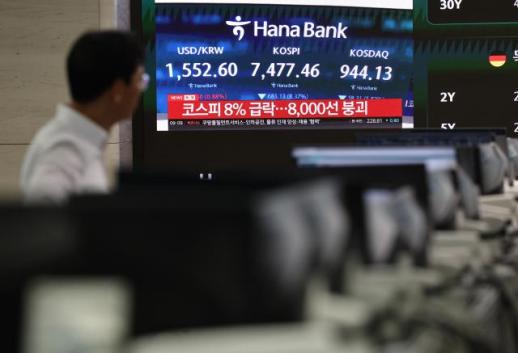 U.S. Semiconductor Stocks Plunge, KOSPI Falls Below 8000 It was a day of fear in the markets. Concerns over U.S. tightening, a sharp drop in semiconductor stocks, and a surge in exchange rates combined to hit the domestic financial market hard, marking a "Black Monday." The KOSPI index fell below 8000 during trading and closed around 7400, while the won-dollar exchange rate reached its highest level in 17 years and three months. According to the Korea Exchange, the KOSPI opened at 8048.09, down 112.50 points (1.38%) from the previous trading day, and fell below 7500 during the session. It closed at 7484.41, down 676.18 points (8.29%). The total market capitalization of the KOSPI dropped by nearly 548 trillion won, from 6136 trillion won to 6686 trillion won in just one day. The KOSDAQ index also saw a significant decline, closing at 911.39, down 91.05 points (9.08%) from the previous day. The sharp drop triggered circuit breakers and temporary halts on sell orders in both the KOSPI and KOSDAQ markets. Samsung Electronics and SK Hynix both lost key price levels, with Samsung closing at 295,500 won, down 10.18%, and SK Hynix at 1,911,000 won, down 7.68%. The domestic stock market was hit hard by dual negative factors: concerns over U.S. tightening and the plunge in semiconductor stocks. U.S. non-farm payrolls for May exceeded market expectations, dampening hopes for a Federal Reserve interest rate cut. Additionally, shares of Nvidia and Micron, along with the Philadelphia Semiconductor Index (SOX), plummeted, quickly eroding investor sentiment. Foreign investors continued to sell off stocks in large volumes, increasing downward pressure on the won. The won-dollar exchange rate surged past 1555 won during trading, reaching its highest level since the global financial crisis. In the Seoul foreign exchange market, the won-dollar rate opened at 1555.2 won, up 16.1 won from the previous trading day's closing rate of 1539.1 won. This marks the highest level based on the opening price since March 6, 2009, during the global financial crisis (1590 won). Although the won-dollar exchange rate closed at 1535.0 won, down 4.1 won from the previous day, it briefly spiked to the highest level since the financial crisis, reflecting the market's anxiety. 2026-06-08 16:15:00
 -
 Samchundang Pharmaceutical Shares Plunge Over 18% Amid Global Market Decline Samchundang Pharmaceutical, which once saw its stock price exceed 1 million won and ranked first in KOSDAQ market capitalization, has experienced a decline of over 18% due to a global market downturn. This drop is attributed to concerns over U.S. monetary tightening and a flight from risk assets, particularly impacting the recently surging pharmaceutical and biotech sectors. On June 8, the Korea Exchange reported that Samchundang's shares closed at 239,000 won, down 18.15% (53,000 won) from the previous trading day. The stock opened at 270,500 won and fell to as low as 238,500 won during the day. The sharp decline in stock price is linked to fears of U.S. monetary tightening and a significant drop in semiconductor stocks, which has triggered a broader aversion to risk assets. The U.S. non-farm payrolls for May exceeded market expectations, dampening hopes for interest rate cuts by the Federal Reserve, while tech stocks like NVIDIA and Micron plummeted, leading to a sell-off in the domestic market. Particularly, the pharmaceutical and biotech sectors, which had seen substantial gains recently, are now facing increased selling pressure as investors seek to realize profits. Samchundang, noted for its rapid rise this year as a prominent growth stock, has been significantly affected by the deteriorating investor sentiment. In March, the company’s stock price surged past 1 million won, driven by expectations surrounding the development of an oral GLP-1 treatment for obesity and diabetes, propelling it to the top of the KOSDAQ market capitalization rankings. However, subsequent management decisions regarding a block deal and the ensuing uncertainty surrounding a licensing agreement with a U.S. partner have shaken market confidence, leading to a reversal in stock performance. Currently, Samchundang's stock price has fallen over 70% from its peak in March. The recent plunge has significantly reduced its market capitalization, impacting its status as a leading growth stock on KOSDAQ. Market analysts suggest that short-term volatility may continue to exert selling pressure on overvalued growth stocks. However, they also note that expectations for improved performance due to the oral GLP-1 business and an increased share of high-margin products remain valid for Samchundang Pharmaceutical.* This article has been translated by AI. 2026-06-08 16:12:00
 -
 Kakao Faces User Concerns Amid Stock Decline Market sentiment toward Kakao has shifted from optimism to concern. On June 8, the KOSPI index, which had been rising, entered a correction phase, while Kakao's stock recently hit a 52-week low. Despite a strong performance in the domestic stock market, particularly for AI beneficiaries, Kakao's shares have struggled to find a rebound, raising concerns about increasing uncertainty surrounding the company. On June 10, Kakao's labor union plans to hold its first-ever strike, a four-hour protest that carries significant symbolic weight. As labor disputes continue, Hong Min-taek, the Chief Product Officer who led the redesign of KakaoTalk last year, has left the company. User dissatisfaction stemming from the controversial changes to KakaoTalk's friend list remains unresolved. CEO Jeong Sin-a recently apologized via the company bulletin board for the failure to reach an agreement in wage negotiations. She also announced the establishment of a 'User First Task Force' within KakaoTalk to prioritize user experience, signaling a commitment to place users at the forefront of the company's values. User-centricity has been a key theme in Kakao's growth history. Launched in 2010, KakaoTalk transformed mobile communication in South Korea by eliminating the cost of text messaging. The platform has since expanded its services to include emoticons, voice calls, video calls, gifting, and shopping, addressing various user inconveniences. Identifying and resolving user issues has been Kakao's competitive edge. The platform continues to receive regular updates every month. Recently, the number of emoticons available for the message reaction feature was expanded from six to 114, reflecting ongoing improvements in functionality. However, some users are questioning whether KakaoTalk is evolving in the right direction. Employees are seeking features that allow them to easily grasp key information in group chats with dozens or hundreds of participants. Open chat users are demanding solutions to issues with advertising accounts and spam. As the AI era progresses, user expectations are rising, but opinions vary on how well Kakao is meeting those expectations. While Kakao was once praised for anticipating and addressing user concerns, there are now criticisms regarding the gap between user-desired changes and the company's initiatives. Jeong Sin-a's leadership is also under scrutiny as she faces the dual challenges of resolving labor disputes and improving profitability while enhancing AI competitiveness and innovating KakaoTalk services. The departure of Hong Min-taek, who led key service reforms, has further highlighted the need for organizational stability as a critical management priority. Some voices suggest that Hong's departure calls for a reevaluation of Kakao's decision-making structure and overall organizational culture, as service reforms should reflect the collective judgment of the entire organization rather than the decision of a single individual. Kakao is one of South Korea's largest mobile platforms and is considered to possess ample resources and technological capabilities in the AI competition. However, the market is not only curious about its technological prowess but also whether Kakao can regain its status as a preferred platform among users and whether its management can provide a clear direction for that goal. The recent 52-week low reflects the market's and users' assessment of Kakao. What Kakao needs now is leadership that reaffirms its commitment to user-centric principles rather than merely introducing new structures or slogans.* This article has been translated by AI. 2026-06-08 16:12:00
 -
 Orion Experiences First Partial Strike Amid Labor Dispute Orion's sales labor union has initiated its first partial strike in the company's history amid ongoing disputes over wage system reforms. The food industry is closely watching the situation as companies face prolonged domestic stagnation and rising labor costs. According to industry sources, the Orion branch of the Korean Confederation of Trade Unions conducted a partial strike from June 4 to June 5. Approximately 70 sales employees responsible for supplying and selling products to domestic supermarkets participated in the strike, which involved refusing to work in the afternoon. The union secured the right to strike with a 94.5% approval rate in a prior vote. Negotiations between Orion and the union began in January, but discussions broke down in April, and mediation attempts by the Central Labor Relations Commission in April and May also failed to reach an agreement. The company proposed a wage increase of 3.5%, up from the previous 2%, but the union rejected this offer, arguing it does not align with the company's growth and is demanding a 7.5% increase. The union is also calling for the implementation of a previously agreed adjustment of the basic salary and allowances ratio (from 60:40 to 70:30) and improvements to the compensation system for on-site duties. This strike is considered unusual given that Orion has historically provided some of the best working conditions in the confectionery industry. According to the company's business report from last year, the average annual salary for employees was 81 million won, significantly higher than that of competitors. However, the conflict has arisen due to a perceived gap in compensation felt by employees. Compared to 2024's average salary of 88 million won, last year's average salary has actually decreased. Additionally, while dividends surged from 49.4 billion won to 138.4 billion won over the past three years, the union claims that employee compensation has not kept pace. The disparity in perceptions between labor and management has also been exacerbated by strong overseas business performance and stagnation in domestic operations. Last year, Orion recorded its highest-ever consolidated revenue of 3.33 trillion won and an operating profit of 558.2 billion won, with 66.7% (2.22 trillion won) coming from overseas subsidiaries in countries like China and Vietnam. In the first quarter of this year, revenue from overseas subsidiaries increased by 24.4% compared to the previous year, while revenue from the Korean subsidiary grew only 0.4%. There remains a significant gap between labor and management regarding how much of the overseas success should be reflected in employee compensation. The industry is concerned that this situation could have broader implications for wage negotiations across the food sector. Major companies like Nongshim are currently engaged in wage negotiations, and the union leading the Orion strike has members in various companies, including Haitai Confectionery, Paris Baguette, Dunkin', Samlip, Pulmuone, Dongseo Foods, and Jeong Sik Food. Orion plans to hold additional negotiations on June 10. An Orion representative stated, "We operate one of the industry's best compensation systems, and the average salary per employee has nearly doubled over the past decade. We provide annual wage increases along with performance bonuses and special bonuses during the Chuseok holiday." The representative added, "We aim to create a better company through amicable negotiations with the union." 2026-06-08 16:12:00
 -
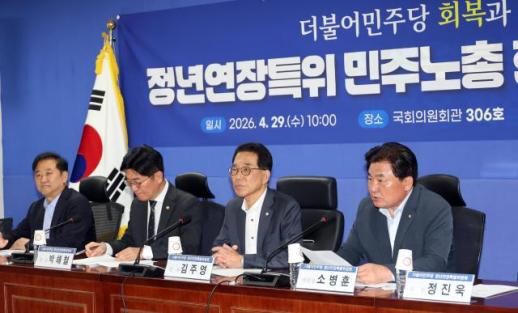 Labor Legislation in the Spotlight: Retirement Age Extension and Worker Rights As the local elections conclude, key labor legislation issues that have been stalled are expected to be revisited. With significant differences between labor and management on issues such as retirement age extension and protections for platform workers, discussions on labor legislation in the second half of the year are set to intensify.◆Renewed Discussion on Retirement Age Extension...Disagreements on Continued Employment ModelAccording to government and political sources on June 8, the National Assembly is expected to discuss major labor policy issues in the second half of the year, including extending the retirement age to 65, the Basic Law for Workers aimed at protecting platform workers, the Worker Presumption System, and reforms to the retirement pension system.The most pressing issue is the retirement age extension. The Democratic Party's Special Committee on Retirement Age Extension is working on final recommendations ahead of its activities concluding at the end of this month. Once the National Assembly's new session is organized, discussions on related bills are expected to accelerate.The retirement age extension has been a persistent topic aimed at bridging the gap between the legal retirement age and the age at which individuals can start receiving national pension benefits. Currently, the legal retirement age is 60, while the pension eligibility age is set to gradually rise to 65 by 2033, potentially creating a gap of up to five years without income.Labor groups strongly advocate for the need for legislation to extend the retirement age. A recent public opinion survey conducted by the Korean Confederation of Trade Unions found that 88.3% of respondents support extending the legal retirement age to 65. Labor unions plan to increase pressure on the government and the National Assembly to advance related legislation in the upcoming session.Conversely, the business sector expresses concerns about rising labor costs and potential impacts on youth employment, calling for a cautious approach.The method of extending the retirement age itself is also a contentious issue. The business sector favors a continued employment model that involves terminating existing contracts and creating new ones, as this allows for easier wage adjustments. In contrast, labor groups oppose any retirement age extension that is predicated on wage reductions.The Ministry of Employment and Labor emphasizes the need for discussions through social dialogue. Minister Kim Young-hoon stated in a recent press briefing, "The discussion on retirement age extension is a well-matured agenda," adding that efforts will be made to persuade stakeholders to aim for passage during the regular session.◆Reviving the Basic Law for Workers and Worker Presumption System...Platform Worker Protections at StakeLegislation aimed at protecting platform workers is also expected to be revisited. The Ministry of Employment and Labor's initiatives for the Worker Presumption System and the Basic Law for Workers were initially targeted for passage before Labor Day but faced delays due to opposition from small business groups and the business sector.The Worker Presumption System aims to classify platform workers who meet certain criteria as employees, thereby expanding the application of labor laws. This initiative is driven by the rapid increase in special employment and platform workers. The current Labor Standards Act defines workers as those who provide labor for wages, leaving many, such as delivery drivers and private tutors, without legal protections. The number of workers not covered by labor laws has risen from 6.69 million in 2019 to an estimated 8.69 million in 2024.The accompanying Basic Law for Workers seeks to establish a framework for guaranteeing basic rights for various labor providers, including platform workers and freelancers.However, the business sector opposes this legislation, citing increased burdens on companies, while labor groups argue that the protections offered are too limited and call for enhancements. Both sides express negative views toward the current government proposal, suggesting that modifications may be necessary during the legislative process.Additionally, discussions on reforms to the retirement pension system, changes to the employment insurance system, and expanding unemployment benefits for voluntarily leaving workers are also expected to be key labor policy issues in the second half of the year.Given that many of the labor legislative issues in the upcoming session involve sharply conflicting interests between labor and management, there are calls for social consensus to precede these discussions. National research institutions, including the Korea Labor Institute, have recommended that social dialogue and consultations among stakeholders are crucial for resolving labor market issues.* This article has been translated by AI. 2026-06-08 16:03:00
 -
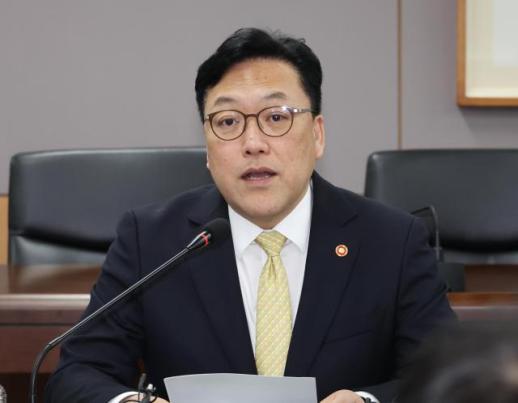 Kim Byeong-hwan Takes Position at Accounting Policy Institute Last September, Kim Byeong-hwan, who stepped down as Chairman of the Financial Services Commission, has found a new role at an accounting research institute. As of April, Kim has been serving as a visiting research fellow at the Accounting Policy Institute, a nonprofit organization under the Financial Services Commission. This marks his first full-time position since retiring about seven months ago. The institute focuses on researching policies, laws, and environments related to accounting, aiming to provide policy alternatives that enhance economic diagnostics and accounting transparency.Given the experience of its visiting researchers and directors, the institute is also a hub for high-level information in the financial sector. Choi Un-yeol, the institute's chairman, previously served as a member of the Bank of Korea's Monetary Policy Committee, while Yoon Chang-ho, a director, has held positions as the former head of the Financial Intelligence Unit (FIU) and CEO of Korea Securities Finance Corporation.A graduate of Seoul National University with a degree in economics, Kim is recognized as a macroeconomic expert, having worked on capital markets and economic policy at the Ministry of Economy and Finance. While there are several research institutes in South Korea, he is believed to have chosen the accounting-focused institute to leverage his strengths.Former heads of financial authorities are pursuing various paths after retirement. Historically, many have transitioned to research institutes or financial-related organizations. For instance, former Chairman Kim Seok-dong became the head of a humanities and social research institute under a law firm, while former Chairpersons Eun Sung-soo and Kim Joo-hyun took on roles as visiting research fellows at the Korea Financial Research Institute shortly after their departures. Former Chairman Ko Seung-beom also joined the Capital Market Research Institute as a visiting research fellow just three months after his retirement in October 2022, later being appointed as the head of the Youth Financial Education Council in October 2024.A source in the financial sector noted, "Research institutions help fill the gap immediately after retirement and maintain networks within the financial sector."Some former officials have moved to law firms. Shin Je-yoon became an advisor at Bae, Kim & Lee LLC, while Choi Jong-ku took on a special advisory role at Hwa Woo LLC. Eun Sung-soo initially joined the Korea Financial Research Institute before becoming an advisor at Kim & Chang, and Lim Jong-ryong also served as an advisor at Yulchon LLC.Another financial sector source remarked, "As the career paths for senior officials from financial authorities narrow after retirement, more are opting for research institutes, universities, or associations. The competition among law firms to recruit former officials is intensifying amid a surge in various regulations."* This article has been translated by AI. 2026-06-08 16:03:00
 -
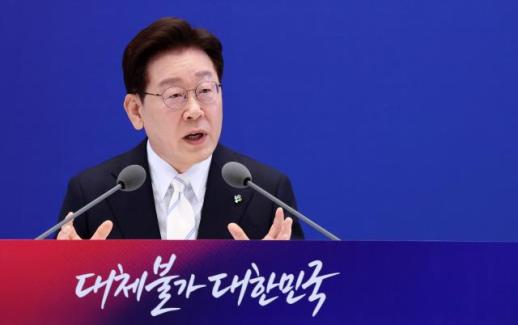 President Yoon Calls for Continued Focus on North Korean Denuclearization President Lee Jae-myung emphasized on June 8 that the goal of denuclearization must not be abandoned, stating that negotiations should aim to halt North Korea's production of nuclear materials and the development of intercontinental ballistic missile (ICBM) technology in the short term. During a press conference at the Blue House to mark his first year in office, President Lee asserted that while long-term denuclearization is essential, it is crucial to set realistic short-, medium-, and long-term goals for dialogue. He noted, "We are imposing sanctions to the fullest extent possible, but it is uncertain whether the door to China is firmly closed to North Korea's evasion of sanctions, while the door to Russia remains wide open. Therefore, despite our pressure, they find ways to escape. This is a regrettable reality." President Lee pointed out that North Korea is currently capable of producing 10 to 20 nuclear weapons annually and is continuously improving its ICBM technology, nearing its final stages of development. He warned that maintaining the status quo would only exacerbate the situation, stating, "Halting this situation would benefit both the Korean Peninsula and the international community." Regarding security on the Korean Peninsula, he remarked, "We cannot pursue nuclear armament. If we do, will Japan and Taiwan remain passive? The entire region would become nuclear-armed, leading to severe international sanctions that South Korea, with its high dependence on foreign trade, cannot withstand. Calls for nuclear armament are truly irresponsible." On international security, he analyzed that if North Korea's nuclear weapons or missile technology exceed what is necessary for regime preservation, they may be exported, posing a significant risk. "Preventing this alone would benefit the international community," he added. President Lee reiterated that the immediate goals for negotiations should include halting the production of additional nuclear materials, preventing the export of nuclear materials, and stopping ICBM technology development. He stated, "If we are questioned about why we abandoned denuclearization, it would only lead to a worse situation by ignoring reality." He mentioned that he has communicated this to U.S. President Donald Trump on two occasions and continues to discuss it with other leaders. In response to a question about the Korea-Japan Mutual Military Support Agreement (ACSA), President Lee described the military cooperation between South Korea, the U.S., and Japan as unique. He expressed that security issues in Northeast Asia should be approached through a complex multilateral security framework, but acknowledged the current confrontational atmosphere necessitates caution. ACSA refers to an agreement between nations to share military supplies such as ammunition, fuel, and food in times of crisis. Regarding the recent incident involving the South Korean vessel Namuho being struck by an Iranian missile in the Strait of Hormuz, President Lee stated, "It is clear that this was not an intentional act. If it were, they would have claimed responsibility. While there are various factors, we assess it as an Iranian missile, and we have lodged a strong protest and demanded measures to prevent recurrence." 2026-06-08 16:00:00
 -
 Special Prosecutor's Investigation Targets Yoon Suk Yeol Amid Allegations The second comprehensive special prosecutor team, led by Special Prosecutor Kwon Chang-young, is narrowing its investigation into former President Yoon Suk Yeol as it enters its final stages. The investigation focuses on three main areas: allegations of rebellion related to martial law, misappropriation of budget for the relocation of the presidential residence, and efforts to suppress the investigation into the stock manipulation case involving Kim Kun-hee and Deutsche Motors. The special prosecutor announced on June 8 that it plans to summon former President Yoon on June 13 at 10 a.m. as a suspect in the rebellion case under military law. This follows a week after the investigation into allegations of abuse of power related to justifying martial law was conducted on June 6. The special prosecutor views Yoon's actions of deploying armed soldiers to the National Assembly and the National Election Commission after declaring martial law as grounds for rebellion. Former Defense Minister Kim Yong-hyun was also summoned on June 4 on similar charges but reportedly refused to testify. The special prosecutor has confirmed through witness interviews related to the Joint Investigation Headquarters of the Defense Security Command that there were substantial preparations for martial law starting around November 2023. Both Yoon's and Kim's legal teams argue that since they are already facing trial for rebellion, the investigation into rebellion charges could constitute double jeopardy. Consequently, the special prosecutor is expected to focus on the legal overlap between the rebellion investigation and the existing rebellion case, the purpose and command structure of military troop deployment, and any prior preparations. The investigation into abuse of power is nearing completion. Special Prosecutor Kwon Young-bin stated during a regular briefing at the government complex in Gwacheon that Yoon did not exercise his right to refuse to testify during the June 6 investigation and generally denied the allegations. Kwon explained that Yoon expressed the belief that martial law is still legal. He reportedly stated that since the martial law was lawful, he instructed that it be communicated to foreign entities, asserting that he does not recognize any wrongdoing or abuse of power. During the June 6 investigation, the special prosecutor condensed much of the prepared content for questioning. Kwon noted, "While there is some regret about the preparation, I believe the investigation concluded satisfactorily on Saturday, and I do not think additional investigations will be necessary." The allegations regarding the misappropriation of the presidential residence relocation budget are also a key focus of the investigation. Following the arrests of former Chief of Staff Kim Dae-ki and former Secretary Yoon Jae-soon, the special prosecutor has also questioned former Minister of the Interior and Safety Lee Sang-min. The investigation is centered on whether the budget for the maintenance of aging facilities was diverted for the presidential residence construction and the involvement of the presidential office, the Ministry of Interior and Safety, and the Ministry of Planning and Budget in this process. On the same day, the special prosecutor conducted searches at the residences of relevant individuals, including the head of the budget office at the Ministry of Planning and Budget and the former economic and financial secretary of the presidential office. The special prosecutor is focusing on whether the Ministry of Planning and Budget condoned or colluded in the budget misappropriation process. With the detention periods for Kim and Yoon approaching, it is expected that charges against related individuals will be filed this week, intensifying the investigation into Yoon's involvement. The allegations regarding the suppression of the investigation into the stock manipulation case involving Kim Kun-hee and Deutsche Motors are also expanding to include higher-level officials. The special prosecutor has summoned officials from the Supreme Prosecutors' Office for questioning and has charged former Prosecutor General Shim Woo-jung with abuse of power. Future investigations may include former Minister of Justice Park Sung-jae to confirm Yoon's involvement. There are expectations within the special prosecutor's office that additional investigations into former President Yoon may continue during the remaining investigation period. The special prosecutor has extended the initial investigation deadline until June 24, with the possibility of two further extensions. Therefore, the special prosecutor is likely to accelerate efforts to clarify the involvement of higher-ups in the rebellion allegations, the misappropriation of the presidential residence budget, and the suppression of the Deutsche Motors investigation. Legal experts suggest that the special prosecutor's investigation has moved beyond the operational staff and advisors to confirm Yoon's directives and approvals. With the abuse of power investigation nearing its conclusion, the rebellion investigation is intensifying, and the inquiries into the presidential residence relocation and the Deutsche Motors investigation suppression are converging, bringing the special prosecutor's investigation into sharp focus on Yoon Suk Yeol.* This article has been translated by AI. 2026-06-08 15:57:00