

Journalist

Jung Sung-chun
-
 Korean Party's National Assembly Leader Election Could Shape Future Leadership The election for the National Assembly Leader of the People Power Party is evolving into a preliminary round for the next party leadership competition. This shift follows former leader Han Dong-hoon's election as an independent in a by-election, prompting pro-Han lawmakers to work on expanding their influence within the party. Analysts suggest that this election could trigger a butterfly effect that reshapes the broader conservative political landscape in South Korea. According to the People Power Party, a mobile voting system will be implemented for the National Assembly Leader election scheduled for June 10, allowing lawmakers who cannot attend the general assembly to participate. This marks the first time mobile voting will be used in this election. Party members who are unable to attend due to overseas trips or other commitments will still be able to cast their votes for their preferred candidates. A debate featuring the candidates will take place the day before the vote. Organized by junior lawmakers, the event will include opening statements from each candidate, four common questions, and a session for free questions from lawmakers, concluding with final remarks. Although not an official debate hosted by the party's election committee, all candidates—Kim Do-eup, Jeong Jeom-sik, and Seong Il-jong—are expected to participate. The party had previously decided to postpone the election by one day to ensure sufficient campaigning time, responding to concerns raised about the election timeline. With the introduction of mobile voting and the organization of a candidate-led debate, the party appears to be gearing up for a successful election. The timing of the election, occurring shortly after the June 3 local elections, is significant as it is closely tied to the upcoming leadership competition. The outcome of the National Assembly Leader election could greatly influence the future dynamics of the party and the conservative political landscape. The next leader is expected to play a crucial role in determining the fate of the 'Han Dong-hoon regime.' A key issue in this election is whether Han Dong-hoon will be allowed to rejoin the party. Lawmakers aligned with Han are advocating for his reinstatement, and the candidates' positions on this matter could significantly impact the election. Han is currently expelled from the People Power Party, and his reinstatement would require the cancellation of his expulsion. While the National Assembly Leader does not have the authority to revoke expulsions, they can exert pressure on the party leadership to address the issue. In a related statement, Kim Do-eup appeared on CBS Radio's 'Park Seong-tae's News Show' and emphasized the need for a united conservative front to achieve a successful government formation, stating, "To create a government, the conservative forces must unite in a chemical bond to release energy. If we are to assume a grand perspective of government formation, Han's reinstatement is necessary." This election is also linked to discussions about accountability for the local election results. Within the party, there is ongoing debate about who bears responsibility for the anticipated losses. If Jeong Jeom-sik, the former policy committee chair, is elected, it could alleviate some of the accountability concerns for the current leadership under Han Dong-hoon. Conversely, if another candidate wins, it may be interpreted as an acknowledgment of the leadership's significant responsibility for the local election losses. The newly elected National Assembly Leader will need to engage in negotiations with the Democratic Party regarding the formation of the National Assembly. Given the contentious nature of the legislative committee discussions, particularly concerning the Legal Affairs and Judiciary Committee, these negotiations are expected to be challenging. Although the People Power Party has increased its seat count through the recent by-elections, it still holds only 110 seats, limiting its negotiating power.* This article has been translated by AI. 2026-06-08 16:54:00
 -
 HMM's Move to Busan Requires Additional Government and Local Support, Says CEO To ensure the successful relocation of HMM, South Korea's only national shipping company, to Busan, additional support from the government and the city is urgently needed. The establishment of a shipping industry cluster that encourages other shipping and port companies to relocate is also essential. Ahn Byeong-gil, CEO of the Korea Maritime Promotion Corporation, stated at a press conference on June 8, "Support from local governments, including Busan, is crucial for the relocation of shipping companies like HMM. Providing incentives is necessary for effective results." Ahn emphasized the need to create a shipping or maritime industry cluster through additional support, focusing on relocating HMM and other shipping and port companies to Busan to enhance regional specialization. He noted, "Busan is also aiming to establish a shipping cluster, but related incentives are essential. According to the 'Special Act on Support for Relocation of Marine and Fisheries Institutions to Busan,' not only the Ministry of Oceans and Fisheries but also private companies can receive support if they relocate to Busan." Industry insiders argue that simply moving HMM's headquarters to Busan should not be limited to a change of address. Previously, SK Shipping and H-Line Shipping also announced their relocations to Busan, but only about 15 employees from SK Shipping currently work there, and H-Line Shipping has only changed its address. Given this context, it would be nearly impossible for all HMM employees to move to Busan. One industry source remarked, "It is premature to discuss a full relocation when the site for HMM's new headquarters has not even been confirmed. In the past, financial public enterprises were attracted to Busan, but now only empty shells remain. We must avoid repeating this mistake." The Ministry of Oceans and Fisheries announced in April that it would secure a site for HMM's headquarters within the 'Phase 1 Redevelopment Area of Busan North Port' in Jung-gu and Dong-gu, but HMM has already changed its address to the 'Heungkuk Life Building' in Choryang-dong. Ahn clarified that the timeline for HMM's relocation is not set for completion by the end of the year, stating, "It does not have to be completed by the end of the year. It means we will finalize the planning within this year, and the current lease for HMM's office runs until May next year." He added, "The outline of the relocation will become clear once labor agreements are reached, and more time is needed." Regarding HMM's privatization, Ahn said, "The Korea Development Bank is in a hurry to sell, but our focus is on how to grow HMM into a global shipping company. There have been no discussions with the bank regarding the sale." Additionally, during the press conference, the Korea Maritime Promotion Corporation revealed the status of financial support for national shipping companies from the previous year. Although the amount of new financing in the shipping market decreased last year, the proportion of private capital inflow increased.* This article has been translated by AI. 2026-06-08 16:51:00
 -
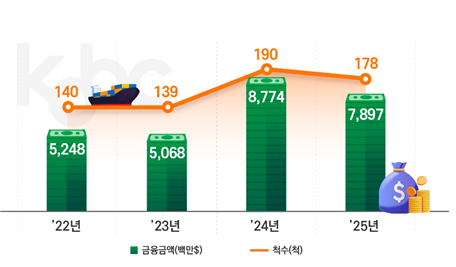 Korean Shipping Market Sees Decrease in Financing Amid Increased Private Investment Last year, the financing executed by 100 national shipping companies in South Korea decreased by more than 10%. However, the influx of private capital increased, leading to a rise in the overall financing balance. The Korea Maritime Promotion Corporation (KMP) released its "2025 Ship Financing Status" report, detailing the funding status and investment trends of major national shipping companies. In the past year, the amount of new funding raised by these companies for ship acquisitions declined. The total executed ship financing for 1,041 vessels fell by 11.2% year-on-year to $7.89 billion. Meanwhile, the cumulative balance of outstanding ship financing, which has not been repaid, rose to approximately $27.3 billion, a 12.1% increase from the previous year. The significant increase in the financing balance at the end of last year is attributed to the sequential delivery of large project vessels, such as the K-3 Qatar liquefied natural gas (LNG) carriers. Foreign financial institutions dominate the domestic ship financing market, accounting for 66% of the total. Their financing execution increased by 3 percentage points compared to the previous year. The proportion of policy financing reached its lowest level since 2022 at 27%, while private financing showed signs of recovery, recording a rate in the 7% range. A KMP official stated, "We have established a stable financing environment through continuous guarantees between shipping companies and private finance, resulting in increased private capital inflow into the shipping industry." Last year, the ship financing market was primarily focused on second-hand vessels, with 74% of the total investment directed toward used ships. Among vessel types, bulk carriers accounted for the largest share at 36%, followed by tankers at 31%. Over the past three years, investments in container ships and LNG carriers have primarily focused on new builds, while bulk carriers and tankers have seen a higher proportion of investment in used vessels. An Byeong-gil, president of KMP, expressed hope that the ship financing statistics, created with the active cooperation of national shipping companies, will provide practical assistance to government policies, national shipping companies, industrial strategies, and private investments.* This article has been translated by AI. 2026-06-08 16:51:00
 -
 Harim Donates Scholarship Books to 75 Elementary Students, Supporting Local Talent for 14 Years Harim announced on June 8 that it held the 14th Elementary Scholarship Book Award Ceremony on June 5 at the Iksan Education Support Center in Jeonbuk. The award ceremony is a key social contribution program aimed at fulfilling corporate social responsibility and promoting reading among local children. It began in 2012 with the goal of nurturing future talent in the community and has now reached its 14th year. In collaboration with the Iksan Education Support Center, Harim selected scholarship recipients based on recommendations from 55 elementary schools in the area. A total of 55 students, who demonstrated academic diligence and good conduct despite financial difficulties in purchasing books, were chosen as scholarship recipients. Additionally, Harim provided support for employees' welfare by selecting 20 children of employees with elementary school-aged children to receive scholarship books. This year, a total of 75 books were distributed to 55 local students and 20 children of employees. Harim CEO Jeong Ho-seok expressed, "I find it meaningful to meet local children through the award ceremony each year and support their dreams. I hope these students gain wisdom through books and grow into leaders who will shape the future society." In addition to the scholarship book program, Harim operates various social contribution initiatives, including support for farming households and activities for marginalized communities, as part of its commitment to ESG management. In May, Harim collaborated with the Jeonbuk Office of Education and the Science Education Center to conduct a 'Global Student Science Camp,' supporting 24 middle and elementary school students from the region on a field trip to explore scientific and technological sites in Japan.* This article has been translated by AI. 2026-06-08 16:51:00
 -
 South Korea Selects Naver, Samsung SDS, and Alice Group for $2 Billion GPU Project The Ministry of Science and ICT announced on June 8 that it has selected Naver Cloud, Samsung SDS, and Alice Group to participate in a project to secure, build, and support advanced graphics processing units (GPUs) worth approximately 2 trillion won (about $1.5 billion). The ministry plans to collaborate with the selected cloud service providers (CSPs) to acquire and establish a total of 9,704 advanced GPUs to support AI innovation in both the private and public sectors. The GPUs to be secured include 2,016 Vera Rubin units and 7,688 B300 units. Naver Cloud will acquire 1,008 Vera Rubin units and 3,112 B300 units, Samsung SDS will secure 1,008 Vera Rubin units and 2,016 B300 units, while Alice Group plans to acquire 2,560 B300 units. Notably, the next-generation Vera Rubin GPUs feature improved bandwidth and processing speeds compared to previous models. This enhancement is expected to reduce data bottlenecks and enable the processing of more user requests simultaneously, thereby decreasing the time and costs associated with AI model training. The Ministry of Science and ICT intends to utilize 2,016 Vera Rubin units and 4,360 B300 units to support the development of independent AI foundation models, national AI projects, and the advancement of AI models and services in collaboration with industry and academia. The ministry plans to initiate GPU purchase orders with the selected CSPs this month, aiming to sequentially launch B300 services by the end of the year as the CSPs complete their installations. The rollout of the Vera Rubin GPUs is scheduled for the first half of 2027, considering the release timeline. Deputy Prime Minister and Minister of Science and ICT Lee Kwang-hoon stated, "The advanced GPUs we are securing, including Vera Rubin, will be a key driver in enhancing the speed of AI research and development and our technological capabilities. We will secure AI infrastructure to support innovation and growth among domestic companies and research institutions." Additionally, the ministry has announced plans to secure a total of 260,000 GPUs by 2030 to achieve AI G3 status. Since February, the government has begun distributing approximately 4,000 of the 10,000 GPUs it initially secured to domestic companies and research institutions.* This article has been translated by AI. 2026-06-08 16:48:00
 -
 Can AI Truly Save Humanity? The Illusion That Technology Will Save Humanity=Adam Becker, translated by Park Joo-yong, East Asia. The author, an astrophysicist and science journalist, critiques the prevailing Silicon Valley ideology that new technologies must be developed as quickly as possible for the benefit of humanity. He questions whether a technology-driven future is based on scientific evidence or merely serves to perpetuate the wealth and power of a few Silicon Valley billionaires. The book centers on interviews with key thinkers from Silicon Valley and Oxford, such as Eliezer Yudkowsky and Anders Sandberg, who view the emergence of artificial general intelligence (AGI) as inevitable. Through these interviews, scientific validation of original papers, and extensive field research, the author traces how the grand worldview of 'techno-salvation' has been formed while revealing the contradictions within this ideological framework. He critically examines how concepts like effective altruism, the singularity, AI alignment issues, and technological accelerationism have risen to prominence. Notably, he analyzes how effective altruism prioritizes the urgent issue of future space colonization over current problems like poverty, climate crises, and war. Yudkowsky's apocalyptic warning that humanity faces a high likelihood of extinction upon the advent of AGI is highlighted as a distraction from real issues such as bias in AI, job displacement, and energy consumption, providing a pretext for the tech industry to evade regulation. The author warns that major visions lack scientific grounding and could lead to disaster for humanity even if realized. He also argues that concentrated technological monopolies could become tools of oppression against humanity. The book emphasizes that the fears articulated by Silicon Valley are not new and prompts readers to consider whether the narrative of salvation promised by technology truly serves all of humanity. "Fear of the apocalypse, fear of death. But these are already familiar to humanity. Fearing death is natural, and immortality has been humanity's oldest fantasy." “Human history—especially the history of the 20th century—is filled with examples of utopian movements that ended violently. In 1990, British philosopher Isaiah Berlin asked, ‘What price would we not pay if we could make humanity forever just, happy, creative, and harmonious?’ He remarked that if such an omelet exists, we should break all the eggs to make it. This was the belief of Lenin, Trotsky, and Mao Zedong. Yudkowsky’s advice to world leaders to risk nuclear war to achieve their goals indicates that such extreme utopian ideologies have already taken root among rationalists.” (p. 287) Careless People=Sarah Winfield, translated by Ahn Jin-hwan, Deflot. The author shares her experiences as the Director of Public Policy at Facebook (now Meta) for seven years, working closely with founder Mark Zuckerberg. Joining the company during its rapid growth as a global social media platform, she initially believed that Facebook's technology would save the world. However, she later testified before the U.S. Senate Judiciary Committee in 2025 regarding Meta's relationship with China, user privacy issues, and attempts at internal retaliation and silencing. The book details labor exploitation, workplace harassment, sexual assault, election interference via the platform, algorithm manipulation targeting youth, and repeated diplomatic blunders that the author either experienced or witnessed. While Facebook promotes the hopeful slogan of making the world a more open and connected place, she criticizes the reality that it destroys community trust and threatens democracy. Her central argument is that while the company has changed the world, the changes have been more negative than positive. She particularly points to Zuckerberg's autocratic leadership style, effectively running the company as a one-man rule. The organizational culture is also problematic; for instance, she was discouraged from discussing her role as a mother. Additionally, the author claims that Facebook has allowed the spread of fake news and hate and racist content, failing to respond actively even as the platform has been exploited as a tool for inciting violence by extremist groups. During the election process, when Donald Trump misled voters with fake news on Facebook, the company's leadership did not take the situation seriously, citing that Trump spent more on advertising than Hillary Clinton. Novelist Jang Gang-myung remarked, “What happens when great power ignores great responsibility? It decays from within and destroys the world outside. This book is a vivid indictment of how irresponsibly a colossal force in our era has acted and how rotten it has become inside.” “Like Mao Zedong's Little Red Book, Facebook's own Little Red Book is filled with the words, images, and core principles of its supreme leader. In this case, the leader is not Mao but Mark. Another ‘MZ’ is expressing a peculiar form of Maoist fervor. The first page reads, ‘Facebook was created to achieve a social mission. To make the world a more open and connected place.’” (p. 75)* This article has been translated by AI. 2026-06-08 16:42:00
 -
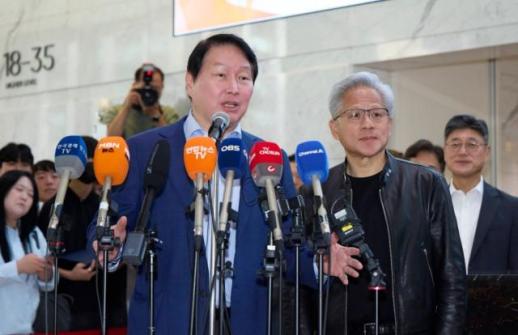 Nvidia CEO reaffirms close alliance with SK hynix, unveils plans for next-Gen robotics chip SEOUL, June 8 (AJP) - Nvidia's CEO Jensen Huang, who has been in Seoul since last Friday, began his day on Monday with a visit to SK Group, where he stressed Nvidia's "deepening, near-exclusive" reliance on the group for the era of artificial intelligence (AI). He praised SK hynix, an affiliate of SK Group, as a major player in global AI development and announced plans to use its memory in Nvidia's next-generation robotics processors. "I’d like to announce a long-term partnership with SK, we've been friends and partners with SK for a very long time," Huang said. "SK is the largest memory department. Without SK's partnership, today's AI would have not developed as wonderfully as it has." SK Group chairman Chey Tae-won said the two companies will jointly build future "AI factories" which includes AI data centers as well as SK hynix's fabrication plants and elevate their collaboration from a simple supplier relationship to a comprehensive, group-wide partnership to meet surging infrastructure demands. Beyond its dominance in AI data centers, Nvidia is aggressively expanding its hardware ecosystem, with Huang highlighting four new products: the Vera Rubin AI supercomputer, the Vera CPU, the RTX Spark for AI PCs, and the Jetson Thor robotics processor. He also confirmed that the tightly bound partnership will extend into this new frontier of physical AI. "We build a processor called Jetson Thor, and Jetson Thor will have SK hynix inside of it," Huang said, putting an end to speculation about hardware partners for Nvidia's push into the robotics sector. He praised South Korea's readiness for this next technological wave, citing the country's robust manufacturing sector and deep pool of AI talent. "The age of physical AI has finally arrived. And no country is prepared for robotics than Korea," he said. But it remains to be seen what impact their closer cooperation will have on other chipmakers. When asked by AJP whether the strengthened partnership with SK implies reduced reliance on other South Korean memory makers, Huang declined to answer. When asked what constitutes South Korea's strongest asset, Huang pointed to the country's comprehensive tech ecosystem, pointing out that its advancement in software and science is so deep that South Korea has become one of the leading contributors to global AI. "South Korea is world class in many factors, but South Korea has many advantages," Huang said. Highlighting South Korea’s rapid technological evolution, he added, "The basic combination creates a perfect environment for South Korea to take advantage of the AI revolution." Monday's meeting between Huang and Chey came just a day after the two mingled at a casual gathering over fried chicken and beer at a franchise restaurant in southern Seoul the previous evening. At the gathering, Huang enthusiastically praised an SK hynix high-bandwidth memory (HBM) chip as "the best," a public endorsement that highlights the formidable alliance between the two and signals potential impacts on the wider semiconductor supply chain. Meanwhile, their growing alliance appears to remain robust, as SK hynix's revenue linked to Nvidia reached about 7.78 trillion won (US$5.66 billion) in the first quarter alone, cementing SK hynix as Nvidia's largest single memory supplier, according to the latest financial data. The high-profile alliance with SK hynix stood in stark contrast to the absence of its rival, Samsung Electronics. Samsung chief Lee Jae-yong, who was on an overseas trip, was unable to attend last night’s reunion gathering, following a similar event last fall. But still Huang is unlikely to overlook the world's largest memory chipmaker. When asked by AJP about plans to meet Samsung's chief and executives, he said, "I'm looking forward to meeting YH tomorrow," referring to Jun Young-hyun, the newly appointed head of Samsung's semiconductor division. According to multiple industry sources, Huang and Jun are reportedly scheduled to have a private meeting at The Hotel Shilla in central Seoul before Huang's departure. 2026-06-08 16:41:26
 -
 Shortage of Ballots May Affect More Than 50 Polling Stations Concerns are growing that the scale of the ballot shortage during the June 3 local elections may be larger than initially reported. The Reform Party has received a report from the National Election Commission (NEC) indicating the potential need for re-elections in certain areas. On June 8, Chun Ha-ram, the floor leader of the Reform Party, stated at a National Assembly press conference, "I received a report from the NEC's deputy secretary-general regarding the current status of the ballot shortage situation." According to Chun, the NEC has identified that 50 polling stations nationwide have experienced actual ballot shortages. Among these, 22 polling stations required voters to wait before casting their ballots. However, this figure is based on preliminary counts as of June 5, and it is expected that the number may increase following further verification. In fact, the NEC reported that concerns over ballot shortages prompted the urgent dispatch of additional ballots to 67 polling stations across the country. Of these, 50 experienced actual shortages, while the remaining 17 received extra ballots as a precautionary measure, even though they did not face shortages. Additionally, it has been revealed that the decision to extend voting hours at some polling stations in Seoul until 10 p.m. was made unilaterally by the chair of the Seoul Election Commission. In response, Chun emphasized the potential legal implications and the need for a "selective re-election" in certain districts where voters faced delays. The Reform Party plans to file a petition for the annulment of some elections in Seoul due to the ballot shortage. Chun explained that during the report, the NEC indicated that if there are objections regarding the validity of the elections, petitions and lawsuits could be filed. Following this news, reactions online included comments such as, "Isn't this a violation of voting rights?", "Fifty polling stations is not just a simple mistake", "Re-elections seem necessary", and "The NEC must be held accountable". Meanwhile, the NEC is reportedly conducting further investigations to determine the exact scale and circumstances of the ballot shortage.* This article has been translated by AI. 2026-06-08 16:36:00
 -
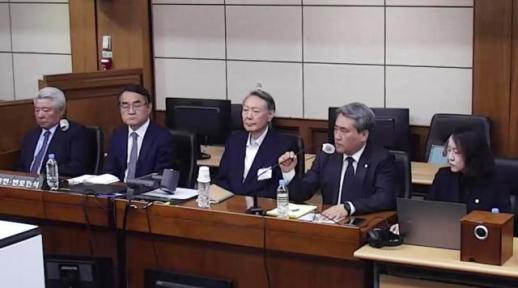 Prosecutors Seek Two-Year Prison Sentence for Yoon Suk Yeol Over False Statements The special prosecutor's team, led by Kim Geon-hee, has requested a two-year prison sentence for Yoon Suk Yeol, who is charged with making false statements during his campaign as the presidential candidate for the People Power Party.During the final hearing on Yoon's election law violation case held on June 8 at the Seoul Central District Court, the special prosecutor urged the court to impose a two-year sentence.The special prosecutor stated, "The Constitution of the Republic of Korea mandates that the president be elected by direct vote of the people, making the dissemination of false information that influences the public's judgment a serious crime in itself. Following the defendant's statements in this case, various allegations against him quieted, allowing him to maintain his status as a leading presidential candidate."Additionally, the prosecutor argued, "Considering the trends in approval ratings and vote margins during the 20th presidential election, this offense should be viewed as having influenced the election results."Yoon is accused of making false statements regarding Jeon Seong-bae during an interview at the launch of the Buddhist Leaders Forum on January 17, 2022, claiming he had met Jeon only through introductions and had never met him with his wife.He is also charged with making false statements at a discussion hosted by the Kwanhun Club on December 14, 2021, denying that he introduced a lawyer to Yoon Dae-jin, the brother of former Yoon Suk Yeol, while serving as the head of the Central Investigation Department of the Supreme Prosecutors' Office in 2012.If Yoon receives a sentence of more than 1 million won in fines in this case, the People Power Party will be required to return 39.7 billion won in election expenses to the National Election Commission, which were reimbursed after the presidential election.* This article has been translated by AI. 2026-06-08 16:36:00
 -
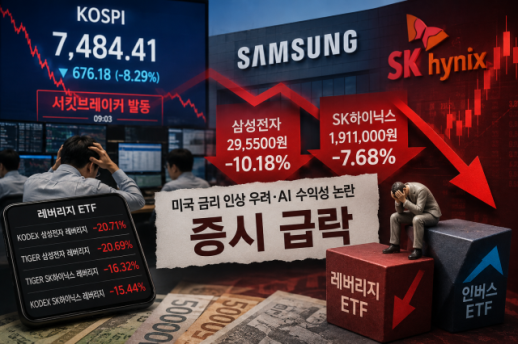 KOSPI Plummets to 7,000s Amid High-Leverage Investor Losses Concerns over interest rate hikes from the U.S. and a sharp decline in global tech stocks have heightened volatility in South Korea's stock market. Individual investors, who had heavily invested in single-stock leveraged ETFs for Samsung Electronics and SK Hynix, now face significant valuation losses as leading stocks tumble. Amid growing warnings of overheating from foreign media, concerns about the concentration in the domestic stock market are also rising. On June 8, the KOSPI opened at 8,048.09, down 112.50 points (1.38%) from the previous trading day, and the decline accelerated, triggering a circuit breaker at 9:03 a.m. The index fell as low as 7,442.73, prompting a sell-off sidecar, and ultimately closed at 7,484.41, down 676.18 points (8.29%). The KOSPI index, which had closed at 8,801.49 on June 2, dropped 15% in just three trading days. The decline follows strong U.S. employment data in May, raising concerns about tightening by the Federal Reserve, coupled with news of capital increases being considered by hyperscalers, which has sparked debates over AI profitability. Major stocks like Samsung Electronics and SK Hynix were hit hard, with Samsung falling 10.18% to 295,500 won and SK Hynix dropping 7.68% to 1,911,000 won. Single-stock leveraged ETFs, which attracted many individual investors, were particularly hard hit. The trading volume for 16 leveraged and inverse ETFs focused on Samsung and SK Hynix reached 8.2 trillion won on this day. Since the listing of related products on May 27, 14 types of long-direction leveraged ETFs saw a cumulative trading volume of 58 trillion won and net purchases by individuals of 7.4 trillion won over seven trading days until June 5. During the same period, approximately 79% of the total net purchases of domestic equity ETFs (7.7 trillion won) were concentrated in semiconductor-related products, exacerbating market concentration. As the underlying assets plummeted, leveraged ETFs also experienced significant declines. The KODEX Samsung Electronics single-stock leveraged ETF dropped 20.71%, while the TIGER Samsung Electronics single-stock leveraged ETF fell 20.69%. The SK Hynix leveraged ETF also saw declines of 15% to 17%. In contrast, inverse products recorded double-digit gains. While the exact scale of losses for individual investors has not been quantified, industry experts believe that a significant number of investors have likely entered a valuation loss zone. Historically, individual investors have shown a tendency to aggressively buy leveraged products during stock price declines. Park Yoo-an, a researcher at KB Securities, noted, "In the domestic leveraged ETF market, the correlation between individual supply and daily returns is low," adding that there is a characteristic of concentrated bargain hunting during downturns. Opinions on the market outlook are divided. Bloomberg reported that global investors are shifting from optimism to caution regarding the Korean stock market. Some foreign investment institutions are reducing their exposure to AI-related stocks or increasing their hedging. European financial firm Optiver warned that the proliferation of single-stock leveraged products could increase market volatility. Conversely, domestic securities firms view the recent drop as a process of overheating correction rather than a trend reversal. Jo A-in, a researcher at Samsung Securities, stated, "This adjustment is more about normalizing overheated positioning than damaging the AI semiconductor industry," and noted that the earnings estimates for domestic companies remain on an upward trajectory, enhancing the valuation appeal of the Korean stock market. Therefore, rather than rushing into bargain buying, it is advisable to gradually increase exposure to AI-leading stocks by utilizing the short-term volatility expected from major events scheduled for this week. However, with the U.S. Consumer Price Index (CPI) announcement and simultaneous expiration of futures and options scheduled for this week, short-term volatility is expected to continue. Lee Kyung-min, a researcher at Daishin Securities, commented, "The excessive concentration of leading stocks has accumulated as a result," suggesting that while it is necessary to keep open the possibility of the KOSPI dropping to the low 7,000s or temporarily falling below that level, there is no need to hastily sell leading stocks. 2026-06-08 16:36:00