

Journalist

KI SU JEONG
-
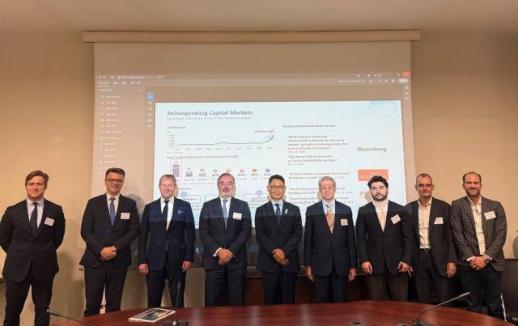 South Korea Promotes Economic Growth to European Investors in Paris The South Korean government held an investment briefing in Paris on June 4, aimed at promoting the country's economic growth and capital market reforms to key European investors. Attendees expressed strong interest, noting that they already view the South Korean market as a "core market" on par with the U.S. and Europe. The Ministry of Finance announced that Deputy Minister Heo Jang hosted the briefing, which included senior executives from major French investment firms such as Amundi, BNP Paribas, Crédit Agricole, Natixis, and Société Générale. During the briefing, Heo emphasized the solid fundamentals of the South Korean economy. He reported that exports surged over 40% year-on-year to approximately $390 billion from January to May, driven by a semiconductor supercycle. He also noted that the country's GDP growth rate for the first quarter was 1.7%, the highest among OECD member countries reported to date. Additionally, gross domestic income rose by 7.5% compared to the previous quarter, indicating ongoing growth. Heo highlighted South Korea's external soundness as an attractive investment factor, stating that the current account surplus for the first quarter reached $85 billion, ranking fifth globally and representing a 220% increase from the previous year. He projected that if the current trend continues, the surplus could significantly exceed last year's record of $123 billion. He pointed to capital market reforms as a key factor behind the strong performance of the South Korean stock market. He noted that reforms such as amendments to corporate law, enhanced shareholder protections, and separate taxation of dividend income are being implemented. He stated that the stock market is transitioning from a "Korea Discount" to a "Korea Premium," particularly in light of the semiconductor and artificial intelligence supercycles. He also mentioned that since the inclusion in the World Government Bond Index (WGBI) in April, foreign investment in government bonds has reached approximately $18.7 billion. The government actively promoted its foreign exchange market modernization policies, including 24-hour market operations, the establishment of an offshore won payment system, and improvements to account opening and settlement procedures for foreign investors. Currently, 80 foreign financial institutions are registered as foreign exchange business operators in South Korea, and nighttime trading is gradually increasing. European investors attending the briefing showed keen interest in strategies to address the prolonged Middle Eastern conflict, the recent surge in the South Korean stock market, and the outcomes of foreign exchange market reforms. They particularly praised the growth trajectory of the South Korean economy and the government's commitment to market reforms, stating, "The South Korean market is already recognized as a core market comparable to European and U.S. markets."* This article has been translated by AI. 2026-06-05 10:03:00
 -
 KB Kookmin Bank Launches 'KB Veterans Benefit Remittance Check' Service with No Fees KB Kookmin Bank announced on June 5 that it will launch the 'KB Veterans Benefit Remittance Check' service in honor of National Defense and Veterans Month.This service is designed to assist veterans living abroad who do not have local bank accounts, allowing them to receive and use foreign currency remittance checks directly.The Ministry of Veterans Affairs plans to transition to a remittance payment method for veterans living overseas starting in 2027 to enhance the convenience of benefit receipt. However, to minimize the inconvenience for some beneficiaries who find it difficult to open and use overseas accounts, KB Kookmin Bank has collaborated with the ministry to introduce the KB Veterans Benefit Remittance Check service.To reduce the burden on customers using this service, KB Kookmin Bank will waive all fees associated with issuing remittance checks. This initiative aims to make it easier for national merit recipients and their families living abroad to receive their benefits.A representative from KB Kookmin Bank stated, "This service has been established to ensure that veterans living abroad can receive their benefits more conveniently and securely. We will continue to contribute to creating social value through various inclusive financial practices for those who have dedicated themselves to the nation."In addition to launching this new service, KB Kookmin Bank is also participating in volunteer activities at the National Cemetery in Seoul to commemorate National Defense and Veterans Month. 2026-06-05 10:03:00
 -
 Goldman Sachs Projects SpaceX AI Revenue to Surge 100-Fold by 2030 Goldman Sachs has projected that SpaceX's artificial intelligence (AI) revenue will increase nearly 100-fold by 2030, ahead of the company's anticipated initial public offering (IPO) next week. According to the Financial Times on June 4, Goldman Sachs, the lead underwriter for SpaceX's IPO, forecasts that the company's AI revenue will rise from $3.2 billion in 2025 to approximately $322 billion by 2030. The overall revenue for SpaceX is also expected to grow from $18.7 billion in 2025 to $474 billion in 2030. These projections reflect the recent surge in aggressive AI investments by major tech companies. Goldman Sachs conveyed this information verbally to key investors during SpaceX's IPO roadshow, the Financial Times reported. In February, SpaceX merged with xAI, an AI startup founded by Elon Musk, CEO of Tesla. The majority of the former xAI team is now part of SpaceX's AI division. According to SpaceX's investment prospectus, xAI recorded a loss of $6.4 billion last year but is expected to tap into a total addressable market (TAM) of $26.5 trillion in the future. This marks a significant shift, as the TAM for SpaceX's original core business, the satellite internet service Starlink, was only projected at $2 trillion. Goldman Sachs estimates that Starlink's revenue will reach $144 billion by 2030, which would be less than half of the projected AI revenue. Additionally, the revenue from SpaceX's rocket division is expected to increase from $4.1 billion last year to $8.3 billion by 2030. However, for SpaceX's AI division to achieve these ambitious targets, its proprietary AI model, Grok, must compete effectively with leading models from companies like Google, OpenAI, and Anthropic. The Financial Times also noted that Musk has recently dismissed all ten co-founders of xAI due to performance issues, raising concerns about the rapid organizational changes. SpaceX plans to finalize its offering price on June 11, with trading on the Nasdaq set to begin on June 12. The proposed share price is $135, which could allow SpaceX to raise $75 billion and achieve a valuation of $1.75 trillion.* This article has been translated by AI. 2026-06-05 09:57:00
 -
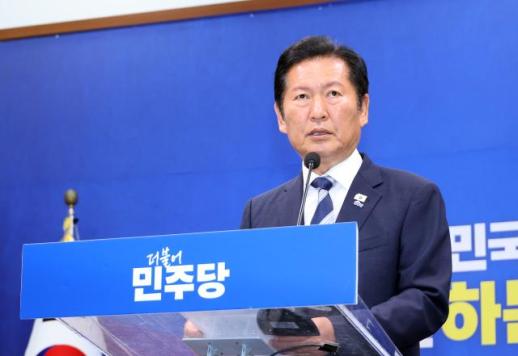 Ruling Party Faces Internal Strife After Local Election Wins and Seoul Loss The Democratic Party achieved a significant victory in the June 3 local elections, winning 12 out of 16 regional leadership positions. However, the party's failure to reclaim the crucial Seoul mayoralty has sparked discussions among some lawmakers about accountability within the leadership. With the party's national convention approaching in August, competition for future leadership roles is intensifying. Park Soo-hyun, the newly elected governor of Chungcheongnam-do and a former party spokesperson, cautioned on Facebook that failing to reflect on the election results and linking them to the upcoming leadership struggle could alienate public sentiment. "What we need to do now is to sincerely reflect on ourselves. Is demanding the leadership's resignation the best course of action?" he asked, emphasizing the need for personal accountability within the party. Following the June 4 mayoral election, where Democratic candidate Jung Won-oh lost to Oh Se-hoon of the People Power Party, some party members expressed their dissatisfaction with party leader Jung Cheong-rae. Lawmaker Yoon Jun-byeong stated, "While the appearance of victory in the local elections is impressive, we cannot claim a complete win if we lost in Seoul." He pressed the party leader for accountability. Similarly, fellow lawmaker Park Beom-gye remarked, "It may not be a defeat, but it certainly feels like a failure. Despite overall positive election results, it is embarrassing to call it a victory. Yet, there has been no acknowledgment of responsibility from the leadership." Kang Deuk-gu, a lawmaker aligned with the pro-Lee Jae-myung faction, also noted, "There were areas where we could have won but ended up with disappointing results. Looking back, there were shortcomings from the nomination process to managing the election period. The leadership failed to capture the urgency felt on the ground." Meanwhile, Jung Cheong-rae expressed gratitude to the public for their support, stating, "I am thankful to the people for giving the Democratic Party a significant victory, but it hurts that we could not reclaim Seoul." Party Secretary-General Cho Seung-rae acknowledged the mixed feelings about the election results, saying, "While there are regrets, I believe this local election was a victory for the Democratic Party. I will remember the warm interest, affection, criticism, and encouragement shown during this election."* This article has been translated by AI. 2026-06-05 09:54:00
 -
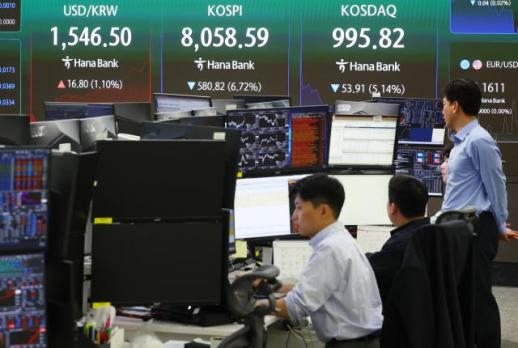 KOSPI opens sharply lower after Wall Street chip sell-off, prompting sidecar halt SEOUL, June 5 (AJP) - South Korean stocks plunged in early trading on Friday, prompting a temporary halt on program sell orders as investors dumped semiconductor shares following an overnight sell-off in U.S. chipmakers. Just 30 minutes into Friday's trading session, the benchmark KOSPI was down 5.65 percent at 8,151.63, while the junior KOSDAQ shed 3.67 percent to 1,011.25. According to the Korea Exchange, a sell-side sidecar was activated at 9:08:25 a.m. after a sharp decline in KOSPI 200 futures. The sharp decline followed heavy losses in U.S. semiconductor stocks overnight, with investors taking profits after a months-long rally in artificial intelligence (AI)-related shares. 2026-06-05 09:46:25
 -
 Samyang's Buldak tops 10 billion units, unveils new mascot Peppo SEOUL, June 05 (AJP) - South Korea's Samyang Foods announced that cumulative sales of its Buldak instant noodle brand had surpassed 10 billion units, a milestone the company is marking by rolling out a next-generation character, Peppo, to anchor an aggressive push into licensing and digital content. The fiery brand, which turns 14 this year, crossed the threshold at the end of May after generating about 7 trillion won ($4.54 billion) in cumulative revenue, the company said Friday. Buldak now sells in some 100 countries, churning out 2 billion units a year, or roughly 63 packets every second worldwide. Growth has accelerated sharply since the brand passed 1 billion units in 2017, hitting 4 billion in 2022 and 9 billion in 2025 before vaulting past 10 billion in barely half a year. Buoyed by the surge, Samyang became the first Korean food maker to top $900 million in exports last year and now accounts for more than 60 percent of the country's ramen shipments abroad. To capitalize on the momentum, Samyang is making Peppo, a chick hatched from an egg laid by predecessor mascot Hochi, the new face of the Buldak universe. Developed by affiliate Samyang Anni, the digital-native character has drawn 1.06 million subscribers on YouTube since its 2024 debut and has already featured on packaging for products such as Buldak Mac & Cheese in North America. "In the food industry a character usually serves as a tool to promote a product's flavor, but we questioned that formula and decided to raise ours as a global brand with a life of its own," said a Samyang Anni spokesperson. New domestic packaging featuring Peppo begins rolling out this month, starting with Buldak sauce, while branded merchandise and an official website are slated to follow, part of what Samyang calls its "eatertainment" vision first unveiled in 2023. 2026-06-05 09:42:08
 -
 KOSPI Plummets Over 4% Amid U.S. Tech Stock Correction and Foreign Selling The South Korean stock market opened sharply lower, dropping over 4% due to a correction in U.S. tech stocks and significant foreign selling. The early trading session saw the activation of a sell-side circuit breaker, indicating a marked decline in investor sentiment. As of 9:04 a.m. KST, the KOSPI index was down 355.50 points (-4.11%) at 8,283.91. The index opened at 8,323.20, down 316.21 points (-3.66%), before extending its losses. At 9:08:25 a.m., a sell-side circuit breaker was triggered due to a sharp drop in the KOSPI 200 futures index, pausing program sell orders for five minutes. This circuit breaker activates when the KOSPI 200 futures index falls more than 5% for one minute. In the U.S. markets overnight, the three major indices closed mixed. The Dow Jones Industrial Average and the S&P 500 rose by 1.73% and 0.41%, respectively, while the tech-heavy Nasdaq Composite fell by 0.09%. Notably, Broadcom saw a significant drop of 12.59%, while other memory-related stocks like Micron Technology (-7.74%), SanDisk (-3.92%), and Western Digital (-3.13%) also experienced declines. Market analysts suggest that this correction is more about profit-taking than a deterioration in fundamentals. Han Ji-young, a researcher at Kiwoom Securities, stated, "The adjustment in leading stocks is not due to worsening fundamentals or macroeconomic issues, such as an impending memory down cycle or increased discount rate pressure from rising interest rates. Rather, it appears to be a temporary surge of investors looking to realize profits following consecutive record highs, leading to a brief influx of selling after specific events." In terms of market supply and demand, foreign investors are engaging in large-scale net selling. In the securities market, individual and institutional investors have net bought 447.2 billion won and 75.7 billion won, respectively, while foreign investors have net sold 550.8 billion won. Most of the top market capitalization stocks are also in decline. Samsung Electronics (-5.97%), SK Hynix (-7.57%), SK Square (-9.04%), Hyundai Motor (-4.00%), Samsung Electro-Mechanics (-3.85%), LG Energy Solution (-1.66%), Samsung Life Insurance (-6.74%), and Samsung C&T (-12.34%) are all experiencing losses, with only HD Hyundai Heavy Industries showing an increase of 3.53%. The KOSDAQ index is also down. At the same time, the KOSDAQ index recorded a decline of 25.27 points (2.41%) to 1,024.46. The index opened at 1,035.22, down 14.51 points (1.38%), and continued to widen its losses. In the KOSDAQ market, individuals have net bought 28.8 billion won, while foreign and institutional investors have net sold 27.2 billion won and 1.8 billion won, respectively. Most of the top KOSDAQ stocks are also declining. EcoPro BM (-4.00%), Alteogen (-0.43%), EcoPro (-3.96%), Rainbow Robotics (-4.62%), Juseong Engineering (-10.53%), Kolon TissueGene (-0.18%), Rino Industry (-2.71%), Samchundang Pharmaceutical (-2.42%), HLB (-0.57%), and Peptron (-0.19%) are all showing downward trends. Meanwhile, analysts suggest that the upcoming visit of Jensen Huang, CEO of NVIDIA, and discussions on collaboration with domestic companies could impact related stocks. Seo Sang-young, a researcher at Mirae Asset Securities, noted, "While there are still concerns about the dollar/won exchange rate and ongoing foreign selling, the CEO's visit and expectations for collaboration with major companies could lead to concentrated interest in specific stocks rather than overall market indices."* This article has been translated by AI. 2026-06-05 09:33:00
 -
![[Video] Police Clash with Citizens Over Voting Issues in Seoul](https://image.ajunews.com//content/image/2026/06/05/20260605093917322704_518_323.gif) [[Video]] Police Clash with Citizens Over Voting Issues in Seoul The aftermath of the "ballot shortage" incident during the June 3 local elections continues to unfold. Tensions escalated as clashes between citizens protesting at polling stations in Songpa District, Seoul, and police were widely shared online, sparking controversy. On June 5, images and videos reportedly taken near the second polling station in Jamsil 7-dong circulated on social media. The footage shows police engaging in physical confrontations with some residents, including a shocking moment where an elderly man appears to be forcibly taken away by officers. One user who shared the images claimed, "They forcibly removed citizens protesting against the deprivation of voting rights," adding, "This is unacceptable in a democratic society." Another user, identifying as a resident of the apartment complex, stated, "Many citizens were forcibly dispersed at the scene," and mentioned hearing reports of injuries among some residents. As a result, political debates surrounding issues of "voting rights deprivation," "evidence destruction," and "forced suppression" have emerged online. Some users expressed sentiments such as, "This is a matter that should be reported by foreign media," and "This is a scene that belongs in a history book," highlighting the involvement of public authority in citizens' protests against voting rights violations. One user remarked, "During Yoon Suk Yeol's martial law, ordinary citizens were not harmed," expressing dismay at the current situation. Earlier, on the day of the June 3 local elections, some areas, including Songpa District, experienced delays and temporary suspensions of voting due to a shortage of ballots. This led to claims that voters had to wait for extended periods or even gave up on voting, further intensifying concerns over election management failures. Meanwhile, police and the National Election Commission are reportedly investigating the circumstances surrounding the ballot shortage and the overall situation at polling stations. 2026-06-05 09:33:00
[[Video]] Police Clash with Citizens Over Voting Issues in Seoul The aftermath of the "ballot shortage" incident during the June 3 local elections continues to unfold. Tensions escalated as clashes between citizens protesting at polling stations in Songpa District, Seoul, and police were widely shared online, sparking controversy. On June 5, images and videos reportedly taken near the second polling station in Jamsil 7-dong circulated on social media. The footage shows police engaging in physical confrontations with some residents, including a shocking moment where an elderly man appears to be forcibly taken away by officers. One user who shared the images claimed, "They forcibly removed citizens protesting against the deprivation of voting rights," adding, "This is unacceptable in a democratic society." Another user, identifying as a resident of the apartment complex, stated, "Many citizens were forcibly dispersed at the scene," and mentioned hearing reports of injuries among some residents. As a result, political debates surrounding issues of "voting rights deprivation," "evidence destruction," and "forced suppression" have emerged online. Some users expressed sentiments such as, "This is a matter that should be reported by foreign media," and "This is a scene that belongs in a history book," highlighting the involvement of public authority in citizens' protests against voting rights violations. One user remarked, "During Yoon Suk Yeol's martial law, ordinary citizens were not harmed," expressing dismay at the current situation. Earlier, on the day of the June 3 local elections, some areas, including Songpa District, experienced delays and temporary suspensions of voting due to a shortage of ballots. This led to claims that voters had to wait for extended periods or even gave up on voting, further intensifying concerns over election management failures. Meanwhile, police and the National Election Commission are reportedly investigating the circumstances surrounding the ballot shortage and the overall situation at polling stations. 2026-06-05 09:33:00 -
 Can Gyeonggi Province Compete in the Global AI Semiconductor Arena? "Governor, Gyeonggi Province is the world's largest semiconductor production base. However, in the age of AI, the winners will not be the producers but the regions that create ecosystems. Will you have Gyeonggi remembered as a 'semiconductor factory' or as the 'heart of AI innovation'?" (ABC AI Era's Question) Where is the heart of South Korea's economy in the 21st century?In the past, it was Ulsan, known for its automotive and shipbuilding industries. In the 1990s, it was Yeouido in Seoul, the hub of finance and home to major corporations. But now, the world has entered a completely different competition. It is no longer about how many cars are produced, but how well AI is utilized. It is no longer about how many factories are built, but how much data is secured. The AI revolution is redrawing the industrial map, with Gyeonggi Province at its center. Samsung Electronics is located in Pyeongtaek, and SK Hynix is in Icheon. Yongin hosts the world's largest semiconductor cluster, while Pangyo is home to South Korea's top digital companies. Gyeonggi Province is where the seeds of the country's AI industry have been most widely sown. The 'Gyeonggi Transformation' proposed by newly elected Governor Choo Mi-ae ultimately leads to the same question: Can Gyeonggi Province become the heart of South Korea's AI industry, beyond just being part of the metropolitan area?Semiconductor power and AI power are not the same. South Korea is a global semiconductor powerhouse. Samsung Electronics and SK Hynix lead the global market and maintain unmatched competitiveness in the memory semiconductor sector. However, it must be acknowledged that being a semiconductor powerhouse is not the same as being an AI powerhouse.In the 20th century, industrial competition was about production volume. The country that produced more and cheaper won. But competition in the AI era is different. The outcome is determined by who secures more data, who creates stronger algorithms, and who attracts more talent. NVIDIA is not a company with many factories. OpenAI is not a manufacturing company either. They dominate the world because they control the AI ecosystem. This presents an opportunity for Gyeonggi Province.Gyeonggi is already South Korea's top semiconductor production base. The question is whether it will remain just a production base or become the center of the AI ecosystem.If the Yongin semiconductor cluster is merely an industrial complex, its significance is limited. However, if it evolves into an innovation city where AI researchers, startups, investors, and universities come together, the narrative changes. The world is currently competing for AI supremacy. Gyeonggi Province must lay the foundation for an AI civilization. Can Pangyo become South Korea's Silicon Valley? The strength of Silicon Valley is not in its buildings.It is in its people.The world's top engineers gather there, along with the best investors. There is a culture that encourages retrying after failure. Universities and companies are interconnected, as are research institutes and markets. Pangyo is the closest place in South Korea to Silicon Valley.Naver and Kakao are located there, along with thousands of startups. The gaming and platform industries have flourished, and recently, AI companies have been rapidly increasing.However, there is still something lacking. Global reach. Silicon Valley attracts talent from around the world. Pangyo still primarily attracts talent from South Korea. Silicon Valley draws global capital, while Pangyo is still centered on domestic investment. Silicon Valley aims to solve global market issues, while Pangyo has yet to fully break away from a domestic market mindset. For Gyeonggi Province to become the heart of AI, Pangyo must be developed into a global innovation city. Pangyo, Seongnam, Suwon, Yongin, Icheon, and Pyeongtaek must be connected into a single AI belt. Only when the semiconductor production base meets the startup ecosystem and universities connect with research institutes can new innovations emerge. Competitiveness in the AI era lies in connectivity. Who connects more talent? Who connects more data? Who connects more ideas? That will determine the future. Gyeonggi Province's competitor is not Seoul. Many people view Gyeonggi Province as a satellite city of Seoul. However, such thinking is outdated in the AI era. Gyeonggi's competitor is not Seoul; it is Silicon Valley. AI is ushering in an era of urban competition. The strength of the United States lies in Silicon Valley. The strength of China lies in Shenzhen. For South Korea to become an AI powerhouse, Gyeonggi Province must be at the forefront. Gyeonggi must become the center of industry and technology. If Seoul and Gyeonggi can be united into a single AI mega-cluster, South Korea can establish the strongest AI ecosystem in Asia. This is where the role of Governor Choo Mi-ae becomes crucial.In this election, Choo presented semiconductors and AI as key growth engines.What matters now is not the promises made, but their execution. The AI industry thrives on speed. Five years from now may be too late. Ten years from now, opportunities may vanish.This is why Choo must act now. : SWOT Analysis :StrengthGyeonggi Province has a world-class semiconductor production base. Pyeongtaek's Samsung Electronics, Icheon's SK Hynix, and the Yongin semiconductor cluster form a strong axis. Pangyo and Seongnam host the largest IT and AI ecosystems in the country. A massive market of 14 million people, along with excellent universities and research institutions, is also a strength. WeaknessDespite its semiconductor production capacity, there is a lack of global AI platform companies. While Pangyo is among the best domestically, it has not achieved the international stature of Silicon Valley. The north-south gap and transportation issues remain burdensome. OpportunityThe AI revolution presents a historic opportunity for Gyeonggi Province. As AI and semiconductors converge, Gyeonggi can leap from a manufacturing-centered economy to an AI-centered economy. The Lee Jae-myung government's AI national strategy is also a favorable factor. ThreatThe United States has companies like NVIDIA and OpenAI. China is expanding its national-level AI investments. Global competition is extremely fierce. The reorganization of the semiconductor supply chain and the competition for technological supremacy also pose ongoing risks. ABC asks Governor Choo Mi-ae * This article has been translated by AI. 2026-06-05 09:30:00
 -
 Bae Jae-kyu: Pioneer of Korea's ETF Market and Advocate for Investment Democracy A pioneer has transformed the financial industry landscape, and Bae Jae-kyu, president of Korea Investment Trust Management, is a key figure in the story of Korea's ETF market. He opened a new era in the Korean capital market by introducing the country's first ETF, KODEX200, in 2002. Subsequently, he launched Asia's first leveraged and inverse ETFs, laying the foundation for the growth of the ETF industry. Today, it is no exaggeration to say that the domestic ETF market, which has surpassed 500 trillion won, has grown on the spirit of challenge embodied by Bae Jae-kyu. His entrepreneurial spirit in finance has not only created products but has also democratized investment, allowing individual investors to achieve diversification similar to that of institutional investors. The history of Korea's asset management industry is divided into the era before and after ETFs, with Bae Jae-kyu at the center. A Pioneer in the Korean ETF Market The essence of entrepreneurship lies in the ability to foresee a future that others cannot see. Bae Jae-kyu recognized this future over 20 years ago when the Korean asset management market was dominated by active funds, where the stock-picking abilities of fund managers determined returns. However, after encountering John Bogle's index investing philosophy in the U.S., he reached a different conclusion: "In the long run, low-cost index investing outperforms active funds." At that time, this assertion was quite unfamiliar in the domestic financial market. Nevertheless, he was convinced and took action. He persuaded financial authorities and exchanges about the necessity of introducing ETFs and actively participated in establishing related systems. Ultimately, the KODEX200, Korea's first ETF, was born in 2002. Today, ETFs have become a core tool for personal finance. Individual investors can now invest in the U.S. Nasdaq, S&P 500, semiconductor stocks, AI, dividend stocks, gold, and bonds with just a click. However, at that time, no one could have predicted the growth of ETFs. Bae Jae-kyu's entrepreneurial spirit is evident here. Entrepreneurs look at future markets rather than current ones. While investors seek visible opportunities, entrepreneurs create invisible ones. ETFs are not merely financial products created by Bae Jae-kyu; they represent a new infrastructure for the Korean capital market. He is not just an operator but a market designer, which is why he is often referred to as the "Father of ETFs" and the "Evangelist of ETFs." Creating a Culture of Investment, Not Just Products Bae Jae-kyu's entrepreneurial spirit extends beyond product development to the innovation of investment philosophy. He has long emphasized that "investment is not about prediction but diversification." Most investors try to predict which stocks will rise, but Bae Jae-kyu believes that investing in entire industries rather than specific companies is more rational in the long term. ETFs are the result of this philosophy. During his time at Samsung Asset Management, he successively launched Korea's first overseas ETF, the first gold ETF, and Asia's first leveraged and inverse ETFs. At that time, financial companies viewed launching new products as risky. However, Bae Jae-kyu embraced change rather than fearing risk. As a result, KODEX became the leading ETF brand in Korea, and Samsung Asset Management emerged as a dominant player with over 50% market share in the ETF sector. Interestingly, he has also played an educational role, giving lectures, participating in interviews, and appearing in YouTube content. He has continuously explained why ETFs are necessary, why long-term investing is important, and why diversification is essential. He believes that the essence of the financial industry lies not in selling products but in educating investors. This distinction is crucial in differentiating between ordinary financial professionals and financial entrepreneurs. Financial entrepreneurs are not just sellers of products; they are creators of investment culture. Bae Jae-kyu has fundamentally changed the investment habits of Koreans through ETFs. Leading the Transformation of Korea Investment Trust Management In 2022, Bae Jae-kyu left Samsung Asset Management to become the president of Korea Investment Trust Management. At that time, Korea Investment Trust Management was a latecomer in the ETF market, with a significant gap in ETF net assets compared to the top players. However, Bae Jae-kyu clearly outlined his direction immediately upon taking office: "We will maintain the strengths of active funds while growing ETFs, TDFs, and OCIOs as future growth pillars." He first completely rebranded the ETF line from KINDEX to ACE. A brand is not just a name; it is a declaration of corporate strategy. ACE signifies the ambition to become the ace in the ETF market. He also restructured the organization, establishing a digital ETF marketing team and strengthening product strategy functions, viewing product development and marketing as core competencies in asset management. The results were swift. Korea Investment Trust Management significantly expanded its ETF market share, entering the top three in the industry. ETF net assets surpassed 16 trillion won, and flagship products like ACE U.S. S&P 500, ACE U.S. Nasdaq 100, and ACE Global Semiconductor TOP4 Plus gained market attention. Notably, the semiconductor ETF strategy reflects his insights into future industries. He emphasizes that semiconductors and power are key infrastructures in the AI era. Indeed, the ACE Global Semiconductor TOP4 Plus ETF has achieved high returns and emerged as a flagship product. Preparing for the Future of Pensions and Asset Allocation in the AI Era Bae Jae-kyu's recent focus extends beyond ETFs to pensions and AI. He believes that the future of investing lies not in simply selecting stocks but in asset allocation. In an era where AI reduces information asymmetry, how one constructs a portfolio becomes more important than what stocks to buy. This philosophy is evident in the expansion of TDF and OCIO businesses. Since his appointment, he has nurtured TDF and OCIO as core growth areas, particularly enhancing long-term asset management services in line with the expansion of the retirement pension market. Recently, he also launched 'KimRobo,' an AI-based retirement pension asset management service. This service uses AI algorithms to suggest asset allocations tailored to investors' preferences and goals. It is not just a digital service; it illustrates the future direction of asset management. While traditional financial companies once sold funds, the future will see AI providing personalized portfolios. Bae Jae-kyu is already preparing for this change. He describes investing as "the act of deferring current consumption for future consumption." This philosophy aligns with the essence of financial entrepreneurship. Finance is not merely an industry for gathering money; it is an industry for designing people's futures. Bae Jae-kyu created the ETF market and is now preparing for the era of AI-based asset management. His entrepreneurial spirit in finance can ultimately be summarized in one sentence: "Making it easier, cheaper, and safer for investors to invest." This has been the essence of his financial innovation for over 20 years. SWOT Analysis:Strengths: A symbolic figure who created the domestic ETF market, introducing Korea's first ETF and Asia's first leveraged and inverse ETFs. A rare CEO with deep understanding of product development, marketing, and asset allocation.Weaknesses: The strong symbolism of the ETF field may overshadow the presence of active management and alternative investments. Korea Investment Trust Management's ETF market share still lags behind Samsung and Mirae Asset.Opportunities: The domestic ETF market will continue to grow beyond 500 trillion won. The expansion of retirement pensions, TDFs, OCIOs, and AI-based asset management are areas where Bae Jae-kyu has significant strengths.Threats: Intensifying competition in ETF fees, market share competition with Samsung, Mirae Asset, and KB, and the potential reduction of traditional asset managers' roles due to the emergence of AI investment platforms are major risks. 2026-06-05 09:27:00