

Journalist

KI SU JEONG
-
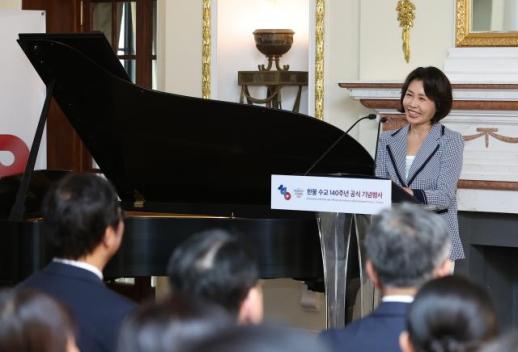 Kim Hye-kyung: Korea and France as Close Partners Through Culture "The mutual understanding built on trust and friendship between our two countries is deepening and expanding every day. Now, we have become close partners who understand each other through cultural and artistic exchanges in our daily lives," said Kim Hye-kyung on June 4 at the 140th anniversary celebration of Korea-France diplomatic relations held at Deoksugung Palace in Seoul. Kim noted, "140 years ago, we opened our hearts to each other despite the distance and differences in language and culture." She expressed gratitude for France's support during the Korean War, stating, "France was a significant force in protecting our freedom and peace as a member of the UN forces. The noble sacrifices and dedication of French youth during that time remain in the hearts of our people. I would like to take this opportunity to express my deep gratitude once again." She added, "The French people love Korean cultural content and K-pop, while we highly appreciate French literature and art through the works of Victor Hugo, Monet, and Rodin. I hope this event becomes a precious time for our hearts to connect and unite." The event was attended by approximately 80 guests, including Philippe Bertoux, the French Ambassador to South Korea; Choi Hwi-young, Minister of Culture, Sports and Tourism; actress Jeon Ji-hyun; and Felix from the K-pop group Stray Kids. Ambassador Bertoux remarked, "The signing of the Korea-France Treaty of Commerce and Navigation in 1886 was a historic treaty that marked the beginning of our diplomatic relations." He continued, "With President Emmanuel Macron's state visit to Korea in April, our relationship has been elevated to a global strategic partnership. Through this, our soft power will be strengthened through mutual exchanges." The celebration featured a performance by soprano Jo Sumi and French pianist David Kadouch.* This article has been translated by AI. 2026-06-04 18:18:00
 -
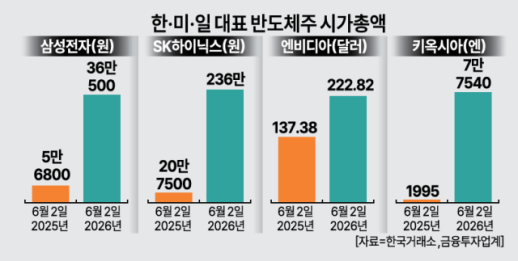 Kioxia Surpasses Toyota, Nvidia Outpaces Apple as Semiconductor Sector Reshapes Market Caps in Korea, U.S., and Japan Artificial intelligence (AI) is transforming the market capitalization landscape of stock exchanges in the U.S., South Korea, and Japan. Previously dominated by smartphone, internet platform, and automotive companies, the market is now led by AI semiconductor and memory firms. In the U.S., Nvidia has overtaken Apple to become the world's largest company, while in South Korea, Samsung Electronics and SK Hynix are driving stock market gains. In Japan, memory manufacturer Kioxia Holdings is challenging Toyota Motor Corporation, climbing to the upper echelons of market capitalization. According to the Korea Exchange, the KOSPI index reached 8,801.49 as of June 2, marking a 226.1% increase from a year earlier when it stood at 2,698.97. The surge in demand for AI semiconductors has propelled Samsung Electronics and SK Hynix, with their stock prices soaring by 534.7% and 1,037.3%, respectively, significantly outpacing the KOSPI's overall growth. As of June 2, these two companies accounted for approximately 52% of the KOSPI's market capitalization. With the focus on AI benefiting the semiconductor sector, the status of these companies in the South Korean stock market has risen significantly. Once regarded primarily as a smartphone-centric IT company, Samsung Electronics has emerged as a key beneficiary of the expanding demand for memory semiconductors in the AI era. Recently, it has entered the top 10 global market capitalization rankings, competing with major tech giants. SK Hynix's transformation is even more dramatic. As a key supplier of high-bandwidth memory (HBM) to Nvidia, it is now considered one of the biggest beneficiaries of the AI era. Analysts note that the company has shifted from being heavily influenced by the DRAM market to becoming a central player in AI infrastructure expansion. Just two years ago, SK Hynix was far outside the top 100 in global market capitalization but has recently climbed to 12th place, joining the ranks of leading global technology firms. The positive outlook for the semiconductor sector is also boosting expectations for the South Korean stock market. Global investment bank Goldman Sachs recently raised its 12-month target for the KOSPI from 9,000 to 12,000, citing a longer-than-expected favorable semiconductor environment and improved corporate profit forecasts. This adjustment comes less than a month after the target was increased from 8,000 to 9,000. While Samsung Electronics and SK Hynix lead the South Korean market, Nvidia is effectively dominating the U.S. market. Nvidia's market capitalization recently surpassed $5.2 trillion, making it the world's largest company. In 2017, Nvidia's market cap was approximately $117 billion, accounting for just 3.4% of the total market cap of the seven major U.S. tech companies (M7). However, by virtually monopolizing the market for AI training graphics processing units (GPUs), Nvidia's value has skyrocketed. It now represents 22.5% of the total M7 market capitalization, a significant increase of about 6.6 times over nine years. This shift underscores how AI has completely altered the power dynamics of the U.S. stock market. In Japan, AI is also shaking up the stock market landscape. The spotlight is on Kioxia Holdings, a NAND flash memory company. For a long time, Japan's stock market has been dominated by automotive and industrial firms, with Toyota Motor Corporation symbolizing Japanese manufacturing and holding the top market cap. However, Kioxia's recent stock surge has disrupted this status quo. The company's shares recently rose by over 7%, pushing its market cap past 45 trillion yen at one point, allowing it to surpass Toyota and become the second-largest publicly traded company in Japan. Just a year ago, Kioxia was ranked 169th in market capitalization. Market analysts believe that the changes brought about by AI in the stock market are unlikely to be temporary. Kim Young-geun, a researcher at Mirae Asset Securities, stated, "Kioxia is reducing its sensitivity to economic fluctuations by increasing its revenue share from data centers and establishing a stable profit structure through a disciplined supply strategy. This change will positively impact the entire memory sector." He maintained target prices for Samsung Electronics and SK Hynix at 550,000 won and 3,800,000 won, respectively. 2026-06-04 18:15:00
 -
 Gentle Monster Launches Veggie Collection at Pop-Up Store in Seoul On June 4, the pop-up store located in Seoul's Seongsu-dong, known as House Nowhere, drew attention with a unique display. A giant broccoli character, 'Vegimon,' was seen peacefully resting with a small onion on its head, creating a whimsical atmosphere reminiscent of a farm. Moving past Vegimon, visitors encountered the true stars of the event: ten new eyewear styles from Gentle Monster's Veggie collection. This collection reinterprets the 'Farm Girl Core' trend, which has recently taken the global fashion and lifestyle market by storm. The Farm Girl Core aesthetic emphasizes a natural and rustic vibe, contrasting with urban sophistication. The Veggie collection features organic shapes inspired by vegetables like tomatoes and bell peppers, with all products designed to be foldable. Notably, many attendees were drawn to the 'Radi 02' model with round metal frames, worn by K-pop star Karina in a campaign video, and the 'Topi 02' model, which boasts curves reminiscent of a bell pepper. The pop-up store was filled with characters that enhanced the atmosphere, featuring various vegetable characters placed throughout the space, creating an illusion of walking through a farm. The interactive photo booth was a popular spot, allowing visitors to create their own Vegimon character and receive a photo card. This area was bustling with young visitors eager to take pictures with the Vegimon plush toy. Gentle Monster's latest project aims to reach beyond the domestic market and target a global audience. On June 5, the Veggie collection will simultaneously launch in six major cities worldwide, including Shanghai, Beijing, Tokyo, Bangkok, and New York, welcoming fans around the globe. Customers purchasing Veggie collection products at the pop-up store will receive a limited-edition 'Vegimon keychain' as a gift, while the collection will also be available on the official website and in physical stores. * This article has been translated by AI. 2026-06-04 18:15:00
 -
 Shin Young Securities Plans to Retire 32% of Shares and Increase Cash Dividends Shin Young Securities plans to retire 32.01% of its outstanding shares and increase cash dividends to enhance shareholder returns. According to a filing with the Financial Supervisory Service on June 4, the company will present its plan for the retirement and utilization of its treasury stock at the annual general meeting scheduled for June 19. Shin Young Securities holds a total of 8,422,754 shares of treasury stock, which accounts for 51.23% of its issued shares. Of this, the company plans to retire 5,262,283 shares (32.01%) within the statutory deadline. Based on the closing price of 188,400 won on that day, this amounts to approximately 999 billion won. The shares to be retired are from the existing preferred stock. Shin Young Securities acquired these shares during the process of converting preferred stock into common stock in April 2024 to protect the rights of preferred stock investors. This decision follows a recently enacted amendment to the Commercial Act, which mandates that treasury stock acquired after the law's implementation must be retired within one year. Treasury stock acquired before the law's implementation must be retired or managed according to a plan approved by the shareholders' meeting by September 2027. Shin Young Securities has proposed its treasury stock retirement plan to shareholders more than a year ahead of the legal deadline. The company stated that this move aims to address market concerns regarding the high proportion of treasury stock and to clarify uncertainties about future utilization plans. After the retirement, the remaining treasury stock of 3,160,471 shares (19.22%) will be used for shareholder returns and employee performance compensation. The specific timing and method of disposal will be finalized with shareholder approval before September of next year. The company is also increasing its dividends. Shin Young Securities has decided to raise the cash dividend for common stock by 2,500 won (50%) from the previous year, bringing it to 7,500 won per share. As a result, the total dividend amount will increase by approximately 20 billion won compared to the previous year. A representative from Shin Young Securities stated, "We plan to retire a significant portion of our treasury stock within the legal deadline and actively utilize the remaining shares as a means of returning value to shareholders. We will proactively respond to the capital market's demand for enhancing corporate value and the intent of the Commercial Act amendment."* This article has been translated by AI. 2026-06-04 18:12:00
 -
 Starbucks Faces Backlash Over Controversial Marketing Campaign "We have terminated the employee involved as of today. We had no way to prevent this. We would appreciate your understanding and will manage our staff better in the future." This apology was issued by an individual claiming to be a manager after a controversy erupted when a restaurant employee mocked customers online. This four-sentence statement has since become a reference point for corporate apologies, often cited in online communities as a model for acknowledging mistakes, taking responsibility, and promising to prevent recurrence. An effective apology demonstrates an understanding of the wrongdoing and shows corrective actions taken.By this standard, Starbucks Korea's response to the 'Tank Day' marketing controversy last month was swift. Shinsegae Group Chairman Jeong Yong-jin dismissed Starbucks Korea CEO Son Jeong-hyun and the responsible executives on the day of the incident. The following day, he issued a public apology stating, "I acknowledge that I have taken lightly the pain and sacrifices of all those who have dedicated themselves to democracy, and I take full responsibility for this mistake." He also promised to provide education on historical awareness and ethical standards to all employees. The apology included all the essential elements: accountability, acknowledgment of wrongdoing, and a commitment to prevent future issues.However, unlike previous cases, the phrase "we had no way to prevent this" does not apply to the 'Tank Day' marketing incident. The event was planned by Starbucks Korea's commerce team and went through approvals from the team leader, responsible staff, department head, and CEO. No one raised concerns about terms like 'Tank Day' or 'bang on the desk' during this process. It has been confirmed that there were instances where approvals were granted without reviewing attached files. There were clearly multiple opportunities to prevent damage to the company's image and boycotts, but internal mechanisms failed to function each time. This cannot be simply attributed to a minor mistake or lack of sensitivity from the staff.Moreover, while there used to be a legal review process for such marketing phrases, this time that step was skipped. Jeong Sang-jin, Shinsegae Group's Chief Management Officer, acknowledged, "Due to the prioritization of marketing immediacy, the legal review process that was previously in place was not followed, revealing a lack of social and historical sensitivity within Starbucks Korea." In prioritizing rapid execution, they bypassed basic verification procedures. Despite holding the title of the 'undisputed number one' coffee franchise, the internal processes were evidently lax.Risk management is not about writing an apology after a crisis occurs; it is about preventing issues from arising internally before they escalate. Starbucks, in particular, is a brand known for frequent marketing campaigns. Seasonal events, merchandise, and promotions often involve phrases that directly connect with consumers. Even minor expressions can clash with social contexts. If phrases that could trivialize historical events or be interpreted as hate speech are not filtered out, a 'second Tank Day' controversy could arise at any time.On May 26, Chairman Jeong bowed his head and promised two things: to make today’s apology a starting point rather than an end, and to regain public trust through actions rather than words. For Jeong's promises to resonate with consumers, the first step must be a thorough review of internal systems. This does not mean simply adding more approval layers. It means establishing procedures to identify and halt problems, fostering an environment where dissent can be voiced, and implementing a verification system that reflects social sensitivity.As Jeong stated, consumer trust cannot be restored through apologies alone; it must be accompanied by action. Brand trust is rebuilt when consumers are assured that similar incidents will not happen again. For Starbucks to be seen as a space for enjoying coffee rather than a battleground for ideological conflicts, it must first demonstrate what changes have been made following the apology. 2026-06-04 18:12:00
 -
 Special Prosecutor's Investigation Targets Yoon Suk Yeol Ahead of First Summons The second comprehensive special prosecutor team, led by Kwon Chang-young, is narrowing its investigation into former President Yoon Suk Yeol ahead of his first face-to-face questioning scheduled for June 6. The special prosecutor is summoning key figures involved in the emergency martial law declared on December 3 and the relocation of the presidential residence, including former Defense Minister Kim Yong-hyun, former Minister of the Interior and Safety Lee Sang-min, and former Chief of Staff Kim Dae-ki, to clarify the facts surrounding the allegations and determine what charges to apply against the former president. According to legal sources, the special prosecutor summoned both Kim and Lee as suspects for questioning on June 4. Kim faces allegations of rebellion and organizing a criminal group under military law, while Lee is accused of abuse of power. On the same day, Kim Dae-ki also underwent additional questioning. The focus of the special prosecutor's investigation is the upcoming questioning of former President Yoon, who is accused of directing the National Security Office and the National Intelligence Service to justify the martial law to allied countries, including the United States, immediately after its declaration (abuse of power). Initially, the special prosecutor considered making Yoon's appearance public but opted for a closed summons due to objections from his legal team. Legal experts believe this investigation will extend beyond merely confirming the allegations regarding the justification of martial law. The trajectory of the special prosecutor's investigation suggests a focus on reconstructing the entire command structure of the emergency martial law, with Yoon at its center. In fact, the special prosecutor is investigating Kim Yong-hyun under the charge of rebellion under military law. They believe that Yoon, Kim, and military leaders colluded to deploy armed forces to the National Assembly and the Election Commission. They are also examining evidence that suggests the formation of a so-called 'Second Investigation Division' alongside former Army Intelligence Commander Roh Sang-won to seize control of the Election Commission. The special prosecutor has also applied the same rebellion charges to former Special Warfare Command Chief Kwak Jong-geun and former Capital Defense Command Chief Lee Jin-woo, expanding the investigation to the Joint Chiefs of Staff. The special prosecutor has classified the allegations related to the Joint Chiefs of Staff as a 'first recognized case' and has charged former Chairman Kim Myung-soo and other leaders with serious offenses related to insurrection. There is speculation within and outside the legal community that the special prosecutor aims to establish a 'three-tier command structure' linking Yoon, the Joint Chiefs of Staff, and field commanders. This involves not only confirming that troops were deployed to the National Assembly and the Election Commission but also identifying who issued the orders, how they were communicated, and how they were executed. Amid allegations that some units did not follow normal command and control procedures during the martial law, the special prosecutor is also reportedly reviewing related facts. The necessity of examining whether the military command and control system (C4I) was operational during the emergency martial law and the routes of troop movements has been raised in this context. The investigation into the relocation of the presidential residence is also directed at Yoon. The special prosecutor is investigating the circumstances under which 2.8 billion won was illegally diverted from the Ministry of the Interior and Safety's budget during the 2022 relocation process, questioning whether the presidential office requested or pressured for the budget diversion and examining allegations that civil servants who opposed the diversion faced personnel disadvantages. Further questioning of Yoon is anticipated. The special prosecutor plans to summon former National Intelligence Service Deputy Director Hong Jang-won on June 11 to clarify the circumstances surrounding the delivery of the martial law justification messages. They have recently indicated that evidence suggests preparations for the emergency martial law were ongoing for an extended period. Attention is focused on how far the special prosecutor can pursue charges against Yoon. Currently, the publicized allegations involve abuse of power, but the special prosecutor is also investigating the possibility of charging Yoon with being the leader of rebellion under military law. Legal experts suggest that the scope of charges could expand depending on the testimonies and evidence obtained. Whether the rebellion charges applied to Kim Yong-hyun, Kwak, Lee, and others can be linked to Yoon will likely be a pivotal point in the ongoing investigation. Yoon's first summons is expected to mark the beginning of the comprehensive special prosecutor's investigation reaching its peak.* This article has been translated by AI. 2026-06-04 18:06:00
 -
 DP sweeps local elections but defeats in key races signal challenges ahead SEOUL, June 4 (AJP) - The ruling Democratic Party (DP) swept 12 of 16 metropolitan mayoral and gubernatorial races in this year's local elections on Wednesday, claiming an overall victory, but the results exposed growing vulnerabilities in Seoul and other battlegrounds that could reshape the political landscape. While the liberal party regained ground nationwide under President Lee Jae Myung, analysts said even a handful of defeats in high-profile races suggested voter dissatisfaction with the ruling camp despite its numerical advantage. The DP suffered a particularly painful loss in Seoul, widely regarded as the symbolic center of South Korean politics and a key barometer of centrist public opinion. The party also lost several closely watched parliamentary by-elections held simultaneously with the local elections including a tight race in the Buk district of the country's southern port city of Busan, where independent candidate Han Dong-hoon defeated DP candidate Ha Jung-woo in a dramatic reversal. Political observers said the mixed outcome reflected sophisticated "split-ticket voting" by the electorate, with voters backing the ruling party in many regional races while supporting conservative or independent candidates in strategically important contests. Despite losing Seoul, the DP lawmakers significantly improved their standing in the capital's district-level races. The party won 17 of Seoul's 25 district mayor posts, reversing the political map from the 2022 local elections, when conservatives held 17 districts and the Democrats controlled only eight. Still, defeats in Seoul and conservative strongholds raised concerns inside the ruling camp about waning support among moderates and voters in the capital regions. The June 3 elections also highlighted signs of changing political dynamics in the conservative stronghold of Daegu. DP candidate Kim Boo-kyum earned 45.05 percent of the vote in the Daegu mayoral race, an impressive improvement compared with the party's performance in the 2022 election. People Power Party (PPP) candidate Choo Kyung-ho won the race with 53.92 percent. In the previous local elections in 2022, PPP candidate Hong Joon-pyo won the Daegu mayoralty with 78.75 percent, while the DP candidate received only 17.97 percent. Although Kim fell short of victory, party officials viewed the result as evidence that regional political barriers in the country's southeast may be weakening. Attention is now shifting to the DP's upcoming national convention, expected as early as August, where party leader Jung Chung-rae is widely expected to seek another term. Jung is expected to argue that leading the party to victories in 12 metropolitan races justifies his reelection, while critics inside the party point to losses in Seoul and major by-elections as evidence of strategic failures. Potential challengers include Prime Minister Kim Min-seok and former party leader Song Young-gil, according to party officials. The results also intensified pressure on the PPP's leader Jang Dong-hyeok. Calls for Jang's resignation emerged within the party after conservatives failed to prevent the DP from dominating the nationwide gubernatorial races. However, Jang rejected demands to step down, saying Thursday that he would continue leading the party and seek a "new path" together with party members. Conservative lawmakers nonetheless argued that the party's overall defeat overshadowed gains in the parliamentary by-elections, where the opposition and independent conservative candidates secured several important victories. Lawmakers from the two major parties who spoke with AJP emphasized different priorities. The DP lawmaker stressed "humility," while the PPP lawmaker emphasized "unity." Rep. Kim Kyo-heung, a three-term politician from the DP, acknowledged the mixed public sentiment reflected in the election. "Even though the DP won the local elections overall, it lost the Seoul mayoral race, candidate Ha's race in Busan, the by-election in Pyeongtaek, and the mayoral elections in Ansan, Seongnam, and Yongin,” Kim said. "The DP governors, mayors, district heads, city council members, district council members and county council members elected in this election must remain humble," he added. A three-term lawmaker from the PPP said the opposition faced structural disadvantages. "In my experience, the first election held one year after a presidential election is always extremely difficult for the opposition," the lawmaker said. Yoon Sang-hyun, a five-term lawmaker from the PPP, said the local elections had been winnable for the party but that it lost because of internal divisions and a lack of vision. Yoon said the party had called for judgment against President Lee Jae Myung, but "that alone was not enough because we failed to speak about hope together." He said the only way for the PPP to win nationwide elections again was for politicians who share conservative values to unite, rather than divide into rival factions and fight each other. "If we split the party in two while fighting over who is pro-Yoon and who is anti-Yoon, we will once again forget why voters punished us yesterday," he added. 2026-06-04 18:05:54
 -
 Thermal Management Emerges as Key Factor in Electric Vehicle Market The thermal management system, which affects the driving range and charging speed of electric vehicles, is emerging as a new opportunity for the automotive parts industry. As the transition to electrification accelerates, competition to dominate the thermal management parts market is intensifying. According to industry sources, Hyundai Wia has signed a supply contract for a thermal management system for the PBV (Purpose Built Vehicle) PV7, set to be launched by Kia next year. This expands the supply of thermal management systems from the previously supplied PV5 to the new model. Hyundai Wia is positioning thermal management systems, a core component of electrification, as a future growth driver and is fostering related industries. Earlier this year at CES 2026 in Las Vegas, the company unveiled an Integrated Thermal Management System (ITMS), a cooling module, and a slim heating, ventilation, and air conditioning (HVAC) system. As the growth potential of internal combustion engine vehicles slows, Hyundai Wia is ramping up its thermal management parts business. A company representative stated, "We are increasing investments to maintain profitability in our existing internal combustion engine business while developing thermal management systems as a future growth engine. We plan to expand our supply range in line with global automakers' electrification model expansion plans." Typically, electric vehicles require more stringent temperature management than internal combustion engine vehicles, as the battery and motor must operate at optimal temperatures to maintain stable driving ranges. The electrification model is expected to gradually expand in the domestic automotive market. The Hyundai Motor Group aims to establish a lineup of 31 electric vehicles by 2030 as part of its electrification strategy. Notably, next year will see the launch of the first long-range electric vehicle (EREV) model, which will offer a driving range of over 600 miles (approximately 965 km), increasing the importance of the thermal management system. Hanon Systems, a leading player in the domestic thermal management market, is directly benefiting from the electrification of the mobility industry. The company supplies battery thermal management systems for electric vehicles (EVs), hybrid vehicles (HEVs), plug-in hybrid vehicles (PHEVs), and hydrogen fuel cell vehicles (FCEVs) to global automakers. According to financial information firm FnGuide, Hanon Systems is projected to see its operating profit consensus for the second quarter of this year reach 109.1 billion won, a 69.7% increase compared to 64.3 billion won in the same period last year. Industry experts believe that as electric vehicle technology advances, the importance of supporting thermal and energy management technologies will grow. Professor Kim Pil-soo of Daelim University’s Future Mobility Department stated, "The higher the performance of electric vehicles, the more the level of thermal management technology determines performance and efficiency. As the adoption of electrified vehicles expands, the related market growth trend will continue." 2026-06-04 18:03:00
 -
 Netmarble Sells G-Tower Headquarters for 697.7 Billion Won Netmarble is selling its headquarters, G-Tower, located in Guro-gu, Seoul, as part of efforts to secure liquidity through asset sales. On June 4, Netmarble announced that it has decided to sell the land and building of G-Tower, located at 38 Digital-ro 26-gil, Guro-gu, Seoul, for 697.67 billion won. This amount represents 8.62% of Netmarble's total assets of 8.936 trillion won as of the end of 2025. G-Tower serves as the headquarters for Netmarble and is also home to major affiliates such as Coway and Netmarble F&C. The company plans to relocate to a new headquarters in Gwacheon by the second quarter of 2028. After the sale of G-Tower, Netmarble will continue to maintain its office there until the move to the new building. The transaction will involve NH Investment & Securities, which will participate as the trustee for the JB Asset Management Real Estate Investment Trust No. 4. The sale is scheduled for June 12. Netmarble clarified that the sale price excludes taxes and fees associated with the transaction. A Netmarble official stated, "The sale of G-Tower is aimed at optimizing asset management and securing financial flexibility, and we intend to restructure our asset portfolio through this process."* This article has been translated by AI. 2026-06-04 17:54:00
 -
 From chalkboards to AI: How South Korea turns election night into must-watch TV shows SEOUL, June 4 (AJP) - With vote counting for this year's local elections underway on Wednesday, millions of viewers did not simply refresh their phones for results; they sat down and watched. The country's election night broadcasts have evolved into some of the most elaborate live television events in the country. What began as a functional exercise in relaying vote totals has become a high-stakes arena where major networks aggressively compete, blending real-time data and predictive modeling with immersive studio design and entertainment-style graphics. Wednesday's local elections offered the latest glimpse into this competition. Major terrestrial networks once again treated the ballot-counting process as their annual flagship production. MBC anchored its broadcast around a 33.7-meter LED media wall and a rotating LED cube, alongside an AI-generated countdown video. KBS focused on institutional staging and data-heavy presentation. SBS, meanwhile, expanded its partnership with OpenAI, deploying a dedicated AI situation room alongside generative video art. It was not always this way. When South Korea returned to direct presidential elections in 1987, election broadcasts were closer to public-service bulletins than prime-time entertainment. Anchors read numbers from counting centers, and simple tables and maps told viewers who was leading. The first major shift came in 1995, when MBC and Gallup Korea broadcast their own election-night predictions during local elections, correctly calling all 15 regional governor races. The move sparked legal controversy, but forced a rewrite of the rules. Exit polling was formally legalized the following year, and from that point broadcasters could frame the entire night the moment polls closed — explaining momentum and uncertainty before the first ballots were counted. Graphics and technology did the rest. In 2012, SBS introduced VIPON, its real-time graphics system, pairing live vote data with animated parodies of popular Korean dramas and films. The approach drew strong viewer responses, set the tone for the following decade and soon drew international attention — SBS won a platinum award at the 2018 Houston International Film Festival for its 2017 presidential election coverage, and outlets including the BBC and the Washington Post later covered the format extensively. Today, these broadcasts double as technology showcases. KBS brought viewers into a virtual studio via a metaverse platform during the 2022 presidential election. In 2025, MBC produced an AI-generated countdown video while SBS deployed a generative AI situation room in partnership with OpenAI Korea. SBS pushed that further in 2026, running an AI situation room analyzing election data in real time alongside a ChatGPT-powered assistant for viewers to look up candidate pledges and voting trends. The ratings battle remains fierce. During the 2025 presidential election, MBC's broadcast peaked at 14.5 percent nationwide — the only major terrestrial network to record double-digit ratings. In the 2022 presidential election, KBS led with a peak of 11.1 percent. In the 2026 local elections, MBC again topped the ratings with a peak of 8.3 percent, its third consecutive election victory. The contrast with other countries is striking. In the U.S., some 42.3 million viewers tuned in across 18 networks during the 2024 presidential election, but the format remains rooted in maps, vote totals and panel discussion. Fox News led that night with around 10.3 million viewers in primetime, while CNN drew 5.1 million — a 26 percent decline from 2020, continuing a longer trend of falling linear viewership on election night. Britain's BBC drew a peak of 4.5 million viewers for its 2024 general election coverage, with a cumulative 7.3 million tuning in across all broadcasters at the 10 p.m. exit poll announcement. The coverage was authoritative but deliberately restrained. Japan's NHK delivers results with similar formality — a presentation style that makes South Korean broadcasts look, by comparison, like a different genre of television. Some Japanese networks have begun taking note: during the 2026 general election, Fuji TV introduced Korean-style election graphics, drawing attention in both countries. Part of South Korea's distinction is structural. Broadcasters are allowed to release exit poll data as soon as voting closes, giving networks an immediate narrative to build around. Part of it is also cultural. South Korean audiences have come to treat election night as a collective ritual — a shared experience that combines politics, suspense and spectacle. Whether that approach helps citizens better understand elections or risks turning politics into entertainment is a debate media critics continue to revisit. Each election cycle now brings a contest not only among candidates, but among networks competing to define what democracy looks like on screen. 2026-06-04 17:45:47