

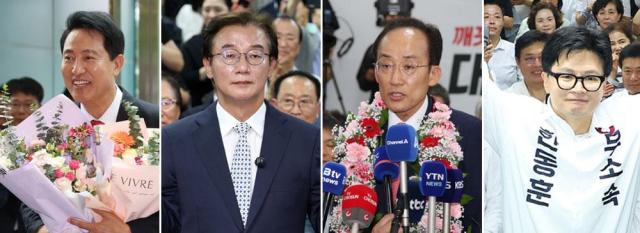
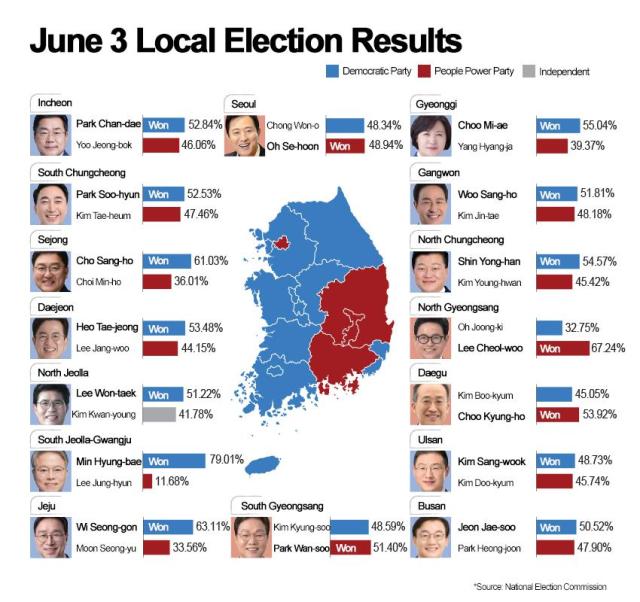
While the liberal party regained ground nationwide under President Lee Jae Myung, analysts said even a handful of defeats in high-profile races suggested voter dissatisfaction with the ruling camp despite its numerical advantage.
The DP suffered a particularly painful loss in Seoul, widely regarded as the symbolic center of South Korean politics and a key barometer of centrist public opinion.
The party also lost several closely watched parliamentary by-elections held simultaneously with the local elections including a tight race in the Buk district of the country's southern port city of Busan, where independent candidate Han Dong-hoon defeated DP candidate Ha Jung-woo in a dramatic reversal.
Political observers said the mixed outcome reflected sophisticated "split-ticket voting" by the electorate, with voters backing the ruling party in many regional races while supporting conservative or independent candidates in strategically important contests.
Despite losing Seoul, the DP lawmakers significantly improved their standing in the capital's district-level races. The party won 17 of Seoul's 25 district mayor posts, reversing the political map from the 2022 local elections, when conservatives held 17 districts and the Democrats controlled only eight.
Still, defeats in Seoul and conservative strongholds raised concerns inside the ruling camp about waning support among moderates and voters in the capital regions.
The June 3 elections also highlighted signs of changing political dynamics in the conservative stronghold of Daegu.
DP candidate Kim Boo-kyum earned 45.05 percent of the vote in the Daegu mayoral race, an impressive improvement compared with the party's performance in the 2022 election. People Power Party (PPP) candidate Choo Kyung-ho won the race with 53.92 percent.
In the previous local elections in 2022, PPP candidate Hong Joon-pyo won the Daegu mayoralty with 78.75 percent, while the DP candidate received only 17.97 percent.
Although Kim fell short of victory, party officials viewed the result as evidence that regional political barriers in the country's southeast may be weakening.
Attention is now shifting to the DP's upcoming national convention, expected as early as August, where party leader Jung Chung-rae is widely expected to seek another term.
Jung is expected to argue that leading the party to victories in 12 metropolitan races justifies his reelection, while critics inside the party point to losses in Seoul and major by-elections as evidence of strategic failures.
Potential challengers include Prime Minister Kim Min-seok and former party leader Song Young-gil, according to party officials.
The results also intensified pressure on the PPP's leader Jang Dong-hyeok.
Calls for Jang's resignation emerged within the party after conservatives failed to prevent the DP from dominating the nationwide gubernatorial races. However, Jang rejected demands to step down, saying Thursday that he would continue leading the party and seek a "new path" together with party members.
Conservative lawmakers nonetheless argued that the party's overall defeat overshadowed gains in the parliamentary by-elections, where the opposition and independent conservative candidates secured several important victories.
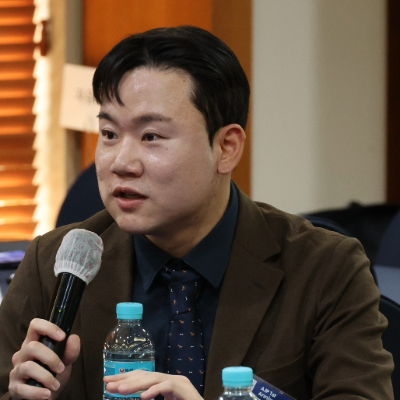
Rep. Kim Kyo-heung, a three-term politician from the DP, acknowledged the mixed public sentiment reflected in the election.
"Even though the DP won the local elections overall, it lost the Seoul mayoral race, candidate Ha's race in Busan, the by-election in Pyeongtaek, and the mayoral elections in Ansan, Seongnam, and Yongin,” Kim said.
"The DP governors, mayors, district heads, city council members, district council members and county council members elected in this election must remain humble," he added.
A three-term lawmaker from the PPP said the opposition faced structural disadvantages. "In my experience, the first election held one year after a presidential election is always extremely difficult for the opposition," the lawmaker said.
Yoon Sang-hyun, a five-term lawmaker from the PPP, said the local elections had been winnable for the party but that it lost because of internal divisions and a lack of vision.
Yoon said the party had called for judgment against President Lee Jae Myung, but "that alone was not enough because we failed to speak about hope together."
He said the only way for the PPP to win nationwide elections again was for politicians who share conservative values to unite, rather than divide into rival factions and fight each other.
"If we split the party in two while fighting over who is pro-Yoon and who is anti-Yoon, we will once again forget why voters punished us yesterday," he added.
Copyright ⓒ Aju Press All rights reserved.
