

Journalist

KI SU JEONG
-
 Han Dong-hoon Wins Busan North District by-election, Aims to Restore Balance in South Korea Han Dong-hoon, an independent candidate, has won the by-election for the Busan North District seat in the National Assembly. According to the National Election Commission on June 4, Han secured his victory by a margin of 1,425 votes over Ha Jung-woo, the candidate from the Democratic Party. Upon confirmation of his election, Han expressed his gratitude, stating, "I sincerely thank the great citizens of Buk-gu for opening the path to a historic victory for the future of our district and the revival of conservatism." He pledged to prioritize the interests of Buk-gu residents, Busan citizens, and the people of South Korea in fulfilling his responsibilities. "I will focus on the development of Buk-gu, the rebuilding of conservatism, and controlling the runaway government of Lee Jae-myung to restore balance in South Korea," he vowed. Han also remarked, "I have realized how formidable and awe-inspiring public sentiment is. I will be a politician who listens to the people's voice." Regarding his plans to rejoin the People Power Party, he stated, "Specific plans are not important; I will keep my promise to return." He further addressed the leadership of Jang Dong-hyuk, asserting, "This election was not just about my evaluation. The urgent need for conservative revival is what the citizens have mandated us to achieve."* This article has been translated by AI. 2026-06-04 02:45:00
 -
 Min Hyung-bae Elected as First Mayor of Integrated Jeonnam-Gwangju Min Hyung-bae of the Democratic Party has been elected as the first mayor of the Integrated Jeonnam-Gwangju. According to the National Election Commission, as of 2 a.m. on June 4, with 87.16% of the votes counted, Min secured 79.02% of the total votes. He decisively defeated Lee Jeong-hyun of the People Power Party, who received 11.58%, as well as Kang Eun-mi of the Justice Party with 3.92%, Lee Jong-wook of the Progressive Party with 3.72%, and independent candidate Kim Kwang-man, who garnered 1.74%. After the announcement of his election victory on June 3 at his campaign office in Seo-gu, Gwangju, Min expressed his gratitude, stating, "You have entrusted me with the significant responsibility of being the mayor of the Integrated Jeonnam-Gwangju. I sincerely thank you and will honor the choice of the citizens." He added, "We stand at the threshold of South Korea's first and only integrated special city. This is an opportunity for Jeonnam and Gwangju to unite and become a new growth axis for the country. Together with the citizens, we will pave this new path and demonstrate overwhelming growth led by the region." Min also emphasized his commitment to creating opportunities for growth, stating, "I will provide young people with the chance to dream in their hometowns, ensure reliable care for families raising children, and guarantee seniors access to nearby hospitals and a safe daily life." He concluded by pledging to establish a citizen-led government where administrative actions follow the decisions of the people.* This article has been translated by AI. 2026-06-04 02:36:00
 -
 Song Young-gil Poised for Return to National Assembly After By-Election Victory Former Democratic Party leader Song Young-gil is set to return to the National Assembly, with expectations of making a significant impact at the party's convention in August. As of 2 a.m. on June 4, Song is projected to win the by-election for the Incheon Yeonsu-gap district, leading by a substantial margin over his opponent, Park Jong-jin of the People Power Party. Upon confirming his likely victory, Song visited his campaign office and stated, "I will be a strong support for the Lee Jae-myung government," adding, "I will work hard to help the Democratic Party maintain its focus." He emphasized, "I take seriously the residents' demand for a politics that is evaluated based on ability and results. I will devote all my efforts to the development of Yeonsu." This marks Song's anticipated return to the National Assembly after resigning his seat in 2022 to run for mayor of Seoul. Should he return, he is expected to compete for party leadership against figures such as Jeong Cheong-rae and Kim Min-seok. During the election period, Song expressed his dissent against the party leadership's decisions and indicated he might enter the leadership race if called upon by party members. If elected, Song will achieve his sixth term in the National Assembly, joining fellow Democratic Party member Jo Jeong-sik, who has also been nominated as a candidate for National Assembly Speaker, as one of the longest-serving members in the party. Song has shifted from his previous constituency in Incheon Gyeyang-gu to run in Incheon Yeonsu-gap this time.* This article has been translated by AI. 2026-06-04 02:24:00
 -
 Experts Urge Focus on Livelihoods and Community Unity After Local Elections The first nationwide election since the launch of the Lee Jae-myung administration has concluded. In the June 3 local elections, 4,227 officials were elected, including heads of regional governments, education superintendents, local government heads, and various council members. Additionally, 14 vacant National Assembly seats were filled by local voters. In an interview with Aju Economy on June 3, six political analysts identified improving livelihoods and revitalizing local economies as the top priorities for the newly elected officials. They also emphasized the need to unify a divided public sentiment during the election period. It was suggested that this process could lead to competition for party leadership and a realignment of the political landscape between progressive and conservative factions. "Livelihoods Are on the Brink... Local Governments Must Step Up" Experts unanimously agreed that newly elected officials must prioritize improving livelihoods and local economies. They also advised that elected leaders in the metropolitan area should address real estate issues. Given the number of regional governments that have seen leadership changes, there is a strong call for these officials to demonstrate a new approach. Eom Kyung-young, head of the Era Spirit Research Institute, stated, "Despite recent positive developments in exports and the stock market, the polarization of real income and regional economic stagnation are worsening. Improving livelihoods and revitalizing local economies should be the top priority through collaboration with the central government or alliances with other regional governments." Political analyst Park Sang-byeong remarked, "Livelihoods are not just on the brink; they have already fallen off the edge. The central government must look at the entire nation, so local governments need to take responsibility for livelihoods. It is the mandate of the citizens for mayors and governors to embrace the declining livelihoods." Choi Jin, head of the Presidential Leadership Research Institute, advised, "Do not be overly swayed by central politics; focus all efforts on revitalizing the local economy. Given the difficulties in local economies, there must be a concerted effort to recover in the short term." The intense rivalry between the ruling and opposition parties during the local election process, along with internal conflicts over party nominations, underscored the importance of unity. Leaders must demonstrate the ability to mend divided public sentiment and move toward common goals. Political analyst Lee Jong-hoon emphasized, "It is crucial for elected officials to fulfill their campaign promises, but those who win by narrow margins must pay more attention to unity. They should pursue a pragmatic approach to foster community integration." Choi Yo-han, another political analyst, added, "I hope the government and local authorities can work together as co-responsible entities chosen by voters, transforming crises into opportunities, rather than engaging in passive administration where the state supports and the region merely executes." Next Nationwide Election in Two Years... Accelerating Political Landscape Changes With no nationwide elections scheduled until the April 2028 general election, both progressive and conservative factions are expected to undergo a realignment. Experts predict an intensification of the internal power struggle within the Democratic Party and the People Power Party, urging a swift resolution of internal conflicts. The results of this local election are not anticipated to significantly impact the next general election. Voters are likely to base their decisions more on evaluations of the Lee Jae-myung administration and the Democratic Party regarding central political issues rather than the political landscape of local power. Shin Yul, a professor of political science at Myongji University, noted, "Theoretically, local power can activate regional organizations, but general elections are more influenced by central political issues. In the 2024 general election, the People Power Party held local power, yet the Democratic Party secured nearly all the seats." However, some experts argue that the winning party in local elections, often referred to as grassroots democracy, cannot be overlooked as it may provide an advantageous position for the next general election. Choi Jin stated, "Controlling local power can create favorable conditions in both physical and institutional aspects." Experts are focusing more on the immediate internal power struggles within the Democratic Party and the People Power Party, as well as the potential realignment of the progressive and conservative political landscape, rather than the general election two years from now. The Democratic Party is preparing for its national convention in August, while the People Power Party faces growing skepticism about the 'Jang Dong-hyuk regime' due to the election results, making internal competition for leadership inevitable. Additionally, discussions about the integration and reorganization of the progressive camp, including the Democratic Party and the Justice Party, as well as competition for leadership or potential splits within the conservative camp, are also expected to emerge. Choi Jin predicted, "The Democratic Party's national convention will be heated. Conflicts between factions will intensify as they prepare for the next presidential election," adding that the conflicts arising from the election period between the Democratic Party and the Justice Party may cause discussions on integration to temporarily subside. There are also suggestions that the Democratic Party should focus more on re-establishing its government rather than internal power struggles. Park Sang-byeong warned, "While we will unite for the success of the Lee Jae-myung administration and the re-establishment of the government after the election, internal disputes will continue. However, the more important factor is achieving tangible results. Without concrete achievements, we will not receive votes in the next general election." Experts also raised the possibility of renewed discussions on the merger between the Democratic Party and the Justice Party, which had surfaced earlier this year. Park Sang-byeong stated, "It will be difficult for the Democratic Party and the Justice Party to separate before the general election. The manner of their integration will be crucial, depending on whether Justice Party leader Cho Kuk enters the National Assembly, which will determine whether it is an equal merger or an absorption merger." However, some believe that the intense clashes between the two parties during this election, coupled with the imminent Democratic Party national convention, could serve as variables in the reorganization of the progressive camp. The People Power Party is also expected to face sharp conflicts among its factions. Choi Jin predicted, "The pro-Yoon (supporters of President Yoon Suk-yeol) and anti-Yoon factions will fight fiercely, as they must seek a path forward for the next general election while engaging in a bloody struggle for leadership." Analysts suggest that the by-elections will have a greater impact on the internal power dynamics of the People Power Party than the local elections. Shin Yul stated, "Chairman Jang will not relinquish his position regardless of the outcome. The conservative camp's dynamics will depend heavily on former leader Han Dong-hoon's entry into the National Assembly, which will influence various scenarios and the presidential race." There are also concerns that the Jang Dong-hyuk regime may collapse following the local election defeat, or that a new conservative party may emerge. Eom Kyung-young predicted, "The People Power Party will inevitably distance itself from the far-right factions known as 'Yoon Again.' The leadership of Jang Dong-hyuk has been significantly undermined due to the local elections, indicating a potential transitional period for establishing new leadership." Park Sang-byeong also noted, "The conflict between those trying to maintain the Jang Dong-hyuk regime and those seeking to dismantle it will continue until the next general election. If the internal situation does not change significantly as the general election approaches, a new conservative party may emerge."* This article has been translated by AI. 2026-06-04 02:06:00
 -
 Ruling Party Gains Public Support, Accelerates Legislative Agenda Under Lee Jae-myung's Government The ruling party has strengthened its position in the National Assembly and secured significant local power, bolstering the governance of Lee Jae-myung's administration. The government and ruling party are expected to accelerate their legislative agenda, focusing on economic and reform initiatives based on cooperation between central and local governments. According to political sources on June 3, the local elections held on that day were the first nationwide elections since the inception of the Lee Jae-myung administration, effectively serving as a midterm evaluation of the new government. Exit polls indicated that the Democratic Party is projected to win most of the regional leadership positions. The Democratic Party has established a favorable trend, particularly in the Seoul metropolitan area and the Chungcheong region. This continued momentum following last year's general election victory is seen as a reflection of the early stability narrative of the administration. The party emphasized the need for policy cooperation between the central and local governments during the election campaign, promoting support for the administration. Lee Yeon-hee, the Democratic Party's Strategic Planning Committee Chair, commented on the exit poll results from the three major broadcasting networks (KBS, MBC, SBS), stating, "This is a predictive survey confirming public sentiment supporting President Lee Jae-myung's effective governance and national stability." Regarding the high voter turnout exceeding 60%, she analyzed that "the Democratic Party's supporters and moderate voters seeking stability in governance came out to the polls to lend support to the Lee Jae-myung administration and to energize the government's agenda." The party's advantage in the Seoul metropolitan area is considered significant, as this region is home to nearly half of the nation's voters and is a key battleground that can influence national election outcomes. While the main opposition party, the People Power Party, emphasized the need for checks on the administration, they failed to overcome the ruling party's narrative of national stability. Winning in the Chungcheong region, which has historically played a decisive role in elections, is also viewed positively. The nationwide public sentiment is expected to bolster the legislative process for the administration's agenda in the National Assembly. With the Democratic Party holding a majority in the National Assembly and securing significant local government positions, the momentum for policy initiatives is likely to increase. With no nationwide elections until the 2028 general elections, the government and the National Assembly have time to focus on completing reform tasks. The ruling party plans to intensify efforts in the upcoming regular session of the National Assembly to address issues such as normalizing the real estate market and promoting balanced regional development, which President Lee has emphasized since taking office. Discussions on the proposed citizen dividend system utilizing artificial intelligence (AI) revenue, introduced by Chief Policy Officer Kim Yong-beom during the election period, may also commence in earnest. The re-pursuit of the so-called "Special Prosecutor Law" granting the right to dismiss charges is also anticipated. Although the Democratic Party took a step back due to strong opposition from the opposition party and the legal community before the local elections, they have decided to process the special prosecutor law following the elections. President Lee also mentioned on May 4 that "it is essential to clarify the truth through a special prosecutor and to establish judicial justice," highlighting the necessity of the special prosecutor law. However, the relatively close results in the Yeongnam region and some key battlegrounds suggest that the government and ruling party may need to moderate their pace in future governance. While they achieved victories nationwide, there remains significant public sentiment advocating for checks on the government in various regions. As a result, rather than pushing forward with reform tasks unilaterally, the administration is expected to carefully monitor public opinion trends and adjust the pace and priorities of their initiatives. Policies directly related to people's livelihoods and the economy are likely to be approached with caution, fostering social consensus and cooperation with the opposition party.* This article has been translated by AI. 2026-06-04 02:06:00
 -
 Democratic Party Wins Local Elections, Opposition Suffers Defeat The Democratic Party achieved a decisive victory in the local elections and National Assembly by-elections held on June 3, with no unexpected outcomes. The People Power Party had hoped for a last-minute rallying of support, aided by former Presidents Lee Myung-bak and Park Geun-hye campaigning for them, but failed to turn the tide. This outcome is seen as a boost for the administration of President Lee Jae-myung, marking its first year in office. In this election, the Democratic Party was expected to sweep the metropolitan area, and it demonstrated strong support even in the conservative stronghold of Yeongnam. The party attributed its success to high approval ratings for President Lee Jae-myung. Cho Seung-rae, the party's secretary-general, held a briefing at the National Assembly around 10 p.m., stating, "We asked the public to support the president, and they responded." Conversely, the People Power Party, which had expressed optimism about a close contest due to late conservative consolidation, appeared shocked as the results came in. Following the exit polls, the party's leadership has not issued any significant statements regarding the election outcome. Earlier, Jang Dong-hyuk, the party leader, left the counting room without making any comments. The atmosphere in the counting room was filled with sighs and silence. As of 11:50 p.m., the People Power Party was leading in the conservative strongholds of Gyeongbuk and Gyeongnam, but was trailing in other regions. In Daegu, known as a conservative bastion, the race remained tight. Throughout the election, the People Power Party attempted to criticize the Lee Jae-myung administration by discussing issues like the cancellation of prosecution special investigations, but their efforts did not resonate with voters. Consequently, calls for the resignation of Jang Dong-hyuk's leadership are expected to intensify. Regarding the election results, Eom Kyung-young, director of the Era Spirit Research Institute, told Aju Economy, "With no nationwide elections for the next two years, this is akin to giving a blank check to President Lee and the Democratic Party," adding that it reflects public sentiment allowing the ruling party to govern as it sees fit. He also emphasized that this could be viewed as a judgment on the regressive actions of Jang Dong-hyuk and the People Power Party. 2026-06-04 02:06:00
 -
 Choo Mi-ae Thanks Gyeonggi Residents After Winning Governor Election Choo Mi-ae, the Democratic Party candidate elected as the governor of Gyeonggi Province, expressed her heartfelt gratitude to the residents on June 4, stating, "I sincerely thank the citizens for their choice." Choo arrived at the election office in Ingyedong, Suwon, shortly after midnight and received congratulations from members of her campaign committee. Reflecting on her campaign journey, she remarked, "I have never taken an easy path and have always focused on the people. I am truly grateful that the citizens of Gyeonggi trusted my sincerity and chose me." She added, "This choice goes beyond support for me personally; it reflects the Gyeonggi residents' desire for normalization in South Korea and significant change in Gyeonggi Province." Choo pledged to accelerate the 'Gyeonggi Transformation' as an administrator, saying, "I feel a heavy responsibility to ensure that this choice is one that residents will never regret. I will work closely with Gyeonggi lawmakers and local leaders to address the pressing issues of transportation, housing, jobs, and balanced development." She emphasized, "From now on, I will take responsibility for the Gyeonggi Transformation and pave the way for a proud Gyeonggi. I will faithfully uphold the changes and results that the residents desire." With this victory, Choo has made history as the first female head of a metropolitan government, following her record as the longest-serving female lawmaker. However, she downplayed speculation about her potential candidacy in the next presidential election. Choo stated, "I need to earn the trust that I can handle this role well before considering larger responsibilities. I cannot use this position as a means to an end." She added, "I must build trust through my capabilities before thinking about the next steps. Deciding on future ambitions right after being elected does not align with my philosophy or principles." Later that morning, Choo will begin her first official schedule as governor by paying respects at the Suwon Memorial Tower, followed by attending the campaign committee's disbandment ceremony at her election office.* This article has been translated by AI. 2026-06-04 01:21:00
 -
 Will Promises on Railways, Redevelopment, and Subsidies Be Fulfilled After the Election? Following the local elections, voters' attention naturally shifts to the fulfillment of campaign promises. There is growing curiosity about when the various commitments made during the campaign—such as expanding rail and transportation networks, revitalizing redevelopment and reconstruction projects, enhancing welfare for youth and seniors, distributing local currency, and increasing caregiving services—will become a reality. To be clear, promises will not be implemented immediately after the election. The first step following the election is a thorough review of the commitments. Elected local government heads can establish a transition committee once their election is confirmed. This committee assesses the organization, functions, and budget status of the local government, as well as prepares the new leader's policy direction. During this process, campaign promises are reformulated into administrative language. While promises made during the campaign were commitments to “do” something, the transition committee will begin evaluating whether there is funding available, whether amendments to ordinances are necessary, whether discussions with the central government or regional authorities are required, and whether local council approval can be secured. Particularly for promises that involve funding, the budgetary process cannot be bypassed. According to local government law, the budget proposal is prepared by the local government head and submitted to the local council, which then reviews and approves it. The establishment, amendment, or repeal of ordinances, as well as the review and confirmation of budgets, are also matters that require council approval. Therefore, promises that require financial resources, such as expanding local currency, providing youth allowances, supporting senior transportation costs, and offering childbirth and childcare subsidies, cannot be implemented solely based on the new leader's will. It may be necessary to secure related budgets and amend existing ordinances or create new ones. If changes to already approved budgets are required, the preparation of a supplementary budget proposal and the approval process by the local council may also be needed. Large-scale promises, such as redevelopment and reconstruction, road and rail projects, and the establishment of industrial complexes, are even more complex. These issues cannot be resolved solely with the local government's budget; they also involve urban planning, permits, negotiations with the central government and regional authorities, and coordination with private businesses. What appeared as a simple slogan during the election may require multiple procedures once it enters the realm of administration. However, June is not a meaningless period. Rather, it is during this time that the priorities of the promises will be established. The transition committee will reveal which promises are classified as key tasks, which projects will be pursued in the early stages of the term, and which existing projects will be maintained or modified, thereby indicating the direction of the new local government. Voters should pay close attention to this aspect after the election. It is crucial to observe whether the elected official's promises are reflected in the actual budget proposals, organizational restructuring, and plans for advancing ordinances. If pre-election commitments do not transform into post-election administrative plans, they will remain mere slogans. While the local elections have concluded, the verification of promises is just beginning. The transition process that starts immediately after the election will serve as the first test of what the new local government will prioritize, what will be postponed, and what may be effectively abandoned.* This article has been translated by AI. 2026-06-04 00:03:00
 -
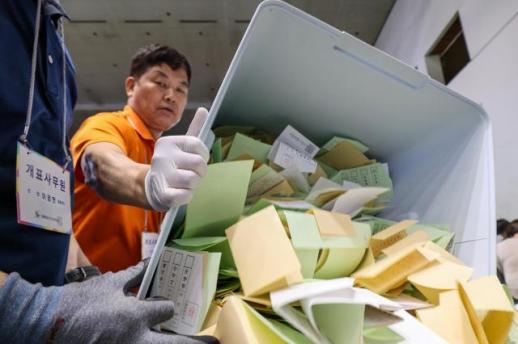 Ruling Democratic Party dominates early vote counting in S. Korea's local elections SEOUL, June 03 (AJP) - Early vote counting for the June 3 local elections shows the ruling Democratic Party taking the lead in 14 of 16 metropolitan and provincial races, including the Seoul mayoral election. The conservative People Power Party is leading in only one region, North Gyeongsang Province. If the current trend continues, the elections will end in a sweeping victory for the Democratic Party. The early results suggest that voters in the first nationwide elections since President Lee Jae Myung took office a year ago are heavily backing the ruling party. The Democratic Party framed the election as a judgment on the 2024 insurrection and a vote for government stability, countering the opposition's calls to hold the current administration accountable. According to the National Election Commission, 14.0 percent of all votes had been counted as of 10 p.m. Wednesday. In the highly contested Seoul mayoral race, where 5.46 percent of votes have been counted, Democratic Party candidate Jung Won-oh is leading with 65.72 percent against People Power Party incumbent Oh Se-hoon, who has 31.88 percent. The counting rate remains below average in Seocho and Songpa districts, which are traditional conservative strongholds in the capital. The Seoul mayoral race was marred by logistical issues earlier in the day when polling stations in Songpa, Gangnam, and Gwangjin districts ran out of ballot papers, leaving voters waiting in line. The People Power Party is demanding a halt to the vote counting and calling for a revote in the city. In Gyeonggi Province, Democratic Party candidate Choo Mi-ae leads with 51.07 percent over the People Power Party's Yang Hyang-ja, who has 43.16 percent. In Incheon, Democratic Party candidate Park Chan-dae is ahead with 60.04 percent against the People Power Party's Yoo Jeong-bok at 39.04 percent. The Democratic Party also took early leads in four regions that exit polls conducted by three major broadcasters had projected as tight races: Busan, Daegu, North Jeolla Province, and Gangwon Province. In Busan, the Democratic Party's Jeon Jae-soo leads with 53.60 percent against the People Power Party's Park Hyung-jun. In Daegu, Kim Boo-kyum of the Democratic Party has 53.48 percent, leading the People Power Party's Choo Kyung-ho. In Gangwon Province, the Democratic Party's Woo Sang-ho is ahead of the People Power Party's Kim Jin-tae with 54.00 percent. In North Jeolla Province, Democratic Party candidate Lee Won-taek is leading independent Kim Kwan-young with 52.52 percent to 41.37 percent. Democratic Party candidates Min Hyung-bae in Jeonnam-Gwangju Special City and Wi Seong-gon in Jeju Province are certain to win, securing 81.62 percent and 61.35 percent, respectively. For the People Power Party, Lee Cheol-woo is the likely winner in North Gyeongsang Province with 64.64 percent. The race for South Gyeongsang Province governor remains a dead heat with 14.98 percent of the votes counted. Democratic Party candidate Kim Kyoung-soo has 49.71 percent, narrowly trailing the People Power Party's Park Wan-soo at 50.28 percent. The Democratic Party is also dominating the 14 parliamentary by-elections held alongside the local elections. In the Busan Buk-gap district, with 8.7 percent of votes counted, Democratic Party candidate Ha Jung-woo is leading with 53.37 percent. He is comfortably ahead of independent Han Dong-hoon at 38.55 percent and the People Power Party's Park Min-shik at 8.06 percent. In Gyeonggi Province's Pyeongtaek-eul district, where 6.1 percent of the vote has been counted, Rebuilding Korea Party candidate Cho Kuk is leading a three-way race with 38.12 percent. He is followed by the Democratic Party's Kim Yong-nam at 32.80 percent and the People Power Party's Yu Eui-dong at 23.76 percent. In the Gongju-Buyeo-Cheongyang district of South Chungcheong Province, Democratic Party candidate Kim Young-bin leads with 55.06 percent against the People Power Party's Yoon Yong-geun at 39.26 percent, with 10.48 percent of votes counted. In Ulsan's Nam-gap district, traditionally considered a conservative stronghold, Democratic Party candidate Jeon Tae-jin is leading with 57.41 percent against the People Power Party's Kim Tae-gyu at 37.40 percent, based on a counting rate of 8.7 percent. In Gyeonggi Province's Hanam-gap district, which saw a razor-thin margin in the previous general election, Democratic Party candidate Lee Kwang-jae is leading with 66.42 percent against the People Power Party's Lee Yong at 31.66 percent, with 14.0 percent of the vote counted. The People Power Party is securing a significant lead in Daegu's Dalseong-gun district, where Lee Jin-sook has 64.54 percent compared to the Democratic Party's Park Hyung-ryong at 35.45 percent, with 32.3 percent of the vote counted. Of the 14 seats contested in the by-elections, 13 were previously held by the Democratic Party and one by the People Power Party. 2026-06-03 23:59:28
 -
 Cabinet Reshuffle Expected Following Democratic Party Victory in Local Elections 6·3 local elections concluded without surprises, resulting in a victory for the ruling Democratic Party, which has shifted focus to the formation of the second Cabinet of the people's sovereignty government.According to political sources on June 3, President Lee Jae-myung is expected to initiate a Cabinet reshuffle soon.The most significant focus is on the Prime Minister position. Kim Min-seok, who is being mentioned as a potential candidate for the party leadership, is likely to submit his resignation within this month. On June 2, he held a farewell dinner with Cabinet members at the Prime Minister's residence in Samcheong-dong, Seoul, which some in the political arena interpreted as a goodbye gathering.The attention on the next Prime Minister is heightened not only because it is a key appointment but also because potential candidates are already serving in the Cabinet.In the Blue House, speculation has arisen that Chief of Staff Kang Hoon-sik and Policy Chief Kim Yong-beom could be appointed as the next Prime Minister. As the administration enters its second year, it is essential to demonstrate governance achievements, making the likelihood of surprising external appointments low.Among current Cabinet members, Justice Minister Jeong Seong-ho, Deputy Prime Minister and Minister of Economy Koo Yun-cheol, Minister of Trade, Industry and Energy Kim Jeong-kwan, and Minister of the Interior and Safety Yoon Ho-jung are also being considered.Minister Jeong passed the 28th Judicial Examination and graduated from the Judicial Research and Training Institute alongside President Lee. He has maintained a close relationship with the President for nearly 40 years, often referred to as a leader of the pro-Lee faction during Lee's tenure as Democratic Party leader.On the same day, President Lee encouraged voting through a message on X (formerly Twitter), announcing Minister Jeong's entry into social media and urging followers to support him.As Prime Minister Kim's resignation is anticipated, the nomination of his successor will likely lead to appointments of other ministers and Blue House aides.There are indications that evaluations of the first Cabinet's performance have concluded. A significant reshuffle involving three to four ministries is expected, creating a tense atmosphere within those departments. Given President Lee's governance style, a thorough performance-based reshuffle is anticipated. The second Cabinet appointments are expected to resume around July, coinciding with departmental reports.If Minister Jeong is not nominated as the next Prime Minister, he is expected to retain his position. Minister Kim, who heads the Ministry of Trade, is likely to remain in his role due to the continuity required in U.S.-Korea tariff negotiations and the transition to AI in manufacturing.Ministers Jeong Dong-young (Unification), Park Jin (Foreign Affairs), Ahn Gyu-baek (Defense), and Baek Kyung-hun (Science and ICT) may also be included in the reshuffle.The reshuffle of Blue House aides is also imminent. The vacancies left by former Chief of Future Planning for AI Ha Jung-woo and former spokespersons Kim Nam-jun and Jeon Eun-soo, who left to run in the elections, will need to be filled. There is also speculation that individuals who campaigned but unfortunately lost may be considered for future talent pools.Additionally, rumors of personnel changes at the senior secretary level are circulating within and outside the ruling party.* This article has been translated by AI. 2026-06-03 23:57:00