

Journalist

Ko Yu-hwan
-
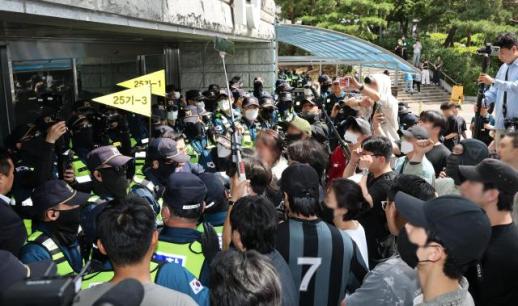 Legal Battle Looms Over Voting Paper Shortage in Local Elections A historic shortage of voting papers during the June 3 local elections is set to escalate into a legal battle. A constitutional petition has been filed alleging violations of voters' rights, while defeated candidates are preparing lawsuits to invalidate the election and seek state compensation, indicating a broad legal confrontation ahead. According to legal sources on June 5, the Constitutional Court has accepted a petition filed by a citizen against the National Election Commission (NEC) regarding the constitutionality of the voting paper shortage. The petitioner claims that the NEC's failure to provide sufficient ballots infringed upon the fundamental right to vote. Additionally, attorney Do Tae-woo, who previously represented the defense during President Yoon Suk Yeol's impeachment trial, has announced plans to file a constitutional petition and a request for a provisional injunction against the NEC. The Constitutional Court will first review whether the petition meets legal requirements with a designated panel of three judges. If deemed valid, the case will be referred to the full panel of nine judges for further deliberation. Civic groups have also swiftly filed criminal complaints. On June 3, the Citizens' Livelihood Countermeasures Committee reported NEC Chairman Noh Tae-ak and Secretary-General Heo Cheol-hoon, among other senior officials, to the Seoul Metropolitan Police for neglect of duty and abuse of power. The police plan to begin investigations with witness interviews starting June 8. As the situation develops into a legal dispute, legal experts suggest that proving criminal intent may be challenging unless clear evidence is presented. The most contentious legal issue will likely arise from lawsuits filed by defeated candidates. The NEC has stated that there will be no re-voting or re-elections due to this incident. However, under the Public Election Act, candidates or parties can file for election invalidation or disqualification lawsuits within two weeks of the election date. The critical question remains whether the shortage of ballots had a tangible impact on the election results. Attorney Jeong Byeong-sil, an expert in election law, noted, "A shortage of ballots alone does not automatically invalidate an election. The specifics and extent of the violation, as well as the number of voters who left without voting, will be key issues that could affect the outcome of the election." Jeong added that since Oh Se-hoon, affiliated with the People Power Party, was elected, it seems unlikely that the party would continue to demand a halt to the counting process. However, for city councilors or district councilors, if they believe their election outcomes were affected, they may still pursue separate lawsuits for election invalidation or disqualification. In contrast, the situation could change for local council elections where outcomes are determined by narrow margins. If the number of voters who could not cast their ballots exceeds the vote difference, it could be argued that the irregularity affected the election results. Furthermore, there is a possibility that a similar case from the 2021 Berlin local elections, where a shortage of ballots led to a re-election order the following year, could be mirrored in local elections in South Korea. However, a lawyer from Seocho District stated, "The mentioned overseas case differs from our legal system, and the circumstances are quite different from those in South Korea, so even if a lawsuit proceeds, it seems unlikely that the results of the Seoul mayoral election would be deemed invalid." Separately from the potential for election result reversals through lawsuits, individual voters whose rights were infringed may have a strong case for civil claims against the state for compensation. Jeong explained, "Regardless of the conclusion on election invalidation or disqualification, voters who did not receive ballots could file for damages against the state due to the infringement of their voting rights." 2026-06-05 16:39:00
 -
 NVIDIA CEO Jensen Huang Celebrates Korean Gaming Culture at T1 Basecamp Jensen Huang, CEO of NVIDIA, arrived in Korea on June 5 and immediately visited a PC bang, expressing high regard for the country's gaming culture and esports. Huang landed at Gimpo International Airport around 1 p.m. and headed to the T1 Basecamp PC bang in Hongdae, where he met with League of Legends esports team T1 players, including Faker (Lee Sang-hyeok), Doran (Choi Hyun-jun), Owner (Moon Hyun-jun), Phase (Kim Soo-hwan), and Keria (Ryu Min-seok). The T1 Basecamp is operated by T1. According to T1 officials, the players were pleased to meet Huang despite their busy schedules during the 2026 LoL Champions Korea season. Fans welcomed Huang with cheers as he interacted with them, taking photos and signing autographs. Huang remarked, "The Korean gaming industry made GeForce a big bang." He expressed gratitude for the growth of NVIDIA alongside the popularity of gaming in Korea and the development of PC bang culture. He added, "Korea's gaming culture has brought GeForce to its current position, and this is entirely thanks to Korea." He also stated, "Korea is the birthplace of esports. Korea created esports and the culture of watching esports." Huang emphasized, "Korea has held a special place in my heart for a long time and is very important to NVIDIA. Thank you for supporting us for so long. We are also your passionate fans." On this occasion, Huang gifted Faker a signed GeForce RTX 5090 graphics card, which currently trades for over 4 million won. Huang described it as a "one-of-a-kind graphics card" and joked that it could be worth a million dollars. During the event, Huang introduced NVIDIA's new PC superchip, the RTX Spark, which can handle complex software stacks like DirectX and OpenGL simultaneously and will support AI agents on PCs in the future. The RTX Spark is currently being developed for laptops, desktops, and workstations, with a planned release this fall. Huang and Faker also hosted a fan event, giving away GeForce and RTX Spark vouchers to attendees. Faker commented on the meeting with Huang, saying, "Graphics cards are very important to gamers. I believe we owe our success as gamers to NVIDIA's graphics cards, making this a very meaningful time." 2026-06-05 16:39:00
 -
 Starbucks Controversy Highlights Political Tensions in South Korea Initially, the controversy surrounding Starbucks Korea's 'Tank Day' appeared to be a marketing misstep. However, as time passed, it became evident that the incident exposed deep societal fractures in South Korea. The issue began on the anniversary of the May 18 Democratic Movement when Starbucks Korea used the phrase 'Tank Day' in its promotions, which was deemed highly inappropriate. Critics argued that the company showed a severe lack of historical sensitivity. For the people of Gwangju and the families of the victims, this was not merely a marketing slogan but a painful reminder of past wounds.In response, Starbucks quickly halted the event, dismissed its CEO, and both Jeong Yong-jin and the U.S. headquarters issued apologies. This marked the first time since the company's founding that the chairman publicly apologized to the nation. Jeong announced plans to conduct an internal investigation and implement measures to prevent a recurrence.Companies must take responsibility for their actions, especially when they trivialize issues connected to the tragedies of modern Korean history. Global corporations should adhere to stricter standards when addressing historical and social memories.However, the controversy did not stop there. It swiftly escalated into the political arena, with the ruling party, government ministries, and the Blue House all taking action. Some ministries effectively began to discourage the use of Starbucks products or halt collaborations. The Democratic Party even proposed amendments to the May 18 Special Act. In contrast, the opposition criticized this as a "government-led boycott," "political violence," and a "people's trial for the local elections." Ultimately, the Starbucks controversy transformed from a corporate crisis into a battleground for partisan politics.The May 18 incident is a significant historical event that cannot be treated lightly. Gwangju symbolizes South Korea's democracy. Given the upcoming local elections, the political response is somewhat understandable, as the May 18 movement remains a current political and social symbol.Nevertheless, there are boundaries that politics must respect. In a democratic society, voluntary boycotts by consumers are a form of freedom, and it is natural for civil society to criticize corporations. However, when government entities exert pressure to discourage the use of specific companies, it raises concerns about excessive state intervention in the market and consumer choices.Particularly concerning is the rapid escalation of pressure from government ministries and the ruling party following presidential remarks. Some ministers even suggested measures such as halting Starbucks operations or reviewing purchase histories. The opposition responded by stating, "We have become a society that judges even coffee brands through political lenses."This situation is not solely a result of Starbucks' misstep. Jeong Yong-jin's political image has also played a significant role. His previously established conservative image, shaped by past controversies such as the 'anti-communism' hashtag, has amplified the current backlash. Criticism from political circles and civic groups has shifted focus from Starbucks' management to Jeong personally, with demands for him to "kneel and apologize," "repent," and even "resign." What began as a marketing failure has morphed into a political trial of the corporate leader.In today's interconnected world, the social media statements and political images of corporate leaders carry significant weight. In a society like South Korea, where partisan divisions are pronounced, a business leader's image can become a corporate risk.At the same time, politicians must resist the temptation to overly politicize historical issues. When the pursuit of historical preservation devolves into a competition for political pressure, public fatigue is inevitable. Holding corporations accountable is one thing; expanding this into a political symbolic war during election seasons is entirely different. If historical issues become fodder for partisan mobilization, history itself risks being trapped within political discourse.What is particularly concerning is the current structure where all social issues are rapidly absorbed into partisan politics. Now, even a coffee brand, an advertising slogan, or a corporate leader's social media post can immediately become a subject of political interpretation. Companies begin to prioritize political considerations over consumer preferences, and consumption itself increasingly resembles a political choice. Such a society is not healthy.The fundamentals, principles, and common sense are surprisingly simple. Companies should not treat history lightly. Politicians should not overly politicize historical issues. State power must be cautious in its intervention in the market and consumer choices. And citizens should maintain their composure, even in moments of anger.The Starbucks controversy serves as a symbolic event illustrating how quickly South Korean society absorbs all issues into partisan politics. An event surrounding a cup of coffee has escalated into a matter involving the president, ministers, party leaders, special law amendments, boycotts, and political disputes. This reflects the current reality of South Korean politics.What is needed now is not greater anger but responsible reflection from corporations and measured restraint from politicians.“The Giwon-sang column is a representative opinion piece that examines the essence of Korean society and global trends based on the principles of 'fundamentals, principles, and common sense' as stated by Aju Business Daily.”* This article has been translated by AI. 2026-06-05 16:36:00
 -
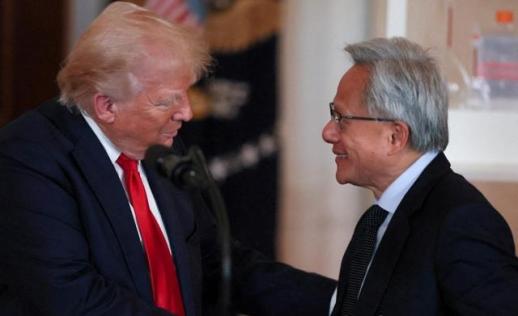 Why Xi Jinping Cannot Abandon Taiwan During a summit between U.S. President Donald Trump and Chinese President Xi Jinping, Taiwan emerged as the most discussed and sensitive topic. Trump himself revealed that Xi asked whether the U.S. would defend Taiwan, indicating that Taiwan was at the forefront of Xi's concerns, despite discussions on tariffs, trade, and supply chains.China has long referred to the Taiwan issue as a "core interest," but its obsession has intensified recently, primarily because Taiwan has become the heart of the global artificial intelligence (AI) industry.Until a few years ago, the Taiwan issue was mainly interpreted through the lenses of history, nationalism, and territorial sovereignty. While these factors remain significant, under Xi's regime, the "great rejuvenation of the Chinese nation" is not merely a slogan for economic growth; it is a political project aimed at achieving unification with Taiwan by 2049, the centenary of the founding of the People's Republic of China. For the Chinese Communist Party, Taiwan is not just an island but a symbol tied to its legitimacy. However, Taiwan now also represents a strategic asset in the realm of AI supremacy.Today, the global AI industry cannot function without Taiwan. NVIDIA's AI semiconductors, as well as servers from Apple and Meta, and Tesla's autonomous driving systems, all rely on advanced processes from Taiwan's TSMC. No matter how well U.S. tech companies design their products, they depend on Taiwan for production, making Taiwan the focal point of the world's cutting-edge semiconductor supply chain.Interestingly, the situation is similar for China. Amid U.S. semiconductor sanctions, China has been advocating for an "AI ecosystem without NVIDIA," yet many AI semiconductors developed by Chinese companies still rely on TSMC's production lines. Even the AI vehicle chips showcased by Chinese semiconductor firms at the Beijing International Auto Show were noted to be produced using TSMC's 4-nanometer process.Ultimately, both the U.S. and China, as well as the entire global AI industry, are dependent on Taiwan. This is why Xi cannot abandon Taiwan. While Taiwan was once a political symbol, it has now become a strategic asset for future industries. Semiconductors are no longer just components; they are critical infrastructure that influences military power, economic strength, and AI competitiveness. For Xi, Taiwan is a territory that "must be unified" and a technological hub that "cannot be surrendered to the U.S."Another crucial aspect is the Chinese leadership's perception of time. While U.S. policies can shift dramatically with elections, China operates on a 10- to 20-year timeline. There is a strong belief within China that "time is on China's side." In fact, economic ties between China and Taiwan have deepened significantly, with cross-strait trade volumes increasing substantially over the past decade and industrial connections strengthening.Xi's regime is also solidifying its long-term governance structure. China has entered a new five-year plan, and discussions suggest that Xi's leadership could continue beyond 2027. This indicates that Taiwan strategy is not a short-term event but a long-term project.The challenge is that as the AI era progresses, Taiwan's strategic value will only increase. Just as past struggles over oil shook the Middle East, future competition over semiconductors is likely to disrupt East Asia, with Taiwan at its center.In 1954, Mao Zedong stated, "The most important issue in U.S.-China relations is the Taiwan issue, and it is a long-term problem." Nearly 70 years later, that statement remains largely true. The difference now is that while Taiwan was once a geopolitical issue of the Cold War, it has become a key engine of the global economy in the AI era.This is why Xi cannot relinquish Taiwan—not just for territorial reasons, but because the future world order hinges on that island.* This article has been translated by AI. 2026-06-05 16:36:00
 -
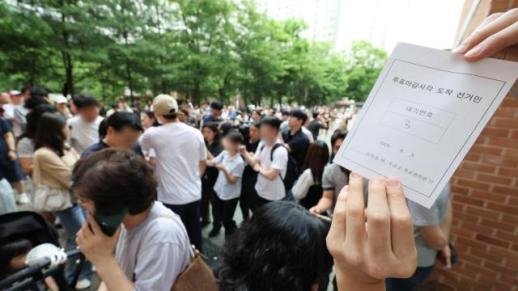 Voting Disruption Due to Ballot Shortage in South Korea's Local Elections In a democratic nation, a shortage of ballots has led to voting disruptions. The June 3 local elections have become a significant event due to this issue. How could such a situation occur? Elections are among the most critical and fundamental administrative tasks carried out by the state. For democracy to function, elections must be conducted fairly, allowing citizens to accept the results. This is why the Election Commission is granted a high status and authority, as specified by the constitution as an independent body. However, there was a shortage of ballots, the most basic requirement for an election. In certain polling stations in Songpa-gu, Gangnam-gu, and Gwangjin-gu, voting was delayed due to a lack of ballots, forcing voters to wait in long lines. In some areas, voting continued even after exit poll results were announced. The Election Commission has apologized, but an apology alone is insufficient. This incident is not merely an administrative error; it indicates a failure in the election management system. Ballots are essential for conducting elections. Situations where there are no ballot boxes, marking tools, or ballots should never occur. This is akin to a hospital operating room lacking surgical instruments or an airport control tower without communication equipment. The more serious issue lies in the Election Commission's response. When this situation arose, the Central Election Commission pointed to the responsibility of local election commissions. However, this does not appear credible to the public. The Central Election Commission oversees national elections, and the ultimate responsibility for election management lies with it. If problems arise on the ground, and the central body claims no responsibility while blaming local commissions, whom should the public trust? Controversies surrounding the Election Commission are not new. During the 2022 presidential election, there was a scandal involving 'basket voting,' where ballots were transported in baskets and shopping bags for COVID-19 positive voters, shocking the public. In 2023, allegations of preferential hiring for children of former and current officials emerged, with substantial evidence revealed during audits. Now, the ballot shortage incident has occurred. While one incident might be seen as a coincidence, repeated controversies of a similar nature cannot be dismissed as mere chance. This is why the public feels uneasy. Mistakes can happen once, but if problems persist within the same organization, the public will begin to question the very operation of that organization. The Election Commission has historically rejected external interference, citing its independence and political neutrality. While the independence of election management bodies is crucial, it cannot serve as a basis for evading responsibility. In fact, the stronger the independence, the greater the accountability should be. If an independent body operates without external oversight, lacks accountability when issues arise, and repeatedly encounters problems, public trust will inevitably erode. This incident has reignited discussions about the role of the Election Commission chairperson. Currently, the chair of the Central Election Commission is a non-permanent position held by a Supreme Court justice. Traditionally, a Supreme Court justice appointed by the Chief Justice has served as chair. However, the fact that the highest official responsible for overseeing elections has a primary job elsewhere has long been criticized. Many argue that the day-to-day operations of the Election Commission are often managed by the Secretary-General, leaving the chair in a largely symbolic role. While it cannot be definitively stated that having a Supreme Court justice as chair is the direct cause of this incident, it is clear that the current system has failed to earn public trust. Citizens want to know who is responsible after the election concludes. They seek clarity on who prepared, who received reports, who made final decisions, and who will be held accountable. However, finding those answers within the Election Commission is currently challenging. Democracy operates on trust. Trust in election results ultimately stems from confidence in the electoral process. The danger of the ballot shortage incident lies not merely in the lack of a few pieces of paper. It raises concerns about the fairness and reliability of elections, potentially increasing the number of citizens questioning the integrity of the process. Whether claims of electoral fraud are true or not is a separate issue. However, when the Election Commission repeatedly generates controversies, it creates an environment where such claims gain traction. This is even more dangerous. Democracy functions on trust, not conspiracy theories. Preserving that trust is the very reason for the existence of the Election Commission. This incident cannot be brushed aside as a simple administrative error. A thorough investigation is necessary to determine who made what decisions, why there was a ballot shortage, whether the reporting system functioned correctly, and what actions the Central Election Commission took. Those responsible must be held accountable. If an election management body cannot uphold the basics of its duties, it must question its own existence. Elections are the flowers of democracy, and the Election Commission is the gardener tending to them. If the gardener fails to perform their role, the flowers will inevitably wilt. This incident is not just about a shortage of ballots; it is a warning signal for the entire election management system in South Korea.* This article has been translated by AI. 2026-06-05 16:33:00
 -
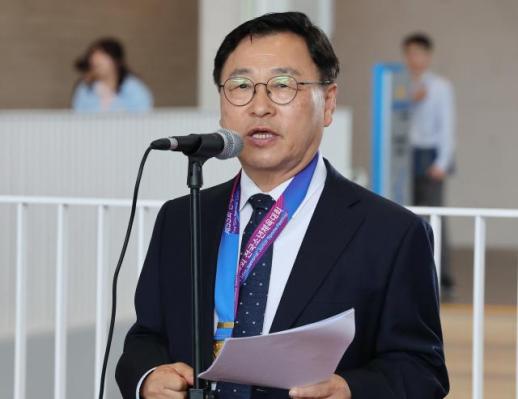 Reelected Seoul Education Chief Jeong Geun-sik to Advance Education Policies Jeong Geun-sik has successfully secured reelection as the Seoul Education Chief during the nationwide local elections held on June 3, 2026. His victory is expected to provide momentum for the administration of education in Seoul. There is anticipation regarding the swift implementation of his key campaign promises, known as the 'Jeong Geun-sik Education Policy.' With this election result, the progressive educational framework in Seoul, which has been in place since 2014, is expected to be further solidified. Jeong's reelection ensures the stability and continuity of Seoul's educational administration, which manages an annual budget of 11 trillion won. Immediately after his election was confirmed on June 4, Jeong expressed his gratitude in a written statement, saying, "The choice of the citizens of Seoul reflects a desire for schools where each student is respected and can grow together beyond competition and anxiety." He emphasized that he would not forget the voices of citizens and students he encountered during the campaign, stating, "We will continue to change without stopping and will ensure a more stable continuation of our initiatives." This indicates a commitment to accelerate the qualitative deepening of innovative future education and the fulfillment of his campaign promises. As a result, Jeong's five key policy areas centered around 'responsible education for all and creative future education' are expected to gain concrete execution through the upcoming budget planning for the second half of the year. One of the most notable areas is the education welfare sector, which aims to complete free education as guaranteed by the constitution. Jeong has pledged to fully implement 'complete free early childhood education' during his term, which includes covering the costs of education, meals, after-school programs, and childcare for children aged 3 to 5. Significant welfare spending policies, such as full transportation cost support for students and the elimination of field trip costs for elementary and middle school students, are also expected to gain traction. The 'customized growth responsible education' system, which strengthens the responsibilities of public education, is also anticipated to be quickly established. Jeong plans to expand the current 11 'Seoul Learning Diagnosis Growth Centers' to all 25 districts, enhance the S-PLAN literacy and numeracy diagnostic assessments, and gradually assign specialized teachers for basic academic skills to all schools. Additionally, there are signs of investment in future-oriented holistic education infrastructure, which will include the use of AI educational technology alongside traditional reading of printed texts to foster critical thinking skills. Education officials believe that Jeong's reelection will increase predictability in Seoul's educational administration, alleviating concerns about the uncertainty of policies that have historically stimulated the private education market during election seasons. However, challenges such as the need for efficiency in educational finances due to a declining school-age population and the establishment of a robust system for protecting teachers' rights remain pressing issues. An education sector official emphasized, "Since Jeong has declared his intention to embrace the wishes of citizens who made different choices, he must demonstrate leadership that integrates conflicts in the education field and builds a comprehensive educational safety net."* This article has been translated by AI. 2026-06-05 16:33:00
 -
 'Black Friday' chip sell-off sends KOSPI plunging more than 5% SEOUL, June 5 (AJP) - South Korea’s benchmark KOSPI plunged more than 5 percent on Friday to close at 8,161.59 points, as semiconductor stocks led a sharp sell-off across global markets. The decline followed an artificial intelligence (AI)-led chip outlook from U.S. chipmaker Broadcom, which reignited fears that the AI boom has run ahead of itself. The drop of about 479 points from the previous session was sharp enough to trigger a "sidecar," an automatic curb on program trading activated when index futures fall 5 percent. The damage tracked a single variable across Asia: how heavily each market leans on chips. In Seoul, where Samsung Electronics and SK Hynix together account for an outsized share of the index, the blow was the hardest. SK Hynix tumbled nearly 10 percent to around 2,070,000 won and Samsung Electronics fell about 6 percent to around 330,000 won ($214.4), the two giants that drove this year's record rally now leading its sharpest reversal. The small-cap KOSDAQ fell about 4.5 percent. Foreign investors sold roughly 3.5 trillion won of South Korean stock, extending the longest selling streak in the market's modern history, and the won weakened past 1,540 to the dollar, a fresh low for the year and another step in the slide the Bank of Korea warned of two weeks ago. The day was not uniformly red, however. As investors fled the crowded chip trade, they ran straight into defensive shelter. Banks were the best-performing sector, with Shinhan Financial Group rising more than 7 percent to around 107,500 won, while the tobacco maker KT&G and the casino operator Paradise also gained. In a telling sign of the flight to safety, Hyundai Motor ended essentially flat at around 698,000 won, barely moving while the market around it collapsed. The money did not leave Korea so much as hide, the same rotation impulse that has run all week now hardening into an outright defensive crouch. The shock originated across the Pacific. Broadcom's outlook sent the Philadelphia Semiconductor Index down more than 5 percent overnight, and the question it raised, whether the year's relentless AI rally had finally met a catalyst large enough to break it, is the one that each market in the region then answered differently. China's Shanghai Composite slipped just 0.75 percent to around 4,028, but not because its chipmakers were spared. They were not. The foundry SMIC fell more than 5 percent to around 128 yuan, the AI-chip designer Cambricon dropped about 4.5 percent, and Hua Hong Semiconductor tumbled more than 7 percent, declines every bit as steep as South Korea's. The difference was what surrounds them: where two chipmakers dominate Korea's index, the Shanghai market is anchored by giant state-owned banks, energy producers, and industrial names that held firm and cushioned the benchmark even as its technology shares sold off. Beijing's market did not dodge the AI scare; its sheer breadth simply absorbed it. Japan landed in the middle. The Nikkei 225 fell more than 1 percent to around 66,588, a second straight decline after setting a record earlier in the week, with the damage concentrated in the chip-equipment makers most exposed to Broadcom's warning. Tokyo Electron tumbled nearly 7 percent to around 59,400 yen and Advantest fell about 5 percent to around 26,900 yen. SoftBank Group, which had fallen sharply the previous day, steadied to edge up about 1 percent to around 7,400 yen as the selling rotated away from it. Japan's loss was milder than South Korea's, cushioned by a more diversified index and a weak yen that supports exporters such as Toyota. Friday was a stress test, and it measured one thing above all: how much of each market is tied to the AI chip trade. South Korea, where semiconductors are effectively the index, took the full force and watched money flee into banks and defensives; Japan absorbed a glancing blow; and China's benchmark barely moved, not because its chipmakers escaped but because they are a far smaller part of a far broader market. The question now is whether Broadcom's warning marks a genuine turn in the AI cycle or merely a pause, and whether the foreign selling and the sinking won that have shadowed this rally all along have finally found the catalyst to bring a record run back to earth. 2026-06-05 16:32:31
 -
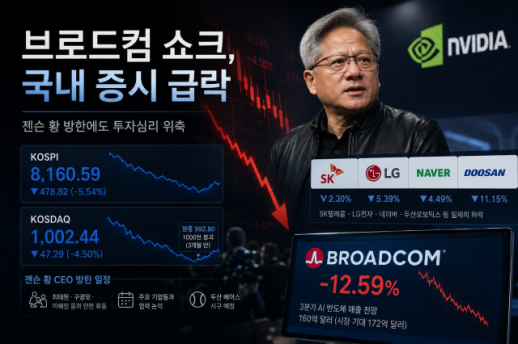 NVIDIA CEO Jensen Huang's Visit Fails to Boost South Korean Market Amid Broadcom Shock The South Korean stock market, which had been buzzing with anticipation for NVIDIA CEO Jensen Huang's visit, struggled to gain traction on the day of his arrival. The so-called "Broadcom Shock," triggered by a sharp decline in U.S. semiconductor stocks, overshadowed the positive sentiment surrounding Huang's visit. On June 5, the Korea Exchange reported that the KOSPI closed down 478.82 points (-5.54%) at 8160.59. The index opened at 8323.20, down 316.21 points (-3.66%), and continued to decline. A sell-off sidecar was activated at 9:08 a.m. due to a sharp drop in the KOSPI 200 futures index, halting program sell orders for five minutes. The KOSDAQ also experienced significant turbulence, dropping 56.93 points (-5.42%) to 992.80, falling below the 1000 mark for the first time since March 4. Although buying interest later helped the KOSDAQ recover above 1000, it still closed in the low 1000s. The steep decline was attributed to a correction in U.S. semiconductor stocks. On the previous night, shares of Broadcom (-12.59%), Micron Technology (-7.74%), SanDisk (-3.92%), and Western Digital (-3.13%) all fell sharply. Broadcom's forecast of $16 billion in AI semiconductor revenue for the third quarter fell short of market expectations of $17.2 billion, leading to a rapid decline in investor sentiment. Initially, there were high hopes that Huang's visit would lead to the emergence of new "NVIDIA beneficiaries." During his first visit last year, expectations of collaboration with NVIDIA drove SK Hynix's stock up nearly 22% from the announcement of his visit to their first meeting. Other AI semiconductor-related stocks, such as SK Square (up 9.1%), Samsung Electro-Mechanics (up 8.7%), and Samsung Electronics (up 6.3%), also saw gains during that period. However, this time the atmosphere has shifted. The anticipation surrounding Huang's visit had already been priced in, and the correction in U.S. tech stocks led to profit-taking across related sectors. LG Electronics, which had previously hit its upper limit, saw a 16.43% drop the day before, giving back some of its gains. Other companies, including LG (-7.21%), LG CNS (-6.85%), Doosan Robotics (-5.28%), and Doosan (-6.15%), also experienced declines. SK Telecom fell 13.02%, while Naver dropped 4.63%. The weakness in related stocks continued on this day, with LG Electronics (-7.62%), LG (-5.39%), LG CNS (-7.04%), Doosan Robotics (-11.15%), Doosan (-3.33%), Naver (-4.49%), and SK Telecom (-2.30%) all closing lower. Huang, who arrived in Seoul in the afternoon, is scheduled to have a dinner meeting with Chey Tae-won, chairman of SK Group, Koo Kwang-mo, chairman of LG Group, and Lee Hae-jin, chairman of Naver's board. Over the weekend, he plans to attend a Doosan Bears home game at Jamsil Baseball Stadium, where he will throw the ceremonial first pitch. Market analysts believe that actual collaboration outcomes will have a greater impact on stock prices than the visit itself. During his stay, Huang is expected to discuss cooperation in physical AI, robotics, AI data centers, and semiconductors with domestic companies. Lee Kyung-min, a researcher at Daishin Securities, noted, "The influx of expectations surrounding Huang's visit and the profit-taking that followed have increased market volatility. Huang has indicated that he has many meetings planned with companies including Hyundai, LG, SK, Samsung, and Naver, and mentioned that several gifts are prepared for Korea."* This article has been translated by AI. 2026-06-05 16:27:00
 -
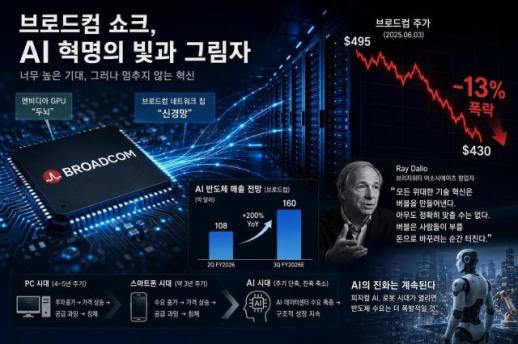 Understanding the Impact of Broadcom's Earnings Guidance on the Market Broadcom, a semiconductor company based in California, was once a dominant player in the wireless communication chip market. However, during the smartphone era of the 2000s, it struggled against Qualcomm, the reigning champion. With the advent of the AI era, Broadcom has regained prominence, creating network chips that connect the "brain" developed by Nvidia to data centers. This has led to Broadcom being dubbed the "hidden infrastructure king of the AI era," enjoying growth comparable to Nvidia. The company's stock has soared, rising from $119 two years ago to $495 this year. However, following its second-quarter earnings report on June 3, the stock plummeted by about 13%. This decline was not due to poor performance; Broadcom reported $22.19 billion in revenue and earnings per share (EPS) of $2.44 for the second quarter, marking increases of 48% and 88%, respectively, compared to the previous year. Notably, AI semiconductor sales reached $10.8 billion in the second quarter, a staggering 148% increase year-over-year, with third-quarter projections at $16 billion, a 200% rise. So why did the stock drop? The reason lies in the company's guidance, or its future earnings outlook, which fell short of market expectations. Broadcom projected third-quarter AI chip sales at $16 billion, below the anticipated $17.2 billion, prompting market reassessment. The "Broadcom shock" also sent shockwaves through the Korean stock market, which saw a drop of over 6% during trading on June 5, reflecting broader global market impacts. The "Broadcom shock" highlights the immense expectations surrounding AI and the underlying concerns about a potential bubble. The assessment that "even doubling year-over-year growth is insufficient" underscores the high bar set for AI-related performance. Ray Dalio, founder of the world's largest hedge fund, Bridgewater Associates, shared insights during a Bloomberg TV interview on June 3, stating, "All great technological innovations create bubbles, and no one can predict them accurately." He suggested that, similar to the internet boom, the AI revolution may also be accompanied by a bubble. Dalio noted, "Bubbles burst when people try to convert their wealth into cash." Currently, investments are being made based on the future potential of AI innovations, but at some point, investors will demand actual returns, leading to the exit of companies that cannot meet these expectations. Dalio's comments reflect a recurring argument regarding the "AI bubble." In summary, he pointed out: "In the past two to three years, there has been a global AI investment boom, primarily led by major U.S. tech companies. These so-called 'hyperscalers,' which operate large-scale AI data centers, have poured astronomical amounts of money into maintaining their leadership in the AI era. Key players include Meta Platforms, Microsoft, Amazon, and Alphabet (Google). The combined capital expenditure (CAPEX) forecast for these four companies from fiscal years 2025 to 2030 is estimated at $5.3 trillion, equivalent to approximately 8,000 trillion won. To sustain such massive investments, they need to generate revenue from AI operations. While some funding may come from loans or equity offerings, fundamentally, profits must be realized to cover expenses. If AI-generated revenues fall short of expectations, planned CAPEX could be disrupted, leading investors who bought stocks based on vague optimism to reconsider their positions." Concerns about the AI bubble extend to the semiconductor sector. The significant capital expenditures (CAPEX) by hyperscalers like Meta, Amazon, and Microsoft are ultimately investments in semiconductor purchases. The soaring demand for Nvidia's GPUs and Broadcom's network chips, along with the rising performance and stock prices of companies like Samsung Electronics and SK Hynix, which produce components like HBM needed for AI chip manufacturing, is driven by the purchasing power of these hyperscalers. Ultimately, investors are keenly interested in whether the semiconductor supercycle driven by AI is sustainable. If the proponents of the AI bubble are correct, hyperscaler companies may face a period of negative growth, leading to a disruption in their extensive capital expenditure plans and a decline in semiconductor purchase demand. A reduction in semiconductor demand by hundreds of trillions could have significant repercussions for the market. This is why semiconductor stocks in the U.S. and Korea experience sharp declines whenever concerns about the AI bubble arise. So, how long will the semiconductor supercycle last? Will it begin to decline the moment the AI bubble bursts? There are alternative perspectives on this issue, supported by robust arguments. Some assert that the AI bubble does not imply limitations on the innovations AI can achieve, and that demand for AI-driven semiconductors will continue to grow at an extraordinary pace. Recently, TSMC Chairman Wei Zhejia expressed this view, stating, "It will take a long time to meet customer demand for AI chips." The expectation is that the supply of semiconductors will lag behind AI demand for several years. Analyses suggesting that the semiconductor cycle differs from past cycles further bolster this outlook. Historically, the semiconductor cycle during the PC era lasted about four to five years, driven by demand from PCs, which dictated the market's ups and downs. This cycle followed a pattern of corporate IT investment leading to rising memory prices, increased supply, decreased demand, oversupply, and subsequent recession. During downturns, semiconductor companies' profits declined, and investments were curtailed. Samsung's rise as a DRAM powerhouse was due to its aggressive investment strategy during downturns, preparing for future booms. The cycle during the smartphone era was shorter than that of the PC era, but still followed a roughly three-year pattern, with semiconductor (memory) demand fluctuating in line with the expansion of smartphone adoption and the introduction of new form factors. However, entering the AI era has distinctly altered the semiconductor cycle. The amplitude of fluctuations is decreasing, and the cycles are becoming narrower. According to analysis by Mirae Asset Securities, the semiconductor cycle, which was around 27 months in 2010, has recently shortened to 12 months. This change has been driven by the explosive demand for AI-related semiconductors. In addition to consumer demand from PCs and smartphones, the emergence of hyperscalers has transformed the cycle itself. Moreover, AI is evolving. The realm of AI, once centered on web pages, is now expanding into the physical domain (Physical AI). Kim Jin-guk, CEO of VIP Asset Management, noted, "If we enter the era of robots, semiconductor demand could explode even further," highlighting the uncertainty surrounding how many GPUs, CPUs, and communication chips will be used in each robot and how many robots will be produced. Concerns about the AI bubble will likely persist. Each time earnings forecasts fall short of market expectations, as seen with the Broadcom shock, semiconductor stocks may experience significant volatility. Some hyperscaler companies may falter, and certain investment plans may be revised. The market will react accordingly. However, it is also evident that historically, great technological innovations have always grown alongside bubbles. This was true for railroads and the internet. While bubbles may burst, innovations endure. The same will hold true for the AI era. While caution is warranted regarding the existence of bubbles, it is crucial to observe who will reap the benefits of these innovations. This may well be the path to successful investing in the age of AI revolution and innovation.* This article has been translated by AI. 2026-06-05 16:24:00
 -
 Samsung Electronics Launches 'Thank You Festival' with 20% Purchase Rebate Samsung Electronics is launching a 'Thank You Festival' that offers customers a 20% rebate in digital Onnuri gift certificates for their purchases. This initiative is part of the company's plan to expand social contributions by 5 trillion won over five years, aimed at benefiting customers and supporting local businesses. According to industry sources on June 5, starting June 8, Samsung will provide digital Onnuri gift certificates equivalent to 20% of the purchase amount for customers buying Samsung products. The total value of the rebates during the event is expected to reach approximately 400 billion won. Samsung chose to offer gift certificates instead of direct price discounts to encourage spending in traditional markets and local businesses. The Onnuri gift certificates can be used at traditional markets, shopping districts, and small businesses. Analysis by the Small Enterprise and Market Service indicates that sales at stores accepting Onnuri gift certificates increased by about 4% shortly after joining the program, with the growth effect expanding to 12.2% by the third year. Uniformed public service workers, including military personnel, police, firefighters, and correctional officers, will receive an even greater benefit. Samsung recognizes these individuals as 'K-Heroes' and will provide them with a 30% rebate on their purchases. The estimated number of eligible beneficiaries exceeds 700,000, including active-duty military and civil service members. This event is connected to Samsung's 'K-Hero Family Festa,' which has been running since 2024. The company has previously offered special purchase benefits to honor the sacrifices and dedication of uniformed public service workers who ensure national and public safety. Notably, this festival follows Samsung's commitment to social reinvestment after reaching a wage agreement in 2026. The company announced plans to allocate 5 trillion won over the next five years to ensure that its growth and achievements benefit not only employees but also society at large. The Thank You Festival is an early example of tangible consumer benefits from this initiative. Following this festival, Samsung is also considering additional social contribution measures, including support for partner companies, inclusive finance, and nurturing AI talent. The aim is to expand a foundation for mutual growth among partners, local communities, and future generations. A Samsung representative stated, "We are continuously reflecting on our social responsibilities while considering the expectations and perspectives of the public. We will implement various measures step by step to ensure that our achievements are shared with society."* This article has been translated by AI. 2026-06-05 16:21:00