

Journalist

Lee Baek-soon
-
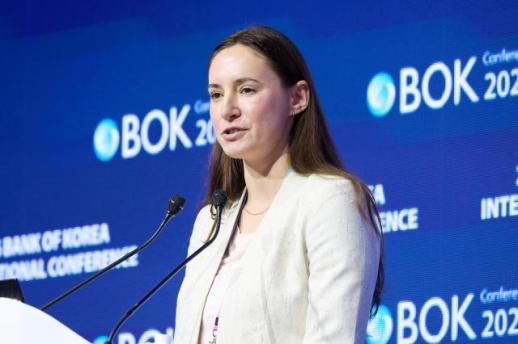 AI Emerges as a Tool for Monetary Policy and Financial Stability, Central Banks Must Adapt A recent analysis suggests that artificial intelligence (AI) will revolutionize the core functions of central banks. Given AI's potential applications in monetary policy formulation and financial stability monitoring, experts argue that central banks must undergo fundamental reforms. Sophia Kazinnik, a senior researcher at Stanford University's Digital Economy Research Institute, presented these insights on June 2 at the '2026 BOK International Conference' in Seoul. Kazinnik stated, "In monetary policy, AI can enhance the accuracy of real-time predictions by extracting and filtering high-frequency data, such as online product price listings and satellite image analysis, to complement the lag in official statistics. In terms of financial stability, large-scale unstructured text analysis can proactively identify signals of systemic risk." Despite these advantages, the adoption of AI in global central banks has been slow due to the complexity of public objectives and the stringent accountability required. Sharing sensitive information externally poses additional challenges. In contrast, the Bank of Korea (BOK) implemented its sovereign AI, 'BOKI,' in January, becoming the first among global central banks to do so. This system is currently used for tasks such as report translation, regulatory searches, and policy support. During the presentation, experts emphasized the necessity of building integrated databases, expanding computing infrastructure, and ensuring access to computing resources to facilitate AI utilization. Kazinnik noted, "Given the nature of central bank operations, a certain level of data barriers is inevitable for personal data and governance control. However, to resolve bottlenecks in large-scale data usage and perform advanced analytics, establishing a 'data lake' is essential." When the Federal Reserve (Fed) in the United States integrated AI into its operations, it was found to significantly enhance productivity. The New York Fed alone saved approximately 1.17 million hours annually in its open market operations. Treasury Services at the St. Louis and Atlanta Feds are projected to save 3.18 million hours, while cash operations managed by the San Francisco, Kansas City, and Dallas Feds are expected to reduce labor hours by 3.51 million through AI. Kazinnik recommended that to successfully implement AI, central banks should designate AI representatives within departments to foster a culture of self-directed learning, rather than solely relying on external experts. He emphasized, "For central banks to fully realize the potential of AI, they must fundamentally innovate not only the related infrastructure but also their operational processes, systems, and norms alongside the technology." 2026-06-02 14:48:00
 -
 Samsung Heavy Industries Wins $3.2 Billion FLNG Contract in North America Samsung Heavy Industries has secured a contract for one floating liquefied natural gas production facility (FLNG) worth 4.33 trillion won (approximately $3.2 billion) from a client in North America. According to Samsung Heavy Industries, construction is set to begin following the issuance of the client's notice to proceed, with delivery scheduled for July 2030. The company has reportedly captured 64% of the global FLNG market, having secured seven out of the eleven new FLNG units built to date, including the world's largest FLNG, Shell's Prelude. A Samsung Heavy Industries official stated, "This contract reaffirms our overwhelming competitiveness in the FLNG sector, and we will continue to achieve success in the global FLNG market based on our proven technology and execution experience." Meanwhile, Samsung Heavy Industries' cumulative orders for the year have reached a total of 28 vessels worth $8.3 billion, achieving 60% of its annual order target of $13.9 billion. Following a recent order on May 27 for one LNG carrier, two large gas carriers, and two oil tankers from a Bermuda-based shipping company, Samsung Heavy Industries continues to build on its recent successes.* This article has been translated by AI. 2026-06-02 14:45:00
 -
 SpaceX Plans $750 Billion IPO, Allocates 5% of Shares to Employees and Associates SpaceX has allocated a portion of its shares for its upcoming initial public offering (IPO) to employees and associates. The company is preparing for a massive listing expected to raise approximately $750 billion, while also revealing the possibility of an early termination of a significant AI computing lease with Anthropic. On June 1, CNBC reported that SpaceX disclosed in a revised securities filing that up to 5% of the IPO shares will be allocated to a direct stock program. This program allows employees, customers, partners, and other designated individuals to purchase shares. The recipients will include 'specific employees and personnel,' with participation determined at the discretion of management. Those who acquire shares will be able to sell them immediately after the IPO. Typically, in an IPO, initial shares are allocated primarily to large institutional investors. The direct stock program opens a portion of these shares to company insiders and customers. CNBC noted that companies like Airbnb, Uber, and Rivian have utilized similar programs during their IPO processes. The scale of this IPO is unprecedented. CNBC estimates that SpaceX will raise about $750 billion from this listing. Earlier this year, Elon Musk indicated a company valuation of $1.25 trillion when he merged AI startup xAI with SpaceX. According to CNBC, only Facebook and Alibaba have surpassed a $100 billion valuation on their first day of trading on U.S. exchanges. The IPO timeline is also approaching. SpaceX may hold an investor presentation as early as this week, with a potential Nasdaq listing on June 12. Goldman Sachs and Morgan Stanley are serving as lead underwriters, with Morgan Stanley managing the direct stock program. The revised filing also included details about the AI computing lease with Anthropic. SpaceX is leasing computing capacity equivalent to approximately 325,000 NVIDIA GPUs to Anthropic at its Colossus and Colossus II facilities in Greater Memphis, Tennessee. Under the agreement, Anthropic will pay SpaceX $1.25 billion per month until May 2029, following a two-month preparation period. However, the contract can be terminated by either party with 90 days' notice after the initial three months. This new information raises concerns that a contract, which could be a significant source of long-term AI revenue for SpaceX, may end within six months. On the same day, Anthropic also announced that it had submitted a confidential IPO filing to the U.S. Securities and Exchange Commission (SEC). As both SpaceX and Anthropic pursue IPOs simultaneously, the sustainability of AI infrastructure investments and large computing contracts will likely become focal points for market evaluations.* This article has been translated by AI. 2026-06-02 14:42:00
 -
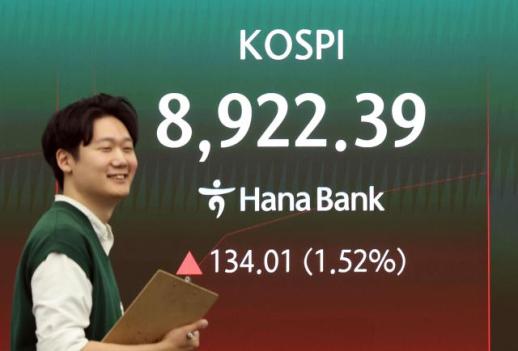 South Korea's Stock Market Surpasses India to Become Sixth Largest Globally South Korea's stock market has surpassed India to become the sixth largest in the world, driven by a surge in shares of Samsung Electronics and SK Hynix amid a boom in artificial intelligence (AI) memory semiconductors. According to Bloomberg, as of June 1, the market capitalization of South Korea's stock exchange stood at $5.42 trillion (approximately 7,550 trillion won), surpassing India's market capitalization of $4.84 trillion. Bloomberg calculates market capitalization based on total outstanding shares, excluding exchange-traded funds (ETFs) and American depositary receipts (ADRs). The South Korean stock market has experienced a sharp upward trend this year, steadily climbing the global rankings. As of April 27, the market capitalization reached $4.04 trillion, moving past the United Kingdom ($3.99 trillion) to become the eighth largest globally. At that time, the KOSPI index broke the 6,600 mark for the first time, propelled by a rally in AI semiconductors led by Samsung and SK Hynix. On May 6, the market capitalization increased to $4.59 trillion, allowing South Korea to surpass Canada ($4.05 trillion) and rise to seventh place. The KOSPI index also crossed the 7,000 mark for the first time based on closing figures. The strong performance in semiconductors has continued, enabling South Korea to overtake India and secure the sixth position globally. This year, South Korea's stock market capitalization has increased by 86%, while India's has decreased by about 9%. Both Samsung Electronics and SK Hynix have surpassed a market capitalization of $1 trillion this year, leading the KOSPI's upward trend and helping South Korea rise from eighth to sixth place in just over a month. Currently, the only stock markets larger than South Korea's are those of the United States ($79.47 trillion), mainland China ($15.09 trillion), Japan ($8.63 trillion), Hong Kong ($7.24 trillion), and Taiwan ($5.15 trillion). Bloomberg analysts attribute South Korea's rapid ascent to its critical role in the AI semiconductor supply chain. Ross McGarry, a senior analyst at UK-based asset management firm Asset Value Investors, told Bloomberg, "The memory cycle has driven the rally, and the key question will be whether South Korea can sustain this revaluation through corporate governance reforms."* This article has been translated by AI. 2026-06-02 14:30:00
 -
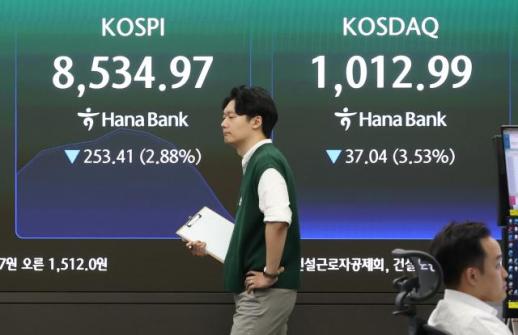 KOSPI Plummets Over 2% Amid Foreign Sell-Off of 7 Trillion Won The KOSPI index opened higher on June 2, buoyed by optimism surrounding artificial intelligence (AI) from NVIDIA, but quickly fell over 2% due to significant profit-taking by foreign investors. After nearing the 8,900 mark early in the session, the index dropped to the 8,600 level in the afternoon, reflecting increased volatility. As of 1:42 PM, the KOSPI was down 189.60 points (2.16%) at 8,598.78, according to the Korea Exchange. The index began the day at 8,883.19, up 94.81 points (1.08%), and briefly rose to 8,933.62 shortly after the opening. This surge was influenced by all three major U.S. stock indices reaching record highs overnight and NVIDIA's announcement of its entry into the PC market with AI chips. However, volatility was evident from the start. At around 9:09 AM, the KOSPI fell to 8,503.48, down 284.90 points (3.24%) from the previous day, before recovering some losses. Yet, it resumed its decline in the afternoon. In the securities market, individuals and institutions were net buyers, purchasing 7.5788 trillion won and 1.466 trillion won, respectively. In contrast, foreign investors led the decline with net sales of 7.4322 trillion won. Movements among major stocks were mixed. SK Hynix (-2.88%), Hyundai Motor (-4.33%), Samsung Electro-Mechanics (-12.32%), and LG Energy Solution (-2.75%) saw declines, while Samsung Electronics (1.07%), SK Square (2.15%), Samsung Life Insurance (5.61%), and Samsung C&T (1.10%) experienced gains. Profit-taking in large-cap semiconductor and AI-related stocks, which had recently driven the market, has led to increased sector differentiation. The KOSDAQ index also showed weakness, recording a decline of 29.28 points (2.79%) to 1,020.75 at the same time. In the KOSDAQ market, foreign and institutional investors were net buyers of 250.8 billion won and 130.7 billion won, respectively, while individuals sold off 376.9 billion won, contributing to the index's drop. Among the top market capitalization stocks, Kolon TissueGene (13.66%) and Juseong Engineering (4.58%) showed strength, while EcoPro BM (-3.67%), Alteogen (-2.19%), EcoPro (-1.92%), Rainbow Robotics (-2.79%), Samchundang Pharmaceutical (-6.74%), and Rino Industrial (-4.93%) faced declines. Han Ji-young, a researcher at Kiwoom Securities, noted that "NVIDIA's announcement of its entry into the AI PC market and positive U.S. manufacturing indicators are stimulating investment sentiment in semiconductors." However, he cautioned that with the recent concentration of funds in semiconductor and AI hardware sectors, there is a need to consider short-term profit-taking pressures and the potential for increased volatility. He added, "Currently, the market is driven more by AI narratives than by earnings, and while expanding the weight of leading semiconductor and IT hardware stocks remains valid, a barbell strategy that includes previously neglected earnings stocks in sectors like securities, power equipment, and shipbuilding should also be considered."* This article has been translated by AI. 2026-06-02 14:30:00
 -
 K-Beauty Shifts Strategy in the U.S. Market The strategy for K-Beauty's expansion into the U.S. market is evolving. Companies are moving away from reliance on online platforms and social media buzz, focusing instead on building local logistics and offline infrastructure or acquiring major distributors. According to industry sources, CJ Olive Young opened its first U.S. store in Pasadena, California, on May 29. The company has also launched a dedicated online mall for the U.S. market and an integrated membership program called 'OY Members.' To support this initiative, it established a 36,000-square-foot logistics center in Bloomington, California, in March. This automated facility, which can expand to 50,000 square feet, will manage inventory for both the physical store and online deliveries. The company is replicating its 27-year-old beauty retail model in the heart of the U.S. Olive Young plans to open its second store, 'Olive Young Century City,' in the Westfield Century City shopping mall in Los Angeles this month, with a goal of securing a total of five stores by mid-2024. Gudai Global, which owns brands such as 'Chosun Beauty,' 'Tirtir,' and 'Skin Food,' has opted for an acquisition strategy to leverage existing local distribution networks. In January, Gudai Global acquired control of Hanseong USA, a K-Beauty-focused distributor in the U.S., for approximately 100 billion won. Hanseong USA is a key vendor supplying K-Beauty products to major retailers like Costco, Ulta Beauty, and Target. The company reported sales of about 170 billion won last year, more than doubling from the previous year. This acquisition allows Gudai Global to expand its distribution network and complete its value chain, covering production, logistics, and distribution. It also enables the company to supply external K-Beauty indie brands such as 'Myeongji Factory,' 'Mediheal,' and 'VT' to major U.S. channels through Hanseong USA. Gudai Global aims to establish a global distribution hub through its Japanese subsidiary, 'Gudai Global Japan,' and Hanseong USA in North America. Amorepacific and LG Household & Health Care have also pursued local brand acquisitions to strengthen their distribution channels. Amorepacific acquired the American beauty brand Tata Harper, which is present in over 800 stores including Sephora and Neiman Marcus, for 168.1 billion won in 2022. Similarly, LG Household & Health Care purchased The Cream Shop, which has channels in Ulta Beauty and Walmart, for 148.5 billion won in the same year, opting for a strategy that brings local distribution networks under their control. The acceleration of K-Beauty companies in building local distribution networks is seen as a strategy to overcome structural limitations that have hindered long-term growth. Historically, reliance on local distributors or agents has weakened price control and complicated brand image management as the number of channels increased. There is also a calculation to reclaim distribution margins previously given to third parties to maximize profitability. An industry insider noted, "We have seen K-Beauty trends come and go in the U.S. If we own the distribution network, we can control pricing and brand image, which is essential for establishing a lasting presence rather than a temporary trend."* This article has been translated by AI. 2026-06-02 14:27:00
 -
 Government Conducts Surprise Inspections at Power Line Construction Sites Ahead of Rainy Season The government is conducting surprise inspections at power line and tower construction sites in preparation for the upcoming rainy season. The Ministry of Climate, Energy, and Environment announced on June 2 that it will visit the construction site office and tower construction areas of the Donghae-Shin Gapyeong power line project in Hongcheon County, Gangwon Province, to assess disaster prevention measures ahead of the rainy season. This initiative comes as localized heavy rainfall has become more frequent due to climate change, increasing the risk of disasters at large infrastructure construction sites, including power lines, roads, and railways. The mountainous terrain of Gangwon Province particularly raises concerns about soil erosion and landslides during heavy rains, underscoring the need for proactive measures before the rainy season. The ministry aims to ensure that safety measures are effectively implemented at the sites ahead of the expected rainy season, which is scheduled to begin in mid to late June. Recent incidents of soil erosion at certain sections during the tower construction have heightened these concerns. During the inspection, the ministry will evaluate the status of emergency and permanent restoration efforts at locations where soil erosion has occurred outside designated areas. It will focus on checking drainage maintenance and slope stabilization measures as part of disaster prevention strategies. Additionally, considering the nature of power line construction, which often involves elevated work, the ministry will assess whether safety management protocols are being properly followed at the construction sites. The ministry will also emphasize thorough site management to prevent safety blind spots, including the monitoring of helicopter transport and elevated work, the provision and usage of safety gear, and communication management for foreign workers. Lee Jae-sik, the Director of Power Network Policy at the ministry, stated, "Thorough reinforcement work and disaster preparedness must be completed before the rainy season begins. I urge Korea Electric Power Corporation, construction companies, and supervisory teams to work together to operate site patrols and ensure comprehensive measures to prevent disasters and mitigate safety risks during the rainy season."* This article has been translated by AI. 2026-06-02 14:27:00
 -
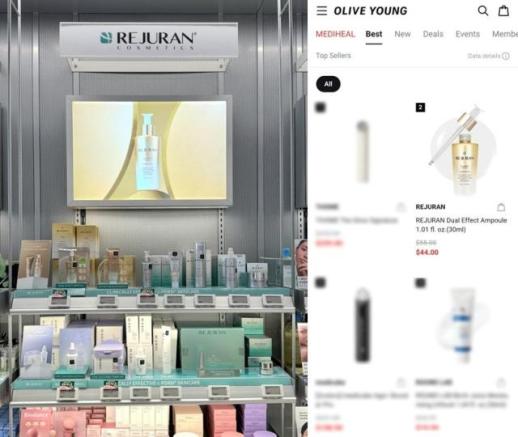 Rejuvaskin Expands into North America with Olive Young Partnership Pharma Research announced that its derma cosmetic brand, Rejuvaskin, has launched in both the online and offline stores of Olive Young in the United States, marking a significant step in expanding its distribution network in North America. Rejuvaskin debuted at the newly opened Olive Young store in Pasadena on May 29 and is set to launch at the Westfield Century City location this month. Additionally, the brand has begun selling products through the Olive Young U.S. online store. This entry is part of a strategy to diversify distribution channels in the North American market. Rejuvaskin has been expanding its presence in the U.S. through major platforms like Amazon and Sephora. The product lineup includes the Dual Effect Ampoule, Turnover Ampoule, Nutritive Cream, and Turnover Mask. Notably, the Dual Effect Ampoule and Turnover Ampoule quickly became bestsellers on the Olive Young U.S. online store shortly after their launch. Pharma Research reported that its medical aesthetic business, led by Rejuvaskin, generated 146.1 billion won in revenue and 57.3 billion won in operating profit in the first quarter of this year, reflecting increases of 25% and 28%, respectively, compared to the same period last year. This growth is attributed to strong domestic demand for Rejuvaskin, robust growth in the cosmetics sector, and an expansion in global exports. Rejuvaskin plans to strengthen collaboration with CJ Olive Young's U.S. subsidiary and enhance marketing efforts to broaden its local sales base. A company representative stated, "We will promote the unique competitiveness of Rejuvaskin and expand our presence as a K-derma brand in the North American market."* This article has been translated by AI. 2026-06-02 14:27:00
 -
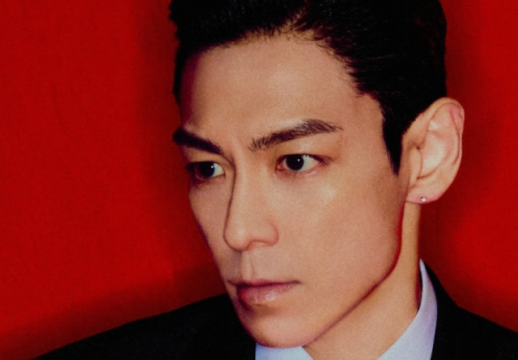 Former BIGBANG member T.O.P announces free Yokohama fan meeting SEOUL, June 02 (AJP) - K-pop boy band BIGBANG's former member T.O.P will hold a free solo fan meeting for 10,000 attendees in Yokohama, Japan, next month, the rapper's agency said Tuesday. The event accelerates the 38-year-old's independent activities following the release of his first solo studio album earlier this year. Topspott Pictures announced that the event will take place on July 9 at the Pia Arena MM. The agency stated that the large-scale gathering will be offered completely free of charge, but attendance is exclusively restricted to official paid membership holders in Japan. The management company noted that the artist is planning a diverse range of activities to reconnect directly with his international supporters. "T.O.P is preparing various programs for local fans who have waited a long time to communicate," Topspott Pictures said in a statement. The upcoming Japanese showcase follows the April release of his first full-length studio album, Another Dimension. The album and the arena fan meeting mark a significant public return for the artist, who spent a long period with limited public communication before establishing his standalone footprint. Choi Seung-hyun debuted in 2006 as the lead rapper of BigBang, a highly successful South Korean group formed by YG Entertainment, one of South Korea's entertainment powerhouses. He officially announced his departure from the group to focus on his solo career in May 2023. 2026-06-02 14:25:38
 -
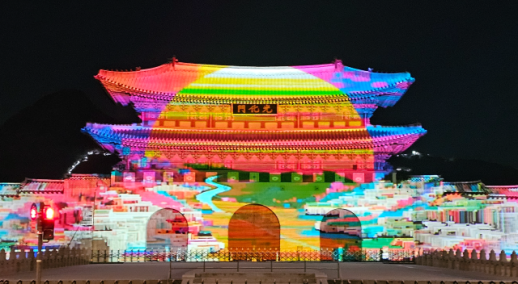 Monthlong outdoor exhibition to feature Seoul's city design project SEOUL, June 2 (AJP) - An exhibition along the walking path of Dongdaemun Design Plaza will kick off later this week, the Seoul Metropolitan Government said on Tuesday. The exhibition under the banner of "Design Seoul Walk," is scheduled to run from Friday to June 25 along a 150-meter sloped section of the DDP walking path, allowing visitors to explore Seoul's public design projects as they move through the space. The exhibition moves design out of the gallery and into the city itself, tracing its presence across public campaigns, transport information, safety facilities, public art, and street furniture. The exhibition space will feature a restrained palette of white, gray and black, with QR codes placed on major displays, allowing visitors to access background information and project details on their phones. One section looks at how Seoul has built a consistent visual identity across the city including public campaign logos and a redesigned subway map. Another section covers projects designed to make the city safer and more user-friendly including the conversion of unused subway spaces into public facilities such as lockers for runners, improved street kiosks, and enhanced safety signage. The exhibition will also feature a media art project that uses the exterior of DDP as a large-scale digital canvas, along with public art installations and products developed through city support for design startups and small and medium-sized companies. Visitors can also interact with examples of Seoul's "fun design" projects — including benches, lighting, and photo spots featuring pictograms inspired by city landmarks. "The exhibition aims to show how design has shaped the city and people's everyday lives," said Choi In-gyu, a city official. "We hope visitors discover how design adds value to daily life — and how much pleasure it can bring." 2026-06-02 14:24:07