

Journalist

Lee Bu-hyung
-
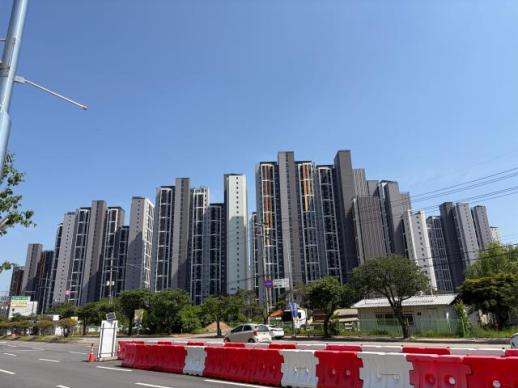 Demand for Housing Shifts from Seoul to Gyeonggi and Incheon as 30-Somethings Lead Market In the Gyeonggi housing market, buyers in their 30s have emerged as the most active group. Factors such as high housing prices in Seoul, lending restrictions, and a shortage of rental properties have led to increased demand for housing in areas adjacent to the capital. Analysis of data from the National Statistical Portal on June 2 revealed that the number of apartment purchases by Seoul residents in other regions reached 3,480 in March. This marks an increase from 2,855 in January and 3,032 in February, showing a consistent upward trend over three months. A significant portion of this so-called "Seoul-exit" demand has shifted towards Gyeonggi and Incheon, which accounted for 84.3% of purchases by Seoul residents in March. In March, purchases of apartments in Gyeonggi by Seoul residents totaled 2,637, a 26.3% increase from the previous month. Incheon saw 298 purchases, up 35.5% during the same period. Overall, apartment purchases in the metropolitan area (Gyeonggi and Incheon) by Seoul residents reached 2,935, a 27.2% rise from the previous month. Seoul residents have notably increased their presence in border cities. In March, Gwangmyeong recorded 349 total apartment transactions, with 148 (42.4%) attributed to purchases by Seoul residents. Similarly, over one-third of buyers in Hanam (37.6%) and Guri (37.3%) were also from Seoul. In absolute numbers, Goyang led with 269 transactions, followed by Namyangju with 247, Yongin with 193, Anyang with 176, and Guri with 174. Areas with anticipated improvements in transportation, such as the GTX line and subway extensions, are seeing concentrated demand. In Incheon, the influx of Seoul residents has also risen. In March, purchases of apartments by Seoul residents in Incheon reached 298, a 35.5% increase from the previous month. The highest number of transactions occurred in Seo-gu with 104, followed by Bupyeong-gu with 77, both showing relatively high proportions of Seoul residents at 13.4% and 13.0%, respectively. As of March, the share of apartment purchases by Seoul residents in non-metropolitan areas remained low at 15.7%, indicating that most demand is concentrated in the metropolitan area. In terms of regions, purchases were recorded at 96 in Gangwon, 93 in South Chungcheong, and 55 in North Chungcheong. Additionally, buyers in their 30s are the most active segment in the Gyeonggi housing market. In March, 6,060 of the 16,895 apartment transactions in Gyeonggi were made by this age group, accounting for 35.9% of the total. This figure is 12.7 percentage points higher than the 40-somethings at 23.2%, and exceeds the national average of 31.6% and Incheon’s 30.8%. The scale of transactions in Gyeonggi also significantly surpasses that of Seoul. During the same period, 2,794 apartment purchases by 30-somethings in Seoul were recorded, only half of Gyeonggi's total. While the proportion of 30-something buyers in Seoul was higher at 43.4%, the actual number of transactions in Gyeonggi was approximately 2.2 times greater. Kim In-man, head of Kim In-man Real Estate Economic Research Institute, stated, "Due to the rental crisis and high housing prices in Seoul, young couples and other actual buyers in their 30s are turning their attention to the outskirts of Seoul or the Gyeonggi area. With the burden of living costs and improvements in transportation conditions, it is likely that the buying trend in Gyeonggi will continue for the foreseeable future."* This article has been translated by AI. 2026-06-02 16:33:00
 -
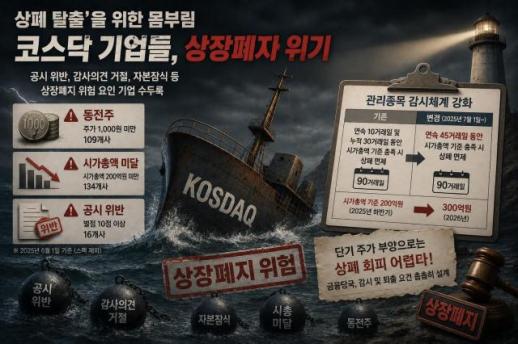 Delisting Risks Rise for KOSDAQ Companies Amid Stricter Regulations The struggle to avoid delisting is not limited to penny stocks. Numerous companies on the KOSDAQ market face risks of delisting due to violations of disclosure regulations, rejected audit opinions, and capital erosion. The traditional method of temporarily boosting stock prices to evade crises is becoming increasingly difficult as financial authorities tighten monitoring and delisting criteria. According to the Korea Exchange, starting in the second half of this year, the monitoring system for management-designated stocks will be strengthened. Previously, companies designated as management stocks could avoid delisting if they met market capitalization criteria (200 billion won this half-year and 300 billion won next year) for 10 consecutive trading days or a cumulative total of 30 trading days within 90 trading days. However, under the new rules, companies must meet the market capitalization criteria for 45 consecutive trading days to avoid delisting. This means that even temporary stock price increases due to favorable news could still lead to delisting risks. For instance, ABPROBIO, a KOSDAQ-listed company, was designated as a management stock in March due to a capital erosion rate of 61.8%. In response, the company has initiated measures to bolster its capital, including a 90% capital reduction, a rights offering, and the issuance of convertible bonds. Despite these efforts, its stock price fluctuates around 1,000 won, keeping its market capitalization at approximately 32 billion won. If the company's value deteriorates further, maintaining its listing could become increasingly challenging. Similarly, companies like DAP and Iwon CompoTech have been newly designated as management stocks this year due to capital erosion rates exceeding 50%. Iwon CompoTech's stock price is currently at 1,552 won, with a market capitalization of 12.4 billion won, raising concerns about its ability to meet the strengthened market capitalization criteria. DAP's stock price and market capitalization stand at 1,883 won and 41.7 billion won, respectively, which meet this year's listing maintenance requirements, but the increase to 300 billion won next year leaves little room for error. As the criteria for delisting-related penalties have been tightened, the company with the highest accumulated penalty points is Coas, with 42 points. Coas was designated as an unreliable disclosure company after being found to have delayed disclosures or provided inaccurate information during the acquisition of stocks from Iwha Electric, Etron, and EID last October. If it receives additional penalty points, it could be subject to delisting review. DawanSys follows closely behind with 23 accumulated penalty points. The company is currently suspended from trading due to a delisting cause stemming from a rejected audit opinion on its financial statements last year. Its revenue dropped by over 70% compared to the previous year, and its operating losses exceeded 100 billion won. Additionally, the termination of a contract for supplying electric trains to Korail has heightened concerns about its operational normalization. Even if issues related to audit opinions are resolved in the future, the burden of accumulated penalty points remains a concern. Industry experts believe that the recent reforms to the delisting system will not only introduce new criteria but also mark the beginning of a serious effort to address struggling companies. Lee Geon-jae, a researcher at IBK Investment & Securities, stated, "While more than 90 companies are newly listed on the KOSDAQ market each year, the number of companies being delisted is less than half. We need to address the structural issues of unprofitable companies that have not resolved problems such as poor business performance, lack of communication with investors, and capital erosion to achieve qualitative improvement in the KOSDAQ market."* This article has been translated by AI. 2026-06-02 16:27:00
 -
 Trump says deal with Iran may be reached 'over the next week' SEOUL, June 2 (AJP) - U.S. President Donald Trump again said that Washington and Tehran are moving closer to a deal that could extend a ceasefire and ease tensions in the Strait of Hormuz, raising hopes for a possible end to the prolonged conflict in the Middle East, which began in late February. In a phone interview with ABC News on Monday, Trump said a memorandum of understanding (MOU) with Iran could be reached "over the next week," calling ongoing talks "looking good." The proposed deal would lay the groundwork for extending the ceasefire while keeping the strait open to shipping, as both sides continue negotiations over Iran's nuclear program and regional security. Trump said there had been "a little glitch" in the negotiations, although he admitted difficulties. "It's not a simple thing," he said. "So it's not an easy thing for them. It's actually not easy from our standpoint either. But we're getting what we need to get." But it still remains to be seen, as this is not the first time Trump has made similar remarks, and several key issues remain unresolved. Adding to the uncertainty, Iran said earlier in the day that it had suspended communications with the U.S. over Israel's military actions in Lebanon. 2026-06-02 16:26:04
 -
 Candidate Unification Fails in Key Elections in Pyeongtaek and Busan 6.3 by-elections in Pyeongtaek and Busan North Gap are heating up as candidate unification efforts have effectively collapsed, leading to heightened tensions among the candidates. Initially, there was speculation about a possible unification of progressive and conservative candidates, but escalating power struggles have deepened divisions.According to political sources on June 2, the conflict in Pyeongtaek has escalated into a partisan battle. Jo Guk of the Jo Guk Innovation Party has launched a concentrated attack on Kim Yong-nam of the Democratic Party over allegations of operating a loan shark business, prompting a negative campaign between the Democratic Party and the Innovation Party. As the Innovation Party pressured Kim to reconsider his candidacy, the Democratic Party labeled Jo as a 'fake Democratic candidate,' intensifying their counterattacks.On the eve of the election, Democratic Party Secretary-General Jo Seung-rae stated, "The Democratic candidate for Pyeongtaek is Kim Yong-nam, not Jo Guk," asserting that while it may appear to be a two-horse race, the People Power Party candidate's support is rising, increasing the likelihood of a three-way contest. He previously questioned Jo's legitimacy, asking, "Why is the Innovation Party candidate running under the guise of the Democratic Party?" Jo countered, saying, "Can't you hear the voices across the country of forces conspiring against the Democratic progressive camp?"Meanwhile, Yoo Ui-dong of the People Power Party left the door open for unification with Hwang Kyo-ahn of the Liberty and Innovation Party. In an emergency press conference, Yoo urged Hwang to unify, stating, "We cannot let our small differences allow the candidates of privilege and unfairness to take Pyeongtaek." He added, "Public sentiment is already leaning towards me. A decisive victory is possible even in a five-candidate race, but if we unite, a more certain and overwhelming victory is guaranteed. Let’s set aside our minor differences and work together on the larger path." However, Hwang's conditions for unification, which include an apology regarding former President Park Geun-hye and a change in stance on election fraud, have led to skepticism about the feasibility of such an alliance.In Busan North Gap, the three candidates are also engaged in mutual attacks. Democratic candidate Ha Jung-woo took to Facebook to target independent candidate Han Dong-hoon, stating, "I am not a powerful special prosecutor or a media-favored presidential contender. I lack flashy rhetoric and enthusiastic fandom. However, what I possess is a strong will and desire to work for Buk-gu." He emphasized, "I have no ambition to become president or rebuild conservatism; my only responsibility and mission is to work for Buk-gu."In contrast, Han responded to allegations of 'collective false residency' raised by the Democratic Party, calling them "absurd claims that are the opposite of the reality in Buk-gu," and hinted at legal action. The Democratic Party's Busan chapter had previously reported that Han and his supporters were attempting organized and collective false residency in Buk-gu and called for a thorough investigation by the election commission.Han pointed to monthly population statistics released by the Buk-gu office, showing a decline in population in April and May, arguing, "If there were organized false residencies, how could the population continue to decrease? The desperation of the Democratic Party and Ha's camp, facing imminent defeat, is clearly revealed through their false smear tactics. I will hold them accountable without exception for their mudslinging tactics that turn the election into a quagmire."Meanwhile, Park Min-sik of the People Power Party intensified his attacks on Han, stating, "Please judge the other independent candidate who sees Buk-gu as just a stop on the way to division among conservatives with your vote." Kim Seong-geun, an independent candidate in the Busan North Gap by-election, announced his withdrawal from the race and declared his support for Park a day before the election. Park described Kim's endorsement as a judgment and warning against forces that attempted to distort public sentiment through dubious opinion polls, asserting, "There is a rising anger among true Buk-gu residents to eradicate fake transient politics and opportunistic politics."* This article has been translated by AI. 2026-06-02 16:24:00
 -
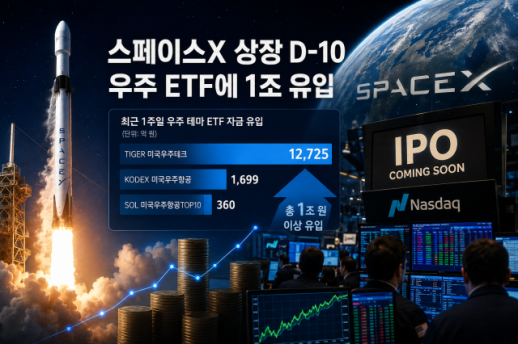 SpaceX IPO Approaches as $1 Billion Flows into Space-Themed ETFs As the initial public offering (IPO) of U.S. space exploration company SpaceX approaches, significant investments are flowing into domestic space-themed exchange-traded funds (ETFs). Over the past week, more than 1 trillion won (approximately $1 billion) has been invested in these space-themed ETFs in South Korea. According to Koscom ETF Check on June 2, the TIGER U.S. Space Tech ETF saw a net inflow of 1.2725 trillion won, ranking second among all ETFs for fund inflows. Notably, on the previous day alone, 255.5 billion won was invested, demonstrating strong interest from investors. Individual investors were particularly active, with net purchases of 972.8 billion won, placing this ETF fourth among all ETFs during the same period. Other space industry ETFs also attracted significant funds. The KODEX U.S. Aerospace ETF received 169.9 billion won, ranking eighth in inflows, while the SOL U.S. Aerospace TOP10 saw an inflow of 36 billion won. With domestic investors unable to directly participate in the IPO, the growing demand for indirect investments through ETFs is evident. The surge in fund inflows is linked to SpaceX's upcoming investor roadshow starting June 4. The company is expected to clarify its funding size and final offering price, with plans to list on the Nasdaq as early as June 12. Market evaluations place the company's value between $1.75 trillion and $2 trillion, with the offering size estimated around $800 million, potentially setting a record for the largest IPO ever, surpassing the previous record held by Saudi Aramco at $29.4 billion. Attention is also focused on how this IPO might absorb investments in AI-related companies. Given the scale of the IPO, there are concerns that global institutional investors may liquidate some of their growth stocks to participate in the offering. Kim Il-hyuk, a researcher at KB Securities, noted, "Several companies in the same sector are likely to face supply shocks due to SpaceX's entry into the market." However, some analysts caution against interpreting this as a negative signal for the semiconductor industry as a whole. Due to the nature of SpaceX's business model, it could actually expand the demand base for the semiconductor ecosystem in the long term. Kim added, "SpaceX is expected to continue its focus on AI infrastructure investments, which may benefit semiconductor, equipment, and power infrastructure companies."* This article has been translated by AI. 2026-06-02 16:24:00
 -
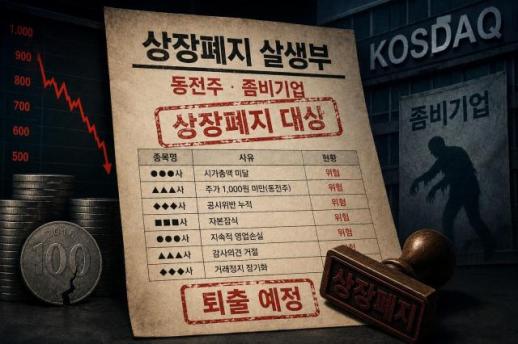 July Marks Critical Month for KOSDAQ as Delisting Risks Rise for 200 Companies The critical month of July is approaching, bringing with it a strengthened delisting system for KOSDAQ companies. Starting July 1, the new regulations will intensify efforts to weed out underperforming firms. Currently, over 200 companies are at risk of delisting due to factors such as insufficient market capitalization, penny stock status, and repeated disclosure violations. According to financial authorities, the enhanced delisting criteria will take effect on July 1. Companies with a market capitalization below 20 billion won, stocks priced under 1,000 won, or those accumulating 10 or more penalty points for disclosure violations (down from the previous threshold of 15 points) will be targeted for delisting. As of July 1, among the 1,822 KOSDAQ-listed companies (excluding SPACs), 134 have a market capitalization below 20 billion won, and 109 are classified as penny stocks. After excluding duplicates, approximately 203 companies are expected to fall into the potential delisting category. In addition to market capitalization criteria, many companies are also facing challenges due to disclosure violations. Currently, 70 KOSDAQ companies have been penalized under exchange management standards, with 16 of them accumulating 10 or more penalty points. The company with the highest penalty points is Coas, with a total of 42 points, followed by Daewon Sys with 23 points, CCS with 22.5 points, and Korea Union Pharma with over 21 points. Concerns about financial stability are also rising, as three KOSDAQ companies have been newly designated as management issues this year due to capital impairment rates exceeding 50%: AB Pro Bio, Iwon Compo Tech, and DAP. Market analysts predict that if delistings begin in July, the impact on retail shareholders could be significant. As of the end of last year, there were approximately 2.63 million retail investors holding shares in companies with a market capitalization below 20 billion won and classified as penny stocks. Some of these companies have thousands of individual investors, raising concerns that many will suffer losses if delistings occur. A securities industry representative stated, "The authorities aim to eliminate companies that have only maintained their listings while increasing investor losses." However, given the high proportion of retail investors in the KOSDAQ market, it is essential to establish protective measures for minority shareholders during the delisting process.* This article has been translated by AI. 2026-06-02 16:21:00
 -
 Syangyong Construction Wins 123 Billion Won Contract for Mapo Redevelopment Project Syangyong Construction is expanding its contracts for housing redevelopment projects in Seoul and the surrounding metropolitan area. On June 2, the company announced that it was selected as the construction firm during a general assembly of the Changjeon-dong housing redevelopment association held on May 31. The project involves constructing six apartment buildings named 'The Platinum,' consisting of 292 units, along with community facilities, on the site located at 46-1 Changjeon-dong. The construction cost is estimated at 123 billion won, with a projected timeline of approximately 44 months from the start of construction. The site is part of Seoul's Moa Town initiative and is conveniently located near Sinchon Station on Line 2 and Gwangheungchang and Daehyeong Stations on Line 6, with Gwangheungchang Station just a four-minute walk away. Including this project, Syangyong Construction has been accumulating contracts in major redevelopment projects across Seoul, such as the Hong-eun-dong housing redevelopment, the Siheung 5-dong Moa Town project, the Cheonho-dong housing redevelopment, and the Noryangjin Eunha Mansion area redevelopment. A representative from Syangyong Construction stated in a phone interview, "We plan to continue securing contracts for housing redevelopment projects in the future." Meanwhile, due to a recent downturn in the construction market and a contraction in the project financing sector, mid-sized construction companies are increasingly focusing on smaller-scale redevelopment projects like housing redevelopment.* This article has been translated by AI. 2026-06-02 16:21:00
 -
 Small Asset Managers Target ETF Market Beyond Samsung and Mirae Asset Domestic exchange-traded funds (ETFs) have entered a 500 trillion won era, prompting small and mid-sized asset management firms to actively pursue opportunities in the ETF market. While Samsung Asset Management and Mirae Asset Management dominate with over 70% market share, these smaller firms are seeking new growth avenues, particularly through active ETFs. According to the financial investment industry on June 2, firms such as DS Asset Management, Life Asset Management, Daol Asset Management, and iM Asset Management are exploring entry or expansion into the ETF business. DS Asset Management has completed its ETF organizational setup by hiring Jeong Seong-in, who previously led the ETF business at Kiwoom Investment Management, and aims to launch an active ETF on the KOSDAQ by July. The firm plans to introduce up to three ETF products in the second half of the year. Life Asset Management has applied for a public fund management license. Currently holding only a private fund license, the firm plans to enter the ETF market as soon as it receives approval for public funds. Daol Asset Management is also in the process of hiring staff with an eye on entering the ETF market. Meanwhile, iM Asset Management is reviewing the launch of new products after releasing a KOSPI 200 ETF in February of last year. Just a few years ago, skepticism prevailed regarding the entry of small and mid-sized asset managers into the ETF market. The prevailing belief was that the business required economies of scale, making it difficult for latecomers to survive. Currently, Samsung Asset Management and Mirae Asset Management together hold a combined market share of 70% in the domestic ETF market. Despite this, small and mid-sized firms cannot ignore the ETF market, as it has become a core business in asset management. With the ETF market capitalization exceeding 500 trillion won, it has emerged as a key vehicle for individual investors to channel significant funds into the stock market. The growth of active ETFs is particularly encouraging smaller firms to enter the market. Unlike passive ETFs, which simply track an index, active ETFs allow fund managers' investment decisions to directly influence returns. Firms with extensive experience in private equity management are seen as well-positioned to identify specific industries or stocks and implement concentrated investment strategies through active ETFs. Profitability is also an attractive factor. While scale competition is crucial in the ETF market, active ETFs can command relatively higher fees based on differentiated management performance. Investors, expecting higher returns, are generally less resistant to higher fees. The business model is shifting toward securing profitability based on management performance rather than competing solely on assets under management (AUM). A notable example is Timefolio Asset Management. By focusing on active ETFs, Timefolio's market share jumped from 10th place at the end of 2024 to 7th place in March of this year. Its profitability has also significantly increased, with a net profit of 85.1 billion won for the 2025 fiscal year, a 145% rise from 34.7 billion won the previous year. Industry experts believe that the performance of DS Asset Management will be a pivotal factor in determining the speed at which small and mid-sized firms enter the ETF market. Despite the increasing polarization in the ETF market, the emergence of additional success stories through active ETFs could lead to more private equity firms entering the ETF space. An industry insider remarked, "In the past, the ETF market was seen as the domain of large firms, but now there is a new option with active ETFs. As firms with private equity management experience begin to incorporate their unique investment strategies into ETFs, the competitive landscape may gradually change." 2026-06-02 16:21:00
 -
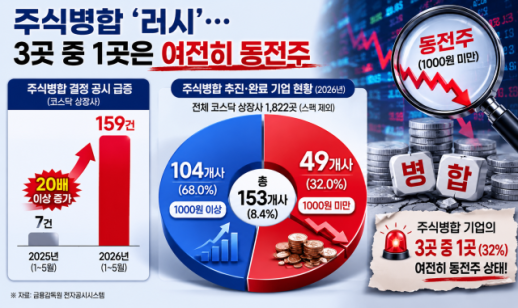 Stock Consolidation Surge: One-Third of Companies Remain Penny Stocks KOSDAQ-listed company Kespion, a manufacturer of wireless communication devices, has struggled with stagnant stock prices for years. On February 23, the company announced a 2-for-1 stock consolidation (from 500 won to 1,000 won per share). While the stated purpose was to stabilize stock prices and enhance corporate value by maintaining an appropriate number of circulating shares, the real motivation was to avoid the so-called "penny stock delisting" criteria announced by financial authorities in mid-February. After a trading suspension lasting over two months, trading resumed on May 4, but Kespion's stock closed at 751 won on June 1. The company's discussion forums are filled with anxious shareholders worried about delisting. This year, the KOSDAQ market has seen a surge in stock consolidation announcements. Following the government's announcement of measures to eliminate penny stocks and reform delisting regulations in February, related disclosures have skyrocketed. The number of stock consolidation announcements from January to May has increased more than twenty-fold compared to the same period last year. This move is seen as a survival tactic to artificially inflate stock prices. However, the limitations are evident. It is estimated that one in three companies that decided to consolidate their stocks this year still remain penny stocks with prices below 1,000 won, putting them at risk of being listed on the "delisting blacklist." According to the Financial Supervisory Service's electronic disclosure system, 159 KOSDAQ companies announced stock consolidation decisions from January to May this year. This marks an increase of over twenty times compared to just seven announcements during the same period last year. Excluding six companies that had their proposals rejected at shareholder meetings, a total of 153 companies are currently pursuing or have completed stock consolidations. This represents about 8.4% of the total 1,822 KOSDAQ-listed companies (excluding SPACs). The urgency behind these consolidations stems from the impending delisting of penny stocks. According to revised KOSDAQ listing regulations, companies whose stock prices fall below 1,000 won for 30 consecutive trading days will be designated as management items. If they fail to exceed this threshold for 45 out of the next 90 trading days, they will face final delisting procedures. The revisions also include measures to prevent circumvention. Companies that have conducted stock consolidations or reductions in the past year are prohibited from further consolidations or reductions for 90 trading days after being designated as management items. Additionally, any consolidation or reduction exceeding a 10-to-1 ratio is not allowed during this 90-day period. Violating these rules will result in immediate delisting. The problem is that stock consolidation is not a fundamental solution for escaping penny stock status. Among the 153 companies that have pursued or completed stock consolidations, 49 (32.0%) still had stock prices below 1,000 won as of the end of last month. For instance, Wonpung Moolsan, which decided on a stock consolidation in March, had a closing price of just 524 won on June 1. Other KOSDAQ companies at risk of delisting due to two consecutive years of delisting criteria include Samyoung ENC and Tubesoft, both of which have market capitalizations below 20 billion won. Currently, Samyoung ENC has been granted a three-month improvement period, while Tubesoft is awaiting a decision on its delisting from the Corporate Review Committee. A securities industry insider noted, "It is not easy for companies to improve their performance or financial structure in the short term, so many companies are likely to become candidates for delisting. Companies that cannot escape penny stock status through consolidation are at a significant crossroads for survival." Market analysts caution against interpreting stock consolidation as a signal of improved corporate value. Stock consolidation merely reduces the number of circulating shares while increasing the price per share, without changing the market capitalization or actual value of the company. For example, Aptun, which resumed trading on May 8, saw its stock price surge close to the upper limit immediately after trading resumed, but it ultimately closed down 17.54% from the previous trading day due to profit-taking. In addition to KOSDAQ, there are companies in the KOSPI market facing delisting risks. There are a significant number of potential risk companies in the KOSPI market as well. Currently, there are 99 companies with market capitalizations below 30 billion won and 39 penny stocks with prices below 1,000 won. Excluding duplicates, a total of 129 companies fall under at least one of these criteria. Notably, the KOSPI market has also seen an increase in forced delisting cases this year. In the past three years (2023-2025), only five companies were delisted due to reasons such as rejection of audit opinions, but this year, five companies, including Daedong Electronics, Kukbo, Well Biotech, IHQ, and Philux, have already been delisted. Recently, the delisting of Geumyang, which has 240,000 shareholders, has caused a stir. Geumyang is currently seeking legal action against the Korea Exchange's delisting decision by filing for a suspension of the decision's effectiveness. 2026-06-02 16:21:00
 -
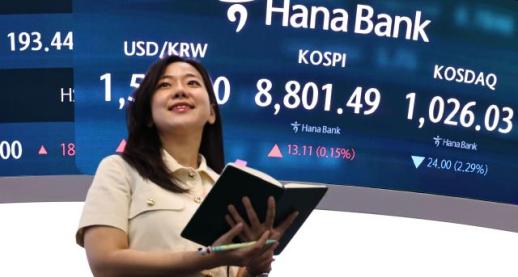 Samsung Electronics Surges Past Meta to Join Global Top 10 by Market Cap The KOSPI index experienced significant fluctuations, swinging over 400 points before closing higher. Amid this volatility, Samsung Electronics saw its stock rise by more than 3%, securing a spot among the top 10 global companies by market capitalization. On June 2, according to data from the global market capitalization tracking site CompaniesMarketCap, Samsung Electronics' market cap reached $1.526 trillion, surpassing Meta to rank 10th globally. At one point during the trading session, it even exceeded Tesla, which ranked 9th. Samsung Electronics closed at 360,500 won, up 11,500 won (3.30%) from the previous trading day. Its market capitalization increased to 2,107.58 trillion won, setting a new record for the highest closing price. In contrast, the domestic stock market exhibited extreme volatility. The KOSPI closed up 13.11 points (0.15%) at 8,801.49. The index opened at 8,883.19 and briefly rose to 8,933.62, attempting to break through the 8,900 mark. However, heavy selling by foreign investors pushed it down to the 8,503 level, resulting in a drop of 4.9% from its intraday high. The index managed to recover most of its losses, finishing in positive territory. In the securities market, individual and institutional investors made net purchases of 8.1191 trillion won and 237 billion won, respectively, while foreign investors sold off 8.0505 trillion won. Among the top market cap stocks, Samsung Electronics provided crucial support to the market. SK Hynix closed slightly lower at -0.13%, while SK Square (7.17%), Samsung Life (17.07%), and Samsung C&T (6.70%) showed strong gains. Conversely, Hyundai Motor (-2.80%), LG Energy Solution (-2.75%), HD Hyundai Heavy Industries (-1.61%), and Samsung Electro-Mechanics (-9.58%) saw declines. Market analysts suggest that funds have been concentrated in Samsung Electronics, viewed as a major beneficiary of the recent rally in AI semiconductors. Kang Jin-hyuk, a researcher at Shinhan Investment Corp, noted, "The volatility of the index has increased due to profit-taking ahead of local elections, but Samsung Electronics has maintained relative strength, drawing significant investor interest as it reached the 10th position in global market capitalization during the session." Indeed, Samsung Electronics' stock has surged over 60% in the past month. The stock price, which was in the 220,000 won range at the end of April, surpassed 360,000 won on this day. During the same period, its market capitalization increased by approximately 800 trillion won. In the global market cap rankings, Nvidia remains in first place with a valuation of $5.4 trillion, followed by Alphabet, Apple, Microsoft, and Amazon. Among Asian companies, Samsung Electronics and SK Hynix both have market capitalizations exceeding $1 trillion, following TSMC. The KOSDAQ index closed down 24.00 points (2.29%) at 1,026.03. Foreign and institutional investors made net purchases of 337.3 billion won and 126.2 billion won, respectively, while individuals sold off 449.6 billion won.* This article has been translated by AI. 2026-06-02 16:18:00