
Journalist

Lee Hak-loh
-
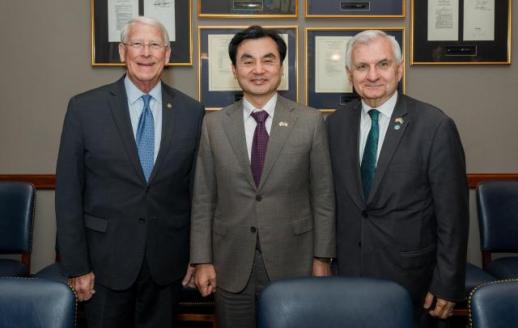 Defense minister seeks US support for Korea's nuclear-powered submarine plan SEOUL, May 13 (AJP) - Defense Minister Ahn Gyu-back has asked senior U.S. Navy and congressional officials to support South Korea’s push to acquire nuclear-powered submarines, the Ministry of National Defense said Wednesday. Ahn, who is visiting the U.S. for the first time since taking office, met with Hung Cao, acting secretary of the U.S. Navy, in Washington on Tuesday morning to discuss key alliance issues, according to the ministry. During the meeting, Ahn stressed that South Korea is an ideal partner for shipbuilding cooperation with the U.S., citing its advanced shipbuilding capabilities and the enactment of a special law providing a legal basis for investment in the U.S. He also said South Korea’s acquisition of nuclear-powered submarines would contribute to shared security interests between Seoul and Washington and mark an important milestone in upgrading the bilateral alliance. Ahn asked for active support from the U.S. Navy Department, the ministry said. The two sides agreed to continue close cooperation, the ministry said. The leaders of South Korea and the U.S. agreed in a joint fact sheet last year to cooperate on South Korea’s construction of nuclear-powered submarines as part of Seoul’s broader $350 billion investment package for the U.S., but follow-up negotiations have made little progress. Ahn also met with key U.S. lawmakers on Monday and Tuesday to discuss alliance issues, including the transfer of wartime operational control, or OPCON, from Washington to Seoul. They included Senate Armed Services Committee Chairman Roger Wicker, ranking member Jack Reed and Sen. Rick Scott, chairman of the Senate Armed Services Subcommittee on Seapower. Ahn thanked Congress for its longstanding support for the alliance and asked for bipartisan cooperation to help develop the alliance in a future-oriented and mutually beneficial way. Ahn also visited Arlington National Cemetery on Monday and the Korean War Veterans Memorial on Tuesday to lay wreaths. 2026-05-13 10:50:55
 -
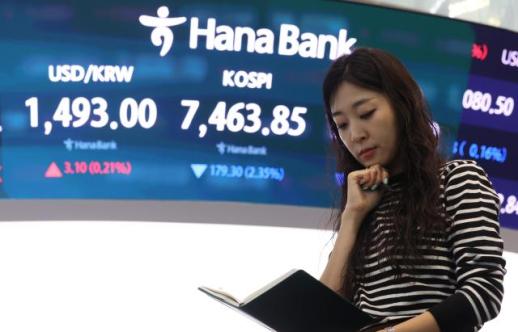 KOSPI briefly sinks to 7,400 level amid AI dividend shock and Samsung labor unrest SEOUL, May 13 (AJP) - South Korean shares extended losses for a second straight session Wednesday as fears of a monthlong strike at Samsung Electronics rattled investor sentiment after marathon government-mediated labor talks collapsed overnight. As of 10:20 a.m., the benchmark KOSPI was down 0.4 percent at 7,613.11 after briefly falling as low as 7,402. The junior KOSDAQ slipped 0.9 percent to 1,169.16. The decline followed an exceptionally volatile session Tuesday, when the KOSPI briefly surged to 7,999.67 before reversing sharply to close more than 5 percent lower after remarks by presidential policy chief Kim Yong-beom on a possible national “AI dividend” unsettled investors in South Korea’s semiconductor-heavy market. Kim suggested that part of the massive tax revenues and profits generated from the AI boom should be redistributed more broadly to the public. The sharp swings underscored how heavily South Korea’s equity rally has become concentrated in a handful of AI-linked semiconductor stocks. As investor funds increasingly pile into a small group of beneficiaries, market volatility in Seoul has outpaced that of U.S. equities. While the U.S. VIX index — often referred to as Wall Street’s fear gauge — has remained in the low 20s near historical norms, Korea’s VKOSPI has surged above 70, its highest level since market turmoil triggered by the U.S.-Iran conflict. Aggressive momentum trading and growing fear-of-missing-out buying have further amplified volatility in Seoul. According to corporate tracker CEO Score, the combined market capitalization of companies listed on the KOSPI, KOSDAQ and KONEX exchanges has surged 172.9 percent since President Lee Jae Myung took office 11 months ago, climbing from 2,597 trillion won ($1.9 trillion) in June 2025 to 7,088 trillion won as of Monday. Much of the gain has been driven by Samsung Electronics and SK hynix, which together accounted for more than 56 percent of the total increase in market value. The two chipmakers now represent roughly 42.4 percent of South Korea’s total stock market capitalization, highlighting the market’s growing dependence on AI-related semiconductor demand. That concentration intensified Wednesday’s selloff. Samsung Electronics fell 5.02 percent to 265,000 won in morning trading, while SK hynix slipped 1.63 percent to 1,805,000 won. The South Korean government and Samsung Electronics management simultaneously ratcheted up pressure on the labor union ahead of next week’s planned monthlong strike after negotiations over a profit-linked bonus system broke down early Wednesday. “A strike must never happen under any circumstances,” Deputy Prime Minister and Finance Minister Koo Yun-cheol wrote on X on Wednesday, pledging to continue mediation efforts to keep negotiations alive. Samsung Electronics, which had largely remained restrained in public comments over union activity, issued its strongest statement yet expressing “deep regret” over the union’s decision to declare negotiations deadlocked after a 17-hour mediation session at the National Labor Relations Commission in Sejong ended around 3 a.m. Among other major stocks, Hyundai Motor rose 2.32 percent to 661,000 won, while Hyundai Mobis jumped 5.66 percent to 579,000 won. HD Hyundai Heavy Industries gained 1.70 percent to 719,000 won. Battery shares also weakened. LG Energy Solution fell 0.79 percent to 439,500 won, while Samsung SDI dropped 2.38 percent to 614,000 won. Defense and industrial shares traded mixed, with Hanwha Aerospace edging down 0.47 percent to 1,278,000 won and Doosan Enerbility sliding 3.42 percent to 121,300 won. Financial stocks were mostly lower, with Samsung Life Insurance falling 1.0 percent to 296,500 won and KB Financial Group slipping 0.13 percent to 153,400 won. The Korean won weakened slightly to 1,493.80 per dollar from the previous session’s close of 1,489.90 won. Overnight on Wall Street, major U.S. indexes closed mixed as stronger-than-expected inflation data pushed Treasury yields higher and triggered profit-taking in technology shares. The Dow Jones Industrial Average rose 0.11 percent, while the Nasdaq Composite fell 0.71 percent and the S&P 500 slipped 0.16 percent. U.S. consumer prices in April came in slightly above expectations, with headline inflation at 3.8 percent and core inflation at 2.8 percent. The data pushed the benchmark 10-year Treasury yield above 4.46 percent, increasing pressure on richly valued AI and semiconductor stocks. Oil prices also climbed after hopes for a breakthrough in U.S.-Iran negotiations weakened, with U.S. crude futures settling above $102 a barrel and adding to broader inflation concerns. Elsewhere in Asia, major stock markets traded lower as investors turned cautious ahead of the summit between U.S. President Donald Trump and Chinese President Xi Jinping set to open in Beijing on Thursday, while also monitoring geopolitical tensions in the Middle East. Japan’s Nikkei 225 was trading at 62,600.17, down 0.23 percent, while China’s Shanghai Composite Index fell 0.48 percent to 4,194.29. Hong Kong’s Hang Seng Index was also trading lower at 26,322.38, down 0.097 percent. 2026-05-13 10:45:17
 -
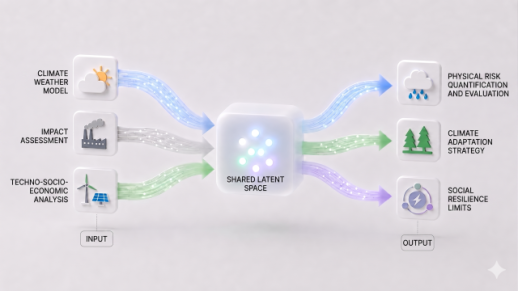 KAIST researchers develop AI framework for climate crisis prediction SEOUL, May 13 (AJP) - Researchers at the Korea Advanced Institute of Science and Technology (KAIST) developed an artificial intelligence framework designed to analyze the integrated impacts of climate change on global economies and energy systems, KAIST said Wednesday. The international research team, led by Professor Jeon Hae-won and Professor Oh Hye-yeon, introduced a foundation model that processes earth observation data, economic scenarios, and policy indicators within a shared virtual space. This system allows for the simultaneous analysis of physical climate phenomena and their resulting socio-economic effects. Existing climate research often separates physical weather predictions from economic impact assessments, which leads to delays in policy decision-making due to fragmented data systems. The new AI framework utilizes a mixture of experts structure, where specialized AI modules collaborate to improve the accuracy and reliability of long-term forecasts. The team also released a prototype tool called the Machine Learning-Integrated Assessment Model (ML-IAM) v1.0. This high-speed emulator can process thousands of different policy scenarios within minutes, whereas traditional integrated assessment models often require several hours to analyze a single scenario. Testing showed that the AI emulator achieved 97 percent accuracy when compared to 15 different international integrated assessment models. The researchers stated that the tool can simulate the immediate effects of policy changes, such as increasing carbon taxes or expanding renewable energy infrastructure. "The climate-AI model is expected to bridge the gap between climate scientists and policymakers," Professor Jeon Hae-won said Wednesday. "The high-speed AI emulator will become a core technology for providing practical climate solutions by enabling near real-time policy analysis." The research was conducted in collaboration with institutions including Peking University, Imperial College London, and the International Institute for Applied Systems Analysis. The findings were published in the journal Nature Climate Change on April 28, 2026, while the technical details of the emulator were presented as a preprint in Geoscientific Model Development on January 9, 2026. "AI technology must contribute to solving the climate crisis that threatens human survival beyond being a mere commercial tool," Professor Oh Hye-yeon said Wednesday. "This international joint research demonstrates that AI can serve as a global public good to address social challenges." (Reference Information) Journal/Source: Nature Climate Change Title: Artificial Intelligence to Support Cross-Disciplinary Climate Change Research Link/DOI: https://bit.ly/4fi4MpR Journal/Source: Geoscientific Model Development Title: ML-IAM v1.0: Emulating Integrated Assessment Models With Machine Learning Link/DOI: https://bit.ly/4u8Yc9W 2026-05-13 10:33:39
 -
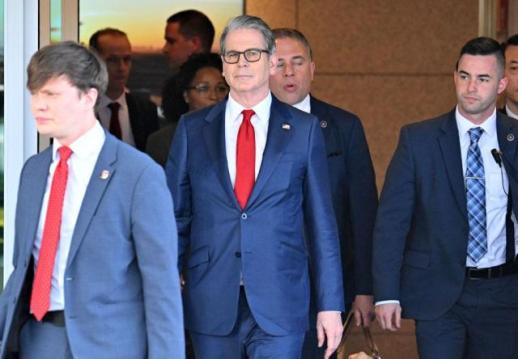 US treasury secretary arrives in Seoul SEOUL, May 13 (AJP) - U.S. Treasury Secretary Scott Bessent arrived in Seoul on Wednesday for talks with a Chinese official, just a day ahead of U.S. President Donald Trump's visit to Beijing for a summit with Chinese President Xi Jinping. Bessent is set to meet with South Korean President Lee Jae Muing at Cheong Wa Dae in the morning before holding talks with visiting Chinese Vice Premier He Lifeng later in the day. He is also expected to meet with South Korean Finance Minister Koo Yun-cheol and other senior financial officials to discuss a broad range of topics including tariffs, trade policy, and broader economic cooperation. Before his arrival in Seoul, Bessent met with Japanese Prime Minister Takaichi Sanae and Japanese Finance Minister Katayama Satsuki in Tokyo the previous day as part of his three-nation trip. Bessent will later head to Beijing, where he will join Trump, who is scheduled to land there later in the day for talks with Xi on Thursday and Friday. Trump's trip will mark the first visit by a U.S. president to China in nearly a decade, with the last such visit taking place during his first term in 2017. Just ahead of his departure to Beijing, Trump told reporters that he is going to be talking "a lot of different things" with Xi, adding "I would say more than anything else will be trade." Key topics for talks between the leaders of the world's two largest economies are expected to include efforts to stabilize energy supplies and reopen the Strait of Hormuz amid the prolonged conflict in the Middle East, as well as trade and tariff-related issues after the two countries clashed last year over steep tariffs. 2026-05-13 10:27:40
 -
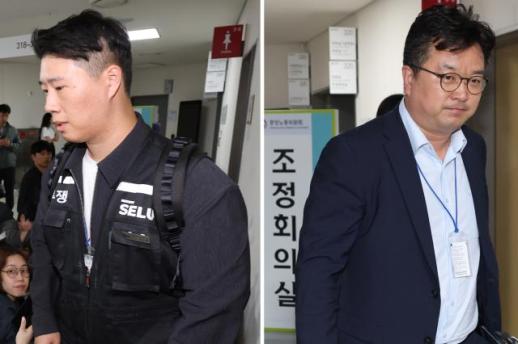 Gov't, Samsung management jointly pressure union after wage talks collapse SEOUL, May 13 (AJP) - The South Korean government and Samsung Electronics management ratcheted up pressure on the labor union ahead of a planned monthlong strike next week after marathon government-mediated talks over a profit-linked bonus system collapsed early Wednesday. “A strike must never happen under any circumstances,” Deputy Prime Minister and Finance Minister Koo Yun-cheol wrote on X on Wednesday, pledging to continue mediation to keep the dialogue momentum alive. Samsung Electronics, which so far has stayed muted over the union activities issued a strongest-yet statement expressing “deep regret” over the union’s decision to declare negotiations deadlocked after a 17-hour mediation session at the National Labor Relations Commission in Sejong ended around 3 a.m. “It is deeply regrettable that the government’s post-mediation efforts were nullified by the union’s declaration of a breakdown,” the company said. “The union’s decision is causing significant concern and anxiety not only for the company but also for employees awaiting a settlement, as well as shareholders and the public.” The National Samsung Electronics Union (NSEU) announced the talks had “finally broken down,” rejecting the latest mediation proposal as a step backward from previous discussions. According to Samsung, the government attempted to facilitate compromise by presenting multiple proposals based on the positions of both labor and management, but the union ultimately walked away from the negotiations. Samsung also accused the union of insisting on a rigid institutionalization of the bonus system while rejecting management’s proposal for a more flexible compensation structure tied to business performance. The core dispute centers on the union’s demand to formalize a compensation scheme allocating 15 percent of operating profit to employee bonuses and abolish the existing bonus ceiling. Management wants to maintain the current Excess Profit Incentive (OPI) framework, which caps bonuses at 50 percent of monthly salary. “The company will continue efforts to prevent the worst-case scenario through sincere dialogue until the end,” Samsung said, while thanking government officials and mediators involved in the process. The government has also intensified calls for compromise amid concerns over the broader economic fallout of a strike at the country’s largest corporation. Koo said earlier this week that Samsung’s record earnings were tied not only to corporate efforts but also to public infrastructure investment and the support of hundreds of subcontractors across the semiconductor supply chain. The union has warned it could launch a full-scale strike as early as May 21 if negotiations remain stalled. While the government has legal authority to invoke emergency arbitration that could suspend industrial action for up to 30 days, officials at the labor commission said the measure is not currently under active review. Samsung Electronics shares that been rallying around historic highs fell 2.4 percent upon the breakdown news Wednesday. 2026-05-13 10:26:30
 -
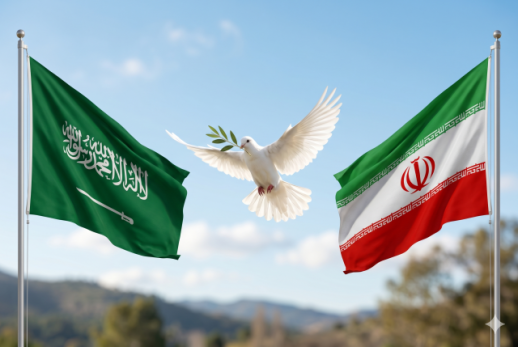 ASIA INSIGHT: The Middle East must now move toward a 'Noah Accord' Saudi Arabia’s First Direct Strike on Iranian Soil — The Middle East Must Now Move Toward a “Noah Accord” A new desert wind is sweeping across the Middle East. Reports that Saudi Arabia has directly struck targets inside Iranian territory are not merely another military headline. They represent a historic signal that the regional order has entered a new and more dangerous phase. For decades, Saudi Arabia and Iran confronted one another while carefully avoiding a direct crossing of certain invisible lines. Their rivalry unfolded through proxy wars, intelligence operations, oil politics and sectarian conflict. Yet the landscape is now changing. The retaliatory strikes reportedly carried out by the United Arab Emirates, the alleged infiltration attempt by Iran’s Revolutionary Guards into Kuwait, and the widening activity of pro-Iranian militias stretching from Iraq to Syria all suggest that the Middle East is becoming a single interconnected theatre of instability. What makes this moment especially significant is the gradual erosion of the old American-centered security architecture in the region. Saudi Arabia is no longer merely an oil kingdom sheltered under the American umbrella. It is transforming itself into a strategic state built simultaneously around artificial intelligence, advanced industry, NEOM, logistics, tourism and global finance. From Riyadh’s perspective, the threat posed by drones and missiles linked to Iran’s Revolutionary Guards is no longer simply a military concern. It is a direct challenge to the kingdom’s economic future and national survival. And yet perhaps the most important detail is this: after the strikes, Saudi Arabia reportedly reopened diplomatic channels and sought de-escalation. That reveals a deeper truth. Both sides understand that if this conflict spirals beyond control, everyone loses. Iran controls one of the world’s most critical strategic chokepoints — the Strait of Hormuz — while also possessing a broad asymmetric network of drones, missiles and proxy forces extending through Hezbollah, the Houthis and other regional actors. Saudi Arabia and the Gulf states, meanwhile, command immense financial power tied to global energy markets, LNG infrastructure, maritime trade and increasingly the future of AI investment. If this confrontation expands into full-scale regional war, the consequences will not stop at the sands of the Gulf. The shockwaves would reach semiconductor factories in South Korea, precision manufacturers in Japan, industrial corridors in India and chemical industries across Europe. Oil prices would surge. LNG markets would convulse. Shipping insurance costs would soar. Supply chains would fracture. Data centers powering the AI revolution could face severe energy instability. Financial markets across the world would tremble. It is precisely at this point that a larger question emerges. The Middle East no longer needs merely another cease-fire agreement or temporary diplomatic arrangement. It needs a deeper civilizational framework for coexistence. That is why I have long argued for what I call a “Noah Accord.” Why Noah? According to the Book of Genesis, humanity spread again after the Great Flood through the descendants of Noah’s three sons: Shem, Ham and Japheth. In the traditional understanding of Abrahamic civilization, the peoples of the Middle East — including Jews and Arabs — are linked through the lineage of Shem. The very word “Semitic” originates from his name. The Jewish people trace their spiritual and historical roots through this lineage. So do the Arab peoples. Abraham himself stands within that same broad ancestral tradition. In other words, beneath centuries of war and division, Israelis and Arabs ultimately emerge from intertwined civilizational roots. And here lies the crucial point regarding Iran. Iran is often viewed simply as Persia — a distinct and separate civilization standing outside the Arab world. Historically, Persia indeed developed its own imperial identity shaped by Central Asia, ancient Iranian traditions and deep philosophical currents of its own. Yet modern Iran is also profoundly connected to the same Abrahamic civilizational sphere. Islam itself stands within the broader monotheistic tradition that reveres Abraham and Noah. The Quran honors Noah as one of the great prophets. The spiritual memory shared by Judaism, Christianity and Islam is therefore not divided by absolute walls, but connected through overlapping narratives of origin and survival. In that sense, Iran is not an alien civilization standing outside the region’s deeper historical structure. It remains part of the same vast Middle Eastern civilizational family — though separated by history, empire, sect and politics. This matters enormously. Today’s Middle East appears trapped inside overlapping conflicts: Shia versus Sunni, Arab versus Persian, Jew versus Muslim, America versus Iran. But when one travels deeper into history, beyond modern geopolitics and ideological slogans, another reality emerges. These societies are not strangers born of separate worlds. They are civilizations that diverged from shared memories, shared prophets and intertwined human origins. That is why the story of Noah matters. Not because of bloodlines alone, but because Noah represents survival through coexistence. The Ark was not built for one tribe alone. It symbolized the minimum structure necessary for life to continue amid catastrophe. And humanity today faces another kind of flood. Artificial intelligence, nuclear tension, collapsing supply chains, energy warfare, demographic decline, climate disruption and civilizational anxiety are arriving all at once. The Middle East sits at the center of many of these converging pressures. What the region now requires is not merely military victory, but a new architecture of coexistence. The essence of a Noah Accord would therefore rest on several principles. First, the collective protection of strategic waterways such as the Strait of Hormuz and the Red Sea. Second, a mutual prohibition against attacks on civilian infrastructure and energy facilities. Third, the establishment of long-term channels for dialogue across sectarian and civilizational lines — between Sunni and Shia, Arab and Persian, Jew and Muslim. Fourth, a shared commitment that advanced technologies, including artificial intelligence, should serve human survival and prosperity rather than endless war. And fifth, a recognition that Israel, Iran, Saudi Arabia, the UAE and the broader Middle East must ultimately see one another not as civilizations destined for annihilation, but as peoples bound to coexist. The Abraham Accords already opened one path toward reconciliation between Israel and several Sunni Arab states. The process remains incomplete and fragile, but it nevertheless established a critical principle: that coexistence is possible. The next challenge is Iran. As the leading power of the Shia world, Iran too may eventually need to recognize that it is not a civilization fated to stand permanently outside the regional order, but part of the same deeper historical and spiritual continuum. Likewise, Israel, Saudi Arabia and the Gulf states must eventually understand that Iran cannot forever be treated solely as an enemy to be contained or destroyed. Because in the current structure, no one can truly achieve total victory. America may possess overwhelming military superiority, yet it cannot fully stabilize Hormuz through force alone. Iran may mobilize proxies and asymmetric warfare, yet it cannot indefinitely sustain confrontation against the wider international system. Saudi Arabia and the Gulf monarchies may command immense wealth, but their futures remain vulnerable if energy routes collapse into permanent instability. In the end, the future of the Middle East will depend not on absolute triumph, but on managed coexistence. And perhaps this is where Asia itself carries an important lesson. For centuries, the West has often spoken in the language of power, finance, military dominance and efficiency. Asia, by contrast, has accumulated long civilizational traditions centered on balance, coexistence, continuity and social harmony. Confucian moderation, Buddhist interdependence and Islamic communal ethics all contain elements of this broader search for sustainable human order. What the world seeks now is not simply more breaking news. It seeks an answer to a deeper question: How shall humanity continue to live together in the age that is coming? The flames spreading across the Middle East are not merely regional fires. They are warnings about the direction of civilization itself in the age of artificial intelligence. That is why the region must ultimately move beyond temporary truces and toward a larger moral imagination. Toward a Noah Accord. An accord in which Israel, Saudi Arabia, the UAE and the Sunni Arab world, together with Iran and the Shia sphere, recognize that beneath their divisions they remain descendants of the same human story. And perhaps, in the age now unfolding before us, that recognition may become the first plank of a new Ark for humanity itself. 2026-05-13 10:23:12
 -
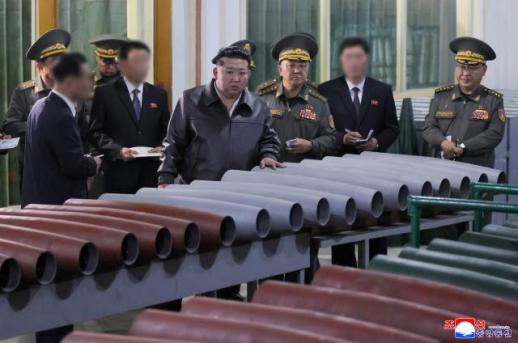 North Korean leader inspects munitions factories, calls for stronger artillery forces SEOUL, May 13 (AJP) - North Korean leader Kim Jong-un inspected munitions factories and called for strengthening "mortar and howitzer forces," state media reported on Wednesday. According to the state-run Korean Central News Agency (KCNA), Kim, accompanied by senior military officials and other key aides, "gave field guidance at several munitions industrial enterprises" earlier this week to "learn about the implementation of munitions production assignments for the first half" of this year. Kim "repeatedly stressed the need to strengthen mortar and howitzer forces," while outlining key tasks such as "setting up a specialized artillery production complex and a small-arms production factory" to meet the future needs of North Korea's military, KCNA said. He emphasized the need to "further modernize" production systems and improve manufacturing processes "in a more scientific way." Kim was also quoted as saying that North Korean munitions industry workers would "make strenuous efforts" to strengthen the country's defense capabilities. 2026-05-13 10:02:09
 -
 S. Korea extradites mastermind who targeted BTS' Jungkook in $25.4 mln fraud SEOUL, May 13 (AJP) - South Korean authorities on Wednesday repatriated a 40-year-old Chinese national accused of leading a sophisticated hacking ring that attempted to steal 8.4 billion won from BTS star Jeon Jung-kook. The suspect, identified only as A, was escorted from Bangkok to Incheon International Airport following a coordinated effort between the Ministry of Justice and the National Police Agency. The extradition marks a major development in an investigation into a syndicate that allegedly siphoned 38 billion won ($25.4 million) from 16 high-profile victims. The group specialized in hunting for wealthy individuals who were physically unable to check their financial alerts, such as celebrities serving in the military or individuals in correctional facilities. The 28-year-old BTS member became a primary target while he was away for his mandatory military service. The hackers allegedly used his stolen personal data to open fraudulent phone accounts, which they used to bypass security and attempt to seize his shares in HYBE, the agency behind BTS. A massive loss was only avoided because his management agency spotted the unauthorized activity in time. Once the agency realized someone was trying to move the 8.4 billion won in stocks, they worked with financial institutions to freeze the transactions immediately. Other victims included corporate chairmen and legal professionals who lost significant amounts of cash and cryptocurrency. Investigators said the gang started with a list of 258 potential targets before narrowing it down to a final list based on who had the most assets and the least ability to fight back quickly. South Korean officials spent months working with Thai prosecutors and Interpol to secure the suspect's return. This follows the earlier extradition of a 36-year-old accomplice in August, as part of a wider crackdown on transnational cybercrime. The Ministry of Justice said it intends to pursue international fraud rings until all members are brought to justice. The accomplice is currently standing trial in South Korea after being indicted in September following his initial extradition. 2026-05-13 09:23:49
 -
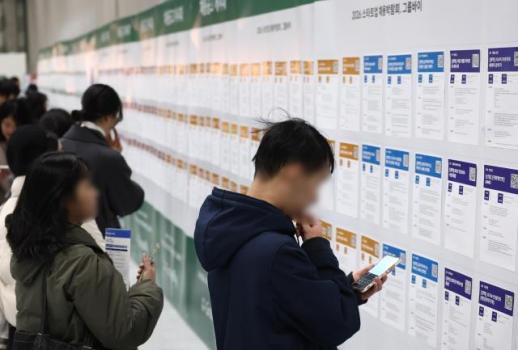 UPDATE: Job growth hits 16-month low in Korea in April, youth employment dips *Updated with additional information SEOUL, May 13 (AJP) — South Korea’s job growth slowed in April to its weakest pace since December 2024, when the country was grappling with the aftermath of the martial law episode, as the war in the Middle East dragged into a third month. The number of employed people aged 15 and older rose by 74,000 from a year earlier to 28.96 million in April, the Ministry of Data and Statistics said Wednesday. It marked the smallest gain in one year and four months, since December 2024, when the number of employed people fell by 52,000. The employment rate for the working-age population, aged 15 to 64, stood at 70 percent, up 0.1 percentage point from a year earlier. But youth employment continued to weaken. The employment rate for people aged 15 to 29 fell by 1.6 percentage points to 43.7 percent, extending its decline for a second straight year since May 2024. Concerns are growing because the weakness in youth employment cannot be explained simply by demographic decline. According to the statistics agency, the number of employed people in their 20s fell by 195,000 from a year earlier, while the youth employment rate has been declining for 24 consecutive months since May last year. The April drop was also sharper than in previous months, widening from declines of 0.7 percentage point in February and 0.9 percentage point in March. The youth unemployment rate stood at 7.1 percent, down 0.2 percentage point from a year earlier, but the figure does not necessarily point to an improvement. The number of people preparing for employment plunged by 43,000, or 6.4 percent, from a year earlier to 626,000, while the number of discouraged workers rose by 15,000. Polarization between experienced workers and newcomers also deepened. The number of unemployed people with prior work experience fell by 1.7 percent on year to 785,000, while the number of unemployed people with no prior work experience surged 21 percent to 68,000. Amid the continued bifurcation of the labor market, more people are staying in education or training. The number of economically inactive people enrolled in education or training rose by 96,000, or 3 percent, over the past 12 months — an unusual increase for April, when the figure typically declines or remains flat. This suggests that young people are delaying their entry into the labor market rather than exiting it altogether, waiting for job conditions to improve. The number of people in their 20s who said they were “taking a break” came to 376,000, down 16,000 from a year earlier, marking a second consecutive monthly decline. The overall increase in those taking a break was driven by people aged 60 and older, whose number jumped 8.4 percent on year to 1.18 million. By industry, employment increased in health and social welfare services by 261,000 and in arts, sports and recreation-related services by 54,000. But job losses continued in professional, scientific and technical services, down 115,000; manufacturing, down 55,000; and agriculture, forestry and fisheries, down 92,000. The decline in professional, scientific and technical services — sectors favored by younger workers and increasingly exposed to artificial intelligence — points to a shortage of quality entry-level jobs and a structural shift in the labor market that is worsening youth employment conditions. The Ministry of Economy and Finance and the Ministry of Employment and Labor on Wednesday unveiled the "Youth New Deal" to address the sluggish job market caused by the Middle East conflict and the shift toward AI. A central component is the "K-New Deal Academy," a vocational training program involving 70 companies, including the top 10 conglomerates, which aims to train 12,000 individuals to align skills with corporate demand. The "Youth Leap Boot Camp," a joint university-industry initiative, will also launch in July following university selections in June. Public and private internship programs are also set to begin recruitment this month. 2026-05-13 09:02:17
 -
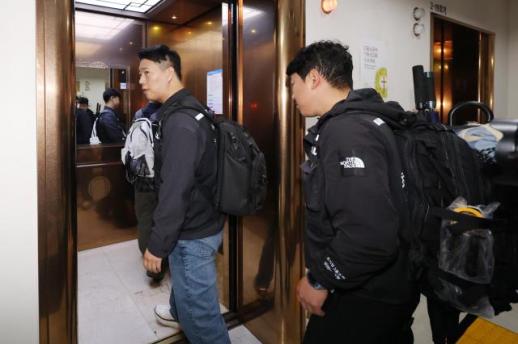 Samsung Electronics union heads toward strike after govt-mediation talks collapse SEOUL, May 13 (AJP) -Samsung Electronics and its largest labor union failed to bridge differences over bonuses in a final round of government-mediated wage negotiations, raising the likelihood of a monthlong strike that could ripple through the global semiconductor supply chain starting next week. The breakdown came after 17 hours of overnight talks at the National Labor Relations Commission in Sejong, where labor and management sought to reach a 2026 wage agreement but ultimately ended negotiations without a deal. Choi Seung-ho, head of the Samsung Electronics branch of the National Samsung Electronics Union, declared the post-mediation process “finally deadlocked” early Wednesday. “We asked for a mediation proposal because the gap between labor and management could not be narrowed, but after nearly 12 hours of waiting, the proposal turned out to be a step backward,” Choi told reporters after the talks collapsed around 3 a.m. The core dispute centered on whether to institutionalize and expand Samsung’s bonus system. The union is demanding the removal of bonus caps and the establishment of a transparent, formalized compensation structure tied to company performance. It has proposed allocating 15 percent of Samsung Electronics’ estimated annual operating profit of 270 trillion won ($194 billion) into bonus funding. Under the union’s proposal, average bonuses for employees in the Device Solutions (DS) memory division could reach roughly 600 million won per worker, while even loss-making nonmemory operations such as foundry and System LSI units could receive payouts exceeding 300 million won. Choi criticized the mediation proposal for effectively preserving the current excess profit incentive (OPI) framework, including its 50 percent bonus ceiling. “The proposal maintained the existing OPI system rather than introducing transparency,” he said. “The 50 percent bonus cap also remained intact.” Management has reportedly proposed broader compensation for struggling nonmemory divisions on the condition that losses improve, but the union rejected what it described as temporary and externally linked standards. Choi also objected to a proposal tying DS division bonuses to whether payouts exceeded those at SK hynix. “It is not desirable to connect our company’s performance to external factors,” he said, adding that the union could not accept a one-off measure lacking institutional guarantees. The union said it no longer intends to participate in further post-mediation proceedings, though Choi said labor would still consider listening if management presented a “proper proposal.” Samsung management and the union had already failed to reach an agreement during earlier mediation sessions held in February and March. The two sides resumed negotiations through a special post-mediation procedure starting Monday. The National Labor Relations Commission said it proposed “various alternatives” based on both sides’ positions but concluded that differences remained too wide after the union requested termination of the mediation process. The commission added that additional mediation could still be arranged if both parties later agreed to resume talks. With negotiations now broken off, the possibility of a full-scale strike planned for May 21 has intensified. The union, which claims around 73,000 members, said about 41,000 workers had already indicated their intention to join a strike, and Choi claimed participation could exceed 50,000 under the company’s current proposal. He stressed the union intended to proceed legally. “There is no point in waiting any longer,” Choi said. “We have no intention of engaging in illegal labor action. We will carry out lawful industrial action.” The union also said it would now focus on responding to Samsung’s court request for an injunction against what the company described as illegal labor activities. The market has been closing watching the government-mediated talks in fear of the repercussions on the chip-led exports and stock rally. Some forecasts estimate losses could exceed 40 trillion won if production disruptions spread across key semiconductor lines, while observers also warn of customer defections and long-term supply chain damage. The American Chamber of Commerce in Korea recently warned that disruptions at Samsung could destabilize global memory chip supply and increase price volatility. Concerns have also spread to suppliers and subcontractors. Samsung’s sustainability report lists roughly 1,700 partner firms across first- through third-tier supply chains, raising fears that prolonged production disruptions could trigger broader employment instability among smaller manufacturers. The government could still interfere through an emergency arbitration powers as a last resort. Under South Korea’s labor law, the labor minister may order emergency arbitration when industrial action is deemed likely to seriously damage the national economy or threaten public welfare. Such a move would ban strikes for 30 days while compulsory mediation and arbitration proceed. The measure has been invoked only four times in modern South Korean history, including during strikes at Hyundai Motor Company in 1993 and pilot walkouts at Asiana Airlines and Korean Air in 2005. A commission official, however, said emergency arbitration was “not a matter currently under our review.” 2026-05-13 07:56:39