
Journalist

Lee Hugh
-
 Top 10 South Korean Brokerages’ Q1 Net Profit Nearly Matches Big Five Banks South Korea’s securities industry has narrowed the earnings gap with banks, buoyed by a strong stock market that has lifted trading and brokerage revenue. On the 6th, the financial investment industry and FnGuide said the combined first-quarter net profit of the 10 largest brokerages by equity totaled 4.4656 trillion won, bringing results to roughly the level of the banking sector. By firm (consensus estimates), Mirae Asset Securities posted the largest net profit at 1.0332 trillion won, followed by Korea Financial Holdings (Korea Investment & Securities) at 672.9 billion won, Meritz Financial Group (Meritz Securities) at 668.5 billion won, Kiwoom Securities at 417.9 billion won, Samsung Securities at 386.0 billion won and Daishin Securities at 69.5 billion won. Brokerage units of financial groups also reported: NH Investment & Securities 475.7 billion won, KB Securities 350.2 billion won, Shinhan Investment Corp. 288.4 billion won and Hana Securities 103.3 billion won. Against that backdrop, the combined first-quarter net profit of the five major banks totaled 4.4420 trillion won. By bank, Shinhan Bank led with 1.1571 trillion won, followed by Hana Bank with 1.1042 trillion won and KB Kookmin Bank with 1.1010 trillion won. NH NongHyup Bank posted 557.7 billion won and Woori Bank 531.2 billion won. The securities industry’s net profit relative to banks has risen steadily, from 27.8% in 2022 to 36.3% in 2023, 42.9% in 2024 and 50.0% in 2025. Last year, the combined net profit of the 10 brokerages reached 7.67 trillion won, close to half the 15.33 trillion won earned by the five banks. Analysts said the gap has narrowed faster this year as stock prices rose and trading value expanded, improving brokerages’ earnings structure. Brokerage business was cited as the main driver, with commission income jumping as both retail investors and foreign funds flowed into the market. The industry has also diversified revenue sources compared with the past, with results from global investment and trading adding support. Mirae Asset Securities, which is expected to post more than 1 trillion won in first-quarter net profit, saw earnings surge as valuation gains tied to its SpaceX investment increased sharply. Regulatory changes were also described as supportive. The introduction of comprehensive investment management accounts, known as IMA, and the expansion of short-term note issuance businesses are increasing the scale of brokerages’ fund management and broadening opportunities to generate revenue across investment and corporate finance. Market watchers said the brokerage sector is likely to remain resilient for the time being on the back of the market rally. Woo Do-hyung, an analyst at Yuanta Securities, said credit provision balances and client deposits (130 trillion won) rose 4.1% and 17.6%, respectively, from the previous month to record highs. He said buying sentiment remains firm and turnover among retail investors is likely to keep rising. * This article has been translated by AI. 2026-05-06 14:51:17
 -
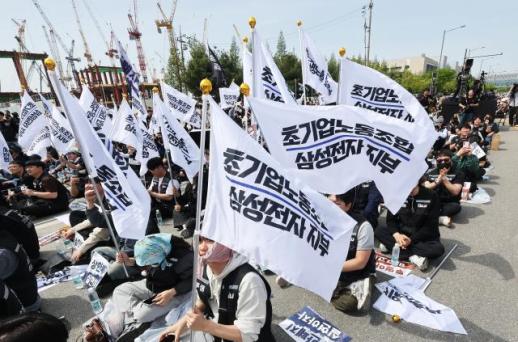 Samsung Electronics Shareholder Groups Rally Against Union’s Planned Strike as Market Cap Tops $1 Trillion As Samsung Electronics’ market value climbed past $1 trillion, some shareholder groups took to the streets to oppose the company’s union plan for a general strike. The groups called for a ban on the strike and said they would pursue tough measures, including damage claims, if an illegal strike occurs. Industry officials said Wednesday that shareholder groups including the Shareholder Action Practice Headquarters hung banners and held a rally in the Hannam-dong area of Seoul’s Yongsan district opposing the union’s planned walkout. The banners said the strike would “only give overseas semiconductor companies a windfall,” and included slogans such as “A strike in essential semiconductor processes is more serious than a strike by the military or police” and “Ban ruinous strikes that hold the national economy hostage through legislation.” The groups said that if the union representing a majority of Samsung Electronics workers pushes ahead with a general strike starting May 21 and holds a rally near the Hannam-dong home of Chairman Lee Jae-yong on the first day, they will stage a counter-rally with more than 100 shareholders. A day earlier, the Korea Shareholder Movement Headquarters warned it would seek damages from all union members if what it called an illegal strike damages key assets. Calling the planned walkout “a self-destructive act that harms corporate value,” the group said that if a strike begins in an illegal form and damages the company’s core assets, shareholders would join forces to seek damages from all union members who participate, citing a legal theory of “infringement of third-party rights.” The union has demanded performance pay equal to 15% of annual operating profit and has announced an 18-day general strike starting May 21. Based on market estimates of operating profit, the amount would total 45 trillion won. Samsung Electronics on Wednesday became the second company in Asia to join the “$1 trillion market cap club.” As of 2:30 p.m., shares were up 15.05% from the previous session at 267,500 won. Market capitalization rose to 1,563 trillion won, or about $1.0738 trillion. That put Samsung Electronics above the $1 trillion mark, following Taiwan Semiconductor Manufacturing Co., the world’s largest foundry operator, with a market cap of $1.86 trillion. 2026-05-06 14:44:12
 -
 Kakao Pay posts record Q1 operating profit, extends streak of profitability Kakao Pay said it posted its highest-ever quarterly results in the first quarter, driven by growth across its payments, financial services and platform businesses. In a regulatory filing on Tuesday, the company reported consolidated revenue of 300.3 billion won and operating profit of 32.2 billion won for the January-March period. That was up 41.7% and 630.9%, respectively, from a year earlier, both record highs. Operating margin rose to 10.7%, and net profit margin reached 11.6%, both in double digits. Transaction volume also increased. Consolidated transaction value rose 15% from a year earlier to 50.9 trillion won. Revenue-contributing transaction value climbed 15% to 14.6 trillion won, holding at about 29% of total transaction value. The balance of Kakao Pay Money top-ups continued to rise, reaching 2.5122 trillion won. Remittance transaction value also grew 15% from a year earlier as stock trading expanded. Financial services led the gains. Revenue from the segment jumped 82% to 145.9 billion won, helped by a 137% increase in investment-service revenue and a 78% rise in insurance-service revenue. The segment accounted for 49% of total revenue, as the company broadened earnings beyond payments. Payments revenue rose 13.3% to 138.4 billion won. Online payments at merchants outside the Kakao Group increased 24%, supporting revenue growth, the company said, citing data-driven solutions aimed at boosting partner sales. Overseas payment transaction value increased 20% from a year earlier. Subsidiaries also contributed. Kakao Pay Insurance posted first-quarter revenue of 24.3 billion won, up 85% from a year earlier, while regular premium payments rose 157%. Kakao Pay Securities reported quarterly revenue of 100.1 billion won and operating profit of 23.6 billion won, both record highs. Chief Executive Shin Won-geun said the company’s data-driven business model and new growth engines have moved onto a firmer track. “We will keep our growth momentum solid so that technological innovation can translate into higher corporate value,” he said.* This article has been translated by AI. 2026-05-06 14:43:17
 -
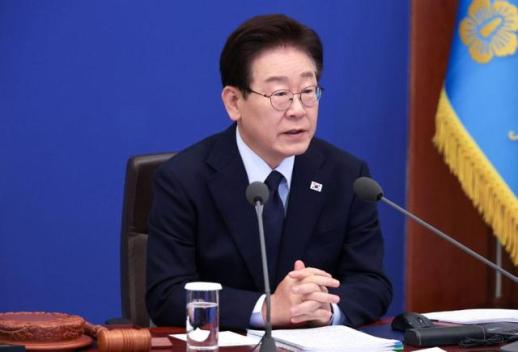 South Korea to send special envoy to Costa Rican president's inauguration SEOUL, May 6 (AJP) - South Korea will send former lawmaker Yang Kyung-sook as a special envoy to Costa Rica as the country's new president is set to be inaugurated this week. In a written press briefing, presidential spokesperson Kang Yu-jung said Yang is set to attend Costa Rican President-elect Laura Fernandez's inauguration ceremony on Friday. She will deliver a personal letter from President Lee Jae Myung to Fernandez and discuss South Korea's foreign policy priorities with the new government. Kang said the envoy will convey the Lee administration's intention to strengthen practical cooperation between the two countries in various areas including infrastructure and education. Yang is also expected to attend other events including a reception hosted by the Central American country's foreign minister. 2026-05-06 14:37:51
 -
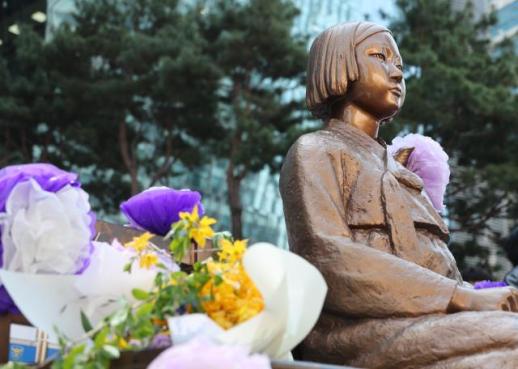 Police 'liberate ' iconic Statue of Peace for first time in six years SEOUL, May 06 (AJP) - The barricades surrounding the Statue of Peace were dismantled by police on Wednesday after six years of isolation and confinement. The bronze monument, which symbolizes victims of Japanese wartime sexual slavery, is now publicly accessible and free from the immediate threat of vandalism. The Statue of Peace depicts a teenage girl sitting on a chair, staring toward the former site of the Japanese embassy in central Seoul. Since its first installation in 2011, approximately 200 similar statues have been placed worldwide in cities such as Washington DC, Sydney, Toronto, and Shanghai. The barriers had been in place since June 2020 to shield the site from aggressive pro-Japan activists and historical revisionists. During a celebratory event on Wednesday, supporters described the removal as the liberation of the statue. The action coincided with the 1,751st weekly demonstration held near the former Japanese Embassy in central Seoul. Activists from the Justice Memory Solidarity prepared for the opening by cleaning the statue with wet wipes and placing a purple floral wreath on its head. Han Kyung-hee, the chairperson of the Justice Memory Solidarity, told the crowd that the statue has finally returned to the arms of the citizens after five years and 11 months. She said that while the public had been unable to sit in the empty chair beside the girl for years, they never stopped fighting for its protection. The barricades were originally requested by the activist group itself as a desperate measure to prevent the statue from being defaced by far-right protesters. Tensions at the site had escalated in 2019 as groups began demanding the removal of the monument while shouting historical denials. The legal path for the removal opened after Kim Byeong-heon, the leader of a prominent revisionist group, was arrested in March. He faces charges of defaming the deceased victims by publicly denying the forced nature of their ordeal. Investigations by South Korean prosecutors revealed that Kim's activities were supported by approximately 76 million won ($5,222) in funding from Japanese donors. The prosecution stated that this money was used as the primary engine for his long-term campaign to erase the history of the victims. According to historical records from the National Institute of Korean History, the Imperial Japanese Army systematically forced an estimated 200,000 women into sexual slavery during the Pacific War. These victims, many of whom were young South Korean girls, were transported to frontline brothels across the Pacific front where they were subjected to repeated forced sexual violence. The Statue of Peace incorporates specific details to reflect this history, including short, uneven hair that represents the girl being forcibly torn from her family. Her bare feet and lifted heels symbolize the restless spirits of victims who were unable to find peace or a sense of home after the war ended. The monument is officially registered as the first public artwork of the Jongno District and is managed by the local government. Police officials confirmed they will continue to deploy personnel to the area to ensure the safety of the site following the removal of the physical barriers. 2026-05-06 14:35:56
 -
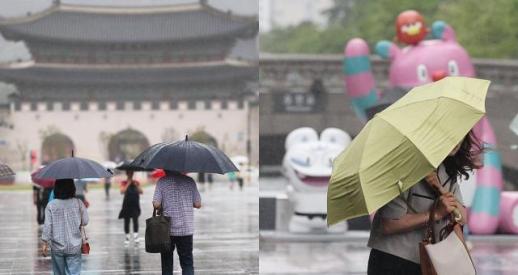 When Will the 2026 Rainy Season Begin in Korea? The 2026 rainy season in South Korea is expected to start around the same time as in previous years and last for about a month. According to weather observations from 1991 to 2020, the typical pattern of the monsoon begins in Jeju Island, followed by the southern and central regions of the country. Based on this pattern, the anticipated start dates for the 2026 rainy season are as follows: Jeju Island is expected to see the onset between June 19 and 21, the southern region around June 23 to 25, and the central region, including the capital area, between June 25 and 27. The end of the rainy season is also projected to follow a similar timeline to previous years. Jeju Island is likely to experience the conclusion around July 20, the southern region between July 24 and 25, and the central region from July 26 to the end of July. The overall duration of the rainy season is expected to be about 30 to 31 days, which aligns closely with the average duration of 31 to 32 days. However, these projections are based on historical weather data, and actual start and end dates may vary by one to three days due to factors such as the expansion of the North Pacific High, the positioning of stationary fronts, and changes in atmospheric flow. Experts have noted that climate change is increasingly affecting precipitation patterns, making it more important to prepare for the intensity of rainfall rather than just the duration. While the duration of the rainy season may be similar to previous years, experts are paying attention to the possibility of different precipitation patterns. Instead of steady rainfall over long periods, there is a trend toward intense downpours occurring in shorter bursts. This could lead to greater damage even with the same amount of rainfall. Recently, claims circulating on social media that it will rain continuously for a month have been deemed exaggerated. It is typical for the rainy season to include clear days and breaks in rainfall, and continuous rain is not common meteorologically. However, localized heavy rain could create the impression that it is raining constantly. Additionally, weather statistics indicate that unstable atmospheric conditions can lead to sudden downpours, often referred to as “guerrilla rain,” continuing into early August. In recent years, there have been instances of stronger localized downpours occurring after the rainy season has ended, highlighting the importance of disaster preparedness during the summer months. Experts emphasize the need to prepare for potential natural disasters such as flooding, landslides, and river overflow this summer. Even if the rainy season duration is similar to previous years, concentrated rainfall at specific times could result in significant damage. This forecast is based on statistical predictions derived from 30 years of weather data, and actual weather conditions may vary as the season progresses. Therefore, it is essential to continuously monitor the Korea Meteorological Administration's short-term and medium-term forecasts. 2026-05-06 14:35:15
 -
 Lotte Card Q1 Operating Profit Jumps 201% to 41.5 Billion Won Lotte Card said Tuesday it posted 41.5 billion won ($415억원) in operating profit for the first quarter, up 201.4% from 13.8 billion won a year earlier. The company also reported a rebound in membership after last year’s large-scale personal data leak. First-quarter membership totaled 9,566,000, up 10,000 from a year earlier. Asset quality indicators improved as well. As of the end of March, the delinquency transition rate — the share of performing loans that become loans overdue by at least two months — stood at 0.318%, close to the pre-Legoland incident level of 0.311%. Lotte Card kept a double-digit market share. Based on personal and corporate credit sales among eight dedicated card issuers tracked by the Credit Finance Association, its first-quarter share was 10.6%, following 11.0% in the previous quarter. Lotte Card attributed the results to a stable earnings structure built around a portfolio focused on high-quality customers. It also cited stronger risk management and lower bad-debt costs. CEO Jeong Sang-ho said, “It was an important time to show the company’s resilience after last year’s cyber incident, and employees worked together to achieve the valuable result of higher operating profit.” He added, “We will continue to respond to internal and external uncertainty as one team.” Separately, a Lotte Card official said that because a final decision by the Financial Services Commission is still pending, the company will “faithfully explain” its efforts to prevent damage from the incident in seeking reduced sanctions. On April 30, Lotte Card said a second meeting of the Financial Supervisory Service’s sanctions review committee confirmed heavy penalties, including a 4.5-month business suspension and an administrative fine of about 5 billion won. 2026-05-06 14:34:24
 -
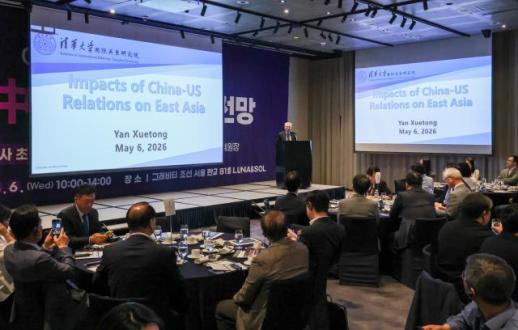 Prelude to U.S.-China summit, scholars discuss fault lines in Korea SEOUL, May 06 (AJP) -Scholars from South Korea and China gathered in Seongnam on Tuesday to dissect the shifting balance between Washington and Beijing ahead of a closely watched meeting between U.S. President Donald Trump and Chinese President Xi Jinping due next week. At Gravity Pangyo in Gyeonggi Province, academics and policy experts filled the conference hall for a special seminar examining how intensifying U.S.-China rivalry is reshaping diplomacy, technology and security across East Asia. Hosted by the Gyeonggi Research Institute under the theme “Changes and Prospects in U.S.-China Relations,” the event unfolded against the backdrop of prolonged tensions in the Middle East and growing uncertainty over global supply chains. Participants exchanged views on South Korea’s strategic options as geopolitical competition between the world’s two largest powers deepens. Among the keynote speakers was Yan Xuetong, honorary dean of the Institute of International Relations at Tsinghua University, who joined Korean scholars in discussing the evolving regional order and the diplomatic challenges facing Seoul. 2026-05-06 14:34:11
 -
 How a Rising Gen Z Democratic Operative Became a Pro-Iran Activist Abroad "They all died fighting for fascism, genocide, pedophilia and cannibalism." Carla Walsh, a 22-year-old American pro-Iran activist, posted that message on X about four U.S. troops who were killed in a drone attack during the Iran war in March. On May 5 (local time), she also posted on X a statement attributed to Iran’s military that warned the United Arab Emirates that the UAE, described as “Islamic land,” should not become a base for U.S. and “Zionist” (Israeli) forces and equipment, calling it a betrayal of the Islamic world and Muslims. The Boston Globe, in a story published May 5, traced Walsh’s path and said she did not always project a pro-Iran, anti-U.S. stance. As recently as six years ago, she was seen as a promising young figure in the Democratic Party. The Globe cited her work on Sen. Ed Markey’s 2020 reelection campaign, where she used online memes to help turn the senator, then in his 70s, into a Gen Z political icon. The paper said she could not vote at the time but “enjoyed talking to reporters more than doing (school) math homework.” After Markey’s victory, Walsh gained wider attention through interviews with The New York Times and NPR. The Times said at the time that “the Markeyverse (supporter group) used a powerful political strategy that cemented him as a symbol of the left.” In November 2023, Walsh began to diverge from other young Democrats, according to the report. She climbed onto the roof of an Elbit Systems facility in New Hampshire and vandalized the building by painting it; video circulated online. The New Hampshire Journal reported that after her arrest, her sentence was reduced to 60 days in jail in exchange for a guilty plea, with the remaining time suspended. At a sentencing hearing in November 2024, she cheered and showed no sign of embarrassment, the report said. It also said she voted in the U.S. presidential election before being jailed and wrote the name of a Hamas leader who had been killed, Yahya Sinwar, on her ballot. After the trial, Walsh left the United States. City Journal reported she traveled last year to Cuba and Iran and has recently been staying in Lebanon. While in Iran, it said, she attended the Sobh International Media Festival hosted by state broadcaster IRIB and visited Iran’s National Aerospace Park, where she praised Iranian drones and missiles. The Free Press reported that Walsh “is pledging loyalty to Iran, Hamas and Hezbollah,” and said the U.S. government placed her on a watch list based on what it described as extensive connections to the governments of Cuba and Iran. The outlet said her pro-Iran, pro-Cuba and pro-Lebanon propaganda activities could lead to prosecution under U.S. law. A U.S. counterterrorism official was quoted as saying, “I’ve never seen someone who’s been to prison be so openly connected to terrorism.” Walsh’s family said in an email to The Free Press, “We truly love Carla, but we have serious and fundamental political differences with her.”* This article has been translated by AI. 2026-05-06 14:31:11
 -
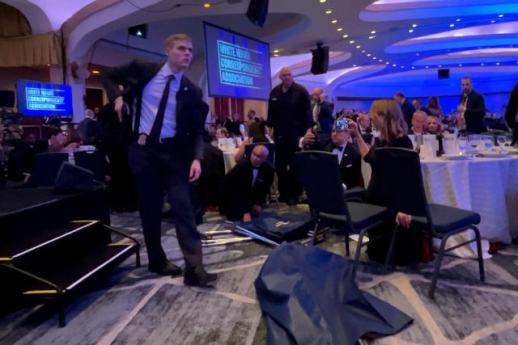 Trump’s Unity Message Loses Force as Actions Undercut Words "Right now, it is more important than ever that we come together and show the world what it means to be Americans." In July 2024, as the presidential campaign intensified in Pennsylvania, Trump’s words helped reshape the race. After surviving an assassination attempt, he delivered a message of unity with a markedly different tone, as if he had already secured the presidency. Paired with an image of him, blood on his face, raising a clenched fist beneath the U.S. flag, the moment became a political narrative. Trump went on to win an election that had been expected to be close. During his first term, Trump had taken steps far from national unity, including supporting the “Capitol riot.” Still, his call for unity after the shooting resonated in a society sliding toward extremes, and some voters backed him with the hope that “this time might be different.” The narrative was so complete that some even floated claims the shooting had been staged. In 2026, the reality of “Trump’s second term” looks different. Broad tariff hikes, fired without distinguishing friend from foe, have paralyzed the global economy, the article says. This year, the Iran war has reinforced that “Trump risk” remains an ongoing concern worldwide. The “peacemaker” and “unifier” promised in his inaugural address are nowhere to be found, replaced by what the article calls a “troublemaker” stoking division in the United States and beyond. Against that backdrop, two shootings occurred near the White House in less than 10 days. The April 25 shooting at the White House Correspondents’ Association dinner revived memories of the Pennsylvania assassination attempt two years earlier. After the latest incident, Trump again struck a unifying note, saying, "We need to resolve our differences." But the message carried less weight than it did two years ago, the article argues, because his actions over the past year have eroded its credibility. Unlike during the campaign, when the shooting boosted his approval ratings, the article says his ratings have remained at rock bottom despite the recent gunfire. The article says the “Trump paradox” offers a pointed lesson with local elections a month away. A public figure’s message is shaped not by words alone, it argues, but by the record behind them. As candidates soon fan out across the country promising local development and community unity, voters should look past election-season rhetoric and judge the paths candidates have taken in daily life. The article argues that politicians who routinely feed on hatred and conflict but call for “unity” only during campaigns are misleading voters. Promises offered without funding plans or a concrete roadmap, it says, can be as empty as Trump’s “peacemaker” pledge. It also warns that when a local government leader refuses to cooperate with councils and other levels of government and instead governs unilaterally, residents bear the cost. The article concludes that Trump’s unity message lost power because his record showed no trace of unity. It says the responsibility now lies with voters to seek leaders who prove themselves through their lives and conduct, not their slogans.* This article has been translated by AI. 2026-05-06 14:28:26