
Journalist

Lee Hugh
-
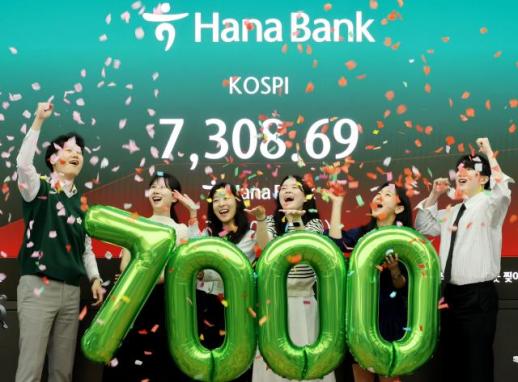 KOSPI rockets above 7,300 in record-breaking chip rally *Updated with performance of other Asian markets. SEOUL, May 06 (AJP) - What once seemed improbable has rapidly become reality as South Korea’s benchmark KOSPI vaulted above the 7,300 mark on Wednesday, just three weeks after reclaiming the 6,000 level as feverish foreign buying turbocharged semiconductor and AI infrastructure stocks despite lingering uncertainty surrounding the Strait of Hormuz crisis. As of 10:09 a.m., the KOSPI stood at 7,325.31, up 5.60 percent from Monday’s close, after surging to an intraday high of 7,338.61 earlier in the session. Foreign buying total 1.25 trillion won, overwhelming local selling. The celebration however was heavily skewed with losers outnumbering gainers by 674 to 204. The move marked the index’s first break above the 7,300 threshold and underscored the extraordinary pace of the rally after the KOSPI first crossed the 6,000 mark on Feb. 25. The Korean won also recovered to near pre-war levels in the 1,450 range against the U.S. dollar. The dollar-won exchange rate fell to 1,457.70 won from 1,462.8 won in the previous session. The KOSPI has remained remarkably resilient despite the Middle East war and South Korea’s heavy dependence on Gulf energy imports for manufacturing and exports. The benchmark first broke above 4,000 in October last year, topped 5,000 in January and crossed 6,000 a month later, before storming into the 7,000 era within barely half a year. The latest leg higher followed another record-setting session on Wall Street overnight, where both the S&P 500 and the Nasdaq Composite closed at all-time highs as easing oil prices and optimism surrounding AI-driven semiconductor demand outweighed lingering geopolitical concerns in the Middle East. Investor sentiment improved after reports indicated that the fragile ceasefire between the United States and Iran was largely holding despite intermittent clashes, easing fears of supply disruptions and pushing oil prices lower. West Texas Intermediate crude futures fell 3.90 percent to settle at $102.27 a barrel. Technology shares led gains in the United States. Intel jumped nearly 13 percent on news of fresh semiconductor supply negotiations with Apple, while the Philadelphia Semiconductor Index soared 4.23 percent. Advanced Micro Devices surged another 15 percent in after-hours trading after posting strong first-quarter earnings. The global semiconductor rally spilled into Seoul, fueling aggressive buying in chip-related shares. Samsung Electronics surged 12.26 percent to 261,000 won, while SK hynix jumped 9.68 percent to 1,587,000 won, with both hitting fresh intraday record highs. SK Square, the largest shareholder of SK hynix, soared 10.80 percent to break above the 1 million won mark. Brokerage firms also rallied sharply on expectations that surging trading activity would boost commissions and earnings. Mirae Asset Securities jumped 15.22 percent to a fresh 52-week high, while Kiwoom Securities advanced 10.06 percent. Automakers and battery-related shares also traded higher, with Hyundai Motor gaining 3.34 percent, Kia rising 1.69 percent and LG Energy Solution adding 0.11 percent. Defense and shipbuilding-related shares, however, lagged behind the broader market rally. Hanwha Aerospace fell 1.30 percent, while HD Hyundai Heavy Industries slipped 4.26 percent. HMM also declined 1.65 percent after a fire broke out aboard one of its cargo vessels anchored near the Strait of Hormuz on Monday, adding another layer of uncertainty to already fragile global shipping routes. Meanwhile, the tech-heavy KOSDAQ bucked the broader rally, slipping 0.90 percent to 1,202.83. Elsewhere in Asia, Japanese markets remained closed for the Golden Week holiday. Hong Kong’s Hang Seng Index traded higher, rising 0.54 percent to 26,037.53 and China’s Shanghai Composite Index also advanced, gaining 1.05 percent to 4,155.44. 2026-05-06 10:34:14
 -
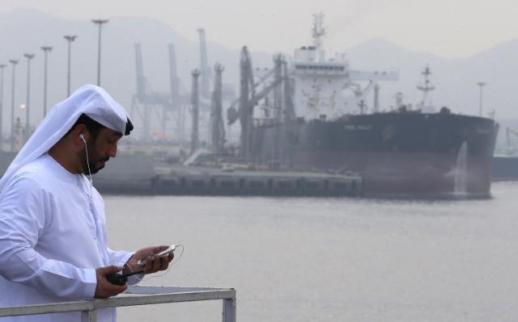 UAE: Strategic Neighbor or Hostile Adversary to Iran? When analyzing the Middle East, one of the most dangerous attitudes is to simply label a country as being on one side or another. Iran is a Shia revolutionary state, while Saudi Arabia and the UAE are Sunni Gulf monarchies. Israel is Iran's primary security adversary, and the United States traditionally serves as the security guardian for the Gulf monarchies. On the surface, the dynamics appear clear: Iran versus anti-Iran, Shia versus Sunni, Persia versus Arab, revolutionary republic versus monarchy.However, the reality of the Middle East is far more complex. The actions of the UAE exemplify how multifaceted and calculated today's Middle Eastern order is.Recently, while denying UAE claims that Iranian forces attacked, Iran warned of "devastating retaliation" if military actions targeting Iranian ports and coasts were initiated from UAE territory. The UAE claimed to have intercepted missiles and drones from Iran and reported a fire at an oil facility in Fujairah, which Iran denied. The key point here is not just the dispute over facts. Iran, while asserting "we did not do it," simultaneously pressures the UAE by stating, "We will not tolerate you becoming a military base for the U.S. and Israel." This reflects Iran's strategic language: denial serves diplomatic purposes, while warnings are meant for deterrence.The UAE's situation is even more complicated. While claiming to have been attacked, it refrains from direct military retaliation. This is not solely due to fear. The UAE is a small but wealthy nation. Dubai's finance, Abu Dhabi's energy, Fujairah's ports, advanced logistics, tourism, and international capital trust are crucial for national survival. A full-scale conflict with Iran could destabilize the UAE's core. Although Iran faces economic difficulties and international sanctions, it possesses missiles, drones, the Revolutionary Guard, and asymmetric naval capabilities. If the UAE retaliates once, Iran could respond with an even greater retaliation, which would simultaneously disrupt international insurance rates, shipping costs, port traffic, oil transport, and foreign investment sentiment. Therefore, the UAE's choice is to "express anger but avoid escalation." This is not submission but calculation.At the center of this calculation are the Strait of Hormuz and Fujairah. The Strait of Hormuz is a critical artery for global energy flows. Iran controls the northern coastline, while the UAE operates ports and energy transport networks on the southern side. Fujairah serves as a strategic port that circumvents risks associated with the Strait of Hormuz, yet it remains within the range of Iranian missiles and drones. Geography dictates fate in the Middle East. From a South Korean perspective, the UAE appears as a gateway to the region, a hub of advanced cities and investment, but its territory faces the vast Persian state of Iran. The reason the UAE strongly opposes Iran yet does not cross the threshold into war lies here. Small powers in the Middle East do not survive solely through courage; they endure through a sense of balance.At the root of the Iran-UAE relationship lies sectarian issues. Iran is a Shia revolutionary state. Since the Islamic Revolution in 1979, Iran has defined itself not merely as a nation-state but as a country with a revolutionary ideology. In contrast, the UAE and other Gulf monarchies are based on Sunni monarchical order. Iran positions itself as the center of a resistance axis against the West and Zionism, while the Gulf monarchies regard Iran as a "exporter of revolution that could destabilize their regimes." However, religion is merely a facade; the underlying issues are power and security. When Iran warns the UAE not to become a "nest for the U.S. and Zionists," it may sound like a religious condemnation, but the core message is a military warning. Iran fears that the UAE could become a hub for U.S. and Israeli intelligence, air defense, and naval operations.Additionally, historical tensions between Persia and the Arabs complicate matters. Iran is a nation with memories of the ancient Persian Empire. Throughout its long history—from the Achaemenid, Sassanid, Safavid, Qajar, and Pahlavi dynasties to the Islamic Republic—Iran has viewed itself not as a peripheral nation in the Middle East but as the center of civilization. The UAE, a modern state that gained independence in 1971, has rapidly become a global hub through its strategies in finance, ports, energy, aviation, investment, and advanced cities. The deep civilizational state of Persia and the emerging commercial state of the Arabs face each other across the Persian Gulf. They cannot ignore each other, nor can they fully trust one another.Another deep-seated issue is the dispute over the islands of Abu Musa, Greater Tunb, and Lesser Tunb. Iran seized these islands during the process of Britain's withdrawal from the Gulf in 1971, and the UAE still views this as an occupation of its territory. These islands are not merely subjects of territorial disputes; they are strategic points that can monitor the entrance to the Strait of Hormuz. For Iran, they represent a defensive line for the Persian Gulf, while for the UAE, they are an old thorn in its national security. Thus, the relationship between the UAE and Iran is not simply diplomatic; it intertwines cooperation and hostility, trade and security, religion and territory, history and reality.This complexity is also evident in the relationship between the UAE and Saudi Arabia. Both countries are Sunni Gulf monarchies that are wary of Iran. However, it is a misconception to view the UAE as a subordinate partner to Saudi Arabia. The recent UAE withdrawal from OPEC and OPEC+ dramatically illustrates this point. The UAE announced its departure from OPEC and OPEC+ on April 28, 2026, with the withdrawal taking effect on May 1. This marked a significant decision ending nearly 60 years of membership in OPEC. The UAE cited its long-term economic strategy, energy production capacity, and independent production policies as reasons for its exit.This decision is not merely a shift in oil policy; it is a declaration of independence from the Saudi-centric Gulf energy order. Saudi Arabia has long been the de facto leader of OPEC, and its oil policies have set the standard for Gulf order. However, the UAE has grown its production capacity and has been dissatisfied with being constrained by OPEC's production quotas, despite its ability and willingness to sell more oil. From the UAE's perspective, to invest in future cities, artificial intelligence, defense, finance, space, and renewable energy, it needs to maximize current earnings. This has led to a clash between Saudi Arabia's long-term price management strategy and the UAE's market share expansion strategy.Moreover, this withdrawal comes amid the backdrop of the Iran war and Gulf security instability. According to Reuters, the UAE has stated that it is reviewing its multilateral relationships following its OPEC exit but has drawn the line at planning further withdrawals. This indicates that the UAE is not merely leaving OPEC; it is recalculating existing frameworks that do not align with its national security and economic interests. If the UAE believes that traditional multilateral frameworks like the Gulf Cooperation Council, Arab League, and OPEC are insufficient shields against Iranian military pressure, it will no longer entrust its national fate to formal alliances.Thus, the UAE's OPEC exit carries three significant implications: first, a strategic differentiation from Saudi Arabia; second, a weakening of the OPEC-centered oil order; and third, an enhancement of the UAE's strategic autonomy. The UAE no longer wishes to remain a "wealthy small state in the Gulf." It aims to control its energy production, weave a multilayered network with the U.S., Israel, South Korea, India, China, and Europe, and establish itself as a logistics, finance, defense, and technology hub in the Middle East. It seeks to confront Iran while avoiding full-scale war, cooperate with Saudi Arabia without becoming dependent, and partner with the U.S. without complete reliance. This is the UAE's survival strategy.In this context, the UAE is neither an ally of Iran nor an absolute enemy. It is not a younger sibling of Saudi Arabia, nor is it a rival that has split from Saudi Arabia. The UAE is a security partner of the U.S., but it is not a satellite state that follows only American orders. The UAE has normalized relations with Israel but has not abandoned its identity in the Arab and Islamic world. The UAE is one of the most pragmatic countries in today's Middle East, balancing principles, securing interests, diversifying risks, and seizing opportunities. It warns Iran not to "cross the line," asserts to Saudi Arabia that "we will determine our share," and proclaims to the world that "the gateway to the Middle East is us."This is where the significance of the relationship between South Korea and the UAE grows. South Korea and the UAE are not merely trade partners. They share a strategic partnership that encompasses nuclear power, energy cooperation, defense industry collaboration, construction, infrastructure, finance, digital technology, content, artificial intelligence, and the space industry. The Comprehensive Economic Partnership Agreement (CEPA) between South Korea and the UAE is a mechanism to institutionalize this relationship. The CEPA was signed on May 29, 2024, making the UAE the first Arab country to enter into a comprehensive economic agreement with South Korea. It encompasses not only tariff reductions but also a framework covering goods, services, investment, energy, supply chains, and digital cooperation. The South Korean Customs Service has also described the UAE CEPA as a means to expand market entry into the Middle East and enhance cooperation with resource-rich countries.The UAE holds special significance for South Korea. First, it is a partner in energy security. South Korea relies heavily on energy imports, and instability in the Middle East can simultaneously pressure prices, industrial production, trade balances, and exchange rates. Cooperation with the UAE can extend beyond stable procurement of crude oil and gas to include hydrogen, renewable energy, nuclear power, and carbon reduction. Second, the UAE serves as a hub for South Korea's defense industry in the Middle East. Middle Eastern countries are keenly interested in modernizing their defense capabilities due to threats from Iranian missiles and drones, maritime security concerns, and urban air defense needs. South Korea can expand defense cooperation based on cost-effectiveness, delivery timelines, and technological reliability. Third, the UAE acts as a platform for South Korean companies to enter the Middle East, Africa, and South Asia. From bases in Dubai and Abu Dhabi, South Korean firms can connect to Saudi Arabia, Qatar, Oman, Kuwait, Egypt, India, and East Africa.However, South Korea must not view the UAE merely as a "good market." The UAE is a land of opportunity but also a point of risk. Should Iran directly pressure the UAE, South Korean companies' construction sites, logistics networks, oil transport, financial transactions, and insurance costs could all be affected. As South Korea strengthens defense and energy cooperation with the UAE, Iran may perceive South Korea as part of the U.S., Israel, and Gulf camp. Therefore, South Korea's Middle East strategy should not become a simplistic diplomacy that leans toward one side. While deepening strategic cooperation with the UAE, it must also maintain diplomatic channels with Iran. It should leverage the competition between Saudi Arabia and the UAE without getting entangled in the emotions of either side. While technological cooperation with Israel is necessary, the sentiments of the Arab and Islamic world must not be overlooked.South Korea's direction with the UAE is clear. First, energy security cooperation should expand from a focus on crude oil imports to a joint strategy for future energy. Building on the successful experience of the Barakah nuclear power plant, the scope of cooperation should widen to include nuclear operation, maintenance, workforce training, small modular reactors, hydrogen production, carbon capture, and power grid stabilization. The UAE is an energy-producing country, while South Korea possesses energy technology and industrial manufacturing capabilities. Together, they could form a powerful combination in the Middle East's energy transition market.Second, defense cooperation should evolve from mere arms sales to a collaborative security ecosystem. The threats faced by the UAE are not traditional tank warfare but include drones, missiles, maritime unmanned systems, cyberattacks, and terrorism targeting ports and refineries. South Korea has significant opportunities for cooperation in areas such as Cheongung, radar, air defense, naval vessels, unmanned systems, cybersecurity, and integrated command systems. However, South Korea should be cautious about expressions that may appear as an aggressive military alliance. It is essential to assist in strengthening the UAE's defensive capabilities without appearing as a war coalition directly targeting Iran.Third, industrial cooperation utilizing the CEPA should be meticulously designed. Simply looking at the effects of tariff reductions is too narrow. The UAE serves as a logistics, finance, exhibition, certification, and investment platform in the Middle East. The South Korean government and private sector should create a joint support system to help small and medium-sized enterprises enter halal markets, Arabic-speaking markets, and African markets through the UAE. K-content, online gaming, healthcare, education, smart cities, security, food, beauty, construction materials, and green technologies should all be transformed into practical export platforms through the CEPA.Fourth, preparations should be made for energy market volatility following the UAE's OPEC exit. If the UAE gains the freedom to expand production outside OPEC, there may be short-term expectations for increased supply. However, competition with Saudi Arabia, risks from the Iran war, instability in the Strait of Hormuz, and competition with U.S. shale could lead to significant fluctuations in oil prices. South Korea should strengthen long-term supply contracts, strategic reserves, joint storage facilities, crude oil and gas swaps, and emergency logistics route discussions with the UAE. Energy is about security, not just price. While it is important to buy when prices are low, ensuring uninterrupted supply during crises is even more crucial.Fifth, South Korean diplomacy should read the new order in the Middle East through the UAE. The old Middle East structure centered around Saudi Arabia, with Iran as the opposing axis and the U.S. managing the situation, has become much more complex. The UAE is strengthening its independent course, Saudi Arabia is pursuing industrial transformation through Vision 2030, Qatar is leveraging mediation diplomacy and gas hegemony, Iran maintains asymmetric military power despite sanctions, and Israel has deeply integrated into the regional order through technology, intelligence, and military strength. In addition, China, India, Russia, Europe, and the U.S. are all involved with their respective interests. South Korea must focus on structures rather than emotions in this complex landscape.Ultimately, the UAE's present reflects the future of the Middle East. It confronts Iran but does not sever ties. It cooperates with Saudi Arabia but does not become dependent. It leaves OPEC but does not disappear from the energy market. It partners with the U.S. while enhancing its autonomy. It collaborates with Israel but maintains its Arab identity. It broadens economic cooperation with South Korea while carrying the shadow of war risks. This is the UAE's intricate calculation.South Korea must read this calculation with a clear mind. It is right to regard the UAE as a strategic partner. However, a strategic partnership is not merely about applause; it involves understanding the risks of the partner and protecting our national interests within those risks. The reasons the UAE does not retaliate directly despite being attacked by Iran, why it has withdrawn from the Saudi-centric OPEC order, and why it seeks to partner with Asian industrial nations through the CEPA all converge into one: a national strategy that pursues both survival and prosperity.The Middle East may always appear as a sea of injustice, but beneath it flows a cold calculation. Iran seeks to expand its space through threats, Saudi Arabia maintains order through oil and religious authority, and the UAE aims to seize the future through capital, technology, and ports. South Korea must establish a practical strategy rather than sentimental diplomacy on this complex chessboard. It should deepen cooperation with the UAE while managing the Iran risk, maintain balance with Saudi Arabia, and leverage both the U.S. security network and the Asian economic network.The UAE is not an ally of Iran, but it cannot completely make Iran an enemy. The UAE is a brother nation to Saudi Arabia, yet it does not wish to remain a subordinate partner. The UAE is a strategic partner of South Korea, but it is not a safe zone that South Korea can enter thoughtlessly. This contradiction and balance hold the truth of the Middle East. Truth lies in seeing complex structures rather than simple divisions, justice in understanding the survival calculations of small nations, and freedom in designing one's own path without being dragged into others' games.What the UAE is doing now is precisely that. South Korea should do the same. 2026-05-06 10:33:31
 -
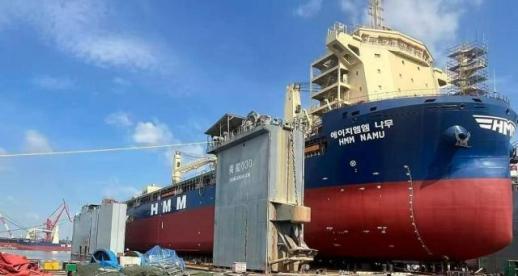 Trump Raises Pressure on Iran Over Hormuz; Lee Jae-myung Government Urged to Set Clear National-Interest Line U.S. President Donald Trump is again increasing pressure in the Middle East. The United States, targeting Iran, has even raised the possibility of controlling the Strait of Hormuz as it steps up military and diplomatic pressure. The strait is a key route for global oil shipments and is vital for South Korea, since a large share of the Middle Eastern crude it imports passes through it. The situation is no longer just a regional dispute; it is becoming a broader crisis tied to Washington’s strategy to check China, a reshaping of global supply chains and energy security concerns. The Lee Jae-myung government has faced a difficult foreign-policy test soon after taking office. The United States is pressing allies to expand their roles, and European countries are accelerating talks on international coordination to secure maritime safety. Lee has reportedly moved to respond by considering participation in a Britain- and France-led international video conference on the Strait of Hormuz. South Korea’s government, however, should be most wary of “pragmatic diplomacy” without clear principles. Pragmatism should mean flexibility grounded in national interests. Without a clear standard, it can look like indecision. Approaches that either unsettle ties with the Middle East to avoid displeasing Washington, or heighten concerns about strains in the South Korea-U.S. alliance by focusing only on Middle East variables, both carry risks. South Korea relies on its alliance with the United States as the core of its security, while its energy structure remains heavily dependent on the Middle East. That makes this more complex than choosing one side. The Strait of Hormuz issue can directly affect international oil prices, the exchange rate, inflation and industrial competitiveness. Markets are already voicing concern that if Middle East risks become prolonged, South Korea’s growth outlook and financial markets could face significant pressure. A central problem is that South Korean diplomacy still appears driven by short-term responses. Each time tensions rise, the government is seen adjusting its stance and weighing how far to go, without a clear sense of strategic priorities. Standards are not clearly defined on how much to cooperate if the United States makes requests, where to draw the line between military involvement and support for maritime safety, or what role to play between economic sanctions and diplomatic mediation. For the Lee government’s stated goal of “pragmatic diplomacy centered on national interests” to carry real meaning, it must first define what those national interests are. National interests are not the same as a government’s political calculations. Managing relations with the United States matters, but so do energy security and industrial stability. Once foreign policy is approached through domestic political camps, national strategy is bound to wobble. The Hormuz situation also highlights vulnerabilities in South Korea’s economic structure. Its crude import mix still depends heavily on the Middle East, and preparations for maritime logistics risks are not sufficient. That is why discussions on diversifying supply chains, expanding strategic stockpiles and redesigning energy security must move in parallel. Diplomatic rhetoric alone cannot prevent a crisis. What is needed now is not a binary choice of siding with the United States or the Middle East. South Korea must clearly define its national interests and act consistently by that standard. Alliances are important, but cannot come ahead of national interests. At the same time, national interests should not be used as a pretext to undermine trust in an alliance. Diplomacy ultimately requires balance. Trump’s pressure is likely to intensify. The world is already moving toward a new order in which economics and security are increasingly intertwined. South Korea has reached a point where it cannot hold out with an ambiguous posture. The Lee government now needs to show, beyond the word “pragmatic,” what standards will guide the country’s actions. 2026-05-06 10:30:18
 -
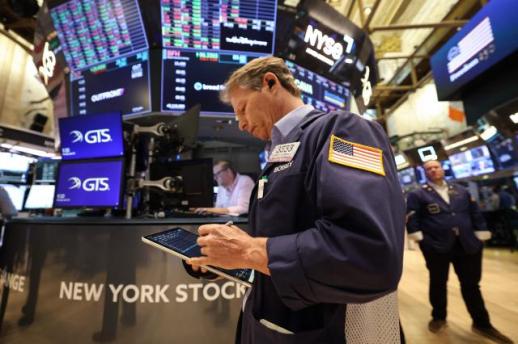 SEC Proposes Ending Quarterly Reporting Requirement, Allowing Semiannual Option U.S. securities regulators have unveiled a proposed rule change that would end the requirement for public companies to file quarterly earnings reports and allow them to opt for semiannual reporting instead. MarketWatch and other outlets reported that the Securities and Exchange Commission said in a statement on May 5 (local time) that it is proposing amendments to rules and forms so listed companies can choose semiannual reports in place of quarterly filings. Under current rules, U.S.-listed companies must file three quarterly reports and one annual report each fiscal year. If adopted, the proposal would let companies choose to file one semiannual report and one annual report instead of quarterly reports. Companies that choose semiannual reporting would file a new form, Form 10-S. The deadline would be set at 40 or 45 days after the end of the first half of the fiscal year, depending on the company’s filing status. The SEC said the changes are intended to give companies and investors flexibility to choose the reporting cycle that best fits their needs. It also said it plans to revise Regulation S-X, which sets financial statement requirements for periodic reports, registration statements and proxy disclosures, to reflect the new semiannual option and simplify existing requirements. SEC Chairman Paul Atkins said in the statement, “The rigidity of SEC rules has limited companies and investors from deciding for themselves which interim reporting cycle is most appropriate,” adding that if the proposal is finalized it would provide greater regulatory flexibility. The proposal will go through a 60-day public comment period after it is published in the Federal Register, and then be put to a vote by the SEC. President Donald Trump said in September last year that companies should not be forced to report quarterly and should report results semiannually. The Wall Street Journal reported in March that the SEC was preparing a related proposal. Some investors have raised concerns that fewer earnings reports could reduce corporate transparency and credibility. The Investment Company Institute said in a statement on May 5 that it is important to strike a balance between reducing unnecessary compliance burdens and maintaining the quality of the disclosure system that supports investor confidence.* This article has been translated by AI. 2026-05-06 10:24:15
 -
 Samsung Securities jumps more than 6% on expectations for Interactive Brokers tie-up Samsung Securities shares rose sharply on expectations of cooperation with a global brokerage firm. According to the Korea Exchange, Samsung Securities was trading at 147,300 won as of 9:55 a.m. on the 6th, up 6.82% (9,400 won) from the previous session. The securities industry said Samsung Securities has recently begun a pilot service with U.S. online brokerage platform Interactive Brokers (IBKR) to support foreign investors trading South Korean stocks. The process for foreigners to trade South Korean shares had been complicated, but under the partnership, IBKR users can invest in South Korean stocks more easily through Samsung Securities. In a report released on the 6th, Baek Du-san, an analyst at Korea Investment & Securities, said Samsung Securities shares rose 28% on the 4th, attributing the move to heightened attention on news of a partnership with IBKR, which is strong in online stock trading. Baek said foreign individual investors, including IBKR customers, can use Samsung Securities as an intermediary to trade South Korean stocks through the IBKR app, comparing it to how South Korean individuals can easily trade U.S. stocks through domestic brokerage apps. He added that the business model became possible due to regulatory and policy changes, including the launch of an integrated foreign investor account in 2017, the abolition in 2023 of the requirement for financial investment firms to immediately report transaction details for that account (T+2), designation as an innovative financial service, and revisions to financial investment business rules. Those changes allow overseas brokerages that do not operate securities businesses in South Korea to provide South Korean stock trading services through partnerships with local brokerages, he said.* This article has been translated by AI. 2026-05-06 10:15:51
 -
 Brokerage Stocks Jump as KOSPI Breaks 7,000, Mirae Asset Securities Up 15% As the KOSPI index climbed above 7,000 to set a new record, South Korean brokerage shares rose broadly. According to the Korea Exchange, as of 10 a.m. on the 6th, Mirae Asset Securities was trading at 81,000 won, up 15.22% from the previous session. Samsung Securities rose 5.22% to 145,100 won. Other brokerage-related stocks also gained, including Kiwoom Securities (up 10.53%), Korea Investment Holdings (up 5.15%), NH Investment & Securities (up 4.12%), Hyundai Motor Securities (up 10.67%), Yuanta Securities (up 16.09%), SK Securities (up 5.78%), DB Financial Investment (up 7.37%) and Hanwha Investment & Securities (up 16.73%). The KOSPI rose 2.25% from the previous session to 7,093.01, pushing past 7,000 and extending its run of record highs. The rally was seen as drawing buying on expectations of higher trading activity and improved brokerage earnings. Jang Young-im, a researcher at SK Securities, said April’s average daily trading value and margin loan balances “held at solid levels,” adding that “with the stock market continuing to show strength, a favorable environment for the securities industry is also continuing into the second quarter.”* This article has been translated by AI. 2026-05-06 10:15:00
 -
 Actress Yoon Yu-seon Caps 'Yumi's Cells' Season 3, Continues Busy OTT Run Actress Yoon Yu-seon appeared in the final episode of TVING’s original series “Yumi’s Cells” Season 3, adding warmth to the drama’s closing. Yoon played Yeong-sim, the mother of Yumi (Kim Go-eun), in the last episode of the recently concluded season. “Yumi’s Cells” Season 3 follows Yumi, now a star writer, as she meets an unexpected figure, Sun-rok (Kim Jae-won), and falls in love again. In the series, Yeong-sim is a steady presence by Yumi’s side and looks on Sun-rok with kindness. Though her screen time was brief, Yoon delivered a calm, gentle performance that reinforced the character’s warmth. Returning as part of Yumi’s family after Seasons 1 and 2, she helped bring a familiar tone to the finale. The cameo also aligns with Yoon’s recent run of projects. She returned last month in Netflix’s “Bloodhounds” Season 2 as Yoon So-yeon, the mother of Geon-woo (Woo Do-hwan). The action series, starring Woo and Lee Sang-yi as they take on an illegal boxing league, rose to No. 1 in Netflix’s non-English TV category after its release. In “Bloodhounds” Season 2, Yoon portrayed a mother determined to protect her son from injustice, using restrained emotion and a firm gaze to add weight to the story. Her role helped anchor the characters’ emotional arc amid the high-tension action. Yoon has also expanded her work beyond acting into variety shows and hosting. She recently appeared on an entertainment program with her husband, attorney Lee Seong-ho, sharing their daily life as a couple. She also took on her first solo MC role on Channel A’s “The Body Geniuses,” a tailored health-solution program offering information for healthier living, meeting viewers with a steady, approachable hosting style. With steady work across dramas, streaming series, variety programs and hosting, Yoon continues to broaden her range, with attention on what she will do next. 2026-05-06 10:11:09
 -
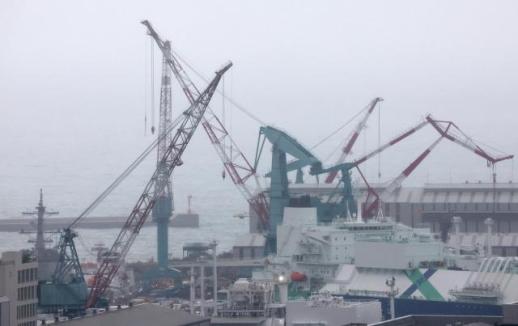 South Korea Labor Ministry Raids HD Hyundai Heavy Industries Over Ulsan Submarine Fire Labor authorities have launched a forced investigation into a recent fire aboard a submarine at a shipbuilding site in Ulsan. The Ministry of Employment and Labor said Tuesday it was conducting searches and seizures at HD Hyundai Heavy Industries' Ulsan headquarters and other locations over a Navy submarine fire at the company's Ulsan shipyard that killed a worker in her 60s. About 60 people, including labor inspectors and police, were deployed. Authorities are securing computers and related materials and focusing on whether fire-prevention measures and evacuation steps were properly carried out. The fire broke out at about 1:58 p.m. on April 9 on the Hong Beom-do, a 214-class (1,800-ton) Navy submarine undergoing maintenance at the Ulsan shipyard in Ulsan's Dong District. Most workers evacuated, but A, a woman in her 60s employed by a subcontractor, was trapped inside. After the fire was put out, firefighters searched the vessel and found her at about 4:38 p.m. near an interior passageway. Rescue efforts were hampered by the extremely tight space and repeated explosions after water used in firefighting came into contact with electrical equipment. Authorities dried the submarine and dismantled high-capacity batteries before recovering her body about 33 hours after the fire began. The Labor Ministry's Ulsan office said it will use the seized materials to determine whether required safety measures were followed and who is responsible. It will also review possible violations of the Occupational Safety and Health Act and the Serious Accidents Punishment Act. A ministry official said authorities will actively use measures such as searches, seizures and custodial investigations at workplaces where serious accidents occur or where similar incidents recur due to failures to follow basic safety rules.* This article has been translated by AI. 2026-05-06 10:10:15
 -
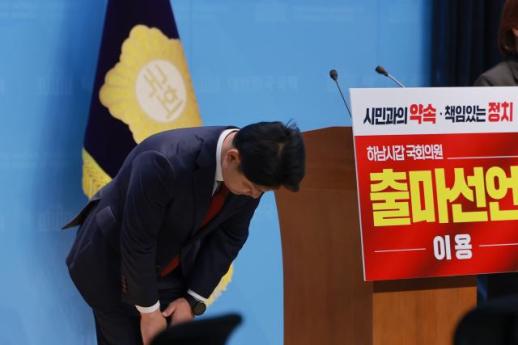 Lee Yong Announces Bid for Hanam Gap By-Election, Apologizes for Yoon Administration Lee Yong, a former lawmaker from the People Power Party, announced May 6 that he will run in the parliamentary by-election in Gyeonggi Province’s Hanam Gap district, pledging to “restore the rule of law and democracy” and “open a bigger future for Hanam.” Lee, who served as chief aide to Yoon Suk Yeol during Yoon’s presidential campaign and was known as a close protector, apologized, saying he is not free of responsibility “now that the Yoon Suk Yeol administration has disappointed and hurt the public.” Speaking at a news conference at the National Assembly press center, Lee said, “If you helped create an administration, you must also take responsibility when it fails.” “Creating an administration was the reason a party exists, and I carried out my duties as a People Power Party lawmaker,” he said. “But now that the administration has disappointed and hurt the public, I am not free of responsibility. I’m sorry. I sincerely apologize.” He added, “I will not make excuses or hide. I will not avoid the public’s punishment,” and said he would change first, take responsibility where needed, fix what must be fixed, and rebuild trust through actions rather than words. Taking aim at former Democratic Party lawmaker Choo Mi-ae and Lee Kwang-jae, a Hanam Gap candidate, Lee said the election is “a contest between someone running for Hanam and someone who came to Hanam for an election,” adding, “Hanam is not a nest where migratory birds stop briefly and leave.” Lee said he did not leave Hanam after losing the last general election because “an election ending does not mean promises to citizens end.” He said he spent the past two years visiting neighborhoods across the city and met residents for talks and other outreach sessions as few as five times a day and as many as 20. He said he would keep promises to Hanam residents and put their lives at the center of his politics, and urged voters to “judge the arrogant Lee Jae-myung administration” on June 3 and to restore livelihoods and ensure Hanam’s development continues without interruption. * This article has been translated by AI. 2026-05-06 10:09:14
 -
 Trump Says Pope Is Soft on Iran Nuclear Issue; Pope Reaffirms Opposition to All Nuclear Arms U.S. President Donald Trump and Pope Leo XIV have again traded sharp words, this time over Iran’s nuclear issue. After Trump said the pope was taking a complacent approach to Iran’s pursuit of nuclear weapons, the pope pushed back, saying the Catholic Church has long opposed all nuclear arms. The pope spoke to reporters Monday aboard the papal plane as he returned to Rome from a trip to Africa. “I am only delivering the message of the Gospel and peace,” he said. He added that “the Catholic Church has opposed all nuclear weapons for years,” distancing himself from the claim. The exchange flared again after Trump’s recent remarks in an interview with conservative host Hugh Hewitt, in which Trump said the pope was being complacent about Iran’s nuclear weapons issue. The Associated Press reported, however, that the pope has not supported Iran’s nuclear armament and instead reaffirmed his longstanding opposition to all nuclear weapons. The clash is not new. On April 13, Trump attacked the pope, suggesting he was weak on crime and problematic in diplomacy. The pope responded at the time that he was not afraid and would continue criticizing the suffering caused by war. The timing has drawn attention as U.S. Secretary of State Marco Rubio is scheduled to meet the pope at the Vatican this week. U.S. officials said the visit was planned in advance, not an improvised effort to smooth things over, but Trump’s latest comments have fueled speculation that the meeting now carries added political weight.* This article has been translated by AI. 2026-05-06 10:07:24