
Journalist

Lee Jaeho
-
 Korea's Fair Trade Commission Eliminates Cap on Whistleblower Rewards for Reporting Unfair Trade Practices The Fair Trade Commission (FTC) of South Korea has announced the elimination of the cap on rewards for whistleblowers who report unfair trade practices, including collusion. Whistleblowers will now receive up to 10% of the total fines imposed for violations.On May 21, the FTC stated that it will conduct a 20-day public notice period until June 10 for a proposed amendment to the regulations governing rewards for whistleblowers reporting violations of the Fair Trade Act.The amendment aims to encourage insiders to report unfair trade practices, such as collusion, to enhance the detection and correction of legal violations. Ultimately, it seeks to strengthen deterrence against corporate misconduct and establish a fair market economy.The current reward limits range from 100 million won to 3 billion won, which the FTC believes have deterred potential whistleblowers due to insufficient compensation relative to the risks involved in reporting. The amendment reflects the understanding that collusion among companies often occurs secretly, making it difficult to detect or prove violations without insider reports.To address these issues, the FTC plans to simplify the reward calculation method, setting the reward at 10% of the total fines imposed, while also considering the whistleblower's contribution. The FTC believes that larger rewards will incentivize more active reporting of significant legal violations.Additionally, the timing of reward payments will be adjusted. Under the current system, rewards are paid within three months of a legal ruling on the violation, which can lead to issues when the final legal status of the fines is not yet determined.Moving forward, the FTC will pay a basic reward once the fines are initially paid into the national treasury, with the remaining rewards distributed after the final determination of the fines.An FTC official stated, "Through the improvement of the whistleblower reward system, we aim to reinforce our strict response to collusion and other unfair practices, while encouraging active reporting from both insiders and outsiders. We expect this will further strengthen the deterrent effect against legal violations."* This article has been translated by AI. 2026-05-21 14:30:44
 -
 Kakao Faces First Joint Strike Threat Amid Prolonged Labor Dispute Kakao is facing a potential strike as prolonged labor negotiations over bonuses and job security continue. The Kakao Union, part of the Korean Chemical Fiber and Food Industry Workers' Union, escalated pressure by approving a strike vote on May 20, while Kakao aims to reach a consensus during the mediation period. According to the IT industry on May 21, a total of five Kakao entities, including Kakao Corp, Kakao Pay, Kakao Entertainment, DK Tech, and XL Games, held a rally on May 20 to support the strike vote, which passed in favor of a strike. The two sides extended the mediation period after their first meeting on May 18, with the next session scheduled for May 27. If mediation fails, the union at Kakao Corp will gain the right to strike. Previously, four subsidiaries had sought mediation from the Gyeonggi Provincial Labor Relations Commission due to stalled wage negotiations, but mediation was halted during the first meeting, granting them strike rights. The Kakao Union has been unable to reach an agreement on the compensation structure, including bonuses, during previous wage negotiations. Concerns about job security have also arisen amid ongoing restructuring within Kakao's subsidiaries. During the rally on May 20, the union presented four key demands: 1) management reform and accountability, 2) job security and community safety nets, 3) fair performance compensation and profit distribution, and 4) the establishment of universal labor conditions and welfare systems. The union believes that the difficulties in wage negotiations stem not only from the compensation system but also from job insecurity and a management-centered performance distribution structure. They plan to continue discussions on their collective demands separately from wage negotiations. Industry sources indicate that the Kakao Union requested bonuses amounting to 13-15% of Kakao's operating profit last year. However, the union clarified on May 20 that their collective demands are separate from the wage negotiations and that they have not demanded bonuses based on operating profit. There is a divergence in perspectives between the union and management regarding Kakao's performance improvement. The union argues that the efforts of employees during the restructuring and cost-efficiency measures have contributed to profitability, warranting discussions on profit distribution. Conversely, Kakao is cautious about expanding compensation due to uncertainties surrounding AI investments. Recent analyses suggest that Kakao's profitability improvements are largely due to restructuring and cost adjustments rather than aggressive business expansion. Kakao has been accelerating its restructuring efforts, including transferring shares and management rights of subsidiaries such as Kakao Games, Kakao Healthcare, and AXZ, the operator of the portal Daum. As a result, the number of Kakao's subsidiaries has decreased from 142 in September 2023 to approximately 93 currently. The outcome of the upcoming mediation session on May 27 is expected to be a critical turning point for the potential strike. If a strike occurs, it could impact Kakao's ongoing services, including KakaoTalk, as well as its planned AI projects and schedules for the second half of the year. Kakao is currently working on a project to integrate AI agents into its core messaging service, KakaoTalk, which encompasses conversation, search, recommendations, and payments. A strike could pose challenges for the advancement of these new business initiatives. The four subsidiaries outside of Kakao Corp are involved in finance and gaming sectors. A Kakao representative stated, "Since both parties agreed to extend the mediation period on May 18, the company will continue to strive for a smooth agreement during the remaining time. We will also work to ensure that there are no disruptions to our ongoing services and project plans." Meanwhile, the potential for Kakao's strike to influence labor relations in other IT companies is being closely watched. The IT Committee of the Korean Chemical Fiber and Food Industry Workers' Union, which includes companies like Naver, Nexon, and Neople, also participated in the rally on May 20. Given that Neople's union previously conducted a strike over bonus distribution issues, the ongoing labor disputes surrounding compensation structures in the IT industry may resurface.* This article has been translated by AI. 2026-05-21 14:28:04
 -
 Korea's Fair Trade Commission to Investigate AI Service Market On May 21, the Fair Trade Commission (FTC) announced it will conduct a survey of major domestic and international companies participating in South Korea's artificial intelligence (AI) service market. The aim is to analyze and assess the current trading practices and competitive conditions within the domestic AI service sector.The FTC noted that while the integration of AI services is driving innovation and competition in related products and services, it is also contributing to increased market concentration among a few companies. This concern is echoed by major global competition authorities in the UK, France, and Australia, which are focusing on the AI service market within the entire AI value chain.To proactively address potential competition and consumer issues, the FTC will conduct this survey under Article 87, Section 1 of the Monopoly Regulation and Fair Trade Act, aiming to understand the structure and competitive landscape of the domestic AI service market.In the first phase of the survey, the FTC plans to target 17 key providers of AI service-enabled products, whether they are offering their own or third-party AI services.Key areas of investigation will include: the current status of AI service businesses and related transactions, the competitive landscape within the AI service market, the methods of AI service provision to consumers, and any experiences of anti-competitive or unfair trading practices.The second phase of the survey will focus on consumer perceptions and behaviors regarding AI services and products, set to begin in July.An FTC official stated, "We will closely analyze the results of the survey and maintain ongoing communication with market participants and experts in academia. We plan to publish a policy report on 'Competition in the Downstream AI Market' later this year to foster a fair competitive environment in the AI market."* This article has been translated by AI. 2026-05-21 14:24:37
 -
 ASIA DEEP INSIGHT: The truth and illusion of Samsung Electronics' strike and tasks ahead SEOUL, May 21 (AJP) - South Korea's industrial order is again standing at a critical crossroads. The labor dispute at Samsung Electronics, together with the broader controversy over performance-based bonuses, is no longer merely an internal matter between management and labor. It has become a national question about the structure of South Korean capitalism, the future of industrial competitiveness and the rules of distribution in the age of artificial intelligence. Samsung Electronics has reached a final labor-management agreement covering wage increases, adjustments to performance compensation, expanded welfare benefits and improvements in working conditions. The immediate confrontation has been contained. Yet the issue cannot be dismissed as a passing conflict inside one company. Samsung Electronics and SK hynix are not ordinary domestic corporations. They are strategic global enterprises at the heart of the world's semiconductor supply chain. Their labor relations are now directly linked to international capital markets, national industrial strategy and the credibility of the South Korean economy. The world is in the middle of an AI semiconductor war. Nvidia and AMD in the United States, TSMC in Taiwan, China's state-led semiconductor drive and Japan's attempt to rebuild its chip industry are all part of a vast global contest. Semiconductors are no longer just electronic components. They are the foundation of military power, national security, artificial intelligence, data centers, automobiles, aerospace and quantum computing. In this environment, a strike at Samsung Electronics inevitably attracts global attention. What foreign investors and supply-chain partners fear most is not simply a rise in wages. Their deeper question is whether South Korea's advanced industrial supply chain remains stable and predictable. Capital markets value stability and predictability above almost everything else. The semiconductor industry requires long-term investment on a scale of tens of trillions of won. Samsung's Pyeongtaek complex, its Taylor plant in Texas, next-generation HBM lines and AI memory facilities all demand extraordinary capital. The payback period is measured not in months but in years, often in decades. This is not an industry that can be governed by slogans, impulses or short-term emotion. At the same time, labor in this industry is no longer what it once was. In the age of AI semiconductors, labor is not simple assembly work. Extreme ultraviolet processes, HBM design, advanced packaging and ultra-fine manufacturing require world-class engineers and highly skilled workers. In advanced industry, labor is not merely a cost. It is a strategic asset. That is why the Samsung labor dispute should not be viewed as a contest in which one side must win and the other must lose. Labor must respect the sustainability of the enterprise. Management must recognize the dignity and contribution of labor. Both sides must operate within global rules. Samsung Electronics and SK hynix are South Korean companies, but they are also world companies. Their labor relations must now be managed by international standards, with full awareness of investor confidence and supply-chain responsibility. At the center of this controversy lies the idea of the "residual claimant." The question is simple but profound: Why do shareholders have the first claim on residual profits? A modern corporation is built on the symmetry of risk and reward. Creditors receive contracted interest and give up the right to excess profit. Workers receive contracted wages and a degree of employment protection, while being shielded from the company's full downside risk. The state receives taxes in return for providing social infrastructure, education, public order and legal systems. After all these claims are settled, the party left to absorb the remaining profit or loss is the shareholder. This is why shareholders are called residual claimants. When a company earns extraordinary profits, shareholders may benefit from what remains. But when a company collapses, or when its market value plunges, shareholders are the first to absorb the loss. During the semiconductor downturn of 2023, Samsung Electronics' operating profit fell sharply. Workers' wages were not cut in proportion to that collapse. Suppliers were not asked to return payments already made. But the company's market capitalization fell, and shareholders — including ordinary retail investors and the National Pension Service — bore the loss. The true residual claimant is revealed not in moments of profit, but in moments of loss. This does not mean the contribution of labor should be ignored. Quite the opposite. In the AI era, human creativity, collective expertise and accumulated organizational knowledge increasingly determine corporate value. The value of a semiconductor company does not come only from its factories. It comes from its research teams, process engineers, design capability, production discipline and decades of institutional experience. The real question, therefore, is not who should take everything. The real question is how the gains of growth can be shared in a sustainable way. That is why global companies use stock options, long-term incentives, employee share ownership plans and performance-linked compensation systems. Labor is not merely a cost line. It is a partner in growth. But labor, too, must face the harsh realities of global capital and global competition. Samsung Electronics and SK hynix are not competing primarily against domestic rivals. They are competing against the United States, Taiwan, China and Japan. China is mobilizing state capital on a massive scale to achieve semiconductor independence. The United States is pouring subsidies into its chip industry. Taiwan has built an entire national ecosystem around TSMC. If South Korea consumes its strength in internal conflict, both labor and management will suffer. If industrial competitiveness weakens, jobs will disappear and the foundation of the national economy will erode. Here, one must understand the difference between CAPEX and OPEX. CAPEX, or capital expenditure, refers to investment for the future: new fabs, advanced equipment, next-generation technology, AI infrastructure and long-term industrial capacity. OPEX, or operating expenditure, refers to the costs of running the business: wages, maintenance, utilities, administration and day-to-day expenses. The semiconductor industry is a CAPEX-heavy industry. Samsung Electronics and SK hynix invest tens of trillions of won every year in future facilities. A single EUV machine can cost hundreds of billions of won. Advanced packaging and AI memory production require immense capital. If short-term compensation demands sharply raise OPEX, companies may reduce future CAPEX. That would weaken long-term competitiveness. The semiconductor industry is not an industry that merely distributes today's profit. It is an industry that reinvests today's profit to win tomorrow's technological sovereignty. Japan's semiconductor decline was caused in part by the collapse of long-term investment discipline. By contrast, TSMC became the world's leading foundry by maintaining an almost religious commitment to capital investment. Nvidia, too, became the company it is today only after decades of investment in research, design and the AI ecosystem. For that reason, the Samsung labor issue must not be reduced to a short-term wage dispute. Labor must understand the structure of future investment. Management must design more sophisticated systems for sharing success. The key is to preserve future competitiveness while ensuring that the people who create value share in its rewards. President Lee Jae Myung's recent remarks at a Cabinet meeting offer an important guide. He did not deny the three basic labor rights. On the contrary, he affirmed that labor rights are constitutional protections designed to defend workers, who are often the weaker party in economic life. But he also emphasized that the exercise of rights must be accompanied by solidarity and responsibility. That message matters. Lee's words carry particular weight because he himself was once a boy factory worker. He knows from personal experience the hardship of labor, the imbalance of power in the workplace and the pain of industrial society's lower rungs. He is therefore not speaking about labor from abstraction alone. He understands both the desperation of workers and the realities of enterprise. Brazilian President Luiz Inácio Lula da Silva, who recently visited Seoul, also rose from the world of labor. Lula, too, came from poverty and factory work, and later became one of the world's most prominent labor leaders before entering national leadership. Though they come from different continents, Lee and Lula share a deep historical sympathy rooted in the lived experience of labor. Yet neither man remained confined to narrow labor ideology. Lula, as president, sought to balance worker protection with industrial growth, investment and exports. Lee, in the Samsung case, likewise emphasized not confrontation for its own sake but the need for rights to remain within the bounds of responsibility. The president's message may be summarized in three principles. First, labor rights are constitutional rights and must be respected. Second, the sustainability of companies and the competitiveness of national industry must also be protected. Third, the exercise of rights must be disciplined by responsibility, restraint and concern for the broader community. This may become an important guideline for the future of South Korean labor relations. In the past, South Korean labor relations were too often defined by confrontation and collision. In the AI era, they must evolve toward shared growth and shared responsibility. Artificial intelligence will dramatically raise productivity. It will also reshape human labor at its roots. Some jobs will disappear. Others will become far more valuable. In such an age, traditional wage struggles alone cannot provide a sustainable answer. A new social compact is needed. Workers must be able to participate not only through wages, but through long-term gains tied to corporate growth. Companies must build innovation systems centered on human dignity, not merely cost reduction. The state must use taxation, welfare, education and retraining to cushion the shocks of industrial transformation. The central task of the AI age is a harmonious productivity revolution. When labor and capital see each other as enemies, industry declines. When they recognize each other as partners in growth, innovation endures. South Korea now stands at a decisive moment. Samsung Electronics and SK hynix are not merely corporations. They are strategic assets on the front line of South Korean industrial civilization. If they weaken, the damage will not be limited to one balance sheet. It will touch the future industrial order and national competitiveness of South Korea itself. What is needed now is not agitation, nor emotion, nor easy populism. What is needed is clear realism and mature social wisdom. Labor must accept responsibility. Management must accept responsibility. The state must accept responsibility. Freedom without responsibility cannot endure. Industry without hope cannot endure either. The philosophy of solidarity and responsibility emphasized by Lee may become the core of a new South Korean model of labor relations. The question is no longer how to defeat the other side. The question is how to build an order of innovation and coexistence. Industry does not grow by struggle alone. Nor does it grow by capital alone. Technology and labor, investment and innovation, responsibility and trust must move together. What South Korea needs now is not a winner-takes-all doctrine, but a mature industrial community capable of competing with the world while growing together. 2026-05-21 14:06:47
 -
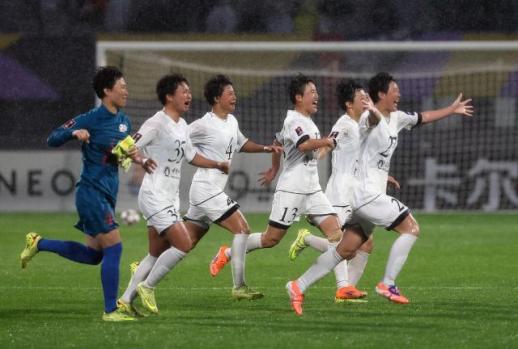 State media breaks silence to cover North Korea's win over South Korea in women's football SEOUL, May 21 (AJP) - North Korea advanced to the final of the Asian Football Confederation (AFC) Women's Champions League after beating South Korea, state media reported on Thursday. Breaking its silence over the reclusive country's footballers' trip to South Korea last weekend, the state-run Korean Central News Agency (KCNA) reported briefly that its Naegohyang Women's Football Club beat its rival 2–1 in a semifinal match in Suwon, Gyeonggi Province the pervious day. In a rain-soaked match, North Korea came from behind to defeat South Korea. South Korea had taken the lead just minutes into the second half but could not hold on, as an equalizer by North Korean player Choe Kum-ok came about five minutes later, followed by another goal from Kim Kyong-yong in the 67th minute. South Korea also missed a late penalty, failing to salvage a draw at least. The North Korean team will now face against Japan's Nippon TV Tokyo Verdy Beleza in the final at the same venue in Suwon on Saturday. Wednesday's match marks the first time in about eight years that North Korean athletes have participated in a sporting event held in South Korea. 2026-05-21 13:56:49
 -
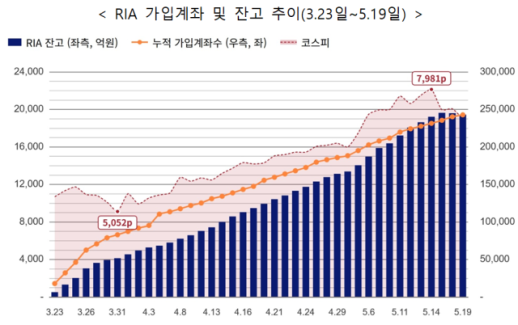 NVIDIA Sales Fund Samsung Electronics as RIA Sees 1.9 Trillion Won Inflow The trend of overseas investment funds returning to the domestic stock market is gaining momentum. Since the introduction of the Domestic Market Return Account (RIA) on March 23, approximately 2 trillion won has flowed in within less than two months. Notably, funds have shifted towards domestic semiconductor stocks like Samsung Electronics and SK Hynix, as well as domestic exchange-traded funds (ETFs). On May 21, the Financial Investment Association reported that as of May 19, the cumulative number of RIA accounts reached 242,856, with a total balance of 1.9443 trillion won. The RIA account offers capital gains tax exemption benefits when transferring overseas investment funds to domestic assets. The balance, which was around 414 billion won at the end of March, increased to 1.3389 trillion won by the end of April and approached 1.9443 trillion won by May 19. The balance of domestic assets also rose from 123.4 billion won to 1.2129 trillion won during the same period. The Financial Investment Association explained, "Funds from the sale of overseas stocks are flowing into domestic stocks and equity funds, contributing to increased demand in the domestic market and foreign currency inflow." Investors in their 40s and 50s make up the majority of account holders. As of May 8, 31% of accounts were held by individuals in their 40s, followed by 26% in their 50s, 21% in their 30s, and 12% aged 60 and above. In terms of balance, those in their 50s accounted for 32% of the total, with 27% in their 40s, 19% aged 60 and above, and 15% in their 30s. However, the share of account holders under 30 also reached 31%, indicating a positive influx of younger investors into the domestic capital market. Investment trends show that funds exiting high-risk leveraged ETFs and major U.S. tech stocks are moving into domestic semiconductor stocks and ETFs. The top-selling overseas stocks included NVIDIA (180.1 billion won), Direxion Semiconductor 3x ETF (SOXL, 94.7 billion won), Tesla (50.4 billion won), and Alphabet A (45.1 billion won). Conversely, the top domestic purchases included Samsung Electronics (78 billion won), SK Hynix (66.7 billion won), Hyundai Motor (14.6 billion won), KODEX 200 (13.4 billion won), and TIGER Semiconductor TOP10 ETF (12.3 billion won). The Financial Investment Association also noted that starting next month, the tax benefits associated with the RIA will be gradually reduced, urging investors to be cautious. The capital gains tax exemption rate for profits from the sale of overseas stocks through the RIA will remain at 100% until the end of this month, but will decrease to 80% in June and July, and to 50% after August. To receive the full 100% exemption, the settlement of overseas stock sales must be completed by the end of this month. Since there is a time lag between the transaction date and the settlement date, investors should check the settlement schedules with their brokerage firms. Additionally, the proceeds from the sale of overseas stocks must be managed within the RIA for one year after the settlement date, including investments in domestic listed stocks, domestic equity funds, and deposits. Failure to comply may result in the loss of tax benefits. Han Jae-young, head of the Financial Investment Association, stated, "The Domestic Market Return Account has significant implications as it facilitates the inflow of liquidity that was previously in overseas markets into the domestic capital market. We will continue to supply a variety of attractive domestic investment products in collaboration with the industry to contribute to exchange rate stability and productive finance."* This article has been translated by AI. 2026-05-21 13:55:23
 -
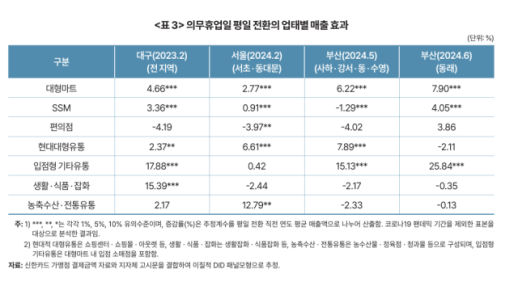 Increased Consumer Spending at Large Supermarkets on Weekends Calls for Policies Linking Traditional Markets A recent study by the Korea Development Institute (KDI) indicates that the controversial shift of mandatory closing days for large supermarkets to weekdays has positively influenced consumer sentiment and has not adversely affected sales at traditional markets. On May 21, KDI released a report titled "The Direction of Retail Policy Suggested by the Transition of Mandatory Closing Days to Weekdays." The institute compiled data on the adjustment of mandatory closing days across local governments and analyzed monthly credit card transaction data from Shinhan Card between 2015 and 2024. Sales at large supermarkets increased from 26.4 trillion won in 2006 to 39.5 trillion won in 2014, but then began to decline, dropping to 28.3 trillion won in 2023. The number of stores also grew from 2006 to 2012, but the growth rate has since slowed, with a recent trend of decline. This reflects a shift in the operational model of large supermarkets from expansion to structural adjustment. In this context, Daegu became the first city to change its mandatory closing day to Monday in 2023. Following this, other cities such as Cheongju, Seoul, Busan, and Gyeonggi have also mandated that large supermarkets close on weekdays. The government has announced plans to transition mandatory closing days to weekdays in 2024, creating an environment that allows for more flexible decision-making regarding closing days. The number of cities and districts that have made this transition increased from eight in February 2023 to about 30 by February 2025, with the number of large supermarkets affected rising from 18 to 67. Notably, the increase has been particularly pronounced since mid-2024. The analysis revealed that sales at large supermarkets increased across major regions, including Daegu, Busan, and Seoul. Specifically, sales rose by 4.7% in Daegu, 2.8% in Seoul (Seocho and Dongdaemun), and between 6.2% and 7.9% in Busan. This increase suggests a partial recovery in consumer spending that had been constrained by previous weekend operating restrictions. Lee Jin-guk, a senior researcher at KDI, stated, "Dual-income households or families with children find it difficult to shop at large supermarkets unless it’s on the weekend. The transition to weekdays has expanded consumer convenience, allowing shopping on weekends, which has contributed to the increase in sales at large supermarkets." Sales increases were also confirmed at semi-large stores (SSM), which are directly affected by the mandatory closing day regulations. In Daegu, sales rose by approximately 3.4%, while in Busan's Dongnae District, the increase was 4.1%. Furthermore, the analysis found that weekend operations at large supermarkets did not lead to a decrease in sales at traditional markets. KDI interprets this as evidence that traditional markets operate as independent retail channels, competing only in certain areas rather than being direct substitutes for large supermarkets. However, in regions where there is a high degree of substitution between offline stores or where online shopping is not prevalent, the increase in large supermarket sales could potentially lead to a decline in traditional market sales. Since the transition to weekdays for mandatory closing days, online payment amounts have decreased by 2.9%. This suggests that improved access to offline retail, including large supermarkets, has led to a shift in some consumer spending from online to offline. KDI believes that rather than negatively impacting traditional markets, the weekend operations of large supermarkets can stimulate consumer linkage effects, and thus policies should be developed to connect the two sectors. The senior researcher noted, "In areas like Seocho and Dongdaemun in Seoul, where many traditional markets exist, the weekend operations of large supermarkets appear to draw consumers to nearby traditional markets, creating linked consumption. Instead of merely restricting large supermarket operations, it may be more effective to develop strategies that integrate visitors to large supermarkets with traditional markets for mutual benefit."* This article has been translated by AI. 2026-05-21 13:52:41
 -
 Implementation of AI Basic Law to Facilitate Public AI Adoption and Research The Ministry of Science and ICT (MSIT) is preparing to implement the revised "Basic Law on the Advancement of Artificial Intelligence and the Establishment of Trust" (AI Basic Law) in July, focusing on refining subordinate regulations. The aim is to strengthen the institutional foundation for fostering the AI industry by expanding the adoption of AI in the public sector, supporting vulnerable groups, and establishing AI research institutes. On May 21, the MSIT announced that it has prepared a draft of the "AI Basic Law Enforcement Decree" and will begin the legislative notice process. The enforcement decree is set to take effect alongside the revised AI Basic Law on July 21. Key provisions of the revised AI Basic Law include: the establishment of a National AI Strategy Committee, promotion of AI adoption and utilization in the public sector, legal basis for the establishment and operation of AI research institutes, support for accessibility and costs for vulnerable groups, encouragement of AI startups, support for AI professionals, and provision of public data for training purposes. The draft enforcement decree specifies the scope of vulnerable groups, which now includes not only individuals with disabilities, the elderly, basic livelihood recipients, and those in the near-poverty level, but also women with career interruptions, job seekers, employees of small and medium-sized enterprises outside the capital region, and agricultural and fishing workers. This measure addresses the potential for high-cost, high-performance AI services to create new social disparities. The decree also defines the range of AI products and services prioritized in the public procurement market. Products and services verified for AI technology application by the Korea Artificial Intelligence Promotion Association and those separately announced by the MSIT will be included. The Korea Telecommunications Technology Association (TTA) will conduct the technical review. Support for the costs of using AI products and services has been expanded. In addition to vulnerable groups such as individuals with disabilities, the elderly, and job seekers, support will also be available for talented individuals from universities in non-capital regions and those in science and engineering fields, within budget limits. Procedures for utilizing venture investment funds to promote AI startups are also included in the enforcement decree. Heads of central administrative agencies can request the Korea Venture Investment Corporation to establish investment plans for the AI industry after consulting with the Ministry of SMEs and Startups. The criteria for establishing and operating AI research institutes have been clarified. Various entities, including universities and companies, can establish AI research institutes with the permission of the MSIT, and the decree specifies the requirements for establishment and national support. Following the legislative notice, the MSIT plans to finalize the enforcement decree through regulatory and legal reviews, cabinet meetings, and government council discussions. Kim Kyung-man, head of the AI Policy Division at the MSIT, stated, "The implementation of the revised law is expected to further strengthen the legal support for the expansion of AI utilization and the development of the industry. We will actively support the advancement of the AI industry through the expansion of AI products and services in the public procurement market and the establishment of AI research institutes." Meanwhile, South Korea's AI Basic Law passed the National Assembly in December 2024. The AI Basic Law came into effect on January 22 of this year, making South Korea the second country in the world to enact such legislation after the European Union. Under the AI Basic Law, the Minister of Science and ICT is required to establish a basic AI plan every three years. Notably, sectors that significantly impact citizens' lives, such as healthcare, autonomous driving, and investment services, are classified as high-impact AI and are subject to additional responsibilities for operators. * This article has been translated by AI. 2026-05-21 13:49:59
 -
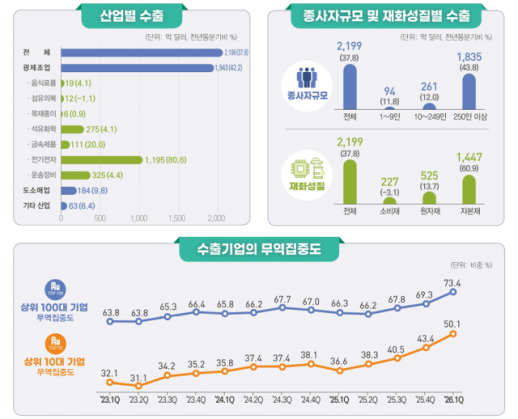 Surge in Semiconductor Exports Leads to Increased Concentration Among Top Companies The ongoing boom in semiconductor exports is intensifying the concentration of exports among a few large companies in South Korea. In the first quarter of this year, the trade concentration of the top 10 exporting companies surpassed 50% for the first time, reaching a record high. According to the "Q1 2026 and Annual Company Characteristics Trade Statistics" released on May 10 by the National Data Agency and the Korea Customs Service, the trade concentration of the top 10 exporting companies was recorded at 50.1%. This marks a 13.5 percentage point increase compared to the same period last year and is the highest level since the statistics began in 2010. The trade concentration among the top 100 companies also rose to 73.4%, an increase of 7.2 percentage points from the previous year, further highlighting the dominance of these firms, which now account for more than half of total exports, while the top 100 companies represent over 70%. This trend is largely attributed to the booming electrical and electronics sector, particularly semiconductors. In fact, the export of the manufacturing sector surged by 42.2% compared to the same period last year, driven by significant increases in the electrical and electronics and metal products sectors. By company size, exports increased across large, medium, and small enterprises, but the growth rates varied significantly. Large companies saw their exports rise by 52.9% year-on-year, demonstrating a robust increase, primarily due to the rise in capital goods and raw material exports. In contrast, medium-sized enterprises experienced a modest export increase of 7.4%, while small businesses saw a 10.7% rise. Medium-sized firms reported growth in capital goods, raw materials, and consumer goods, while small businesses showed increases across all categories. In addition to the manufacturing sector, retail exports grew by 9.8%, and other industries saw a 6.4% increase. Although sectors like information and communication and construction experienced declines, transportation and warehousing, along with facility management, showed growth. Exports also increased across all employee size categories. Companies with 250 or more employees reported a 43.8% increase in exports, while those with 10 to 249 employees saw a 12.0% rise, and firms with 1 to 9 employees experienced an 11.8% increase. This indicates a pronounced export growth trend among large companies. Imports also continued to rise. In the first quarter of this year, imports increased by 8.6% for large companies, 13.5% for medium-sized firms, and 14.5% for small businesses, reflecting a general expansion in capital goods, raw materials, and consumer goods imports. By industry, imports in the manufacturing sector rose by 8.6%. Although the petrochemical sector saw a decline, increased imports of electrical and electronics and metal products offset this drop. Retail imports surged by 17.4%, while other industries, particularly transportation and public administration, increased by 8.5%. Import growth was also noted across all employee size categories, with companies employing 250 or more workers increasing imports by 9.2%, those with 10 to 249 employees by 14.1%, and firms with 1 to 9 employees by 15.9%. Notably, small businesses saw increases in imports related to wholesale, metal products, and transportation and warehousing.* This article has been translated by AI. 2026-05-21 13:48:00
 -
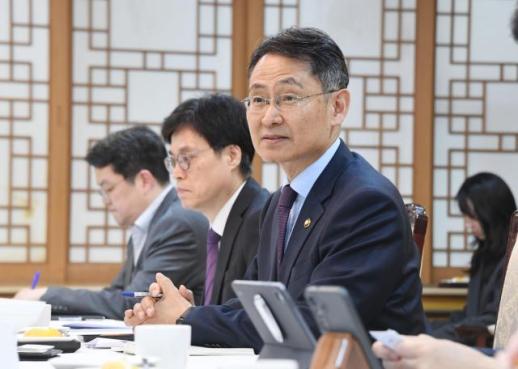 South Korea Accelerates Inclusion in MSCI Developed Markets Index The South Korean government is accelerating reforms in the foreign exchange and capital markets to facilitate its inclusion in the MSCI (Morgan Stanley Capital International) developed markets index. The plan aims to implement over 70% of the overall roadmap by the end of the first half of the year, enhancing market accessibility and trading convenience for foreign investors. On May 21, the Ministry of Finance held a meeting of the "Foreign Exchange Stability Council and MSCI Developed Markets Index Inclusion Task Force," chaired by Deputy Minister Heo Chang, to review the progress of the "Comprehensive Roadmap for Foreign Exchange and Capital Markets" announced in January. Out of the eight key areas and 39 tasks outlined in the MSCI roadmap, 25 tasks (64%) have been completed so far. The government plans to push forward with three additional tasks by June, bringing the total to 28 (over 70%) by the end of the first half. Since February, relevant agencies have been working on institutional improvements focusing on account and payment systems, investor identification systems, English disclosures, and enhanced access to derivatives. The reform of the Korea Securities Depository system now allows for settlement processing based on nominal accounts for each fund, and the issuance of Legal Entity Identifier (LEI) confirmation letters for foreign corporate account openings has been recognized as valid identification, reducing translation and notarization burdens. Additionally, the removal of trading hour restrictions for KOSPI futures on Eurex and FTSE has improved access to Korean derivatives for foreign investors. The government is also working on restructuring the foreign exchange market. The domestic foreign exchange market is set to begin 24-hour trading from July 6, following a pilot trading session on June 29. The establishment of an offshore won payment network is also in progress, with IT testing scheduled for June, pilot operations in September, and full operations targeted for January 2027. During the meeting, the government finalized plans to reform the overseas foreign exchange business institution (RFI) system. To encourage greater participation of global financial institutions in the domestic foreign exchange market, the government will reduce registration and reporting burdens and expand the use of operational won accounts. Specifically, for global financial institutions utilizing a centralized booking model (CBM), the responsibility structure will be simplified, focusing on the headquarters as the booking entity, significantly streamlining the registration process for branches and trading entities. The reporting deadline for sanctions-related issues will also be extended from the previous seven days to 30 business days. The government plans to enhance the utilization of operational won accounts by allowing them to be used like integrated accounts for investment, enabling the management of customer funds separately, securities settlement fund transfers, and temporary won borrowing (OD). Deputy Minister Heo stated, "Most of the roadmap tasks are being implemented as planned, and we are confirming positive responses from foreign investors. Since foreign investors are particularly concerned about the smooth operation of actual trading and settlement processes, we will closely monitor the detailed operational situation." Meanwhile, the government discussed plans to reform the monitoring system for cross-border virtual asset transfers, a task outlined in the roadmap. Following the recent passage of the revised Foreign Exchange Transactions Act, registration of virtual asset service providers and mandatory reporting of transfer histories will be enforced, with plans to share related information with the National Tax Service, Customs Service, Financial Supervisory Service, and Financial Intelligence Unit.* This article has been translated by AI. 2026-05-21 13:45:30