

Journalist

Lester Munson
-
 World AI Film Festival Holds First Asia Edition in Seoul, Honors AI Shorts The World AI Film Festival’s Seoul awards ceremony drew about 1,500 guests on March 6 at Lotte Concert Hall in Seoul, organizers said, as filmmakers and officials highlighted how artificial intelligence is reshaping production and storytelling. WAIFF (World AI Film Festival), co-founded by Institut EuropIA and Marco Landi, is described by organizers as the first and largest international network focused on the convergence of film and AI. With its main event based in France and editions expanding to Brazil, Japan and China, Seoul was selected as the first host city in Asia, the festival said. Aju Media Group participated as a media partner, covering changes in storytelling and the creative ecosystem in the AI era, according to the organizers. Opening the ceremony, Landi said one of the festival’s main goals is “discovering talent, protecting their rights and compensation.” He added that the five finalists from the Seoul edition are scheduled to be screened at a festival in Cannes, France. Ha Jung-woo, senior secretary for AI Future Planning at the presidential office, called it meaningful that the “experimental venue” where AI and creativity meet opened in Seoul as the first Asian edition. He said AI is rapidly expanding beyond industry and society into culture and the arts, and in film and content it is becoming “a completely new driving force” that broadens how creators work and how stories are told. Ha stressed that the value of the technology lies in human imagination and creativity. “AI is not something that replaces creation, and it should not become that,” he said, calling it a collaborator that expands creators’ possibilities and a partner for exploring new forms of expression. He added that it can help people with ideas create new forms of content media and broaden access to diverse content. The festival also drew attention for its international jury. Animator and producer Nelson Shin (Shin Neung-gyun), a juror, presented an excellence award and spoke about the pace of change. “I was very scared while doing this event,” Shin said. He recalled that after about 100 years of making films with cameras and projectors, Steve Jobs made “Toy Story” digitally, and “suddenly the workforce making films was reduced to one-twentieth.” “And now, in less than 20 years, AI has come,” he said, adding he worried there might be a way to stop it. During judging, he said, he could not tell what was shot with a camera and was surprised that “AI did everything.” “Now, in this era when anyone can make a work, everyone here is a writer,” he said. Jury chair Son Seung-hyun, CEO of Westworld, said WAIFF tours globally from Sao Paulo to Seoul, Kyoto and Cannes to explore new relationships among film, AI and human creativity. He said the Seoul participants were not only using new technology but also pioneering a new visual language. Son said the jury sought to avoid entries centered on technical spectacle or fully automated results. “What we focus on is not the amount or flashiness of AI, but the creator’s intent, meaningful energy, and reflection and originality embedded in the technology,” he said. He outlined four criteria: vision over perfect execution; guided intent over automation, including whether at least three AI tools were combined with clear purpose; meaning over short-term trends, seeking messages with long-term cultural impact; and the creator’s agency, judging how clearly the human voice came through. The grand prize went to director Kim Won-kyung’s “Could Know, Could Not Know.” “I came up from Seogwipo in Jeju,” Kim said after the win. “I never expected this, and I’m truly grateful. While working as a marketer, I used AI only as a work tool, but I was able to make the content I had really dreamed of and even receive an award, and my mind went blank. I will accept this with gratitude, thinking of it as the start of the second act of my life.” Other winners included the excellence award for “LOSING, About the Time Remaining” (directed by Lim Da-young and Lee Sang-hoon); an encouragement award for “The Dog, the Octopus and Me” (directed by AI Revolution); the AI advertising award for “Magic Mirror” (directed by Ji Seong-min); the AI shorts series award for “The More You Swallow” (directed by Lee Eun-young and Son Hee-song); the AI screenplay award for “Ticket to Neverland” (directed by Heo Min, Son Min-ho and Kim Han-in); the AI soundtrack award for “Arca” (directed by Lee Su-yeol); the AI Film Youth Award for “Manin” (directed by A-Frame); and the AI jury award for “Gum” (directed by Hwang Ha-min). On March 7, a day after the awards, the “WAIFF Seoul 2026 Creative Intelligence Forum” at Lotte Cinema World Tower addressed issues including production innovation using generative AI, next strategies for K-content, copyright protection and ethical guidelines. Organizers said WAIFF Seoul 2026 concluded successfully, positioning AI-driven creation as a step toward a sustainable industry ecosystem rather than a one-off event.* This article has been translated by AI. 2026-03-09 00:04:48
 -
 Actor Park Shin-yang Brings ‘Fourth Wall’ Solo Exhibition to Seoul “When I looked closely, and for a long time, it was far from something round and red. I kept thinking about whether an apple has to be round and red,” actor Park Shin-yang said. Park said he began painting after two apples given to him by the late Bishop René Dupont started to rot and he could not bring himself to throw them away. As he painted, he moved from asking how to draw an apple to asking what painting itself is. He has since painted about 40 apples, he said, and over time the apples in his work became neither red nor round. Through that process, he said, he found his own sense of movement: an apple does not have to be round and red. Park is holding his second solo exhibition at the Sejong Center for the Performing Arts’ museum. At a March 6 news conference at the venue, he said, “Everything is expression,” adding, “The word ‘expression’ doesn’t hold unless you talk about ‘me.’” He also stressed the need to understand one’s feelings before trying to talk about them. “To speak about my emotions and express them, I first have to know what kind of emotion it is,” he said, underscoring the importance of knowing oneself. As he painted and examined his emotions, Park said he traced the roots of his longing to a friend named Kirill, whom he studied with while in Russia. “Kirill is the person I know who looks at people with the most generosity,” he said. “He’s a friend with a gaze that opens up the possibilities of existence, a friend who puts you at ease.” Like the apples, Park said he painted Kirill in different ways. He said people told him, “If you miss your friend, you can just go see him,” but that was not the point. He said he asked himself when and where the longing began, when it grew strongest, how it eased, how it guided him, and whether longing is a common or even necessary human emotion. He said he tried to place on the canvas not only feelings toward the person he missed, but also his attitude toward those feelings. Interpreting his emotions and trying to understand himself, he said, naturally led to painting. The exhibition is closely tied to that self-exploration. Calling theater the background of his life, Park said he designed the show as what he described as Korea’s first theatrical exhibition. In the exhibition, which he calls a “studio,” 15 actors perform like spirits between the paintings and visitors. The staging is meant to let the “fourth wall” — the invisible boundary between stage and audience — shift freely between reality and imagination. Park has described himself as having lived as a clown. In his book <Discovery of Emotions>, he mentions the fourth wall and recalls, “The distance I tried to forget keeps catching my eye now.” In the exhibition, the spirit-like figures in clown form cross that unseen boundary. Asked near the end of the news conference why he pursued theatrical elements even if some visitors might feel uncomfortable, Park replied: “I don’t know why I shouldn’t try. No one knows whether it will be uncomfortable or enjoyable,” he said. The exhibition runs from March 6 to May 10. 2026-03-09 00:03:23
 -
 Mi Hyang Lee Wins Blue Bay LPGA for First Tour Title in 8 Years, 8 Months Mi Hyang Lee won on the LPGA Tour for the first time in 8 years and 8 months, capturing the Blue Bay LPGA in China on Saturday. Lee shot a 1-over 73 in the final round at Jian Lake Blue Bay Golf Course (par 72) in Hainan province, mixing five birdies with two bogeys and two double bogeys in the $2.6 million event. She finished at 11-under 277, edging Zhang Weiwei of China (10-under 278) by one shot. Lee earned $390,000 (about 580 million won). Lee, who debuted on the LPGA Tour in 2012, won her first title at the 2014 Mizuno Classic and last won in July 2017 at the Scotland Open. Saturday’s victory was her third career LPGA title. She also became the first South Korean winner of the 2026 LPGA season, which opened in late January. “I had forgotten what it feels like to win, so I wanted to feel it again,” Lee said in a postround interview with a local broadcaster. “I stayed patient with my caddie. I really wanted to win.” “I’ve had a lot of difficulties over the past few years,” she said, thanking her father, caddie, coach, friends and family. She added that fellow players on tour had consistently encouraged her, saying, “This win is something they made possible.” Hyejin Choi finished tied for fifth at 7-under 281 alongside A Lim Kim, Yu Liu of China and Rio Takeda of Japan. Rookie Yu-min Hwang tied for 18th at 1-under 287 with Ji-eun Shin among others. Rookie Dong-eun Lee, making her LPGA Tour debut, tied for 39th at 4-over 292.* This article has been translated by AI. 2026-03-08 23:36:00
 -
 Korean Artist Park Yu-ra Wins Germany’s Ars Viva Prize Korean artist Park Yu-ra, 35, has won Germany’s young artist award, the ars viva Prize. The Kulturkreis der deutschen Wirtschaft, a cultural association backed by German business, said on the 8th that it selected Park, along with Herman Singh Luchiman, 31, and Luciano Pecovitz, 27, as winners of the 2027 ars viva Prize. Judges said Park shows “a keen sensitivity to how sound exists in the world and shapes environments,” adding that her work explores how acoustic structures affect the relationship between space and people. Park studied at the Kunstakademie Düsseldorf and the Academy of Media Arts Cologne. She now works between Düsseldorf and Seoul, presenting site-based pieces that combine audio with sculpture, video and installation. Established in 1953, the ars viva Prize is awarded to visual artists age 35 or younger who live in Germany. Past recipients include Rosemarie Trockel, Candida Höfer and Wolfgang Tillmans.* This article has been translated by AI. 2026-03-08 21:30:15
 -
 P1Harmony Wraps Third World Tour With Seoul Encore, Debuts New Songs P1Harmony returned to Seoul after a run through 25 cities across Asia, North America and Europe, closing its third world tour with an encore concert that highlighted both its established catalog and what comes next. The group performed its “P1ustage H : MOST WANTED” encore on March 8 at Live Arena in Seoul’s Songpa district, marking the end of a tour that began in Seoul in August and continued through Oceania, Asia, North America, Latin America and Europe. The “MOST WANTED” theme — moving toward what P1Harmony and its fandom, “P1ece,” want most — was set from the opening, which followed a VCR about searching for hope in a ruined world. The group launched into “Black Hole” and “The Boy Who Ate the Sun,” then kept the pace with “DUH!,” “Scared” and “Before The Dawn.” Backed by a live band, the members shifted smoothly between dance, hip-hop and band-driven arrangements while maintaining steady live vocals. They moved freely across the extended stage and responded to fan requests by singing lines on the spot, narrowing the distance between artist and audience. Solo stages added variety between songs spanning the group’s early releases and its current sound. Intak performed “After Party,” and Jongseob paired “STUPID LOVE” with “Praise the Lord.” Keeho delivered a jazz-styled arrangement of “Creep.” Theo appeared with an acoustic guitar, read a letter to fans and said, “Thank you for helping this moment stay somewhere in your hearts for the rest of your lives, so I can sing in your youth.” He then sang “Twenty-Five, Twenty-One.” Jiung chose CNBLUE’s “I’m sorry,” telling fans, “I tried hard to reflect your feedback. I hope this song becomes a day that gives you enough strength to spend all of 2026 happily.” Reuniting as a full group, P1Harmony returned to high-tempo performance tracks including “Work,” “Bop,” “Pretty Boy” and “Jump,” then continued with “BFF,” “Everybody Clap,” “Heartbeat Drum,” “Follow me” and “Flash.” The encore also served as a preview of upcoming releases. The group performed tracks in Korea for the first time from its first English album, “EX,” released during the tour. It also debuted the title track from its ninth mini album, “UNIQUE,” due out March 12, along with the B-side “L.O.Y.L.” Jongseob said the new title track is “a genre P1Harmony is trying for the first time,” and asked fans to listen. Keeho added, “We’re releasing a new album after breaking a 10-month gap. Because ‘DUH!’ got a good response and results, there was both anticipation and pressure for the new album, ‘UNIQUE.’ I hope you give it lots of love.” For the encore, the group ran through “Countdown To Love,” “Play Harmony” and “SAD SONG.” Theo said, “I think we’ll be able to send off this tour feeling really relieved. Thank you for letting us make happy memories.” Jongseob added, “It’s time for ‘MOST WANTED’ to end in Seoul after a tour that lasted half a year. Thank you for being with us on this long journey. I hope this concert is something you need — for who you are now and who you’ll be tomorrow. We’ll be P1Harmony that can repay you.” Intak said, “A lot of thoughts cross my mind because we prepared so hard. Thank you to the fans by our side. Thank you for coming to love us and cheer for us until the end.” Jiung said, “It’s hard for me alone to change the world, but if someone leaves happy after watching our stage, isn’t that changing that person’s world? Someday, if I’m older and there’s even one audience member left, I want to perform — and I will — so I hope you stay with P1Harmony until then.” Soul said the concert could deliver both surprise and emotion, adding, “I hope you feel all of that before you go.” Keeho compared the show’s pace to a movie, saying films can feel short at two or three hours, but concerts can feel different. He thanked fans who had waited from the tour announcement through ticketing and the show itself, and said, “Thank you for giving us good energy for three days. We’ll carry that into promotions for the new album.” The group now turns to its next release. “UNIQUE,” its first mini album in 10 months since “DUH!,” follows a storyline in which the hero P1Harmony returns after declaring a strike. After 25 cities, the group is back in Seoul — and back with fans — as it begins its next chapter. * This article has been translated by AI. 2026-03-08 19:57:17
 -
 Kim Yun-ji Wins First Winter Paralympic Gold by a South Korean Woman South Korean Paralympic prospect Kim Yun-ji, 19, made history by winning the first Winter Paralympic gold medal by a South Korean woman. Kim won the women’s sitting biathlon sprint 12.5-kilometer race at the 2026 Milan-Cortina d’Ampezzo Winter Paralympics on Saturday (Korea time) at the Tesero Cross-Country Stadium in Italy. She finished in 38 minutes, 00.1 seconds, beating Germany’s Anja Wicker to the line. The gold was the first by a South Korean woman in an individual event in Winter Paralympic history. It was also South Korea’s first Winter Paralympic gold in eight years, since Shin Eui-hyun won in cross-country skiing at the 2018 Pyeongchang Games. The medal was South Korea’s first gold at an overseas Winter Paralympics.* This article has been translated by AI. 2026-03-08 19:12:00
 -
 Korea’s ‘Yellow Envelope’ Labor Law Takes Effect, Industry Warns of Disruption Business groups say the so-called Yellow Envelope Act — revisions to Articles 2 and 3 of the Trade Union and Labor Relations Adjustment Act — will take full effect starting on the 10th, and they warn it could trigger major disruption across industry. Korea’s manufacturing base — including autos, defense, shipbuilding and construction — relies on dense networks of first-tier suppliers and multilayer subcontractors. An industry official said the subcontracting structure became entrenched during Korea’s rapid industrialization and warned that if the law is used to increase management pressure or as a tool in strikes, companies could face a worst-case scenario of being consumed by labor talks year-round. As of the 8th, industry officials said they expect more labor-management disputes if the law expands the definition of “employer,” and they fear a rise in cases in which subcontractors challenge corporate management rights. Under the revisions, a prime contractor can be treated as an employer even without a direct employment contract if it is in a practical position to control subcontracted workers’ hours, wages or work methods. Observers say the change could directly affect industries where multilevel subcontracting is common, including shipbuilding, autos, construction, steel, petrochemicals, semiconductors, IT, platform businesses and services. Hyundai Motor, for example, has about 5,000 subcontractors, including first-, second- and third-tier suppliers. In construction, where partners are often organized by project, three major builders — Samsung C&T, Hyundai Engineering & Construction and GS E&C — have about 1,900 first-tier partners and roughly 16,000 partners in total. Shipbuilding has fewer partner firms than autos or construction, but it relies far more heavily on outsourced labor. The combined subcontractor workforce at three major shipbuilders — HD Hyundai, Samsung Heavy Industries and Hanwha Ocean — totals about 45,000, about 1.5 times their directly employed workforce of 31,000. An industry official said that with grievances among subcontracted workers already accumulated, negotiations could, in some cases, lead to a surge of demands. The official warned that normal business operations could become difficult and that manufacturing sites could be thrown into confusion and conflict. Business groups also voiced concern that the law is taking effect as the economy faces multiple pressures, including U.S.-driven tariff risks, a reshaping of global supply chains and what they described as “three highs” — a weak currency, high interest rates and high oil prices — linked to the war in the Middle East. A business official said that with companies facing unprecedented external uncertainty, the law’s ambiguity could make management decisions even harder, and urged labor and management to pursue coexistence for shared interests rather than deepen distrust.* This article has been translated by AI. 2026-03-08 18:05:45
 -
 Dubai-to-Incheon Airfares Surge as Middle East War Cuts Flights, Stranding Travelers Airfares out of Dubai briefly jumped more than ninefold as the Middle East war sharply reduced flights, raising anxiety among South Koreans trying to return home. Even Korean Air, the only South Korean carrier with a direct Middle East route, extended its suspension, and switching to partner airlines in the same alliance has proved difficult as other carriers also cut service. Industry officials said March 8 that ticket prices for Dubai-to-Incheon flights have surged. Emirates flight EK0322, departing Dubai at 3:30 a.m. local time and arriving at Incheon at 4:50 p.m. Korea time, had a lowest fare of 5.63 million won as of March 6. That was about 910% higher than the average daily lowest fare over the past two weeks. Direct Dubai-to-Incheon tickets were generally in the 6 million won range. The spike followed the war in the region. On Feb. 28, the United States and Israel carried out airstrikes on Iran, and Iran has been retaliating. With airspace closed over major Middle Eastern countries, demand surged when some airlines resumed operations, sending prices soaring. Fares later eased as more flights operated during a lull. As of March 8, the lowest fare for an Emirates flight departing Dubai early March 9 and arriving in Incheon in the afternoon was 1.21 million won, still about 59% above the two-week average. South Korea’s government-chartered flight also helped cool prices. The government secured an Etihad Airways flight departing Abu Dhabi at 5 p.m. Korea time on March 8 as its first charter since the war began. The flight carried 290 people, prioritizing seriously ill passengers. About 3,500 South Koreans are believed to be staying in 14 Middle Eastern countries after flight cancellations, according to reports. Uncertainty remains over whether air routes could close again. An Emirates flight departing Dubai was abruptly canceled on March 5. Korean Air has suspended its Dubai route through March 15. Passengers booked on Korean Air’s Dubai service must find other flights on their own. In many cancellations, travelers can be rebooked on another airline in the same alliance through an endorsement, but that has been difficult because SkyTeam’s Middle East carriers have also sharply reduced operations. The government is discussing additional charter flights with Korean Air, but officials said it will not be easy. Korean Air extended its suspension after receiving a notice from local airport authorities barring operations. A Foreign Ministry official said, “We are in contact with various countries, and even if it is not an existing route, charter flights can be requested as needed.”* This article has been translated by AI. 2026-03-08 18:04:35
 -
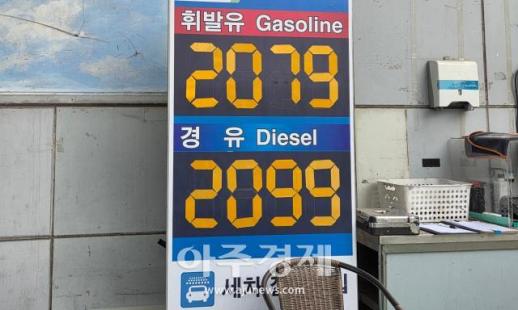 South Korea Gasoline Prices Near 2,000 Won as Middle East Tensions Lift Oil The war involving the United States, Israel and Iran is showing signs of dragging on, sending international oil prices sharply higher. South Korea’s pump prices are also climbing, raising fears of a repeat of 2022, when gasoline rose above 2,000 won per liter amid fallout from the Russia-Ukraine war. According to the Korea National Oil Corp.’s Opinet price information system, the nationwide average gasoline price stood at 1,894.86 won per liter as of 1 p.m. on March 8, up 5.46 won from the previous day. Diesel averaged 1,917.34 won per liter, up 6.79 won. Consumers say the increase feels steeper on the ground. While the government has signaled a willingness to intervene strongly — including mentioning a review of setting a maximum price — price gains have only slowed somewhat, and some stations across the country are already posting gasoline and diesel prices in the 2,000-won range. Seoul recorded the highest averages nationwide, with gasoline at 1,945 won per liter and diesel at 1,968 won. Markets are also bracing for further increases in global crude prices. Goldman Sachs said international oil could top $100 a barrel if tensions in the Middle East do not ease. If disruptions to traffic through the Strait of Hormuz persist, it warned, supply concerns could intensify and add to upward pressure on prices. Goldman Sachs said that if a blockade of the strait continues, it cannot rule out Brent crude rising above $147 a barrel, as in past spikes in 2008 and 2022. Analysts say if oil moves above $100, South Korea’s gasoline prices would likely break through the 2,000-won threshold. As cost pressures mount, the industry says it is preparing a response. Three petroleum groups — the Korea Petroleum Association, the Korea Petroleum Distribution Association and the Korea Gas Station Association — said they would actively cooperate so that international oil price increases are not reflected too abruptly at domestic gas stations. Still, the government and consumers appear skeptical of the pledge. A delivery driver said, “If I make about 30 deliveries a day, I earn around 25,000 won, but after various costs I actually take home only about 10,000 won,” adding, “With fuel prices rising too, it feels like my insides burn every time I fill up.” Lee Eun-hee, a professor of consumer science at Inha University, said South Korea has sizable crude stockpiles, meaning there is no need to raise domestic fuel prices sharply right away even if global prices rise. “But recently the pace of increases has been excessively fast,” she said, adding that commercial drivers such as delivery workers face an unavoidable burden and that policy support such as energy vouchers should be considered.* This article has been translated by AI. 2026-03-08 18:03:38
 -
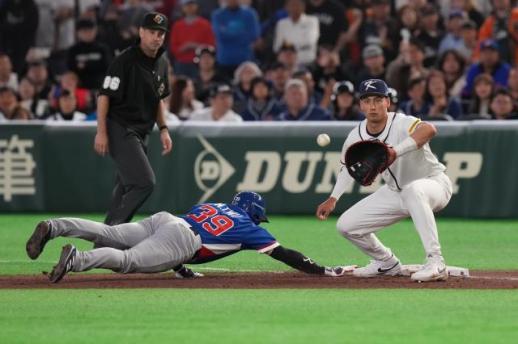 Korea's WBC hopes hang on Australia after Taipei loss SEOUL, March 08 (AJP) -South Korea’s hopes of advancing at the 2026 World Baseball Classic were left hanging by a thread Sunday after a 5–4 extra-innings loss to Chinese Taipei at Tokyo Dome, requiring the team a convincing final-game victory to stay alive. The defeat dropped South Korea to 1–2 in Pool C, while Chinese Taipei finished its schedule at 2–2. South Korea will close the opening round against Australia at 7 p.m. Monday, but its path to the quarterfinals depends first on Japan defeating Australia in Sunday night’s game. If Japan wins, South Korea could still force a three-way tie at 2–2 by beating Australia. The final standings would then be determined by tournament tiebreaker rules, beginning with fewest runs allowed, followed by earned runs allowed, batting average and drawing lots. That scenario leaves South Korea with the steepest task among the tied teams. To realistically advance, Korea would likely need a decisive victory over Australia while keeping its runs allowed low, making Monday’s game effectively a must-win by a wide margin. Sunday’s loss came despite a standout performance from Kim Do-yeong, who nearly carried South Korea to victory with a two-run homer in the sixth inning and an eighth-inning RBI double that tied the game at 4–4. Chinese Taipei broke the tie in the 10th inning under the WBC’s tiebreak rule that begins with a runner on second base. Chiang Kun-Yu’s bunt drove in the go-ahead run, and South Korea failed to capitalize on its own scoring chance in the bottom half. The loss also extended a troubling trend for South Korea, which is still trying to reach the knockout stage for the first time since 2009, when it finished runner-up. The defeat followed another narrow loss a day earlier against defending champion Japan. South Korea stunned the Tokyo Dome crowd by jumping to a 3–0 lead in the first inning and later clawed back from a 5–3 deficit, but ultimately fell short 8–6 on Saturday night. 2026-03-08 17:00:14