

Journalist

Lester Munson
-
 How South Koreans celebrate Lunar New Year's first full moon SEOUL, February 27 (AJP) - Markets are bustling with shoppers as the first full moon of the lunar year, known as Daeboreum, approaches. As Daeboreum, a day when people traditionally pray for health and a good harvest falls next Tuesday, Gyeongdong Market, one of the largest farmers' markets in Seoul, was packed with shoppers on Friday. Stores and stalls there were selling a variety of nuts such as walnuts, peanuts, pine nuts, and ginkgo nuts, tempting shoppers. In an age-old tradition, South Koreans eat nuts on this festive day, as cracking and eating hard-shelled nuts is believed to strengthen teeth. People also enjoy "ogokbap," a bowl of five grains with an assortment of seasoned vegetables, to get the healthy nutrition their body needs in winter. They also believe that eating them helps the body endure the hot summer months. 2026-02-27 17:00:48
 -
 Koyote’s Shinji Shares Wedding Photos Ahead of May Marriage to Singer Moon Won Koyote member Shinji has released wedding photos. Shinji posted several images on social media on Feb. 27 with the caption, “Wedding photo.” In the photos, she poses in a wedding dress and other outfits. Comments included “Bless you,” “A goddess, literally,” and “It’s a full-on photo shoot.” Shinji is set to hold a wedding ceremony in May with singer Moon Won.* This article has been translated by AI. 2026-02-27 16:51:15
 -
 Why Helicopters Still Matter in the Drone Age Army forces cannot do without helicopters. They are a core means of moving airborne troops and are effective at suppressing armored threats that endanger infantry. Helicopters gained prominence after the Vietnam War, when armed UH-1s carrying machine guns and rockets helped make rotorcraft a main Army combat platform. U.S. attack helicopters such as the Apache later earned the nickname “tank killer.” Since the Russia-Ukraine war, helicopter units have faced a new challenge as low-cost drones have shown they can strike tanks and armored vehicles and reshape the battlefield. Some argue drones now offer better value than expensive attack helicopters. This article looks at South Korea’s helicopter fleet and where it may be headed. ◆South Korea’s main helicopters: Surion and Mireon The Army’s helicopter force centers on two domestically developed aircraft: the Surion (KUH-1) transport helicopter and the Mireon (LAH) light armed helicopter. The Mireon, which began entering Army service in 2024, carries a 20mm cannon, air-to-ground guided missiles and unguided rockets. The two-seat aircraft is designed for mobility and attack missions, including close air support and troop cover. It uses a modern fire-control system based on the Airbus Helicopters H155 platform. The Surion is built for transport. Developed to replace aging 500MD light attack helicopters and UH-1H utility helicopters, it is South Korea’s first indigenous medium utility helicopter. It can carry 13 troops and is fitted with a 7.62mm machine gun. Delivered to the Army since 2012, more than 200 are now in operation. Korea Aerospace Industries, the main producer of the Surion and Mireon, has focused on rotorcraft. According to filings with the Financial Supervisory Service’s electronic disclosure system, KAI’s rotorcraft revenue as of the third quarter of last year totaled 269.544 billion won, or 12.3% of total sales. In 2024, the Surion was exported to Iraq, and the company is seeking to expand overseas, including by joining a bid this year for an attack-helicopter program in Bangladesh. ◆Debate over helicopter relevance As drones have risen in the Russia-Ukraine war, the helicopter industry has entered a transition. Low-cost first-person-view, or FPV, drones with forward cameras can inflict significant damage on infantry and armored forces. They can be used in swarms and are seen as cost-effective, and the Army is putting more emphasis on training drone specialists. With drones emerging as a key capability, some in South Korea have questioned whether helicopters are still needed. Industry officials say drones may affect the market but cannot fully replace helicopter missions. “Drones are cost-effective, but because they rely on communications, they are vulnerable to electronic attacks such as electromagnetic pulses,” one official said. “Helicopters have the advantage in complex missions such as troop transport, air assault, and battlefield command and control.” The United States, a leading defense producer, has not stopped modernizing helicopters. It is upgrading the Apache and Black Hawk while testing cockpit automation and unmanned operations. The V-280 Valor, being developed by Lockheed Martin and Bell, is drawing attention as a next-generation U.S. Army aircraft. It uses a tiltrotor design, taking off like a helicopter and then tilting its rotors forward in cruise so fixed wings provide lift. Analysts also say South Korea should expand manned-unmanned teaming, or MUM-T, to strengthen its helicopter force. At a National Assembly seminar on Feb. 24 titled “The Future of Attack Helicopters and Drones,” participants cited results showing that operating attack helicopters (Apache) in a MUM-T concept produced 91% enemy lethality and 83% friendly survivability, compared with 56% and 54% when operated alone. Jang Won-jun, a professor in the Department of Advanced Defense Industry Studies at Jeonbuk National University, said the right direction is to move beyond operating manned helicopters alone and combine them with unmanned aircraft. Considering troop reductions and challenges in securing specialized personnel, he said, a phased shift toward unmanned operations is needed. 2026-02-27 16:42:25
 -
 Korea's one-winged rally: stock and economy reliant on chips SEOUL, Feb 27 (AJP) - From eye-popping KOSPI gains — more than doubling since the start of 2025 — to growth rebounding toward a potential rate of around 2 percent, South Korea’s economy appears, at first glance, to be regaining momentum. But strip away the semiconductor effect, and the underlying picture remains fragile. After an almost uninterrupted rally since year-end, the benchmark KOSPI briefly traded above 6,300 this week — only a month after celebrating the 5,000 milestone. It ended Friday at 6,244.13, taking a modest breather after a near 50 percent surge in the first two months of the year. The rally has been driven overwhelmingly by semiconductor bellwethers. Samsung Electronics is trading around 200,000 won ($141) per share, while SK hynix has crossed 1 million won ($709). Both companies are projected to post more than $100 billion in operating profit amid explosive demand for high-bandwidth memory powering artificial intelligence infrastructure. Growth upgraded — but narrowly based The semiconductor boom has lifted broader growth forecasts. The Bank of Korea (BOK) on Thursday revised up its 2026 growth estimate to 2 percent from 1.8 percent, following 1 percent growth in 2025. The IMF and OECD have also projected expansion near 2.1 percent. Yet the structure of that growth is increasingly concentrated. Excluding the IT sector, growth would slow to around 1.4 percent, according to the BOK. The growth gap between the IT sector and other industries widened from roughly 5 percentage points in the second half of 2024 to 9.5 percentage points by the third quarter of 2025. Construction investment — a key gauge of domestic demand — is projected to contract 2.1 percent this year. As high-value jobs cluster in semiconductors and other advanced manufacturing, income disparities are widening. Wages in IT manufacturing have risen since 2025, while pay levels in other sectors have stagnated or declined. The stock market reflects the same imbalance. On Wednesday, when the KOSPI broke through 6,000, Samsung Electronics rose 1.75 percent to 203,500 won and SK hynix gained 1.3 percent to 1,018,000 won. Yet nearly 60 percent of listed stocks — about 1,400 issues — declined that day. Together, Samsung Electronics and SK hynix now account for roughly 40 percent of total KOSPI market capitalization with valuation topping 2,000 trillion won. When President Lee Jae Myung took office on June 4, their combined market cap stood near 700 trillion won. Samsung Electronics on Thursday joined the exclusive $1-trillion market-cap club. Such concentration raises vulnerability concerns. “South Korean stocks could fluctuate more significantly than those of other nations in the event of a global slowdown or supply chain disruption,” the Korea Center for International Finance (KCIF) warned Friday, citing excessive semiconductor concentration in the domestic market. K-shaped growth in focus Policymakers are increasingly acknowledging the imbalance. In the BOK’s latest six-month dot plot, four out of 21 rate projections pointed to a 25-basis-point cut to 2.25 percent. While most members favored holding rates steady, the presence of easing signals suggests that some policymakers are weighing sectoral weakness beneath headline growth. “Our economy appears to be moving toward 2 percent growth based on outward indicators, but a closer look reveals the challenge of K-shaped growth,” President Lee Jae Myung said at a growth strategy meeting on Jan. 9. Governor Rhee Chang-yong noted that stagnation in non-IT sectors remains a concern. “There were arguments that the stagnation of other industries due to K-shaped growth must be taken into account,” he said, without specifying individual committee views. Economists warn that divergence between sectors could translate into deeper polarization. “The gap in economic growth leads to a gap in the stock market, which in turn widens income and asset disparities,” said Kim Gwang-suk, head of the Economic Research Office at the Korea Institute for Industrial Economics & Trade (KIET). “Support should focus on non-semiconductor industries such as agriculture and chemicals, rather than sectors that have already achieved self-sustainability.” Others argue that boosting productivity through technological innovation may offer a longer-term solution. “Physical AI — applying software intelligence to physical industrial environments — can significantly enhance productivity if implemented effectively,” said Yoo Seung-joo, professor of computer engineering at Seoul National University. Korea possesses a strong industrial base capable of adopting such solutions, said Hwang Soo-wook, a researcher at Meritz Securities, adding that broader AI deployment across manufacturing sites could narrow productivity gaps. 2026-02-27 16:33:50
 -
 British Ambassador tours Hanwha Ocean's shipyard in Geoje SEOUL, February 27 (AJP) - British Ambassador to Seoul Colin Crooks visited Hanwha Ocean’s shipyard in Geoje on Friday. According to the shipbuilder, Crooks inspected a diesel-electric Jang Bogo-class submarine currently under construction during a tour of the shipyard. Thursday's visit was made to review the status of cooperation, as Hanwha Ocean is participating in the Canadian Patrol Submarine Project (CPSP) through a strategic partnership with British defense firm Babcock. Hanwha Ocean has proposed the Jangbogo-III Batch-II submarine for the project, which is equipped with British-made torpedo launch tubes and an advanced weapons control system. Hanwha Ocean said its partnership with Babcock could help it better understand and meet the project's requirements, given that the British firm currently provides maintenance, repair, and operations services as well as naval support for the Royal Canadian Navy. Both companies also believe the partnership could boost their competitiveness by supporting Canada's push for localization, enhancing industrial capability, and ensuring the long-term reliability of submarine maintenance. Crooks said the partnership would lay an "important foundation" for expanding cooperation across defense-related sectors in the years to come. 2026-02-27 16:33:11
 -
 BTS Comeback D-22: The story behind Gwanghwamun SEOUL, February 27 (AJP) - Today’s Gyeongbokgung is often the first breath Seoul offers to the world. Tourists in flowing hanbok pass beneath Gwanghwamun, their silk sleeves catching early-spring light. Cameras rise in unison at the changing of the royal guards. On the stone terrace of Geunjeongjeon, the old wooden eaves frame a startling horizon — beyond them, the clean axis of modern Seoul. For many visitors who first encountered Korea through K-dramas and K-pop, this palace is both backdrop and origin story. Here, timber and tile meet glass and steel. Here, a dynasty’s memory and a nation’s cultural present stand face to face. And at the very center lies a path once reserved for a king. The King’s Road, 600 Years Opened to the World Beyond Gwanghwamun, through Heungnyemun Gate, three stone lanes unfold beneath one’s feet. The middle path rises ever so slightly — subtle, deliberate. This was Eodo, the king’s road. On either side walked civil officials and military officers, each to their rank, each to their place. Even today, the stones whisper hierarchy. Order survives in elevation. In 2026, this path returns to the public imagination. As it aligns with the performance route of BTS, the phrase “the King’s Road” circulates anew — no longer confined to royal ritual, but echoing across global pop culture. When the ceremonial axis of a Joseon court meets a contemporary stage, Gyeongbokgung ceases to be mere scenery. It becomes layered time — history sedimented beneath sound. Geunjeongjeon: Where Power Was Made Visible At the palace heart stands Geunjeongjeon, hall of state ceremonies. Coronations. Investitures of crown princes. Receptions for foreign envoys. Grand assemblies of court. Here, authority was not simply declared — it was staged. Raised upon a double-tiered stone platform, the hall commands height both physical and symbolic. Along its balustrades stand the Four Guardian Deities — Blue Dragon, White Tiger, Vermilion Bird, Black Tortoise — and the twelve zodiac animals. Power here required no speech. It was encoded in elevation, orientation, ornament. If a modern stage rests upon this axis today, the audience does not merely attend a concert. They enter a space dense with ritual memory. Sajeongjeon and Gangnyeongjeon: The Border of State and Self If Geunjeongjeon was the public theater, Sajeongjeon was governance in conversation — the king meeting ministers in daily counsel. Behind the throne stood the Irworobongdo, the folding screen of sun, moon and five peaks — symbol of sovereign authority extending across the Korean Peninsula. The same image appears behind King Sejong on Korea’s 10,000-won note. Its symbolism endures in pocket and palm. Further within lies Gangnyeongjeon, the king’s living quarters. This was private space — historians of the Annals of the Joseon Dynasty were not permitted to reside here. Record paused. Power exhaled. Wooden floors opened to summer air; ondol-heated rooms held winter warmth. The king, too, lived within climate, within season, within the ordinary rhythms of this peninsula. The palace was a stage of sovereignty — and also a dwelling of a single human life. Gyeonghoeru: Banquet, Cosmology, and Reflection If Geunjeongjeon was ritual, Gyeonghoeru was celebration — the politics of hospitality. Foreign envoys were welcomed here; meritorious officials honored. Rebuilt in 1867, the pavilion stands upon forty-eight stone pillars. Twenty-four inner columns are round; twenty-four outer columns square — embodying the philosophy of cheonwon jibang: heaven is round, earth is square. Even the roofline carries guardians — small figurines to ward off evil spirits, ornaments permitted only to the highest-ranking structures. This is no mere pavilion. It is cosmology in timber and stone. Hyangwonji: Rest, and the Weight of Tragedy Deep within the palace grounds rests Hyangwonji, a pond once meant for royal repose. At its center stands Hyangwonjeong Pavilion, where king and queen walked, paused, breathed. Water, forest, reflection — a softer register than the tension of the throne hall. Yet beyond it lies Geoncheonggung Palace, site of the 1895 assassination of Queen Min by Japanese agents — the Eulmi Incident. Soon after, King Gojong sought refuge at the Russian Legation. Gyeongbokgung became, in effect, an emptied palace. Thus serenity and sorrow coexist. Time does not erase; it accumulates. With the Japanese annexation in 1910, Gyeongbokgung endured sweeping destruction. Many halls were dismantled or relocated. The Japanese Government-General Building once stood heavily upon this ground. Since 1990, restoration has advanced steadily. Yet only about 30 percent of the original structures stand today. The goal: 40 percent restoration by 2045. Eodo was once touched only by royal steps. It bore the weight of ritual and rule. Now citizens and visitors traverse it freely — silk skirts brushing stone, smartphones lifted to capture angles once forbidden. In twenty-one days, another moment will arrive. BTS is scheduled to perform. The palace that once anchored a dynasty prepares to connect, through music, to the world. The ceremonial axis becomes a cultural stage. 2026-02-27 16:14:08
 -
 Asian Culture Calendar SEOUL, February 27 (AJP) - Dec. 5 - Mar. 15 Garden of Morning Calm Winter Lights Festival 2026 Mar. 15 Seoul Marathon 2026 Mar. 14 - 16 Jeju Fire Festival Mar. 29 - Apr. 6 Jinhae Gunhangje Festival Japan Mar. 1 Konomiya Naked Festival Mar. 6 Umekoji Handicrafts Market Feb.1 - May 24 Kyoto Nippon Festival 2026 Mar. 9 - 22 Grand Sumo Tournament 2026 Hong Kong Mar. 21 Complex Live! Mar. 27 - 29 Art Basel Hong Kong Feb. 27 - Mar. 30 The 54th Hong Kong Arts Festival Mar. 25 - 29 Art Central 2026 Singapore Mar. 21 Hari Raya Puasa 2026-02-27 16:11:37
 -
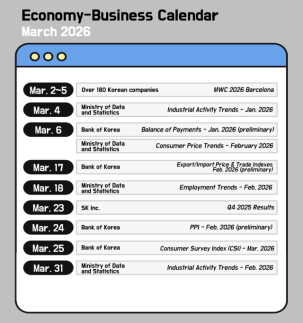 Korean Economy/Business Calendar SEOUL, Feb 27 (AJP) - Mar. 2–5 (Mon–Thu) MWC 2026 Barcelona - Over 180 Korean companies Mar. 4 (Wed) Jan. 2026 Industrial Activity Trends - Ministry of Data and Statistics Mar. 6 (Fri) Jan. 2026 Balance of Payments (Preliminary) - Bank of Korea February 2026 Consumer Price Trends - Ministry of Data and Statistics Mar. 17 (Tue) Feb. 2026 Export/Import Price & Trade Indexes (Preliminary) - Bank of Korea Mar. 18 (Wed) Feb. 2026 Employment Trends - Ministry of Data and Statistics Mar. 23 (Mon) (Mon) Q4 2025 Results - SK Inc. Mar. 24 (Tue) Feb. 2026 PPI (Preliminary) - Bank of Korea Mar. 25 (Wed) Mar. 2026 Consumer Survey Index (CSI) - Bank of Korea Mar. 31 (Tue) Feb. 2026 Industrial Activity Trends - Ministry of Data and Statistics *Major Shareholders' Annual General Meetings (AGM) Mar 18 (Wed) - Samsung Electronics Mar 20 (Fri) - Samsung Biologics - Samsung C&T - LG Energy Solution - Kia Mar 23 (Mon) - LG Electronics - NAVER Mar 24 (Tue) - POSCO Holdings - Celltrion 2026-02-27 16:11:14
 -
 South Korea conditionally approves Google's long-awaited request for map data SEOUL, February 27 (AJP) - Global tech giant Google is now allowed to use official South Korean map data for its app services, the Ministry of Land, Infrastructure and Transport said on Friday. According to the ministry, it decided to approve Google's long-awaited request to use precision map data for its services like Google Maps and Google Earth, following a meeting with officials from other relevant ministries, provided that Google "strictly comply with security guidelines." Under the conditional approval, Google will still face some restrictions including blurring classified sites such as military facilities and security-related installations and limiting the exposure of precise coordinates. It will also need to assign domestic companies to handle map data processing. Any satellite or aerial imagery of South Korean territory used in Google's services must also undergo security screening to restrict exposure and have precise coordinates removed. The ministry said it will monitor Google's compliance with the conditions, and warned that serious violations could result in the suspension or revocation of the approval. Google, along with other major foreign tech companies, has repeatedly sought permission since 2007 to use such data to offer services similar to those it provides in other countries. Friday's decision was likely influenced by the growing number of foreign tourists visiting South Korea and the economic benefits that improved map services could bring. 2026-02-27 15:59:31
 -
 New Books: ‘Rome in the Baroque’ and Two More Titles Rome in the Baroque: A City That Opens Your Eyes to Beauty=By Jeong Jin-guk, Datjip. Art critic and photographer Jeong Jin-guk writes that after suffering repeated losses during the COVID-19 pandemic — family, friends and acquaintances — he traveled to Rome. The book pairs photographs he took across the city with humanities-based reflections that came to him on site, aiming to share the essence of Baroque art with friends who could not make the trip. Jeong argues that 17th-century Baroque art shaped the Rome seen today, describing churches in the historic center as “giant museums” where architecture and art are inseparable. He writes that Baroque works foregrounding the Virgin Mary as a compassionate mother became a refuge that encompassed the worlds of masters including Bernini, Caravaggio and Borromini, and that churches touched by their hands evolved beyond religious facilities into living spaces for art. He also frames Baroque as a “visual art” strategy by the Catholic Church to win back popular support in response to the Reformation. In that context, he rereads Rome’s churches, galleries and museums, inviting readers to consider art and faith, life and the cycles of nature amid masterpieces and saints’ legends. “Churches redeveloped in this period decided their facades to fit road conditions. The sacred axis of stubbornly aligning direction had no meaning, and they prioritized roads that made it easier for worshippers to come and go. Elders took the view, ‘What could be more sacred and important than following a path that is good for believers to repent and pray!’ It was a rational yet flexible judgment typical of Romans. They did not believe in ancient geomancy, but they also did not openly dismiss superstition, mindful of public sentiment. For these reasons, the rear and front of churches often changed to match new roads, side-aisle doors were turned into main entrances, or facades were redesigned.” (p. 273) The Invisible Hands Behind the Korean Wave=By Kwon Ho-jin and others, Sawu. The book collects voices of the “invisible hands” that have supported the Korean Wave behind idol stars and hit content. Its 12 co-authors are figures who have worked over the past 30 years in fields including content exports and production, policy design, tourism and academic research. They focus on how the Korean Wave was planned and delivered, then translated and adjusted to local languages and cultures, and they describe how it seeped into fans’ daily lives around the world. The authors also examine the structure of Hallyu as it expanded into industry, tourism and business, viewing it as a layered social, historical and political landscape — what they call a “scene.” “Changing ‘single-director’ arts institutions — where the government appointed the head and the head ran the organization alone — into ‘committees’ was also meant to block government interference and give cultural and arts experts independence and autonomy. Today we take bodies like the Korean Film Council or the Arts Council Korea for granted, but it was not that long ago they were the Korean Motion Picture Promotion Corp. and the Korea Culture and Arts Foundation. When I was a working-level official in the Culture Ministry’s arts bureau, I handled the work of converting the foundation into the Arts Council. I went to the National Assembly several times with an amendment to the Culture and Arts Promotion Act. Back then, I said countless times, ‘Support, but do not interfere.’” (p. 57) Create 3 Million Won in Monthly Dividends in 3 Years With 10 Million Won=By Insaeng-eop, Gyeongiro-um. During the COVID-19 pandemic, the author writes, he narrowly kept his job amid layoffs and began worrying, “If I get fired tomorrow, how will I make a living?” Confronted with the limits of side jobs and juggling multiple gigs, he started looking for ways to make “money work for itself,” focusing on U.S. dividend ETFs and covered-call ETFs. The book says it can create tangible cash flow in a short period without a large investment, and lays out portfolio construction and management based on the author’s chosen mix of dividend ETFs, BDCs and covered-call ETFs. It also explains ETF structures and types, basic mechanics, tax issues and risk factors to help readers design their own portfolios. “One advantage of ETFs is that you can see very transparently where your money is and how it is invested. Most ETFs disclose their holdings and weights on a daily basis. For example, if you hold an S&P 500 ETF, you can immediately check what percentage is in Apple, what percentage is in Microsoft, and how much is allocated to sectors like health care or financials.” (p. 38) * This article has been translated by AI. 2026-02-27 15:48:23