
Journalist

Lim, Kwu Jin
-
 Wall Street bias leaves Korean won lagging despite equity boom SEOUL, May 11 (AJP) - The bias toward Wall Street stocks among South Korean investors has eased, but not nearly enough to offset foreign divestment from Korean equities — a gap that helps explain the won’s stubborn weakness. According to data released by the Bank of Korea (BOK) last Friday, outbound stock investment by residents rose by $4 billion in March, slowing sharply from $13.46 billion in January and $8.64 billion in February. The central bank said a strong dollar and risk aversion likely cooled the overseas buying spree. The U.S. dollar climbed as high as 1,530 won after the outbreak of war in Iran in late February and averaged around 1,490 won in the postwar period. “The rise in the exchange rate weakened the incentive for new outbound investment, and investor caution grew as volatility in the U.S. stock market expanded,” Kim Young-hwan, director of the BOK’s Economic Statistics Department 1, said during a press briefing Friday. But while the pace of outbound investment slowed, domestic investment shrank even more sharply. In March, foreign investors posted a net outflow of $34.4 billion from the Korean market, nearly triple the $11.9 billion outflow in February. The BOK said a global risk-off shift triggered by geopolitical threats, combined with Korea’s “K-shaped” market structure — where nearly half of total market capitalization is concentrated in Samsung Electronics and SK hynix — amplified volatility in Korean equities. The fact that Korean investors continued to buy foreign stocks even amid deepening risk aversion points to their entrenched confidence in overseas markets. A recent study by the Korea Capital Market Institute (KCMI) found that investors in their 20s and 30s, as well as high-net-worth individuals who primarily invest in overseas exchange-traded products, tend to hold stocks much longer than domestic market investors. KCMI said that if the turnover rate of overseas investors is assumed at around 68 — calculated as shares traded divided by listed shares, multiplied by 100 — the combined turnover rate for domestic and overseas markets is roughly twice that level or higher. That suggests trading frequency is far higher in the domestic market, represented by the benchmark KOSPI and tech-heavy KOSDAQ. The result has been greater volatility in the Korean stock market and deeper distrust among long-term investors. Based on closing prices from Jan. 2 to May 11, the KOSPI’s average daily fluctuation was about 2.3 percent, far higher than the Nasdaq’s 1.6 percent, the S&P 500’s 1.1 percent and the Dow Jones Industrial Average’s 0.9 percent. In an “Issue Note” published last week, the BOK also said domestic stock investors tend to treat rallies in the Korean market as short-term valuation gains rather than opportunities for long-term investment. High volatility, the report said, has eroded investor confidence and discouraged patient capital. As overseas preference and foreign capital outflows overlap, the won has struggled to recover. On April 30, when the Bank of Japan intervened to strengthen the yen from 160 to 155 per dollar and the dollar index fell to 98, the Korean won still weakened by 4.3 won to close at 1,476.1 per dollar. Despite reduced concerns over the unwinding of the yen-carry trade, the won market swung sharply as foreign investors sold more than 1 trillion won ($679.35 million) worth of shares on the KOSPI alone. Even on Monday, when the KOSPI surged 4.3 percent to a record high of 7,822.24, the won weakened by 0.7 won to close at 1,472.4 per dollar. The decline reflected another heavy outflow from won-denominated assets, as foreign investors dumped 3.48 trillion won worth of Korean stocks. “As excessive trading in the domestic securities market has hindered investment performance, the perception of overseas markets — especially the U.S. — as long-term investment destinations remains strong,” said Kim Min-ki, a researcher at KCMI. He warned that won weakness will persist unless Korea addresses its chronic problems of market volatility and excessive concentration. 2026-05-11 17:46:46
 -
 Seoul mulling deploying Hyundai Motor robots for border patrol SEOUL, May 11 (AJP) - South Korea’s military is quietly studying whether robotic dogs and wearables built by Hyundai Motor Group could one day complement human patrols along the tense front lines dividing the Korean Peninsula, as demographic collapse begins to hollow out the ranks of one of the world’s largest conscript armies. The discussions, still at an early stage, underscore how a shrinking birthrate is forcing Seoul’s military planners to confront a strategic dilemma once considered unthinkable: how to defend one of the world’s most heavily armed borders with fewer and fewer soldiers. “The Army is seeking cooperation with the government, industry and academia to become a more technology-driven force,” an Army official told AJP. “We are also exploring possible cooperation with Hyundai Motor.” Behind the bureaucratic language lies a more urgent reality. South Korea’s standing military force has fallen from 563,000 troops in 2019 to roughly 450,000 this year, according to Defense Ministry data, with Army enlistment numbers dropping by nearly 100,000 over the same period. “The decrease in military manpower is unavoidable,” the Army official said. “In line with that, we are also looking at ways to improve the efficiency of our forces.” Military and industry officials say working-level talks have already taken place between Army Headquarters and Hyundai Motor Group over possible deployment concepts involving robotics systems ranging from the MobED unmanned mobility platform to the X-ble Shoulder wearable robot and Spot, the four-legged robot developed by Boston Dynamics, the U.S. robotics company controlled by Hyundai. For South Korea’s military, the interest is less about futuristic combat fantasies than basic arithmetic. The Defense Ministry says the armed forces are already about 50,000 troops short of their target manpower level of 500,000. The military has loosened physical standards for conscription to compensate, but the pool of eligible young men continues to contract as the country’s fertility rate remains among the lowest in the world. The strain is already reshaping the structure of the force itself. Since 2006, the number of divisions and higher-level units has shrunk from 59 to 42 through mergers and disbandments. What Seoul is confronting is part of a broader military trend emerging across aging societies. From Washington to Beijing, armed forces are increasingly experimenting with unmanned systems to compensate for shrinking manpower and rising battlefield risks. The U.S. military has tested semi-autonomous robot dogs for perimeter security at facilities including Cape Cod Space Force Station, viewing them as force multipliers capable of conducting repetitive patrols in dangerous areas without exhausting human troops. China, meanwhile, has moved more aggressively, publicly showcasing rifle-equipped robot dogs during exercises including the Golden Dragon 2024 drills with Cambodia, hinting at future battlefield roles alongside infantry units. South Korea’s military appears far more cautious. Officials and defense experts say current discussions center primarily on non-lethal missions such as surveillance, reconnaissance, logistics transport and patrol support rather than armed combat roles. Still, the symbolism is difficult to ignore in a country where military service has long rested on mass mobilization and manpower. The war in Ukraine has further accelerated military interest in unmanned systems, demonstrating how wheeled robotic platforms can transport ammunition, food and medical supplies while evacuating wounded soldiers under fire. For Hyundai Motor Group, any eventual military deployment could also become a pivotal test case for its broader robotics ambitions after the conglomerate deepened its push into physical AI and robotics through its acquisition of Boston Dynamics in 2021. The company, however, stopped short of confirming any formal defense partnership. “We are reviewing ways to cooperate with various parties in robotics,” Hyundai Motor Group said, “but no cooperation with a specific partner has been decided beyond what has already been publicly disclosed.” 2026-05-11 17:33:32
 -
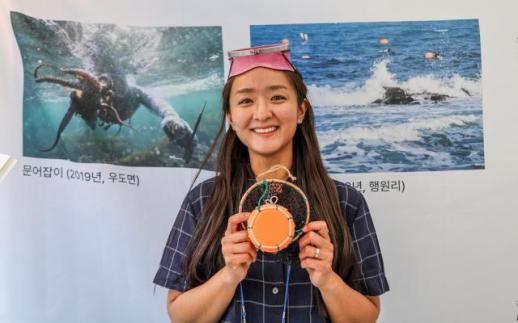 Festival brings taste of rural coastal life to Seoulites SEOUL, May 11 (AJP) - A fishing village-themed festival kicked off on Monday at Gwanghwamun Square, offering city residents a taste of coastal life and a glimpse into rural relocation opportunities. Hosted by the Ministry of Oceans and Fisheries and the Korea Fisheries Infrastructure Public Agency, the three-day festival provides information for those interested in relocating to fishing villages, along with details on government policies, support programs, and fisheries-related job opportunities. Visitors can get consultations and learn more through dedicated booths. They can also take part in various hands-on programs and events featuring residents who have relocated to fishing villages. Additional activities include seafood tasting events and meditation programs inspired by coastal life. The festival runs daily from 11 a.m. to 8 p.m. at Gwanghwamun Square in Seoul until Wednesday. 2026-05-11 17:28:04
 -
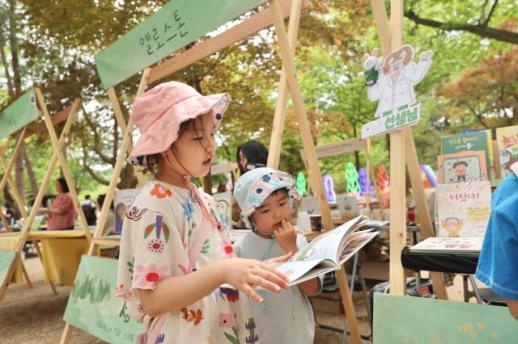 Nami Island turns into an island of fairytales SEOUL, May 11 (AJP) -Under canopies of fresh spring leaves and tree-lined paths washed in soft May sunlight, families wandered through Nami Island this weekend as the 2026 Nami Island International Children’s Book Festival transformed the popular riverside retreat into a sprawling storybook playground. Held under the theme “Romance,” NAMBOOK 2026 opened on May 1 and runs through May 17, blending literature, art and performance across the island’s open-air stages and wooded walkways. The 17-day festival has drawn children clutching picture books, parents pushing strollers and young readers sprawled across lawns with books in hand. At the Eco Stage and Free Stage, the rhythmic sounds of percussion troupe Mulove echoed through the island as children gathered around performers, some swaying to the music while others sat cross-legged on the grass. Nearby, children’s choirs filled the spring air with songs as visitors paused beneath towering metasequoia trees to watch. Inside the UNICEF Lounge, pages of world literature came alive during multilingual reading sessions featuring illustrated books from around the globe. Children listened intently as presenters introduced stories from different cultures before joining hands-on activities inspired by the readings. At the Daloreum Art Playground, one of the festival’s busiest corners, children crowded around a massive community banner for the “Draw a Face—Together, We Connect” program, carefully sketching self-portraits into blank oval spaces. The growing collage of colorful faces stretched across the canvas like a collective portrait of the festival itself. Elsewhere, mime artists entertained passersby along winding footpaths while outdoor reading spaces offered quieter moments away from the crowds. Children leafed through books beneath the shade of trees as ferry arrivals continued to bring waves of visitors onto the island throughout the day. The Nami Book Fair, titled “Some Bookstore,” also featured domestic and overseas publishers showcasing illustrated children’s books, independent titles and art publications, adding to the festival’s atmosphere of literary exploration. Already one of South Korea’s most popular family spring destinations, Nami Island takes on a particularly festive atmosphere during NAMBOOK, where literature blends with performance, nature and play. Admission to the festival is included with regular island entry, while most programs remain free for visitors. 2026-05-11 17:08:48
 -
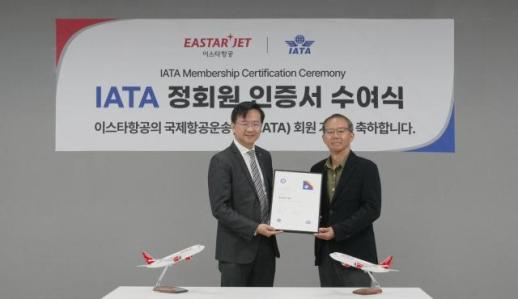 Eastar Jet joins IATA as full member to strengthen global competitiveness SEOUL, May 11 (AJP) - Eastar Jet has joined the International Air Transport Association as a full member, the airline said Monday, in a move aimed at strengthening its global competitiveness and safety standards. IATA is the world’s largest airline industry association, with 374 member airlines from 129 countries. It plays a central role in the global aviation industry by setting and managing international standards and regulations for air transport, as well as assigning airline designator codes such as Eastar Jet’s “ZE.” Eastar Jet obtained the IATA Operational Safety Audit certification on Dec. 30 last year, a mandatory requirement for full IATA membership. The airline was officially approved as a full member on May 4. Eastar Jet held a ceremony at its headquarters in western Seoul on Friday to mark its IATA membership, with CEO Cho Joong-seok and IATA officials in attendance. Eastar Jet said the membership will help the airline strengthen cooperation with global carriers and further enhance its safety management system in line with international standards. “Joining IATA as a full member is meaningful because it shows that our safety and operational systems have been officially recognized at the international level,” Cho said. “Based on our safety capabilities that meet global standards, we will continue to grow into an airline trusted by our customers.” The airline also received a perfect score of 100 in the safety category of the 2025 Air Transportation Service Evaluation conducted by the Ministry of Land, Infrastructure and Transport and the Korea Transport Institute. Eastar Jet has also been expanding its international network. On May 1, the airline launched its Busan-Almaty route, becoming the first and only carrier to operate the service. The route operates twice a week, on Mondays and Fridays, and the inaugural flight from Busan recorded a load factor of 99 percent, according to the company. 2026-05-11 17:08:09
 -
 Fake K-ramen Spreads to Nepal with Korean Branding "Feels like a Korean store"... Counterfeit Korean ramen floods Nepali resort On May 8, at a supermarket in Pokhara, Nepal, a popular tourist destination just a 10-minute walk from Phewa Lake, the ramen aisle was the first thing to catch the eye. Most of the products on the shelves featured Korean writing, creating a familiar atmosphere reminiscent of a Korean grocery store. Upon closer inspection, however, a strange sense of unease emerged. While the products appeared to be Korean, they were actually from local and overseas brands. The most notable was a stir-fried noodle product branded as 'HANKOOK.' Its design, featuring a black background with a chicken character breathing fire, strongly evoked Samyang Foods' Buldak Bokkeummyeon. The English label 'BULDAK' and the product name 'Buldak Bokkeummyeon' were nearly identical, and the phrase 'Taste of Korea' was placed where a 'Made in Korea' mark would typically appear, adding to the confusion. The original product, along with its pink-packaged counterpart, was being sold under the same guise. As I continued to browse the aisle, more similar products caught my attention. The use of Korean writing varied widely. The Nepali ramen brand 'Current' prominently displayed the word '현재' (meaning 'current') on its packaging, while 'Jackpot' included the phrase '공동자금' (meaning 'joint fund'), which was completely unrelated to ramen. Many products emphasized spiciness by incorporating Korean words. Phrases like '악마의' (meaning 'devil's') and '라라 매콤한' (meaning 'spicy') were scattered throughout the shelves. A local store employee remarked, "The important thing is that it has Korean writing; it creates a perception that it’s a Korean ramen, which increases its popularity." Consumer reactions were similar. Robin, a 28-year-old from India, selecting products in front of the shelf, said, "I didn’t know the HANKOOK product was a knockoff. I just assumed it was Korean ramen because it had Korean writing on it." He added, "I chose it because it was cheaper than the original." From Southeast Asia to Japan... The resurgence of 'K-style' products without clear nationality This phenomenon is not limited to Nepal. As the popularity of K-food rises, local products across Asia are increasingly adopting Korean-style packaging and Korean writing. This trend goes beyond merely importing and selling Korean products; local companies are actively mimicking the design and naming conventions of Korean ramen. A prominent example is in the Indian market. The large food company ITC is selling 'Daebak Ramen' under its instant noodle brand 'Yippee.' The product prominently features the Korean word '대박' (meaning 'big hit') on the front, using a striking black and red color scheme to emphasize the image of spicy Korean ramen. The word 'Korean' is also included to highlight the concept of Korean ramen. Indonesia is witnessing a similar trend. The local ramen brand Mie Sedaap has introduced a product concept called 'Korean Seasoned Dak Galbi Ramen,' featuring the Korean phrase '양념 닭갈비' (meaning 'seasoned chicken galbi') on its packaging and emphasizing flavors of smokiness and spiciness with a red color design. Japan, known as the birthplace of instant ramen, is also not exempt. Local brands in Japanese convenience stores and supermarkets prominently display products labeled 'Korean Jjamppong' and 'Korean-style ramen.' Many products feature Korean writing more prominently than Japanese, or use red and black designs to emphasize the image of spicy Korean ramen. Nissin Foods, Japan's largest ramen company, has previously faced controversy. Its 2023 product 'Nissin Yakisoba U.F.O. Stir-fried Noodles Korean-style Sweet and Spicy Carbonara' received criticism for its pink packaging and product concept being similar to Samyang Foods' 'Carbonara Buldak Bokkeummyeon.' The use of the Korean term '볶음면' (meaning 'stir-fried noodles') in the product name also drew attention. Industry experts attribute this trend to the success of K-ramen, particularly centered around Shin Ramyeon and Buldak Bokkeummyeon. According to the Ministry of Agriculture, Food and Rural Affairs, K-food exports reached a record high of $13.62 billion last year, a 5.1% increase from the previous year. Notably, ramen exports surged by 21.9% to exceed $1.52 billion, marking the first time a single item surpassed the $1 billion mark. The growth trend continues this year, with ramen exports in the first quarter reaching $435 million, a 26.4% increase from the previous year. “Image theft while evading legal frameworks”... Food industry faces brand erosion The food industry views the recent trend of 'borrowing Korean writing' abroad as a significant change rather than a mere fad. In the past, packaging typically featured English and local languages, but now Korean writing and the label 'KOREA' itself are becoming key elements that enhance product competitiveness. However, with this increased prominence comes growing concern about brand erosion. According to Samyang Foods, the popularity of Buldak Bokkeummyeon has led to a rapid increase in imitation products. While past imitations often involved direct copying of logos or characters, recent trends show a clever evasion of legal regulations. A representative from Samyang Foods stated, "Recently, there are many cases where the unique color combinations or packaging designs of our brand are closely mimicked to confuse consumers. They may slightly alter the details of mascot characters or insert phrases like 'Korean-style spiciness' to make them appear authentic." A representative from Nongshim noted, "In the past, many cases involved directly copying product names, but now we see more instances of cleverly imitating designs, colors, and overall ambiance. Since they don't directly replicate trademarks, legal responses are becoming more complicated." The industry is monitoring similar products through local distribution networks and consumer reports, taking legal action such as sending warning letters and administrative measures. Registration of trademark rights and packaging design copyrights is also expanding in key countries. One industry insider remarked, "While the rising status of K-food is encouraging, the malicious imitation that confuses consumers with Korean products is a serious issue that undermines brand value in the long term." 2026-05-11 17:06:57
 -
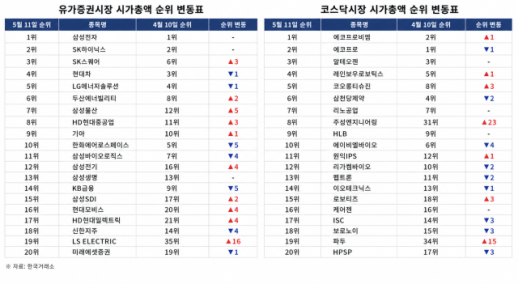 Major Shakeup in KOSPI Market as 17 of Top 20 Stocks Change There has been a significant shift in the rankings of the top stocks by market capitalization on the KOSPI. Despite geopolitical risks stemming from the Middle East, leading semiconductor companies have maintained their positions based on solid fundamentals, while stocks in the robotics and shipbuilding sectors have surged. In contrast, power equipment stocks, which saw a sharp rise last month, have faced profit-taking, causing them to drop in the rankings. According to the Korea Exchange on May 11, 17 of the top 20 stocks by market capitalization on the KOSPI have changed positions compared to a month ago (April 10). This means that the lineup of the 'Top 20' has been completely reshuffled, excluding Samsung Electronics, SK Hynix, and Samsung Life, which hold the 1st, 2nd, and 13th positions, respectively. The primary drivers of this upheaval are strong semiconductor exports and the rapid rise of the robotics, power equipment, and shipbuilding sectors. Preliminary semiconductor export figures for May have reached record highs, signaling a recovery in the industry, which has led to a broad rally in semiconductor-related stocks. The most notable gain in the KOSPI market was seen by Samsung C&T, which climbed five spots from 12th to 7th, driven by expectations of enhanced shareholder return policies and corporate governance reforms. SK Square, benefiting from a reevaluation of its stake in SK Hynix, rose three spots from 6th to 3rd, securing a place in the top three. Doosan Enerbility moved up two spots from 8th to 6th, capitalizing on momentum from nuclear power, while HD Hyundai Heavy Industries also climbed three spots from 11th to 8th. The shipbuilding sector, in particular, received a boost from the signing of a memorandum of understanding (MOU) related to the MASGA project by Minister of Trade, Industry and Energy Kim Jeong-kwan and U.S. Secretary of Commerce Gina Raimondo. The automotive sector also saw Kia rise one spot from 10th to 9th, driven by ongoing expectations surrounding physical artificial intelligence (AI). Several stocks outside the top 20 made notable gains. LS ELECTRIC surged 16 spots from 35th to 19th, entering the 'Top 20'. Conversely, Hanwha Aerospace, a leader in the defense sector, fell five spots from 5th to 10th after a significant drop. KB Financial also dropped five spots from 9th to 14th, while Samsung Biologics (7th to 11th) and Shinhan Financial Group (14th to 18th) each fell four spots. The KOSDAQ market also experienced significant changes, with 16 of the top 20 stocks changing positions. The standout performer was JUSUNG Engineering, which soared 23 spots from 31st to 8th, riding the momentum from the semiconductor equipment sector. Lee Kyung-min, a researcher at Daishin Securities, stated, "As long as the upward trend in forward earnings per share (EPS) continues, there is ample room for KOSPI to rise. A rotation strategy focusing on undervalued stocks in sectors such as healthcare, hotels and leisure, and software will be effective as the semiconductor surge stabilizes."* This article has been translated by AI. 2026-05-11 17:02:17
 -
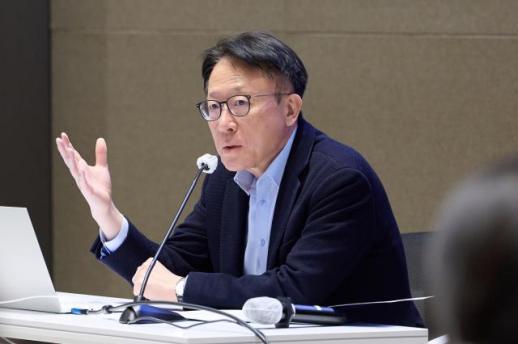 Outgoing BOK dove delivers hawkish swan song amid inflation risks SEOUL, May 11 (AJP) — Inflation has become increasingly worrisome and is likely to dominate upcoming monetary policy discussions at the Bank of Korea, outgoing Monetary Policy Board member Shin Sung-hwan said Monday, in a notable hawkish turn from one of the central bank’s most dovish voices. Shin, whose term ends Tuesday, admitted during a press conference that he had previously favored rate cuts, but said that if he were still to remain on the board, he would now be more concerned about inflation risks. Shin had been the sole dissenter advocating a rate cut when the BOK held its benchmark interest rate steady in January, April, August, October and November last year. “Inflation is always the policy priority,” he said, arguing that central banks should prioritize price stability over growth, particularly when inflation risks drifting above the BOK’s 2 percent target. He warned that if oil prices remain elevated through year-end, secondary inflationary pressures across the broader economy would become unavoidable, making the fight against inflation more difficult than initially expected. Shin identified the surge in global crude prices following the Middle East conflict as the single biggest variable facing policymakers. “We initially expected oil prices to stabilize around $70 per barrel by the end of this year, but under the current situation, it now appears likely to hover closer to $90,” he said. Brent crude climbed as high as $105 a barrel during intraday trading Monday, roughly 50 percent above prewar levels. Since joining the board in May 2022, Shin had been widely viewed as a representative dove within the committee. During his tenure, he issued seven dissenting votes in favor of rate cuts. Even as former Governor Rhee Chang-yong maintained a cautious policy stance, Shin consistently argued for easing to support weak domestic demand and relieve pressure on the real economy. But he said the environment had shifted rapidly in recent months. “Just as the housing market was already making it difficult to lower rates, the Middle East situation deteriorated immediately afterward,” Shin said. “At this point, it is not desirable to add inflationary pressure through a rate cut.” Shin also described “polarization” within the South Korean economy as the most difficult challenge during his tenure. “Economic growth represents the overall performance of the economy, but now we have a situation where a sector accounting for roughly 10 percent of the economy determines the headline figure,” he said, referring to the growing dominance of the semiconductor sector. He warned that disparities across industries have widened to the point where appropriate interest-rate levels differ sharply depending on the sector. In the past, strong growth in leading industries generated broader trickle-down effects across the economy, Shin said, but that transmission mechanism has weakened considerably. As a result, higher interest rates risk placing even greater burdens on already struggling sectors. Regarding the recent rise in government bond yields, Shin said a combination of surging long-term U.S. Treasury yields and mounting inflation expectations had contributed to the move. “Long-term U.S. interest rates reflect concerns over inflation expectations,” he said, adding that similar concerns are also likely influencing the rise in South Korean government bond yields. Shin is not the only BOK official signaling a more hawkish shift. “We need to stop thinking about lowering the benchmark interest rate and begin considering the possibility of raising it,” Ryoo Sang-dai said earlier this month during a press conference at the Asian Development Bank annual meeting in Samarkand, Uzbekistan. Ryoo added that clearer signals regarding the BOK’s future policy direction could emerge during the May monetary policy meeting. Bond prices continued to fall amid a growing atmosphere for an interest rate hike. The yield on the three-year government bonds closed at 3.598 percent, up 2.9 basis points, while the ten-year yield finished at 3.950 percent, up 4.1 basis points. 2026-05-11 17:01:12
 -
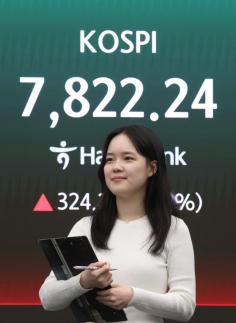 KOSPI Hits Record High Amid Semiconductor Surge, Deepening 'K-Shaped' Market The KOSPI has once again reached an all-time high, driven by a rally in major semiconductor stocks, particularly Samsung Electronics and SK Hynix, as the index approaches the 7,900 mark. However, the surge is concentrated on these two large-cap semiconductor companies, exacerbating the 'K-shaped' market phenomenon where performance varies significantly among different sectors. On this day, the KOSPI closed at 7,822.24, marking a record high with an increase of 324.24 points (4.32%) from the previous trading day, which closed at 7,498.00. The index has surged over 54% since the end of March, when it stood at 5,052.46. Compared to the closing figure of 4,214.17 at the end of last year, the KOSPI has risen by 85.62% this year. Market analysts are optimistic, with domestic brokerages suggesting that the KOSPI could surpass 8,000 and even reach 9,000. Foreign investment bank JP Morgan has projected that the index could exceed 10,000. The recent upward trend is largely attributed to the semiconductor sector. On this day, Samsung Electronics and SK Hynix saw their shares rise by 6% and 13%, respectively, fueled by growing expectations for increased demand for AI semiconductors. However, the concentration of gains in the semiconductor sector raises concerns. The recent rise in the domestic stock market has increasingly focused on Samsung Electronics and SK Hynix. On this day, the combined market capitalization of Samsung Electronics (including preferred shares), SK Hynix, and SK Square accounted for 52% of the KOSPI's total market cap. Among the 34 KRX indices calculated by the Korea Exchange, all nine indices with the highest recent gains included Samsung Electronics and SK Hynix. The semiconductor index topped the list with a 22.98% increase, followed by the value-up index at 22.16%. The average increase for indices that included these two stocks was 19.45%, while the average for other indices without them was only 0.27%. This indicates a market where returns are heavily influenced by the inclusion of major semiconductor stocks. The trend of concentration is also evident in trading volumes. The average daily trading volume of the KOSPI this month reached 48.4982 trillion won, a 64.1% increase from last month's 29.555 trillion won. In contrast, the average daily trading volume decreased from 947.18 million shares to 773.96 million shares, reflecting a decline in the number of traded stocks but a surge in trading volume for specific large-cap stocks. So far this month, the average daily trading volume for Samsung Electronics and SK Hynix combined has reached 74.5353 trillion won, accounting for 37% of the total KOSPI trading volume. Including Samsung Electronics' preferred shares and SK Square, the combined share of these four stocks rises to 42%, up from 34.6% last month, indicating a deepening concentration trend. Market experts believe there is still potential for further KOSPI gains. Analysts suggest that while the current concentration in the semiconductor sector may continue for some time, there is also a possibility that market momentum could gradually spread to other sectors. Kim Jong-min, a researcher at Samsung Securities, noted in a recent report, "Behind the explosive rise lies extreme polarization in returns. In the future, we are likely to see a rotation of investments toward semiconductor materials, alternative energy, and physical AI beneficiaries." He added, "A gradual rotation following extreme concentration could serve as a stepping stone for the KOSPI's resurgence."* This article has been translated by AI. 2026-05-11 16:59:49
 -
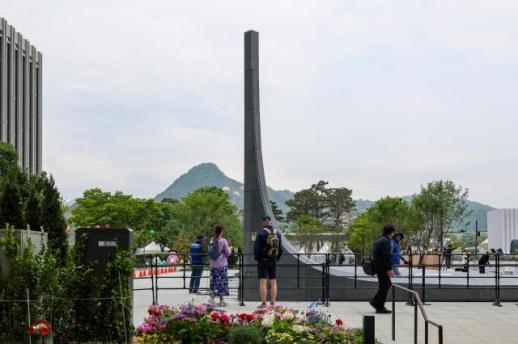 Memorial space for Korean War heroes set to open at Gwanghwamun SEOUL, May 11 (AJP) - A memorial garden honoring soldiers who died in the Korean War and other war veterans is set to open this week at Gwanghwamun in central Seoul, according to the Seoul Metropolitan Government. City officials and workers were busy making final preparations on Monday, just a day ahead of the opening of the space, dubbed the "Garden of Gratitude," which commemorates the sacrifices and contributions of around 22 countries that sent troops and provided support during the 1950–53 Korean War. The space also features an installation selected through a public competition. The 6.25-meter-tall piece includes 23 rifle-shaped sculptures, symbolizing the countries that assisted during the war. City officials said the space is expected to give visitors a place to reflect on the history of the Korean War and international solidarity. Earlier in 2024, the city government initially proposed erecting a 100-meter-tall flagpole to hoist a giant national flag as a new symbol meant to inspire patriotism. But the plan immediately sparked controversy, with critics arguing it would be excessive and a waste of public funds, and was eventually scrapped. 2026-05-11 16:58:05