

Journalist

Lim Byung-sik
-
 New Rules to Compensate Consumers for Hotel Booking Cancellations To prevent hotels from unilaterally canceling reservations to raise prices, new consumer compensation regulations will be established. Under the proposed measures, hotels that cancel existing bookings to sell rooms at higher rates will be required to refund the deposit and compensate consumers with 200% of the canceled accommodation fee. On June 4, Deputy Prime Minister and Minister of Economy and Finance Koo Yun-cheol chaired a meeting of the Special Task Force on Living Costs at the Government Seoul Building, where the implementation status and future plans for measures to eradicate price gouging were discussed. In response to a surge in hotel prices and unilateral booking cancellations during recent BTS concerts in Busan, the government has decided to strengthen consumer protection measures. During the concert week, some hotels in Busan reportedly raised their rates by an average of 2.4 times, with some prices increasing as much as 7.5 times compared to the previous and following weekends. As of May 29, a total of 311 complaints regarding tourism inconveniences were reported, with 256 of those related to booking cancellations. The government will revise consumer dispute resolution standards to address cancellations made for the purpose of price increases or resale. The proposed amendments will include provisions for refunding deposits and compensating consumers with 200% of the canceled accommodation fees. A related bill is expected to be introduced later this month. Additionally, the government plans to implement a "price assurance system" that requires hotels to report and publicly disclose peak season rates. Hotels will be mandated to report their seasonal rates to local governments and make this information available on booking platforms and their websites. Measures will also be considered to penalize hotels that charge above reported rates or fail to report their rates in advance. Enforcement against price gouging will also be intensified. A joint government inspection team, including the Ministry of Interior and Safety, the Ministry of Culture, Sports and Tourism, the Ministry of Health and Welfare, the National Tax Service, the National Police Agency, the Fair Trade Commission, and local governments, will focus on violations related to the mandatory posting of accommodation rates and unreported lodging operations. Strict measures will be taken against confirmed cases of collusion or tax evasion. The government will also enhance penalties for businesses engaging in price gouging. The point deduction for hotels during grading evaluations will increase from a maximum of 10 points to 30 points for unfair pricing practices. Penalties will also be imposed during the selection process for various government support programs and events. As the summer vacation season and various festivals approach, the government plans to continue special inspections in collaboration with relevant departments and strengthen its response system to ensure immediate on-site inspections and administrative actions upon receiving complaints. 2026-06-04 14:06:00
 -
 Government to Stabilize Supply of Cabbage and Radishes Amid Summer Heat and Rain Concerns As concerns rise over unstable agricultural supply due to expected heavy rains and high temperatures this summer, the South Korean government announced it will activate a Summer Agricultural Supply Stabilization Task Force starting on the 15th. The government also plans to supply 21,000 tons of cabbage and radishes to stabilize prices.On June 4, the Ministry of Agriculture, Food and Rural Affairs held a special task force meeting at the Government Seoul Complex to discuss the 'Measures for Stabilizing Agricultural and Marine Products Supply in Preparation for Summer Heat and Rain.'According to the Korea Meteorological Administration, this summer is expected to be hotter and wetter than usual. The average summer temperature over the past decade has been recorded at 24.6 degrees Celsius, and this year may exceed that figure. Rainfall is likely to be particularly high in June and July.These climatic forecasts raise concerns about poor crop growth and decreased productivity in livestock. Prolonged high temperatures could lead to calcium deficiency in crops, sunburn, and reduced egg-laying rates in poultry.In August 2024, for instance, cabbage prices surged by 90% compared to the previous year due to high temperatures. In 2023, 100,000 laying hens and broilers died from the heat.In response, the Ministry of Agriculture will collaborate with the Rural Development Administration, the National Agricultural Cooperative Federation, and the Korea Agro-Fisheries & Food Trade Corporation (aT) to monitor crop conditions and respond swiftly to any signs of crisis starting on the 15th.Key items for supply management include cabbage, radishes, pork, chicken, and eggs, which will be closely monitored for growth and production trends. Proactive measures will be implemented to stabilize the supply of these products.Additionally, the government plans to supply 21,000 tons of cabbage and radishes (15,000 tons of cabbage and 6,000 tons of radishes) and utilize 7,000 tons from storage facilities to address any reductions in supply. They will also encourage an increase in planting area for shipments after September through advance purchase contracts.To counter rising egg prices, the government will diversify import sources, bringing in 31.23 million fresh eggs from the United States, Thailand, and Brazil. Furthermore, by the end of this month, they will prioritize the import of 11 million hatching eggs and will gradually import the remaining quantities.The government is also considering special discount support during the summer vacation period based on the supply and price situation of agricultural and livestock products, as well as working with self-help organizations to lower delivery prices.In light of concerns over rising sea temperatures, comprehensive measures against high temperatures and red tides will be implemented. The government will expand real-time sea temperature monitoring networks and enhance information sharing, while also distributing the largest-ever supply of high-temperature response equipment, such as liquefied oxygen supply devices. Simultaneously, they will promote seafood consumption to encourage early harvesting before high-temperature-related deaths occur. 2026-06-04 14:06:00
 -
 Government Considers Lifting Oil Price Cap if Global Prices Stabilize The South Korean government is considering lifting the oil price cap if global oil prices stabilize structurally. However, with the recent consumer price inflation rate soaring to 3.1%, officials plan to maintain the price cap to ensure stability in essential goods and services. On June 4, Deputy Prime Minister and Minister of Economy and Finance Ku Yun-cheol chaired a task force meeting at the Government Seoul Office to discuss recent consumer price trends and response measures. The government stated that it would review the possibility of lifting the price cap if supply uncertainties are resolved with the resumption of shipping through the Strait of Hormuz or if global oil prices stabilize and the risk of sharp increases diminishes. However, during ongoing uncertainties in the Middle East, officials plan to manage the price cap flexibly based on market conditions. Since implementing the price cap in March following the outbreak of conflict in the Middle East, analysis has shown that without the cap, the consumer price inflation rate last month would have risen to 3.7%, 0.6 percentage points higher than the reported 3.1%. The reduction in fuel taxes is estimated to have contributed about 0.3 percentage points to this figure. In light of persistently high oil prices, the government plans to alleviate the burden on vulnerable groups. This includes swiftly executing support payments for high fuel prices, raising the subsidy limit for diesel used by freight trucks by 52.8%, and providing price-linked subsidies for tax-exempt fuel for farmers and fishermen. The government is also considering additional incentives for gas stations that contribute to price stability, such as selecting and rewarding 'good gas stations.' To stabilize essential goods prices, the government will implement measures to increase supply. This includes introducing tariff quotas for pork and chicken to boost supply volumes and considering emergency tariff quotas for the second half of the year. Discounts for agricultural and fishery products provided by the government and producer organizations will be expanded to a maximum of 50%. Additionally, to stabilize egg prices, the government plans to increase imports of fresh eggs from the United States and Thailand, and release 8,000 tons of government stockpiled seafood, including pollock, mackerel, squid, and hairtail, at prices 30-40% lower than market rates. A task force will be established to ensure stable supply of agricultural and livestock products in preparation for summer heatwaves and heavy rains. To manage prices for essential services, the government will conduct special inspections in collaboration with relevant departments to address excessive pricing and price collusion in accommodations ahead of the summer vacation season and local festivals. It plans to push for legal amendments to introduce a voluntary price reporting system for accommodations and establish consumer protection measures that require compensation of 200% of the accommodation fee for unjustified cancellations. Furthermore, the government will launch a data plan that allows continued use of basic communication services even after the data limit is reached, aimed at reducing communication costs.* This article has been translated by AI. 2026-06-04 14:03:00
 -
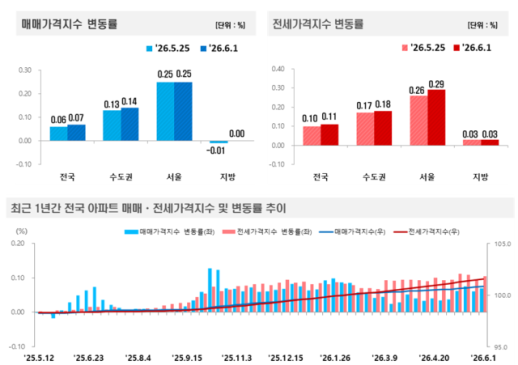 Housing Prices Rise in Dongtan Amid Semiconductor Industry Boom Apartment prices in Seoul have maintained a steady increase of 0.25% for six consecutive weeks, reflecting a strong trend in the metropolitan area. In Dongtan, Hwaseong, expectations surrounding the semiconductor industry have led to a significant surge of 0.60%, marking the highest increase nationwide, while other regions remained stable. According to the Korea Real Estate Agency's report on nationwide apartment price trends for the first week of June, the average apartment sale price across the country rose by 0.07% compared to the previous week. The metropolitan area saw a 0.14% increase, with Seoul specifically rising by 0.25%, while other regions showed no change at 0.00%. Despite a cautious buying sentiment in Seoul, transactions continued, particularly in newly built, large-scale, and transit-oriented developments, sustaining the upward trend. In the northern districts, Dongdaemun (0.37%), Seongdong (0.35%), Gangbuk (0.35%), and Seongbuk (0.34%) led the price increases. In the southern districts, Gangseo and Yeongdeungpo both rose by 0.31%, with Songpa (0.28%), Guro (0.27%), and Dongjak (0.25%) also experiencing gains. In Gyeonggi Province, Dongtan in Hwaseong led the charge with a 0.60% increase. Gwangmyeong (0.43%) and Seongnam's Sujeong District (0.42%) also continued to rise in key residential areas. Conversely, Gwacheon (-0.19%) and Icheon (-0.16%) showed declines, particularly in large and established residential areas. In Incheon, prices increased by 0.02%. Yeonsu District (0.06%) and Donggu and Michuhol Districts (each 0.04%) saw gains, while Namdong District (-0.02%) and Gyeyang District (-0.01%) faced declines. The regional market displayed notable disparities. While Jeonbuk (0.07%) and Jeonnam (0.06%) experienced increases, Gwangju (-0.11%), Jeju (-0.04%), and Daegu and Daejeon (each -0.03%) saw decreases. As a result, overall prices in the provinces remained stable. The rental market also continued its upward trend. Nationwide, apartment rental prices rose by 0.11%, with the metropolitan area increasing by 0.18% and Seoul by 0.29%. In Seoul, demand for rentals in educational districts, transit hubs, and large complexes remained steady, leading to an increase greater than the previous week's 0.26%. In Seoul, Songpa District recorded the highest increase at 0.50%, followed by Seongdong (0.48%), Dobong (0.47%), Seongbuk (0.43%), and Nowon (0.41%). In Gyeonggi Province, Dongtan (0.37%), Gwangmyeong (0.34%), and Hanam (0.32%) showed notable increases. Nam Hyuk-woo, a researcher at Woori Bank's Real Estate Research Institute, stated, "As expectations for improvements in the semiconductor industry grow, we are seeing a strong housing market in the southern Gyeonggi residential areas. In particular, the apartment market in Dongtan, which is well-connected by transportation and has excellent living conditions, is leading the upward trend." He added, "In northeastern Seoul, there is a relative shortage of rental and lease properties, and the increase in rental prices is significant. This has likely prompted some renters to shift to the buying market due to the rising rental costs."* This article has been translated by AI. 2026-06-04 14:03:00
 -
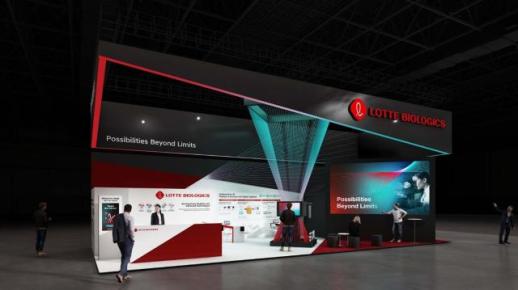 Lotte Biologics Highlights CDMO Capabilities at Bio International Convention 2026 Lotte Biologics announced on June 4 that it will participate in the 2026 Bio International Convention (BioUSA) in San Diego, California. BioUSA, organized by the Biotechnology Innovation Organization, is the largest global exhibition for the pharmaceutical and biotechnology industries, bringing together major pharmaceutical companies, investors, and research institutions to explore collaboration opportunities. Lotte Biologics has participated for five consecutive years since 2022. The company plans to facilitate discussions with global clients through a visitor exchange area and private meeting rooms. It will also conduct an "in-booth presentation" to showcase its vision and business capabilities, along with programs related to antibody-drug conjugates (ADCs). The in-booth presentations will take place three times during the event. On the first day, Lotte Biologics will introduce its development and production collaboration strategy with Asimov. The second day will feature a presentation on scale-up strategies based on computational fluid dynamics (CFD). The third day will focus on strategies for the digitalization of manufacturing processes to improve operational efficiency. This year’s exhibition booth will also display photos and videos of the first plant at the Songdo Bio Campus, which is set to be completed in August. The presentation will highlight the plant's production processes and facilities, emphasizing its commercial production capabilities. Previously, the company received the 2026 CDMO Leadership Awards, underscoring the quality and execution capabilities of its contract development and manufacturing organization (CDMO) services. A representative from Lotte Biologics stated, "We plan to enhance our global CDMO competitiveness based on the dual-site operations connecting Syracuse and Songdo."* This article has been translated by AI. 2026-06-04 14:03:00
 -
 Election Paper Shortage Undermines Trust in South Korea's Election Commission The shortage of ballot papers during the June 3 local elections is not merely an administrative error. It reflects a failure by the National Election Commission (NEC) to fulfill its fundamental responsibilities for ensuring the fairness and reliability of elections. The fact that voters had to wait for ballots at polling places, which should be the starting point of democracy, is shocking. In some polling stations in Seoul's Songpa, Gangnam, and Gwangjin districts, voters faced long waits due to insufficient ballots. Some locations extended voting hours until 10 p.m., leading to chaos as protesting citizens and YouTubers gathered at the scene. The NEC also delayed its voter turnout reporting. The commission later issued an apology and stated it would review its ballot printing standards. However, what the public wants to know is not just an apology but why this situation occurred. According to the NEC's internal guidelines, at least 50% of the number of registered voters should have ballots printed for local elections. The issue lies in the fact that some regional election commissions adhered strictly to this minimum standard. Notably, it has been reported that Songpa only printed ballots for 50% of its registered voters. The NEC explained that it conservatively estimated the quantity of ballots to minimize leftover ballots, citing concerns that excess ballots could lead to management burdens and issues of loss or leakage. However, this explanation lacks credibility. The primary value that an election management body should prioritize is not the reduction of leftover ballots but the assurance of voters' rights to participate in elections. If the concern over surplus ballots leads to a shortage of necessary ballots, then the priorities are fundamentally misplaced. More troubling is that this incident is not an isolated occurrence. During the 2022 presidential election, there was controversy over 'sock voting' involving COVID-19 patients. Last year's early presidential election saw absurd scenes where voters received ballots while eating and returning to cast their votes. The public demands not only political neutrality from the NEC but also its professionalism and stability. However, the recent recurring controversies raise doubts about whether the NEC is meeting these expectations. An even greater concern is the spread of conspiracy theories regarding election fraud. Our society has been grappling with serious social conflicts stemming from election disputes and conspiracy theories for several years. While this incident does not directly imply election fraud, the NEC's repeated mistakes provide new justifications for those who believe in such theories. An election management body that has lost the public's trust will find it difficult to persuade citizens, regardless of the explanations it offers. Elections are the heart of democracy. The reason the public accepts election results is that they trust the electoral process itself. When that trust is shaken, it becomes challenging to accept the outcomes. What is now needed is not merely a revision of guidelines. The NEC must thoroughly disclose why it applied only the minimum standards and who made those decisions. The standards for ballot printing, demand forecasting systems, and emergency supply chains must be comprehensively reviewed. Above all, those responsible for the repeated management failures must be held accountable. The most critical element that should never be in short supply during elections is ballot papers. The shortage of ballots is not just a matter of a few sheets of paper; it is a warning that public trust in democracy is eroding. If the NEC once again tries to evade responsibility or merely enhance the system, it will inevitably lead to greater distrust. The public is not demanding a perfect election; they are simply asking for the basics of common sense and fairness to be upheld. 2026-06-04 14:03:00
 -
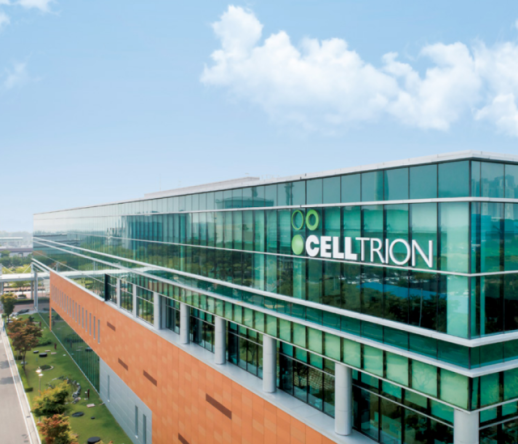 Celltrion Burns 100 Billion Won in Shares to Enhance Corporate Value Celltrion is stabilizing its stock price and increasing shareholder returns through share buybacks and cancellations. On June 4, Celltrion announced that the procedure for canceling shares worth approximately 100 billion won has been finalized through a listing change. A total of 489,977 shares have been canceled, reducing the total number of shares issued by Celltrion to about 221.63 million. This share cancellation is part of the company's plan to buy back and cancel shares worth around 100 billion won, which was recently disclosed. The company stated, "We expect that the reduction in the number of shares will lead to an improvement in earnings per share (EPS) and an increase in per-share value." In addition to the share cancellation, Celltrion is pursuing further shareholder return policies. The company has decided to buy back an additional 100 billion won worth of shares and is currently in the process of acquiring them. If these shares are canceled by the end of the year, the total amount of shares canceled this year is expected to reach about 2 trillion won. According to Celltrion, the cumulative amount of shares canceled over the past three years is approximately 18.56 million shares, accounting for about 8.4% of the current total shares issued. Celltrion is also rapidly implementing comprehensive market response measures announced last month. Currently, the company is conducting a free capital increase of about 10.92 million shares, along with stock purchases of 1 billion won each by the company and its largest shareholder, totaling 2 billion won. The company's performance is showing improvement. In the first quarter of this year, Celltrion recorded consolidated sales of 1.145 trillion won, a 36% increase compared to the same period last year. Operating profit surged by 115.5% to 321.9 billion won, achieving the highest quarterly performance to date. This growth is attributed to the expansion of high-profit biosimilar products and improvements in profitability, with analysts predicting even stronger growth in the second half of the year. Celltrion has set an annual sales target of 5.3 trillion won for this year, aiming to enter the '5 trillion club' after surpassing 4 trillion won in sales last year. The company and its largest shareholder are in the process of acquiring stocks worth a total of 2 billion won, and employees are also expected to participate in voluntary stock purchases through employee stock ownership plans. A Celltrion representative stated, "The continuous share cancellations and additional purchases reflect our confidence in our solid fundamentals and future growth. We will pursue both expanded shareholder returns and enhanced competitiveness in our core business to achieve sustainable growth and increase corporate value."* This article has been translated by AI. 2026-06-04 14:00:00
 -
 Baemin Launches Campaign with Veterans Affairs Ministry for June 'Month of National Defense' Baemin has organized a meaningful event to honor veterans. The company, operated by Woowa Brothers, announced on June 4 that it will collaborate with the Ministry of Veterans Affairs for a campaign in recognition of the 'Month of National Defense.' This campaign utilizes ideas selected from a public idea contest held by the Ministry of Veterans Affairs in March and April. Baemin aims to promote a culture of gratitude and respect for veterans through this event using its app. Until June 8, users can access content on the Baemin app that highlights the significance of the Month of National Defense and the importance of honoring veterans. Customers who share the link to this page will be eligible to receive Baemin coupons worth 5,000 won, with 400 coupons available daily on a first-come, first-served basis. Baemin stated that this initiative seeks to seamlessly connect daily life with the values of national defense and to foster a culture of remembering and appreciating the sacrifices made by veterans. Kim Joong-hyun, head of the Sustainable Management Division at Woowa Brothers, said, "We planned this campaign to share the values of honoring veterans with our customers during the Month of National Defense. We will continue to grow as a service that positively impacts the daily lives of citizens through various activities that realize social value." * This article has been translated by AI. 2026-06-04 14:00:00
 -
 Economic Bureaucrats Fail to Secure Local Leadership in Recent Elections In the recent local elections, candidates for regional leadership positions with backgrounds in the Ministry of Economy and Finance faced significant defeats, effectively diminishing the influence of economic bureaucrats in local governance. Analysts suggest that these candidates, who promoted their abilities in budget acquisition and central government networking, could not overcome the prevailing political winds favoring established parties. In the Jeju gubernatorial race, Moon Sung-yu of the People Power Party lost decisively to Lee Seong-gon of the Democratic Party. Moon, a former head of the Ministry of Economy and Finance's Planning and Coordination Office, as well as the Public Procurement Service and Korea Asset Management Corporation, highlighted his experience in budget and finance as his strengths in the campaign. However, the election results were unfavorable. According to final tallies, Lee secured 63.1% of the vote, while Moon garnered only 33.5%, marking a significant gap. Despite promoting his image as an 'economic governor' and budget expert, he was unable to reverse the Democratic Party's strong momentum. In the Jeonbuk gubernatorial election, Kim Kwan-young of the People Power Party also faced defeat. A former economic bureaucrat who entered politics after passing the administrative examination and working as a civil servant in the Ministry of Economy and Finance, Kim campaigned on his economic expertise and administrative experience but lost to Democratic Party candidate Lee Won-taek. The final vote difference was in the single-digit range, making it a relatively close contest in the history of Jeonbuk gubernatorial elections, but he could not overcome the party dynamics. As a result of this election, there are no newly elected regional leaders from the Ministry of Economy and Finance. In the 2022 local elections, Kim Dong-yeon, a former Deputy Prime Minister for Economy, was elected as the governor of Gyeonggi Province, maintaining the presence of economic bureaucrats in regional leadership, but that trend has now been broken. Political analysts suggest that the timing of this election, held shortly after the presidential election, meant that party support played a more significant role than individual candidate expertise. In particular, many candidates with backgrounds as current lawmakers won, indicating that local organizational strength and party affiliation were more decisive than experience in central government. In this election, Moon Sung-yu emphasized his ability to address local issues and secure national funding, while Kim Kwan-young highlighted his economic expertise and administrative experience. However, voter choices were more heavily influenced by party dynamics. The advantages of budget acquisition and central government networks that economic bureaucrats typically possess appeared to be less effective, while the Democratic Party's momentum and the advantages of incumbency played a significant role in the outcomes.* This article has been translated by AI. 2026-06-04 14:00:00
 -
 Korea Investment Corporation Opens Tokyo Office to Expand Alternative Investments The Korea Investment Corporation (KIC) is set to open an office in Tokyo to enhance its alternative investment strategies in Japan. This move aims to capitalize on opportunities arising from ongoing corporate governance reforms and business restructuring among Japanese companies. Bloomberg reported on June 4 that KIC plans to establish its Tokyo office in early July. This marks the first time the sovereign wealth fund, which manages assets worth $232 billion (approximately 355 trillion won), will have a dedicated base in Japan. The Tokyo office will be KIC's sixth overseas location, joining existing offices in New York, London, Singapore, Mumbai, and San Francisco. KIC cited significant changes in Japan's alternative investment market as a key reason for this expansion. KIC Chief Investment Officer Lee Hoon stated in a recent announcement, "The Japanese alternative investment market is undergoing a structural transformation, creating opportunities to acquire high-quality assets." As of the end of last year, alternative assets accounted for over 20% of KIC's total portfolio. The Tokyo office will not only focus on alternative investments but will also explore opportunities in traditional assets such as stocks and bonds. Lee added, "Corporate governance reforms and portfolio restructuring are underway in Japan, and we expect Japan to offer differentiated investment opportunities in Asia." KIC recorded an annual return of 13.9% last year. The opening of the Tokyo office is expected to enhance local asset discovery and investment networking in Japan. 2026-06-04 14:00:00