
Journalist

Pei Guangjiang
-
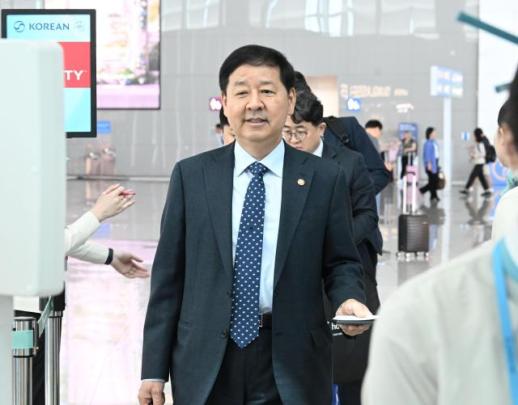 Finance chief Koo departs for Paris G7 meeting, London investment relations session SEOUL, May 18 (AJP) - Deputy Prime Minister and Minister of Economy and Finance Koo Yun-cheol departed on Sunday to attend the Group of Seven Finance Ministers and Central Bank Governors meeting and to host a South Korean economy investment relations session. Amid expanding volatility in international oil prices and exchange rates driven by the stalled dispute between the U.S. and Iran, the government plans to manage national creditworthiness through briefings for foreign investors and consultations with financial authorities of major nations. According to the Ministry of Economy and Finance, Koo will attend the G7 Finance Ministers and Central Bank Governors meeting in Paris, France, on Tuesday. The meeting will be attended by G7 member nations—including the United States, Japan, the United Kingdom, France, Germany, Italy, and Canada—alongside invited countries such as South Korea, India, Brazil, and Kenya, and leaders of major international organizations including the IMF, World Bank, OECD, and Financial Stability Board (FSB). Koo is also scheduled to hold bilateral meetings with British Chancellor of the Exchequer Rachel Reeves, Canadian Minister of Innovation, Science and Industry François-Philippe Champagne, and German Vice Chancellor and Minister of Finance Lars Klingbeil to discuss economic and financial cooperation. While South Korea is not a full member of the G7, it has been repeatedly invited to major multilateral economic meetings due to its supply chain stability and competitiveness in the semiconductor and AI industries. The government is also emphasizing that South Korea can serve as a "middle-power platform" bridging advanced and emerging economies. The upcoming meeting will primarily focus on global imbalances and the establishment of international partnerships. Recently, "global imbalances"—such as excessive surpluses in China and oil-producing nations and foreign exchange instability in emerging markets caused by dollar dominance—have re-emerged as key global economic issues. In his opening remarks, Koo plans to emphasize that the complex crises stemming from the prolonged Middle East conflict cannot be resolved by the efforts of a single country, while sharing South Korea’s emergency economic response plans and policies to boost domestic demand and investment. He will also present perspectives on major global issues from a middle-ground position connecting G7 members and emerging countries. Prior to the G7 schedule, Koo will host an investment presentation on the South Korean economy for major global investment institutions in London on Monday morning, local time. The government plans to explain the global competitiveness of the Korean economy, alongside core policy directions such as capital market advancement and the implementation of a hyper-innovative economy, while calling for active investment expansion in South Korea. The government has recently focused on improving accessibility for global investors through foreign exchange market structural reforms and capital market advancement policies. Representative examples include the extension of foreign exchange market operating hours, the reorganization of the short-selling system, and efforts for inclusion in the World Government Bond Index (WGBI) since April, as well as ongoing bids to join the Morgan Stanley Capital International (MSCI) Developed Markets (DM) Index. London is evaluated as one of Europe's largest financial hubs, where major global bond and foreign exchange investors are concentrated. Amid expanding volatility in global capital flows due to geopolitical risks in the Middle East and a strong dollar, the government appears focused on securing trust in the Korean market through direct contact with overseas investors. On the same day, Koo will hold individual meetings with top executives from major global financial firms, including HSBC and Schroders. The meetings will cover the current state of the global economy and international financial markets, alongside explanations of the South Korean government’s foreign exchange and capital market reform efforts and improvements to the investment environment. Koo will subsequently meet with European Bank for Reconstruction and Development (EBRD) President Odile Renaud-Basso to discuss development cooperation projects integrating artificial intelligence (AI) and support measures for developing nations. 2026-05-18 12:55:51
 -
 Putin to Visit China Days After Trump, Highlighting China's Growing Diplomatic Role Russian President Vladimir Putin will make a state visit to China from May 19 to 20, just four days after U.S. President Donald Trump’s visit. The Chinese state media outlet Global Times reported that it is highly unusual for a country to host both the U.S. and Russian leaders within a week, emphasizing China's rise as a center of global diplomacy. It is not just the U.S. and Russia. Following French President Emmanuel Macron's visit last December, British Prime Minister Keir Starmer also traveled to China earlier this year. Leaders of permanent members of the UN Security Council have increasingly visited Beijing in recent months. Global Times anticipates that China's influence in global governance will become more pronounced during the Asia-Pacific Economic Cooperation (APEC) summit scheduled for this fall. Li Haidong, a professor at the China Foreign Affairs University, noted that both the U.S. and Russia, which have been in prolonged conflict over issues like the Ukraine crisis and European security, are treating China as a 'must-visit' destination. He described it as symbolically significant for a single country to emerge as a key diplomatic platform for two major powers. Li added that the simultaneous engagement of leaders from four permanent UN Security Council members with China reflects a shared recognition of China's international standing. He stated that advancing major international agendas on key issues such as economic recovery, climate governance, nuclear non-proliferation, and regional security is challenging without China's involvement. This recognition also indicates that major powers view China as a stabilizing factor amid increasingly unstable global circumstances. In this context, Ray Dalio, founder of Bridgewater Associates, remarked on May 16 through Bloomberg that there is a growing belief among U.S. allies that the U.S. may not fully protect them in times of crisis. He interpreted the increasing number of leaders seeking relations with China as a form of 'tribute system,' acknowledging China's regional influence and power. Ahead of Putin's visit, Chinese state media mobilized to create a positive atmosphere. The People's Daily, the official newspaper of the Communist Party of China, stated on May 18 that "China-Russia relations are at their best in history," highlighting a model of great power relations characterized by enduring friendship, comprehensive strategic cooperation, and mutual benefits. The state-run Xinhua News Agency also emphasized in a commentary that "practical cooperation is the intrinsic driving force behind the stable development of China-Russia relations," noting that both countries have consistently collaborated across various fields despite a complex and rapidly changing international environment. During his two-day state visit, President Putin is expected to hold talks with President Xi Jinping, issue a joint statement, and sign multiple agreements between government departments and enterprises. There are expectations that the two countries will once again showcase their close strategic cooperation, contrasting with the lack of clear agreements reached by President Trump during his recent summit with Xi on key issues such as Iran, Taiwan, and trade disputes. Since taking office, President Putin has visited China more than 20 times and has met with Xi over 40 times, maintaining a close relationship. The last direct meeting between the two leaders occurred during the 80th anniversary military parade in Beijing last September, where they were joined by North Korean leader Kim Jong Un, showcasing their close ties at Tiananmen Square. On May 17, the day before Putin's visit, the 10th China-Russia Expo opened in Harbin, Heilongjiang Province. In a congratulatory message, Xi expressed hope that the deepening and practical cooperation between China and Russia would yield fruitful results, and he encouraged both countries to leverage their geographical proximity and complementary strengths to expand comprehensive practical cooperation. He emphasized the expectation that this would provide new momentum for the long-term development of the comprehensive strategic partnership between China and Russia, enhancing economic and social development and improving the welfare of their peoples.* This article has been translated by AI. 2026-05-18 12:55:33
 -
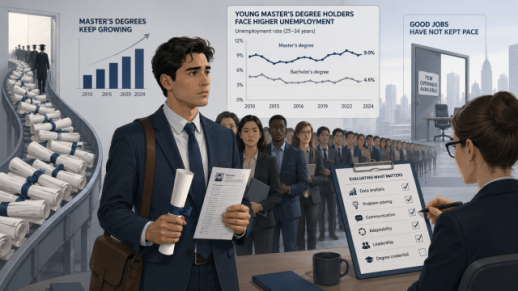 High Unemployment Rates Persist for U.S. Workers Under 35 with Master's Degrees The employment premium associated with master's degrees in the United States is diminishing. While the number of master's programs has rapidly increased, the quality job opportunities that these degrees were expected to provide have not kept pace. Companies are increasingly prioritizing practical skills over academic qualifications in their hiring processes. According to a report by the Wall Street Journal on May 17, labor market research firm Burning Glass Institute analyzed data from the U.S. Bureau of Labor Statistics (BLS) since 2003 and found that the unemployment rate for master's degree holders under 35 has reached one of its highest levels in the past two decades. In contrast, the unemployment rates for those with doctoral, law, or medical degrees in the same age group remain low. Gad Levanon, chief economist at Burning Glass Institute, attributed the weakening investment return of master's degrees to an oversupply of graduates compared to the available jobs. He noted that while employment trends for advanced degree holders used to move in tandem, a widening gap has emerged between master's and professional degrees. The supply of master's degrees has surged significantly. A report from the Center for Education and the Workforce indicates that the number of master's programs in the U.S. increased by 69% from 2005 to 2021, surpassing 33,500. In the past five years, there has been a rise in programs aimed at retraining for artificial intelligence (AI), including specialized one-year courses in online MBA, data science, and healthcare management. The disparity arises from how degrees function in the job market. Medical and law degrees often lead directly to licensure, while master's degrees serve more as a 'signal' of capability. As the number of master's degree holders increases, the rarity of this signal diminishes. Levanon stated, "A master's degree is no longer a guaranteed pathway to good jobs." In fact, the employment situation for master's degree holders under 35 has worsened compared to the average over the past 20 years. The Wall Street Journal reported that the unemployment rate for this group was only higher during specific periods, such as the COVID-19 pandemic and shortly after the 2008-2009 financial crisis. In the past year, the employment rate for those with associate degrees has been higher than that of master's degree holders. Corporate hiring attitudes are also shifting. A survey from Drexel University's LeBow College of Business found that over 40% of companies reported no plans to hire MBA graduates this year, a significant increase from 26.8% last year. Johnny Taylor Jr., president of the Society for Human Resource Management (SHRM), noted that the rise of AI has led companies to focus more directly on job performance capabilities rather than degrees. However, the utility of a master's degree has not completely vanished. Amir Zelcher, who is enrolled in the MBA program at Texas A&M University, is set to begin a full-time position at Texas Instruments this fall. He credited the school's career preparation program and support for interviews and salary negotiations as beneficial for his job search. The effectiveness of the degree now hinges more on the demand for the major, the school's career support, and actual job skills.* This article has been translated by AI. 2026-05-18 12:53:40
 -
 LG CNS Introduces Humanoid Robots at Curly's Logistics Center LG CNS is partnering with e-commerce company Curly to implement humanoid robots and enhance logistics automation at its centers. The collaboration aims to determine the types of robots and tasks suitable for the logistics environment through on-site suitability verification. On May 18, LG CNS announced the signing of a memorandum of understanding (MOU) for a proof of concept (PoC) for humanoid robots and logistics automation. The signing ceremony was attended by Curly Chief Operating Officer Heo Tae-young, LG CNS Executive Vice President Park Sang-kyun, and Executive Vice President Lee Jun-ho of the Smart Logistics and City Division, among other key executives from both companies. The agreement outlines plans to leverage Curly's logistics infrastructure to develop humanoid robot suitability verification, logistics intelligence solutions, and explore new business opportunities. Curly is enhancing its delivery services based on a retail tech-driven logistics infrastructure, expanding its offerings from fresh produce to beauty, fashion, and home goods. The humanoid robot PoC at Curly's logistics center is a central element of this partnership. Both companies will identify logistics tasks that can reduce worker burdens and improve safety through robot implementation. Additionally, they plan to verify the on-site suitability of LG CNS's robot learning and operation platform, 'Physical Works.' This will involve measuring and analyzing the robots' task accuracy, execution speed, and efficiency improvements compared to existing methods. LG CNS will integrate automation equipment and logistics operating systems at Curly's logistics center to streamline the entire logistics process from receiving to storage, picking, and shipping. Previously, LG CNS has worked on the construction of Curly's Gimpo integrated logistics center and Changwon logistics center, acquiring expertise in managing ambient, refrigerated, and frozen environments in one location, as well as logistics know-how for rapid delivery. Based on successful applications of humanoid robots in logistics centers, both companies plan to jointly explore new business opportunities and advance next-generation logistics intelligence driven by robotics. Industry experts predict that by 2030, 25% of the global humanoid robot deployment will focus on logistics and warehousing, making logistics centers a key battleground for the robotics industry. Recently, LG CNS unveiled its RX platform, 'Physical Works,' designed for real industrial applications. This platform enables quadrupedal robots, wheeled robots, and autonomous mobile robots (AMRs) to operate independently and collaborate effectively. Notably, demonstrations showed humanoid robots picking plastic bags off boxes on conveyor belts and passing them to quadrupedal robots for transport. Given that Curly's logistics center is expected to have a similar environment, the collaboration between Curly and LG CNS is anticipated to catalyze the growth of the domestic logistics robotics commercialization industry. Heo Tae-young, Curly's COO, stated, "Curly is accumulating vast amounts of data from our logistics operations and leveraging data and artificial intelligence (AI) to enhance efficiency. We hope to achieve innovation in logistics by connecting LG CNS's physical AI technology with our operational data." Park Sang-kyun, Executive Vice President of LG CNS, remarked, "The combination of Curly's logistics operational expertise and LG CNS's technological capabilities can create significant synergies in the field of logistics automation. Through this collaboration, we aim to develop innovation technologies centered on the field."* This article has been translated by AI. 2026-05-18 12:51:05
 -
 Samsung's Micro RGB TV Receives Perfect Score in UK Reviews Samsung Electronics' new Micro RGB TV is receiving widespread acclaim from major IT media outlets in the UK and the US. On May 18, reports indicated that the UK IT publication Trusted Reviews awarded Samsung's Micro RGB TV a perfect score of 5 out of 5, designating it as a 'Highly Recommended' product. The publication praised the TV for its "unmatched color reproduction and excellent brightness," highlighting its impressive performance in the accurate filmmaker mode that passed HDR testing. It also commended the 4K upscaling feature powered by the 'Micro RGB AI Processor,' which delivers exceptional detail and clarity without screen noise. Another UK IT outlet, Expert Reviews, named the new product a 'Best Buy,' noting that its glare-free feature effectively reduces light reflection, enhancing viewing experiences, especially in dark environments. In the US, tech media outlet TechAeris praised the TV as a product that maximizes the home theater experience, offering overwhelming color, powerful HDR, and various gaming features, making it highly recommended for consumers who prioritize color and performance. Targeting the ultra-premium TV market, Samsung Electronics continues to expand its Micro LED lineup. Following the introduction of the world's first 115-inch Micro LED TV last year, the company has diversified its offerings this year with six models, including 55, 66, 75, 85, and 100 inches, significantly broadening consumer choices. Notably, the new 'R95H' model features the 'Micro RGB AI Processor,' which analyzes scenes in real-time and categorizes color tones to deliver vivid picture quality. It also supports the 'Micro RGB Color Booster Pro' and 'Micro RGB HDR Pro' functions, which finely adjust colors and contrasts for clear visuals in any lighting condition.* This article has been translated by AI. 2026-05-18 12:50:17
 -
 Gwangju Must Embrace Forgiveness and Reconciliation, 5.18 Movement Commemoration Says The 46th anniversary of the May 18 Democratic Movement was commemorated once again in Gwangju, at Geumnam-ro and in front of the former Jeonnam Provincial Office. Forty-six years have passed since the tragic events of May 18. This movement is no longer just a source of pain for a specific region or a political controversy. It has become the root of democracy in South Korea and a historical account of the people's resistance to state violence in defense of human dignity and freedom. However, history is not completed by memory alone. The true completion of history lies in reconciliation and forgiveness. The tragedy of Gwangju is not yet fully resolved. The wounds of the victims' families remain fresh, and those who held power at the time have yet to fully confront their responsibilities before history. What South Korea needs now is not another cycle of hatred or political exploitation, but a sincere repentance and a commitment to restore human dignity. This symbolic journey must begin with a heartfelt apology from those responsible for the violence. In particular, the families of former President Chun Doo-hwan and other key figures from that era should eventually visit Gwangju together. This is not about a political event; it requires a humble acknowledgment of the historical wounds as human beings. Paying respects at the National May 18 Democratic Cemetery and apologizing before the spirits of the victims is not merely about addressing the past. It can serve as a historical consciousness for South Korea to break the cycle of hatred and move toward becoming a mature democratic nation. At the same time, the families of the victims and civil society in Gwangju must also contemplate a greater commitment. This is not about forgetting but about forgiving. Forgiveness without truth is hollow, but a history without forgiveness makes it difficult to move forward. Ultimately, the ultimate goal of democracy is not revenge but the restoration of the dignity of human life. The great scriptures of humanity have all taught the dignity of life and reconciliation. The Bible says, “Love your enemies.” “Those who live by the sword will die by the sword.” The Dhammapada teaches, “Hatred cannot be overcome by hatred; only love can do that.” In the Analects, Confucius states, “One must overcome resentment with virtue.” The Tao Te Ching also says, “The strong do not last, but the gentle ultimately prevail.” In the end, the great spirit of human civilization converges into one. Power that disregards human life does not endure, and history ultimately sides with those who sought to protect life. In this regard, the tragedy of May 1980 stands as one of the greatest lessons in modern Korean history. The moment state power treats the lives of its citizens lightly, it loses its legitimacy. The fundamental purpose of politics is not to maintain power but to protect human life and uphold the dignity of the people. Thus, May 18 is not merely a democratic movement but also a 'history of respecting life.' Even amidst gunfire, citizens tried to save one another, shared rice balls, and lined up in front of blood donation vehicles for the injured. The essence of Gwangju was not hatred but humanity. Today, South Korea stands once again at a crucial crossroads. Political polarization has reached extremes, and language that defines each other as enemies is rampant. However, if Gwangju is truly the sacred ground of South Korean democracy, it must now move beyond the memories of hatred to embrace the spirit of reconciliation and forgiveness. Of course, this is not an easy task. Reconciliation without a genuine apology can become hypocrisy. Therefore, what is first needed is the sincerity of those responsible for the violence. It must not be a mere show of respect or a formal apology; it should be a humble kneeling before the sanctity of human life. Only when the families of the victims and the citizens of Gwangju can make a historic, grand decision on this foundation will South Korea finally be recorded as a nation that has completely overcome May 18. Even Chun Doo-hwan, a former president who once dominated an era, is said to remain unburied, existing only in a state of ashes. This is not just a personal tragedy; it symbolizes the fate of power that disregarded human life throughout history. Hatred begets more hatred. However, forgiveness ends the cycle of historical evil. The May of Gwangju now poses a higher question to South Korea: Can we truly transcend hatred? Can we build a new community on the dignity of human life? Only at the end of that path will May 18 be truly completed as the spirit of South Korea.* This article has been translated by AI. 2026-05-18 12:47:05
 -
 Song Eon-seok Calls for Public Support to Check Government's Power Song Eon-seok, the floor leader of the People Power Party, urged the public on May 18 to fill the gaps in the party's ability to check the government's and ruling party's overreach. During a press conference at the National Assembly, he stated, "The June 3 local elections are crucial for curbing the dangerous regime of Lee Jae-myung and the unstable dominance of the Democratic Party. The choice to prevent the cancellation of charges and tax burdens, as well as to stop labor strikes, is the People Power Party." He highlighted legislative actions taken by the government and ruling party over the past year, including the three broadcasting laws, the Yellow Envelope Act (revised labor union law), and the three judicial laws. He emphasized, "Now they are mobilizing state power to cancel charges against a single president's crime. Only a strong warning from the public can stop this government overreach." Previously, the Democratic Party proposed a special prosecutor bill on April 30 to investigate allegations of manipulated investigations and prosecutions by the Yoon Suk-yeol administration. According to the bill, the special prosecutor can take over cases specified in the law, including the Ssangbangwool North Korea remittance case and allegations of corruption in the Daejang-dong, Wirye, and Baekhyeon-dong development projects, and decide whether to prosecute or maintain charges. The opposition coalition has strongly opposed granting the special prosecutor the authority to decide on maintaining charges, labeling it a "charge cancellation special prosecutor" and claiming it aims to cancel charges against President Lee Jae-myung, who is a suspect in the case. They view this special prosecutor as an infringement on judicial independence. Song further criticized the Democratic Party for nominating incompetent and unqualified candidates in various local government elections, stating, "We must judge the arrogance of the Democratic Party for nominating such individuals in this election. If you believe the country is in danger and the future is uncertain, please join the People Power Party." He also commented on recent polling showing a rebound in support, urging candidates to approach the election with confidence and sincerity. He said, "Although we are still lacking, I believe that with this attitude, a 'golden cross' is possible."* This article has been translated by AI. 2026-05-18 12:45:05
 -
 Kim Sang-wook: Ulsan Mayoral Race Expected to Be a Three-Way Contest Kim Sang-wook, the Democratic Party's candidate for Ulsan mayor, stated on May 18 that candidates from the pro-democracy camp share a common purpose and emphasized that the issue of unification is not about personal ambition. During an appearance on KBS Radio's current affairs program, Kim responded to questions about the unification process, saying, "We must not allow the remnants of the December 3 coup to extend the rule of the People Power Party's local government." He added, "Setting aside personal interests for a moment, the discussions aimed at unifying our efforts have been the driving force behind this process. We will continue to work towards unification with this strength." A public opinion poll regarding unification between Kim and Kim Jong-hoon, the Progressive Party's candidate, will be conducted over two days from May 23 to 24. Kim noted, "The polls for local leaders have already begun, and we have agreed on a specific schedule that prioritizes the mayoral race, followed by the provincial council elections. We expect to present the results of the mayoral candidate unification to the public around May 25 or 26." Earlier, on May 14, Kim announced a unification agreement with candidate Hwang Myung-pil. He stated, "I suggested that Hwang Myung-pil of the Justice Reform Party and Kim Jong-hoon of the Progressive Party join forces for campaign activities, and they agreed. We will present our policies, direction, and commitments to the citizens, demonstrating our unity." Regarding the possibility of unification between Kim Du-gyeom of the People Power Party and independent candidate Park Maeng-woo, Kim assessed that it is fundamentally difficult. He explained, "Park is running for the sake of addressing issues with the current administration and normalizing the People Power Party, rather than for personal gain. A poorly executed unification would undermine his justification for running." He further stated, "A mid-campaign unification would lack legitimacy," predicting that the Ulsan mayoral election will likely be a three-way contest. Kim acknowledged that there are many variables in competing against these candidates, noting, "Ulsan is a place where the vested interests of the People Power Party operate strongly, so the last-minute mobilization of their supporters is significant. Local newspapers and other regional influences also create many variables."* This article has been translated by AI. 2026-05-18 12:43:40
 -
 Park Chan-wook Receives France's Prestigious Cultural Honor France takes immense pride in its cultural heritage, and it is rare for the nation to award its highest cultural honor to a foreign artist. Director Park Chan-wook has received this prestigious accolade, making him only the fourth Korean to do so. Since the early 2000s, the French cultural community has shown a special affection for Park, often referring to him as "Cannes Park". This recognition, however, carries significant weight as it reflects a diplomatic achievement acknowledging South Korea's cultural depth, which meets the stringent standards of Western mainstream society. This award should not be dismissed as merely a reflection of the success of K-movies or the trend of K-culture. It signifies a rise in the status of South Korea, moving beyond an era where economic growth and export figures defined its advancement. Now, culture and the arts, which encapsulate a nation's philosophy and ideals, represent its true maturity. South Korea, once a passive recipient of Western culture, has now established itself as a source of inspiration and philosophical discourse. Despite the abundance of cinematic giants worldwide, France's enthusiasm for Park Chan-wook is clear. His work exemplifies the pinnacle of "auteur theory," which the French film critics hold in high regard. After winning the Jury Prize at the Cannes Film Festival in 2004 for "Oldboy," Park has consistently pushed boundaries with films like "Thirst," "The Handmaiden," and "Decision to Leave," never resorting to complacent self-replication. Park's lens delves into the darker aspects of humanity, exploring themes of desire, sin, and redemption. He masterfully controls provocative subjects with stunning visuals while posing philosophical questions, satisfying the French intellectual appetite for cinema as both art and philosophy. His unique ability to present universal aesthetics wrapped in Korean sentiment has elevated him to the ranks of cinematic masters. His meticulous craftsmanship and perfectionism, which do not falter in the face of Hollywood's vast resources, have garnered respect even from the most discerning sectors of Western cinema. The significance of this award diverges sharply from the commercial success of K-pop idols or dramas. While global streaming services have expanded the reach of Korean content, the steadfastness of auteur directors like Park strengthens the foundation and sustainability of K-culture. The industrial power that generates hundreds of millions in revenue from single projects and attracts millions of global fans is crucial, but the respect for a nation's philosophy and aesthetics in the global arena is paramount. A single well-crafted artwork or a masterful creator can wield more influence than dozens of diplomats. This recognition is a vital component of South Korea's soft power, underscoring the need to view culture not merely as a revenue source but as a measure of national dignity. Well-honed cultural assets transcend generations, and their value increases over time. However, it is essential not to become complacent in the glory of this honor. The current reality of the Korean film industry is sobering. The sector is experiencing a severe downturn, with skyrocketing ticket prices and fierce competition from global streaming platforms leading to a stark polarization of the box office. Even major productions with budgets in the hundreds of millions are struggling, and investment capital is rapidly drying up. In a market dominated by strict financial logic, the proliferation of formulaic films reliant on safe box office strategies and star casting is stifling creative diversity. In such a homogenized system, the emergence of a "second Park Chan-wook" seems uncertain. Independent and artistic films from emerging directors, which should present fresh perspectives and provocative narratives, are often unable to secure screening opportunities, depriving them of audiences. The birth of a cinematic master is not solely the result of individual genius. A supportive environment that allows for seemingly reckless experimentation and enables emerging creators to recover from painful failures is essential. Effective government support for creative endeavors, expansion of seed funds, and industry-wide efforts to reform the monopolistic structure of screens are more urgent than ever. France's tribute to Park Chan-wook serves as a painful reminder of our own neglect of a precarious ecosystem. If we fail to confront the deep shadows hidden behind the bright spotlight, the golden age of Korean cinema may fade into mere past glory. Transforming the weight of this honor into a catalyst for industry-wide reform is the true challenge that lies ahead.* This article has been translated by AI. 2026-05-18 12:41:36
 -
 Jung Cheong-rae Calls for Judgment of Insurrection Forces in Upcoming Local Elections Jung Cheong-rae, leader of the Democratic Party, emphasized on May 18 that the upcoming local elections must serve as a judgment against insurrection forces that threaten constitutional order. He expressed his determination to restore democracy during the 46th anniversary of the May 18 Democratization Movement. Speaking at a central election campaign committee meeting in Gwangju, Jung stated, "Without the experience of the May 18 Democratization Movement, there would be no current South Korea. The Lee Jae-myung administration and the Democratic Party will do our utmost to bear the historical weight and responsibility." He pledged to write a victorious history that judges the insurrection forces and restores democracy in the local elections. Jung further noted, "If it weren't for the May 18 Democratization Movement, we would not have been able to prevent the December 3 martial law." He highlighted the historical significance of the May 18 movement. He explained, "During the December 3 martial law and insurrection, if the current constitution had not existed, we would not have been able to prevent the martial law. The democratic struggle of 1987, which created that constitution, was possible because of the May 18 Democratization Movement." Jung added, "The strength that allowed us to overcome the current December 3 martial law and insurrection comes from Gwangju in May 1980. We are alive today thanks to the spirits of Gwangju." Additionally, the Democratic Party hinted at plans to reintroduce a constitutional amendment to include the spirit of the May 18 movement, which was recently blocked by opposition from the People Power Party. Jung expressed, "I deeply apologize for not being able to include the spirit of May 18 in the preamble of the constitution. Including the spirit of May 18 in the constitution is the aspiration of the majority of the people who defended democracy. We will do our utmost until the end." Han Byeong-do, the floor leader, also stated, "The Democratic Party wanted to include the spirit of the May 18 movement in the preamble of the constitution, but it could not be realized due to opposition from the People Power Party. I promise before the spirits of May that the Democratic Party will promptly reintroduce the constitutional amendment to ensure that the spirit of May 18 is included in the preamble of the constitution."* This article has been translated by AI. 2026-05-18 12:39:31