

Journalist

Salih Murat Tamer
-
 Korea's K-Tech Demo Day Held in New York to Boost U.S. Market Entry for SMEs The Korea SMEs and Startups Agency is enhancing financial support for small and medium-sized enterprises (SMEs) entering the U.S. market. On June 2, the agency held the "K-Tech Demo Day" in Manhattan, New York, showcasing 12 domestic tech service SMEs. The event attracted over 200 attendees, including representatives from global venture capital firms and investment banks such as Third Prime and JPMorgan Chase, as well as officials from the New York City Economic Development Corporation, the New Jersey Economic Development Authority, and the Brooklyn Chamber of Commerce. The morning session featured investment presentations (IR pitching) from the 12 startups, along with one-on-one investment consultations. The afternoon included discussions on local government support policies for businesses, financial support programs from local banks, strategies for attracting U.S. venture capital investment, and a panel discussion featuring Korean entrepreneurs in the K-beauty, food, and tech sectors. Earlier this year, in January, the agency opened the "K-Startup Center Silicon Valley" to assist domestic startups in expanding into the U.S. market and increasing exports. Park Il-cheol, a commercial attaché at the Korean Consulate General in New York, stated in his remarks, "Our overseas missions and local public institutions are working as a united team to actively support the entry of our SMEs into the U.S. market. I will ensure that this event serves as a successful example of our government's support for the global expansion of SMEs through collaborative efforts." Park Jang-hyuk, the agency's global growth director, emphasized, "This event is focused on providing practical assistance for attracting U.S. venture capital investment for promising domestic tech service SMEs. We will continue to strengthen connections with local investors, banks, and government agencies to expand financial support for domestic companies entering the U.S. market."* This article has been translated by AI. 2026-06-04 17:18:00
 -
 Baekdabang Launches Two New Baumkuchen Flavors Filled with Cheese and Custard Cream Daebong Korea's coffee brand Baekdabang has introduced two new dessert items, the 'Cheese Holic Baumkuchen' and 'Custard Holic Baumkuchen,' filled with cheese and custard cream, respectively. On June 4, Baekdabang announced the launch of these new flavors, which follow the previously released 'Choco Holic Baumkuchen.' The 'Cheese Holic Baumkuchen' features a rich cheese cream filling that delivers a savory and sweet flavor, while the 'Custard Holic Baumkuchen' is filled with smooth and sweet custard cream, emphasizing a creamy taste. The new products will be available at Baekdabang locations nationwide, excluding some stores, as well as at Baekdabang's Bakery Research Institute. Baekdabang has been accelerating its dessert menu expansion recently. Following the launch of 'Choco Churros Chewy Balls' and 'Corn Chewy Balls' last month, the introduction of the Baumkuchen products further broadens its dessert offerings. A Baekdabang representative stated, "We introduced these new products to expand our dessert menu that pairs well with coffee. We will continue to enhance customer satisfaction through a diverse dessert lineup."* This article has been translated by AI. 2026-06-04 17:18:00
 -
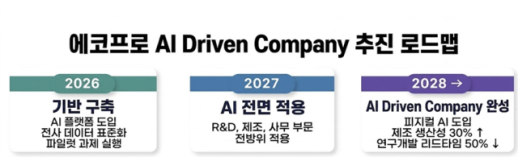 EcoPro Launches Comprehensive AI Initiative Ahead of 30th Anniversary EcoPro has announced its commitment to a company-wide initiative called "AX (AI Transformation)," aiming to integrate artificial intelligence (AI) across all sectors by its 30th anniversary in 2028. On June 4, EcoPro stated that it plans to go beyond using AI as a mere work assistant, applying it comprehensively in manufacturing and research and development (R&D) to drive significant innovation. Notably, the company's Hungarian subsidiary, EcoPro BM, aims to enhance productivity through the introduction of AI-based robotics for operational automation. EcoPro intends to implement a "three-phase roadmap" to become an AI-driven enterprise, leveraging partnerships with leading AI consulting firms. According to the AX three-phase roadmap, EcoPro will establish the foundation for AX this year through company-wide data standardization and pilot projects. Building on this, the company plans to scale up operations next year, with the goal of becoming an AI-driven company by 2028, where AI will facilitate 24/7 operations across all domestic and international subsidiaries. Initially, EcoPro will integrate AI into its R&D sector, aiming to reduce the lead time from R&D to mass production by 50%. Previously, the timeline for product planning to mass production took at least three to five years, but the company plans to cut this duration in half using AI. The introduction of "Physical AI" will also be pursued, with plans to establish autonomous manufacturing plants and laboratories. This implementation is expected to allow robots to take over hazardous tasks, creating a continuous operation and experimentation system that functions 24/7 throughout the year. The production sites will also integrate AI operational systems. The current reliance on workers' experience and intuition will shift to an "AI autonomous control environment" utilizing a manufacturing data platform and machine learning. EcoPro aims to enhance operational efficiency and manufacturing productivity by 30% through the establishment of an "AI autonomous control mother line" in precursor and cathode material calcination lines. AI is expected to analyze and predict defect causes with 95% accuracy and reduce energy consumption by approximately 15-20% through a data-driven predictive maintenance system. Lee Soo-ho, Vice President of EcoPro's AI Innovation Office, stated, "Beyond innovating traditional manufacturing methods, collaboration with AI is now essential. We plan to create an environment where employees can naturally utilize AI as a colleague, thereby improving operational efficiency across the board." Meanwhile, EcoPro BM plans to commence full-scale production at its Debrecen plant in Hungary during the first half of the year. This move aims to directly address the tightening regional regulations, such as the EU Critical Raw Materials Act (CRMA), while strengthening its supply chain and securing new clients among European original equipment manufacturers (OEMs).* This article has been translated by AI. 2026-06-04 17:12:00
 -
 Kyochon F&B Launches Summer Market Popup at Shinsegae Department Store in Daegu Kyochon F&B will host a popup store at the Shinsegae Department Store in Daegu, showcasing its food and beverage brands, including chicken, craft beer, and makgeolli. The popup store, themed 'Summer Market,' will run from June 5 to June 11 on the first basement floor of the Shinsegae Department Store's food hall. This event features a modern reinterpretation of the atmosphere of traditional markets and taverns. Visitors will have the opportunity to sample a variety of Kyochon products, including chicken, makgeolli, craft beer, sauces, and vinegars. Kyochon F&B is expanding its business beyond chicken to include traditional liquors, fermented products, craft beer, and sauces. Participating brands in this event include Kyochon Chicken, craft beer brand Moon Bear, traditional liquor and fermented products brand Fermentation Workshop 1991, sauce specialist BHNBIO, and K&P Food, which produces fermented vinegar and pickled radishes. The event will also feature a set menu that includes Kyochon Chicken's popular side dishes, such as 'Spicy Rice Cake Soup' and 'Wedge Potatoes,' along with boneless chicken. Limited-time menu items like 'Cheongyu Boneless Chicken' and 'Chili and Nacho Boneless Chicken,' which received positive feedback at the popup in April at Hyundai Department Store in Pangyo, will also be available again. Alcoholic beverages will also be offered. Moon Bear will provide craft beer packages and wine beer packages, while Fermentation Workshop 1991 will sell its 'Galaxy' series, 'Galaxy Starry Night,' and APEC set. Additionally, various products showcasing Kyochon’s food culture, including Fermentation Workshop 1991's fermented product sets, BHNBIO's sauce sets, and K&P Food's fermented vinegar, will be available for tasting and purchase at the venue. Following the success of the popup at Hyundai Department Store in Pangyo, which drew long lines, Kyochon F&B plans to further expand customer engagement through this event. The previous popup featured popular pairings like Kyochon boneless chicken with Fermentation Workshop 1991's 'Galaxy Makgeolli,' as well as limited-time menu items that sold out quickly. A Kyochon F&B representative stated, "This popup store is designed to allow customers to experience Kyochon’s diverse flavors in a unique market setting within a department store. We will continue to expand opportunities for customers to engage with various brands and food cultures."* This article has been translated by AI. 2026-06-04 17:09:00
 -
 Choi Seung-ho: Government Would Intervene in Samsung Strike Within 30 Minutes Choi Seung-ho, chairman of the Samsung Electronics Inter-Company Labor Union, is facing criticism for failing to take responsibility following the recent wage negotiation agreement. Concerns have been raised that he is attributing internal dissatisfaction with the agreement to "government pressure" while avoiding resolution of conflicts with the DX division. On June 4, industry sources reported that Choi stated in a recent internal message, "If there is a strike, the government will intervene within 30 minutes, and adjustments reflecting operating profits will be impossible." This suggests that the potential for urgent government intervention influenced the union's decision to accept the provisional wage agreement for 2026. Regarding the postponement of performance bonuses for loss-making divisions, Choi noted, "We provisionally agreed that a one-year delay is the bottom line for the Joint Action Headquarters." He added, "I would like to provide more explanation about the provisional agreement, but I was asked if this could be done within a day." This explanation appears to be a response to internal backlash against the agreement. While a special performance bonus linked to operating profits was established for the DS division, limited compensation was applied to the DX division and some other organizations, leading to increased dissatisfaction within the union. Choi cited potential government intervention and the judgment of the Joint Action Headquarters as reasons for not pushing for stronger demands. However, Choi's use of the term "government intervention" suggests that he was indicating the possibility of the government stopping a strike through urgent mediation, which could lead to arbitration by the Central Labor Relations Commission. Although the mandatory mediation system previously applied uniformly to essential public services has been abolished, the current law still allows for arbitration procedures following urgent mediation. Choi also addressed internal communication, stating, "I will ensure that this does not happen in the future." He mentioned that he would provide additional comments during the staff farewell ceremony, effectively acknowledging that there was insufficient explanation and feedback during the agreement process. The approach to the conflict between the DS and DX divisions has also sparked controversy. After the agreement passed, Choi mentioned the possibility of negotiating separately for DS and DX and proposed a leadership structure of five members from DS and three from DX. While this is framed as a way to reflect the interests of each division, it may be perceived as an attempt to maintain DS-centric outcomes while sidelining DX concerns. Currently, the employee ratio between Samsung Electronics' DS and DX divisions is approximately 60 to 40. However, a five-to-three structure would increase the DS representation to 62.5%. By reducing the overall size of the leadership and limiting DX's representation to three members, the decision-making influence of DX would inevitably diminish. This raises concerns that the proposal may not be a balanced approach but rather a fixed advantage for DS. Choi stated, "We plan to facilitate communication of opinions by organizing staff members by division." However, after drawing lines between DS and DX, the response to DX's backlash appears to be a move towards separation, which has been criticized as lacking integrated leadership. Critics argue that the union chairman, who should mediate conflicts, is instead institutionalizing the conflict structure. The upcoming reappointment general meeting scheduled for June 17 is also a variable. Choi has expressed his intention to seek evaluation from union members, but there are mixed opinions internally about whether the reappointment process is a mechanism for accountability or a political maneuver to maintain his position. Some interpret this as an attempt to reaffirm leadership based on support from the DS division amid the divided interests of DS and DX. Choi's statement that he plans to establish a delegate system starting in 2027 also appears to be a reactive measure. Concerns have been raised through media reports about the lack of internal checks, such as a delegate council, in the operation of the Samsung Electronics union. The decision to introduce a delegate system is seen as a response to these criticisms. However, setting the implementation date for next year suggests an intention to avoid immediate accountability regarding the current agreement and the reappointment process. An industry insider remarked, "Even if there was government pressure, the responsibility for the agreement lies with the union leadership. While separating DS and DX may disperse dissatisfaction in the short term, it could further divide the internal union at Samsung Electronics in the long run."* This article has been translated by AI. 2026-06-04 17:06:00
 -
 Jokuk Resigns as Party Leader After Election Defeat, Takes Responsibility Jokuk, the leader of the Jokuk Innovation Party, announced on June 4 that he would resign from his position following his defeat in the Pyeongtaek by-election. He stated, "I will step down as party leader, taking responsibility for the election results." However, he left open the possibility of re-election, saying he would reflect and prepare for the future. In a Facebook post, Jokuk said, "I will take a moment to pause, but I urge my fellow party members to move forward confidently. I am resigning as party leader today due to the election results." He attributed the election outcome to his shortcomings, stating, "I was unable to open a new path of hope for the dedicated party members who have devoted themselves under the name of the Innovation Party." Jokuk expressed concern about divisions within the broader democratic camp, yet emphasized, "The fact that the Innovation Party remains the third-largest party in the National Assembly has not changed. I urge the new leadership to strengthen the DNA of the Innovation Party even more." He added, "Please ensure a definitive conclusion to the urgent task of prosecutorial reform. Respect each other and unite to walk the path of social reform without wavering. I, too, will reflect on myself and prepare for what comes next." Previously, Jokuk aimed to secure a seat in the National Assembly through the Pyeongtaek by-election. However, he finished third, behind Yoo Yi-dong of the People Power Party and Kim Yong-nam of the Democratic Party, effectively ending his hopes of returning to the legislature. Jokuk was elected as party leader during the second national party convention held on November 23 last year in Cheongju, Chungbuk, marking the beginning of his term.* This article has been translated by AI. 2026-06-04 17:06:00
 -
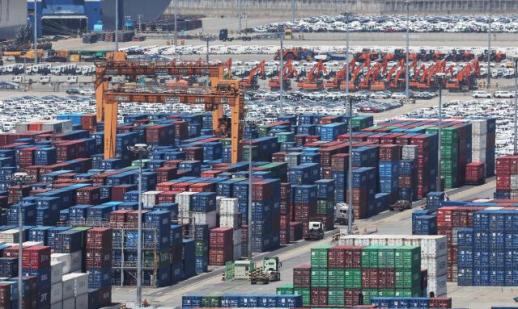 U.S. Tariff Burden on South Korean Companies Drops from 3rd to 6th Place South Korea's ranking in effective tariff rates on exports to the United States has improved since the announcement of the U.S. reciprocal tariff policy in April of last year. In the second quarter of 2025, South Korea ranked third among the top 10 exporting countries to the U.S., but this dropped to sixth place in the first quarter of this year, indicating a reduction in tariff burden. The effective tariff rate is calculated by dividing the tariff amount by the U.S. import value. According to an analysis of customs statistics by the Korea Chamber of Commerce and Industry (KCCI) on June 4, South Korea's exports to the U.S. in the first quarter of this year totaled $36.74 billion, with a tariff amount of $3.2 billion and an effective tariff rate of 8.7%. This rate is significantly lower than China's 26.4%. South Korea ranks sixth among the top 10 exporting countries to the U.S., following India (14.1%), Japan (11.2%), Germany (10.3%), and Vietnam (9.9%). In the first quarter of this year, South Korea's tariff amount on exports to the U.S. was $3.2 billion, placing it seventh among the top 10 exporting countries. The implementation of a 10% general tariff on U.S. imports in April last year and item-specific tariffs on automobiles and parts (25%) and steel and aluminum (50%) peaked in the third quarter. However, following the conclusion of tariff negotiations between South Korea and the U.S. and a reduction in automobile tariffs to 15% in November last year, the burden has decreased. Compared to China, which recorded a tariff amount of $16.58 billion on exports to the U.S., South Korea's performance appears relatively favorable. The effective tariff rate for the automobile sector, which has the highest proportion of tariff amounts among export items, fell significantly from 21.3% in the second quarter of last year to 13.5% in the first quarter of this year. Conversely, the effective tariff rate for steel and steel products, which has the second-highest tariff amount, increased to 42.5% in the first quarter of this year due to the implementation of a 50% item-specific tariff in June last year. In terms of automobile tariffs, South Korea experienced a delay in the application of reductions compared to Germany and Japan. As a result, in the fourth quarter of last year, the gap widened with Germany and Japan, but by the first quarter of this year, South Korea's rate was higher than Japan's (12.5%) but lower than Germany's (14.5%). Regarding steel tariffs, South Korea's low export proportion of raw materials such as pig iron and ferroalloy to the U.S. (only 2%) has resulted in high rates. In contrast, Brazil has a lower effective tariff rate of 20%, attributed to its 52% share of pig iron and ferroalloy in U.S. steel exports, which benefits from lower rates. While it is true that South Korea's tariff burden has eased, uncertainties remain due to the potential for changes in U.S. tariff policy and the still high steel tariff rates. The KCCI stated, "Close monitoring of Section 232 tariff measures related to key export items such as semiconductors is necessary, along with ongoing diplomatic support from the government to resolve tariff uncertainties." It also emphasized the need for policy support to protect domestic production bases and maintain competitiveness in the global market, stating, "Support to enhance our companies' price competitiveness, such as domestic production tax credits and strengthened export financing, should continue, alongside efforts to enhance capabilities through AI transformation in manufacturing over the medium to long term."* This article has been translated by AI. 2026-06-04 17:03:00
 -
 Everland Hosts 'Football and Taco' Event Amid Rose Festival Everland, operated by Samsung C&T's resort division, is welcoming visitors this June with an exciting soccer event titled 'Football and Taco' alongside its stunning Rose Festival featuring 3 million blooming roses. On June 4, Everland announced that it has chosen soccer as the theme for the sixth installment of its monthly special project, the 'Whatever Series.' This initiative offers guests unique experiences each month. At the festival content zone in front of Everland's Alpine Village, a 'Football Training Camp' has opened, allowing participants to complete training missions and earn rewards. Guests can engage in position-specific missions for forwards, goalkeepers, and midfielders, as well as additional bingo challenges to record their scores. Based on their total points, participants can receive prizes such as Amazon Express Q-Passes, cheering tools, and soccer merchandise. A special program where guests can experience actual soccer skills is also available. Every Friday and Saturday, elementary school students can learn techniques from freestyle soccer experts Lee Hyun-yong and Park Jin-seok of the 'Lycats Crew.' From Wednesday to Sunday, a recreational event called 'High-Intensity Training with Coaches' will take place. Photo zones reminiscent of soccer fields and training camps will be set up throughout the area. A special photo opportunity featuring the character 'Jack' dressed in soccer-themed attire will also be available. Collaborative merchandise between the K League 2's Suwon Samsung and Everland characters will be sold at the camp's shop. Adjacent to the soccer experience area, a 'Mexican Food Street' has been established, featuring four food trucks offering a variety of dishes, including Mexican chicken tacos, walking tacos, elote, and Mexican shrimp. Additionally, the zoo will host a prediction event linked to its animal enrichment programs. Throughout June, visitors wearing soccer jerseys will receive discounts on admission and benefits for camp participation through the 'Play & Cheer Up!' promotion. After an energetic day, visitors can unwind at the Everland Rose Festival, which opened on May 22 and is currently at its peak. The festival, themed around a classic hotel garden called 'Hotel Loroiti,' has attracted approximately 200,000 visitors within its first ten days. The current rose bloom rate is about 90%. In the Rose Garden, guests can explore over 40 varieties of the homegrown garden rose 'Everrose,' developed by Everland since 2013. In the 'Rose Lab' experience area, visitors can smell four types of Everrose, while a fragrance delivery robot named 'Roji' circulates throughout the garden. A popularity vote for a new rose variety, set to be officially launched soon, is also being conducted both online and offline. At night, the 'Purple Rose Zone' and a 3-meter tall chandelier photo zone will feature garden lighting displays. Jazz band performances will take place daily. Rose-themed food and merchandise are also attracting attention. At the restaurant Cucina Mario, a pizza shaped like a rose made with beef and rose-flavored ade will be offered, while snack booths will sell heart-shaped churros and roseberry ice cream. Visitors can also find over 20 new merchandise items inspired by the artist Daria Song.* This article has been translated by AI. 2026-06-04 17:03:00
 -
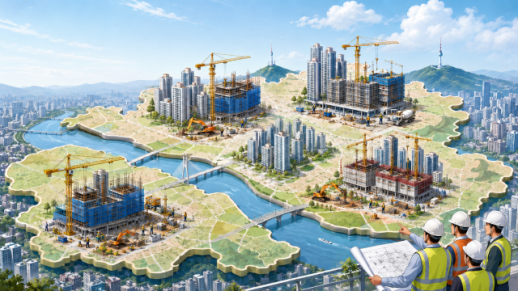 Shifts in Seoul's Apartment Supply: Hyundai Engineering Leads, Daewoo and Lotte Follow Interest is growing in the changing rankings of construction companies in Seoul's apartment supply market. Hyundai Engineering & Construction has taken the lead, with Daewoo Engineering & Construction and Lotte Engineering & Construction closely following. According to the real estate industry on June 4, Hyundai Engineering & Construction has secured the largest share of the planned general sales in Seoul this year. The company is maintaining its top position with projects like 'The H Class' in Banpo-dong, Seocho-gu, and 'The H Kentronine' in Heukseok-dong, Dongjak-gu. The H Class is a large complex being developed through the reconstruction of the Banpo Jugong 1st Complex, consisting of a total of 5,007 units, with 1,832 units expected to be available for general sale. The H Kentronine, part of the Heukseok 9 district redevelopment project, is also expected to offer around 430 units for general sale. Together, these two projects will provide Hyundai Engineering & Construction with over 2,000 units available for general sale in Seoul. Daewoo Engineering & Construction is also likely to rank high in Seoul's supply this year. Key projects include 'Jangwi Prugio Mark One,' part of the Jangwi 10 district redevelopment, as well as 'Summit Hill' in Heukseok 11 district and 'Summit the Tresia' in Noryangjin 5 district. Notably, Jangwi Prugio Mark One is a significant project with over 1,000 units available for general sale, which will boost Daewoo's ranking in Seoul's supply. Lotte Engineering & Construction continues its supply in Seoul through projects like 'Bukhansan Signature Castle' in the Galhyeon 1 district redevelopment, along with 'Bangbae Leel' and 'Ichon Leel.' After establishing a presence in the Seoul market last year with key locations like Jamsil Leel, Lotte is promoting both northern and southern redevelopment projects this year. Samsung C&T has supplied 'Raemian Elavine' this year, a reconstruction project in the Banghwa 6 district of Gangseo-gu. This complex consists of 557 units, with 272 units available for general sale. However, Samsung C&T's supply this year appears to have significantly decreased compared to last year. The rankings for supply in Seoul this year seem to be influenced more by the approval of redevelopment projects, schedules of associations, pricing, and market conditions than by the capabilities of individual construction companies. Given the limited supply of new land in Seoul, most of the supply from large construction companies comes from reconstruction and redevelopment projects. The timing of sales for major redevelopment projects can greatly affect rankings, even for the same company. Industry experts anticipate that this year's Seoul sales market will see demand concentrated around major complexes in the Gangnam area. Despite rising construction costs and pricing pressures, the scarcity of new developments in key locations in Seoul remains high. A representative from a major construction company stated, "Supply in Seoul is inherently limited, so the impact of confirmed redevelopment project sales is significant. This year's rankings are likely to be determined more by the schedules of large projects than by the annual strategies of individual construction companies."* This article has been translated by AI. 2026-06-04 17:03:00
 -
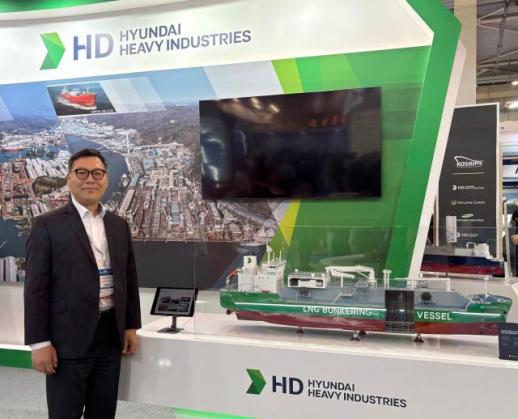 Future of K-Shipbuilding Amid War: Key Survival Strategies from Korea's Big Three The Posidonia 2026, the world's largest maritime and shipbuilding exhibition, has opened in Athens, Greece. This event brings together global shipowners, shipbuilders, and energy companies, focusing on the future competitive landscape surrounding eco-friendly transitions, artificial intelligence (AI), autonomous navigation, and energy security. Aju Economy has visited the Posidonia venue to explore the opportunities, challenges, and future growth strategies facing K-Shipbuilding amid global market changes. The global shipping and shipbuilding market is rapidly restructuring due to the impacts of the Middle East conflict. Disruptions in energy supply chains have increased demand for energy carriers, presenting new opportunities for the shipbuilding industry. Executives from Korea's three major shipbuilders participating in the Posidonia 2026 on June 4 identified energy transport, eco-friendliness, and digital technology as key factors determining future competitiveness. While past competitiveness in shipbuilding was based on construction capabilities and order volumes, the new benchmarks are expected to be energy security, eco-friendly ship technology, and AI-driven digital innovation capabilities. ◇ Turning Crisis into Opportunity: Energy Security Creates New Demand Jeong Ihyo, Executive at HD Hyundai Heavy Industries, stated, "The ongoing geopolitical risks, such as the situation in the Middle East, have significantly reduced predictability in the shipbuilding and shipping markets. I anticipate that the second half of the year will see robust trends based on energy security and eco-friendly transitions." Yoon Jae-kyun, Vice President and Head of Sales at Samsung Heavy Industries, noted, "The war in the Middle East has led to a surge in global energy prices, increasing volatility in the shipbuilding sector, including rising prices for second-hand vessels and charter rates." However, they emphasized that this market uncertainty represents an opportunity rather than a crisis. Jeong remarked, "Uncertainty does not necessarily lead to a decline in demand. Ultimately, what matters is our agility in responding to changes." Kang Sang-don, Executive at Hanwha Ocean, also highlighted that recent geopolitical risks are driving new demand. He explained, "The prolonged war has led to increased orders for energy and tanker vessels, such as Very Large Crude Carriers (VLCCs) and Very Large Gas Carriers (VLGCs). We expect orders to ramp up, particularly around U.S. liquefied natural gas (LNG) export projects." Yoon added, "The conflict in the Middle East is prompting countries worldwide to diversify their energy supply sources. The decrease in LNG production in the region could lead to longer transportation distances and increased project investments and long-term supply contracts." ◇ Shared Vision for the Future, Yet Diverse Survival Strategies While the executives shared a common outlook on the future of the shipbuilding industry, their proposed solutions varied. HD Hyundai emphasized AI and digital technology, Samsung Heavy Industries focused on eco-friendly initiatives, and Hanwha Ocean highlighted LNG value chain competitiveness. Jeong noted, "At this Posidonia, global shipowners have shown significant interest not only in traditional physical Energy Saving Devices (ESDs) but also in AI-based digital ESDs. The combination of eco-friendly technology and digital solutions is enhancing market trust in vessel performance." Indeed, HD Hyundai has garnered considerable interest and trust from global shipowners through its autonomous navigation solution, HiNAS Control. This solution has secured over 350 orders, including a contract for 40 vessels with domestic shipowner HMM, proving its commercial viability. HD Hyundai achieved the most significant collaborative outcomes at this Posidonia, signing over ten global agreements, the highest among Korea's three major shipbuilders. Yoon stated, "Samsung Heavy Industries is solidifying its competitiveness in the global market as a leader in the LNG value chain, from floating liquefied natural gas facilities (FLNG) to LNG ship terminals (FSRU) and LNG carriers. Recently, we are also nurturing a floating data center business as a future growth area due to rising AI demand." Hanwha Ocean emphasized its LNG competitiveness. Kang remarked, "We have a portfolio that can secure profitability across various vessel types, focusing on LNG carriers and VLCCs. We will collaborate with group affiliates, including Hanwha Shipping, to expand the value chain from LNG trading to transportation, securing a competitive edge." ◇ China's Pursuit Remains Intense: Focus on Technology, Not Price The executives identified China as the most significant variable in the market. However, they agreed that by prioritizing technology and trust over price competition, they could maintain their competitive edge. Jeong acknowledged, "It is true that China poses a threat. However, we will maintain our competitiveness in high-value markets based on our technological capabilities, software strengths, and delivery reliability." Yoon also emphasized, "Ultimately, technological competitiveness is key. As new energy sources like ammonia, hydrogen, and small modular reactors (SMRs) emerge, it is crucial to proactively secure related technologies." Kang added, "While it is true that Chinese shipyards are expanding their market share, this reflects a difference in order strategies focused on price. Korean shipyards maintain competitiveness in high-value markets based on quality, delivery, and profitability." 2026-06-04 17:03:00