

Journalist

Salih Murat Tamer
-
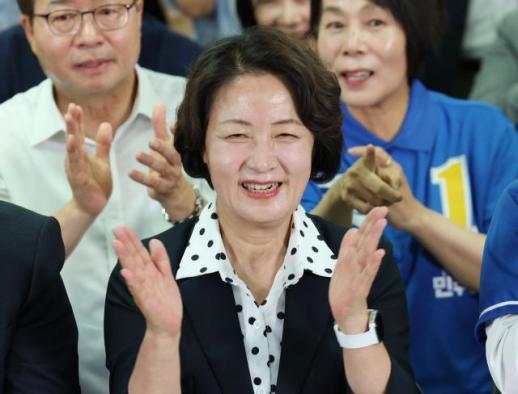 Former justice minister Choo Mi-ae to become first female provincial governor in South Korea SEOUL, June 03 (AJP) - The Ruling Democratic Party candidate and former justice minister Choo Mi-ae is certain to win the Gyeonggi Province gubernatorial race, making her the first woman to head a metropolitan or provincial government in South Korean history. According to the National Election Commission on Wednesday, Choo is projected to defeat People Power Party candidate Yang Hyang-ja in the June 3 local elections. The six-term lawmaker maintained a wide lead over Yang throughout the campaign, cementing her victory early on. Her win breaks a long-standing glass ceiling in South Korean politics. Since the country introduced nationwide local elections in 1995, women have consistently run for top regional posts but have never won. The closest attempts occurred in 2022 and 2010. In the 2022 Gyeonggi governor race, conservative candidate Kim Eun-hye lost to Democratic Party candidate Kim Dong-yeon by a margin of 0.15 percentage points after a tight race that stretched into the morning after election day. In 2010, Democratic Party candidate Han Myeong-sook lost the Seoul mayoral election to Oh Se-hoon by 0.2 percentage points. During the 2021 Seoul mayoral by-election, former Minister of SMEs and Startups Park Young-sun, running for the Democratic Party, lost to Oh by 18.3 percentage points, securing 39.2 percent of the vote. Female representation among candidates for top regional posts declined this year. Only five women, or 9.8 percent of 51 candidates, ran for metropolitan mayoral or gubernatorial seats, roughly half of 18.2 percent seen in the 2022 elections. Choo is the only woman to win such a post this year. In 2022, all 10 female candidates running for these positions lost. A former judge from Daegu, Choo entered politics in 1995 after being recruited by former President Kim Dae-jung, who was then leading the National Congress for New Politics. She earned the nickname "Choo d'Arc" -- combining her surname with Joan of Arc -- after leading a campaign group in the conservative stronghold of Daegu that helped secure Kim's 1997 presidential win. Choo was first elected to the National Assembly in 1996 for Seoul's Gwangjin-eul district. She went on to represent the district for five terms in the 15th, 16th, 18th, 19th, and 20th parliaments. She was elected party leader at the Democratic Party convention in 2020 and served as justice minister during the Moon Jae-in administration. In the recent 22nd general election, she secured her sixth term after receiving a strategic nomination for Gyeonggi Province's Hanam District. Although considered a strong contender for National Assembly speaker in the first half of the 22nd parliament, she lost the internal party primary to Woo Won-shik. She then took the helm of the Legislation and Judiciary Committee, spearheading efforts to pass prosecution reform bills. Choo is widely regarded as a prominent hardliner within her party, known for her strong drive and clear political stances. Because her term as Gyeonggi governor will end in 2030, a timeline that aligns with the next South Korean presidential election, political watchers view her as a potential presidential contender. 2026-06-03 23:49:32
 -
 Unprecedented Voting Paper Shortage in Local Elections Sparks Outrage An unprecedented shortage of voting papers occurred during the local elections held on June 3. The National Election Commission (NEC) arranged for emergency deliveries of voting papers and allowed voters waiting at polling stations to cast their ballots even after the official closing time. However, some voters at over ten polling places, including those in Seoul, chose to abandon their votes. In response to the growing controversy, Heo Cheol-ho, Secretary General of the NEC, expressed deep regret for undermining public trust and promised to implement measures to prevent a recurrence. According to the NEC, the polling places affected by the shortage included 14 locations in districts such as Songpa-gu's Garak 2-dong, Jamsil 2-dong, Jamsil 4-dong, Jamsil 7-dong, Munjeong 2-dong, Gangnam-gu's Cheongdam-dong, and Gwangjin-gu's Guui 3-dong. However, the People Power Party reported that 17 polling places, including those outside Seoul, experienced a lack of voting papers. Notably, at the second polling place in Jamsil 7-dong, Songpa-gu, voting hours were extended until 10 p.m., leading some voters to abandon their ballots or wait to confirm the counting process before voting. Jang Dong-hyuk, leader of the People Power Party, visited the NEC to demand a halt to the vote counting. The party maintains that a re-election should be conducted if necessary. Oh Se-hoon, the candidate for Seoul mayor, stated, "Vote counting should be suspended until measures are in place for areas where voting could not occur," emphasizing that no one should have their voting rights infringed upon. In contrast, Jo Seung-rae, Secretary General of the Democratic Party, expressed strong regret over the NEC's mismanagement but dismissed the People Power Party's calls for a vote counting halt and re-election as unwarranted. Interestingly, most of the areas affected by the voting paper shortage are known to have strong conservative support, suggesting that the repercussions of this incident may continue for some time after the election concludes.* This article has been translated by AI. 2026-06-03 23:39:00
 -
 What to Expect in the Month Following the June 3 Local Elections The 9th nationwide local elections have concluded, marking a new phase for local governments. However, the elected officials will not immediately assume their roles as mayors, governors, or heads of local districts. The official terms for the newly elected officials will begin on July 1 and last until June 30, 2030. The terms for local council members, local government heads, and education superintendents are all set for four years and are elected through direct, secret ballots by residents. Following the elections, the 'elected official system' will take effect. Elected local government heads can establish a transition committee as soon as their election is confirmed. This committee will assess the organization, functions, and budget of the local government and prepare the new leader's policy direction. The size of the transition committee is also legally defined. For cities and provinces, it can include up to 20 members, including a chair and vice-chair, while for cities, counties, and districts, it can have up to 15 members. The committee will exist from the time the official is elected until 20 days after the start of the local government head's term. Thus, the month of June serves as a preparation period before the new local government officially launches. During this time, the elected officials will review key administrative issues, budget structures, operational conditions, and the feasibility of the pledges made during the election. The Ministry of the Interior and Safety has also distributed a manual for the operation of transition committees to local governments to ensure a smooth handover of responsibilities for the 9th elected local governments. Meanwhile, current officials will continue to bear administrative responsibilities until the end of their terms. The confirmation of the elected officials does not grant them immediate authority over approvals or personnel decisions. The new leaders will fully assume their powers starting July 1. From the residents' perspective, the day after the election does not mean an immediate change in policy; rather, it marks the beginning of a period to gauge the direction of the new local government. It will become evident during this time how the slogans from the election translate into actual organizational changes, budget allocations, and implementation plans for the pledges made.* This article has been translated by AI. 2026-06-03 23:36:00
 -
 Choo Mi-ae Poised to Win Gyeonggi Province Governorship, First Female Regional Leader Choo Mi-ae, the Democratic Party candidate for governor of Gyeonggi Province, is likely to win the election, which would make her the first female leader of a metropolitan government in South Korea. According to the National Election Commission, as of 11:16 p.m. on June 3, with 26.51% of the votes counted, Choo led with 969,869 votes, or 53.51%. Her opponent, Yang Hyang-ja of the People Power Party, received 740,560 votes, or 40.90%. Exit polls conducted by major broadcasters KBS, MBC, and SBS indicated that Choo had a support rate of 60.4%. She maintained a lead over her opponent from the start of the vote counting. Yang conceded defeat around 11 p.m., stating, "I humbly accept the will of the Gyeonggi residents expressed through today’s vote. Public sentiment is always right." She also extended her congratulations to Choo. 2026-06-03 23:24:00
 -
 Seoul Faces Unprecedented Ballot Shortage During Local Elections On June 3, an unprecedented ballot shortage occurred at several polling stations in Seoul during the local elections, sparking controversy. The National Election Commission (NEC) issued a public apology, while the People Power Party (PPP) demanded a halt to vote counting and called for the elections to be postponed. Heo Cheol-hoon, the NEC Secretary-General, held an emergency briefing and stated, "We deeply apologize for undermining public trust in fair election management. We will identify the causes and issues immediately after the vote counting ends and implement measures to prevent recurrence." According to the NEC, as of 6:20 PM, 14 polling stations in Seoul experienced ballot shortages, leading to delays and interruptions in voting. The affected areas included Garak 2-dong, Jamsil 2-dong, Jamsil 4-dong, Jamsil 7-dong, Munjeong 2-dong in Songpa-gu, Cheongdam-dong in Gangnam-gu, and Guui 3-dong in Gwangjin-gu. The PPP criticized the situation and demanded a halt to vote counting and a re-election. Jang Dong-hyuk, the party's representative, held a briefing at the party's headquarters in Yeouido and declared, "This election in Seoul is tainted. A contaminated election is invalid. We must immediately stop the counting until a thorough investigation is conducted." He also warned of potential legal action against the NEC, stating, "We waited for the NEC's announcement scheduled for 9 PM, but there was no satisfactory explanation. The NEC must provide a clear explanation that the public can accept and take legal responsibility for this situation." When asked if the party would file for an injunction to halt the counting if the NEC proceeded, he replied, "If we file now and the NEC continues counting, there may be no benefit to the request. Therefore, the NEC should voluntarily stop the counting first." Song Eon-seok, the party's floor leader, also called for a delay in the elections. He stated at a press conference, "We formally request a postponement of the elections under Article 196 of the Public Election Act, emphasizing that the elections in Seoul cannot proceed as planned." He expressed concerns about the management of ballots during the urgent transfer from other locations, stating, "There are significant doubts about whether proper ballot management was conducted during the hurried transfer. With voting continuing after 6 PM, the possibility that exit poll results could influence the voting cannot be ruled out." He hinted at the possibility of a re-election, referencing a case from last year in which Germany's Federal Constitutional Court declared a local election in Berlin invalid due to systemic mismanagement by election authorities, ordering a re-vote. The party leadership is also taking a proactive stance. Shin Dong-wook, head of the Fair Election and Secure Voting Committee, visited the NEC office in Gwacheon to express their serious concerns. Jeong Hee-yong, the party's Secretary-General, stated, "We cannot overlook this situation," criticizing the earlier controversy over ballot transparency and the current shortage. Bae Hyun-jin, chair of the Seoul party chapter, held a press conference at the National Assembly, asserting, "This is not just a simple mistake; it demonstrates a complete breakdown of the basic election management system and undermines the foundations of democracy." Meanwhile, in areas like Songpa-gu, voters faced delays or interruptions in voting due to the ballot shortage. Lee Sang-neung, head of the NEC's Election Division, noted at a press conference that Songpa-gu had printed ballots for only 50% of its total voter population, explaining, "Given that there are 146 polling stations in Songpa-gu, some stations may have more voters than expected, leading to the ballot shortage." As a result, voting at the second polling station in Jamsil 7-dong was extended until 10 PM. 2026-06-03 23:12:00
 -
 Chaos Erupts at Jamsil 7-dong Polling Station Over Ballot Box Removal On June 3, the main voting day for the 9th nationwide local elections, several polling stations in Seoul faced a shortage of ballots. At the Jamsil 7-dong No. 2 polling station in Songpa District, a crowd gathered to protest the removal of ballot boxes after voting ended, leading to a chaotic situation. According to the National Election Commission, ballot shortages were reported at a total of 14 polling stations across Seoul, including 12 in Songpa District, one in Gangnam District, and one in Gwangjin District. The commission arranged for additional ballots to be sent to the affected stations and extended voting hours for waiting voters, even after the official closing time. The Jamsil 7-dong No. 2 polling station was one of the most affected, extending its voting hours from the original 6 PM to 10 PM for those holding waiting tickets due to the ballot shortage. Earlier, the ruling People Power Party expressed outrage, stating, "While voters are waiting due to the shortage, the Election Commission is attempting to retrieve the ballot boxes from this location." Party officials visited the site to protest, and the polling station decided to extend voting hours for those who had queued before 6 PM but were unable to vote due to the lack of ballots. As voting continued late into the evening, confusion escalated. Some election workers reportedly requested announcements in nearby apartment complexes to remind voters holding waiting tickets to return to the polling station. Some citizens protested that the votes cast at this polling station should be invalidated, while others insisted, "The removal of the ballot boxes must be stopped." After voting concluded, tensions flared during the process of transporting the ballot boxes. Around 10:34 PM, a crowd gathered to prevent the removal of the ballot boxes from the Jamsil 7-dong No. 2 polling station. In response, the Election Commission requested police assistance. The People Power Party has labeled the situation a threat to election integrity and is vocally opposing it. Jang Dong-hyuk, the party's chief election strategy committee member, stated, "This election in Seoul has been tainted," calling for an immediate halt to the counting of votes until the situation is clarified. The party is raising concerns about the ballot shortages, the process of additional ballot deliveries, and the continuation of voting after the deadline, suggesting the need for a recount or a new election. Conversely, the Democratic Party acknowledges the Election Commission's mismanagement but rejects the People Power Party's calls for halting the counting and conducting a re-vote. Jo Seung-rae, the Democratic Party's head of the election strategy committee, criticized the Election Commission for the ballot shortage but stated, "The People Power Party's demands for stopping the counting and re-voting are not worth considering." This incident highlights significant failures in the fundamental preparation of ballots by the Election Commission, making it difficult for them to evade responsibility. However, as calls to prevent the removal of ballot boxes and demands for a halt to the counting arise, the controversy has escalated beyond local confusion to questions about the reliability of the election results. How transparently the Election Commission discloses the scale of the ballot shortages, the process of additional deliveries, and the procedures for issuing waiting tickets and conducting voting after the deadline will likely be key issues in the ongoing debate.* This article has been translated by AI. 2026-06-03 23:03:00
 -
 Yang Hyang-ja Acknowledges Defeat in Gyeonggi Province Election Yang Hyang-ja, the People Power Party candidate for Gyeonggi Province Governor, acknowledged her defeat on the night of June 3, stating, "I will humbly accept the will of the people of Gyeonggi Province." In a message sent to residents at 11 p.m., Yang admitted, "I fell short in many ways," and recognized the victory of her opponent, Lee Jae-myung of the Democratic Party. She expressed her commitment to accept the election results. Yang expressed her gratitude to the residents, saying, "I sincerely thank the people of Gyeonggi Province for their overwhelming love and guidance. Those who supported me did their best, and the responsibility lies solely with me as the candidate." She reiterated her acceptance of the voters' decision, stating, "I humbly accept the will of the people of Gyeonggi Province as shown in today's voting. Public sentiment is always right," and extended her congratulations to Lee. Yang concluded her message by emphasizing, "This challenge may end here, but I will do my best for a better Gyeonggi Province and a greater South Korea, no matter where I am," and expressed her deep gratitude once again for the overwhelming support. 2026-06-03 23:03:00
 -
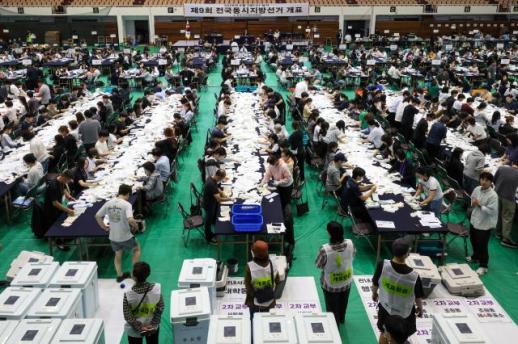 Counting begins as South Korea's local elections draw to a close SEOUL, June 03 (AJP) - Vote counting for the 9th National Simultaneous Local Elections got underway at approximately 7:10 p.m. on Wednesday at polling centers across the country, including the Gwanak-gu Election Commission counting station set up at Seoul National University gymnasium in Gwanak-gu, Seoul. The final voter turnout stood at 60.9 percent, based on figures tallied as of 6 p.m. Exit polls conducted jointly by KBS, MBC, and SBS projected the Democratic Party winning 11 of 16 mayoral and gubernatorial races, with People Power taking one and four too close to call. In Seoul, Democratic Party candidate Jeong Won-o was projected to lead with 51.4 percent against incumbent Oh Se-hoon of People Power at 46.0 percent. The results split the mood across party war rooms. Cheers broke out at the Democratic Party headquarters, while a heavy silence settled over People Power. Counting is expected to continue through the night. 2026-06-03 23:00:21
 -
 Early Election Results Show Democratic Party Leading in 14 of 16 Regions As the nationwide local elections continue to be counted, the Democratic Party is showing a strong lead in 14 out of 16 regional governor races. The only area where the People Power Party is ahead is Gyeongbuk, indicating that if the current counting trends hold, the Democratic Party is poised for a significant victory. According to Yonhap News, as of 10 p.m. on June 3, the overall vote count stands at 14.0%. This election marks the first nationwide election since the inauguration of the Lee Jae-myung administration, with the Democratic Party currently benefiting from a favorable trend amid competing narratives of 'stability' and 'judgment' against the ruling party. In the highly contested Seoul mayoral race, with a vote count of 5.46%, Democratic candidate Jeong Won-oh is leading with 65.72%, significantly ahead of People Power Party candidate Oh Se-hoon, who has 31.88%. However, the vote counts in the People Power Party's strongholds of Gangnam, Seocho, and Songpa are below average, leaving room for the gap to narrow. In the metropolitan area, Democratic candidates are also in the lead. In the Gyeonggi governor race, candidate Choo Mi-ae is ahead with 51.07%, surpassing People Power Party's Yang Hyang-ja at 43.16%. In the Incheon mayoral race, Park Chan-dae is leading with 60.04%, well ahead of People Power Party's Yoo Jeong-bok at 39.04%. In other competitive regions such as Busan, Daegu, and Gangwon, the Democratic Party has also gained an early advantage. In Busan, Jeon Jae-soo is leading with 53.60%, while Kim Boo-kyum in Daegu has 53.48%, and Woo Sang-ho in Gangwon has 54.00%, all ahead of their People Power Party opponents. In the Jeonbuk governor race, Democratic candidate Lee Won-taek is leading with 52.52% against independent candidate Kim Kwan-young. In the Democratic stronghold of Honam, the party is showing overwhelming dominance. In the Gwangju mayoral race, Min Hyung-bae is leading with 81.62%, and in the Jeju governor race, Wi Seong-gon has 61.35%, making their victories highly likely. The People Power Party is only maintaining its lead in Gyeongbuk, where candidate Lee Cheol-woo is projected to win with 64.64%. Conversely, in the Gyeongnam governor race, with a vote count of 14.98%, Democratic candidate Kim Kyung-soo is at 49.71%, while People Power Party's Park Wan-soo is at 50.28%, indicating a very tight race. The Democratic Party's favorable trend is also evident in the concurrent by-elections. In Busan Buk-gap, with a vote count of 8.7%, Democratic candidate Ha Jung-woo is leading with 53.37%, significantly ahead of independent candidate Han Dong-hoon at 38.55% and People Power Party's Park Min-sik at 8.06%. In Chungnam's Gongju, Buyeo, and Cheongyang, Democratic candidate Kim Young-bin is leading with 55.06% over People Power Party's Yoon Yong-geun at 39.26%. In Ulsan Nam-gap, Democratic candidate Jeon Tae-jin has 57.41%, ahead of People Power Party's Kim Tae-kyu at 37.40%. In Gyeonggi's Hanam-gap, a previously competitive district, Democratic candidate Lee Kwang-jae is leading with 66.42%, significantly ahead of People Power Party's Lee Yong at 31.66%. Meanwhile, in Daegu's Dalseong-gun, People Power Party candidate Lee Jin-sook is leading with 64.54%, confirming the consolidation of traditional support. One of the most closely watched areas in the by-elections, Gyeonggi's Pyeongtaek, shows an unexpected lead for Justice Party candidate Cho Guk, who has 38.12%, ahead of Democratic candidate Kim Yong-nam at 32.80% and People Power Party's Yoo Ui-dong at 23.76%. However, as the counting is still in its early stages, it is too soon to predict the final results. Particularly in key battlegrounds like Seoul, Busan, and Gyeongnam, the dynamics could change as counting progresses. So far, the Democratic Party appears to be securing an early lead in both the regional governor elections and the by-elections, according to Yonhap News. 2026-06-03 23:00:00
 -
 Blue House: Election Commission Responsible for Ballot Shortage On June 3, the Blue House addressed the ballot shortage that occurred during the 9th nationwide local elections, stating that it is an issue the Election Commission must handle.A Blue House official responded to reporters' inquiries about the situation, emphasizing that the Election Commission is an "independent constitutional institution" and not part of the executive branch.Earlier that afternoon, several polling stations in the metropolitan area experienced a temporary halt in voting due to a lack of ballots, sparking controversy.Heo Cheol-hoon, Secretary-General of the National Election Commission, issued a public apology, stating, "We have caused significant confusion and concern among the public."* This article has been translated by AI. 2026-06-03 22:54:00