

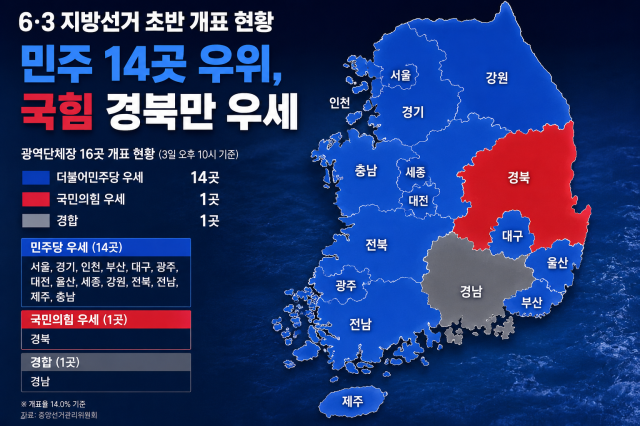
As the nationwide local elections continue to be counted, the Democratic Party is showing a strong lead in 14 out of 16 regional governor races.
The only area where the People Power Party is ahead is Gyeongbuk, indicating that if the current counting trends hold, the Democratic Party is poised for a significant victory.
According to Yonhap News, as of 10 p.m. on June 3, the overall vote count stands at 14.0%. This election marks the first nationwide election since the inauguration of the Lee Jae-myung administration, with the Democratic Party currently benefiting from a favorable trend amid competing narratives of 'stability' and 'judgment' against the ruling party.
In the highly contested Seoul mayoral race, with a vote count of 5.46%, Democratic candidate Jeong Won-oh is leading with 65.72%, significantly ahead of People Power Party candidate Oh Se-hoon, who has 31.88%. However, the vote counts in the People Power Party's strongholds of Gangnam, Seocho, and Songpa are below average, leaving room for the gap to narrow.
In the metropolitan area, Democratic candidates are also in the lead. In the Gyeonggi governor race, candidate Choo Mi-ae is ahead with 51.07%, surpassing People Power Party's Yang Hyang-ja at 43.16%. In the Incheon mayoral race, Park Chan-dae is leading with 60.04%, well ahead of People Power Party's Yoo Jeong-bok at 39.04%.
In other competitive regions such as Busan, Daegu, and Gangwon, the Democratic Party has also gained an early advantage. In Busan, Jeon Jae-soo is leading with 53.60%, while Kim Boo-kyum in Daegu has 53.48%, and Woo Sang-ho in Gangwon has 54.00%, all ahead of their People Power Party opponents. In the Jeonbuk governor race, Democratic candidate Lee Won-taek is leading with 52.52% against independent candidate Kim Kwan-young.
In the Democratic stronghold of Honam, the party is showing overwhelming dominance. In the Gwangju mayoral race, Min Hyung-bae is leading with 81.62%, and in the Jeju governor race, Wi Seong-gon has 61.35%, making their victories highly likely.
The People Power Party is only maintaining its lead in Gyeongbuk, where candidate Lee Cheol-woo is projected to win with 64.64%. Conversely, in the Gyeongnam governor race, with a vote count of 14.98%, Democratic candidate Kim Kyung-soo is at 49.71%, while People Power Party's Park Wan-soo is at 50.28%, indicating a very tight race.
The Democratic Party's favorable trend is also evident in the concurrent by-elections. In Busan Buk-gap, with a vote count of 8.7%, Democratic candidate Ha Jung-woo is leading with 53.37%, significantly ahead of independent candidate Han Dong-hoon at 38.55% and People Power Party's Park Min-sik at 8.06%.
In Chungnam's Gongju, Buyeo, and Cheongyang, Democratic candidate Kim Young-bin is leading with 55.06% over People Power Party's Yoon Yong-geun at 39.26%. In Ulsan Nam-gap, Democratic candidate Jeon Tae-jin has 57.41%, ahead of People Power Party's Kim Tae-kyu at 37.40%.
In Gyeonggi's Hanam-gap, a previously competitive district, Democratic candidate Lee Kwang-jae is leading with 66.42%, significantly ahead of People Power Party's Lee Yong at 31.66%. Meanwhile, in Daegu's Dalseong-gun, People Power Party candidate Lee Jin-sook is leading with 64.54%, confirming the consolidation of traditional support.
One of the most closely watched areas in the by-elections, Gyeonggi's Pyeongtaek, shows an unexpected lead for Justice Party candidate Cho Guk, who has 38.12%, ahead of Democratic candidate Kim Yong-nam at 32.80% and People Power Party's Yoo Ui-dong at 23.76%.
However, as the counting is still in its early stages, it is too soon to predict the final results. Particularly in key battlegrounds like Seoul, Busan, and Gyeongnam, the dynamics could change as counting progresses. So far, the Democratic Party appears to be securing an early lead in both the regional governor elections and the by-elections, according to Yonhap News.
* This article has been translated by AI.

Copyright ⓒ Aju Press All rights reserved.