

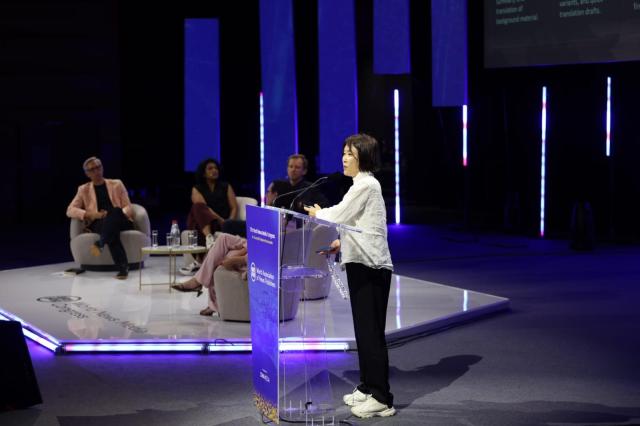
South Korea's AJP, an AI-native news agency built for that shift, took its place alongside publishers from India and Germany to argue that the technology is dissolving the old path of search, click and read, replacing it with content that anticipates what readers want before they ask.
The session, titled "How AI Is Transforming the News Experience," was moderated by Dmitry Shishkin, a former BBC World Service digital editor and now an independent media adviser, whose long-championed "user needs" model framed much of the discussion.
The 77th congress, organized by the World Association of News Publishers and held at the Palais du Pharo from June 1 to 3, drew about 1,000 participants from more than 60 countries, representing over 450 news publishers.
Seo Hye-seung, managing editor of AJP and part of the Aju Media Group, opened with a personal story about her 83-year-old mother, who now relies on her smartphone to take her medication and book restaurants.
"This is the most ordinary thing that's happening in Korea," Seo said, noting that the country had absorbed broadband, smartphones and now AI faster than almost anywhere. She cited a study finding that more than half of office work in Korea passes through an AI tool at some point each day.
Because AJP entered the crowded English-language agency market late, Seo said, it was built to its advantage.
"We were built AI-native from the first line of code," she said, adding that reporters with less than two years of experience now produce 5,000-word features and analyses.
The group publishes in five languages, she said, filtering selected stories from its Korean flagship through a system called AI Pick that translates them automatically. The automation lifted output in four additional languages tenfold and raised English traffic by about 30%, according to the company.
Seo said the shift had freed journalists to seek out audiences rather than wait for them, pointing to the group's saturation coverage of a BTS concert in central Seoul earlier this year. "The new question is who offers the best experience," she said, "because users know best."
Sannuta Raghu, executive producer and head of the AI lab at India's Scroll.in, said AI was becoming core infrastructure for what she called "personal, machine-mediated sense-making."
Her newsroom, she said, employs about 20 people in a country of 1.4 billion. Five years ago it abandoned the chase for breaking news to focus on context and depth, finding its paying readers among academics and researchers studying South Asia.
Rather than compete with chatbots that aggregate answers from many sources, Raghu said, Scroll.in was turning its platform into a "trusted workspace" offering what she termed auditable comprehensiveness.
"We are very open about the comprehensiveness gap," she said, describing a system that maps what the newsroom can cover and transparently fills the rest from verified sources such as datasets and government bodies.

Markus Knall, chief editor and director of content at Germany's Ippen Digital, struck an optimistic note for community journalism.
"This may be the best time for local publishers in the last few years, and AI is the reason," Knall said. He argued that small audiences and high costs, once crippling constraints, had become the sector's biggest opportunity.
Ippen runs about 170 local news websites in Germany, he said. On a recent election night, the group published more than 4,000 articles covering some 20,000 communities, output he said no human staff could ever match.
But Knall warned against treating AI purely as an efficiency tool, urging newsrooms to chase genuine new scale while reserving human reporters for the trust that underpins democratic life.
Astrid Maier, chief deputy editor and head of strategy at German news agency dpa, said the industry was facing not an efficiency story but a wholesale platform shift.
"If there weren't any independent news agencies right now in the age of AI, they should be invented right now," Maier said, arguing that verified, fact-committed information was more vital than ever as machines learn to read the structured data inside each news article.
She presented DPA-IQ, a trusted information layer launched as a minimum viable product two weeks ago, which lets clients' AI agents pull verified text, images and soon video on demand rather than receiving a constant push down the wire.
Maier cautioned that if publishers did not set shared standards for how facts are attributed within such systems, the large technology platforms would set them instead. "Otherwise facts won't matter anymore," she said.
The discussion echoed a session a day earlier on the evolution from search optimization toward answer- and generative-engine optimization, where panelists stressed that audiences increasingly meet the news through AI rather than the open web.
Across both sessions the underlying message was consistent: while algorithms and platforms keep shifting, the direct relationship between a publisher and its readers remains the enduring source of value.

Copyright ⓒ Aju Press All rights reserved.
![[WNMC 2026] AJP Director Seo Hye-seung: AI Native News Agency is the Answer – Korean Model Unveiled in Marseille](https://image.ajunews.com/content/image/2026/06/03/20260603160445551206_278_163.jpg)
![[WNMC 2026] No Map in the Age of AI... Media Outlets Must Chart Their Own Course](https://image.ajunews.com/content/image/2026/06/03/20260603123832131110_278_163.jpg)
![[WNMC 2026] Global News Organizations Embrace AI for Economic Growth](https://image.ajunews.com/content/image/2026/06/03/20260603124211564523_278_163.jpg)