
Journalist

Seo Hye Seung
-
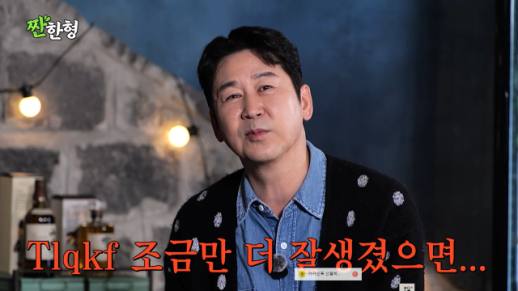 Shin Dong-yeop YouTube Talk Show Controversy Highlights Platform Accountability Debate Controversy is again spreading around comedian Shin Dong-yeop’s YouTube talk show, “Jjanhanhyeong.” A portion of a teaser that drew allegations of sexual harassment has been deleted, but public backlash has not quickly subsided. Critics say removing only the disputed clip does not address the underlying problem. The program has repeatedly faced criticism over heavy drinking scenes, provocative remarks and jokes about people’s bodies. The latest dispute is widely seen not as a one-off mistake but as the result of a pattern built into the format. At the center of the debate is how YouTube has changed. Channels with millions of subscribers no longer fit the category of purely personal creations. Their influence now rivals that of terrestrial broadcasters. And because the platform naturally draws in teenagers, its social impact can be even broader. Yet the framework for regulation and accountability still treats such content as “personal media.” That gap is a key reason similar controversies keep recurring. Even so, regulating YouTubers the same way as public broadcasters is not realistic. YouTubers do not receive state-assigned frequencies or public funding. They are private actors competing in the market. Applying public-broadcast-style rules simply because a channel is influential can upset the balance between rights and obligations. What is needed is not identical regulation, but responsibility proportional to influence. The problem is that the current system does not properly design that responsibility. In the YouTube ecosystem, revenue is driven by views and exposure. The more sensational the content, the faster it spreads — and the more money it can generate. In that structure, appeals for creators to show restraint have clear limits. Telling producers to “stay within the lines” while algorithms reward provocation does not match reality. A more workable approach is to redesign incentives rather than rely on blunt regulation. First, channels with a certain level of influence should face minimum accountability standards. That should not mean pre-screening or censorship, but basic measures such as age ratings, warnings for risky content and obligations to issue corrections after the fact. The aim is to protect choice without undermining free expression. Second, any standards should be based not on subscriber counts alone but on actual reach. On YouTube, algorithm-driven exposure can matter more than subscriptions. Even a small channel can reach millions with a single Shorts video. Rules built only around channel size fail to reflect that reality. New benchmarks should consider exposure levels, youth reach and the nature of the content. Third, the platform’s role should be strengthened. Global platforms such as YouTube have limited incentives to tighten controls on their own. A “co-regulation” model combining government, platforms and the market is presented as a practical alternative. Measures such as brand-safety standards that steer advertisers away from sensitive content, limits on exposure for repeatedly controversial channels and age-based filtering are already used in global markets. The goal is not to block speech, but to prevent risky content from being amplified excessively by distribution systems. Fourth, creators also need to adapt — not as a moral lecture, but as a question of sustainable strategy. Content that depends on shock value may work in the short term, but repeated reliance can erode trust and damage brand value. As influence grows, content becomes more than personal expression and carries broader social impact. Creators who fail to adjust may ultimately be rejected by audiences. YouTube has already become a central medium in society, but the ways responsibility and regulation are handled remain stuck in older frameworks. The debate cannot be reduced to a simple choice between autonomy and regulation. The task is to build a more precise system that respects free expression while ensuring accountability matches influence. The “Jjanhanhyeong” controversy is not only about one program. It raises a structural question for the YouTube era: In a time when the key issue is not who is speaking but how many people are affected, what standards of responsibility should apply? The answer, the article argues, lies less in regulation than in design.* This article has been translated by AI. 2026-05-03 14:00:20
 -
 China-Taiwan Diplomatic Rivalry Intensifies in Africa and South America China and Taiwan are stepping up diplomatic competition in Africa and South America, vying for the last remaining Taiwan allies in each region. On May 2 (local time), Taiwan President Lai Ching-te arrived in Eswatini, according to the BBC and other outlets. The small monarchy in southeastern Africa, formerly known as Swaziland, gained independence from Britain in 1968. Eswatini has been Taiwan’s only diplomatic ally in Africa since Burkina Faso cut ties with Taiwan and established relations with China in 2018. The relationship is close: Prince Bulebenkosi Dlamini, a son of King Mswati III, completed undergraduate and master’s studies at Shih Chien University in Taiwan. Lai’s trip had originally been planned for last month to mark the king’s 40th anniversary on the throne and his 58th birthday. Taiwan’s presidential office said the visit was canceled then after Seychelles, Mauritius and Madagascar denied overflight clearance to Lai’s delegation. Bloomberg reported that after the overflight denials, Taiwan urgently asked Germany and the Czech Republic to allow a stopover, but was turned down. Eswatini rolled out a red carpet on the runway and Prime Minister Russell Mmiso Dlamini greeted Lai. In a meeting with the king, Lai said, “Taiwan is a sovereign country and belongs to the world.” Chinese authorities criticized the visit as “despicable behavior like a rat,” the report said. China has also recently introduced tariff exemptions for all African countries except Eswatini. Taiwan is pursuing an oil storage facility and an industrial park project in Eswatini. Taiwan Deputy Foreign Minister Chen Ming-chi previously said Taiwan would show “how Taiwan will support Eswatini’s economy” during Lai’s visit. A similar contest is playing out over Paraguay, Taiwan’s only diplomatic ally in South America. The New York Times reported May 2 that the relationship dates to 1957, when Chiang Kai-shek, Taiwan’s first president, and then-Paraguayan President Alfredo Stroessner aligned under an anti-communist banner. The paper said Paraguay is among the most strongly anti-China countries in Latin America, drawing praise from U.S. President Donald Trump’s administration. Secretary of State Marco Rubio has called conservative Paraguayan President Santiago Pena “a strong ally of the United States.” The report said Taiwan has backed Paraguay with a range of support, including a presidential aircraft, helicopters, electric buses and trips to Taipei for Paraguayan politicians. Taiwan also helped fund construction of Paraguay’s National Congress building. As China pressed Paraguay to “quickly make the right decision,” Taiwan increased support, providing a $200 million loan for housing for low-income residents and a $20 million grant for a hospital. Taiwan currently has 12 diplomatic allies, including the Vatican and Haiti. 2026-05-03 13:46:23
 -
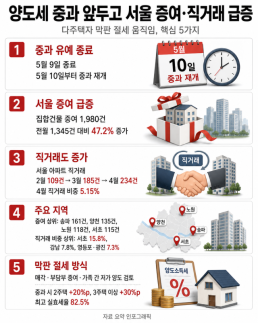 Seoul Gifts and Direct Home Sales Rise Ahead of End to Capital Gains Tax Break for Multi-Homeowners As a temporary suspension of heavier capital gains taxes for multi-homeowners nears its end, both gift transfers and direct, broker-free apartment deals are rising in Seoul. With higher tax rates set to return, some owners are moving beyond straightforward sales, turning to options such as debt-assumption gifts and discounted transfers within families to cut tax bills. According to the Supreme Court’s registry information system, Seoul recorded 1,980 gift-transfer registrations for “collective buildings” last month, up 47.2% from 1,345 the previous month. It was the highest monthly total since December 2022, when there were 2,384. The category includes apartments, multi-family housing and officetels. Nationwide, gift-transfer registrations totaled 5,560, the highest since December 2022, when 9,342 were recorded ahead of a change in the tax base for gift acquisition taxes. The latest increase is widely seen as an effort to reduce taxes before the end of the capital gains tax break for multi-homeowners. With sales of homes with tenants allowed through May 9, more owners appear to be transferring homes to children through debt-assumption gifts. By district in Seoul, Songpa led with 161 cases, followed by Yangcheon with 135, Nowon with 118, Seocho with 115, Yongsan with 106, and Gangnam and Dongjak with 104 each. Yongsan nearly doubled from 54 the previous month, up 95.3%. The rise in both high-priced areas such as Gangnam and Yongsan and in districts such as Yangcheon and Nowon suggests tax-driven demand is spreading across the city. Direct apartment transactions in Seoul have also increased, according to the Ministry of Land, Infrastructure and Transport’s real transaction disclosure system. Such deals rose from 109 in February to 185 in March and 234 in April. Direct transactions accounted for 5.15% of 4,544 reported apartment deals in April. These transactions bypass licensed brokers and often involve family members or other related parties. In April, Seocho had the highest share of direct transactions at 15.8%. Gangnam posted 7.8%, while Yeongdeungpo and Gwangjin each recorded 7.3%. Market watchers say some of the activity reflects demand to transfer homes to relatives at below-market prices before heavier capital gains taxes resume. Under the inheritance and gift tax law, even transactions between related parties are treated as normal sales — and not subject to gift tax — if the reported price is within the smaller of 30% below the most recent three-month transaction price or 300 million won. Some multi-homeowners appear to be using direct transactions to reduce holdings before the higher tax rates take effect. The suspension of heavier capital gains taxes for multi-homeowners ends May 9. Starting May 10, multi-homeowners selling homes in regulated areas will face surcharges on top of the basic tax rate: 20 percentage points for two-home owners and 30 percentage points for those with three or more. Including local income tax, the effective top rate can rise to 82.5%. The government has announced supplemental steps to reduce confusion as the break ends. If a land-transaction permit is filed by May 9 and the sale process — including final payment and registration — is completed within a set period, sellers can avoid the heavier tax. For the three Gangnam districts and Yongsan, the process must be completed by Sept. 9; for Seoul’s other 21 districts and 12 areas in Gyeonggi Province, the deadline is Nov. 9. An exception also applies to homes with tenants. If a lease existed as of Feb. 12 and a land-transaction permit is filed by May 9, the requirement for the buyer to live in the home is deferred until the lease ends, but only when the buyer is a first-time homeowner. An industry official said “last-minute tax-saving moves by multi-homeowners are likely to continue” and that when a simple sale is difficult, more owners may consider gifts, debt-assumption gifts or direct transactions with related parties. The official also warned that discounted transfers and debt-assumption gifts could later face scrutiny by tax authorities, making it important to carefully assess pricing and the requirements for taking over debt. 2026-05-03 13:45:17
 -
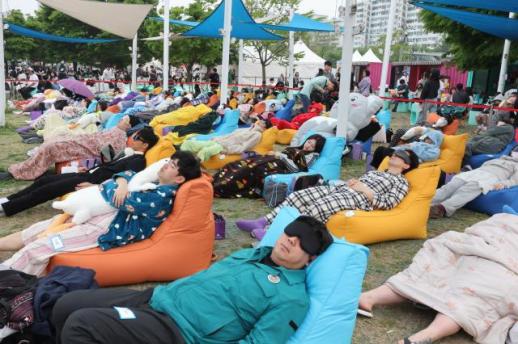 Even sound sleep becomes a competition — and fashion show — in Korea SEOUL, May 03 (AJP) -The ability to fall sound asleep — and stay that way no matter what — has quietly become a modern superpower in a world vibrating nonstop with alarms, scrolling feeds, office chats and late-night anxiety. So when a giant banner reading “Don’t wake me unless you’re a prince” fluttered above rows of sleeping bags along the Han River on Saturday afternoon, few in Seoul found it strange. At exactly 3 p.m., 170 contestants gathered at Mulbit Plaza in Yeouido Hangang Park for the third annual “2026 Han River Napping Championship,” a competition where the goal was neither speed nor strength, but the rarest luxury of all: deep, uninterrupted sleep. Some arrived in pajamas. Others came armed with plush toys, neck pillows and blankets. One contestant wore a full Winnie the Pooh costume. Another drifted toward the starting line dressed as Snow White. By the time the opening announcements ended, the riverside looked less like a competition venue than a giant outdoor bedroom assembled by an exhausted civilization. Hosted by the Seoul Metropolitan Government, the championship has grown into one of the city’s quirkiest and most unexpectedly relatable events since debuting in 2024, tapping into a national epidemic of fatigue in one of the world’s most sleep-deprived societies. This year’s applicants included a nurse surviving on fragmented sleep after high-stress shifts, a man in his 30s worn down from helping his insomnia-stricken wife sleep each night, and an engaged couple whose wedding preparations had apparently become a form of endurance training. But sleeping peacefully beside the Han River was only the beginning. Contestants were judged on “sleep concentration” — the ability to remain in deep sleep despite increasingly annoying disruptions engineered by organizers. Officials crept among the sleepers armed with feathers, delicately tickling exposed hands and faces. Mosquito buzzing sounds echoed across the venue like a humid summer nightmare. Hosts wandered through the rows deliberately talking loudly, attempting to provoke reactions from competitors pretending to be asleep. Some twitched. Others rolled over defensively. A few appeared so deeply unconscious they seemed to transcend earthly concerns altogether. Heart-rate monitors tracked sleep quality and deep-sleep duration in real time, turning naps into biometric competition. Before the event began, contestants stretched through pre-sleep yoga sessions aimed at releasing tension from overworked shoulders and stiff office backs. Nearby, spectators quietly watched the bizarre serenity unfold, occasionally applauding particularly committed sleepers. The championship also doubled as an impromptu fashion show for the chronically tired. A “Best Dresser” contest rewarded the most creative pajama styling, with citizens voting for favorites among contestants dressed in cartoon onesies, fairy-tale outfits and elaborate sleepwear ensembles that looked more prepared for a costume parade than a nap. Yet beneath the humor and absurdity, the event carried an unmistakably modern undertone. In a hyperconnected country where people routinely sacrifice rest to work, commute, study and endlessly remain online, the act of truly switching off — phone silenced, eyes closed, mind blank — has become both rebellion and aspiration. For a few hours beside the Han River, at least, exhaustion itself became a shared performance. And perhaps the only competition where losing consciousness was the ultimate sign of victory. 2026-05-03 13:23:22
 -
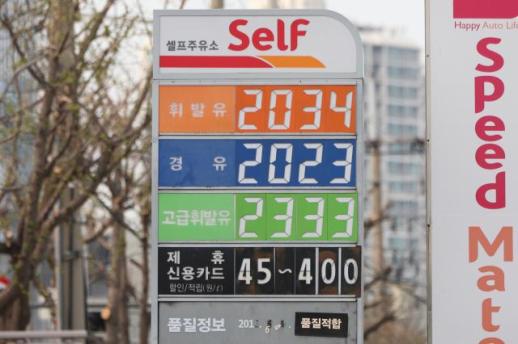 Korean refiners estimate bumper Q1 but beyond uncertain SEOUL, May 03 (AJP)-South Korea’s four major refiners are estimated to have posted combined first-quarter operating profits nearing 5 trillion won ($3.6 billion) on spike in export margins from cheaper inventories due to the blockade of the Strait of Hormuz, though the windfall is expected to be short-lived once cheaper crude inventories are exhausted. According to market consensus compiled by brokerages, SK Innovation is estimated to have turned out an operating profit of about 2.36 trillion won for the January-March period, sharply rebounding from an operating loss of 44.6 billion won a year earlier. S-Oil is forecast to have earned around 1.08 trillion won, while GS Caltex and HD Hyundai Oilbank are projected to report operating profits in the mid-1 trillion won range and around 200 billion won, respectively. The earnings surge came as refining margins spiked after the outbreak of the Middle East conflict in late February disrupted oil flows and tightened fuel supply across Asia. Singapore complex refining margins — a key profitability benchmark for Asian refiners — jumped from $5.7 per barrel in February to $16.5 in March, more than tripling the industry break-even level of around $4-$5 per barrel. The rise in margins coincided with a sharp rally in global crude prices. Dubai crude, the benchmark most relevant for Asian refiners, climbed to $100.46 per barrel as of April 30 from $61.08 at the end of last year, a gain of 64.5 percent. Brent crude surged nearly 94 percent over the same period to $118.03, while U.S. benchmark WTI advanced 86 percent to $106.88. The widening spread between crude procurement costs and refined fuel prices effectively turned South Korean refiners into one of the few major beneficiaries of the regional supply shock. “Amid the Iran war, Korean refiners became virtually the only suppliers in the Asia-Pacific region capable of securing relatively cheaper feedstock for domestic supply while exporting products at elevated margins,” said Jeon Woo-je, an analyst at KB Securities. “The favorable market cycle could continue beyond previous boom periods through the end of next year.” South Korean refiners, which rank among the world’s top five in refining capacity, generate roughly 50 to 70 percent of sales from exports, allowing them to capitalize aggressively on overseas shortages of gasoline and diesel. The headline earnings may overstate the sector’s underlying profitability. Market estimates suggest that roughly 40 to 50 percent of first-quarter operating profit stemmed from inventory-related gains rather than structural improvement in refining operations. Refiners typically hold three to four months of crude inventories, while imported oil takes four to eight weeks to arrive and enter production. During periods of rising oil prices, refiners process cheaper crude purchased earlier while selling refined products based on current elevated market prices. The timing effect temporarily inflates margins, but the reverse occurs once crude prices begin to decline. The concern is that refiners are now replenishing inventories at sharply higher prices. Because refining is a continuous-process industry requiring uninterrupted crude purchases regardless of market conditions, companies are reinvesting first-quarter profits into substantially more expensive replacement barrels, particularly as alternative crude supplies command steep premiums following disruptions to Middle Eastern shipments. Analysts estimate that every $1 change in crude oil prices affects the combined earnings of the four refiners by more than 100 billion won. Domestic policy pressure has also challenge their profitability. Under a government “maximum price guideline” introduced in March to contain inflation, refiners were required to cap domestic fuel prices despite surging global energy costs, limiting margins in the local market compared with exports. Industry estimates suggest cumulative losses linked to the pricing measure have already exceeded 3 trillion won. Although the government pledged compensation, disputes are expected over reimbursement calculations as a 4.2 trillion won emergency reserve fund nears depletion. 2026-05-03 13:11:43
 -
 How to Manage Urban Data Center Conflicts: Speed Permits and Fair Compensation As artificial intelligence services spread, data centers are moving rapidly into urban neighborhoods, intensifying disputes in many areas. A case in Seoul’s Geumcheon district, in Doksan-dong, is being cited as an early sign of the kind of clash likely to recur nationwide. Demand is surging for “edge data centers” located close to users as AI services that require ultra-low latency — such as autonomous driving and real-time interpretation — expand. The problem is that social acceptance and rules are not keeping pace with the technology. One point is clear: data centers moving into cities is not a choice but an inevitability. Unlike older industrial facilities that could be pushed to the outskirts, data centers compete on distance. To cut delays, they must be near users, which points to urban sites. AI competitiveness ultimately depends on processing speed, and giving up speed means losing industrial competitiveness. But that does not mean social agreement can be ignored. Today’s conflicts are not simply misunderstandings or a lack of communication. Data centers consume large amounts of electricity and bring tangible burdens, including noise and heat from cooling systems and pressure on the power grid. Those are real costs residents must bear, and they cannot be resolved through explanations or publicity alone. The core issue is not psychology, but cost. That means the response must change as well. First, policymakers should move away from framing speed and agreement as opposing goals. The need is not to slow projects, but to build systems that produce agreement faster. Setting preapproved zones and standardized siting criteria and procedures can reduce disputes before they start. Projects that meet set standards should be eligible for fast-track permits, on the condition of transparent disclosure and prior consultation. Speed and agreement are not a choice; they are a design requirement to achieve together. Second, benefit-sharing should be redesigned realistically. Data centers are “low-employment infrastructure” with limited job-creation effects, making compensation arguments centered on jobs less persuasive. Instead, compensation should shift to direct economic benefits residents can feel, such as rebates tied to electricity costs, local development funds, or free digital infrastructure. Market logic is that burdens should be matched by commensurate compensation. Third, the roles of the national government and local communities should be clearly separated. The central government should set siting standards and safety rules, while local governments negotiate whether to accept projects and under what conditions within that framework. Leaving all burdens to local disputes without clear standards is problematic, but so is a one-sided push from the center. Bottom-up participation and top-down standards are not mutually exclusive; they are two pillars that should share functions. Fourth, a system should be introduced to price external costs and provide automatic compensation. Measurable harms — including noise, heat and power burdens — should be disclosed in real time, with compensation triggered automatically when thresholds are exceeded. That is presented as the most practical way to reduce conflict. The argument is that institutions, not explanations, and compensation, not trust, resolve disputes. Data center conflicts are not limited to one area. As the AI era deepens and edge infrastructure spreads, such clashes are expected to occur more often and on a larger scale. Treating them as routine complaints or a temporary phenomenon, the article argues, will only ensure they repeat. The central point is straightforward: technology demands speed, while society demands acceptance. The only way to meet both is to institutionalize the costs of conflict and distribute them fairly. If speed cannot be reduced and conflict cannot be avoided, the remaining option is to maintain speed while managing conflict through careful design. The article concludes that AI competitiveness depends less on the technology itself than on how it is connected to society, and that data center disputes are a key test. It calls for moving beyond a simple speed-versus-agreement frame toward practical solutions that include costs and compensation.* This article has been translated by AI. 2026-05-03 13:04:24
 -
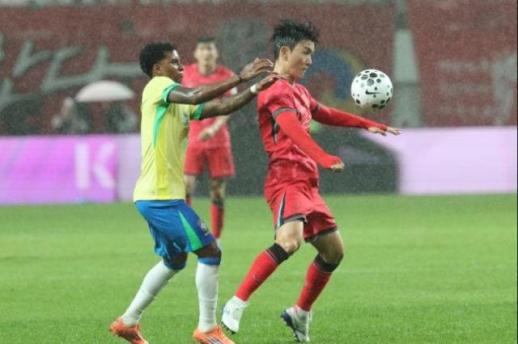 Dutch report says South Korea midfielder Hwang In-beom out for season with injury South Korea national team midfielder Hwang In-beom, who plays for Feyenoord in the Dutch Eredivisie, will end his season early because of injury. Dutch outlet 1908.NL reported on May 3 (Korean time), citing sources, that Hwang will not be able to play in the remaining matches. Feyenoord, currently second in the league, has three games left before the season ends. Hwang injured his right ankle in a match against Excelsior on March 16. He was named to Hong Myung-bo’s squad for March international matches but ultimately did not join. He has not played an official match for his club since, focusing on rehabilitation. The injury is also a setback for South Korea as it prepares for the 2026 FIFA World Cup in North America. Hwang has been a key midfielder and a central link in Hong’s lineup. The outlet said Hwang’s World Cup participation is uncertain, while adding there is also an optimistic view that he could recover at an appropriate time.* This article has been translated by AI. 2026-05-03 12:24:14
 -
 South Korea Steps Up Crackdown After 600 Billion Won in Illegal FX Deals Uncovered South Korea is strengthening interagency enforcement as authorities continue to uncover large-scale overseas outflows of funds through illegal foreign exchange transactions. The Ministry of Finance and Economy said Saturday that it held an all-government meeting of its Illegal Foreign Exchange Transaction Response Team on April 30 to review enforcement results and major cases. The team said it found that a small overseas remittance operator abused virtual accounts to illegally send about 400 billion won overseas, including proceeds from online gambling sites. The case was referred to prosecutors on suspicion of operating an unregistered foreign exchange business, among other allegations. Authorities also confirmed that a money broker received about 200 billion won in used-car and auto-parts export payments in virtual assets without filing required reports, then paid won to domestic firms after deducting fees. That case was also sent to prosecutors, and additional probes of the related companies are underway. In another case under investigation, exporters allegedly underreported scrap metal export prices and brought the difference into South Korea through a money-transfer scheme using accounts held under borrowed names. The government cited interagency coordination in the investigations. The Financial Supervisory Service shared suspected illegal remittance activity found during an inspection with the Korea Customs Service, which investigated and referred the case to prosecutors. The National Tax Service is examining whether the companies evaded taxes, and the National Intelligence Service is supporting collection of information on overseas-linked crimes. The finance ministry and the Bank of Korea said they are reinforcing the response system by expanding foreign exchange information sharing and improving related rules. The government said it will continue to tighten enforcement through coordinated action as illegal foreign exchange transactions grow more complex and sophisticated. The response team was launched in January and is operating a joint framework. At a meeting held last month, it said it would respond strictly, including immediate complaints over the spread of false information and illegal foreign exchange transactions.* This article has been translated by AI. 2026-05-03 12:05:54
 -
 South Korea approves five National Growth Fund projects, bringing total to 8.4 trillion won The Financial Services Commission is moving to step up investment through the National Growth Fund. The FSC said Saturday it approved funding support for five projects at a meeting of the fund’s investment review committee. With the latest approvals, the fund has approved 11 projects totaling 8.4 trillion won in cumulative financing. A key agenda item was a 100 billion won direct investment in Upstage, a South Korean AI venture that develops AI solutions for businesses and government and builds large language models. The FSC said the investment will be used to develop next-generation AI models and build infrastructure to operate large language models, as part of a planned 560 billion won fundraising effort. The committee also approved a project to build a national AI computing center. The FSC said the approval confirms 400 billion won in capital fundraising, with plans to pursue additional loans of up to more than 2 trillion won. A proposal tied to building an advanced industrial belt in Saemangeum was also approved. The National Growth Fund decided to provide Future Graph with a total of 250 billion won in low-interest loans, including 200 billion won from an advanced strategic industries fund. The FSC said the factory project, with 400 billion won to be invested, is expected to establish an annual production base of 37,000 tons of spherical graphite at the Saemangeum National Industrial Complex. Other approved items included an expansion of STGen Bio’s contract manufacturing plant for biopharmaceuticals and low-interest loans for a midsize semiconductor materials company. The FSC said it is accelerating investment planning after creating the 150 trillion won National Growth Fund to foster advanced strategic industries and support an economic rebound. It said it will regularly announce large-scale projects with broad industrial spillover effects while responding on an ongoing basis to diverse funding needs across the advanced-industry ecosystem.* This article has been translated by AI. 2026-05-03 12:05:10
 -
 South Korea launches public contest for water-energy integration ideas The government is seeking policy ideas that treat water and energy as a single system, aiming to improve efficiency by linking areas that have been managed separately. The Ministry of Climate, Energy and Environment said Saturday it will run a nationwide “Water-Energy Convergence” idea contest from May 4 to 31. In this context, “water-energy convergence” refers to a cooperation platform that integrates the water and energy sectors into one circular system and applies it jointly in policy and projects. One example cited is an alert service that provides real-time integrated information by combining the advanced metering infrastructure (AMI) remote-metering networks previously operated separately by Korea Electric Power Corp. and Korea Water Resources Corp. Water underpins energy production, including power generation, cooling and hydrogen production, while energy is essential across the full water cycle, from intake and purification to transport and treatment. Because the two sectors depend on each other, calls for integrated management have persisted. The contest is designed to go beyond technical proposals and focus on policy ideas the public can feel. It will accept entries in two categories: policy proposals for young people and practical, everyday saving measures open to all. After preliminary screening, a public vote and final evaluation, the government plans to select six winners. Prizes, including minister’s awards, will total 7 million won. The contest also follows steps to formalize integrated water-energy policy. In February, the ministry launched a Water-Energy Convergence Forum involving 12 public institutions to build a basis for policy cooperation. The ministry said it plans to link policies, technologies and resources across the two fields to establish an integrated management system. “The key task is to merge water and energy policies into one to improve convenience in people’s daily lives,” said Kim Ji-young, the ministry’s director general for water-use policy. “We will reflect ideas found through the contest in policy.”* This article has been translated by AI. 2026-05-03 12:04:29