
Journalist

Seo Hye Seung
-
 BGF Logis, Cargo Truckers Union Reach Deal; Improvements to Apply to All Drivers BGF Logis, the logistics unit of BGF Retail, said it has reached a final agreement with the Cargo Truckers Union, ending a dispute that disrupted deliveries. In a statement released April 30, BGF Logis said talks with the union concluded that day and that the resulting improvements in working conditions will apply equally to all transport workers who work with the company, regardless of affiliation or union membership. The company said blockades at its logistics centers and ready-to-eat food plants will be lifted immediately once the agreement is signed, and deliveries will resume in stages after each site completes internal preparations. BGF Logis said it decided to extend the terms to nonunion workers to fulfill its “duty and responsibility” to those who stayed on the job during a difficult period. It added that it will use the agreement as an opportunity to build a healthier logistics ecosystem and will continue efforts to support customer convenience and stable store operations. The agreement signed earlier April 30 includes a 7% increase in transport fees, one paid day off per quarter for truck owner-operators, guarantees for union activities, and civil and criminal immunity related to the recent rallies, along with withdrawal of injunction requests, according to reports. It also includes provisions on restoring the honor of a deceased union member and paying respects. BGF Retail, which operates the CU convenience store chain, said it will prepare support measures for franchisees. The company plans to assess damage at stores, gather feedback from the field and develop assistance plans. After internal preparations, BGF Logis plans to restart operations centered on its Jincheon logistics center and aims to normalize all logistics centers and plants within this week. * This article has been translated by AI. 2026-04-30 16:01:44
 -
 Samsung Elec flags prolonged AI-driven memory crunch as orders stretch to 2027 SEOUL, April 30 (AJP) - Samsung Electronics said surging artificial intelligence demand is likely to keep memory markets exceptionally tight well into next year, with orders now extending as far as 2027, underscoring the depth of the current supply squeeze. The company, already swamped with orders stretching into next year, said the extraordinary tightness will persist and that production will remain unaffected even if labor action proceeds. “Our capacity far lags behind customer demand amid extremely tight inventory levels. Demand far exceeds our capacity, with coverage at a historic low,” Kim Jae-joon, executive vice president of memory strategy and marketing, said on a conference call Thursday after the company confirmed record quarterly results for the three months ended March. The imbalance has deepened to the point where Samsung is accepting orders for 2027, including long-term agreements (LTAs) with key clients to secure business visibility. Driven by aggressive expansion, Samsung expects its next-generation HBM4 chips to account for more than half of total high bandwidth memory (HBM) sales by the third quarter. The Device Solutions (DS) division posted record earnings, generating 53.7 trillion won ($39.2 billion) in operating profit on revenue of 81.7 trillion won, translating into an operating margin of 65.7 percent — still trailing domestic rival SK hynix’s 71.5 percent. Addressing market views that conventional DRAM is currently more profitable than HBM due to recent price spikes, Samsung said it would not prioritize short-term gains. “A balanced supply of both HBM and conventional DRAM is essential to sustain AI-driven demand,” the company said. “We will maintain a balanced product mix, taking into account mid- to long-term growth and long-term customer relationships.” In a move to enhance shareholder returns, Samsung said it will cancel remaining treasury shares equivalent to 1.2 percent of common stock and 1.7 percent of preferred shares, valued at about 14.6 trillion won ($10.6 billion) based on the board resolution date. Capital expenditure reached 11.2 trillion won in the first quarter, with 10.2 trillion won allocated to expanding semiconductor facilities. Labor tensions, however, remain a key overhang. Management said it is seeking to resolve disputes through dialogue and avert a planned 18-day strike from May 21, while pledging to keep production lines running even if a walkout occurs. Samsung confirmed consolidated operating profit of 57.23 trillion won on revenue of 133.87 trillion won. Beyond the semiconductor business, the Device eXperience (DX) division posted operating profit of 3 trillion won on sales of 52.7 trillion won. 2026-04-30 16:01:17
 -
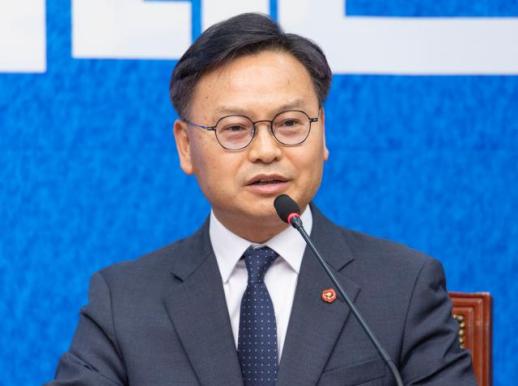 Democratic Party Taps Kim Seong-beom as Third Recruitment Pick Ahead of June 3 By-Elections The Democratic Party on April 30 named Kim Seong-beom, a former vice minister of oceans and fisheries, as its third “talent recruitment” pick ahead of the June 3 parliamentary by-elections. Kim is widely expected to run in Seogwipo, Jeju, the seat vacated by Wi Seong-gon after Wi confirmed his bid for Jeju governor and resigned his lawmaker post. Kim said he wants to work for his hometown of Seogwipo. Party leader Jeong Cheong-rae introduced Kim at a National Assembly event, calling him “a master” in the oceans and fisheries field. Jeong said Kim was appointed vice minister as soon as the Lee Jae-myung government launched and showed strong performance, adding that Kim wants to use more than 30 years of experience for Seogwipo’s development and South Korea’s maritime future. Kim said he spent 32 years in public service, working mostly in oceans and fisheries administration. He said that as vice minister he delivered results, including handling the relocation of the oceans ministry to Busan and raising fines for illegal Chinese fishing boats. Kim, who is from Namjeju and attended school in Seogwipo, said he left Seogwipo, gained broader experience and returned. “I will use the national-level experience and strength I have built up for my hometown of Seogwipo,” he said. Wi, who attended the event, encouraged Kim. Wi said Kim is “yomangjida,” explaining it as a Jeju dialect expression meaning “bold and capable,” and said he believes Kim will do well. The party previously recruited attorney Jeon Tae-jin from Ulsan as its first pick and on April 20 gave him a strategic nomination in Ulsan Nam-gap. It then recruited Ha Jeong-woo, former senior presidential secretary for AI future planning, and Jeon Eun-su, former presidential spokesperson, as picks No. 2 and No. 3, respectively. Jeong said the party plans to continue recruiting. After visiting Deokpung Traditional Market in Hanam, Gyeonggi Province, the day before, he told reporters that after the third recruitment event there was a “99.9%” chance of adding one more person, saying he had someone in mind.* This article has been translated by AI. 2026-04-30 16:00:14
 -
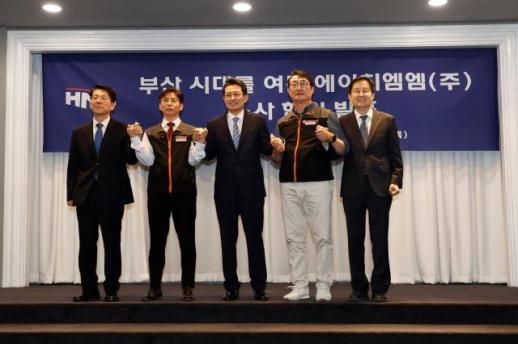 HMM reaches labor-management deal to move HQ to Busan SEOUL, April 30 (AJP) - South Korea’s HMM, the world’s eighth-largest shipping company, said Friday that its labor and management have reached an agreement to relocate the company’s headquarters to the southern port city of Busan, the country’s main maritime gateway, resolving a long-standing dispute that had raised concerns over labor strikes and disruptions to global logistics. Busan, home to South Korea’s largest port, has been positioning itself as a maritime and logistics hub, with the government pushing to cluster shipping, finance, and related industries in the city. While the government expects the relocation to strengthen operational efficiency and create synergies with port infrastructure and maritime institutions in the city, concerned voices erupted from workers from government offices and companies, including HMM, who were worried about their families leaving their hometown to move to Busan. The shipbuilder said that the agreement reflects a shared commitment to national priorities such as regional development and decentralization. HMM added that with the prolonged Middle East conflict continuing to strain global supply chains, the deal was reached to avoid a potential labor strike stemming from labor-management differences, which could have disrupted both domestic and international logistics and led to broader social and economic impacts. Under the deal, HMM will complete legal procedures to change its registered headquarters following an extraordinary shareholders’ meeting scheduled for May 8. Afterward, the company will first relocate the CEO’s office, after which labor and management will begin detailed talks on the relocation, with a focus on business efficiency and potential synergies. The company said the two sides had held multiple rounds of talks since the second half of last year but failed to reach an agreement, with tensions escalating recently as the union filed for mediation, pursued legal action against the CEO and warned of a possible strike. The company also plans to push ahead with the construction of a landmark office building in Busan’s North Port area to support the local economy. Meanwhile, the company reported revenue of 10.89 trillion won ($7.9 billion) and an operating profit of 1.46 trillion won last year. An official of HMM said the deal reflects national priorities and the company’s role as a national flag carrier, adding that with uncertainties now eased, it will focus on addressing external risks and strengthening its global competitiveness. Founded in 1976, HMM operates a global network connecting more than 60 trade routes and over 100 ports across the Americas, Europe, the Middle East and Latin America. The company has secured container capacity exceeding 1 million twenty-foot equivalent units (TEUs) and aims to expand this to 1.55 million TEUs by 2030, alongside investments in eco-friendly vessels and digital transformation. 2026-04-30 15:59:52
 -
 South Korea’s Kospi Slips After Topping 6,750 as Foreign Selling Spurs Profit-Taking South Korea’s Kospi climbed above the 6,750 level in intraday trading on April 30 but reversed to finish lower as foreign investors sold and overseas uncertainties weighed on sentiment. Ahead of a holiday, profit-taking erased earlier gains and pushed the benchmark back into the 6,590 range. According to the Korea Exchange, the Kospi closed down 92.03 points, or 1.38%, at 6,598.87. It opened up 48.49 points, or 0.72%, at 6,739.39 and briefly topped 6,750 before turning negative. In the main market, retail investors bought a net 1.8065 trillion won, while foreigners and institutions sold a net 1.6773 trillion won and 99.7 billion won, respectively, as they locked in gains. Most heavyweight stocks fell. Samsung Electronics dropped 2.34%, Hyundai Motor slid 4.50%, LG Energy Solution fell 2.64%, Doosan Enerbility lost 1.63%, Hanwha Aerospace dipped 0.21%, HD Hyundai Heavy Industries fell 0.72% and Samsung Biologics slipped 0.20%. SK hynix rose 1.33%. The Kosdaq closed down 27.91 points, or 2.29%, at 1,192.35. Retail investors bought a net 653.5 billion won, while foreigners and institutions sold a net 300.3 billion won and 310.9 billion won, respectively. Kosdaq leaders were mixed. Rainbow Robotics rose 0.15% and Lino Industrial gained 6.33%, while EcoPro fell 4.25%, EcoPro BM lost 2.82%, Alteogen dropped 3.03%, Samchundang Pharm slid 6.09%, Kolon TissueGene fell 5.03%, HLB lost 3.02%, ABL Bio dropped 5.14% and LigaChem Bio fell 5.50%. Lee Kyung-min, a researcher at Daishin Securities, said net foreign selling expanded while institutional selling eased, helping support the market’s lower end. He said the Kospi stayed weak as it digested a hawkish Federal Open Market Committee stance and inflation concerns tied to high oil prices.* This article has been translated by AI. 2026-04-30 15:58:36
 -
 K Bank Q1 Net Profit Jumps 107% to 33.2 Billion Won on Strong Corporate Lending K Bank said in a regulatory filing on Wednesday that it posted net profit of 33.2 billion won ($?) in the first quarter, up 106.9% from a year earlier, as asset growth continued on strong corporate lending. Total customers reached 16.07 million at the end of the quarter, up 540,000 from the end of last year. Deposits totaled 28.22 trillion won, up 1.5% from 27.80 trillion won a year earlier. Loans rose 10.7% to 18.75 trillion won from 16.94 trillion won. Despite a tighter stance on household lending, the bank said its strategy to expand corporate loans — mainly to sole proprietors — drove loan growth. Corporate loan balances more than doubled over the past year to 2.75 trillion won from 1.31 trillion won. The bank said net increases in corporate loan balances have expanded for five straight quarters. Net interest income rose 15.4% to 125.2 billion won from 108.5 billion won. The net interest margin widened to 1.57% from 1.41% on loan growth, changes in the rate environment and an improved funding mix. Noninterest income increased about 4% to 14.2 billion won. Credit loss provisions fell 7.6% to 50.1 billion won from 53.9 billion won, and the credit cost ratio improved to 1.09% from 1.31%. The delinquency ratio edged down to 0.61% at the end of the first quarter from 0.66% a year earlier, while the ratio of substandard or below loans eased to 0.58% from 0.61%. The bank’s BIS capital ratio stood at 21.47%. The average share of mid- to low-credit loans in the first quarter was 31.9%, and the share of new mid- to low-credit loans was 33.5%, both above regulatory thresholds of 30% and 32%, respectively. Chief Executive Choi Woo-hyung said the first quarter was a period in which the bank strengthened its growth base by proactively expanding lending to sole proprietors. He said K Bank will further refine its corporate finance portfolio and seek competitiveness in global digital asset markets, including stablecoins, to continue differentiated innovation.* This article has been translated by AI. 2026-04-30 15:56:05
 -
 South Korea Supreme Court backs workers in Dong-A Transport wage suit, orders overtime pay The Supreme Court has largely sided with workers in a wage lawsuit involving Seoul city bus operator Dong-A Transport, a case that helped spark labor unrest in the sector. According to the legal community on Wednesday, the court’s Third Division, with Justice Lee Sook-yeon as the presiding justice, partially overturned an appellate ruling and sent the case back to the Seoul High Court. The top court left most of the lower court’s decision intact, overturning only part of the portion in which workers had lost. As a result, Dong-A Transport must pay overtime and night-work allowances based on “deemed working hours” — guaranteed hours set by labor and management — even when they exceed actual hours worked. Deemed working hours refer to a system that treats a set number of hours as overtime or night work regardless of actual overtime or holiday work, reflecting the nature of the work schedule and conditions. In its decision, the Supreme Court upheld the lower court’s finding that regular bonuses should be included in ordinary wages. It also found no problem with the conclusion that allowances must be recalculated using ordinary wages that reflect those bonuses, and that the company must pay the difference if it previously paid less. However, the court said the lower court misunderstood the law when it ordered overtime and night-work allowances to be paid only for actual hours worked rather than deemed working hours, and it reversed and remanded that part. The lawsuit was filed by bus driver A and other Dong-A Transport employees in 2015. They argued that a regular bonus paid every other month, calculated at 100% of base pay, should be treated as ordinary wages, and that the company should pay unpaid allowances that were underpaid after excluding the bonus. They also said the company undervalued their actual working time by relying on driving hours entered into the Seoul Bus Management System, excluding time for pre- and post-trip tasks, refueling, waiting, and training. They sought retroactive payment of unpaid overtime, night-work and holiday-work allowances. A trial court ruled for the company, citing earlier Supreme Court precedent that required “fixedness” for pay to qualify as ordinary wages. The decision was overturned on appeal. While the appeal was pending in 2024, the Supreme Court issued a new precedent abolishing the fixedness requirement. Applying that precedent, the appellate court ruled in October last year for the workers by recognizing the regular bonus as ordinary wages. But it ordered allowances to be paid only for actual hours worked, which were shorter than deemed working hours. The workers appealed. The ruling is significant as the first case in which the shift in ordinary-wage doctrine has been applied in practice to the city bus industry. If regular bonuses are included in ordinary wages, overtime, night-work and holiday-work allowances calculated on that basis rise accordingly. If the judgment becomes final after the remand proceedings, cost burdens are expected to increase sharply for Dong-A Transport and other city bus operators. In areas such as Seoul that use a quasi-public system, local governments cover bus companies’ deficits with tax revenue, raising the prospect of substantial public spending. * This article has been translated by AI. 2026-04-30 15:48:17
 -
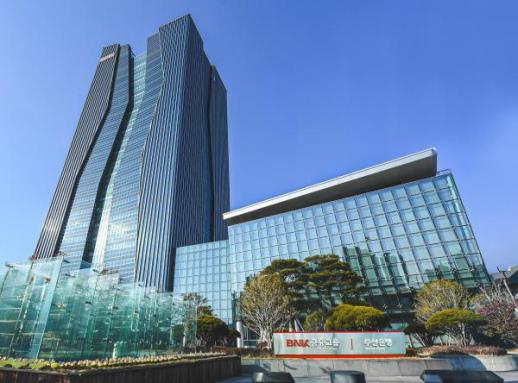 BNK Financial Posts 211.4 Billion Won Q1 Net Profit, Up 26.9% on Year BNK Financial Group said Thursday in an earnings disclosure that its consolidated net profit for the first quarter of 2026 totaled 211.4 billion won. The result was up 26.9%, or 44.8 billion won, from a year earlier. The group said higher selling and administrative expenses and weaker noninterest income were offset by steady net interest income and lower credit-loss provisions. By segment, banking net profit came to 175.6 billion won, up 20.6 billion won from a year earlier. BNK Busan Bank posted a 22.5 billion won increase, while BNK Kyongnam Bank slipped 1.9 billion won. Nonbank units reported net profit of 59.6 billion won, up 25.3 billion won, as results improved across affiliates. BNK Capital rose 10.7 billion won and BNK Asset Management gained 7.5 billion won, the group said. Asset quality indicators weakened. The group’s nonperforming loan ratio was 1.57% and its delinquency rate was 1.42%, up 15 basis points and 28 basis points, respectively, from the previous quarter, which it attributed to an increase in bad loans amid a slowing economy. The group’s common equity Tier 1 ratio stood at 12.30%, up 5 basis points from a year earlier. BNK Financial said its board approved a quarterly cash dividend of 150 won per share, a 25% increase from last year. It also plans to buy back and cancel 60 billion won worth of its own shares in the first half. Park Seong-uk, the group’s chief financial officer, said BNK Financial will work to raise shareholder value by increasing the share of buybacks and cancellations while steadily expanding cash dividends to meet requirements for high-dividend companies under separate taxation of dividend income. * This article has been translated by AI. 2026-04-30 15:43:46
 -
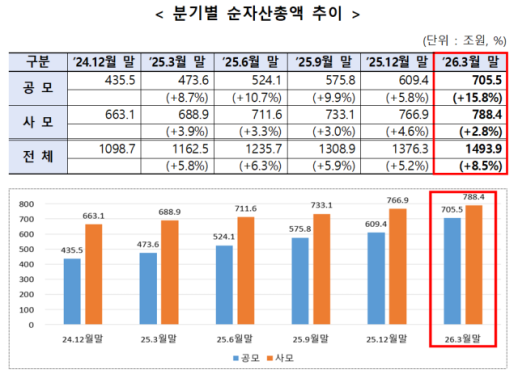 Korea Fund Assets Near 1,500 Trillion Won in Q1 as Stock Funds and ETFs Surge South Korea’s fund market expanded sharply in the first quarter, with total net assets nearing 1,500 trillion won as inflows concentrated in equity funds and money market funds, and exchange-traded funds posted strong growth. The Korea Financial Investment Association said Thursday in its “2026 first-quarter fund market trends” report that total net assets for public and private funds stood at 1,493.9 trillion won at the end of March, up 117.6 trillion won, or 8.5%, from 1,376.3 trillion won the previous quarter. The quarterly growth rate accelerated from 6.3% in the second quarter of last year, 5.9% in the third and 5.2% in the fourth. Both public and private funds increased. Public funds rose to 705.5 trillion won, up 96.1 trillion won, or 15.8%, from the prior quarter. Private funds climbed to 788.4 trillion won, up 21.5 trillion won, or 2.8%. By category, net assets increased across most types, with bond funds the exception, falling 3.9 trillion won. Equity funds posted the largest gain, rising 56.0 trillion won, followed by money market funds, or MMFs, up 34.5 trillion won, and derivatives funds, up 10.2 trillion won. Public-fund growth was led by equity funds and MMFs, while private funds grew mainly in MMFs and special-asset funds. Net inflows also showed a tilt toward equity funds and MMFs. Total funds recorded net inflows of 85.4 trillion won in the quarter, while bond funds alone saw net outflows of 2.5 trillion won. Public funds took in 72.3 trillion won and private funds 13.1 trillion won. By investment region, domestically focused funds drew 73.2 trillion won and overseas funds 12.1 trillion won. By type, net inflows went to equity funds at 32.9 trillion won, MMFs at 32.7 trillion won, derivatives funds at 7.5 trillion won and mixed funds at 4.4 trillion won. Public funds attracted money mainly into equity funds and MMFs, while private funds saw inflows centered on MMFs and mixed-asset funds. The share of domestically focused funds also increased. As of the end of March, domestic-investment funds held net assets of 976.1 trillion won, up 103.9 trillion won, or 11.9%, accounting for 65.3% of the total. Overseas-investment funds rose 13.7 trillion won, or 2.7%, to 517.8 trillion won, lowering their share to 34.7%. Domestic equity funds climbed to 177.8 trillion won, a 41.5% jump from 125.6 trillion won the previous quarter, helping drive overall market growth. Overseas funds posted more modest gains, led by equity and special-asset funds. ETF growth was particularly strong. ETF net assets totaled 360.7 trillion won at the end of March, up 63.6 trillion won, or 21.4%, from 297.1 trillion won the previous quarter. Within ETFs, equity products accounted for the largest share at 58.2%, followed by derivatives at 21.3% and bond ETFs at 14.6%. Net assets in public funds excluding ETFs rose to 344.7 trillion won, up 32.5 trillion won, or 10.4%. Public funds accounted for 47.2% of total fund assets, up 2.9 percentage points from the previous quarter, narrowing the gap with private funds. * This article has been translated by AI. 2026-04-30 15:42:19
 -
 South Korea to Overhaul 2027 R&D Budget, Shift Funds to Strategic Technologies The government is moving to restructure funding for 2027 research and development, concentrating investment on national strategic technologies such as semiconductors, artificial intelligence, advanced bio and quantum technology. It also plans to streamline R&D spending across ministries by cutting discretionary outlays by about 15% and mandatory spending by about 10%. The Ministry of Science and ICT and the Office of Budget Planning said they held a budget strategy meeting on the afternoon of April 30 to discuss the “2027 R&D investment strategy.” The meeting was chaired by Park In-gyu, head of the Science and Technology Innovation Office at the ministry, and attended by more than 30 ministries and agencies that run R&D programs. Under the Framework Act on Science and Technology, the ministry’s Science and Technology Innovation Office draws up a plan each year to allocate and adjust the next year’s national R&D budget, after deliberation and approval by the National Science and Technology Advisory Council by the end of June. The budget office then compiles and considers the plan in drafting the final government budget proposal. The government said the 2027 allocation and adjustment plan will focus on: strengthening strategy through cross-government “one-team” cooperation; restructuring government R&D and reinvesting in priority areas; overhauling programs through broad evaluation and feedback; and introducing an equity-investment approach to R&D support to build a virtuous investment cycle. To improve efficiency and consistency, the government said it will reduce barriers between ministries and allocate R&D budgets from an integrated national perspective. It will also set shared goals and expand cooperation, including strengthening “inter-ministerial collaborative R&D.” It will also pursue spending restructuring for government R&D. More than 30 ministries and agencies will work on budget efficiency and spending adjustments, using benchmarks of 15% for discretionary spending and 10% for mandatory spending across fiscal programs. With resources secured through the restructuring, the government said it will reinvest in national strategic technologies in line with its “direction for advancing the national strategic technology system.” It previously selected 12 strategic technologies, including manufacturing and energy areas such as semiconductors, secondary batteries and hydrogen; mobility, aerospace and communications; and AI, bio and quantum. It also said it would foster the areas systematically by designating 50 detailed priority technologies. The government also plans to hold a “National Strategic Technology Leading Next Project Promotion Conference” (tentative name) in May to select target projects. It will also move to fix inefficient R&D programs. The innovation office said it will strengthen evaluation and inspections and reorganize programs around areas with higher potential to produce results. In addition, the government said it will newly pursue an equity-investment model for R&D support, shifting away from a grant-centered structure to one that can recover investments. Park said the 2027 R&D budget would be a “golden-time budget” to meet goals over the next four years. “We will thoroughly block waste factors and prepare a performance-centered budget that boldly invests in areas that are truly necessary,” he said, adding that the government would work as “one team” to drive technology-led growth. 2026-04-30 15:33:19