
Journalist

Tom Stacey
-
 S. Korea claims North Korean economy on recovery SEOUL, April 15 (AJP) - South Korea’s Unification Ministry said Wednesday that North Korea’s economy is entering a gradual recovery phase in line with closer ties and trade activities with Russia and China. The ministry cited deepening “alliance-level” ties between Pyongyang and Moscow — including cooperation in advanced weapons and technology — alongside increased exchange with China, as key drivers supporting the country’s economic stabilization. The assessment was included in a report submitted to the National Assembly’s Foreign Affairs and Unification Committee as part of a new 2026–2030 inter-Korean relations plan that signals a shift in Seoul’s policy and departure from the former and impeached president President Yoon Suk Yeol. The new pivot under the Lee Jae Myung administration focused on peaceful coexistence, economic cooperation, and a denuclearized Korean Peninsula, while rejecting absorption-based unification and hostile actions. The report delivers a pointed critique of Yoon’s North Korea policy, which offered large-scale economic aid in exchange for denuclearization, as impractical for requiring Pyongyang to act first. The Unification Ministry said past hardline policy increased security instability, weakened the foundation for inter-Korean cooperation, and entrenched confrontational dynamics. It added that detailed annual implementation plans will be developed under the new framework. 2026-04-15 17:56:05
 -
 Korea FDA Visits Functional Cosmetics R&D Site; Firms Report on Disinfectant, OTC Misuse, Patent Transfer MFDS visits functional cosmetics R&D site to speed product rollout Kang Seok-yeon, head of the National Institute of Food and Drug Safety Evaluation, visited the central research institute of cosmetics contract manufacturer Cosmecca Korea and held a meeting with industry representatives, the institute said Tuesday. The visit reviewed development and quality-research facilities for functional cosmetics, including new formulations, and examined recent technology applications and product development trends. Officials also heard concerns about technical hurdles and the need for regulatory improvements. The meeting included the Korea Cosmetic Association and industry officials, who discussed regulatory support to help functional cosmetics reach the market faster. Key topics included support for launches to strengthen global competitiveness, improvements to the functional cosmetics review system, and expanded support based on regulatory science. Kang Seok-yeon said, "We will strengthen regulatory support so functional cosmetics can be developed and launched quickly by reflecting feedback from the field." Chong Kun Dang's 'Bio Spike Guard' shows 24-hour antibacterial effect in real-world study Chong Kun Dang said Tuesday that study results confirming the sustained disinfecting effect of its environmental disinfectant wipes, Bio Spike Guard, were published in Infection & Chemotherapy, an international journal of the Korean Society of Infectious Diseases. Bio Spike Guard combines didecyldimethylammonium chloride (DDAC) and organosilane (Si-QAC). The company said it provides immediate disinfection and forms a protective layer on surfaces that helps kill microbes. The study involved five hospitals — The Catholic University of Korea Seoul St. Mary's Hospital, Asan Medical Center, Seoul National University Bundang Hospital, Konkuk University Medical Center and Gachon University Gil Medical Center — and was conducted as a controlled study in real clinical settings. Researchers compared the product with existing disinfection methods at about 160 sites, including dry areas such as bed rails and nurse stations and wet areas such as sinks and toilet lids. The study found Bio Spike Guard maintained a statistically meaningful reduction in microorganisms from baseline at 1 hour, 6 hours and 24 hours after disinfection. The effect was especially notable in wet areas, where the reduction in microorganisms was greater than in the control group in the 1-hour comparison. GC Green Cross Cool Dream says it is helping prevent teen misuse of OTC drugs GC Green Cross said Tuesday it supported efforts through its Cool Dream brand to prevent adolescents from misusing over-the-counter medicines and to promote a culture of medication counseling. Cool Dream is a sleep aid containing diphenhydramine. The company said it has ranked No. 1 in market share for seven consecutive years, citing fast effects while minimizing concerns about tolerance and dependence. It is a soft capsule made using a patented NeoSol process designed to maximize absorption. The company said it joined public discussion on teen misuse of diphenhydramine, sharing views on prevention steps at a roundtable attended by pharmacists, parents and drugmakers. It also distributed medication guidance leaflets and provided information on the characteristics and side effects of major drugs, saying the materials were designed for use in pharmacies. Samhwa Dang Pharmaceutical to directly acquire S-PASS patent rights; completion expected within days Samhwa Dang Pharmaceutical said Tuesday it will transfer and acquire patent rights to its S-PASS platform technology, an oral formulation conversion technology applied to oral semaglutide, liraglutide and insulin, among others. The company said it previously listed Taiwan-based Summit Biotech as the patent applicant to avoid pushback from global originator drugmakers. Under a comprehensive R&D services contract signed in 2018, Samhwa Dang Pharmaceutical covered R&D costs and all rights, including intellectual property, belonged to Samhwa Dang Pharmaceutical, it said. The company said controversy has recently emerged over patent ownership. CEO Jeon In-seok said at a news conference on April 6, presenting U.S. FDA submission documents, that S-PASS is a patented technology held by the company. Samhwa Dang Pharmaceutical said it will also change the applicant for its ongoing international patent application under the PCT to its own name. The patent assignment agreement between the two companies was signed Monday. An application to change the PCT applicant has been filed with the China National Intellectual Property Administration, and only administrative procedures remain, it said.* This article has been translated by AI. 2026-04-15 17:48:20
 -
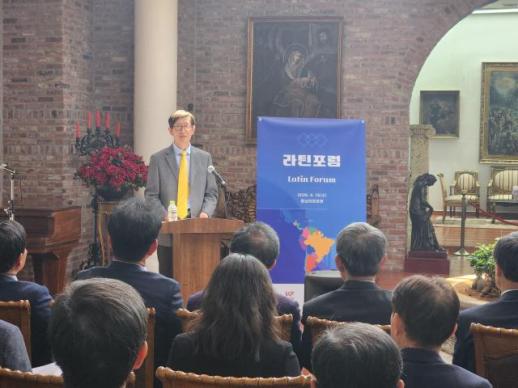 Latin Forum maps US' ambitions to become self-sustaining 'technate' as regional order shifts SEOUL, April 15 (AJP) - The January storming of Venezuela by United States naval forces and the subsequent apprehension of Nicolas Maduro was not merely a regime-toppling maneuver to secure the world's largest crude reserves. It marked the definitive end of Washington's reliance on global oil markets and the birth of an energy-independent, self-sustaining continental fortress. Speaking at this year's Latin Forum on Wednesday, Hankuk University of Foreign Studies Professor Emeritus Kim Won-ho, from the Graduate School of International and Area Studies, framed the attack not as traditional American foreign policy, but as the installation of a radical new governance model. After addressing an audience of diplomats and scholars through a keynote speech, he told AJP his belief that "President Trump is laying a foundation to turn the United States into a self-sufficient 'Technate'." To understand the gravity of this pivot requires an examination of the 1930s and 1940s. Technocracy proposes that modern industrial society is too complex to be managed by elected politicians or the unpredictable fluctuations of price-based economics. Instead, the movement advocated for a system governed by engineers and technical experts who distribute resources based strictly on energy calculations. The ultimate objective was the creation of a "Technate," a singular, geographically self-sufficient bloc spanning North America where political borders dissolve into a streamlined resource engine. The execution of this blueprint is driven by the bitter lessons of Trump's first term. Kim noted in his keynote that during the first term, the president was often "thwarted by the professional bureaucratic class," which he characterized as the "deep state." This internal resistance from career officials effectively stalled the administration's most ambitious structural changes. Returning to power, Trump has shifted to a systemized inner circle. Kim explained that by "wielding Schedule F to purge the career diplomats and civil servants," the administration is removing the "institutional brakes" that once held it back. This process is designed to create what Kim described as a "frictionless domestic machine" capable of executing grand strategy without internal dissent. The historical DNA of this vision entered the administration through Elon Musk. Kim detailed the lineage of Musk’s maternal grandfather, Joshua-Norman Haldeman, who was a "prominent leader in the Canadian branch of the technocracy movement in the 1940s." While the billionaire spectacularly departed the administration in mid-2025 following a bitter public feud with Trump, his ideological blueprint remains deeply embedded in Washington's trajectory. Kim argued that the former advisor viewed the consolidation of North American resources as a "necessary terrestrial prerequisite" for expanding this administrative model beyond Earth, citing the mogul's stated vision that "he will establish technocracy on Mars." Economic siege targets Havana as Rubio anchors regional policy While the administration demonstrated a willingness to use military force to secure Venezuelan energy assets, Kim argued that Washington's approach to Cuba relies on a "strictly non-kinetic set of levers." This localized strategy is driven largely by Marco Rubio. The secretary of state, as Kim pointed out, has used his personal history as a descendant of Cuban immigrants to the U.S. to oversee a "campaign of intense economic and political pressure" specifically tailored to the communist regime of the island. Kim explained the logic behind this strategic divergence: "Because Cuba lacks the massive crude reserves that made Venezuela a technical priority, the strategy shifts from military seizure to systematic strangulation". By cutting off financial lifelines and isolating the government, the administration intends to "collapse the regime from within." According to Kim, this calculated approach ensures that Havana can eventually be "integrated into the new continental bloc" without diverting the military resources required to manage the newly secured energy supply chain in the south. The influence of the secretary ensures this regional framework is designed to outlast current diplomatic cycles. Speaking to AJP on the sidelines of the event, the scholar emphasized the long-term trajectory of this policy: "It is not certain whether the Republicans would secure the next presidency or not, but if the Republicans do, then Trump's steps to change the U.S. into a self-sustaining technate are likely to be carried on by his predecessor." The forum, which drew a gallery of some 100 diplomats and scholars to the region northwest of Seoul, was jointly hosted by the Korean Council on Latin America and the Caribbean and the Korea Foundation. 2026-04-15 17:46:24
 -
 DKZ to End Group Activities After About Seven Years, Shift to Solo Work in June 그룹 DKZ가 약 7년간의 팀 활동에 마침표를 찍는다. 멤버 재찬은 팀 활동 종료 소식을 전하며 팬들에게 감사의 뜻을 전했다. Dongyo Entertainment said on the 15th that after discussions with the members, the group agreed to wrap up DKZ’s activities after its scheduled commitments through May 31, 2026. The agency thanked the members “for their precious effort and time,” and also expressed gratitude to the fandom, known as Dongari, for accompanying the group on its journey. Jaechan also addressed fans directly. “From my debut on April 24, 2019, to today in 2026, so much has happened, and it was a series of happy days beyond what I can put into words,” he said. “Thanks to Ari, I think I was able to feel so many emotions — crying and laughing, enjoying and being happy.” He said he came forward because he felt he needed to share “the end of the journey” from debuting as Dongkiz to becoming DKZ. “Because I was with DKZ, I could become who I am now,” he said, adding that he learned and grew while meeting fans who were “the most precious and reliable” presence for him. Explaining the decision, Jaechan said it still did not feel real that the name DKZ — which he said described his entire life from his late teens to age 26 — would no longer be attached to him. He said the members spent time thinking deeply about the direction each wanted to pursue and their dreams, and concluded that supporting one another while walking separate paths was the more meaningful choice. After group activities end, the five members will pursue individual work. The agency said the members plan to meet fans through solo activities starting in June. It said Jaechan and Juwon have completed contract renewals and will continue working in various fields, while Sehyeon, Mingyu and Giseok will also move forward as artists under the agency. The company said it would continue to fully support all five members and asked for continued encouragement. Jaechan also renewed his exclusive contract and is expected to continue working with Dongyo Entertainment through 2028. “I’ve been promised full support for my overall entertainment activities, so I would be truly grateful if you continue to join me on my journey and be a great source of strength,” he said. “The name DKZ will remain a precious time I will never forget,” he added. “Ari, thank you always, and I love you.” DKZ debuted in 2019 as “Dongkiz.” The group continued activities through a name change and lineup changes, and in 2022 reorganized into a five-member group with the addition of new members.* This article has been translated by AI. 2026-04-15 17:40:01
 -
 AI enters Korean legislature, but humans remain in charge SEOUL, April 15 (AJP) - The National Assembly of South Korea said Tuesday it has launched an AI-powered legislative support platform in collaboration with Samsung SDS, an ICT company affiliated with Samsung Group. The system — a generative AI tailored for legislative use — integrates internal legislative records with external public and academic data to support document search, analysis, and drafting. About 5,000 users, including lawmakers and their aides, are expected to use the platform. The first phase of the project has been completed, with subsequent phases set to expand data coverage, enhance AI functions, and eventually open the platform to the public. While the move is expected to improve efficiency in legislative work, experts caution that AI should remain a support tool, emphasizing that decision-making must ultimately remain a human responsibility, as AI cannot fully account for real-world context. “You cannot explain every context to AI,” said Kang Chang-mook, a professor of electrical engineering at Hanyang University. “Decisions still need to be made by humans.” The platform offers three main functions. It answers policy-related questions, drafts documents, and summarizes meeting records. It also allows users to search across internal and external sources using natural language. In addition, it analyzes existing laws and provisions to suggest similar legislation. The system has been developed in phases, with only the first stage completed so far. The project’s first phase focused on building the National Assembly’s big data infrastructure, according to an official at Samsung SDS. This included converting previously scattered data into AI-readable formats, introducing a legislature-specific language model, establishing data governance, and developing AI-powered search tools. “The next phase will focus on improving the platform by adding more data, enhancing the usefulness of AI services for legislative work, and strengthening data management and maintenance,” he said. In the third phase, he said, the project may expand to include a dedicated AI platform for public use, along with more advanced data structuring and upgraded generative AI capabilities, including agentic AI — a type of AI focused on autonomous systems that can make decisions and perform tasks without human intervention. Despite rapid adoption, structural challenges remain. According to the Korea-based Software Policy & Research Institute, as of 2024, 85.9 percent of central government agencies, all local governments, and 85.5 percent of quasi-governmental institutions in Korea had adopted AI. However, 91.1 percent of administrative staff still use document formats such as HWP and PDF, which are difficult for AI to process. Most public data also remain unstructured, limiting their use for AI training. Data preprocessing alone can account for up to 70 percent of AI adoption costs. Samsung SDS said the platform generates responses based on verified sources such as meeting records and reports to ensure reliability. It added that the system operates on the National Assembly’s internal servers rather than external cloud systems, strengthening data security. South Korea is not alone in adopting AI for legislative work. In the United States, the Senate has approved expanded use of tools including ChatGPT Enterprise, Google Workspace with Gemini, and Copilot Chat. In Brussels, the European Parliament uses AI for translation, summarization, and speech-to-text services, reflecting its multilingual environment. Japan is also expanding adoption, with its Digital Agency planning a pilot program for around 180,000 government officials. However, experts say institutional safeguards will be crucial as AI becomes more embedded in legislative processes, particularly regarding data bias and accountability. They also point to practical limitations, noting that AI may struggle to fully interpret complex legal language and policy context. Concerns have also been raised over data quality, the risk of errors in AI-generated outputs, and unclear lines of responsibility when such outputs are used in policymaking. 2026-04-15 17:33:46
 -
 Following the tracks, following the taste (Gangneung) -2 In quiet courtyards once lived Heo Gyun and Heo Nanseolheon, siblings whose words outlived their time. His Hong Gildong — often called Korea's first novel written in Hangul— still echoes in the air. Here, Gangneung reveals another layer: not just a place to visit, but a place that remembers. The past does not interrupt the present; it settles into it, like a quiet undertone. By the time you reach Gangneung Jungang Market, the journey finds its flavor. Crisp dakgangjeong (sweet fried chicken), soft gamja ongshimi (potato-paste noodle soup), ojingeo sundae (stuffed squid), and the delicate warmth of Chodang tofu — these are not just foods, but continuations of place. Here, visitors and residents move through the same narrow lanes, sharing space, sharing appetite. Nothing feels staged. The market does not perform for tourists; it simply continues. And in that continuity, the boundary between travel and daily life dissolves. Gangneung stays with you in quiet ways. It is there in the moment the sea opens before you, and something within you loosens. Not dramatically, not all at once—but enough to notice. This is why people return. From 2026 to 2027, the city will mark its "Visit Gangneung" years, expanding what it offers. But the essence may remain unchanged: a place where movement leads to stillness, where arrival feels less like an end than a continuation. 2026-04-15 17:20:04
 -
 Young Women Are Transforming South Korea’s Pro Baseball Fan Culture Spring brings a familiar excitement in South Korea — not for cherry blossoms, but for baseball. Cheering sticks, coordinated chants, team merchandise and even dance routines once associated with K-pop fandom have moved into ballparks, reshaping the 45-year-old Korea Baseball Organization league in both scale and style. Last year, pro baseball drew a record 12.31 million spectators and generated more than 1 trillion won in annual economic impact. The KBO is aiming for 13 million fans this year. About 440,000 people attended exhibition games, and the league topped 1 million spectators in a record-low 55 games over 14 days, surpassing last year’s pace and raising expectations of another attendance record (12,312,519). With a surge of women entering the stands, pro baseball has further cemented itself as a national pastime. Women in their 20s and 30s accounted for 38.3% of ticket buyers last year, a shift analysts say is changing how fans watch, spend and participate. The change is visible before fans even reach the gates. On a mild weekend afternoon near Jamsil Sports Complex Station, a team chant echoed through the streets: “Seoul LG, let’s run toward our dream!” Fans streaming out of the subway moved in a steady flow toward the stadium, as if following a set route. Among the red jerseys, women in their 20s and 30s wearing character-collaboration uniforms stood out. Yoo Eun-seo, 23, an LG fan, filmed the chants and took photos with friends for social media. “It feels more like I came to hang out than to watch baseball,” she said. “Cheering, taking pictures — it’s a full-day course.” Ballparks are no longer just places to sit and watch. They have become venues built around experiences — and spending. The fastest changes have come in food and merchandise. Where boiled silkworm pupae and beer once dominated, fans now line up for mala skewers, fruit drinks and desserts. Team stores put key rings, photo cards and character goods front and center. Kiosks draw crowds of fans trying to print photo cards of specific players. Park Si-hyeon, 26, and Yoo Jeong-min, 24, both LG fans, said they buy multiple cards “until the player we want comes out,” adding that “the goods themselves are part of the fun.” A KBO official said the league has become “an experience-based leisure culture combining games with food and entertainment,” with more ways for fans to stay and spend regardless of the result. The official said teams and stadiums have also improved facilities such as restroom cleanliness and nursing rooms, focusing service on safer viewing environments, expanded amenities, and stronger merchandise and content. Under a “fan first” approach, the official added, clubs have stepped up fan service, narrowing the distance between players and supporters. Inside the stands, the new habits are already routine. In a packed stadium with 23,750 seats filled, fans sing along while recording video on their phones. Many stay after the final out to take photos with slogans and post them online. Baseball, for many, has shifted from a sport to watch into content to join and document. How fans follow players is changing, too. Interest now extends beyond performance to appearance, personal narratives and fan service, fueling player-centered fandoms. Waiting for players after games has become a common scene. A club official said players are “being consumed much like idols,” and that individual fandoms can translate into broader team popularity. Teams are responding with more aggressive marketing. Clubs have expanded “special days” and “players days” centered on specific athletes, while limited-edition goods often sell out immediately. KIA collaborated with fashion brand IAB Studio, and the LG Twins released an apparel collection with the YouTube-based brand “Bbodoners.” Kiwoom has sought to attract more women fans through special lectures at women’s universities and campus-linked events. The KBO has also strengthened strategies aimed at younger generations, including student marketer programs, pop-up stores and expanded social media content. The shift is spreading beyond the stadium. Coffee chains, convenience stores and food companies are releasing KBO collaboration products, extending the fan experience into daily life. The economic impact is also clear. Hyundai Research Institute estimated that, based on 2024 pro baseball consumer spending, nationwide production inducement totaled 1.1121 trillion won and employment inducement reached 9,569 people. Clubs’ gate receipts topped 200 billion won. Card company analysis found sales in major business categories near ballparks rose about 90% on game days compared with non-game days. By region, postgame dining sales increased 46% in Daejeon and 42% in Daegu. The league is evolving beyond a corporate-dependent model into a more self-sustaining industry, with some clubs posting profits and demonstrating new revenue streams. This season, games are also expected to feel faster and more immersive as stricter pitch clock rules speed up the pace of play. At the center of the changes are fans — especially women in their 20s and 30s. Their arrival is not only boosting attendance but also reshaping how pro baseball is packaged: viewing is more participatory, spending is more experience-driven, and the industry is leaning into partnerships and expansion. A second KBO official said, “The ballpark is not just a stadium now — it’s a platform,” adding that the experiences fans create have become core content. In that sense, the future of pro baseball is being built as much in the stands as on the field — in the chants, the photos and the merchandise purchases that now help drive the business. 2026-04-15 17:15:32
 -
 Biologics Shift From IV to Subcutaneous Dosing, Reshaping Prescriptions and Sales The biologics market, long dominated by intravenous (IV) infusions, is rapidly shifting to subcutaneous (SC) injections. The change is moving beyond convenience, with growing evidence that dosing method can reshape prescribing patterns and revenue, making formulation a key competitive factor. Industry officials said that in the U.S. market, an insurance billing code (J-code) began applying this month to Merck (MSD)’s SC formulation of its immuno-oncology drug Keytruda. With a J-code, administrative steps between hospitals and insurers are simplified, improving access to prescribing. The industry expects the shift to SC to accelerate further. Several products have already shown how formulation changes can translate into results. Janssen’s multiple myeloma treatment Darzalex reached about 90% of its sales from the SC version within three years of launch. Backed by that shift, 2023 sales rose more than 20% from the previous year, showing how the same drug can see prescriptions and revenue move together as dosing changes. Keytruda is also expected to follow a similar path. While the IV version posted $31.7 billion in sales last year, the SC version generated $40 million in sales just four months after launch, indicating rapid uptake. UBS forecast in a report that the U.S. market for Keytruda SC could grow to about $8 billion next year. Convenience and treatment efficiency are driving the broader shift. IV dosing typically requires a hospital visit and more than an hour for administration, while SC dosing can be delivered in under five minutes and may allow self-injection. SC formulations have been used mainly for autoimmune diseases, but they are increasingly moving into oncology, where clinician monitoring has traditionally been required. A biotech industry official described the trend as competition expanding beyond efficacy to include treatment continuity. The shift is also intensifying technology competition. As more efficient drug delivery begins to influence prescribing choices, securing SC conversion technology is emerging as a core advantage. Globally, competition is centered on companies with formulation-conversion technologies based on human hyaluronidase. U.S.-based Halozyme, through its Enhanze technology, has supported SC conversions of major blockbuster drugs, including Roche’s immuno-oncology drug Tecentriq and Bristol Myers Squibb (BMS)’s immuno-oncology drug Opdivo. In South Korea, Alteogen is seeking to catch up with its Hybrozyme platform, ALT-B4. The technology temporarily breaks down hyaluronic acid in the skin to create pathways for drug dispersion, enabling subcutaneous delivery even for high-volume antibody therapies. Eight global pharmaceutical companies are developing SC formulations using the platform, including deals signed with GlaxoSmithKline (GSK) in January and Biogen in March. Latecomers are also entering. Huons Lab, an R&D subsidiary of Huons Global, has developed technology to convert IV formulations to SC based on its HyDIFFUZ platform. Celltrion is also responding to the expanding SC market with Zymfentra. The company has applied SC conversion technology mainly to its own biosimilars, but plans to expand formulation-conversion services to outside drugmakers. Industry officials said SC conversion is likely to do more than change formulations, potentially reshaping competitive dynamics. “Now, it’s not only the drug itself but also the delivery method that determines competitiveness,” one industry official said. “As patient convenience and treatment efficiency become key standards, demand for SC formulations will grow further.”* This article has been translated by AI. 2026-04-15 17:09:00
 -
 BTS Earns American Music Awards Nods as ‘SWIM’ Hits 100M Views and Charts Stay Strong BTS has landed nominations at the American Music Awards, extended its Billboard run and pushed the music video for its new single “SWIM” past 100 million views on YouTube. According to the AMA nominees list released April 14, BTS was nominated for Artist of the Year. The group previously won the category in 2021 as the first Korean act to do so. BTS also earned nominations for Best Male K-Pop Artist and Song of the Summer, bringing its total to three. “SWIM,” the title track from the group’s fifth full-length album, “ARIRANG,” was nominated for Song of the Summer less than a month after its release. On Billboard’s latest charts released April 14, “SWIM” ranked No. 5 on the April 18 Hot 100. Other “ARIRANG” tracks also charted: “Body to Body” at No. 52, “2.0” at No. 67, “Hooligan” at No. 72, “NORMAL” at No. 82 and “FYA” at No. 90. Six songs from the album have now appeared on the Hot 100 for three consecutive weeks. The group also held No. 1 for a third straight week on Billboard’s Global 200 and Global Excl. U.S. charts with “SWIM.” All 13 vocal tracks placed within the top 50 of the Global 200 and the top 40 of Global Excl. U.S. Over the same period, BTS stayed atop the Billboard 200, Artist 100, Digital Song Sales and Top Album Sales charts for three consecutive weeks. A three-week run at No. 1 on the Billboard 200 is described as an unusual record for K-pop acts and for groups. The “SWIM” music video, released March 20, surpassed 100 million views on YouTube on the afternoon of April 15, adding another 100-million-view video to the group’s catalog. Shot against the sea in Lisbon, Portugal, the video features actor Lili Reinhart and was directed by Tanu Muino. The seven members appear as helpers aboard a ship cutting through waves, supporting a character who has faced setbacks and is trying to move forward. “SWIM” is an alternative pop track about pressing ahead through life’s waves. RM participated in writing the lyrics. The song debuted at No. 1 on the Hot 100 and has remained in the top five for three straight weeks. It has also held No. 1 for three consecutive weeks on Spotify’s Weekly Top Songs Global and continues a long-running No. 1 streak on Spotify’s Daily Top Songs Global. The American Music Awards will be held May 25 at the MGM Grand Garden Arena in Las Vegas. * This article has been translated by AI. 2026-04-15 17:06:09
 -
 New Books: Two Guides to Speaking With Confidence and Listening With Care The Language of Achievement: Calmly, Confidently=By Kim Seop, Apoint. “If your boss gives an unfair order, what would you do?” If that question freezes you, this book offers a way forward. It also speaks to everyday moments, such as when a partner suddenly texts, "Want to grab dinner?" and you feel tired, pressured and unsure how to respond. Kim asks readers to choose between simply talking and actually having a conversation. He argues that attitude matters more than sounding polished like a TV anchor. Clear diction and delivery are less important, he writes, than being able to state your thoughts plainly even if you stumble. He also points to the value of pausing to breathe when blindsided by a question and of reading the needs behind what someone says. The author’s resume is unusual: He passed a high-pressure interview at South Korea’s National Intelligence Service and a final interview at the BBC, which he says is hard to find even reviews of. He started as a YTN announcer, then worked as an NIS agent, and later as a reporter at MBC and the BBC. He now works as a PI consultant designing external communications for corporate CEOs. The book includes practical advice for job candidates, but it is not framed as a set of tricks for passing interviews or winning arguments. As its subtitle, "The power of my story to win someone’s heart," suggests, it emphasizes conviction, composure and room to think as the basis for trust and better relationships. Kim writes that people struggling with small talk, or treating negotiation as a fight to win, may find reason to reassess. He stresses listening as the starting point: "The power to open a closed heart begins with attentive listening," he writes, urging readers to listen closely, ask good questions and show empathy. The book’s editing is uneven, with typos such as "business sege" and an unnecessary symbol ([) where a period should be. "Technique alone can’t move anyone’s heart. Someone who truly speaks well is someone who can honestly put themselves out there. Don’t strain to speak like an announcer. It’s OK to be a bit rough. Speak in my voice, my intonation, my grain. The listener wants sincerity more than pronunciation." (p. 103) Listening With Love=By Park Su-in, Achimdal Park, a music scholar, ranges across the world of sound — classical music, melodies in subway stations, a father’s song from childhood memories, and the rhythmic cloth-beating her mother recalls — and views it through the lens of love. She writes that listening, or leaning in with the ear, is not meaningfully different from loving its object. Asked, "Why did we stop singing in the face of sorrow?" Park argues that song should continue even then. Through the sound of a grandmother’s cloth-beating remembered by her mother, she urges readers to notice what sounds surround them. She writes that readers may come to hear the world in finer detail while also discovering the self that listens, and to think about how love is cultivated. The essay collection includes sheet music to aid understanding and QR codes that link to excerpts of some of the pieces she mentions. "In the scenery of my childhood, sound was low and soft. The sounds between neighbors naturally seeped into one another, and they were both greetings and proof of existence. Now is a time when many things feel delicate, a time overly rigid, or a time of excessive consideration for one another. In crossing the threshold of that consideration, we easily bring in moral yardsticks. An age of tension has arrived, when even the small sounds that rarely intrude are hard to allow." (p. 60) 2026-04-15 16:48:18