
SEOUL, April 15 (AJP) - The National Assembly of South Korea said Tuesday it has launched an AI-powered legislative support platform in collaboration with Samsung SDS, an ICT company affiliated with Samsung Group.
The system — a generative AI tailored for legislative use — integrates internal legislative records with external public and academic data to support document search, analysis, and drafting. About 5,000 users, including lawmakers and their aides, are expected to use the platform.
The first phase of the project has been completed, with subsequent phases set to expand data coverage, enhance AI functions, and eventually open the platform to the public.
While the move is expected to improve efficiency in legislative work, experts caution that AI should remain a support tool, emphasizing that decision-making must ultimately remain a human responsibility, as AI cannot fully account for real-world context.

“You cannot explain every context to AI,” said Kang Chang-mook, a professor of electrical engineering at Hanyang University. “Decisions still need to be made by humans.”
The platform offers three main functions.
It answers policy-related questions, drafts documents, and summarizes meeting records. It also allows users to search across internal and external sources using natural language. In addition, it analyzes existing laws and provisions to suggest similar legislation.
The system has been developed in phases, with only the first stage completed so far.
The project’s first phase focused on building the National Assembly’s big data infrastructure, according to an official at Samsung SDS. This included converting previously scattered data into AI-readable formats, introducing a legislature-specific language model, establishing data governance, and developing AI-powered search tools.
“The next phase will focus on improving the platform by adding more data, enhancing the usefulness of AI services for legislative work, and strengthening data management and maintenance,” he said.
In the third phase, he said, the project may expand to include a dedicated AI platform for public use, along with more advanced data structuring and upgraded generative AI capabilities, including agentic AI — a type of AI focused on autonomous systems that can make decisions and perform tasks without human intervention.
Despite rapid adoption, structural challenges remain.
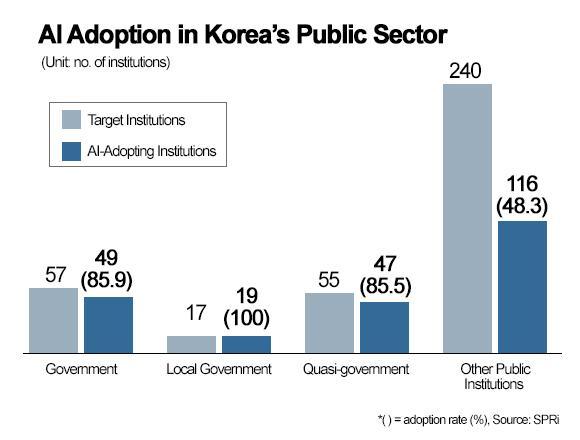
According to the Korea-based Software Policy & Research Institute, as of 2024, 85.9 percent of central government agencies, all local governments, and 85.5 percent of quasi-governmental institutions in Korea had adopted AI. However, 91.1 percent of administrative staff still use document formats such as HWP and PDF, which are difficult for AI to process.
Most public data also remain unstructured, limiting their use for AI training. Data preprocessing alone can account for up to 70 percent of AI adoption costs.
Samsung SDS said the platform generates responses based on verified sources such as meeting records and reports to ensure reliability.
It added that the system operates on the National Assembly’s internal servers rather than external cloud systems, strengthening data security.
South Korea is not alone in adopting AI for legislative work.
In the United States, the Senate has approved expanded use of tools including ChatGPT Enterprise, Google Workspace with Gemini, and Copilot Chat.
In Brussels, the European Parliament uses AI for translation, summarization, and speech-to-text services, reflecting its multilingual environment.
Japan is also expanding adoption, with its Digital Agency planning a pilot program for around 180,000 government officials.
However, experts say institutional safeguards will be crucial as AI becomes more embedded in legislative processes, particularly regarding data bias and accountability.
They also point to practical limitations, noting that AI may struggle to fully interpret complex legal language and policy context. Concerns have also been raised over data quality, the risk of errors in AI-generated outputs, and unclear lines of responsibility when such outputs are used in policymaking.

Copyright ⓒ Aju Press All rights reserved.