


Latest by
-
 Timely Support for Small Businesses: In Tae-yeon Inspects Damage in Geoje and Tongyeong The Small Business Market Promotion Agency announced that In Tae-yeon, the agency's head, visited Geoje and Tongyeong on the 19th to assess the damage caused by heavy rainfall and to listen to the concerns of local merchants.According to the Korea Meteorological Administration, from August 15 to 17, during the Liberation Day holiday, Geoje received 928.0 mm of rain, while Tongyeong saw 752.8 mm. This resulted in flooding and landslides affecting all 17 traditional markets in the Gyeongnam region.During his visit to Okpo Market in Geoje, In inspected the flood damage alongside the market's president and spoke with affected merchants.He then visited the Tongyeong Center of the Small Business Agency, which oversees Tongyeong, Geoje, and Goseong, to review the current situation and support efforts for the flood-affected areas. In emphasized the importance of the center's role in facilitating prompt assistance for small business owners impacted by the heavy rains.After concluding his visit to the Tongyeong Center, In met with merchants at Tongyeong Central Market, expressing his commitment to support their swift recovery.In Tae-yeon stated, "I extend my deepest condolences to the merchants affected by this heavy rainfall. We will do our utmost to quickly assess the damage and ensure that necessary support is provided in a timely manner."* This article has been translated by AI. 2026-08-19 16:52:00
 -
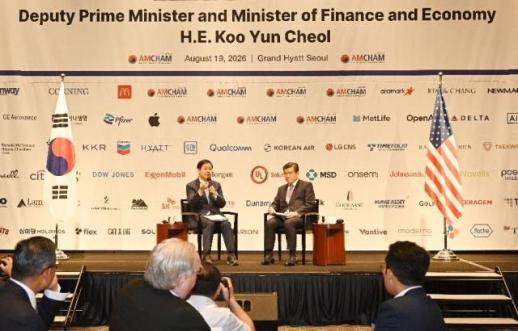 South Korea to raise FX reporting threshold for foreign banks SEOUL, August 19 (AJP) - South Korea will raise the reporting threshold for foreign-currency borrowing by local branches of foreign banks to US$100 million from $50 million, as part of efforts to ease foreign-exchange rules and improve market access, the Ministry of Economy and Finance said on Wednesday. The limit on cash-pooling arrangements will also be raised to at least $100 million from $50 million, Finance Minister and Deputy Prime Minister Koo Yun-cheol said at a meeting with the American Chamber of Commerce in Korea or AMCHAM in central Seoul earlier in the day. Raising the borrowing threshold would allow foreign bank branches to borrow larger amounts of foreign currency before triggering the existing reporting requirement, rather than increasing a ceiling on the amount they are permitted to borrow. The measures follow recommendations from AMCHAM as South Korea works to make its financial and foreign-exchange systems more in line with global standards. The move follows the government's won internationalization roadmap unveiled in July and the shift to round-the-clock foreign-exchange trading, while an offshore won settlement system is scheduled to formally begin operating in January 2027. Koo also pointed to recent capital-market reforms, including an expansion of directors' fiduciary duties to shareholders and South Korea's phased inclusion in the World Government Bond Index, which began in April. Wednesday's meeting at the Grand Hyatt Seoul brought together about 150 participants, including AMCHAM Chairman James Kim, U.S. government officials and executives from Korean and foreign companies. Koo called on U.S. companies to expand investment in South Korea and provide policy feedback based on their experience in the country, saying the government would review proposals raised at the meeting with relevant ministries. 2026-08-19 16:48:27
 -
Kim Min-seok Meets Former President Moon Jae-in, Pledges to Foster Unity in Party Former President Moon Jae-in met with Kim Min-seok, the leader of the Democratic Party, on August 19, expressing concern over factional conflicts that have arisen during the party convention. Moon stated, "There is deep internal injury among party members," and urged for inclusiveness and unity within the party.After the meeting, which lasted about 40 minutes, Chief Spokesperson Park Sung-jun told reporters that Moon emphasized the need for Kim to make special efforts to achieve harmony and inclusiveness within the party.Park also noted that Kim, during his tenure as head of the Democratic Research Institute, had internalized Moon's assertion that "attitude is the essence of politics." He added that this message about language, attitude, and dignity is a crucial virtue for future politics.Moon's concerns about the need to guard against mockery and contempt within the party were also highlighted. According to Park, Moon pointed out that "the prevalence of mockery, contempt, and hatred exacerbates internal conflicts," to which Kim responded, "The foundation of unity is debate in politics. I will ensure that language of mockery, hatred, and contempt does not prevail through campaigns and my role within the party."Since taking office on August 17, Kim has been actively engaging in various activities. On the morning of the meeting, he met with Jeon Jae-soo, the mayor of Busan from the Democratic Party, and immediately chaired a field Supreme Council meeting at the Busan City Party. He later paid tribute at the grave of the late former President Roh Moo-hyun in Bongha Village, Gimhae, and also visited former First Lady Kwon Yang-sook. Kim is scheduled to visit Gangneung in Gangwon Province on August 21 and attend a high-level party-government meeting on August 23. 2026-08-19 16:44:10
-
Kim Min-seok Meets Former President Moon Jae-in, Pledges to Foster Unity in Party Former President Moon Jae-in met with Kim Min-seok, the new leader of the Democratic Party, on August 19, expressing concern over factional conflicts that have arisen during the party convention. Moon stated, "There is deep internal injury among party members," and urged for inclusiveness and unity within the party.After the meeting, which lasted about 40 minutes, Chief Spokesperson Park Sung-jun told reporters that Moon emphasized the need for Kim to make special efforts to achieve harmony and inclusiveness. Park noted, "Moon said there are voices worried about unity within the party, and he asked Kim to work diligently to foster that spirit."Park also mentioned that during Kim's tenure as the head of the Democratic Research Institute, Moon had highlighted that "attitude is the essence of politics," a sentiment that Kim has taken to heart. He added, "The emphasis on language, attitude, and dignity is a crucial virtue in politics moving forward."Moon's concerns about the prevalence of mockery and disdain within the party were also addressed. According to Park, Moon pointed out that "the rampant mockery, disdain, and hatred exacerbate internal conflicts." In response, Kim stated, "The foundation of unity is debate in politics. I will ensure that mockery and hateful language do not prevail, fulfilling my role within the party and through campaigns."Since taking office on August 17, Kim has been actively engaging in various activities. On the morning of the meeting, he met with Jeon Jae-soo, the mayor of Busan, at the Busan City Hall, and then chaired a field Supreme Council meeting at the Busan City Party. Following that, he paid respects at the grave of the late former President Roh Moo-hyun in Bongha Village, Gimhae, and also visited former First Lady Kwon Yang-sook. In the afternoon, he traveled to Yangsan to meet with Moon. Kim is scheduled to visit Gangneung, Gangwon Province, on August 21 and attend a high-level party government meeting on August 23.* This article has been translated by AI. 2026-08-19 16:44:00
-
Trump's Potential Meeting with Kim Boosts Inter-Korean Cooperation Stocks Stocks related to inter-Korean cooperation surged following reports that President Donald Trump may hold a summit with North Korean leader Kim Jong Un as early as this fall. However, analysts caution that these stocks are typical thematic plays without fundamental improvements, urging investors to exercise caution.On August 19, the Korea Exchange reported that stocks classified as inter-Korean cooperation shares showed strong performance. Indief recorded a 29.85% increase, closing at 3,110 won, hitting the upper limit. Good People also rose by 29.84%, finishing at 557 won. Both Indief and Good People are clothing companies that previously operated in the Kaesong Industrial Complex. Hyungji Elite also saw a 2% increase by the end of trading.Ananti closed at 5,350 won, up 18.89%. The company has historical ties to the Mount Kumgang tourism development project. Additionally, Codez Combine rose by 3.56% to 3,635 won, while JST finished up 2.08% at 2,210 won.The rise in inter-Korean cooperation stocks is attributed to renewed optimism regarding U.S.-North Korea relations, following President Trump's expressed willingness to engage in dialogue.The Wall Street Journal reported on August 18 that Trump has urged his aides to push for a meeting with Kim this fall and discussed the possibility of a face-to-face meeting during his next visit to Asia. The Asia-Pacific Economic Cooperation (APEC) summit in Shenzhen, China, in November has been mentioned as a potential venue.The South Korean government has also shown a positive stance on the possibility of resuming U.S.-North Korea dialogue. Foreign Minister Park Jin stated in the National Assembly that, given the nature of Trump's outreach, if Kim desires a meeting, it will happen in some form, calling it a very desirable development from the government's perspective.* This article has been translated by AI. 2026-08-19 16:44:00
-
Actor Hong Min-ki Faces Allegations of Dating Violence and Fan Deception Hong Min-ki, a rising actor known for his roles in dramas such as The Thief Who Loves Me and Love on a Narrow Bridge, is facing legal action amid allegations of dating violence, assault, and threats. A fan has also come forward with claims of deception and disrespect towards fans.On August 19, a fan identified as A, who organized a birthday cafe for Hong, shared a revealing post online expressing her disappointment and discomfort with his behavior. A stated, "Aside from the birthday cafe, there has never been more than two fans present at any offline event," adding that Hong took their time and money for granted.A further criticized Hong's lack of acknowledgment for gifts, saying, "If the gifts weren't valuable, there was never even a simple acknowledgment." She expressed feeling disrespected, likening him to a superficial person focused on cost-effectiveness.The fan continued to detail her experiences, claiming, "He would avoid fans, keeping it a secret from his agency, and when he was recognized, he would give them the cold shoulder. He even pretended to rush to the bathroom to escape conversations."A also mentioned that despite trying to engage Hong with topics about his pet, which he seemed to enjoy, she later realized that even this was insincere, leading her to feel disgusted.Reflecting on the birthday cafe, A remarked, "If he didn't want to attend, he shouldn't have. Why make a fuss about changing his flight to Japan? It was the fans who wanted to leave due to his attitude."She concluded her post with a strong message, stating, "I hope he does not recover from this and faces consequences for his actions. I wish for him to be punished for everything he has done, even as time passes."Prior to this, Hong Min-ki was at the center of controversy after a cease and desist letter from his ex-girlfriend, B, was made public, alleging dating violence. The letter detailed accusations of assault, threats, invasion of privacy, drunk driving while operating an electric scooter, and ongoing verbal abuse and gaslighting, as well as indications of pet abuse. His agency, Fable Company, has denied the allegations and stated they are reviewing the situation and considering legal action, but the recent fan revelations have complicated matters further.* This article has been translated by AI. 2026-08-19 16:40:00
-
 KOSDAQ-listed medical device maker recognized for growth potential SEOUL, August 19 (AJP) - Medical device maker Next Biomedical has been recognized as a rising KOSDAQ-listed firm for the second year in a row, it said on Wednesday. It said it was selected for the Korea Exchange's "rising star" program again this year, which recognizes promising companies based on factors such as technology, financial health and growth potential. The firm attributed the recognition to its technology for controlling bleeding during endoscopic procedures and its growing presence in overseas markets. Despite the recognition, its shares closed 2.22 percent lower at 33,100 won, after falling as low as 32,100 won during the session. Of the 18 companies selected this year, 10 were recognized for a second consecutive year, while eight were selected for the first time, down from 22 companies in 2025. Next Biomedical's main product Nexpowder is a powder used during endoscopic procedures to stop and prevent bleeding in the stomach and intestines. Doctors spray it onto the affected area through an endoscope, a flexible tube used to look inside the body. It then turns into a gel that covers the wound, creating a protective barrier and applying pressure to help control bleeding. The product has also secured regulatory approvals in major markets at home and abroad. It has received authorization from South Korea's Ministry of Food and Drug Safety (MFDS), the U.S. Food and Drug Administration (FDA) and Japan's Pharmaceuticals and Medical Devices Agency (PMDA), as well as certification under the European Union's Medical Device Regulation (MDR). AJP Takeaways • Next Biomedical was selected for the Korea Exchange's 2026 KOSDAQ Rising Star program for a second consecutive year, recognizing its technology, financial stability and growth potential. • Nexpowder, Next Biomedical's main product, is a powder sprayed through an endoscope to help stop and prevent bleeding in the stomach and intestines. • Nexpowder has secured regulatory clearance or certification in South Korea, the United States, Europe and Japan, providing a foundation for the medical device maker's overseas expansion. 2026-08-19 16:34:14
 -
Innovation and Accreditation Must Work Together for Survival, Experts Say In the face of declining school-age populations and financial crises, experts suggest that small universities must integrate university accreditation and innovation support projects into a single operational system to survive. They emphasize the need to avoid one-time achievements and superficial paperwork, advocating for a genuine improvement in institutional quality and sustainable development through the organic connection of these two systems. On August 19, the '2026 Korea Small University EXPO' was held at the Novella Hall of The Riverside Hotel in Seocho-gu, Seoul, co-hosted by Chugye University of Arts and seven other universities. The event, themed 'AI and IR-Based University Innovation,' brought together university presidents, administrators, and innovation project officials to discuss development directions and survival strategies in depth. In his opening remarks, Lim Sang-hyuk, President of Chugye University of Arts, stated, "The significance of this expo lies in expanding each university's innovation into our collective innovation. The competitiveness of small universities is determined not by their physical size but by their clear identity, specialization, responsiveness to change, and meticulous support for each student." In a congratulatory speech, Ahn Se-geun, former head of the Korea Accreditation Institute for Higher Education and a professor emeritus at Konkuk University, noted, "Universities currently face a complex crisis due to declining school-age populations, changes in accreditation systems, the expansion of non-major programs, and the rise of artificial intelligence. It is difficult to achieve sustainable innovation by addressing these issues in isolation at the project or departmental level." Ahn emphasized, "If AI expands the content and methods of education, IR verifies whether these changes lead to actual student growth based on evidence. University evaluations should not merely rank institutions or categorize them as successes or failures; they should serve as a quality assurance process that checks whether promised education is being delivered and helps improve it." The keynote address, a highlight of the event, was delivered by Ahn Sang-du, chair of the Certification Operations Committee at the Korea Accreditation Institute for Higher Education. He discussed 'Response Strategies for Small Universities in Accreditation: Focusing on Integration with Innovation Support Projects.' Ahn addressed the realities faced by small universities, stating, "Small universities are severely understaffed, with one person often handling multiple roles. It is practically impossible to respond individually to the numerous policies the government is rolling out, such as the Anchor (formerly RISE) project, glocal universities, structural optimization, and AI digital transformation." He warned against negative strategies that merely evade government policies or aim to meet minimum standards. He cautioned, "If universities pursue excessive restructuring or indiscriminate recruitment of international students solely to secure financial support, it will lead to disastrous outcomes that ultimately choke the universities themselves. They must carefully consider strategic suitability aligned with their identity and respond positively and responsibly." Ahn's key survival strategy centers on establishing an 'integrated operational system.' He highlighted that starting in 2024, the Ministry of Education will require university accreditation as a prerequisite for government financial support. Failure to obtain accreditation could result in the loss of innovation project funding and even students' national scholarships and loans, creating a dire situation. He explained, "University accreditation is a process that verifies the minimum 'correct standards' to ensure educational quality as a higher education institution, while the innovation support project demands substantial resources to drive real change and requires universities to excel." Ahn stressed that if these two elements are prepared separately, the workload for staff will double, and documentation will become fragmented between the annual innovation projects and the three- to five-year accreditation evaluations. He urged that achievements and reports generated during innovation projects should seamlessly serve as robust evidence for accreditation within a 'single operational system.' A response strategy for the newly introduced fourth-cycle accreditation system was also presented. Ahn noted, "In the fourth cycle evaluation, the existing five areas will be completely integrated, assessing social responsibilities and outcomes within the broader framework of university management. The head of the evaluation team will now review the entire university's operations, making fragmented responses by department ineffective." He proposed a 'mapping' strategy as a practical method for integration. This involves closely linking the 24 evaluation criteria specified in the accreditation manual with the detailed tasks of the innovation support project. Ahn advised, "The definitions and formulas for the indicators required for accreditation should be used without deviation in the innovation projects, and the information disclosure materials should serve as common raw data to eliminate discrepancies. Any weaknesses identified during the accreditation process should not be neglected but should be set as new innovation tasks, with budgets allocated immediately to create a virtuous cycle of improvement." He also urged that when evaluation criteria or interpretations are ambiguous, universities should not rely on rumors or practices from other institutions but should seek official clarification from the Korea Accreditation Institute through formal channels like email. Ahn further emphasized the importance of sustainability in projects and the leadership of university presidents. He expressed concern that in small universities, innovation projects might end up being mere 'projects for the sake of projects' or 'one-time events to exhaust budgets.' He stressed that if meaningful outcomes are achieved, they must be institutionalized through amendments to official regulations, integration into regular organizational structures, and budget planning to ensure continued operation even after government support ends. He pointed out that in small universities, the role of the president is crucial for the institution's survival. He criticized unilateral leadership, stating, "While it may seem effective in the short term, it ultimately undermines the autonomy of the organization and poses a risk of leading the university to the brink of collapse." Ahn urged presidents to rationally redistribute personnel and resources to ensure the integrated operational system functions smoothly, continuously question and check the field, and foster a healthy and flexible organizational culture where staff can freely report weaknesses and negative opinions. In the afternoon session of the Small University Expo, following Ahn's keynote address, programs were conducted to explore practical cooperation and innovation strategies among small universities. Lee Tae-hee, head of the Education Innovation Office at Hanyang University, delivered a lecture titled 'An Invitation to Collaborative Education: Focusing on AI Literacy Education,' assessing the potential for collaborative education among universities. Subsequently, innovative cases rigorously developed by each university were presented. Notable examples included Ryu Jeong-ho's analysis of educational outcomes for students in free major programs at Incheon Catholic University, Jeong Jae-min's establishment and operation of a university-wide support system for student retention at Chugye University of Arts, and Wi Soo-in's creation of a non-engineering AI education model (DSU AI for ALL) at Daeshin University, which captured the audience's attention. Additionally, successful formulas from eight small universities were shared, including Calvin University's ESG community engagement project, Yeongnam Theological University's student competency management system (Young Shiny), Jesus University's development and operation of liberal arts courses linked to local institutions, Pyeongtaek University's practical educational innovation model through extracurricular programs (Team up), and Halla University's AI literacy-based future talent development project.* This article has been translated by AI. 2026-08-19 16:32:00
-
Lee Chan-won's Winning Dishes on 'Pyeon Restaurant' Reach 10 Lee Chan-won has finally achieved '10 Chan-won' on 'Pyeon Restaurant.' From his first winning dish to the latest Kkae Poktan Sundae Jeongol, he has now lifted the trophy for a total of 10 dishes.On August 13, KBS 2TV's 'New Release Pyeon Restaurant' featured a menu competition themed around 'snacks.' Lee Chan-won showcased Kkae Poktan Sundae Jeongol, made with meat sundae, perilla leaves, and perilla powder, securing his tenth victory. He expressed his ambition, stating, "I will aim for 20 Chan-won and 30 Chan-won records on 'Pyeon Restaurant.'" Lee Chan-won's winning streak began in 2022.The first victory came with 'Jintto Galbi,' which aired on May 20, 2022. Inspired by the spicy braised ribs from his hometown Daegu, the dish combined pork ribs with a spicy seasoning and corn mayo, leading to his first win.The day after the broadcast, it was commercialized as 'Jintto Baegi Mapssak Galbi Triangle Kimbap' at GS25, selling over 500,000 units within four days, setting a record for the fastest sales of 500,000 units for a single item at GS25.His second winning dish, 'Spicy Cheonggukjang,' aired on September 2, 2022. This dish added diced radish and dried radish to the traditional Cheonggukjang, enhancing its flavor. It was later released as 'Chan Tto Baegi Doenjang Sullabap' at GS25.Just three weeks later, on September 23, he won again with 'Garlic Butter Jajang Rice.' Inspired by his close friend Hwang Yoon-seong, who was about to enlist, this dish featured garlic and butter-infused jajang rice in a triangle kimbap form. It was also released as 'Jintto Baegi Garlic Egg Fried Jajang Rice' in convenience stores and as a meal kit online.His fourth win came on December 23, 2022, with 'Ssamjang Chicken Stir-fry,' utilizing Korean-style fermented soybean paste. This dish was later commercialized as 'Jintto Baegi Ssamjang Dakgalbi' meal kit and 'Corn Cheese Ssamjang Dakgalbi' lunch box.On April 21, 2023, he won for the fifth time with 'Triple Crown Cheese Burger & Salad,' which featured cheddar, mozzarella, and a homemade cheese sauce, along with tteokgalbi. This marked the first time a burger and salad set was released as a winning product on 'Pyeon Restaurant.'On July 7, 2023, he achieved his sixth victory with 'Spicy Chicken Braised Bibimbap,' which combined braised chicken with scrambled eggs and mayonnaise. This dish was also released as a triangle kimbap and as 'Chan Tto Cheese Spicy Chicken Braised Fried Rice.'After a year-long wait, he won again on September 27, 2024, with 'Spicy Potato Soup Ramen,' which translated the spicy flavor of potato soup into a ramen dish. This was later commercialized as a convenience store meal and meal kit.His eighth win came on May 2, 2025, with 'Dogani Yukgaejang,' a soup dish made with beef tripe and spicy beef soup. It was later produced as a frozen meal called 'Chan Tto Baegi Dogani Yukgaejang' by Our Home.On October 24, 2025, he won for the ninth time with 'Great Pork Cutlet,' a large pork cutlet weighing 250 grams, served with a sauce he created. This dish was later released as 'Chan Tto Baegi Great King Pork Cutlet.'Finally, on August 13, 2026, he secured his tenth win with 'Kkae Poktan Sundae Jeongol,' a hot pot dish made with meat sundae, perilla leaves, and perilla powder. Our Home has since launched a single-serving meal called 'Chan Tto Baegi Meat-filled Sundae Jeongol,' which is available online and in some restaurants and catering menus.In summary, Lee Chan-won's winning record includes four victories in 2022, two in 2023, one in 2024, two in 2025, and one in 2026. Starting with 'Jintto Galbi,' his menu has expanded to include rice, stews, burgers, ramen, yukgaejang, pork cutlet, and hot pot dishes.Having reached ten victories, Lee Chan-won is now set to pursue his self-declared goals of '20 Chan-won' and '30 Chan-won.'* This article has been translated by AI. 2026-08-19 16:32:00
-
KOSPI Plummets Over 5% as Semiconductor Stocks Decline, Falls Below 6500 The KOSPI index dropped more than 5%, falling below the 6500 mark. The decline was driven by a broad sell-off in semiconductor stocks, which had recently led the market's gains, as foreign and institutional investors engaged in significant selling, causing the index to fall over 6% at one point during the trading session. The KOSDAQ index managed to reduce some of its losses, closing around the 820 level.On August 19, the Korea Exchange reported that the KOSPI closed at 6471.17, down 398.66 points (5.80%) from the previous trading day.The index opened at 6528.77, down 341.06 points (4.96%), and continued to widen its losses. At one point, it fell to 6400.81, marking a 6.83% drop, before slightly recovering but ultimately failing to regain the 6500 level by the end of the session.As the market continued to decline early in the session, a sell-side circuit breaker was triggered at 9:06:02 AM, marking the 25th such occurrence in the securities market this year.The sharp decline in the stock market was primarily attributed to the recent downturn in semiconductor stocks. On the previous day, U.S. markets saw significant drops in memory-related stocks, including Micron (-6.9%), SanDisk (-9.0%), and Western Digital (-7.4%), leading to profit-taking in domestic semiconductor stocks.Analysts noted that the recent strong performance of global memory stocks had created a significant pullback pressure. In Japan, Kioxia also experienced a 12.60% drop, reflecting a broader weakness in global memory stocks.Additionally, high U.S. long-term interest rates and geopolitical uncertainties in the Middle East dampened investor sentiment. The yields on 10-year and 30-year U.S. Treasury bonds remained elevated at 4.69% and 5.27%, respectively. Tensions in the Middle East escalated after Iran's parliamentary speaker stated that the country would maintain the closure of the Strait of Hormuz until promises made in a tentative agreement with the U.S. were fulfilled, alongside reports of airstrikes in the region.On this day, individual investors made net purchases of 5.5617 trillion won, engaging in bargain hunting. In contrast, foreign and institutional investors sold a net 3.8188 trillion won and 1.9043 trillion won, respectively, leading the index's decline.Among the top market capitalization stocks, Samsung Electronics (-7.82%), SK Hynix (-9.75%), SK Square (-11.54%), Samsung Electro-Mechanics (-3.68%), Hyundai Motor (-4.83%), KB Financial (-1.25%), and Samsung C&T (-5.96%) all saw declines. Conversely, LG Energy Solution (1.85%), Samsung Biologics (0.85%), and Hanwha Aerospace (2.71%) recorded gains.The KOSDAQ index closed at 824.46, down 9.74 points (1.17%) from the previous trading day.In the KOSDAQ market, foreign and institutional investors made net purchases of 48.1 billion won and 45.7 billion won, respectively, while individual investors sold a net 102.1 billion won.Among the top KOSDAQ stocks, EcoPro (-1.03%), Rainbow Robotics (-1.60%), JUSUNG Engineering (-4.29%), HLB (-2.43%), and Wonik IPS (-2.76%) closed lower. In contrast, Alteogen (1.85%), EcoPro BM (0.64%), Rino Technology (0.15%), IOTech (0.24%), and Peptron (3.28%) finished higher.Lee Kyung-min, a researcher at Daishin Securities, stated, "The domestic stock market experienced a sharp decline due to the turnaround of foreign investors to net selling and the exit of institutional funds. The sell-side circuit breaker was triggered, and a pullback was observed, particularly in the semiconductor sector, which had recently led the market's sharp rebound." He added, "Profit-taking in memory-related stocks such as Micron, SanDisk, and Western Digital was also seen in the U.S. market, and major semiconductor stocks like Samsung Electronics and SK Hynix showed weakness domestically. Geopolitical tensions in the Middle East and high market interest rates also contributed to the dampened investor sentiment."* This article has been translated by AI. 2026-08-19 16:28:00