


Latest by
-
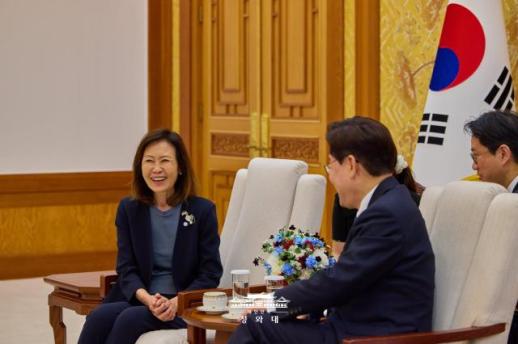 Lee accepts credentials of US Ambassador Steel and others SEOUL, August 12 (AJP) - President Lee Jae Myung welcomed U.S. Ambassador to South Korea Michelle Steel on Wednesday in their first meeting since the Korean American and former congresswoman took up her post in Seoul. Lee greeted Steel at Cheong Wa Dae during a ceremony in which he received credentials from newly appointed ambassadors of four countries. After accepting Steel's credentials, Lee said, "Welcome," before posing with her for a commemorative photo. He then offered the same greeting to her husband, attorney Shawn Steel, who accompanied her to the ceremony, and posed for another photo. A credentials presentation ceremony is a formal diplomatic event in which a newly appointed ambassador presents a letter of credence issued by the head of state of the ambassador's home country to the head of state of the host country. Lee also received credentials from Portuguese Ambassador Vanda Maria Dias Stelzer Sequeira, United Arab Emirates Ambassador Jamal Abdullah Al Suwaidi and Irish Ambassador Sean Hoy. Steel, born in Seoul in 1955, spent part of her youth in Japan before moving to the United States with her family in 1975. She later built a political career in California, serving on the California State Board of Equalization from 2007 to 2015 and the Orange County Board of Supervisors from 2015 to 2021. A Republican, Steel served two terms in the U.S. House of Representatives from 2021 to 2025, representing California's 48th and later 45th congressional districts. She was among the first Korean American women elected to Congress. President Donald Trump nominated her as ambassador to South Korea in April, and the Senate confirmed her on June 17. Steel is the second Korean American to serve as U.S. ambassador to South Korea, after Sung Kim, and the first Korean American woman to hold the post. Steel arrived in South Korea on July 30 and has since begun a series of diplomatic and public engagements. Before Wednesday's meeting with Lee, she met National Security Adviser Wi Sung-lac on Aug. 4 to discuss key issues concerning the South Korea-U.S. alliance. AJP Takeaways: President Lee Jae Myung met U.S. Ambassador Michelle Steel at Cheong Wa Dae on Wednesday, their first meeting since she began her post in Seoul. Michelle Steel is the first Korean American woman to serve as U.S. ambassador to South Korea and the second Korean American to hold the position, after Sung Kim. Steel, a former Republican U.S. congresswoman from California, arrived in South Korea on July 30 and has begun diplomatic engagements focused on the South Korea-U.S. alliance. 2026-08-12 14:35:17
 -
 Hantap Hits Upper Limit for Second Day Following Major Share Purchase Announcement Hantap has recorded its upper limit for the second consecutive trading day, buoyed by news of a large share purchase by its largest shareholder.According to the Korea Exchange, as of 2:14 PM on August 12, Hantap's stock was trading at 2,795 won, up 645 won (30.00%) from the previous day. The stock had already reached the price limit (29.99%) the day before, continuing its strong performance.The surge in stock price is attributed to the decision by the largest shareholder to purchase 2 million common shares in the market to enhance shareholder and corporate value, which has stimulated investor sentiment. The company announced the plan in a disclosure the day before, stating that it intends to acquire approximately 3.3 billion won worth of common shares over about 30 days, from September 11 (settlement date) to October 10.The purchase price was based on the closing price of 1,654 won on August 10, the day before the announcement, and the actual acquisition volume and purchase price may vary depending on future stock price fluctuations.Market analysts interpret the largest shareholder's market purchase as a signal to support the stock price. Hantap disclosed on August 5 that it had been under the market capitalization threshold of 20 billion won for 25 consecutive trading days. If it fails to meet the market capitalization criteria by that day, it may be designated as a management stock on the next trading day.* This article has been translated by AI. 2026-08-12 14:28:00
 -
Korean Cosmetics Company Kolmar Reports Record Q2 Earnings, Shares Surge 25% Korean cosmetics company Kolmar has seen its shares surge over 25% following the announcement of record earnings for the second quarter of this year.As of 1:58 PM on August 12, Kolmar's stock was trading at 135,300 won, up 27,400 won (25.39%) from the previous trading day, according to the Korea Exchange.The company's second-quarter results exceeded market expectations, leading to improved investor sentiment.Kolmar reported consolidated revenues of 861.3 billion won and an operating profit of 110.3 billion won for the second quarter. This represents a 17.8% increase in revenue and a 50.2% rise in operating profit compared to the same period last year, marking the highest figures on a quarterly basis.Notably, the operating profit surpassed the market forecast of 94.9 billion won compiled by financial information provider FnGuide by approximately 16%. The net profit for the same period also rose to 70.6 billion won, a 68.9% increase.The company continued its growth trend in the first half of the year, with cumulative revenues reaching 1.5893 trillion won, up 14.8% year-on-year, and operating profit increasing by 41.8% to 189.2 billion won. The net profit for the first half was 130.6 billion won, reflecting a 100.9% increase.Kolmar attributed its success to the expansion of indie brands into global markets and the seasonal demand for skincare and sun care products, stating, "Orders increased, particularly for skincare and sun care products, due to the peak season and the continued launch of new products by global clients, resulting in record quarterly earnings."* This article has been translated by AI. 2026-08-12 14:24:10
-
Chun Ha-ram Enters Army Training Center After Haircut Chun Ha-ram, the floor leader of the Reform Party, entered the Army Training Center in Nonsan on August 12. Assigned to the National Assembly's Defense Committee, he made this decision to directly experience the training and living conditions of military personnel.On the morning of August 12, the 40-year-old Chun had his hair cut short at a salon in the National Assembly in preparation for his training. This marks his second time entering a training center, having previously done so 14 years ago before serving as a public interest lawyer.Chun will undergo basic training for three days and two nights, starting on August 12, after which he will receive combat uniforms, gear, and supplies as part of the new recruit process.On the second day, he will participate in training exercises simulating wartime conditions, including comprehensive individual combat drills. From 9 p.m. until the early hours of the following day, he will take part in a 20-kilometer night march. On the final day, August 14, he is scheduled to complete a certification ceremony for new soldiers and conclude his training.Chun stated that he felt the need to experience military operations firsthand after being assigned to the Defense Committee. He expressed this sentiment during an appearance on CBS's 'Park Jae-hong's One-on-One Show' on August 10, saying, "Rather than discussing defense policy based solely on my previous experiences, I believe it is essential to update my experiences to develop more realistic policies."He also noted, "As one of the relatively younger members of the National Assembly, I sometimes fall into the illusion that my experiences are up to date. While I have concerns, I am determined to do my best."Chun's office communicated through a press release that since his assignment to the Defense Committee, he has been preparing for committee activities under the principle that "policies arise from the field, not from the desk." He aims to experience the conditions and treatment of military personnel who diligently carry out their duties for the country, even in extreme heat, and to reflect this in future Defense Committee activities and policy inquiries.* This article has been translated by AI. 2026-08-12 14:24:00
-
Justice Ministry to Expedite Nationality Recovery Process for Overseas Koreans Recently, there has been an increase in nationality recovery applications from overseas Koreans, prompting the government to implement a focused processing period to shorten review times. A dedicated organization will also be established to handle nationality applications from foreign nationals.The Justice Ministry announced on August 12 that it will operate a three-month concentrated processing period for nationality recovery applications from overseas Koreans starting this month and continuing through October.Nationality recovery is the process by which foreign nationals who were once citizens of South Korea can regain their nationality with the approval of the Minister of Justice. Over the past five years, the number of nationality recovery applications has been on the rise, with an average review time of 13 months before approval.The Immigration and Foreign Policy Bureau of the Justice Ministry aims to process a total of 3,973 cases during this concentrated period, which is more than four times the average daily processing rate, reducing the average review time from 13 months to 9 months.This initiative is expected to allow overseas Koreans to recover their nationality more quickly, facilitating their settlement in South Korea and access to various administrative services.According to the Justice Ministry, the number of nationality recovery applications has increased from 3,069 in 2021 to 4,710 in 2022, 5,009 in 2023, 5,485 in 2024, and 5,082 in 2025. Last year, the largest number of nationality recoveries by nationality was from the United States, with 2,586 cases, followed by Canada with 656, Australia with 133, Japan with 131, and New Zealand with 118.Additionally, the Immigration and Foreign Policy Bureau is working to establish a dedicated nationality review organization, called the 'Nationality Review Office,' to respond to the increasing number of foreign nationals seeking nationality and to actively attract talent. The establishment of this office is expected to lead to a more efficient nationality review process, a stricter nationality review system, reduced processing times, and enhanced expertise in nationality matters.Minister Jeong Seong-ho stated, "We will continue to improve the review system to expedite the naturalization and recovery of South Korean nationality and strive to establish a dedicated nationality review organization to implement a swift and fair immigration policy service that can be felt by both domestic and foreign nationals."* This article has been translated by AI. 2026-08-12 14:20:20
-
KOSPI Rises Over 3% Driven by Samsung Electronics' 6% Surge The KOSPI index is experiencing a significant rise of over 3%, fueled by simultaneous net buying from foreign investors and institutions. Major semiconductor stocks, including Samsung Electronics and SK Hynix, are leading the index's upward trend. A buying sidecar was also activated during the morning session. In contrast, the KOSDAQ started with a 0.35% decline and has been fluctuating around the break-even point.As of 2:05 PM, the KOSPI is trading at 6,581.79, up 236.26 points (3.72%) from the previous trading day. The index opened at 6,438.50, up 92.97 points (1.47%), and later peaked at 6,668.43, surpassing the 6,600 mark.Individuals are net selling shares worth 3.1176 trillion won, while foreign investors and institutions are net buying 2.3013 trillion won and 1.0105 trillion won, respectively.The Korea Exchange activated a buying sidecar for the securities market at 11:57 AM. The mini KOSPI 200 futures rose 5.13% from the base price of 987.08 points to 1,037.76 points, leading to a five-minute suspension of program trading buy orders from the activation point. This marks the 47th sidecar activation in the KOSPI market this year, with 24 sell sidecars and 23 buy sidecars triggered in the securities market since the beginning of the year.Most of the top market capitalization stocks are performing well. Samsung Electronics is trading at 255,500 won, up 16,000 won (6.68%), while SK Hynix has risen 8,000 won (5.61%) to 1,505,000 won. Other gainers include Samsung Electronics preferred shares (3.19%), SK Square (7.72%), Samsung Electro-Mechanics (4.91%), LG Energy Solution (1.27%), Hyundai Motor (1.24%), Samsung Life Insurance (5.70%), and Hanwha Aerospace (7.29%).On the other hand, Samsung Biologics is down 3.17%, and KB Financial is down 0.36%.At the same time, the KOSDAQ is trading at 858.46, up 0.62 points (0.07%) from the previous trading day. The index opened at 854.85, down 2.99 points (0.35%), and has been fluctuating around the break-even point, with a peak of 860.76 during the session.Individuals are net buying shares worth 284.7 billion won, while foreign investors and institutions are net selling 134.6 billion won and 142.3 billion won, respectively.The top market capitalization stocks in the KOSDAQ are mixed. EcoPro is up 0.66%, EcoPro BM is up 2.00%, Rainbow Robotics is up 1.77%, Juseong Engineering is up 6.25%, HLB is up 0.30%, Wonik IPS is up 6.49%, and EO Technics is up 2.85%. Conversely, Alteogen is down 3.21%, Rino Industrial is down 0.56%, and ABL Bio is down 2.36%.* This article has been translated by AI. 2026-08-12 14:20:00
-
 China grabs over 80% of global ship orders, Korea at 16% SEOUL, August 12 (AJP) - With global ship orders falling by more than half in July from the previous month, China accounted for more than 80 percent of the orders, while South Korea accounted for just 16 percent. According to data released by London-based Clarkson Research Services on Wednesday, global ship orders last month totaled 3.57 million compensated gross tons (CGT) or 137 vessels, down 56 percent from 8.03 million CGT a month earlier and 22 percent from 4.55 million CGT a year earlier. By country, China secured 2.90 million CGT across 111 vessels, accounting for 81 percent of the total, while South Korea secured 570,000 CGT across 21 vessels or 16 percent of the total. China continued to maintain its dominance. Of the 50.93 million CGT or 1,778 vessels in cumulative global ship orders during the first seven months of this year, China secured 38.02 million CGT or 1,394 vessels, accounting for 75 percent of the total, up 107 percent from the same period last year. South Korea secured 8.70 million CGT across 218 vessels, taking a mere 17 percent. Meanwhile, Clarkson's index measuring the cost of building new ships stood at 185.49 in July, up 0.34 percentage points from the previous month and up 29 percent from July 2021, when the index stood at 143.95. By vessel type, an LNG carrier would cost $248.5 million to build, compared with $130.5 million for a very large crude carrier (VLCC) and $259.5 million for an ultra-large container ship in the 22,000 to 24,000 twenty-foot equivalent unit (TEU) class. Industry officials said China's market presence has increased sharply amid a rise in orders for bulk carriers and tankers from domestic shipping companies, while South Korea has maintained a selective strategy focused on higher-value vessels such as liquefied natural gas (LNG) carriers, prioritizing profitability over the number of monthly orders. AJP Takeaways: 0 Global ship orders fell 56 percent in July 2026 from the previous month to 3.57 million compensated gross tons (CGT), or 137 vessels, according to Clarkson Research Services. - China accounted for 81 percent of global ship orders in July 2026, securing 2.90 million CGT across 111 vessels, while South Korea took 16 percent with 570,000 CGT across 21 vessels. - China led cumulative global ship orders from January through July 2026, securing 38.02 million CGT across 1,394 vessels, or 75 percent of the 50.93 million CGT total, up 107 percent from the same period in 2025. - South Korea secured 8.70 million CGT across 218 vessels from January through July 2026, taking a 17 percent share as South Korean shipbuilders focused on higher-value vessels such as liquefied natural gas (LNG) carriers. - Clarkson Research Services' newbuilding price index rose to 185.49 in July 2026, up 29 percent from 143.95 in July 2021; newbuild prices reached $248.5 million for LNG carriers, $130.5 million for very large crude carriers and $259.5 million for 22,000 to 24,000 TEU ultra-large container ships. 2026-08-12 14:16:28
 -
Small Business Leaders Meet with Prime Minister to Discuss KOSDAQ Delisting Criteria The small business sector has requested a delay in the enforcement of stricter market capitalization criteria for KOSDAQ delisting and called for separate bidding for construction materials from the Korea Land and Housing Corporation (LH).The Korea Federation of Small and Medium Businesses announced that on August 12, over 130 participants, including Prime Minister Han Seung-soo, officials from relevant ministries, and representatives from the small business community, attended a regulatory innovation forum for small and venture businesses held at KBIZ Hall in Yeouido. This forum was organized following a luncheon meeting on July 19 between Prime Minister Han and leaders of small business associations, where Kim Ki-moon, the federation's chairman, made the proposal.Kim Ki-moon suggested to the Prime Minister that improving KOSDAQ delisting criteria and implementing separate bidding for public construction materials should be prioritized. He stated, "Since the criteria for KOSDAQ delisting were tightened on July 1, small businesses are at risk of delisting due to market capitalization declines unrelated to their performance or financial status, especially amid recent market volatility. We need to identify the necessary support measures for small businesses struggling due to these market fluctuations."Regarding the separate bidding for construction materials, he noted, "In the case of LH's private participation projects, small business products can be directly purchased under the Market Support Act, but differing opinions among ministries have prevented separate bidding. Given the challenging economic conditions for small construction businesses, the survival of over 360 small manufacturers producing construction materials is at stake, and we hope for a swift revision of the relevant guidelines."The forum included three sessions focusing on: regulatory issues arising from the emergence of new industries, regulatory improvements for small business growth, and sector-specific proposals.In discussing the growth of new industries, participants addressed the lack of relevant systems or unclear regulations affecting new industries and traditional industries. Suggestions included improving regulatory sandboxes, establishing laws and systems for the digital asset industry, revising data regulations for AI development, and creating coordination bodies for harmonizing new and traditional industries.For regulatory improvements related to small businesses, topics included capital market activation, fostering local small businesses, and creating a fair competitive environment. Proposals included easing entry and exit regulations for the KOSDAQ market, improving practices for protecting newly listed companies, relaxing regulations for industries in local industrial complexes, expanding small business participation in mega-projects, introducing a payment linkage system for government procurement projects, and updating industrial safety and health management costs.Sector-specific issues addressed included regulatory challenges faced by manufacturing companies, women-owned businesses, and small merchants. Suggestions included revitalizing small manufacturing of construction materials, excluding the startup support period (seven years) for female CEOs during pregnancy and maternity leave, expanding vehicle types for small business rental needs, applying tariff quotas for edible soybeans, and improving the aT monopoly quantity management system. Twenty-five regulatory issues that could not be addressed during the forum were submitted to the government in writing.Kim Ki-moon remarked, "While our economy continues to thrive, particularly in the semiconductor sector, with record exports in the first half of the year and large corporations achieving unprecedented profits, small businesses are facing the highest loan delinquency rates since 2015, and those supplying to larger companies are not sharing in the successes."He added, "Regulatory innovation is the best way for the government to support small businesses without spending a dime, so proactive regulatory innovation is essential." 2026-08-12 14:16:10
-
Iran Adapts Economy to Survive Amid Oil Export Blockade Despite U.S. sanctions and a maritime blockade putting pressure on its economy, Iran's leadership is shifting to a 'survival mode' to prepare for a prolonged struggle. The strategy focuses on maintaining essential goods and state functions rather than economic recovery, aiming to withstand U.S. pressure for as long as possible.According to the Wall Street Journal (WSJ) on August 11, Iran is rationing scarce supplies and reducing foreign currency use and investment while maintaining imports of essential goods. Much of the burden of the economic crisis is falling on households.The U.S. maritime blockade has dealt a severe blow to Iran's primary revenue source: oil exports. According to the British economic analysis firm Capital Economics, Iran's oil export revenue plummeted from $4.5 billion in June to virtually 'zero' in July.Living conditions are rapidly deteriorating. The annual inflation rate has surpassed 80%, with chicken prices soaring by 190% and milk by 150% compared to a year ago. There are projections that the war's impact could lead to the loss of 2 to 3 million jobs.Iran is prioritizing limited foreign currency for securing essential goods. It is providing $3.5 billion needed for imports of wheat, medicine, and powdered milk at a lower exchange rate than the market. Factories facing production disruptions due to power shortages are being allowed to operate even on holidays.Support for low-income households has also increased. Measures include allowing essential goods to be purchased on credit and raising food purchase subsidies to prevent public discontent from worsening due to economic hardship.The Trump administration believes that the economic difficulties will eventually bring Iran to the negotiating table. President Donald Trump recently cited high inflation and financial difficulties, asserting that 'the economic pressure on Iran is working.'However, the WSJ noted that 'intensifying economic hardship may not immediately lead to concessions from the leadership.' The influence of hardliners has grown, and Iran has built an economic control system over decades of sanctions.Hardy Kaulzadeh, a researcher at the Quincy Institute, stated, 'U.S. pressure is transforming the Iranian economy into a 'survival mode' that maintains only minimal functionality.' He added that even as economic pain increases, it is unlikely to exert enough pressure to change the leadership's security policies.* This article has been translated by AI. 2026-08-12 14:12:10
-
NHN Shares Rise for Second Day Following Earnings Surprise NHN has seen its shares rise for two consecutive days following the announcement of second-quarter results that exceeded market expectations.As of 1:41 PM on August 12, NHN's stock was trading at 61,700 won, up 7,500 won (13.84%) from the previous trading day. The stock opened at 56,800 won and surged to as high as 63,500 won during the session. This follows a remarkable 29.82% increase the previous day, marking another day of double-digit gains.The rise in stock price is attributed to the company's second-quarter performance, which has stimulated investor sentiment. NHN reported an operating profit of 57.9 billion won for the second quarter of this year, a 164% increase compared to the same period last year. Revenue for the same period reached 757.9 billion won, up 25.3%, while net profit rose to 29.1 billion won, a 159% increase.The improvement in performance was driven by steady growth in both the payment and technology sectors. Revenue from the payment segment, which includes Payco and KCP, increased by 27.3% year-on-year to 394 billion won, while revenue from the technology sector, including AI cloud services, grew by 52.9% to 159.8 billion won.The gaming division also contributed to the strong results, with mobile and PC online sales growing together. Revenue from the gaming sector reached 139.6 billion won, a 21.5% increase compared to the same period last year.* This article has been translated by AI. 2026-08-12 14:08:10