


Latest by
-
 KOSDAQ-listed biotech Alteogen rallies on BlackRock stake SEOUL, August 10 (AJP) — Shares of South Korean biotech firm Alteogen jumped more than 15 percent Monday after BlackRock, the world's largest asset manager, disclosed that its combined holdings in the company had crossed 5 percent. As of 11:17 a.m., Alteogen was trading at 346,500 won ($244.74), up 13.77 percent from the previous session. The rally followed a regulatory filing submitted Friday by BlackRock Fund Advisors, which showed that the firm and its affiliated entities held a combined 2,694,448 shares of Alteogen, equivalent to a 5.03 percent stake, as of July 31, according to South Korea's Financial Supervisory Service (FSS). That was up by 24,273 shares from 2,670,175 shares, or 4.98 percent, a day earlier, taking the combined stake above South Korea's 5 percent disclosure threshold. Under the country's capital markets law, investors and their related parties are required to report their holdings once their combined stake in a listed company reaches 5 percent. The reported 5.03 percent represents the combined holdings of funds and client accounts managed by BlackRock Fund Advisors and its affiliated investment managers. No individual fund or client held 5 percent or more on its own, according to the filing. BlackRock Fund Advisors accounted for the largest portion, with 1,524,675 shares, or 2.84 percent. BlackRock Institutional Trust Company followed with 486,925 shares, or 0.91 percent, while while its U.K.-based advisory unit held 431,760 shares, or 0.81 percent. Smaller stakes were held by other affiliated investment managers, including BlackRock Investment Management (UK) Limited at 0.27 percent, BlackRock Japan at 0.06 percent, while entities in Canada, North Asia, Australia, Singapore, the Netherlands and Taiwan each held 0.03 percent or less. AJP Takeaways • Alteogen shares jumped more than 15 percent on Aug. 10, 2026, after BlackRock disclosed that its combined holdings in the South Korean biotech company had exceeded 5 percent. • BlackRock Fund Advisors and its affiliated entities held 2,694,448 Alteogen shares, or 5.03 percent, as of July 31, 2026, up from 4.98 percent a day earlier. • BlackRock Fund Advisors was the largest holder among the reporting entities with a 2.84 percent stake, followed by BlackRock Institutional Trust Company at 0.91 percent and BlackRock Advisors (UK) Limited at 0.81 percent. 2026-08-10 11:21:27
 -
 Lotte World Adventure Differentiates Itself with Diverse K-Horror Content Lotte World Adventure is attracting visitors with a variety of K-horror content that can be selected based on 'horror difficulty.'The signature content 'Gwidam,' aimed at beginners in horror experiences, is set in Magic Island. It involves exploring a haunted house featuring an unidentified entity. This attraction will operate daily from 11:30 a.m. to 8:30 p.m. until November 15, for a fee.Newly added this year, 'Madoshindang' combines horror with mystery in an immersive experience. It follows the story of a missing shaman and a news crew as they uncover the hidden secrets of a closed shrine. This attraction is available for a fee at the same location and time as Gwidam.Offering the highest level of horror, 'Stay Alive in Museum' is an immersive performance set throughout the Lotte World Folk Museum. In this experience, the audience becomes new recruits of a performance team, trapped in the museum and must survive, with the outcome varying based on individual choices. This content is ideal for repeat viewings.The performance starts daily at 7:30 p.m. until the 30th, with a runtime of 90 minutes. A pre-show lasting about 20 minutes will also be held before the main performance. Ticket discounts are available for same-day visitors and repeat viewers. Reservations can be made on the official website.In addition to horror content, the new attraction 'Kong X Godzilla: The Ride,' which debuted on July 24, is also gaining popularity.This attraction is a multimedia dark ride that has the highest production cost for a single ride since the opening of Lotte World Adventure. It spans approximately 1,550 square meters on the third floor of the Adventure, set in the habitat and origin of the giant titans, 'Hollow Earth.'Riders take on the role of new agents of a secret organization called 'Monarch,' boarding an 8-passenger vehicle designed to resemble the exploration vessel 'Hib.' They embark on a mission lasting about 11 minutes. The attraction features massive animatronics reaching heights of 5 meters and widths of 11 meters, large media screens, and dynamic vehicle movements, all intricately synchronized to enhance the immersive experience.* This article has been translated by AI. 2026-08-10 11:20:20
 -
 KickFlip's Donghyeon to release 'Breathe' with Britain's Etham SEOUL, August 10 (AJP) - K-pop artist Donghyeon of KickFlip is turning a fan moment into an official collaboration, teaming up with British singer-songwriter Etham for a new single, "Breathe," JYP Entertainment said Monday. The song will be released on major streaming platforms at 1 p.m. (0400 GMT) on Aug. 14. The pairing came together after Donghyeon posted a cover of Etham's "12:45 (Stripped)" on KickFlip's official Instagram account on Aug. 8. Etham left a comment on the post, drawing attention from fans of both artists. "My company knew I was a big fan of Etham," adding "A songwriter who worked on KickFlip's album told us Etham was also interested in taking part in a KickFlip song camp, and that connection led naturally to the collaboration." Donghyeon said in a statement released through JYP Entertainment. Built around a delicate guitar riff, warm piano lines and a restrained vocal arrangement, "Breathe" is a mid-tempo acoustic pop track that Donghyeon and Etham wrote together. The lyrics trace the overwhelming feeling of a one-sided crush — the fear of revealing one's feelings tangled with the hope of becoming someone special to the other person. The single adds to the solo profile Donghyeon has built alongside KickFlip's group work, through appearances and covers on MBC's "King of Mask Singer," KBS Kpop's "Leemujin Service" and the group's own social media channels. Etham is a British singer-songwriter known for his stripped-back vocal style and acoustic pop sound, including the track "12:45." AJP Takeaway: KickFlip's Donghyeon will release "Breathe" with British singer-songwriter Etham at 1 p.m. KST on Aug. 14, JYP Entertainment said. The collaboration grew out of Donghyeon's Aug. 8 Instagram cover of Etham's "12:45 (Stripped)," after Etham responded to the post and an existing songwriting connection brought the two artists together. "Breathe" is a mid-tempo acoustic pop track co-written by Donghyeon and Etham, built around guitar, piano and restrained vocals, with lyrics centered on the anxiety and hope of an unrequited crush. The single expands Donghyeon's individual profile beyond KickFlip, following appearances and covers on MBC's "King of Mask Singer," KBS Kpop's "Leemujin Service" and the group's official social channels. Etham, a British singer-songwriter known for acoustic pop and stripped-back vocals, brings international recognition from tracks including "12:45" to the collaboration. 2026-08-10 11:14:52
 -
 Nearly 1 in 8 Koreans live outside conventional homes SEOUL, August 10 (AJP) - Nearly one in eight South Koreans living alone resides in motels or other quarters not classified as housing, with the share approaching one in five among those in their 20s and 30s, although the country's housing supply continues to grow far faster than its population. Nearly 975,000 one-person households lived in "non-housing living quarters" in 2025, accounting for 11.8 percent of all one-person households and nearly twice the 6.1 percent rate for households overall, according to the latest Population and Housing Census. Among one-person households headed by people in their 20s or younger, the share reached 20.9 percent. For those in their 30s, it was 19.2 percent. The numbers expose a contradiction at the heart of South Korea's housing market: the country keeps adding homes, but a growing number of households remain outside conventional housing. South Korea's housing stock reached 20.18 million units in 2025, up 1.6 percent from a year earlier, while its population barely moved, rising just 0.02 percent to 51.82 million. Households kept multiplying anyway as families became smaller. Their number rose 1.1 percent to 23.25 million, while one-person households increased 2.5 percent to 8.24 million, accounting for 36.6 percent of general households. In other words, a nearly stagnant population increasingly requires more separate places to live. Yet greater supply has not stopped hundreds of thousands of households from falling outside the conventional housing market. The census counted 1.37 million households, or 6.1 percent, in non-housing living quarters, nearly double the number a decade earlier. It includes officetels and dormitories, and an officetel can function much like a conventional apartment. Not everyone counted in the 1.37 million is therefore living in precarious conditions. Strip out those relatively conventional forms of accommodation, however, and a harder-to-dismiss picture emerges. About 545,000 households were living in hotel or motel rooms, shacks, greenhouses, construction-site quarters, commercial premises and other spaces not legally classified as housing as of Nov. 1, 2025. That was roughly 2.3 percent of the country's 23.25 million households. The figure has risen steadily, from about 403,000 households in 2015 to 490,000 in 2020 and 545,000 last year — an increase of 35 percent over a decade. Because officetels and dormitories are excluded from this narrower count, the increase cannot be explained simply by the growing use of small studio-style accommodation technically classified as non-housing. It instead points to a persistent group that remains unable to enter the conventional housing market even as the country builds more homes. The divide is particularly visible in the Seoul metropolitan area. Gyeonggi Province, Seoul and Incheon together accounted for about 905,000 households living in non-housing quarters, roughly two-thirds of the nationwide total. Incheon recorded the highest share, at 9.6 percent. The census figures do not mean every household outside legally defined housing is unsafe or deprived. But the narrower tally of 545,000 households is more difficult to explain away. South Korea added more than 300,000 housing units in a single year, yet more than half a million households remained in motel rooms, shacks, greenhouses and similar spaces. Such accommodation can also leave residents more exposed to extreme weather and other hazards that conventional housing is better equipped to withstand. Deputy Prime Minister and Finance Minister Koo Yun-cheol visited a jjokbang district in Changsin-dong, central Seoul, on Aug. 7 and pledged support for residents vulnerable to extreme heat. Jjokbang are tiny subdivided rooms often occupied by some of the country's poorest urban residents. AJP Takeaways • Nearly 975,000 one-person households lived in quarters not classified as housing in 2025, or 11.8 percent of all one-person households. • The share climbed to 20.9 percent among those in their 20s or younger and 19.2 percent among those in their 30s. • A narrower group of about 545,000 households lived in motels, shacks, greenhouses and other precarious spaces, up 35 percent from 2015. • South Korea's housing stock grew 1.6 percent to 20.18 million units in 2025 while its population rose just 0.02 percent. • The numbers point to a widening gap between adding housing and making it accessible to the households that need it. 2026-08-10 11:13:24
 -
Different Paths for China's CXMT and Fujian Jinhua in Semiconductor Industry In 2016, two DRAM companies were established in China: Fujian Jinhua, founded by Fujian Province, and CXMT (Changxin Memory Technologies), established by Anhui Province, which was heavily investing in the semiconductor and LCD industries. Although both companies were founded in the same year, their fates diverged significantly.Recently, CXMT went public and has grown into a global competitor, challenging Samsung Electronics and SK Hynix. In contrast, Fujian Jinhua has faced prolonged operational halts and has yet to achieve notable success.Both companies aimed to establish 12-inch wafer fabs and attracted investments worth hundreds of billions of yuan under similar conditions. In terms of construction speed, Fujian Jinhua initially had the advantage. It partnered with Taiwan's UMC to acquire 32-nanometer DRAM technology. However, some personnel from UMC had previously worked at Micron, which led to a lawsuit from Micron in 2017 over allegations of trade secret theft. In October 2018, the U.S. Department of Commerce added Fujian Jinhua to its Entity List, citing that the company posed a threat to the economic survival of U.S. firms due to suspected theft of American technology.As a result, Fujian Jinhua's U.S. semiconductor equipment and software suppliers ceased transactions, forcing equipment scheduled for shipment to return to warehouses. UMC also announced the suspension of its collaboration with Fujian Jinhua, halting the construction of a nearly completed factory. The lawsuit dragged on for nearly six years, and in 2024, a U.S. court found Fujian Jinhua not guilty of trade secret theft. However, the company had already suffered irreparable damage. Currently, Fujian Jinhua has restarted its factory using domestic equipment, but it still faces a significant technological gap with global competitors.In contrast, CXMT took a different approach. Its CEO, Zhu Yiming, acquired the patent portfolio of the bankrupt German company Qimonda and secured licensing agreements with U.S. firm Rambus, legally obtaining intellectual property rights. This strategy avoided any controversies related to personnel or trade secrets. CXMT began mass production of 8Gb DDR4 chips at its Hefei Plant 1 in September 2019. Like many Chinese semiconductor firms, CXMT likely had a significant reliance on foreign equipment. Had the U.S. placed CXMT on the Entity List at that time, it might have faced a fate similar to Fujian Jinhua. However, CXMT had no allegations of technology theft or criminal cases against it, leaving the U.S. without justification to add it to the list.Subsequently, the U.S. Department of Defense imposed sanctions by listing CXMT as a company linked to the Chinese military, but the full ban on equipment and technology supply has been postponed. Meanwhile, CXMT has completed its Hefei Plant 2 and Beijing Plant 1, utilizing a significant amount of domestic semiconductor equipment. Riding the wave of an AI-driven memory supercycle, CXMT recorded its first profit since its establishment in 2025. The company is currently negotiating product supply agreements with Apple, HP, and others, and is also pursuing the construction of a Beijing Plant 2, showcasing rapid growth.The divergent paths of these two companies ultimately boil down to one question: how they secured their technology. The personnel transfer through UMC left Fujian Jinhua vulnerable to allegations of theft, while CXMT's patent acquisition eliminated any such grounds for accusation. This 'first step' has completely separated the trajectories of the two companies. 2026-08-10 11:12:00
-
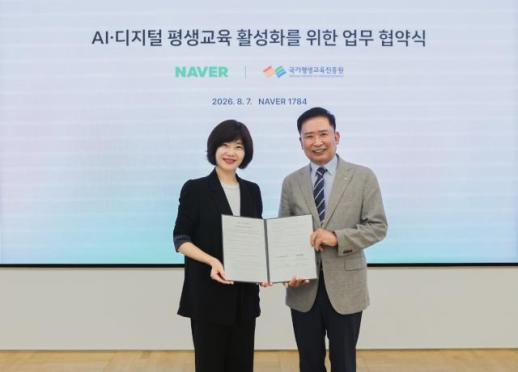 Naver, education institute team up on AI textbooks for seniors SEOUL, August 10 (AJP) - Naver announced Monday it has signed a memorandum of understanding with the National Institute for Lifelong Education (NILE) to jointly develop AI and digital literacy content tailored to senior citizens, as part of a broader push to narrow South Korea's digital divide. The agreement revealed Monday was signed on Aug. 7 at Naver's headquarters in Bundang, the company said. It aims to strengthen everyday AI and digital competency among seniors and other digitally underserved groups amid the wider shift toward AI. Under the partnership, the two organizations plan to co-develop and distribute lifelong education content on AI and digital tools. A key component will be a digital literacy textbook built on Naver's Whale browser, designed to walk users through practical services such as Naver Shopping and Whale's core functions. "By linking Naver's technology with the education field in the era of generative AI, we can innovatively bridge the digital literacy gap in daily life," said Kim Wol-yong, president of NILE. Naver said the collaboration would also feed into its commercial ambitions. Lee Yoon-sook, who heads Naver's shopping business division, said the company would keep upgrading its services for the "AI commerce era" while backing the educational push "so that AI-based services, including Naver Shopping, can become easy and convenient tools for anyone." 2026-08-10 11:05:19
 -
Vietnamese Youth Delay Marriage Amid Economic Concerns In Vietnam, an increasing number of young people are postponing marriage. The single population has grown to approximately 20 million, with the average age for first marriages rising to 27.3 years. Factors such as the need for economic stability, psychological readiness for married life, rising housing costs, and changing family dynamics have shifted marriage from a societal expectation to a personal choice made when individuals feel prepared.According to local reports from VnExpress and Lao Dong on August 10, 2024, Vietnam's single population was estimated at around 20 million, representing about 20% of the country's 100 million residents. The average age for first marriages has increased from 24.1 years in 1999 to 25.2 years in 2019, and is projected to reach 27.3 years by 2024. In some regions, the average age for first marriages has surpassed 30.Delayed Marriage: A Shift to 'Marriage When Ready'The trend of delayed marriage cannot be attributed solely to personal choice. Sociologists suggest that young people in Vietnam are facing pressures to first secure education, employment, income stability, and housing. Marriage has become a stage that individuals choose after meeting various conditions, rather than a starting point in life.A case in point is a man in his 30s living in Hanoi, who shared that he spends nearly two hours communicating with women he meets through matchmaking services and dating sites. Over the past five years, he has posted his profile on dating platforms six times and has even used paid matchmaking services. He has also fallen victim to scams targeting single men. Despite reaching out to multiple women simultaneously to increase his chances, he finds it challenging to transition to marriage.Experts attribute the delay in marriage among the youth to the rapid modernization of Vietnamese society. Ngo Thi Phuong Lan, a professor at Ho Chi Minh City University of Social Sciences and Humanities, noted that the pressures of competition and high living costs have made it difficult for young people to manage multiple responsibilities. She stated, “The delay in marriage is not due to the youth becoming more selective, but rather a way of adapting to the economic and social conditions of modern society.”Psychological readiness is also a significant factor in the decision to delay marriage. A 20-something individual from Ninh Binh expressed a desire to marry only after achieving both economic stability and mental preparedness. He views the age of around 30 as an ideal time for marriage, emphasizing the need for a mindset not only as a spouse but also in addressing issues that arise in married life and preparing for parenthood.Psychological counseling expert Nguyen Hoang Ai diagnosed the trend of delayed marriage as a result of multiple overlapping factors. He explained that young people today have more opportunities for education, career development, and life experiences than previous generations, leading them to view marriage as a choice rather than an obligation. “In the past, marriage was seen as a milestone that one had to go through, but now many people view it as just one option,” he said, adding that individuals are more focused on finding the right partner rather than marrying simply because they have reached a certain age.“Without Money, Marriage is Difficult”: Diverse Reactions to Economic RealitiesOnline reactions to the trend of delayed marriage have largely centered on the financial burdens involved. One commenter noted that without stable assets or economic power, it is better not to start a family. They argued that financial issues and the burden of raising children can lead to conflicts and stress in marriage, particularly after children are born.Conversely, some shared experiences suggesting that late marriage does not necessarily lead to failure. One individual recounted marrying at 36, stating that although neither partner had much, they managed to buy a house the same year and welcomed their first child the following year. This commenter emphasized that financial conditions alone should not dictate the possibility of marriage.Others pointed out that family and societal expectations can complicate the decision to marry. One person shared that their brother faced family opposition when dating a younger partner due to concerns about her age and lack of employment. Later, when he dated a divorced woman, the family also disapproved, leading to his eventual single status. Now, the family is pushing for matchmaking, but the brother shows little interest in marriage.Some commenters noted that the trend of delaying marriage is not unique to Vietnam. One remarked, “The trend of starting a family later is occurring not just in Vietnam but in many countries around the world,” reflecting a broader societal change rather than an individual issue.Experts believe that simply encouraging marriage will not change this trend. Wei Jun Jin Yong, a researcher at the National University of Singapore's Family and Population Research Center, described the delay in marriage in Vietnam as a result of “compressed modernization.” He noted that while economic and social changes are progressing rapidly, traditional expectations for women to fulfill caregiving roles remain entrenched.Yong stated, “When women achieve economic independence, marriage becomes a choice,” adding that the perceived opportunity costs of becoming a wife and mother make marriage a more cautious decision. He highlighted that rising housing costs and expectations for “perfect parenting” are dividing young people into those who do not wish to marry and those who want to but feel financially constrained.The solution, experts argue, lies not in placing the burden on individuals but in creating an environment that reduces the pressures of marriage and parenting. Yong suggested the need for housing support, equal job opportunities, expanded flexible work arrangements, enhanced maternity leave, and improved childcare networks. Professor Lan also cautioned against the notion that complete stability is a prerequisite for marriage, explaining that couples can build stability together over time.* This article has been translated by AI. 2026-08-10 11:04:10
-
Gachon University to Launch Graduate School for AI Semiconductor Design Artificial intelligence (AI) is rapidly spreading in industrial settings, leading to an expansion of educational foundations for training professionals in AI semiconductor design. Gachon University will open a graduate school specializing in AI semiconductor design in March 2027, offering a master's program focused on practical semiconductor design skills. According to Gachon University, the first class will enroll 30 students, with applications for the 2027 academic year accepted from October 19 to November 2. The establishment of this graduate school responds to the recent shift in the AI industry from technologies that train large AI models to implementing AI in physical devices and services, known as 'Physical AI' and inference technologies. As the fields where AI is integrated, such as robotics, autonomous driving, smart appliances, and smart factories, continue to grow, the importance of low-power, high-efficiency semiconductor design capabilities that can operate AI with limited power and computational resources is increasing. In line with these industrial changes, Gachon University plans to offer a curriculum that closely resembles the actual semiconductor development process rather than just theoretical education. Students will engage in the entire semiconductor development process, from design to verification, physical implementation, and tape-out, through project-based learning. Instead of writing a thesis, students will earn their degrees by passing a graduation project review, and patent applications will be included in the curriculum to lead to tangible technological outcomes. The education will consist of six quarters, with two subjects taken each quarter, allowing students to focus on a total of 12 subjects over two years. Key subjects include computer architecture design, AI algorithms, and AI accelerator design, along with 'Industry-Academia R&D Projects I & II' conducted in collaboration with companies. In the region, efforts are underway to strengthen the industrial base around Pangyo, where AI companies and technical talent are gathering. The launch of the AI semiconductor design graduate school is expected to serve as a hub for nurturing talent that connects the university's educational functions with the local fabless and AI industry ecosystem. Gachon University is also establishing the necessary semiconductor design infrastructure for education. Utilizing the semiconductor college, AI building, and Vision Tower, the university plans to conduct team-based industry-academia projects based on a full package of three major EDA tools and HPC infrastructure capable of concurrent design, along with dedicated design practice rooms. Professors with experience in semiconductor design from industry will also participate in the education to enhance the design capabilities required in the actual industrial field. Full tuition scholarships will be offered to the first incoming class. Incentive scholarships based on students' research and project achievements, such as publications in international journals or awards at international competitions, as well as scholarships linked to industry-academia collaboration companies, will also be available. Earlier, Gachon University expanded its collaboration with domestic AI fabless companies by hosting the 'CES 2026 Fabless Summit Korea' in March. Thus, the university plans to further enhance joint research and field-oriented talent development in conjunction with the opening of the graduate school. Recruitment for the 2027 master's program will occur in three rounds. The first application period is from October 19 to November 2, the second from December 17 to 28 at 3 PM, and the third from January 21 to 25, 2027, at 3 PM. The announcement of Gachon University's AI semiconductor design graduate school has generated significant interest among students and the local community. As AI and semiconductors emerge as key sectors of future industries, the opportunity for local students to receive specialized education necessary for the industrial field is being positively evaluated. In particular, the ability to experience the entire semiconductor development process, from design theory to verification, physical implementation, and tape-out, has heightened interest among students in related majors. Students preparing for employment express optimism that this graduate program will provide a pathway to acquire the practical skills demanded by companies. The local community anticipates that the establishment of this graduate school will serve as a bridge connecting Gachon University's educational functions with the AI and semiconductor industry ecosystem formed in the Seongnam and Pangyo areas. If the regional characteristics of AI and fabless companies concentrated around Pangyo combine with the university's semiconductor education and research infrastructure, it could lay the groundwork for nurturing specialized talent needed by companies and expanding industry-academia collaboration. Gachon University also plans to strengthen field-oriented education by operating industry-academia R&D projects in collaboration with companies and utilizing EDA equipment and HPC infrastructure necessary for semiconductor design. Meanwhile, Kim Yong-seok, the inaugural dean of the graduate school, stated, “Our goal is to train AI semiconductor design experts who can be immediately utilized in the semiconductor industry,” adding, “We will produce talent equipped with the practical skills demanded by the industry.” 2026-08-10 11:04:10
-
KOSDAQ Surges Over 6%, Reclaims 850 Points Amid Strong Buying The KOSDAQ index surged over 6%, attempting to stabilize above the 850-point mark. With both foreign and institutional investors engaging in net buying, major stocks in the biomedical and semiconductor sectors, including Alteogen, showed significant gains, contributing to the upward momentum. The strong early gains prompted the activation of a buying sidecar in the KOSDAQ market.As of 10:47 a.m. on August 10, the KOSDAQ was trading at 847.99, up 49.18 points (6.16%) from the previous trading day. The index opened at 807.66, up 8.85 points (1.11%), and later peaked at 852.98, surpassing the 850-point threshold.In terms of investor activity, individuals sold a net 421.4 billion won, while foreign and institutional investors bought a net 168.9 billion won and 258.9 billion won, respectively. The influx of buying from foreign and institutional investors has led to a broad increase in large-cap stocks on the KOSDAQ.The buying sidecar was activated at 9:50 a.m., marking the 18th instance this year. The KOSDAQ 150 futures rose over 6% compared to the previous day's closing price, and the KOSDAQ 150 index increased by more than 3% for a sustained minute, leading to a five-minute suspension of buy orders in program trading. This year, a total of 31 sidecars have been activated in the KOSDAQ market, including 13 sell sidecars.Most of the top market capitalization stocks experienced sharp increases. Alteogen led the gains with a rise of 16.23%, while EcoPro (6.05%), EcoPro BM (5.70%), Rainbow Robotics (3.76%), JUSUNG Engineering (10.88%), HLB (7.51%), ABL Bio (9.01%), Rino Industry (4.87%), Wonik IPS (9.85%), and LigaChem Bio (7.33%) also saw significant increases.Notably, Alteogen's stock price reached 354,500 won, reflecting an increase of over 16%. The surge followed the announcement that BlackRock, the world's largest asset management firm, holds a 5% stake in the company for investment purposes. HLB, LigaChem Bio, D&D Pharmatech, and ABL Bio also showed strong performance due to individual positive news.Semiconductor equipment stocks, including JUSUNG Engineering and Wonik IPS, also exhibited nearly double-digit increases, supporting the overall index rise.Meanwhile, the KOSPI index was trading at 6,304.20, up 45.43 points (0.73%) from the previous trading day. The KOSPI opened at 6,306.33, up 47.56 points (0.76%), and reached a high of 6,394.06 during the session before giving back some gains.Individuals were net buyers of 169.1 billion won, while foreign and institutional investors sold a net 501.2 billion won and 307.8 billion won, respectively.Stocks such as Samsung Electronics (0.43%), SK Hynix (1.41%), Hyundai Motor (1.90%), and Hanwha Aerospace (5.29%) saw gains, while KB Financial (-3.87%) and Samsung Electro-Mechanics (-0.39%) faced declines.* This article has been translated by AI. 2026-08-10 11:04:10
-
LS Electric Partners with GS Construction on AI Data Center DC Power Distribution LS Electric announced that it signed a memorandum of understanding (MOU) with GS Construction on August 10 at the LS Yongsan Tower to jointly respond to changes in the AI data center (AIDC) business environment.The signing ceremony was attended by key executives, including LS Electric Chairman Koo Ja-kyun, GS Construction CEO Heo Yoon-hong, and LS Electric CEO Chae Dae-seok.The executives discussed the global outlook for the AI data center market and focused on technology collaboration and joint responses centered on direct current (DC) power distribution, which has emerged as a key trend in power infrastructure for the AI era.Through this agreement, the two companies will collaborate on the development of next-generation DC power distribution technology to improve power efficiency, a major concern for high-power, high-density AI data centers, and will establish regular technology exchange meetings.Additionally, they plan to maximize business synergy by reliably supplying essential power equipment, such as switchgear, gas-insulated switchgear (GIS), and ultra-high voltage transformers, for GS Construction's AI data center projects.AI data centers, which are equipped with high-performance graphics processing units (GPUs), are increasingly adopting DC power distribution to significantly reduce power conversion losses compared to traditional alternating current (AC) methods.LS Electric possesses world-class capabilities in the DC power distribution sector. The company has commercialized key components of the DC ecosystem, including semiconductor transformers (SST), semiconductor circuit breakers (SSCB), and energy storage systems (ESS), and has established and operates the world's first 100% DC factory in Cheonan, solidifying its technological leadership.LS Electric has accumulated business know-how and established proven reliability by supplying power infrastructure solutions for large data center projects of major U.S. tech companies.With the combination of LS Electric's next-generation DC power distribution technology and GS Construction's data center construction capabilities, the partnership is expected to secure a strong market presence in the rapidly growing AI data center infrastructure market.An LS Electric official stated, "The paradigm of AI data centers is rapidly shifting towards DC power distribution to minimize power loss. We will significantly strengthen our collaboration with GS Construction based on our top-tier power solutions and next-generation distribution technologies, such as SST and SSCB, to lead the global power infrastructure market." 2026-08-10 11:04:00