


Latest by
-
 Blue House Reaffirms Justice Minister Jeong Seong-ho's Role Amid Resignation Speculation The Blue House has reaffirmed that Justice Minister Jeong Seong-ho should continue his role until the establishment and stabilization of the new public prosecution office, despite speculation about his resignation.Hong Ik-pyo, the Blue House's chief of staff, stated on MBC Radio on July 29 that "since the Ministry of Justice is the main agency for the public prosecution office set to launch in October, the minister must fulfill his duties until the system is organized and stabilized." He added, "I do not foresee any immediate personnel changes."While mentioning Jeong's health issues, Hong clarified, "He has not officially expressed his intention to resign," suggesting that personal circumstances may be influencing his situation.Seong Gi-hong, the Blue House's chief of public relations, also commented in an SBS interview, stating, "Public office is not a position one can simply take or leave at will," indicating that various factors would likely influence Jeong's decision.Previously, Jeong had indicated to the media that he felt he had "nothing more to do and no will to continue," and during a parliamentary session, he suggested that "new wine should be put in new bottles," hinting at his resignation.Meanwhile, during a session of the National Assembly's Legislative and Judiciary Committee, Jeong stated that he would not recommend President Yoon Suk-yeol exercise a veto on the proposed amendment to the Criminal Procedure Act, which seeks to abolish the supplementary investigation rights of prosecutors.Jeong remarked, "This is a matter that has been decided by the National Assembly, and the government's concerns have been largely reflected in the legislative process," adding, "It does not seem to be a matter that warrants a separate recommendation for a veto."He further noted, "During the discussions, we adequately conveyed various concerns to the committee, and I believe the legislation has been carried out with those considerations in mind."In response to concerns that the elimination of supplementary investigation rights could delay case processing, Jeong assured that "we will ensure that compliance with supplementary investigation requests is carried out swiftly within one month."On the same day, the Legislative and Judiciary Committee, led by the Democratic Party, passed the amendment to the Criminal Procedure Act. The amendment allows police to request supplementary investigations instead of prosecutors, with a principle that police should complete these investigations within one month.The Democratic Party plans to push for a vote in the plenary session on July 30, while the People Power Party has announced plans for a filibuster.* This article has been translated by AI. 2026-07-29 20:04:00
 -
Vietnam Considers Limiting Online Gaming for Children to 60 Minutes Daily Vietnam is moving forward with a proposal to limit online gaming time for children under 16 to just 60 minutes per day. Current regulations allow users under 18 to play for up to 180 minutes daily, but the new amendment aims to reduce the total gaming time for those under 16 to just one hour. While there is significant support for this child protection measure, questions remain about how age verification and the management of overseas gaming will be handled.According to reports from Vietnamese media, including VnExpress, the Ministry of Culture, Sports and Tourism's Department of Broadcasting, Television, and Electronic Information is gathering opinions on the proposed amendment to the 2024 Decree No. 147 regarding internet management and usage. The amendment focuses on limiting online gaming time for users under 16 to a maximum of 60 minutes per day, while also introducing health impact warnings and age-based game classification standards.The details of the amendment were discussed during a public consultation meeting held on the afternoon of July 23. Nguyen Thi Thanh Huyen, deputy director of the Department of Broadcasting, Television, and Electronic Information, clarified that the new regulation will not calculate gaming time separately for each game. She stated, “The new regulation means that regardless of whether children play one game or multiple games, they can only play for 60 minutes in total.”Under the current Decree No. 147, users under 18 can play a maximum of 60 minutes per game, but their total gaming time cannot exceed 180 minutes per day. In simpler terms, while children can currently play multiple games for up to three hours a day, the proposed amendment would limit those under 16 to just one hour of gaming, regardless of the game.Reasons for Reducing Time from Three Hours to OneThe authorities believe that the existing regulations are insufficient for protecting children. Currently, game companies are required to display warnings stating that “playing for more than 180 minutes a day can have negative health effects,” but the regulations do not specify how often or for how long these warnings must be displayed. As a result, some game companies have been criticized for showing warnings for only very brief periods.The amendment aims to address this issue by providing clearer guidelines. Authorities propose that G1 video games display health warnings every 30 minutes for at least 10 seconds, while G2 video games should display warnings for a minimum of 15 seconds. Additionally, new classification standards will categorize games by age group. In the education and technology sectors, some experts argue that a 60-minute limit is not excessive. Zhu Tuan An, a representative from the Aptech programming education system, praised the authorities for adjusting child health protection policies based on reality and public opinion.The gaming industry generally agrees with the intent of the restrictions but calls for further adjustments. La Suan Tang, an online game publishing manager at VNG Games, noted that the 60-minute rule could reduce the negative impacts of video games while still allowing for recreational and stress-relief activities after school. However, he suggested that the daily limit could be increased to 120 minutes on weekends when academic pressures are lower. The industry has also expressed opinions on the warning display methods. VNG Games proposed that health impact warnings should apply uniformly across all game genres and suggested reducing the warning display time from the proposed 10-15 seconds to 5-7 seconds. They also believe that the content of the warning messages should be adjusted to align with the 60-minute limit.Public Opinion: Support with Concerns About EnforcementPublic sentiment leans toward the necessity of restrictions. A survey conducted by VnExpress from July 24 to 31 indicated that, as of 11:25 a.m. on July 29, about 70% of participants believe that children's gaming time should be limited to less than 60 minutes per day. Approximately 20% prefer that families manage gaming time rather than strict government regulations.Online reactions reflect both support and concerns. One user expressed, “I agree with the 60-minute limit, but I wonder how it will be effectively managed,” questioning whether children might switch to overseas games if the regulations only apply to domestic publishers. This highlights concerns about the scope and enforcement of the regulations.Some voices are calling for even stricter limits. One user suggested a maximum of 30 minutes per day, while another stated, “Games should be for fun, not a waste of time competing.” Concerns about gaming addiction were also raised, with one user noting that excessive gaming can affect not only teenagers but also adults, citing examples of peers who play late into the night, impacting family life. This user emphasized that gaming time can influence personal lives and relationships.Conversely, some argue that restrictions may only heighten children's curiosity. One user claimed that allowing children to play freely could lead to diminished interest over time, stating, “What is forbidden only makes children more curious, leading to secret gaming and potentially negative outcomes.” Questions about the effectiveness of enforcement also arose, with one user asking, “How will this be managed?” Another pointed out, “The issue is how to verify if a child is under 16. If there are time limits, children could easily lie about their age. How will this be managed?”* This article has been translated by AI. 2026-07-29 19:52:00
-
Potato Chips Lead Snack Market as Orion Defends Top Spot Against Nongshim As the domestic potato harvest season comes to a close, competition in the snack industry is heating up, particularly in the potato chip segment. This rivalry has shifted from simple summer marketing to a battle for market dominance. Orion is working to maintain its lead, while Nongshim is accelerating its efforts to catch up, and Haitai Confectionery is strengthening its market strategy with new products, making this summer a critical period for the potato chip market.According to industry sources, Orion has recently begun producing its 'Poca Chip' and 'Swing Chip' using freshly harvested potatoes from major potato-growing regions across the country. The company has contracted with over 300 farms in 24 regions, including Boseong in South Jeolla Province and Dangjin and Yesan in South Chungcheong Province, planning to use approximately 15,000 tons of domestic potatoes. The harvested potatoes will be transported directly to Orion's production facility in Cheongju and its potato storage facilities for processing.Orion established Korea's first potato research center in Pyeongchang, Gangwon Province, in 1988, overseeing the entire process from seed development to cultivation and harvesting. In the second half of the year, Orion plans to expand its production capacity by up to 50% by adding new production facilities for Poca Chips at its Cheongju plant. Poca Chips is a flagship brand generating annual sales of 100 billion won, and the combined global sales of Poca Chips and Swing Chips reached 400 billion won last year.Nongshim is enhancing the presence of its potato chips through unique collaborations targeting consumers in their 10s to 30s. The 'Poshling Guide' project, launched in 2023, features collaborations that reinterpret popular restaurant dishes and K-food as snacks. Following the introduction of 'Potato Chip Yeopdeok Original Flavor' and 'Jackson Pepperoni Flavor,' this year, Nongshim has expanded its lineup with 'Potato Chip Kyochon Soy Sauce Chicken Flavor,' which sold over 2 million bags within a month of its March release, and a second collaboration product, 'Potato Chip Yeopdeok Rose Flavor.'Haitai Confectionery is collaborating with Japan's leading potato chip company, Garubi, to discover the next big hit after the Honey Butter Chip. Recently, it launched 'Garubi Potato Chip Salmon Sushi Flavor,' continuing its 'Taste of Japan in Korea' series. Garubi Potato Chips confirmed market potential in its first year of release in 2024, and last year, its market share expanded more than fivefold, establishing itself as an emerging potato chip brand.The drive for competition in the potato chip market is fueled by the broader struggle for dominance in the snack industry. According to NielsenIQ, Orion ranked first in the overall snack market with sales of 221.7 billion won (23.83% market share) in the first half of last year, closely followed by Nongshim with 219.5 billion won (23.59% market share). The gap between the two companies is just 2.2 billion won, or a mere 0.24 percentage points, indicating a highly competitive landscape.A key point of interest is that the rankings for overall snacks and potato chips differ. In the first half of last year, Nongshim's Shrimp Chips took the top spot in the overall snack category with sales of 57.8 billion won (6.21% market share), while Orion's Poca Chips led the potato chip segment with sales of 54.4 billion won (5.85% market share). In contrast, Nongshim's potato chips generated only 17.2 billion won (1.85% market share), about one-third of Poca Chips' sales. To reclaim the top position in the snack market, Nongshim needs to improve its relatively weak potato chip competitiveness, while Orion must maintain its advantage in potato chips to stay ahead in the overall snack market.According to the Korea Agro-Fisheries & Food Trade Corporation, the domestic potato snack market is valued at 443.6 billion won, reflecting a 1.1% increase from the previous year, indicating continued growth. The strong loyalty to domestic brands is also a factor that has prevented global potato chip brand Lay's from gaining significant influence in the market.An industry insider stated, "Potato chips are one of the most fiercely competitive categories in the snack market, and companies are likely to continue focusing on raw material management and product differentiation." 2026-07-29 19:44:00
-
Heat Wave Continues Nationwide with Highs Reaching 38 Degrees On Thursday, July 30, a heat wave and tropical nights are expected to persist across most regions of the country. In particular, the Gyeongnam area is forecasted to experience a maximum perceived temperature exceeding 38 degrees Celsius, necessitating caution during outdoor activities.According to the Korea Meteorological Administration on July 29, the morning low temperatures on July 30 are expected to range from 21 to 28 degrees Celsius, while daytime highs will be between 31 and 38 degrees Celsius. Many areas will experience tropical nights as temperatures do not drop significantly overnight.The central region and Jeolla Province will see occasional cloud cover, while the Gyeongsang region and Jeju Island are expected to be mostly clear.Air quality is projected to be at a level ranging from 'good' to 'moderate' nationwide.Wave heights in the sea are expected to be 0.5 to 1.0 meters in the East and South Seas, and around 0.5 meters in the West Sea. Offshore wave heights are forecasted to be 0.5 to 1.5 meters in the East and South Seas, and 0.5 to 1.0 meters in the West Sea. 2026-07-29 19:40:20
-
President Lee Sends Condolences Following Earthquake in Kumamoto, Japan President Lee Jae-myung expressed his condolences on July 29 regarding the earthquake that struck Kumamoto Prefecture in Japan, stating, "South Korea will always stand in solidarity with you."In a post on X (formerly Twitter), President Lee said, "I cannot help but feel sorrow upon hearing the news of significant loss of life and property damage."He added, "I pray for the souls of those who lost their lives in this earthquake and extend my deepest condolences to the bereaved families. I also send my heartfelt support to the residents who are suffering from the sudden disaster and have lost their homes."President Lee expressed hope for a swift recovery for the injured and that all missing persons return safely to their families.He also acknowledged the leadership of Japanese Prime Minister Sanae Takaichi, saying, "I hope that under Prime Minister Takaichi's leadership, the Japanese government and people will unite to quickly address the damage and restore normalcy."Earlier, a magnitude 7.1 earthquake struck Kumamoto Prefecture on the afternoon of July 28, with tremors reaching a maximum intensity of 7. Following reports of building collapses and casualties, the Japanese government activated its emergency disaster response headquarters and began rescue and recovery operations.* This article has been translated by AI. 2026-07-29 19:36:00
-
Hampyeong County to Disburse 500,000 Won Per Resident Before Chuseok Hampyeong County in South Jeolla Province has approved its first supplementary budget since the launch of the 9th civil election, allocating 500,000 won per resident to be distributed before Chuseok. This initiative aims to assist residents facing difficulties due to high prices and reduced consumption, while also revitalizing the local economy.On July 30, Hampyeong County announced that the second supplementary budget was approved during the 313th Hampyeong County Council's extraordinary session, totaling 627.2 billion won.This supplementary budget represents an increase of 29.97 billion won (5.02%) from the first supplementary budget of 597.2 billion won. The general account is set at 602.6 billion won, with funds allocated to stabilize livelihoods, recover the local economy, and support key projects based on changing financial conditions and additional fiscal needs.The most notable initiative is the livelihood recovery support fund, which will provide 500,000 won to each resident. A total budget of 15.11 billion won has been earmarked for this program.The support fund will be distributed in accordance with the "Hampyeong County Livelihood Recovery Support Fund Ordinance," aimed at alleviating the financial burden on residents and promoting local consumption to create a virtuous cycle in the local economy.Eligible recipients include residents registered in Hampyeong County as of July 1, 2026, including marriage immigrants and permanent residents.The funds will be issued in the form of prepaid cards, which must be used by December 31 of this year.Applications and disbursements will begin on September 7 at local administrative offices. The county plans to expedite payments before Chuseok to reduce the financial burden of holiday shopping and enhance consumption in local businesses, particularly benefiting small merchants and self-employed individuals. All payments are expected to be completed by October 8.In addition to the livelihood recovery support fund, the supplementary budget includes 40 national and municipal subsidy projects totaling 14.86 billion won. The funding is sourced from additional general grants and national and municipal subsidies, with budget reallocations made to address fiscal needs and ongoing projects since the first supplementary budget.Hampyeong County plans to continue prioritizing financial support for projects closely related to residents' lives while also seeking to identify and promote initiatives that stimulate the local economy and lay the groundwork for future growth.Lee Nam-o, the mayor of Hampyeong County, stated, "As this is the first supplementary budget since the launch of the 9th civil election, we focused on ensuring that residents can feel the benefits through livelihood stabilization and local economic recovery. I hope the livelihood recovery support fund will help alleviate the financial burden on residents and invigorate the local economy."Meanwhile, Hampyeong County plans to continuously monitor the impact of the livelihood recovery support fund on local consumption and analyze its economic ripple effects after disbursement.* This article has been translated by AI. 2026-07-29 18:48:20
-
 Shedding their shells A cicada and its shed exoskeleton cling to a tree at an apartment complex in Seocho-gu, Seoul, during the peak cicada season from early July to mid-September (composite image), July 29, 2026. 2026-07-29 18:47:27
 -
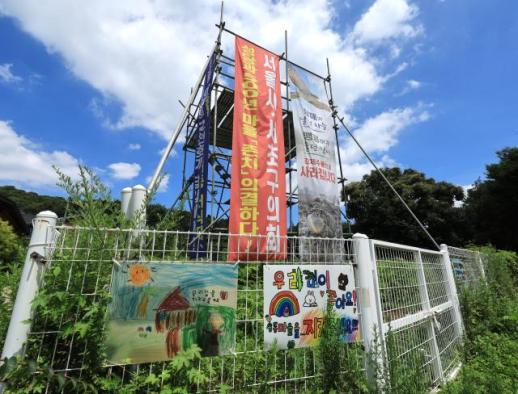 Watchtower against redevelopment installed in Umyeon-dong A banner opposing redevelopment hangs from a watchtower installed in front of Umyeon-dong Catholic Church in Seocho-gu, Seoul, July 29, 2026. 2026-07-29 18:45:19
 -
Special Prosecutors Indict Kim Tae-hyo for Justifying Martial Law; Yoon and Shin to be Charged Former National Security Office First Deputy Director Kim Tae-hyo has been indicted while in custody for allegedly justifying the declaration of martial law to allied nations, including the United States, shortly after it was announced on December 3, 2024. The special prosecutors' office plans to charge former President Yoon Suk Yeol and former National Security Office Director Shin Won-sik in the future.On July 29, the second comprehensive special investigation team, led by Special Prosecutor Kwon Chang-young, announced that Kim was indicted on charges of engaging in important duties related to insurrection and abuse of power.Kim is accused of explaining the background and justification for the martial law declaration to key allied nations through officials from the National Security Office and the Foreign Ministry, following orders from former President Yoon.The messages conveyed at that time reportedly included claims that the martial law was a measure to protect liberal democracy. It was also said to explain that the government was responding to attempts by the National Assembly to paralyze the executive branch through impeachment and budget cuts, which were seen as efforts to undermine constitutional order.The messages allegedly included assertions that former President Yoon maintained a stance against pro-North Korean leftists and anti-Americanism. These communications were reportedly sent to key figures in allied nations, including representatives of then-President-elect Donald Trump.The special prosecutors believe that former President Yoon directed Kim and Shin to explain the background and significance of the martial law to allied nations after its declaration. Yoon reportedly stated during a special prosecutor's investigation last month that he instructed Kim to inform the U.S. side about the martial law situation because Kim was proficient in English.The special prosecutors also determined that Kim directed officials from the National Security Office and the Foreign Ministry to carry out related tasks during the message delivery process. They view the justification of martial law as outside the legitimate duties of these officials, leading to the abuse of power charges.Kim has faced allegations that he directly explained the legitimacy of the martial law to then-U.S. Ambassador to South Korea, Mark Lippert. Unification Minister Jeong Dong-young claimed last year that Kim told Ambassador Lippert in a phone call shortly after the martial law was lifted that the declaration was unavoidable to eradicate anti-state forces.While Kim acknowledged that he spoke with Ambassador Lippert, he maintains that he did not justify the martial law. He stated that about an hour after the martial law was declared, he received a call from Lippert and responded with a message to "let's watch the situation together" before ending the call.The special prosecutors launched a forced investigation in April, conducting searches of Kim's home and university office. They subsequently requested an arrest warrant on July 7, and on July 10, a judge at the Seoul Central District Court issued the warrant, citing concerns about potential evidence destruction.After being detained, Kim requested a review of his detention, but it was denied on July 16. With the expiration of his detention period approaching on July 30, the special prosecutors moved to indict him.The special prosecutors have separated the cases of former President Yoon and Shin, who were also under investigation. They plan to complete their investigation of the two before proceeding with charges. It is reported that Shin's involvement in the message delivery process was deemed less significant than Kim's, leading to the decision not to request an arrest warrant for him. 2026-07-29 18:44:00
-
Surge in Market Volatility Following Launch of Leverage ETFs Market volatility has overwhelmed investors. Recently, the frequency of volatility control device (VI) activations in the domestic stock market has surged. Following the launch of single-stock 2x leverage exchange-traded funds (ETFs), the market has entered a phase of volatility surpassing that seen during the COVID-19 pandemic, characterized by sharp declines and increases. The VI, a safety mechanism designed to prevent drastic price fluctuations in individual stocks, has been activated intensively over the past two months, significantly heightening investors' perception of volatility.According to the Korea Exchange, from January 2 to July 29 this year, the VI was activated a total of 83,834 times in the domestic stock market. This figure is 50% higher than last year's total of 55,875 activations. It also exceeds the annual activation count of 83,604 recorded during the height of the COVID-19 crisis in 2020. With the second half of the year still ahead, the number of VI activations this year is on track to reach an all-time high. Notably, the past two months have seen a marked increase in volatility. In June, the VI was activated 21,257 times, and in July, it was activated 18,085 times, totaling 39,342 activations over the two months. This translates to an average of about 913 activations per trading day during this period.The VI is a system that switches trading to a single-price method for two minutes when the price of an individual stock rises or falls beyond a certain threshold, providing investors with time to reassess prices during rapid fluctuations. There is no limit on the number of activations, meaning the same stock can trigger the VI multiple times in a single day.The KOSPI index has also experienced unprecedented volatility. Since June, there have been 16 trading days where the KOSPI fluctuated by more than 5%. Of these, there were five days of gains and 11 days of losses, indicating a greater number of sharp declines. For instance, on June 9, the KOSPI rose by 8.18% in a single day, while on June 23, it fell by 9.99%. This pattern of significant fluctuations continued, with the KOSPI rising by 5.42% on June 25 and falling by 5.81% the following day. In July, the index also saw unpredictable movements, including a 5.76% rise on July 3, a 5.35% drop on July 8, an 8.95% plunge on July 13, and a 6.24% rebound on July 15, followed by a 6.37% decline on July 16.On July 28, the KOSPI plummeted by 10.84% in a single day, dropping more than 700 points, and during the session, it even showed a decline exceeding 12%. Analysts suggest that the increased size of the index compared to the past has amplified the impact of these daily fluctuations on investors.Overall market anxiety is also rising. The KOSPI 200 Volatility Index (VKOSPI), often referred to as the 'Korean fear index,' soared to a peak of 93.27 during the recent downturn. The VKOSPI reflects the expected future volatility of the market as indicated by option prices. After spiking to the 97 level last month and then stabilizing in the 80s, it has surged again in response to the ongoing market decline, reflecting heightened investor anxiety.The recent increase in volatility is attributed to a growing concentration in large-cap stocks following the launch of single-stock 2x leverage ETFs. Since the introduction of leverage ETFs based on Samsung Electronics and SK Hynix on May 27, demand for leveraged investments among individual investors has surged. However, this has coincided with a downturn in the semiconductor sector, leading to increased losses and a decline in investor sentiment. While it is difficult to definitively state that leverage ETFs directly cause volatility, analysts suggest that they can amplify price fluctuations by increasing buying pressure in rising markets and triggering sell-offs in declining markets.In light of these developments, financial authorities and lawmakers are recognizing the impact of single-stock leverage ETFs on market volatility and are working on regulatory improvements. On this day, Financial Services Commission Chairman Lee Ok-keun acknowledged the criticism that this situation is a 'man-made disaster' by the financial authorities, stating, "I feel a heavy responsibility as the final decision-maker." He also mentioned additional measures, including setting a 20% investment limit for individual investors in single-stock leverage ETFs.* This article has been translated by AI. 2026-07-29 18:44:00