


Latest by
-
 SK Group's Chey Tae-won Advocates for AI Native Nation at San Francisco Summit SK Group has joined forces with global tech giants in Silicon Valley to expand the global AI ecosystem. On July 24, during the K-AI Summit held at the Fairmont Hotel in San Francisco, SK Group reached agreements with Nvidia, Microsoft, and Anthropic to collaborate on AI infrastructure, including AI semiconductors and data centers.Additionally, in a separate meeting with Amazon Web Services (AWS), SK Group discussed expanding domestic AI infrastructure cooperation based on their existing partnership in building a joint AI data center in Ulsan.Following the announcement of nationwide AI data center construction and semiconductor belt investment plans at the 'Three Mega Projects National Report Meeting' in June, SK Group aims to strengthen the execution foundation of these projects through collaboration with global tech firms. This initiative is designed to enhance South Korea's AI competitiveness while expanding the global AI ecosystem.An SK Group official stated, "The expansion of cooperation with global tech giants like Nvidia reaffirms the rapidly growing demand for AI infrastructure, such as AI memory. We expect this collaboration to further energize the recently announced 'Mega Projects' by the government."Nvidia and SK Group to Collaborate on Comprehensive AI InfrastructureSK Group will engage in comprehensive cooperation with Nvidia to build AI infrastructure worth over $500 billion. This partnership, which includes the establishment of AI factories and the supply of AI memory, was formalized with a letter of intent (LOI) signed on the same day.Initially, SK Telecom will receive next-generation GPUs to build a domestic AI factory with a capacity of up to 2 gigawatts (GW) and pursue investment collaboration. This partnership is a concrete step following their agreement in June to establish a GW-class AI factory in South Korea.SK Telecom plans to introduce the next-generation AI computing system 'Vera Rubin,' equipped with SK Hynix's HBM4, based on Nvidia's full-stack AI factory architecture, the 'DSX' platform. The goal is to gradually establish and operate high-performance AI factories starting in 2027, accelerating the development of large-scale AI infrastructure that encompasses sovereign, physical, and agentic AI, while jointly addressing the growing AI demand in the Asia-Pacific region.This collaboration is expected to accelerate the spread of AI infrastructure utilizing Nvidia technology and broaden customer access to advanced cloud services. As a result, SK Telecom will embark on large-scale AI infrastructure investments and expansions, making cutting-edge AI infrastructure more accessible to a wider range of customers.SK Hynix will also engage in long-term cooperation for AI memory supply. Following their previously established long-term technology partnership, Nvidia will provide next-generation AI memory, allowing SK Hynix to expand its growth base in the AI memory business.The two companies plan to jointly develop and optimize next-generation AI memory, such as HBM, to meet the infrastructure demands ranging from large language model (LLM) training to agentic and physical AI.Jensen Huang, founder and CEO of Nvidia, stated, "South Korea has all the conditions to become a global AI powerhouse, including world-class networks, data centers, semiconductor technology leadership, and a vast industrial base. Nvidia will work with SK Telecom and SK Hynix to create a new generation of AI factories that will drive the next growth phase in Korea."Chey Tae-won, chairman of SK Group, remarked, "The competitiveness in the AI era depends not only on how well we utilize AI but also on how much intelligence we can generate. SK aims to build world-class AI factories in collaboration with Nvidia, leveraging SK Telecom's AI infrastructure capabilities and SK Hynix's AI memory, contributing to South Korea's transformation from an AI-consuming nation to a global hub for AI innovation."SK Hynix and Microsoft to Establish Long-term AI Memory Supply CooperationSK Hynix has decided to pursue long-term memory supply cooperation with Microsoft. The two companies aim to supply server memory optimized for AI workloads to Microsoft's data centers in response to the surging demand for AI services.They plan to explore memory solutions tailored to AI workload requirements and establish new standards for AI server memory through validation in actual server environments.SK Telecom Expands AI Data Center Cooperation with Anthropic and AWSSK Telecom and Anthropic signed a comprehensive memorandum of understanding (MOU) to collaborate on building GW-class AI data centers in South Korea. Anthropic is expected to participate in SK Telecom's ongoing AI data center construction project, with plans to discuss specific cooperation methods.With AWS, SK Telecom will expand the scope of cooperation in AI infrastructure based on their partnership in jointly building the Ulsan AI data center. The two companies aim to combine SK Telecom's domestic AI data center construction and operational capabilities with AWS's global cloud and AI technology and customer base to broaden their business in key domestic locations and secure GW-class AI computing capacity in the long term.On the same day, Chey Tae-won met with Sam Altman, CEO of OpenAI, to discuss long-term cooperation in the AI infrastructure sector. SK and OpenAI have been continuously discussing collaboration plans for AI infrastructure, including memory, and have been strengthening their strategic partnership since signing a partnership agreement last October regarding memory supply and the establishment and operation of a southwestern AI data center.Chey Tae-won Proposes Three Key Tasks for Mega Project SuccessDuring the K-AI Summit attended by President Lee Jae-myung, global tech representatives, AI experts, researchers, startups, and investors, Chey Tae-won emphasized the recent announcement of three mega projects, stating, "The investment scale may seem unfamiliar due to its size, but it is a realistic plan based on actual demand in the global AI market."Chey introduced his meetings with executives from global tech firms like Nvidia, Broadcom, Anthropic, and OpenAI, noting, "The scale of AI chips and computing power demanded by companies is growing much faster than expected. The announced investment scale is realistic when considering future demand."He added, "The three mega projects are AI initiatives for South Korea's growth and a project for all of us. We must consolidate our capabilities as quickly as possible to ensure success."Chey outlined three key tasks for project success: 1) Implementing an 'AI Native Nation' where each citizen utilizes at least one AI agent, making South Korea a global AI testbed; 2) Reducing token costs through memory production and expansion of AI data centers; and 3) Establishing AI governance while minimizing AI-related side effects, including job creation and environmental preservation.He also stated, "AI is still in its early stage. South Korea must leap to become an AI infrastructure hub connecting the U.S., Europe, and Asia, based on more memory and AI data centers." 2026-07-25 15:20:00
 -
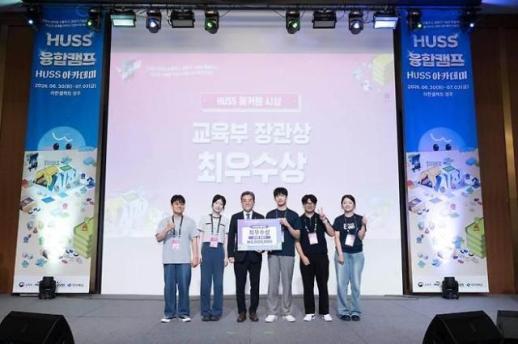 Kookmin students take top prize at HUSS hackathon SEOUL, July 25 (AJP) - Kookmin University students helped win the top prize and two other awards at a national hackathon that asked humanities and social science students to solve social problems with artificial intelligence. The 2026 HUSS Convergence Camp Insight hackathon ran from July 1 to 3 at the Sono Calm resort in Gyeongju, backed by the Ministry of Education and the National Research Foundation of Korea and organized by the council of the Humanities Utmost Sharing System (HUSS), a government program that trains humanities and social science students to work across disciplinary lines. About 430 students and program officials took part in the hackathon, with students from different universities and majors grouped into five-member joint teams to propose solutions to social problems. A total of 55 teams entered. Around 20 advanced through a written preliminary round to the final presentations, where 10 teams took prizes: one top prize carrying the award of the deputy prime minister and education minister, four excellence prizes from the National Research Foundation chairman, and five encouragement prizes from the HUSS council chair. Kookmin students stood on three of those teams, including the one that won it all. The top team, Onsaemiro, included Yang Seung-eon of Kookmin's Department of Political Science and International Relations and Lee Tae-ho of the Department of AI, Big Data and Management. The team proposed ORIGIN, a platform that screens AI-generated traditional culture content for distortion before it spreads. The service analyzes such content for likely historical and cultural errors, then runs it past heritage practitioners and experts before issuing certification. Yang researched distortion cases and the surrounding regulations, defined the problem and built the presentation. Lee tested the feasibility of the solution and shaped a business model aimed at government agencies and public institutions. Kim Yun-seo of the School of Management Information Systems joined the excellence prize team Daumi, which proposed Dahda, an AI-based indoor evacuation navigator for visually impaired people. The service uses Wi-Fi fingerprinting and Bluetooth beacon technology to guide users to the nearest emergency exit during a fire and relays their location inside the building to rescue teams, with voice and vibration guidance tailored to different types of disability. Kim designed and developed the application prototype and handled its interface design. Hyun Yun-su of the School of Management Information Systems and Choi So-yul of Kookmin University Business School (KIBS) joined the encouragement prize team Poporiner, which proposed Daol, a legal and administrative support service for migrant workers offering individual visa schedule management, administrative information and expert consultations in users' native languages. The two managed the team, planned the service and led the research behind its main functions. The results gave Kookmin students a hand in solutions spanning cultural content credibility, disaster safety and support for vulnerable groups, the mix of AI technique and humanities grounding the HUSS program was built to produce. The university's HUSS office said it would keep expanding hands-on education that turns that grounding toward real social problems, working through inter-university cooperation and global partnerships. 2026-07-25 14:59:36
 -
Democratic Party Candidates Express Condolences Over Shipyard Death, Stress Safety Candidates for the leadership of the Democratic Party, Kim Min-seok, Jeong Cheong-rae, and Song Young-gil, expressed their condolences over the death of a worker in his 30s at a shipyard in Gunsan, Jeollabuk-do.According to Yonhap News on July 25, the three candidates voiced their deep regret over the tragic incident that occurred the previous day, emphasizing the need for rigorous safety management in industrial workplaces.Kim Min-seok stated on his X (formerly Twitter) account, "Despite the efforts of the Lee Jae-myung administration to eradicate industrial accidents, it seems we still have a long way to go, and I feel a heavier sense of responsibility. I will ensure that safety in industrial workplaces is prioritized more thoroughly."Jeong Cheong-rae also posted on Facebook, highlighting the necessity for a thorough investigation into the cause of the accident and comprehensive safety checks across workplaces. He added, "The Democratic Party will do its utmost to create safer industrial environments."Song Young-gil expressed his sorrow on Facebook, noting, "It is still a recurring tragedy that someone who leaves for work in the morning does not return home in the evening." He continued, "As someone who worked in a factory in my youth, I will ensure that safety in labor environments is taken more seriously."Meanwhile, according to the Gunsan Fire Department, a report was received on the afternoon of the previous day regarding an incident at a shipyard in Bi-eungdo-dong, Gunsan, where a worker's head became trapped in equipment. Emergency responders quickly transported the worker, identified as A, to the hospital in a state of cardiac arrest, but he ultimately did not survive.* This article has been translated by AI. 2026-07-25 14:48:00
-
Na Hong-jin's 'Hope' Surpasses 3 Million Viewers in 11 Days Na Hong-jin's new sci-fi film 'Hope' has surpassed 3 million viewers just 11 days after its release.According to Yonhap News on July 25, 'Hope' reached the milestone of 3 million viewers on the afternoon of its 11th day in theaters. This achievement comes a day later than the record set by director Yeon Sang-ho's zombie film 'Goonche,' which reached 3 million in 10 days.'Hope,' which premiered on July 15, has consistently held the top spot at the box office. It notably surpassed 1 million viewers on its third day and 2 million on its fifth day, demonstrating the fastest initial audience growth of the year.However, recent trends indicate a slowdown in audience growth. Last week, weekday attendance ranged between 200,000 and 300,000, but this week it has dropped to around 100,000.'Hope' depicts a struggle against an unidentified alien life form that appears near the Demilitarized Zone. This marks Na's first film in a decade since 'The Wailing' in 2016, featuring intense action from actors Hwang Jung-min, Jo In-sung, and Jung Ho-yeon. The film also includes global Hollywood stars such as Michael Fassbender, Alicia Vikander, and Taylor Russell.* This article has been translated by AI. 2026-07-25 14:08:00
-
 Sanhwabi brings Korea's living heritage to Busan stage BUSAN, July 25 (AJP) - A special performance titled "Sanhwabi" filled BEXCO Auditorium in Busan, presented as part of the Intangible Heritage Festival in Busan celebrating the 48th session of the UNESCO World Heritage Committee. South Korea is hosting the committee for the first time since joining the World Heritage Convention in 1988. The 11-day session opened on July 19 and runs through July 29 at BEXCO, bringing together delegates from around the world to decide World Heritage inscriptions and set conservation and management policy. Directed and conceived by Nam In-woo, Sanhwabi explored the roots and future of Korea's intangible heritage, presenting tradition not as a relic but as a living cultural asset that continues to evolve. The production traced how traditional culture weathered the colonial period and rapid modernization, then reached for what comes next, layering media art, electronic music and contemporary stage design over traditional performing arts. The auditorium was nearly full with citizens and committee participants, and applause carried through the evening. Participation was built into the show rather than added to it. In the "Pan" segment, a traditional lion dance pulled audience members in among the performers, and in the closing "Ye" segment, people of all ages climbed on stage to perform alongside the cast. Korea Heritage Service administrator Heo Min joined them to deliver closing remarks, ending the night as a celebration of community and shared heritage. Sanhwabi was staged as one of the signature cultural events of the committee session. 2026-07-25 13:41:19
 -
South Korea and U.S. Tech Giants Forge $950 Billion Semiconductor Partnership South Korean President Lee Jae-myung met with top executives from major global tech companies in San Francisco to discuss large-scale investments and collaborations in sectors ranging from semiconductors to artificial intelligence (AI) data centers and physical AI. Over the next five years, a total of $950 billion will be invested in semiconductor cooperation alone.Kim Yong-beom, head of the Presidential Policy Office, announced on July 24 that President Lee held individual meetings with Jensen Huang, CEO of NVIDIA; Hock Tan, CEO of Broadcom; Sam Altman, CEO of OpenAI; and Dario Amodei, CEO of Anthropic, before attending the 'San Francisco AI Summit.'This event was organized to enhance the scale and execution of the three mega projects announced last month for South Korea's major leap forward by combining the technology and capital of global big tech firms. The government plans to solidify investment and cooperation across the entire AI stack based on South Korea's semiconductor and AI infrastructure, AI models, and physical AI capabilities.Attendees at the summit included President Lee, global tech CEOs, Lee Jae-yong, chairman of Samsung Electronics; Chey Tae-won, chairman of SK Group; Chung Eui-sun, chairman of Hyundai Motor Group; and Lee Hae-jin, chairman of Naver's board. The event attracted over 230 participants, including domestic and international business leaders, researchers, startups, investors, and students.Satya Nadella, CEO of Microsoft, conveyed his commitment to collaborating with South Korea in the semiconductor and AI infrastructure sectors through a video message.In the semiconductor sector, domestic companies and global tech giants have agreed to pursue a total of $950 billion in cooperation.Samsung Electronics and Broadcom signed a memorandum of understanding (MOU) for advanced memory semiconductor supply and AI chip production, valued at $200 billion over the next five years. SK will also engage in long-term supply cooperation for advanced memory semiconductors worth $750 billion with global tech firms, including NVIDIA.The Ministry of Science and ICT and AMD signed an MOU on July 23 to jointly establish and demonstrate AI computing infrastructure that links South Korea's neural processing units (NPU) with AMD's central processing units (CPU) and graphics processing units (GPU). The government views this as a foundation for cooperation that encompasses semiconductor supply and production, next-generation chip co-design, and domestic AI semiconductor validation.In the AI data center sector, investment cooperation is being pursued to secure approximately 5GW of infrastructure and around 2 million GPUs based on NVIDIA's B200 standard.SK Telecom will collaborate with NVIDIA to build and expand AI data centers with a capacity of up to 2GW, prioritizing the allocation of the latest GPU, the Vera Rubin system. They will also pursue investment cooperation for a domestic GW-level AI data center project with Anthropic. Amazon Web Services (AWS) plans to expand its existing Ulsan AI data center project into a major domestic hub to secure GW-level AI computing capacity.Naver aims to establish a global AI factory worth $10 billion, backed by investments from NVIDIA and Brookfield. Naver will secure $1 billion from NVIDIA to enhance GPU supply and technical collaboration, while Brookfield will provide up to $9 billion to jointly build the infrastructure and supply chain necessary for operating the GW-level AI factory.Cooperation plans were also announced in the fields of physical AI, autonomous driving, and AI talent development.Hyundai Motor Group and NVIDIA will jointly develop a standardized 'robot reference platform' to create and validate AI robots, which will be made available to universities and startups to support various robot development initiatives. Hyundai also announced plans for an autonomous vehicle foundry in collaboration with Waymo.Samsung SDS and Anthropic signed a strategic partnership agreement to jointly explore new AI markets and train AI engineers.During the summit, President Lee announced the 'San Francisco AI Declaration,' presenting a vision to make South Korea a global AI production hub and a foundation for innovation. He aims to create a dynamic market that utilizes AI most effectively and to establish a horizontal cooperation network among countries, propelling South Korea to become a global AI hub.President Lee also emphasized the importance of developing AI responsibly and human-centered, aiming to realize an 'AI basic society' that translates growth outcomes into new opportunities for society as a whole. This initiative seeks to position South Korea as an indispensable core country in the global AI supply chain.After the event, President Lee dined with Jensen Huang, Hock Tan, Rani Borkar, president of Microsoft Azure Hardware, and other business leaders, including Lee Jae-yong, Chey Tae-won, and Chung Eui-sun.Participants responded to President Lee's call to action by affirming their commitment to global AI supply chain cooperation. President Lee noted that thanks to corporate investments and collaborations, the country's economic growth rate has significantly increased, achieving its best performance in decades, and urged continued contributions to the development of the industrial ecosystem.Jensen Huang remarked that South Korea is already a 'global powerhouse' in AI, stating, 'While AI technology is indeed challenging, it is not impossible.' He suggested that investing in South Korea could yield top-tier frontier AI models in a short time and emphasized the need to build both domestic AI models and utilize those from other countries.Kim Yong-beom stated, 'The government plans to strengthen cooperation between domestic companies and global big tech through these individual meetings, the AI summit, and the dinner, aiming to achieve visible results from the three mega projects at an early stage.'* This article has been translated by AI. 2026-07-25 13:32:00
-
Lee Discusses AI Collaboration with Global Tech CEOs in San Francisco President Lee Jae-myung met with Jensen Huang, CEO of NVIDIA, and other leaders from U.S. and Korean tech companies to discuss artificial intelligence (AI) collaboration during a dinner in San Francisco. On July 24, local time, President Lee hosted a dinner at The Ramp restaurant with business leaders from both countries. The group enjoyed mini burgers, fish and chips, fried squid, and clam chowder while sipping Budweiser beer at an outdoor terrace table overlooking the San Francisco Bay. President Lee opened the conversation with a light-hearted remark, referencing a previous meeting with Huang in Korea where they had chicken and beer, saying, "We might need some chicken here." Huang then asked the President, "When was the last time you had a burger?" to which President Lee replied he couldn't quite remember. Attendees included Huang, Hock Tan, CEO of Broadcom, and Rani Borkar, President of Microsoft Azure Hardware. From Korea, Lee Jae-yong, Chairman of Samsung Electronics, Chey Tae-won, Chairman of SK Group, Chung Eui-sun, Chairman of Hyundai Motor Group, and Lee Hae-jin, Chairman of Naver's board were present. Government officials included Deputy Prime Minister Baek Kyung-hun and Kim Yong-beom, Chief Policy Officer at the Blue House. During the dinner, President Lee explained to Huang that in Korea, people refer to family as "sikgu," meaning those who share meals together. Huang responded in English, "So we are family," prompting President Lee to propose a toast, saying, "We are sikgu," and emphasizing the significance of sharing a meal. When Deputy Prime Minister Baek offered to cover the meal's cost, Huang jokingly requested another beer. President Lee quipped, "I can’t do that because I’m a public servant," to which Huang humorously replied, "Korea is a rich country." President Lee laughed and agreed, saying, "That’s true, but still, I can’t." The dinner also touched on the recent volatility in the Korean stock market. According to Kim Yong-beom, when President Lee noted that Korean stocks have been experiencing some adjustments, Huang responded, "They will rise again." Huang inquired about Korea's GDP size, and after receiving an explanation, he asked, "So can I have another beer? I need one more." When Huang asked about the forecast for Korea's GDP growth this year, President Lee stated, "Last year it was around 1%, but this year it seems we will exceed 3%. We expect it to rise above the potential growth rate, which hasn’t happened in decades." 2026-07-25 13:12:00
-
K-Heritage Gains Recognition with Expanded Registration of Korean Tidal Flats and Busan Declaration The 48th session of the UNESCO World Heritage Committee is taking place in Busan, elevating the status of K-Heritage. Significant achievements include the expanded registration of 'Korean tidal flats,' the Busan Declaration, which proposes new directions for the preservation of world heritage, and calls for improved exhibition strategies for Japan's Sado Mine. The movement to register Busan as a refuge city heritage by 2030 is also expected to gain momentum.The most notable achievement is the second phase of the expanded registration of 'Korean tidal flats.' On July 25, the World Heritage Committee approved the addition of the tidal flats of Muan, Goheung, Yeosu, and Seosan to the existing sites of Seocheon, Gochang, Sinan, and Boseong-Suncheon. This marks the first instance of expanding the scope of an existing World Heritage site in Korea.The committee praised the Korean tidal flats as a key habitat in the Yellow Sea ecosystem and the East Asia-Australasia migratory bird route. The international community has once again recognized the natural heritage value that contributes to the conservation of migratory waterfowl and various marine life.As the host country, South Korea also led discussions on world heritage. The 'Busan Declaration on World Heritage,' adopted on July 20, was drafted collaboratively by South Korea and experts from 21 World Heritage Committee member countries, as well as the International Centre for the Study of the Preservation and Restoration of Cultural Property (ICCROM), the International Council on Monuments and Sites (ICOMOS), and the International Union for Conservation of Nature (IUCN).The Busan Declaration emphasizes the need for a collective international response to the crises facing world heritage, including armed conflict, climate change, and development pressures. It proposes adding 'cooperation' to the existing five strategic goals of the World Heritage Convention and highlights key issues such as digital transformation, accountability, and inclusive interpretation. The Cultural Heritage Administration plans to pursue follow-up projects to create more concrete and practical outcomes following the declaration.In relation to the Sado Mine issue, South Korea's position has gained support. The World Heritage Committee noted that while Japan has made some progress in developing an interpretation and exhibition strategy that reflects the 'full history' of the Sado Mine, it deemed the efforts insufficient. The committee recommended that Japan comprehensively address the entire history of the mine's development on-site and improve its exhibitions. This marks an official acknowledgment by the international body that Japan has not fully implemented the historical explanations promised during the mine's registration.Additionally, as Busan aims for the registration of the 'Refuge City Busan Heritage,' the push for registration is expected to accelerate. The Cultural Heritage Administration and the World Heritage Centre are currently discussing the necessary measures for registering Busan's heritage as a World Heritage site. 2026-07-25 13:04:00
-
 UNESCO expands Korean tidal flats World Heritage listing SEOUL, July 25 (AJP) - The mudflats where the world's rarest sandpiper refuels twice a year got bigger on the map that matters most. The UNESCO World Heritage Committee on Saturday approved a major expansion of Getbol, Korean Tidal Flats, adding four coastal wetlands and bringing South Korea's only natural World Heritage property on the mainland to six components stretching along the country's southwestern and southern coasts, the Ministry of Foreign Affairs said. The decision, taken at the committee's 48th session in Busan, adds the tidal flats of Yeosu, Goheung and Muan in South Jeolla Province and Seosan in South Chungcheong Province to the property inscribed in 2021. It is a boundary modification rather than a new inscription, so South Korea's World Heritage count stays at 17. According to the announcement, issued jointly by the Ministry of Foreign Affairs (MOFA) and the Korea Heritage Service, the committee found that the expanded property meets criterion (x), the natural heritage standard covering the most important habitats for conserving biological diversity, and cited its value to migratory waterbirds and marine life across the Yellow Sea ecosystem. The approval was expected. The International Union for Conservation of Nature (IUCN), the committee's advisory body on natural sites, recommended the expansion on June 5, and properties arriving with a positive recommendation are rarely turned back. The session itself is a first for South Korea, which has never hosted the committee since joining the World Heritage Convention in 1988. Getbol is the Korean word for tidal flats, the vast plains of mud and sand that the Yellow Sea's tides expose and drown twice daily. The sea's shallow basin and large tidal range have built some of the widest flats on Earth, fed by sediment from rivers on both the Korean and Chinese coasts. What looks like empty mud is among the most productive ecosystems known. UNESCO's records for the property count about 2,150 species, including 857 kinds of macrobenthos, the clams, crabs, worms and snails living in and on the sediment, along with mud octopuses, fiddler crabs and 47 invertebrate species found nowhere else. That buried abundance is what makes the flats matter far beyond South Korea. They sit at the waist of the East Asian-Australasian Flyway, the migration corridor running from breeding grounds in Siberia and Alaska to wintering grounds as far south as Australia and New Zealand, used by an estimated 50 million waterbirds. For long-distance migrants, the Yellow Sea is the critical refueling stop in both directions, and the food packed into its mud is the fuel. The flyway is considered the most threatened of the world's major bird migration routes, largely because so much of the Yellow Sea coastline has been reclaimed for farmland, ports and industry over the past half century. The property provides habitat for 118 migratory bird species, among them eight globally threatened species found only on this flyway. The spoon-billed sandpiper, a bird small enough to sit in a palm with a bill flattened like a spatula, is the starkest case. It is critically endangered, with the wild population estimated in the hundreds, and it cannot complete its migration without the Yellow Sea flats. The endangered black-faced spoonbill, far eastern curlew, great knot and spotted greenshank depend on the same mud, as do the hooded crane, Saunders's gull and Chinese egret. The expansion also deepens a rare piece of cross-border conservation. China won World Heritage status for its own Yellow Sea coast in 2019, with the migratory bird sanctuaries along the Yellow Sea-Bohai Gulf, and the two listings now protect stopover habitat on both shores of the same sea, used by the same birds in the same weeks of the year. Saturday's result closes a condition attached to the original listing, and the history behind that condition is less tidy than the celebration suggests. When Getbol first came before the committee in 2021, IUCN recommended deferral, judging that the four nominated flats at Seocheon, Gochang, Shinan and Boseong-Suncheon did not cover enough of the habitat to justify inscription. South Korea overcame the recommendation on the committee floor. An amendment tabled by Kyrgyzstan drew the co-signatures of 13 of the 21 member states, and the property was inscribed by consensus, with MOFA describing the outcome at the time as the result of active diplomatic engagement with the World Heritage Centre and committee members. The inscription came with a recommendation to expand the property in a second phase. The government initially aimed higher than what was delivered on Saturday. When the 2021 listing was secured, the heritage authorities announced a Phase 2 plan covering nine additional sites, and the committee's own recommendation named candidates including Incheon, Hwaseong and Gunsan alongside the four that made it. The flats that dropped out along the way include some of the most ecologically prominent and the most contested. Ganghwa's flats near Incheon, a designated natural monument and the best-known breeding ground of the black-faced spoonbill, were left out of the nomination, as were the Incheon, Hwaseong and Gunsan flats, all of them under heavier reclamation and development pressure than the sites that went forward. Environmental groups made the gap explicit while the committee was sitting. On July 20, campaigners including the Incheon and Hwaseong branches of the Korean Federation for Environmental Movement held a press conference outside BEXCO, the Busan convention center hosting the session, calling for a third phase covering Incheon, Hwaseong, Gunsan and Busan. Their argument tracks the science: a flyway is a chain of stopovers, and protecting some links while leaving others exposed protects the birds only part of the way. IUCN's approval in June pointed in the same direction, recommending that South Korea continue analyzing additional flats with potential heritage value and keep building local community support, alongside sustaining traditional fishing and gathering practices and strengthening cooperation with other flyway countries. The Korea Heritage Service, led by administrator Heo Min, said the expansion was the joint work of MOFA, the Ministry of Oceans and Fisheries under Minister Hwang Jong-woo, local governments and the Getbol World Heritage Promotion Team, and confirmed international recognition that the 2021 recommendations had been faithfully carried out. The service said it would continue working with the ministries, local governments and communities to preserve the property's value and build a base for sustainable use. The committee session in Busan runs through July 29. 2026-07-25 12:54:42
 -
Defense Minister An Kyu-baek Marks One Year in Office, Commits to Reform On July 25, Defense Minister An Kyu-baek reaffirmed his strong commitment to completing defense reforms as he marked his one-year anniversary in office.In a post on his Facebook page, An acknowledged that "the deeper and broader the scope of reform, the more intense the growing pains will be," but he vowed to move forward without wavering.He stated, "I will shoulder all the burdens of reform" and requested warm encouragement and support from the 550,000 members of the defense family who are quietly walking this path.An characterized the government's defense reform as a "paradigm shift" rather than mere institutional adjustments, emphasizing, "Based on the great achievements that have led South Korea to become a strong nation over the past 80 years, we will surely achieve a new paradigm shift for success in the next 80 years."Notably, he addressed the transfer of wartime operational control, stating, "The journey of recovery is also heading toward a conclusion," and assessed that the timing and conditions for regaining operational control have matured to the point of being encouraging to allied nations.Accordingly, the Ministry of National Defense plans to finalize the verification of the Future Combined Command's Full Operational Capability (FOC) during the upcoming Security Consultative Meeting (SCM) in Washington, D.C., scheduled for October or November. Following this, the defense ministers of both countries aim to propose and announce the target year for the transfer of operational control to their respective presidents. Achieving this transfer by June 2030, before President Lee Jae-myung's term ends, is a key policy goal of the current administration.An also listed significant achievements from the past year, including high-intensity internal audits and personnel reforms in response to the December 3 emergency martial law situation, legal and institutional improvements related to martial law, enhanced constitutional education, the operational deployment of the high-power missile Hyunmoo-5, the unveiling of the nuclear-powered submarine Jangbogo N Project, improvements in service members' treatment, and the easing of military facility protection zones.Looking ahead, he outlined tasks for the remainder of his term, including the establishment of the National Military Academy, restructuring the military, normalizing intelligence and counterintelligence agencies, reforming the Marine Corps into a "quasi-fourth military branch," reorganizing the Defense Drone Headquarters, and increasing duty pay and various allowances.An, who became the first civilian defense minister in 64 years, has led significant military organizational reforms, including the push for the transfer of operational control and the integration of military academies. However, he has faced internal resistance and personal attacks related to past allegations of military service violations during his tenure.* This article has been translated by AI. 2026-07-25 12:52:00