


Latest by
-
 Trump: Iran Funds Will Compensate for Damage to U.S. Ships and Cargo President Donald Trump announced that the United States will use frozen Iranian funds to compensate for damages to American ships and cargo resulting from Iranian attacks.In a post on his social media platform Truth Social on July 23, Trump stated, "All damages occurring to ships, cargo, or anything related will be compensated with the Iranian funds that the U.S. holds and manages." He added, "The scale of the damages could be very large, but this is a fair and equitable measure."This statement implies that compensation for damages incurred by ships and cargo due to Iranian attacks will be paid from frozen Iranian assets. However, Trump did not clarify whether the compensation would be paid directly to shipping companies.Since July 6, at least 11 vessels transiting the Strait of Hormuz have reportedly been attacked by Iran, amid rising tensions between the U.S. and Iran.Currently, Iran's frozen assets abroad are estimated to total $100 billion, with the U.S. managing approximately $2 billion of that amount in the region. The release of these frozen funds was included in a memorandum of understanding (MOU) signed by both countries last month, where Iran demanded the release of its frozen assets in subsequent negotiations, while the U.S. has insisted on the freedom of navigation in the Strait of Hormuz.Despite Trump's comments, the actual use of frozen Iranian funds for compensating damages to ships and cargo remains uncertain. Bloomberg reported that "the use of frozen Iranian funds is a highly controversial issue," noting that victims of Iranian-related terrorism have also urged Trump to use these funds for their compensation.Additionally, in an interview with the U.S. online media Axios, Trump mentioned that he is considering a "large-scale attack" on Iran, stating, "It could be bigger than any attack we've seen before." 2026-07-24 08:52:00
-
T'way Air's Incheon-Sydney Route Surpasses 400,000 Passengers, Daily Flights Start in October T'way Air's Incheon-Sydney route has established itself as a major service, surpassing 400,000 cumulative passengers.According to T'way Air, the Incheon-Sydney route has transported an average of about 120,000 passengers annually since its inaugural flight in December 2022. This month, the total number of passengers exceeded 400,000, with an average occupancy rate nearing 90%.In addition to passenger transport, T'way Air has developed a stable cargo supply chain on the Incheon-Sydney route. The airline currently utilizes the belly cargo of its A330 aircraft to transport air cargo, including electronics, automotive parts, and machinery, in unit load devices (ULDs).As a result, cargo volume on the Incheon-Sydney route has increased from approximately 900 tons in 2023 to about 2,700 tons in 2025, tripling since the route's launch and contributing to improved profitability.Currently, the Incheon-Sydney route operates three times a week (Monday, Wednesday, and Friday), with plans to increase to daily flights starting in October. To date, a total of 1,350 flights have been operated, maintaining a stable operational record.Meanwhile, T'way Air recently announced a name change to Trinity Air during its shareholders' meeting. The new name will be applied to operations after undergoing approval procedures from domestic and international regulatory bodies. In the second half of this year, the airline plans to introduce additional passenger aircraft, including the B737-8.* This article has been translated by AI. 2026-07-24 08:48:00
-
Final Ruling Expected Today in Choi Tae-won and Noh So-young's Property Division Case Choi Tae-won, 65, chairman of SK Group, and Noh So-young, 65, director of the Art Center Nabi, are set to receive a ruling today in their long-running property division case.The Seoul High Court's Family Division, led by Judge Lee Sang-joo, will hold a public hearing at 2 p.m. to announce the verdict in the property division case, which has been ongoing since Choi filed for divorce mediation in July 2017, marking nearly nine years of legal disputes.Choi and Noh married in September 1988 and have three children together, but their relationship deteriorated. In 2015, Choi publicly revealed the existence of an extramarital child, stating, "I have been living apart from Noh for over ten years due to a deep rift between us."Choi filed for divorce mediation in July 2017, but it failed, leading to a formal lawsuit in February 2018. Noh countered with her own lawsuit in December 2019, agreeing to the divorce.In December 2022, the first trial court ordered Choi to pay Noh 100 million won in alimony and 66.5 billion won in property division. However, the appellate court significantly increased the alimony to 2 billion won and the property division amount to 1.38 trillion won in May 2024.This decision was based on the contributions of former President Roh Tae-woo's illicit funds of 30 billion won and Noh's role in the growth of SK Group, determining that Choi's shares in SK Holdings were subject to division.However, in October of last year, the Supreme Court ruled that Roh's illicit funds could not be considered in the property division, stating that even if the funds were funneled into SK, they could not be counted as Noh's contributions. The case was sent back for retrial.The appellate court's ruling on the alimony of 2 billion won was upheld, meaning the retrial will only address the property division.The key issues in the retrial are whether Choi's SK shares are subject to division and, if so, how the division ratio should be calculated. Choi's side argues that the SK shares were formed through inheritance and gifts, thus should not be included in the division.Conversely, Noh's side contends that her contributions in managing the household and raising the children warrant the shares being classified as joint property.The timing for determining the property division is also critical. Depending on whether the reference point is the conclusion of the trial on April 16, 2024, or the conclusion of the retrial on June 26, the valuation could differ by more than five times.As of the conclusion of the trial, SK's stock price was 160,000 won, valuing Choi's shares at approximately 2.7 trillion won. By the conclusion of the retrial, the stock price had risen to around 800,000 won. Both parties have the option to appeal the retrial ruling to the Supreme Court.Meanwhile, the business community is closely watching whether this ruling will impact SK Group's governance structure and asset restructuring strategy. A larger property division could increase Choi's cash flow burden, while a smaller division or exclusion of SK shares from the division could alleviate some uncertainties regarding the group's business restructuring and future investments in areas like artificial intelligence. 2026-07-24 08:44:00
-
SK Telecom and KT Announce Plans to End 3G Services The third-generation (3G) mobile communication, which ushered in the smartphone era, is set to be phased out. SK Telecom (SKT) and KT have officially requested the Ministry of Science and ICT to develop a policy for ending 3G services, and the ministry has indicated it will consider this while prioritizing user protection.On July 23, a meeting was held at SKT's T Tower in central Seoul, attended by Deputy Prime Minister and Minister of Science and ICT Lee Kyung-hwan and executives from the three major telecom companies (SKT, KT, and LG Uplus). During this meeting, the telecom companies proposed the termination of 3G services.Following the meeting, Choi Woo-hyuk, head of the Ministry's Information Protection and Network Policy Office, stated, "The telecom companies have suggested ending 3G services, but this does not mean the government will immediately push for a termination." He emphasized that user protection is the top priority and that discussions will proceed at a predictable pace after thorough consideration, especially given the significant number of Internet of Things (IoT) connections.Currently, SKT and KT are the only providers operating 3G services in South Korea, while LG Uplus skipped directly to fourth-generation (4G) services. SKT and KT continue to maintain 3G services due to residual demand from some voice call users, IoT devices, and emergency elevator communications.However, as the mobile communication market transitions to 5G and AI-based networks, there have been ongoing calls to phase out older generation networks. The rapid decline in 3G users has further fueled the urgency for service termination.According to the Ministry's report on the status of wired and wireless communication services as of the end of April 2026, there were only 346,011 active 3G mobile lines in the country, accounting for a mere 0.6% of all mobile lines. This figure represents a 52.6% decrease from the end of 2023, when there were 729,633 lines.Nonetheless, significant procedures will be required before the actual termination of 3G services. The previous process for phasing out 2G services involved checks on network operations, field inspections, expert consultations, gathering user opinions, and reviewing user protection plans before final approval.Given the Ministry's emphasis on user protection, it is expected that an assessment of the current status of 3G users and related infrastructure will precede any decisions. Hong Sa-chan, head of the Ministry's Communication Policy Planning Division, stated, "We will first assess the current usage of 3G services and request comprehensive data from the telecom companies. Based on this, we will review the termination of 3G services and the necessary procedures."The meeting also addressed advancements in AI-based networks and investment strategies for next-generation communication infrastructure. SKT presented its future network strategy focused on 6G and AI-based Radio Access Networks (AI-RAN).KT discussed plans to expand undersea cable capacity and enhance competitiveness in low-orbit satellite communications. LG Uplus introduced its plans for establishing a standalone 5G network and developing an AI ecosystem based on its AI Data Center in Paju.Additionally, the three telecom companies proposed the establishment of subordinate regulations for expanding investments in AI Data Centers and increasing tax credits for investments. Choi noted, "The tax credit situation requires inter-departmental discussions," and added that unlike previous years, they plan to continue these meetings and provide updates on progress.The Ministry plans to form a public-private committee next month with the three telecom companies to discuss investments in next-generation networks and improvements to communication regulations, aiming to establish reform measures by the end of the year.* This article has been translated by AI. 2026-07-24 08:36:00
-
Casino Regulation: Finding Balance in South Korea's Gaming Industry There is broad agreement on the need to reform South Korea's casino regulations, which have seen little change over the past 30 years. While the foreign-only casino market has expanded, the system for continuously assessing the qualifications and management status of operators has remained largely untouched. The framework for the tourism development fund, introduced in 1995, has also largely stayed the same.The 'Direction for Advancing Casino Regulations' forum held on July 22 at the National Assembly highlighted the differing perspectives on these issues. Government officials and academics argued for strengthening public accountability and management systems, while industry representatives cautioned against regulations that could threaten their survival. Key points of contention included the introduction of a five-year renewal licensing system and adjustments to the burden rate of the tourism development fund.The government's concerns are understandable. The casino industry is a sector that the state has permitted under strict conditions, unlike general tourism businesses. There is a need to establish mechanisms for regularly checking operators' financial health, compliance, and governance, especially as the industry has grown and public responsibilities need to be adjusted accordingly.There are several international examples of renewal licensing systems. However, the fact that these systems exist abroad does not mean that the market conditions are the same. Many overseas integrated resorts cater to domestic demand, while South Korea's foreign-only casinos operate under a fundamentally different market structure. Before applying the same standards, it is essential to consider these differences.What stood out during the forum was that both the government and the industry were not making incorrect arguments. The government emphasized the need for transparency and public accountability in the industry, while industry representatives voiced their ongoing concerns about survival.The reality on the ground is challenging. Although there are signs of recovery following the pandemic, large-scale integrated resorts still face significant financial burdens due to their initial investments. One resort representative noted that annual financial costs alone reach 120 billion won. Given the industry's nature, which requires a long time to recoup initial investments, there are concerns that new burdens could lead to reduced investment and job losses.Proposals to increase the tourism development fund should not be viewed solely through the lens of burden rates. The government has indicated it is considering a progressive approach that applies a maximum burden rate of 15% based on revenue size rather than uniformly. However, since each establishment has different revenue structures, investment levels, and debt sizes, the actual burden could vary significantly. Policies should be designed not just based on revenue increases but also consider operating profits, investment capacity, foreign currency acquisition effects, and contributions to employment.A more significant variable is time. With the opening of the Osaka integrated resort in Japan in 2030, the competitive landscape of the Northeast Asian casino market is likely to change dramatically. A new competitor with global operations, large hotels, international conference centers, and shopping and cultural facilities will emerge. The South Korean casino industry must prepare for more intense competition while discussing regulatory reforms.Thus, the direction of policy must be clear. While regulation is necessary, it should not weaken competitiveness. If a renewal licensing system is introduced, the criteria for evaluation and grounds for cancellation should be clearly disclosed to allow operators to invest in a predictable environment. Objective standards that minimize subjective judgments by evaluators are also needed. Additionally, it may be worth considering a sufficient grace period for new investment establishments.If the burden of the fund is adjusted, its usage must also be clear. There should be trust that the funds collected from casinos will be effectively used for expanding tourism infrastructure, training professionals, preventing problem gambling, and enhancing industry competitiveness. Reasonable incentives for operators contributing to job creation, non-casino facility investments, and local tourism revitalization should also be discussed.The industry must not ignore the need for change. Strengthening management transparency, internal controls, and responsible gambling systems are fundamental conditions for the industry to gain public trust, regardless of regulation. Demands to reduce burdens without addressing these issues are unlikely to be persuasive.This discussion is not about choosing between strengthening regulations or protecting the industry. It is a process of finding how to enhance industry trust while maintaining competitiveness. The government should not overlook industry realities by prioritizing public accountability, and the industry should not reject change solely for survival.As the 2030 opening of the Osaka integrated resort approaches, what the South Korean casino industry needs is not a policy that distinguishes winners from losers, but a system that allows both the government and the industry to enhance competitiveness together. Effective regulation should not stifle the industry but rather support its long-term, healthy growth.* This article has been translated by AI. 2026-07-24 08:36:00
-
South Korea Responds to U.S. 12.5% Tariff on Forced Labor Goods 청와대는 미국 정부가 한국에 12.5%의 관세를 부과하겠다고 발표한 데 대해 "아직 조사가 진행 중인 공급과잉 301조 등을 포함해 최종적으로 양국 간 합의한 15%가 지켜질 수 있도록 미 측과 긴밀히 협의해나갈 예정"이라고 밝혔다. 청와대는 이날 오전 언론 공지를 통해 "한·미 양국은 관세 합의가 준수돼야 한다는 공감대가 있다"며 이 같은 입장을 전했다. 미국무역대표부(USTR)는 23일(현지시간) 지난 3월부터 실시한 '무역법 301조' 조사 결과 강제노동 상품 수입금지를 도입·강제하는 데 실패한 60개 경제주체에 10~12.5%의 관세를 부과하겠다고 밝혔다. 무역법 301조 관세는 '강제노동' 관세와 '과잉생산' 관세로 구성돼 있다. 과잉생산은 자국 내 수요를 초과한 생산을 유지하는 국가를 조사하는 것으로, 한국은 두 가지를 모두 위반한 국가로 지목된 상태다. 다만 과잉생산 관세의 부과율은 아직 발표되지 않았다. 이번에 한국에 부과된 것은 강제노동과 관련해 12.5%를 산정받았다. 다만 지난해 한·미 정상은 상호관세를 25%에서 15%로 낮추는 데 합의한 바 있다. 현재 방미 중인 김정관 산업통상부 장관과 여한구 통상교섭본부장은 미 상무부와 USTR 관계자들을 만나 무역법 301조 관세 부과 상황을 논의하고 한·미 관세 합의 이행을 요구할 것으로 전해졌다.* This article has been translated by AI. 2026-07-24 08:32:00
-
Samsung Heavy Industries Strengthens U.S. Shipbuilding Collaboration Samsung Heavy Industries is embarking on extensive collaboration with the U.S. shipbuilding industry, leveraging its advanced shipbuilding technology and operational expertise.On July 23, during the opening ceremony of the Korea-U.S. Shipbuilding Cooperation Center (KUSPC) held at the Mayflower Hotel in Washington, D.C., Samsung Heavy Industries announced the signing of agreements related to U.S. business operations and joint research.The KUSPC was established under the Ministry of Trade, Industry and Energy to support joint research between Korean and American shipbuilders and facilitate communication between governments and businesses. The ceremony was attended by key officials, including Kim Jeong-kwan, Minister of Trade, Industry and Energy, and Howard Lutnick, U.S. Secretary of Commerce, along with Samsung Heavy Industries' Vice Chairman Choi Sung-an, Vice President Kim Kyung-hee, and representatives from Korea's top three shipbuilders.Samsung Heavy Industries has actively pursued initiatives to strengthen its business collaboration in the U.S. On the same day, Samsung Heavy Industries and Conrad Shipyard received Approval in Principle (AiP) from the American Bureau of Shipping (ABS) for the basic design of a 12,000 cubic meter liquefied natural gas (LNG) bunkering vessel they are jointly developing.This achievement follows the establishment of a cooperative relationship for the joint construction of LNG bunkering vessels in December of last year, where both companies collaborated on the design of vessels to be built in the U.S.Additionally, Samsung Heavy Industries signed a strategic business cooperation agreement with Saronic Technologies, a startup specializing in the design and manufacturing of unmanned surface vehicles. The partnership will focus on researching autonomous navigation and artificial intelligence (AI) digital solutions for unmanned surface vehicles, as well as collaborating on the establishment of production infrastructure based on robotics-driven process automation.Furthermore, Samsung Heavy Industries is expanding its collaboration with U.S. MRO partner Vigor Marine Group. The two companies have signed an agreement to establish a training center in the Pacific Northwest, where Samsung Heavy Industries plans to actively share its advanced technology and expertise.Choi Sung-an, Vice Chairman of Samsung Heavy Industries, stated, "The shipbuilding cooperation project with the U.S. that we have been preparing for will mark a new milestone with today's opening ceremony. We will do our utmost to usher in a renaissance in the Korea-U.S. shipbuilding and marine industry based on our technological capabilities."This collaboration is part of Samsung Heavy Industries' ongoing efforts to penetrate the U.S. shipbuilding market. In April, the company participated in a concept design project for the next-generation logistics support vessel (NGLS) with General Dynamics NASSCO, further broadening its cooperation in the U.S. naval sector. 2026-07-24 08:32:00
-
Financial Commission Advances Leverage ETF Deposit Requirement to July 31 The Financial Services Commission (FSC) will implement stricter basic deposit requirements for single stock leverage exchange-traded funds (ETFs) and exchange-traded notes (ETNs) starting July 31, ahead of the previously scheduled date. This measure aims to stabilize investor demand early, requiring investors to hold at least 30 million won in cash to make new investments or additional purchases.On July 24, the FSC announced the early implementation of the 'Strengthening Basic Deposit Requirements for Single Stock Leverage Products' after consultations with relevant agencies and the financial investment sector. This decision follows a market situation review meeting held on July 16, where the FSC outlined supplementary measures for single stock leverage products.Under the new rules, individual investors wishing to invest in or purchase additional shares of domestic and foreign single stock leverage products must have at least 30 million won in cash. Previously, securities such as stocks, ETFs, and bonds could be counted as 70% of the market value toward the basic deposit, with a minimum deposit requirement of 10 million won.The new system excludes securities from the calculation of the basic deposit. Additionally, the previous system that allowed brokerage firms to relax basic deposit requirements based on trading experience will be abolished. While increases in deposit requirements are permitted, reductions will not be allowed.The FSC has also revised the cash deposit recognition method. Going forward, even if securities are sold, the cash will only be recognized as a basic deposit once the settlement is completed and the actual cash is deposited into the account (T+2 days). Loans taken against the proceeds from sales will also be excluded from the basic deposit. This measure aims to prevent circular trading, where investors sell stocks and immediately buy single stock leverage products.The strengthened basic deposit requirements will also apply to existing investors making additional purchases. However, if they sell their holdings, the basic deposit requirements will not apply.The FSC plans to expedite the development of brokerage firm systems. Firms that fail to complete system construction by the deadline will be advised to limit new transactions in single stock leverage products.Additionally, measures to strengthen management of price discrepancies will be implemented following amendments to exchange regulations, effective August 19. The obligations of liquidity providers (LPs) regarding price discrepancy management will be reinforced, and the procedures for designating investment caution items will be expedited.The minimum trading quantity for single stock leverage products will be increased from 1 to 20 shares, with efforts to expedite the processing procedures and system development to implement this change earlier than the originally planned November date. A temporary halt on new listings and a ban on advertising were implemented immediately following the July 16 meeting, with the price discrepancy management enhancements set to take effect on August 19.The FSC stated, 'We will continuously monitor the impact of the supplementary measures and the market situation. If the market does not stabilize, we will consider additional measures after in-depth discussions with experts and investors.' It emphasized that efforts to revitalize the KOSDAQ market, encourage long-term investment, and introduce innovative financial products will continue unwaveringly.* This article has been translated by AI. 2026-07-24 08:28:00
-
Bitcoin Falls to $65,000 Amid Escalating Middle East Conflict As the risk of U.S.-Iran conflict rises, Bitcoin prices are declining amid soaring international oil prices. According to CoinMarketCap, Bitcoin was trading at $65,141 as of 8 a.m. on July 24, down 1.3% from the previous day.This drop is attributed to heightened tensions in the Middle East and a spike in oil prices. The U.S. has conducted airstrikes on Iran for 12 consecutive days, and President Donald Trump has hinted at the possibility of a large-scale attack on Iran.In an interview with Axios on July 23, President Trump stated, "We are on the verge of making a decision (to attack), and we are fully prepared."As geopolitical crises escalate, international oil prices have surpassed $100 again. September futures for Brent crude closed at $100.69 per barrel, up 7.04% from the previous session. Meanwhile, September futures for West Texas Intermediate (WTI) crude rose 6.17% to $92.19 per barrel.Rising oil prices typically lead to inflation and interest rate hikes, which in turn dampen demand for risk assets like Bitcoin.In line with these concerns, major altcoin prices are also trending downward. Ethereum fell 0.03% to $0.99, while Solana dropped 2.37% to $0.19. XRP is trading at $1.11, down 2.66%.At the same time, on the domestic exchange Bithumb, Bitcoin was trading at 95.47 million won (approximately $64,663), up 0.44% from the previous day. The so-called 'Kimchi Premium' indicates that domestic prices are lower than international prices, currently showing a negative 0.59%.* This article has been translated by AI. 2026-07-24 08:20:00
-
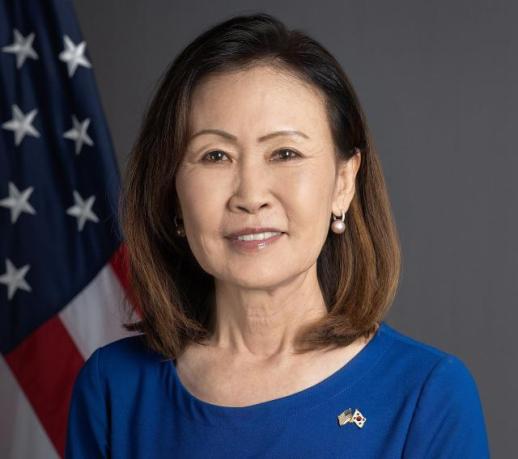 US ambassador to Korea Steel will arrive in Seoul next week SEOUL, July 24 (AJP) - The new United States ambassador to South Korea will arrive in Seoul next week, ending a vacancy of about 18 months at the top of the American mission and putting a confirmed envoy on the ground just as the two governments try to turn a sweeping trade and investment deal into actual projects. Michelle Steel gave the timing Thursday (local time) in response to a question from Yonhap News Agency at the opening of the Korea-U.S. Shipbuilding Partnership Center in Washington. "Next week," she said, referring other questions to the State Department. She called the work of strengthening the Seoul-Washington alliance her "top priority." Yonhap reported that she is widely expected to fly out around Wednesday. The post has had no confirmed occupant since Philip Goldberg left in January 2025, one of the longest gaps in the modern history of the embassy. James Heller has run the mission as chargé d'affaires ad interim, the title given to the senior diplomat who holds an embassy together when no ambassador is in place. A chargé can manage the building and pass messages. What a chargé cannot do is speak with the authority of a presidential appointee, and that distinction has mattered over the past year and a half. It has mattered because almost everything of consequence between the two countries has been decided somewhere else. The tariff and investment package that now defines the relationship was negotiated by cabinet ministers flying back and forth, instead of the embassy in Seoul. U.S. President Donald Trump on Thursday signed a memorandum directing the U.S. Trade Representative to impose tariffs of 10 percent to 12.5 percent on imports from 60 trading partners, including South Korea, following Section 301 investigations into whether they failed to prohibit or effectively enforce bans on imports made with forced labor. Rather than imposing a flat 12.5 percent tariff on Korean goods, however, the White House created a separate category for South Korea, Japan and Switzerland. Under the presidential memorandum, products from South Korea whose existing most-favored-nation (MFN) tariff is below 12.5 percent will be subject to an additional Section 301 duty sufficient to raise the total tariff to 12.5 percent. Products already facing MFN duties of 12.5 percent or higher will pay no additional Section 301 tariff. The White House said capping the total duty at 12.5 percent was "feasible, consistent with the terms of the Agreements on Reciprocal Trade or similar arrangements," and was intended to encourage Korea and the other economies to fulfill commitments on forced-labor import prohibitions. Steel arrives into that. She is 70, born in Seoul in 1955, and moved to the U.S. with her family in 1975. She speaks Korean. Her career before Congress was built on tax and local government in California, first on the California State Board of Equalization, which administers state taxes, and then on the Orange County Board of Supervisors, where she served as chair. She won a House seat in 2020, held it in 2022, and lost it narrowly to Democrat Derek Tran in 2024. Her husband, Shawn Steel, has been the Republican national committeeman for California since 2008 and led the state party from 2001 to 2003. That background points in a clear direction. Steel is a Republican operator with a business and tax orientation and a long-standing personal network in the Korean-American community, not a career Foreign Service officer. Trump nominated her in April, and the Senate confirmed her on June 17 by 55 votes to 39, close to a party-line result. During her time in the House, she pushed the Korean American Divided Families National Registry Act, which sought to help Korean Americans trace relatives separated in North Korea since the 1950~53 Korean War, and she served on Trump's advisory commission on Asian Americans and Pacific Islanders during his first term. Her confirmation hearing on May 20 before the Senate Foreign Relations Committee showed what she is likely to press on. Senator Bill Hagerty of Tennessee told her American technology firms and the e-commerce company Coupang appeared to be treated unfairly in South Korea and asked her to make sure that stopped. Senator Pete Ricketts of Nebraska raised trade barriers on American farm goods and cut quotas for American soybeans. Steel said she would take those cases to Seoul officials directly. The venue for her remarks on Thursday fit the same pattern. The Korea-U.S. Shipbuilding Partnership Center (KUSPC) is funded and staffed by Seoul and sits in Washington as the working base for the shipbuilding side of the package, known in both capitals by the slogan MASGA, or Make American Shipbuilding Great Again. It came out of a memorandum signed on May 8 between South Korea's Ministry of Trade, Industry and Resources and the U.S. Department of Commerce. Commerce Secretary Howard Lutnick attended Thursday's opening alongside Kim and executives from HD Korea Shipbuilding and Offshore Engineering, Samsung Heavy Industries and Hanwha Ocean, which bought the Philly Shipyard in Philadelphia in December 2024 and has committed $5 billion to expanding it. Steel will be the second Korean American to hold the Seoul post, after Sung Kim, who served from 2011 to 2014, and the second woman, after Kathleen Stephens, who served from 2008 to 2011. What she told the Senate in May was blunt. "American companies operating in Korea deserve the same market access that Korean companies enjoy in the U.S.," she said. 2026-07-24 08:11:25