


Latest by
-
 Samsung Electronics Union Plans to Allocate 0-1% of Bonuses for Social Contributions Samsung Electronics' super union is expected to announce plans to allocate a portion of special bonuses for social contributions in the third or fourth quarter of this year. The initiative, which began discussions in early June, is taking shape as a voluntary participation model for employees who wish to contribute.According to industry sources on July 23, the super union communicated through its internal network that it has held several meetings regarding special bonuses and conveyed this to the policy committee yesterday. They anticipate that details about the special bonuses, along with information on social contributions, will be announced in Q3 or Q4.The announcement indicates that social contributions will be considered as a voluntary option, allowing employees to contribute 0-1% of the amount received from special bonuses in the DS division. The union has not set a maximum limit for contributions, stating that if the proposed rate is applied, it could amount to several million won per person. They emphasized that participation is not mandatory.This approach allows employees to choose whether to contribute, rather than implementing a blanket deduction from bonuses. It suggests a strong likelihood that the announcement will include both the special bonus payment details and the social contribution participation options.The union also mentioned who would participate in the social contributions, stating that representatives from the executive board and policy committee plan to take part. The purpose of these contributions is described as a response to public backlash and a shareholder-friendly policy.This announcement follows discussions about social contributions that began in early June. At that time, Samsung Electronics' management and labor were considering a plan for employees to voluntarily donate a portion of the special management bonuses. This discussion reflected the need for social reinvestment in light of criticism raised during a potential strike.Samsung Electronics' executive team had previously announced a plan for a total of 5 trillion won in cooperative investments over five years. The company stated that employees, including union members, would actively participate in this decision. Areas of focus for social contributions included support for vulnerable groups, strengthening the competitiveness of small and medium-sized enterprises, and nurturing future talent.However, specific timelines have not yet been finalized. The super union stated that it will continue discussions regarding the detailed schedule and will announce it once confirmed. If the timing of the special bonus payments and the social contribution participation methods are organized together, the discussions on bonuses between Samsung Electronics' management and labor will extend beyond wage compensation to include social reinvestment discussions. 2026-07-23 10:12:00
-
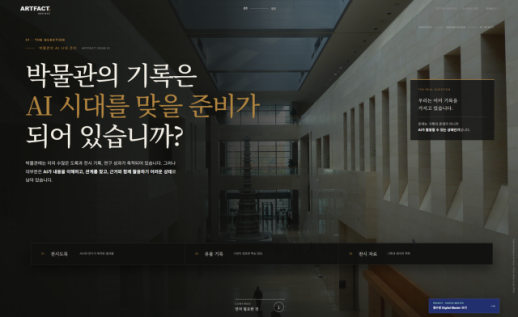 Korean firm launches AI-ready museum archive platform SEOUL, July 23 (AJP) -Korean technology firm Indik said Thursday it has launched a platform that converts museum exhibition catalogs into curator-verified digital archives. The launch comes as museums prepare AI and digital transformation projects for 2027, with budget planning set to begin in September. Based in Jeonju, Indik has developed museum exhibitions, catalogs and cultural heritage content using public data. The platform, called ARTFACT, extracts artifact records, images and exhibition narratives from museum catalogs, linking every record back to its original source page. Indik calls the resulting database a "Digital Master" reviewed, corrected and approved by museum staff before it becomes part of an institution's verified knowledge base. Museums often produce extensive research and exhibition documentation, but much of it becomes scattered across PDF files and image folders once a show closes, Indik says. Curators then have to locate and reorganize the same material for the next exhibition or education program. Collection management databases, though widely used, do not always preserve the curatorial interpretation and narrative connections that catalogs contain — a gap ARTFACT is designed to fill by linking structured collection records to that broader context. "Adopting new AI tools alone will not complete museums' digital transformation," Indik CEO Kwak Hyun-hae said. "Institutions first need reference materials that allow AI to verify sources and context." The process begins with a single representative exhibition catalog. ARTFACT generates a preliminary Digital Master, and staff compare each record against the original pages and images before revising and approving the data. Indik has begun offering consultations for museums, galleries and cultural institutions considering AI or digital transformation projects for 2027, including those that have yet to determine project scope or budgets. The sessions assess the condition of existing materials, the feasibility of building a Digital Master, integration with current collection databases and review procedures ahead of September budget planning. Indik plans to expand the platform with a "Planning Engine" to help curators draft exhibition proposals, educational materials and production guidelines from approved Digital Masters. Its longer-term goal is a "Discovery Platform" that maps relationships among artifacts, historical figures, regions and past exhibitions to support future research and exhibition planning. 2026-07-23 10:11:29
-
 Korea's SME loan delinquencies hit 11-year high SEOUL, July 23 (AJP) —South Korean small and medium-sized enterprises (SMEs) are falling behind on bank loan repayments at the fastest pace in 11 years, further exposing an economy heavily dependent on large chipmakers and a few big manufacturers. According to data released Wednesday by the Financial Supervisory Service (FSS), the delinquency ratio, the share of bank loans that were more than one month overdue, rose to 0.67 percent at the end of May from 0.61 percent in April and 0.64 percent a year earlier. It marked the highest level since October 2016, when the restructuring of major shipbuilders and shipping companies, including STX Offshore & Shipbuilding and Hanjin Shipping, pushed the large corporate loan delinquency rate to a record 2.67 percent. Banks recorded 3.3 trillion won ($2.4 billion) in newly delinquent loans during May, up from 2.9 trillion won the previous month, while they cleared 1.5 trillion won of bad loans through write-offs and sales, down from 1.6 trillion won a month earlier. The monthly new delinquency ratio also edged up to 0.13 percent from 0.12 percent in April. The deterioration was driven primarily by corporate borrowers. The delinquency ratio on corporate loans jumped to 0.84 percent from 0.74 percent a month earlier and 0.77 percent a year earlier. Among them, the ratio for SMEs rose to 1.00 percent from 0.90 percent a month earlier and 0.95 percent a year earlier, reaching its highest level since May 2015. Delinquencies among large corporations also climbed to 0.27 percent from 0.22 percent a month earlier and 0.15 percent a year earlier, the highest since September 2021. Within the SME sector, the delinquency ratio for incorporated SMEs increased to 1.11 percent from 0.98 percent a month earlier, while that for sole proprietors rose to 0.84 percent from 0.78 percent. The rise reflects prolonged weakness in domestic demand has made it harder for smaller businesses that rely heavily on local consumption to repay their loans. Another factor is the government's push to steer more bank lending toward businesses with growth potential rather than household borrowing. While the policy has expanded funding for these companies, some are taking longer to generate stable cash flow, making it harder for some companies to repay their loans. Kim Young-do, a senior researcher at the Korea Institute of Finance (KIF), said in a February report that banks could face growing pressure to expand lending to businesses while limiting the risks that come with it. While household loan delinquencies also rose from the previous month to 0.45 percent, they remained below the 0.47 percent recorded a year earlier, indicating that the overall increase was driven mainly by corporate borrowers. The FSS warned that delinquency rates could continue to rise as corporate lending expands and higher interest rates increase borrowing costs. The regulator said it would encourage banks to clean up bad loans and set aside more money to absorb potential losses. 2026-07-23 10:10:51
-
U.S. to Announce 12.5% Tariff on South Korea Over Forced Labor Concerns The Trump administration is set to announce final trade measures against 60 trading partners, including South Korea, for failing to adequately block imports of products made with forced labor. A 12.5% additional tariff has been proposed for South Korea, drawing significant attention ahead of the final decision.According to documents released by the U.S. Senate Finance Committee, U.S. Trade Representative (USTR) Jamieson Greer stated in written testimony submitted on July 22 that "USTR will announce final actions regarding the failure to address products made with forced labor against 60 trading partners as early as tomorrow."In March, the USTR initiated an investigation under Section 301 of the Trade Act to determine whether major trading partners of the U.S. were effectively prohibiting imports of products made with forced labor. Last month, the USTR suggested imposing additional tariffs of either 10% or 12.5% based on the findings of the investigation.According to USTR documents, South Korea has been classified as a country that has not sufficiently implemented and enforced measures to ban imports of forced labor products. The final tariff rate and specific application methods for South Korea are expected to be confirmed in the upcoming announcement.This action coincides with the expiration of a 10% global tariff imposed under Section 122 of the Trade Act. The White House has been enforcing a temporary 10% import tariff since February 24, lasting for 150 days.Following a federal court ruling that halted existing reciprocal tariffs, the Trump administration has continued its tariff policy using other legal bases, including Section 301 of the Trade Act.For South Korea, there is particular interest in how the proposed 12.5% additional tariff will relate to the existing U.S.-Korea trade agreement. The agreement stipulates a 15% tariff on South Korean products, which pertains to reciprocal tariffs and certain item-specific tariffs. The specific application of the Section 301 tariffs related to forced labor has not yet been disclosed.Greer has previously expressed a commitment to respecting existing trade agreements. He emphasized, "While the specific authorities this administration is using have changed, our trade strategy has not. We will continue to utilize tariffs."* This article has been translated by AI. 2026-07-23 10:08:00
-
Korea Development Bank and Fisheries Cooperative Launch Offshore Wind Power Financial Model The Korea Development Bank and the Fisheries Cooperative are working to establish a participatory financial model that returns profits from offshore wind power development to fishermen and local communities.On July 22, the Korea Development Bank announced that it signed a memorandum of understanding with the Fisheries Cooperative and the Fisheries Bank in Seoul to provide financial support for domestic offshore wind power projects and promote community coexistence.Under this agreement, the three institutions will develop financial support measures for domestic offshore wind projects and jointly design a profit-sharing structure that allows fishermen and local residents to participate in the projects and share in the profits.The Korea Development Bank will review project structures that enable community and fishermen participation based on its experience in offshore wind project financing. The Fisheries Cooperative and the Fisheries Bank plan to support the expansion of participatory financial models by linking their nationwide rural network with financial services.There have been calls to expand the participation of fishermen and local cooperatives in profit-sharing arrangements, which have traditionally been designed around local residents.The three institutions aim to establish fishermen as key partners in offshore wind projects and to specify related financial support measures while jointly identifying promising projects for implementation.In particular, the Fisheries Cooperative plans to create a virtuous cycle model that returns profits from offshore wind development to rural communities in line with the government's 'wind income' policy, with the goal of expanding this as a standard model applicable to the entire domestic offshore wind sector.* This article has been translated by AI. 2026-07-23 10:08:00
-
Jensen Huang Refutes U.S. Concerns Over Chinese AI Competition Jensen Huang, CEO of NVIDIA, has expressed opposition to U.S. efforts to restrict Chinese open-source artificial intelligence (AI) models.In an interview on July 21 in Fort Worth, Texas, Huang described Chinese AI models as "very impressive" and stated that "high-performing open-source models should be utilized." When asked whether U.S. companies should be allowed to use Chinese AI models, he replied, "Of course, they should be allowed." This stance contrasts with concerns from the U.S. government and major AI firms about the technological competition posed by Chinese companies. OpenAI and Anthropic, both NVIDIA clients, have warned that the spread of Chinese open-source AI could threaten U.S. technological superiority.Huang emphasized that low-cost open-source models could expand the market by increasing the number of AI users, asserting, "There is zero possibility that China will push U.S. companies out of the market."His comments come amid heightened scrutiny in the U.S. regarding the recently unveiled Kimi K3 by Chinese company Moonshot AI. The K3 boasts performance close to cutting-edge models at a lower price, with publicly available weights for developers to download and modify.Following the K3's release, concerns emerged that affordable and efficient AI models could reduce the need for large infrastructure investments, leading to sell-offs in semiconductor stocks, including NVIDIA. Huang remarked, "The market initially misunderstood the impact of DeepSeek, and now Wall Street is misjudging Kimi's influence. Free AI is beneficial for hardware, semiconductors, and data centers."He dismissed fears that downloading Chinese AI models could create a "backdoor" for the Chinese government as a "misunderstanding," adding that companies can modify models to fit their environments and operate them in a secure space known as a "sandbox" to control access.Huang also highlighted that open-source models allow external researchers to identify vulnerabilities and develop defenses, enhancing security. He stated, "If everything relies on a single model, the points of attack and failure also converge, making the world much more vulnerable."Regarding Anthropic's restricted cybersecurity AI model, Claude Mythos, he noted, "Even without providing Mythos, other open-source models are already available. Anthropic should be allowed to compete freely; restricting their activities does not benefit U.S. interests."Huang drew a line against viewing the AI competition as a zero-sum game between the U.S. and China, stating, "The AI race is not a competition with a finish line. Both the U.S. and China will exist for a long time, and we will continue to use AI in the future."Huang's interview was released just hours after U.S. Treasury Secretary Scott Vessen announced an investigation into potential intellectual property theft by Chinese AI models. In an interview with Fox Business, Vessen stated, "If it is confirmed that foreign models have stolen technology from U.S. companies, we can impose sanctions," mentioning that a "watermark" from U.S. AI models was found in Chinese models.Huang acknowledged the importance of learning through distillation and AI from other knowledge sources but asserted that companies violating privacy regulations or contracts should be held accountable.* This article has been translated by AI. 2026-07-23 10:08:00
-
Jang Dong-hyuk Calls on President Lee to Clarify Ties with Apartment Buyer Amid Controversy Jang Dong-hyuk, leader of the People Power Party, urged President Lee Jae-myung on July 23 to clarify his relationship with the buyer involved in a controversial 1.7 billion won mortgage linked to the sale of an apartment in Bundang. During a Supreme Council meeting at the National Assembly, Jang stated, "The public is outraged by President Lee's 'Deobul Mortgage' transaction." He added, "Neither the president, the Blue House, nor the Democratic Party seems to understand why the public is angry." Jang criticized the government's dual and triple regulations that have caused housing prices to skyrocket, stating that the president used a loophole known as 'homeowner loans' to sell his property just before it became unsellable. Jang also accused the president of demonizing homeowners, saying, "He has referred to them as devils, yet he has resorted to methods that ordinary citizens could not even imagine." He pointed out that the National Tax Service had identified "cash-rich individuals unaffected by loan regulations and those with excessive private debts" as targets for tax audits two months ago, claiming that President Lee's apartment sale falls under this category. "If an ordinary citizen were involved, they would have been thoroughly investigated for months," Jang remarked, emphasizing that the president's actions in real estate policy are contributing to public outrage. He noted that there are many suspicions regarding the relationship between the buyer listed in the property registry and the president, questioning, "If someone lent 1.7 billion won and is not collecting interest, what kind of relationship could that be? It would be best for the president to clarify this before the public investigates further." Regarding President Lee's upcoming 'National Discussion on Real Estate Policy,' Jang questioned its necessity, stating, "Now that he has sold his own house, he will push for higher property taxes and the abolition of long-term holding exemptions even more aggressively."* This article has been translated by AI. 2026-07-23 10:08:00
-
 KOSPI vaults past 7,000 as foreigners chase chips SEOUL, July 23 (AJP) - Seoul's KOSPI retested 7,000 mark at Thursday's open on as foreign investors kept up buying position for the second session, mostly pivoted toward semiconductor and chip-component names. The index rose 3.4 percent 7,031.09, with foreigners the lone net buyers as individuals and institutions sold into the advance. Foreigners bought a net 680.5 billion won of shares in early trade, against individual selling of 640 billion won as retailers took the foreign return as a cue to exit after volatile bouts. SK hynix led the large caps, climbing 5.6 percent to 1,933,000 won ($1,291). Samsung Electronics rose 4 percent to 271,000 won ($183), extending gains as brokerages lifted their price targets on the stock. Samsung Biologics advanced 2.33 percent to 1,404,000 won after reporting a 30-percent gain in second-quarter revenue and 23 percent in operating profit. Samsung Electro-Mechanics jumped 7.4 percent to 1,444,000 won ($977), the steepest move among the index heavyweights. Advancers outnumbered decliners 678 to 163 on the main board. The tech-heavy KOSDAQ added 1.9 percent to 765.3, running its own advance alongside the main index in Seoul. Traders read the surge as a bet on a strong earnings season, with brokerages flagging the prospect of another quarterly beat at Samsung. In Tokyo, the Nikkei 225 rose 0.9 percent. The won traded at 1,477.5 per dollar, marginally stronger than the previous session. 2026-07-23 10:06:34
-
South Korea's Economy Grows 0.6% in Q2, Surpassing Expectations South Korea's economy showed stronger-than-expected growth in the second quarter of this year. Semiconductor exports offset the negative impacts of rising oil prices due to the ongoing conflict in the Middle East. As a result, expectations for an annual growth rate in the 3% range have increased.According to the Bank of Korea on July 23, the preliminary real GDP growth rate for the second quarter increased by 0.6% compared to the previous quarter, significantly exceeding the forecast of 0.2% made in May. Year-on-year, the growth rates were nearly identical at 3.8% for the first quarter and 3.7% for the second quarter.Despite the pressures on growth from high oil prices linked to the Middle East conflict, strong semiconductor exports were analyzed to have mitigated these effects.Lee Dong-won, head of the Bank of Korea's Economic Statistics Division, stated, "There were concerns that the impact of the Middle East conflict would become more pronounced in the second quarter, but strong growth continued. The robust growth in the second quarter can be attributed to the ongoing semiconductor boom and the relatively limited negative effects of the conflict."He explained that there was no base effect from the high growth in the first quarter. "Typically, when the previous quarter's growth rate is very high, the next quarter sees a significant drop or negative growth, which is referred to as a base effect. However, despite a growth rate of 1.8% in the first quarter, the continuation of 0.6% growth indicates that the growth trend has strengthened," he said.By sector, private consumption increased by 0.4% as both goods and services rose, while government consumption grew by 0.2%, primarily due to health insurance benefit expenditures. Construction investment decreased by 0.2% due to a decline in civil engineering, but facility investment rose by 0.2%, driven by increased spending on semiconductor manufacturing machinery.Investment in intellectual property products surged by 3.3%, marking the highest growth rate since the first quarter of 2012 (5.4%). This increase was influenced by the strong performance of semiconductor exports, with significant rises in research and development (R&D) investments in the semiconductor sector, as well as expanded investments in cloud-based software and related security solutions in the financial sector.Exports increased by 1.4%, led by semiconductors, machinery, and equipment, while imports rose by 0.8%, primarily in automobiles and machinery. The contribution of semiconductors, which accounted for more than half of the growth in the first quarter, fell to below 30% in the second quarter.In terms of contributions to the second quarter growth rate, domestic demand, including consumption and investment, contributed 0.3 percentage points to growth. Net exports (exports minus imports) also boosted growth by 0.3 percentage points, as exports grew more than imports.Private consumption contributed 0.2 percentage points, while government consumption had no impact (0.0 percentage points). Both construction and facility investments also contributed 0.0 percentage points.By industry, manufacturing increased by 1.2%, driven by computers, electronics, and optical instruments. The electricity, gas, and water supply sector decreased by 1.3%, primarily due to a decline in water and raw material recycling, while the construction sector fell by 1.9%, mainly in civil engineering.Agriculture, forestry, and fisheries saw a decrease of 7.1%, while the service sector grew by 1.1%, supported by increases in retail, accommodation and food services, finance and insurance, and information and communication.Real Gross Domestic Income (GDI) in the second quarter increased by 15.6% compared to the same period last year. This GDI growth rate is the largest since the first quarter of 1988 (16.4%).The gap between real GDP growth and GDI has widened compared to the first quarter. Real GDI reflects the real purchasing power of income earned through production activities. The surge was influenced by rising prices of export goods, including semiconductors, which improved trade conditions.With the strong growth in the first half of the year, the annual growth rate is approaching the 3% range. Lee noted, "Given the unexpectedly strong growth in the first half, if the average growth rate in the second half is -0.1% compared to the first half, we can achieve an annual growth rate of 3%. If the annual growth rate reaches the 3% range this year, it would be the first time in five years since 2021."* This article has been translated by AI. 2026-07-23 10:04:00
-
LG Electronics Expands Antimicrobial Material Production to Meet Global B2B Demand LG Electronics is expanding its business-to-business (B2B) functional materials sector by establishing production lines for antimicrobial and coating materials in Vietnam. The company aims to respond to changes in orders and delivery schedules from global clients by diversifying its production bases between Changwon, South Korea, and Haiphong, Vietnam.Recently, LG Electronics announced the start of production for its glass powder-based functional materials, 'LG PuroTec' and 'Easy-Clean enamel,' at its Haiphong facility.The Haiphong production line spans approximately 3,200 square meters and has an annual production capacity of 2,000 tons. When combined with the existing 4,500-ton production line at LG Smart Park in Changwon, LG Electronics' total capacity for functional materials will increase to 6,500 tons.The launch of the Haiphong line represents a 44% increase in LG Electronics' annual production capacity for functional materials.Using the production systems in Changwon and Haiphong, LG Electronics plans to expand its supply to North America, Europe, China, India, and Southeast Asia. The strategy includes diversifying production locations to shorten transportation times and quickly adapt to fluctuations in clients' production schedules.The Haiphong plant has automated about 80% of its processes, from raw material input to melting, cooling, grinding, packaging, and shipping. It employs precise temperature control technology to minimize temperature variations in the melting furnace and maintain consistent product quality.LG PuroTec is a material that reduces contamination from bacteria and mold when added in small amounts to plastics, paints, and rubber. It can be applied not only in home appliances but also in construction materials, sanitary products, food packaging, and medical equipment.Easy-Clean enamel is a coating material that applies a glass-like ceramic layer to metal surfaces. When used in ovens and microwaves, it allows for easy removal of food and grease stains. It is designed to reduce discoloration and scratching at high temperatures, enhancing hygiene and maintenance convenience for cooking appliances.Last year, LG Electronics completed regulatory registrations and toxicity assessments related to antimicrobial agents in the United States and Europe. The company has been researching glass powder technology since 1996 and holds over 420 patents related to functional materials.LG Electronics is also broadening the application range of its functional materials. It has developed 'LG Marine Balance,' which supports the growth of seaweed and halophytes, and 'LG Mineral Wash,' which reduces the use of surfactants in laundry materials. Since the functional materials business was fully launched in 2023, its revenue has more than doubled each year.Kim Young-seok, head of LG Electronics' HS Functional Materials Business Division, stated, "We will provide differentiated material solutions based on our production infrastructure and quality competitiveness, and we will continue to expand opportunities in the functional materials business."* This article has been translated by AI. 2026-07-23 10:04:00