


Latest by
-
 Hanmi Science Recognized for Strengthening IP Competitiveness Hanmi Science has received external recognition for its achievements in strengthening intellectual property (IP) competitiveness. This acknowledgment reflects the company's ability to protect global research and development (R&D) outcomes and translate them into business competitiveness.On July 22, Hanmi Group announced that Han Ji-yeon, head of the IP team at Hanmi Science, was awarded a commendation from the Director of the Intellectual Property Office for her contributions to enhancing IP competitiveness during the 80th anniversary celebration of the Korean Patent Attorneys Association held on June 26 in Seocho-gu, Seoul.In celebration of its 80th anniversary, the Korean Patent Attorneys Association presented government awards and special merit plaques to 43 individuals and organizations, including patent attorneys, companies, research institutions, public organizations, and journalists, who have contributed to the development of patent, trademark, and design systems, as well as technological innovation and industrial competitiveness.Hanmi Group has been strengthening its IP strategy to connect R&D outcomes to competitive assets by establishing patent strategies, securing rights, supporting overseas applications, and facilitating licensing agreements from the early stages of new drug development. The company continues to secure domestic and international rights and build a portfolio for various R&D assets, including biopharmaceuticals and combination and improved drugs.Han Ji-yeon is not only active in the domestic IP field but also shares her expertise in international IP exchanges. She participated as a speaker from Korea at the 'AIPPI Trilateral Meeting 2026' held in Guilin, China, in June, where she presented on 'AI & IP: Bridging Innovation, Creation and Protection.'AIPPI, established in 1897, is an international organization of IP professionals with over 9,000 members across 110 countries. Han discussed issues related to domestic intellectual property rights arising from advancements in artificial intelligence (AI) technology and participated in discussions on regulatory environments and industry responses in various countries.Hanmi Science leads the direction of new drug development and overseas expansion strategies, including licensing out for Hanmi Pharmaceutical. Han Ji-yeon stated, 'We will continue to strengthen the intellectual property foundation that supports Hanmi's R&D competitiveness and proactively respond to changes in the global IP environment.'* This article has been translated by AI. 2026-07-22 11:36:00
-
22 Products Found Containing Drugs in Imported Foods; South Korea Blocks Entry The Ministry of Food and Drug Safety announced that it has blocked the entry of 22 products sold through overseas shopping sites after testing revealed the presence of drug components, including THC, mesembrine, and mitragynine, in items such as gummies and beverages.This inspection was the first conducted under the revised Special Act on the Safety Management of Imported Foods, which provided a legal basis for such checks. The ministry focused on online shopping sites from countries where cannabis use is legal and on products suspected of containing drugs, selecting and purchasing 32 items for testing based on their labeling and advertising that included terms like 'Cannabis,' 'Hemp,' and 'Kanna.'The analysis examined 55 types of drug components, including cannabis, amphetamines, mesembrine, and mitragynine, while also verifying the labeling of 312 substances that are prohibited for import.Of the 32 products tested, 22 were found to contain cannabis and 11 types of drugs, including the controlled substance mitragynine and the temporary drug mesembrine. Some products also contained the pharmaceutical components theobromine, L-DOPA, muira puama, and the prohibited ingredient catuaba, as indicated on their labels.Notably, among the 12 products that used kanna as an ingredient, 9 tested positive for the temporary drug mesembrine. The ministry explained that it prioritized mesembrine for testing after confirming its presence in dietary supplements through overseas safety information last year and developed an analysis method for this inspection.The products identified with drug components were primarily dietary supplements, gummies, and beverages. The ministry cautioned that consumers might mistakenly consume gummies and beverages, which could be perceived as regular food items.Additionally, most of the products that tested positive for drugs did not indicate their country of manufacture or manufacturer, suggesting they may have been produced and distributed illegally.The ministry has requested the Korea Customs Service to withhold customs clearance for the products containing drug components, asked the Korea Communications Standards Commission to block access to online sales sites, and requested the National Institute of Technology and Standards to prevent the sale of hazardous products. Furthermore, it has published information about the products, including names, manufacturers, hazardous components, and photos, on the 'Imported Foods Correctly' website. This service aims to provide safety information about imported foods containing hazardous components to prevent consumer harm.Moreover, the ministry emphasized that consumers should not purchase products registered as hazardous imported foods and should not sell or use purchased products for business purposes.The ministry warned that importing or consuming imported foods containing cannabis and other drugs could result in penalties under the Narcotics Control Act and stated that it will continue regular inspections under the Imported Food Act and provide information on hazardous imported foods to prevent consumer harm.* This article has been translated by AI. 2026-07-22 11:32:00
-
Korean Minister Discusses U.S. Investment Projects Amid Coupang Data Breach Concerns Korean Minister of Trade, Industry and Energy Kim Jeong-kwan, who is visiting the U.S. to attend the opening ceremony of the Korea-U.S. Shipbuilding Cooperation Center, stated on July 22 that he plans to "clarify the details and schedule of U.S. investment projects." Regarding concerns raised by the U.S. about Coupang's data breach, he asserted, "I do not believe that the Korea-U.S. alliance will be shaken by such issues."Before departing from Incheon International Airport, Kim spoke with reporters. He is scheduled to stay in the U.S. until July 25, where he will attend the opening ceremony of the Korea-U.S. Shipbuilding Cooperation Center and meet with key U.S. government officials.On the Korea-U.S. Shipbuilding Cooperation Center, he noted, "We have been promoting the MASGA (Make American Shipbuilding Great Again) project, and it is significant that we now have a platform to officially discuss this." He added that both the Korean and U.S. governments view this development as very meaningful.Regarding U.S. investment, Kim plans to discuss specific project details and timelines with U.S. officials. He emphasized that the clarification of U.S. projects is a clear agenda for this visit, countering claims that there are no distinct topics to address.The recent large-scale data breach at Coupang and the Korean government's response are also expected to be discussed. Kim mentioned, "I anticipate that this will naturally come up in discussions, and while there are claims of discrimination against Korean companies, I believe that misunderstandings can be resolved with sufficient explanation."He further stated, "Our government's position is backed by solid logic and evidence, and we have consistently explained areas where the U.S. may have misunderstandings. If there are misunderstandings, we can clarify them and bridge any gaps between us."On the potential for additional semiconductor plants in the U.S., Kim clarified that corporate strategic decisions take precedence. He remarked, "This is not currently under discussion. Companies need to make strategic investment decisions, especially given the high demand for semiconductors and how to meet that demand."He added that the joint fact sheet between Korea and the U.S. indicates that Korea is not at a disadvantage compared to its competitors in the semiconductor sector. He noted that there have been no further discussions between the governments since that agreement.Regarding the U.S. Trade Act Section 301 investigation and the possibility of additional tariffs, Kim stated that he would discuss these matters with U.S. officials. He mentioned, "The U.S. Department of Commerce and the U.S. Trade Representative (USTR) have expressed to us that any related measures will not exceed the level that has balanced the interests of both countries. Coincidentally, the timeline for the Section 301 investigation overlaps with my visit, so I will discuss these issues thoroughly with the U.S. side."* This article has been translated by AI. 2026-07-22 11:32:00
-
 SK hynix bonus pact faces early test as labor talks intensify SEOUL, July 22 (AJP) - A decade-long profit-sharing pact at SK hynix has returned to the negotiating table just one year after it was signed, as unions push back against a proposed overhaul that could require employees to receive part of their bonuses in company shares. The chipmaker’s production and office-worker unions held separate intensive bargaining sessions with management on Tuesday after the two sides failed to narrow differences over bonuses and other key issues during a third round of formal wage negotiations last week. The company has proposed a new bonus-related plan during this year’s negotiations, according to industry sources. Details have not been disclosed, but one option under discussion is believed to involve the mandatory payment of a portion of bonuses in SK hynix shares. The proposal has drawn resistance from both unions, which argue that it could undermine an agreement reached last year after prolonged negotiations. SK hynix and its unions agreed in 2025 to remove the ceiling on the company’s profit-sharing bonus, known as PS, and maintain the framework for 10 years. Under the agreement, 10 percent of annual operating profit is allocated to the bonus pool. Employees receive 80 percent of their PS payment in cash during the relevant year, while the remaining 20 percent is deferred and paid in equal installments over the following two years. Their peers at Samsung Electronics receive bonus mainly in company shares. The company also operates a voluntary shareholder participation program allowing employees to receive up to half of their PS bonus in company shares. Participants who hold the shares for one year receive an additional cash payment equivalent to 15 percent of the purchase amount. The production workers’ union said the company’s latest proposal went against the intent and basic direction of last year’s agreement. The office workers’ union separately said it would reject any change that reduced employee compensation or weakened the existing bonus formula. Employee concern has grown as SK hynix is expected to generate another year of strong earnings on robust demand for high-bandwidth memory used in artificial intelligence accelerators. Any change in the payment structure could have a significant effect on the timing and form of employee compensation. Industry observers said the company may be seeking to limit large cash outflows and link employee rewards more closely to its long-term share performance. Workers, however, have questioned why a framework promised for 10 years is being reconsidered after only one year. SK hynix operates under a multiple-union system. Its technical and office workers’ union, affiliated with the Korean Confederation of Trade Unions, and its production workers’ union, affiliated with the Federation of Korean Trade Unions, conduct wage negotiations separately with management. 2026-07-22 11:29:55
-
Concerns Rise Over North Korea's New Tactical Road Near DMZ Recent reports confirm that North Korea has constructed a new tactical road extending near the military demarcation line (MDL) within the demilitarized zone (DMZ), raising questions about potential violations of the armistice agreement.On July 20, the BBC reported, based on recently obtained satellite images and expert analysis, that North Korea has developed a new tactical road in the DMZ near Kaesong. The released satellite images show the new road stretching toward the MDL, with some sections confirmed to be as close as 260 meters from the line, prompting concerns. The straight-line distance from this road to Munsan in Paju is approximately 13.5 kilometers.The MDL serves as the boundary separating North and South Korea, with a 2-kilometer buffer zone on each side where military activities are strictly limited. The armistice agreement, signed in 1953, also prohibits hostile actions within the DMZ and restricts the movement and deployment of military personnel and equipment.The South Korean military views this construction as a clear violation of the armistice agreement. The Joint Chiefs of Staff criticized on June 22 that "North Korea is expanding the road within 100 meters of the military demarcation line," stating that the installation of obstacles and road construction in the MDL area is a blatant breach of the armistice agreement.In contrast, the UN Command has a different assessment. On June 24, the UN Command released a fact sheet stating that North Korea's work on the military demarcation line is "difficult to view as a violation of the armistice agreement."The differing interpretations between the South Korean military and the UN Command stem from legal interpretations regarding the scope of the armistice agreement. The South Korean military believes that the expansion of military facilities undermines the DMZ's principle of demilitarization, while the UN Command argues that the current construction details do not definitively constitute prohibited actions under the armistice agreement.The BBC suggested that this tactical road may be part of North Korea's efforts to manage the area around the military demarcation line as a de facto "border" rather than merely a new road. Recently, North Korea has been reinforcing military separation by installing anti-tank obstacles, barbed wire, and barriers on the northern side of the DMZ.Experts believe the new road is likely intended for the rapid movement of troops and equipment, but they caution that the actual military use will need to be monitored through additional satellite images and North Korea's subsequent actions.In response to the report, online users commented, "Why is our country standing still?", "Why do we have to see this from the BBC?", "If the UN doesn't see this as a violation, does that mean we can also advance?", "Do they not remember why we suffered during the Korean War?", "If this isn't a security threat, what is?", and "They might really come in now."* This article has been translated by AI. 2026-07-22 11:28:00
-
U.S. Trade Representative to Announce Additional Tariffs Soon U.S. Trade Representative Jamieson Greer has indicated that additional tariff measures will be announced soon.In an interview with CNBC on July 21, Greer stated, "I expect some actions to come out soon" when asked if new tariffs would be announced shortly.He added, "At this point, I cannot disclose a specific timeline," noting that he has a responsibility to explain the details to Congress and other stakeholders before making them public. However, he reiterated, "I expect actions to be forthcoming soon." The new tariffs are likely to be based on Section 301 of the Trade Act of 1974, which allows for tariffs in response to unfair or discriminatory policies and practices by foreign governments. Last month, the USTR proposed imposing additional tariffs of up to 12.5% on imports from 60 economic zones due to forced labor issues.Greer asserted, "The U.S. has laws prohibiting the trade of goods produced with forced labor, but most other countries lack such laws or do not enforce them properly." He explained that the Section 301 tariffs would encompass approximately 99% of U.S. trade.The investigation includes countries such as South Korea, China, the European Union, Japan, India, Mexico, Taiwan, Vietnam, and Singapore. The USTR is also conducting a separate Section 301 investigation addressing issues of overproduction in manufacturing.This action coincides with the expiration of a 10% global tariff imposed by President Trump under Section 122 of the Trade Act, which will end at 12:01 a.m. Eastern Time on July 24. The global tariff was temporarily introduced shortly after the Supreme Court ruled that reciprocal tariffs based on the International Emergency Economic Powers Act (IEEPA) were invalid.The Trump administration is restructuring the tariff system by utilizing existing trade law provisions that are more likely to be upheld in court. Previously, a 25% tariff was imposed on most imports from Brazil under Section 301, and a 50% additional tariff was announced for certain Canadian products under Section 338 of the Tariff Act of 1930.Tiffany Smith, Vice President of Global Trade Policy at the National Foreign Trade Council (NFTC), stated, "It will be much more difficult for the next administration to revoke tariffs imposed for addressing forced labor, and the Section 301 tariffs are likely to last much longer."* This article has been translated by AI. 2026-07-22 11:28:00
-
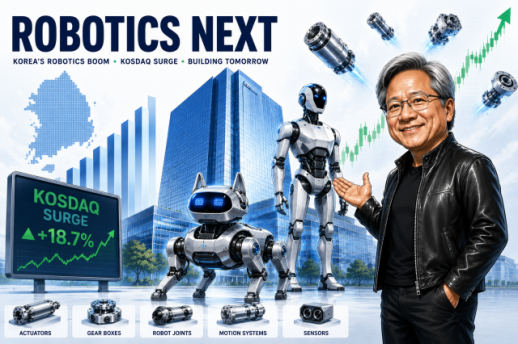 KOSDAQ gains new life from robotics jolt SEOUL, July 22 (AJP) - Robotics stocks jolted the lethargic KOSDAQ market awake on Wednesday as investors bet that Samsung Electronics’ newly elevated robotics ambitions, military demand and Nvidia’s physical AI vision could turn South Korea’s equipment supply chain into the next major technology theme. Industrial robotics and automation company T-Robotics hit the daily ceiling, surging 29.95 percent to 12,540 won and leading gains on the secondary market. The main KOSDAQ index advanced 2.8 percent to 774.54 as of 11:30 a.m. The buying swept through nearly every corner of the robotics chain. Actuator and precision-gear supplier SPG jumped 23.33 percent to 81,400 won, automation equipment maker Coses climbed 23.02 percent to 26,450 won and Samsung-backed humanoid robot developer Rainbow Robotics advanced 19.81 percent to 493,000 won. Motion-control component maker Samhyun rose 16.19 percent to 32,650 won, while industrial robot manufacturer Robotstar gained 15.11 percent to 67,800 won. Robot actuator and platform developer Robotis added 14.72 percent to 226,000 won, robot software company Clobot climbed 13.98 percent to 26,500 won and home-service robot maker Everybot rose 11.42 percent to 14,050 won. The spark came from Samsung Electronics which on Tuesday said it had established the RX, or Robotics eXperience, Division to take charge of robotics strategy, core technology development and business execution as it seeks to build the sector into a new growth engine. The move marks Samsung’s most significant organizational push into robotics since it began expanding the business in 2021 and raised expectations that the country’s largest technology company could pull a wider network of parts suppliers, software developers and equipment makers into the physical AI race. Investors also found a more immediate trigger in the military. Rainbow Robotics and Hyundai Rotem are expected to begin deploying the RB-01K military robot dog with the South Korean Army later this year. Rainbow Robotics manufactures the quadruped platform, while Hyundai Rotem equips it with military sensors, remote-control systems and weapons-related technology for combat use. The project has put suppliers such as SPG under the spotlight because actuators — the motorized joints that allow the robot’s four legs to bend, balance and move — are among the most critical components in a quadruped system. The army could eventually deploy as many as 1,000 units. The robot dogs are expected to patrol bases, enter hazardous areas before soldiers and respond to terrorist threats, allowing the military to carry out more missions with fewer personnel. The image of four-legged machines moving ahead of troops is no longer confined to demonstrations or science fiction. Since Russia’s full-scale invasion in 2022, Ukraine has expanded the use of unmanned ground vehicles to move supplies, evacuate wounded soldiers and inspect dangerous terrain. The U.S. military has tested robot dogs for patrol, surveillance and explosive detection, while China has showcased armed quadruped robots in military exercises as part of its AI-driven modernization campaign. Nvidia Chief Executive Jensen Huang’s remarks during his Seoul visit last month also continued to reverberate through the market. Huang described robotics as South Korea’s next major growth industry, arguing that the country’s position as a global manufacturing powerhouse gives it an advantage in deploying physical AI across factories, logistics networks and other industries. His comments helped reinforce the idea that South Korea could become not merely a user of industrial robots but a broader production base for the sensors, actuators, software and machine intelligence needed to make them operate autonomously. Wednesday’s rally also carried the force of a rebound after months of steep losses. According to IBK Investment & Securities, the combined market value of major domestic robotics companies more than tripled from about 16 trillion won in August last year to 49 trillion won in early June, only to collapse to 23 trillion won as of July 20. Samsung’s latest move has restored some of the excitement, but the brokerage cautioned that the sector’s next leg higher will depend less on organizational announcements and futuristic demonstrations than on whether investment produces commercial products, repeat orders and tangible earnings. 2026-07-22 11:26:23
-
Military Helicopters Deployed to National Assembly During Emergency Martial Law During the emergency martial law on December 3, it is estimated that 12 military helicopters were dispatched to the National Assembly. However, claims have emerged that only about four helicopters are recorded in the data preserved by the Special Warfare Command's command center. There are also allegations that among the multiple units on standby, only one unit's records have been confirmed.If some of the martial law forces operated without following the normal command structure, it is crucial for investigative agencies to determine who issued those orders.Kim Hyun-seok, who has participated in military communications system development for 27 years, stated in an interview with Aju Economy on July 21, "Based on reports and eyewitness accounts during the emergency martial law, it is understood that 12 helicopters were heading to the National Assembly, but only about four are confirmed in the command center's data. The reasons for the lack of records for the other helicopters' movements need to be clarified within the normal command structure."Kim claimed that during his visits to various units for technical support after the emergency martial law, he received testimonies indicating that the satellite-based command and control system (PRE) was not used that day, attributed to 'orders from above.'He explained, "Initially, I asked whether the equipment was functioning normally. However, I received consistent responses from multiple units that they did not use PRE and that there were orders from higher-ups to refrain from doing so.""If Satellite PRE Was Functioning, Helicopter Situations Should Have Been Confirmed at Command Center"Kim's primary concern is the discrepancy between the actual number of helicopters deployed and the command records. According to military officials, the satellite PRE transmits the locations of units and helicopters to the command center, sharing commands and situations. Kim noted that if this system was functioning normally, the helicopters' locations and movements should have been confirmed at the command center.He suggested several reasons for the lack of records for some helicopters: the possibility that the equipment was not brought, that it was brought but not functioning, or that alternative communication methods were used instead of the normal command network.Kim explained that by comparing the records of satellite PRE issuance and return for each helicopter, equipment connection logs, flight records, and the Special Warfare Command's situation logs, it would be possible to determine which scenario is accurate.Additionally, Kim pointed out that not only the helicopters but also the records of units that were fully armed and on standby that day differ from the actual scale.The preserved data only records one unit among those on standby. Even if a unit did not deploy, it is typical for operational standby units to have their operational records documented in the command structure.He stated, "Units that received orders to be on standby while fully armed are also subject to operational control. If only one unit is recorded while many were on standby, it is necessary to verify how the other units were commanded."He also claimed that movements of some units dispatched to the National Assembly, the National Election Commission, and facilities related to broadcaster Kim Eo-jun are not confirmed in the data.During his visits to relevant units for equipment checks and technical support after the martial law, Kim reported hearing from some officials that they did not use PRE during the martial law due to orders from above.He emphasized, "If it was a judgment of one unit or a malfunction of equipment, the explanations should differ among units. If multiple units provided the same response, we need to confirm what orders were issued from which command level."He added, "The core issue of this incident is not the PRE equipment itself, but whether there were orders to prevent its use. If such orders existed, it must be clarified who made the decision and how it was communicated to each unit."Joint Chiefs of Staff Claims No Flight Records, But Command Center Data Needs InvestigationThe Joint Chiefs of Staff stated that they do not possess data related to low-altitude flights in the Seocho District of Seoul during the emergency martial law. However, Kim contended that the command center data he reviewed includes records of helicopter operations.Previously, the Joint Chiefs of Staff responded that there were no records of helicopters carrying martial law forces flying low over the densely populated area of Bangbae-dong after entering the metropolitan area, as reported by Aju Economy in July of last year.Kim stated, "The command center data appears to contain information related to helicopter operations that were transmitted to the Joint Chiefs of Staff. If the Joint Chiefs of Staff claim to have no data, we need to determine whether the transmission did not occur or if the data was not preserved after transmission."Former allied commanders, corps commanders, and former key personnel of the Joint Chiefs of Staff all agreed that if the military command structure was functioning normally, operational information collected at the Special Warfare Command's command center would typically be linked to the Joint Chiefs of Staff's situation system. There is a need to verify whether the command center records and the Joint Chiefs of Staff server records align.According to Kim, the battlefield management system at the Special Warfare Command typically undergoes an initialization process after operations conclude for the next mission. However, some operational data from the martial law period was preserved, suggesting that an internal military official may have kept it as evidence.He remarked, "It seems someone ensured that the data from the day of the martial law was preserved. Without that data, it would have been difficult to compare the actual unit movements and command records."Legal experts have suggested that to verify the authenticity and evidentiary value of the data, an investigation by a military agency with the authority to secure original documents, server creation records, and modification histories is necessary.Kim concluded, "If some martial law forces did not appear in the official command network, we need to clarify whether it was merely an operational issue with the equipment or a result of a different command method. Comparing the original records remaining at the Special Warfare Command and the Joint Chiefs of Staff would help restore the actual command structure of the martial law forces at that time."* This article has been translated by AI. 2026-07-22 11:24:00
-
Government Detains Ship 'Prada' for Violating UN Sanctions Against North Korea The government has detained a ship that reportedly violated United Nations Security Council sanctions against North Korea.According to diplomatic authorities on July 22, the vessel named Prada entered Pyeongtaek Port in March.A Ministry of Foreign Affairs official stated, "Based on information that the Prada was involved in activities violating past Security Council sanctions against North Korea, a joint investigation by relevant agencies is underway regarding the ship that entered Pyeongtaek Port."The official added, "As a result of the government investigation, it has been confirmed that the Prada participated in violations of Security Council resolutions, and as a follow-up measure, the ship is currently being detained."According to Voice of America (VOA), the vessel, also known as Sophia, was mentioned in a joint statement issued in May by South Korea, the United States, Japan, the European Union, the United Kingdom, Australia, Canada, and New Zealand, urging compliance with North Korea sanctions.Satellite images captured evidence of the ship loading coal at North Korea's Nampo Port in September and December 2024, VOA reported.The 10,730-ton cargo ship Prada has reportedly changed its name multiple times to evade sanctions. It was identified as Huataishan from 2008 to 2020, operating under a Chinese flag. In 2024, it operated as Sophia before reverting to Prada a year later.This is not the first time the government has detained a ship for violating North Korea sanctions. In April 2019, the government detained a South Korean-flagged 7,800-ton tanker that was caught transferring oil products to a North Korean vessel in international waters.In July 2024, authorities detained a stateless vessel owned by a Hong Kong shipping company for allegedly illegally transporting North Korean coal near Yeosu, South Jeolla Province.* This article has been translated by AI. 2026-07-22 11:20:00
-
Mixed Reactions to Na Hong-jin's New Film 'Hope' ※ This article contains descriptions of some scenes and developments in the film.Director Na Hong-jin's new feature film 'Hope' has sparked sharply divided reactions, marking his first release in a decade since 'The Wailing.'The film, which runs for 156 minutes, has been praised as a "must-see in theaters" for its relentless action and witty humor. Conversely, some viewers express frustration, claiming the narrative is disjointed and that the story does not conclude satisfactorily in one installment. The ongoing debate among critics and audiences highlights that the film's strengths and weaknesses stem from the same source.For those still undecided about watching 'Hope,' we have compiled a list of its recommended and not recommended aspects. ▲ Experience the Scenes Rather Than Understand the Story'Hope' is a film that pushes audiences through the power of its visuals. Na Hong-jin stated, "While 'The Wailing' conveyed its message through dialogue, 'Hope' aims to evoke feelings through action, visuals, and sound."The film's strength lies not in anticipating what will happen next, but in how to navigate the current scene. Characters confront monstrous beings as they dart through the narrow alleys, homes, vehicles, and walls of Hopohang. As signs break and houses crumble, the village becomes a tool for battle. Characters hide between alleys, use buildings as shields, and drive vehicles to close in on the monsters.This sense of immediacy peaks in a way reminiscent of first-person shooter games. The camera runs alongside the characters, hiding and changing direction, creating a feeling of being at the center of the action. Instead of explaining the situation with wide shots, the film follows the perspective of those caught in danger, immersing the audience in the tension.For viewers familiar with Na Hong-jin's previous works, Hopohang offers additional enjoyment. The forest chase evokes the vast and ominous mountains of 'The Wailing,' while the alley scenes recall the urgency of Kim Yun-seok chasing Ha Jung-woo in 'The Chaser.' The scale of the monster traversing the village gives the impression of watching a live-action version of 'Attack on Titan.'The film's ability to evoke different genre memories in various spaces is a definite highlight of 'Hope.' ▲ Unexpected Humor in Tense MomentsAnother strength of 'Hope' is its ability to build tension to a peak and then deflate it with unexpected humor.In typical action films, the moment a monster is defeated, the feeling of victory lingers. However, in 'Hope,' just as the characters are about to celebrate, Seong-gi (Jo In-sung) falls from a vehicle, bleeding and helpless. Just when the audience expects a sigh of relief, the film flips the scene with a shocking twist.Bum-seok (Hwang Jung-min) exchanges banter with residents while pursuing the monster, and moments of friendly fire occur, or he finds himself slipping while being chased by the creature. Even in life-threatening chases, the characters' bodies do not cooperate as expected. Fear and humor collide on screen, with absurd accidents occurring at the most intense moments, deflating the heightened emotions.A scene where Ha-seul (Lim Hyun-sik) recounts a past encounter with a monster serves as a litmus test for the film's appeal. His seemingly unrelated ramblings become increasingly ridiculous. If one accepts this as a 'brain-dead joke,' they can enjoy the film's rhythm, but for those hoping for a quicker narrative progression, it may feel unnecessarily drawn out. ▲ No Time to Be Bored in 156 MinutesDespite its 2-hour and 36-minute runtime, the film rarely lingers in one place. The investigation into the village's anomalies transitions to a forest hunt, the monster movie shifts to a car chase and shootout, and the latter half expands into a cosmic-scale sci-fi narrative.The music and sound continuously heighten the tension. Ominous sounds signal danger before characters move, and as the chase begins, the tempo and volume increase, propelling the scene forward. Even if viewers do not fully grasp the story's meaning, they can follow along through auditory and visual stimulation.Thus, for audiences seeking to experience different stimuli in each scene rather than a neatly organized story, 'Hope' is worth recommending. This is especially true in larger theaters where the visual and auditory experience is amplified. ▲ Loose Storyline May Lead to DisappointmentThe issue is that while each scene is strong, the narrative connecting them feels loose.The events experienced by Bum-seok and Seong-ae (Jung Ho-yeon) in Hopohang and the residents hunting in the forest unfold separately for a long time. While both settings have individual tension, there is a sense of disconnection, as if two different films are being alternated.Even when the two stories converge in the latter half, it does not naturally resolve everything that has occurred. The reasons for the alien's arrival on Earth, the meaning of their conversations, and how this incident fits into a larger context are not sufficiently explained.Director Na Hong-jin revealed that he presented the aliens' dialogue without subtitles for a time, only revealing their meaning at the end to shift the audience's perspective. He aimed to make viewers, who initially viewed the aliens as threats, understand their circumstances later on.However, audiences asked to shift their perspective in the latter half, without sufficient buildup of the alien family's relationships and circumstances, may first feel the absence of explanation rather than emotional engagement. ▲ Sequel Planned, But First Film Should Stand Alone'Hope' is a film conceived with a sequel in mind. Director Na Hong-jin has already written a follow-up story centered on the alien characters in space.However, the existence of a sequel does not justify the first film's lack of resolution. Even films dealing with a continuous universe should resolve at least minimal conflicts and questions within a single installment. Leaving clues for the next film is different from postponing the core explanations of the current film.'Hope' leaves a strong impression of the latter. After watching 156 minutes, viewers may feel more like they have seen a long and grand prologue rather than a complete story. If one expected to enjoy the symbolism and meaning after the film, as with 'The Wailing,' it is essential to consider that the nature of ambiguity differs.While the questions in 'The Wailing' revolved around how to interpret the clues presented in the film, many of the questions in 'Hope' arise from the film not providing sufficient information. The abundance of interpretive material and the withholding of explanations are not the same type of ambiguity. ▲ Questionable Use of Michael FassbenderAudiences expecting a star-studded cast may feel disappointed. Michael Fassbender and Alicia Vikander, among other international actors, portray the aliens. However, their faces and bodies are obscured behind CG characters.If one anticipated a performance style similar to Thanos in the 'Avengers' series, where the actor's facial expressions and emotions are vividly captured in the digital character, the difference is significant. 'Hope' focuses on maintaining the alien's otherness. Moments to appreciate Michael Fassbender's unique acting are limited, with only his calm gaze and tone remaining.If the aliens had expressed emotions too humanly, it could have felt awkward. Nevertheless, it remains questionable whether the reason for casting a globally recognized actor is sufficiently evident within the film. For viewers who choose films based on the actor's name, the gap between expectations and actual utilization may feel substantial.CGI also presents mixed reactions. In fast-paced action scenes with the monsters, the speed and camera movements can mask awkwardness. However, in scenes where the aliens are shown up close for extended periods, there may be an impression that the real space and digital characters do not fully blend. Although additional CGI enhancements were made before the domestic release after the Cannes screening, Director Na Hong-jin explained that the completion process took a long time. ▲ Direct Dialogue and Angry CharactersSome dialogue merely reiterates the situations shown in the film. A notable example is when Seong-ae exclaims, "No matter how monstrous it is, this is unacceptable." While this may intuitively reveal ethics to some, to others, it may sound like the character is suddenly reciting a stale message. ▲ Who Should Watch 'Hope'?'Hope' may not present a well-structured narrative, but it offers a series of intense moments.If you seek thrilling chases through the alleys of Hopohang and the forest, a balance of suspense and humor, action that makes you feel as if you are running alongside the characters, and the awe of a large screen and sound, there are ample reasons to watch it in theaters. The sheer scale and pace of the film are rare in recent Korean commercial cinema.Conversely, if you prioritize narrative causality, character emotional arcs, the aliens' motives, and a conclusive ending within a single film, it may be wise to choose carefully. The more one expects the symbolism and interpretation found in 'The Wailing,' the greater the potential for disappointment.Whether to watch 'Hope' is not a matter of distinguishing between a good and bad film. It depends on whether one views the film as a complete story or accepts it as a cinematic experience that unfolds over 156 minutes.* This article has been translated by AI. 2026-07-22 11:16:00