


Latest by
-
 Samsung bets on foldables — and fashion — at Galaxy Unpacked SEOUL, July 22 (AJP) - Samsung Electronics is set to widen its foldable smartphone lineup and make its long-awaited entry into the AI smart glasses market on Wednesday (KST), betting that premium hardware, artificial intelligence and fashion-forward wearables can help it challenge Meta in the next phase of consumer AI. At its Galaxy Unpacked event in London, Samsung is expected to unveil the Galaxy Z Fold 8, Z Fold 8 Ultra and Z Flip 8, alongside its first Android XR-powered smart glasses and new Galaxy Watch models, extending its AI ecosystem beyond smartphones. The smart glasses are expected to be developed on Google's Android XR platform and designed in collaboration with global eyewear brands including Gentle Monster and Warby Parker, underscoring Samsung's effort to differentiate its offering with everyday wearability rather than technology alone. The strategy contrasts with Meta's Ray-Ban partnership, which currently dominates the AI eyewear market. Samsung is also expected to introduce the Galaxy Z Fold 8 Ultra, marking the first expansion of its foldable lineup to three models as it targets the premium smartphone segment. The Ultra model is widely expected to feature an 8-inch display, a 200-megapixel main camera and a 50-megapixel ultra-wide camera, while the broader Fold lineup is anticipated to adopt Samsung's new One UI 9 software and a titanium-based hinge structure designed to reduce display creases and improve durability. The event comes as Meta's Ray-Ban Meta glasses have begun reaching South Korean consumers through the country's three major mobile carriers, highlighting intensifying competition in AI-powered wearable devices. Samsung's unveiling is expected to signal a broader push to connect smartphones, XR devices and AI services into a unified ecosystem as the company seeks new growth beyond conventional mobile hardware. 2026-07-22 10:52:55
-
 Discounts on Health Foods Ahead of Chobok: Fresh Chicken, Eel, and Abalone Up to 50% Off As Chobok approaches, major supermarkets are launching discounts on health food ingredients such as fresh chicken, eel, and abalone. This initiative aims to cater to the growing demand for home-cooked or convenient health foods as dining out becomes more expensive. According to industry sources on July 22, Emart and Lotte Mart will hold a week-long health food discount event from July 23 to 29, coinciding with Chobok on July 25. Emart is offering domestic fresh chicken, priced at 3,627 won for 'one whole young chicken' and 9,748 won for 'native chicken soup.' Customers earning Shinsegae points can enjoy a 40% discount on 'antibiotic-free two young chickens.' Seafood is also included in the discounts. Cleaned freshwater eel and live abalone from Wando will be 50% off for customers earning Shinsegae points, while domestic fresh shrimp will be sold at 3,280 won per 100 grams. Australian grain-fed chuck eye roll will be available for 1,990 won per 100 grams for point-earning customers. To ease the burden of cooking, ready-to-eat health foods are also available. Emart's Kitchen Deli offers 'mung bean samgyetang' and 'two eel nutrition rice bowls' for 9,980 won each. 'King seasoned grilled eel' and 'eel gangjeong' are priced at 17,980 won and 12,980 won, respectively. Lotte Mart is selling 'cooperative whole chicken for soup' at 5,592 won, with two types of refrigerated young chicken priced at 3,792 won each. From July 23 to 25, all room-temperature samgyetang will be 15% off with event card payments. During the same period, 'Cooking Strengthened Island Chicken Soup' and 'Cooking Strengthened Domestic Whole Chicken Leg Soup' will be available at about 35% off for L.POINT members using event cards. 'One whole eel rice bowl' is priced at 5,990 won, while 'one plate of smoked duck' is 13,990 won. Lotte Mart is also collaborating with the Ministry of Oceans and Fisheries for the 'Korea Seafood Festival,' offering a 20% discount on key seafood items such as cleaned freshwater eel, live abalone, and domestic fresh shrimp. Live abalone will receive an additional 50% discount for event card payments, and cleaned freshwater eel will also benefit from card discounts. The increase in health food discounts at major supermarkets reflects a trend of consumers preparing health foods at home instead of dining out. Emart reported a 15.2% increase in sales of fresh chicken for soup from July 1 to 20 compared to the same period last year. Sales of Peacock's convenient samgyetang rose by 17.4%, while Kitchen Deli's eel products saw a 55.9% increase. In addition to health foods, seasonal fruits, ready-to-eat meals, and rainy season household items are also included in the promotions. Emart is discounting grapes, sweet corn, and black rice watermelon, while Lotte Mart is offering discounts on seasonal fruits like tangerines, Shine Muscat grapes, and chamoe, as well as summer ready-to-eat meals like cold noodles and soba. Jung Woo-jin, Emart's marketing manager, stated, "As dining out costs rise, there is an increasing demand for preparing health foods at home or enjoying them conveniently." Sim Young-jun, Lotte Mart's promotional marketing team leader, added, "We have prepared health foods and seasonal fresh products at reasonable prices ahead of Chobok." 2026-07-22 10:52:02
-
Hanyang Cyber University and Hanyang University Collaborate on AI Education In response to the rapidly changing landscape of artificial intelligence (AI), Hanyang Cyber University and Hanyang University have joined forces to enhance their AI education capabilities. The two institutions will collaborate broadly, from the joint development of AI curricula and content to training staff on generative AI to improve administrative efficiency, aiming to establish a practical, industry-focused AI education ecosystem for universities and lifelong learning environments. Hanyang Cyber University's AX Business Division announced on July 22 that it signed a 'Business Agreement for Exchange and Cooperation in AI Education' with Hanyang University's Remote Lifelong Education Center on July 20 at Hanyang University's International Hall. The signing ceremony was attended by Min Yeon-ah, head of the AX Business Division at Hanyang Cyber University, and Yang Joo-sung, head of the Remote Lifelong Education Center at Hanyang University, along with key officials from both institutions. This agreement aims to respond swiftly to the rapidly evolving AI education environment and to develop practical AI education programs that can be immediately utilized in universities and lifelong education settings. Key areas of collaboration include: joint development of AI curricula and educational content; training for staff on generative AI and business innovation; utilization and dissemination of AI-related certification programs; training of specialized personnel in AI education; and exchange of educational infrastructure and expertise between the two institutions. Following the signing ceremony, a working meeting was held to discuss practical cooperation strategies. The institutions explored ways to incorporate nationally recognized AI certifications, such as the ACE certification and AI instructor certification, into their actual curricula. They also considered developing hands-on training programs that enable students to apply AI directly in their work and educational settings, moving beyond simple theoretical instruction. Additionally, discussions were held on tailored training programs to enhance the capabilities of staff from both Hanyang Cyber University and Hanyang University. Plans include covering topics such as the use of generative AI, administrative efficiency, educational material production, and AI-based business innovation. The two institutions plan to establish step-by-step training programs that ensure the safe protection of internal information and personal data while enabling staff to effectively utilize AI in repetitive administrative tasks and material production processes. With this agreement, the two institutions aim to combine their strengths in 'AI education expertise' and 'experience in remote education operations' to expand AI education programs that include not only university staff but also adult learners and education professionals. They also plan to gradually implement specific collaborative projects, such as AI-related certification programs and staff training, with the goal of creating a model of excellence in AI education collaboration. Min Yeon-ah, head of the AX Business Division at Hanyang Cyber University, stated, "Our university shares various specialized AI educational content through the knowledge-sharing platform 'Hello, HiCube.' We are also identifying educational needs in the field through interviews with department heads and prioritizing necessary training." She added, "We aim to enhance accessibility by offering AI education through both offline and online formats using Zoom. In the future, we will actively exchange educational content and operational experiences with Hanyang University to create a practical, collaborative model for AI education that combines the strengths of both institutions." Yang Joo-sung, head of the Remote Lifelong Education Center at Hanyang University, emphasized, "It is crucial to realistically enhance AI literacy, one of the most important skills in our society today, at the university level. AICE is the only nationally recognized AI certification, and we are developing a unique educational program for this certification to ensure that our university members can obtain accredited AI qualifications, thereby enhancing the university's competitiveness." Meanwhile, Hanyang Cyber University plans to offer basic training on Gemini Enterprise, efficiency improvements using Claude, and AI agent-based automation training for staff. Advanced training for practitioners will include courses on improving work processes using Claude code and tailored training for specific departments.* This article has been translated by AI. 2026-07-22 10:52:00
-
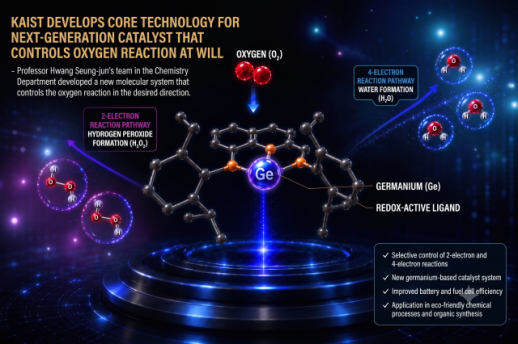 KAIST germanium system switches oxygen reaction pathways SEOUL, July 22 (AJP) - A new molecular system developed in South Korea can be instructed how many electrons to hand over to oxygen, a switch that decides whether a reaction ends in water or hydrogen peroxide and that sits at the center of fuel cell performance, battery chemistry and cleaner industrial manufacturing. Until now, that kind of control has belonged almost entirely to transition metals such as iron, cobalt and nickel. Fuel cells depend on the four-electron route, which turns oxygen into water and releases the most energy. Plants producing hydrogen peroxide want the two-electron route and nothing else. Steering a reaction cleanly down one path rather than the other has been one of the standing problems in catalyst design. The Korea Advanced Institute of Science and Technology (KAIST) said Wednesday that a team led by Hwang Seung-jun, an associate professor in its Department of Chemistry, has demonstrated a single molecular system that can be switched between the two routes on demand. The work appeared online in the journal Chem on July 6. The switch runs on germanium, an element that was not supposed to be capable of this. Germanium sits in the same column of the periodic table as silicon, among what chemists call the main-group elements, the ordinary elements outside the transition metals. Transition metals dominate catalysis because their electron shells let them absorb and release several electrons at a time. Main-group elements normally manage two at most, which is why they have been treated as poor substitutes for reactions involving oxygen. Hwang's team got around that by pairing germanium with a redox-active ligand, a surrounding molecular framework that stores electrons and passes them back and forth. The ligand works as a reservoir. Instead of asking the germanium atom to supply everything on its own, the whole molecule shares the load, and four-electron chemistry becomes possible. Turning the four-electron pathway off proved to be a matter of blocking two electrons at the source. The researchers reacted the germanium compound with iodomethane, attaching a methyl group to the germanium center. That single change shut down the four-electron route and left the reaction running selectively on two electrons. The same platform, structurally modified, produced a different product. Along the way, the team managed to isolate a germanium intermediate that ordinarily forms and disappears within the reaction. The isolated species showed a rare property. A single germanium atom acted as both an electron donor and an electron acceptor, behavior chemists describe as ambiphilic, and it gave the researchers direct evidence of how the switching works rather than an inference from the final products. The compound turned out to do more than react with oxygen. At room temperature and without light, it stripped chlorine and bromine atoms from organic molecules carrying halogens on neighboring carbons, restoring the carbon-to-carbon double bond and regenerating alkenes, the feedstock chemicals behind everything from pharmaceuticals to plastics. That reaction is usually driven by heat or additional processing steps. It also did not occur in the phosphorus version of the same molecule, which has an equivalent electron count, indicating that germanium is not simply a heavier stand-in for phosphorus but has chemistry of its own. "This research shows that catalytic reactions that depended on transition metals can also be achieved with main-group elements such as germanium," Hwang said. He added that he expects the approach to be applied broadly in developing next-generation catalysts for cleaner and more efficient chemical processes, as well as in improving battery and fuel cell performance. The first authors were KAIST postdoctoral researchers Kim Sung-gyu and Oh Jin-rok, with Choi Dae-eui, a combined master's and doctoral student at Pohang University of Science and Technology, where Hwang taught until this year. The National Research Foundation of Korea funded the work through the Ministry of Science and ICT and the Ministry of Education, with additional support from the Samsung Science and Technology Foundation. (Reference Information) Journal/Source: Chem Title: Germanium ligand redox cooperativity: A key to ambiphilicity and switchable two- and four-electron transfer Link/DOI: https://doi.org/10.1016/j.chempr.2026.103127 2026-07-22 10:48:44
-
Threat to Global Oil Supply as Bab-el-Mandeb Strait Faces Blockade The Houthi militia in Yemen has declared a maritime blockade targeting Saudi Arabia, raising concerns about significant disruptions to the global oil supply chain. According to the Wall Street Journal on July 21, shipping and logistics data firm Kpler warned that if navigation through the Bab-el-Mandeb Strait, which connects the Red Sea and the Gulf of Aden, is impeded following issues in the Strait of Hormuz, approximately 25% of the world's oil supply could be affected. Currently, an average of about 45 vessels pass through the Bab-el-Mandeb Strait daily, a significant decrease from the 65 to 72 vessels before the Houthi's intensified attacks in October 2023. Kpler noted, "If the Houthis target Saudi-related vessels as announced, the current traffic could drop to half its current level." The importance of the Bab-el-Mandeb Strait has increased due to disruptions in the Strait of Hormuz. Saudi Arabia transports oil through a pipeline to the Red Sea port of Yanbu before exporting it to Asian markets via this strait. Currently, the daily oil loading at Yanbu is approximately 4 million barrels, nearly quadrupling since before the conflict. Of this, about 2.5 million barrels pass through the Bab-el-Mandeb Strait en route to Asia. Concerns over the blockade are already impacting shipping operations. Two tankers carrying Saudi oil changed their routes and turned back after the Houthi's warning. Jorge Leon of Rystad Energy stated, "If navigation through the Bab-el-Mandeb Strait is blocked while the Strait of Hormuz is already restricted, it would threaten a key route for circumventing Gulf oil exports." Worries about supply disruptions are also rising beyond the Middle East. Recent drone attacks in Ukraine have affected operations at the Caspian Pipeline Consortium (CPC) marine terminal near Novorossiysk, Russia. Oil transported through the CPC accounts for about 2% of global supply.* This article has been translated by AI. 2026-07-22 10:48:00
-
Ruling Party Responds to Opposition Criticism of President Lee's Home Sale The Democratic Party stated on July 22 that "President Lee Jae-myung voluntarily chose to sell his only home, incurring a loss, as he relinquished his membership in the reconstruction association at a time when the project was gaining momentum." This response came after the People Power Party launched an offensive regarding the sale of the president's home.Kang Jun-hyun, the party's chief spokesperson, spoke to reporters after a Supreme Council meeting, saying, "Despite having no obligation to sell his home as a one-household, one-home owner, the president chose to sell his only property, which he had owned for 28 years, at a price below market value to demonstrate his commitment to stabilizing the real estate market and became a non-homeowner."He added, "The registration of ownership transfer and the establishment of a mortgage were done to consider the buyer's acquisition of membership in the association and financial circumstances, with the president assuming the risk of recovery himself. The mortgage registration was an unavoidable procedural measure and is legally distinct from loans or private financing, as some have suggested."Kang expressed regret, stating, "It is inappropriate to distort the fact that all procedures were transparently disclosed."Meanwhile, Jeong Jeom-sik, the floor leader of the People Power Party, remarked during a previous floor strategy meeting that he was "impressed by the cleverness of avoiding loan regulations through such tactics" regarding the president's home sale.President Lee and his wife, Kim Hye-kyung, reportedly sold their jointly owned apartment in Bundang-gu, Seongnam, for 2.9 billion won, while establishing a mortgage of 1.77 billion won.In response to suspicions that the buyer may be an acquaintance of President Lee, the Blue House clarified, "Claims of a personal relationship or special connection with the buyer are unfounded."* This article has been translated by AI. 2026-07-22 10:44:00
-
LIG D&A Begins Development of Intelligent Command System Using AI for Operational Planning LIG D&A is officially launching the development of an intelligent decision support system. On July 22, LIG D&A announced that it has been selected as the lead research and development agency for a defense ICT R&D project overseen by the Ministry of Science and ICT. The project aims to develop an AI-based decision support system that automates and enhances operational planning for commanders based on battlefield situation analysis. Approximately 6.2 billion won (about $5.2 million) will be invested in this initiative. The core objective is to establish a data processing system that leads to command directives through predictions based on battlefield environment analysis, ultimately reducing the time required for operational planning. The intelligent command system is expected to be completed by 2029. A key component of the project is the creation of a 'Defense AI Dedicated Big Data Cloud' that consolidates fragmented battlefield information into a single cloud for real-time integration. This will facilitate technologies such as 'intelligent fact analysis' to diagnose current situations, 'situation development prediction' to forecast power deployment, and 'directive AI-based automatic generation of strategies' to significantly enhance the speed of military command decisions. Meanwhile, the defense industry is accelerating the integration of AI into joint command and control systems and manned-unmanned hybrid systems, pushing forward the AI transformation of defense command systems.* This article has been translated by AI. 2026-07-22 10:44:00
-
NH Nonghyup Financial to Launch 'NH Microfinance Foundation' with $100 Million Contribution NH Nonghyup Financial Group will establish the 'NH Microfinance Foundation' with a contribution of 100 billion won to support financially vulnerable groups and revitalize local economies. The foundation aims to expand inclusive finance centered on local communities by offering specialized products for farmers and young people returning to rural areas, in addition to existing startup and operational funding.On July 21, NH Nonghyup Financial held the first meeting of a task force to establish the NH Microfinance Foundation, reviewing the establishment process and detailed plans. Microfinance is a system that provides low-interest startup, operational, facility improvement, and living stability funds to low-credit, low-income individuals and small business owners.To establish the foundation, major affiliates including NH Nonghyup Bank, NH Investment & Securities, NH Nonghyup Life, NH Nonghyup Property & Casualty Insurance, and NH Nonghyup Capital will jointly contribute a total of 100 billion won. The task force will be led by Hwang Jong-yeon, the Deputy Head of Strategy and Planning at NH Nonghyup Financial. The foundation is expected to be established within this year after consultations with the Financial Services Commission and the Korea Inclusive Finance Agency.NH Nonghyup Financial is focusing on revitalizing local economies through microfinance. In addition to existing startup and operational funding and living stability funds, the company plans to introduce tailored microfinance products for farmers and young people returning to rural areas, leveraging its expertise.Furthermore, to enhance financial accessibility in rural and regional areas where financial institutions are relatively scarce, NH Nonghyup Financial plans to utilize its affiliate sales networks to facilitate consultations and funding support.Lee Chan-woo, Chairman of NH Nonghyup Financial, stated, "Inclusive finance is not a choice for financial institutions but an obligation. We will support the revitalization of local economies at the city and county level through specialized microfinance products and establish an effective inclusive finance model." 2026-07-22 10:44:00
-
 South Korean coming-of-age drama to compete at Toronto film fest this fall SEOUL, July 22 (AJP) - Director Yoon Dan-bi's "The World Before" will vie for an award at this fall's Toronto International Film Festival (TIFF), the film's distributor at9 film said on Wednesday. Her second feature film will compete with 11 other films in the festival's Platform section and have its world premiere at the 51st edition of TIFF, which kicks off its 10-day run on Sept. 10. The festival's only competitive section spotlights "exceptional directorial vision and auteur voices," with the winner to be decided on the festival's final day on Sept. 20. The coming-of-age film is Yoon's second narrative feature, which follows the story of "two teenagers, childhood best friends, who reunite for a summer on a small rural island." It comes about five years after Yoon drew attention with her debut feature "Moving On" in 2019, which received favorable reviews at film festivals at home and abroad, including the Busan International Film Festival and the International Film Festival Rotterdam in the Netherlands. "The World Before" is the second South Korean film to be invited to the section, following Yoon Ga-eun's "The World of Love" last year. It is scheduled for release in South Korea sometime next year. 2026-07-22 10:40:20
-
The Power of Concentration: Lessons from Taiwan and Pittsburgh's AI Clusters for South Korea's Future Today, the evolution of artificial intelligence (AI) has transcended the competition of software operating on desktop monitors. AI is now driving a transformation of civilization by integrating with physical spaces, power grids, and urban infrastructure. Approximately 4,700 trillion won is being invested globally to build an AI civilization, and a nation's survival hinges on how this capital is concentrated in physical spaces. Successful AI cluster examples abroad emphasize the power of concentration, indicating that South Korea must seek urban and industrial solutions. Taiwan's Hsinchu Science Park serves as a prime model of how the physical heart of AI hardware directly correlates with national competitiveness. The concentration of semiconductor design, manufacturing, packaging, and numerous suppliers has created a robust ecosystem, establishing a dominant position in the foundry market, which is central to global AI infrastructure. The essence of this success lies in the 'power of concentration,' where infrastructure, workforce, and supply chains operate as a single, massive organism. The high-density concentration of the foundry ecosystem has lowered production costs and maximized innovation speed, becoming the driving force behind capturing global technological supremacy in a small territory. This underscores the necessity of strong physical concentration rather than dispersed investment in establishing an AI hardware foundation. Pittsburgh, in the United States, represents a historical transformation that overcame the decline of traditional manufacturing through advanced technology and urban regeneration. Once the heart of the American steel industry, this city has evolved into a global hub for physical AI, combining top-tier research capabilities, including Carnegie Mellon University (CMU), with robotics, autonomous driving, and AI. This case illustrates how software-centric AI must integrate with the physical labor, manufacturing processes, and urban spaces of the real world. Former factory and research sites have been reborn as testbeds for experimenting with and validating robots and AI. The adoption of industrial heritage and cutting-edge technology in urban planning has attracted new jobs and talent, marking a milestone in how AI is reshaping our cities and industrial sites beyond virtual spaces. For such massive clusters to function, substantial resources must be supported. Globally, the seed capital for building an AI civilization amounts to trillions of won. This serves as a catalyst for constructing data centers, large-scale power grids, high-speed communication networks, and urban infrastructure that enables seamless operation of autonomous vehicles and robots. However, if this vast capital is fragmented into individual company subsidies, the synergy seen in Taiwan or Pittsburgh will not be achievable. Capital only realizes its true value when combined with a clear spatial strategy. The cornerstone of an AI civilization must ultimately be designed as an 'urban planning-based AI cluster' where computational resources, power, and human living environments are organically connected. South Korea's strategy is clear. First, a shift from 'dispersed' to 'concentrated' cluster strategies is necessary. Domestic policies have tended to support advanced industrial infrastructure in a dispersed manner. Like Taiwan, we must cultivate high-tech special zones at the national level where core companies, research institutions, and semiconductor and AI computational infrastructure are physically concentrated to enhance efficiency. Second, we need to establish 'physical AI' demonstration cities utilizing existing manufacturing hubs. Cities like Ulsan, Changwon, and Gumi, which have strong global competitiveness in manufacturing, should be transformed into testbeds for physical AI that combines AI-based robotics and smart factories. Third, a spatial and energy-oriented master plan for AI infrastructure must be developed. Capital should not be limited to technology R&D but should also be invested in constructing self-sufficient data and energy cities that are reliably connected to new industrial hubs in the outskirts of the metropolitan area or in rural areas, ensuring stable supply of large-scale power and water. In the AI era, national power does not stem from a single outstanding algorithm. It arises from the combination of a strong hardware ecosystem and the physical urban spaces where technology thrives and is validated, that is, from the 'power of concentration' through urban planning. Reflecting on the history of innovation demonstrated by Taiwan and Pittsburgh, we too must make urban and industrial decisions that integrate capital, space, and industry. 2026-07-22 10:40:00