


Latest by
-
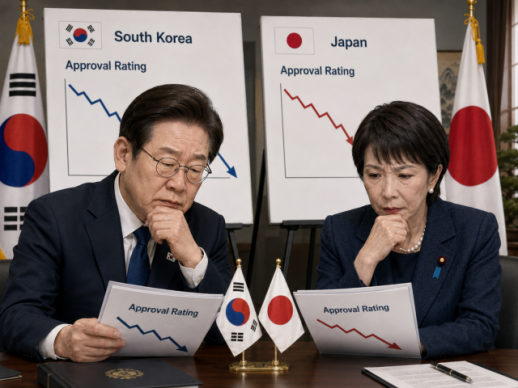 Reality check for Korea's Lee and Japan's Takaichi as their honeymoons end SEOUL, July 20 (AJP) - The chemistry between South Korean President Lee Jae Myung and Japanese Prime Minister Sanae Takaichi appeared immediate, culminating in an impromptu drumming performance during their January summit in Nara. They also had much in common. Both took office as agents of change after periods of political turmoil. Both entered government with approval ratings that would be enviable in almost any mature democracy. Both benefited from weakened opposition camps and presented themselves as decisive leaders capable of breaking with the drift and disorder associated with their predecessors. Lee took office on June 4, 2025, after winning a snap election triggered by the removal of former President Yoon Suk Yeol following his short-lived declaration of martial law. Takaichi became Japan’s first female prime minister on Oct. 21, 2025, giving the governing Liberal Democratic Party a new face after years of scandals, factional conflict and declining public trust. Their political honeymoons were unusually strong. Lee's first Gallup Korea approval rating stood at 64 percent in late June 2025 and later peaked at 67 percent in March and April 2026. Takaichi's Cabinet began with similarly robust support. A Kyodo News poll conducted immediately after its formation put approval at 64.4 percent, while Asahi Shimbun and Mainichi Shimbun surveys measured 68 percent and 67 percent, respectively. Some later polls placed her support above 70 percent. The numbers reflected more than ordinary post-election goodwill. Lee benefited from a widespread desire to restore institutional stability after the martial law crisis. Even voters wary of his combative political style could view his government as a return to normal democratic administration. His emphasis on economic revival, pragmatic diplomacy and active government reinforced the perception that the presidency was functioning again. Takaichi combined the symbolism of becoming Japan's first female leader with a direct and energetic communication style. Her promises to raise disposable income, confront inflation and restore confidence resonated particularly strongly with younger voters. She quickly converted personal popularity into political power. In February, the LDP won 316 seats in the lower house, while the governing bloc, including the Japan Innovation Party, secured 352 of the chamber's 465 seats, exceeding the two-thirds threshold needed to override the upper house on ordinary legislation. By July, however, the mood surrounding both leaders had changed. Lee’s Gallup Korea approval rating fell to 52 percent in a July 14-16 survey, down from 67 percent at its spring peak. His disapproval rating rose to 37 percent. Realmeter placed his positive assessment lower, at 48.4 percent, marking a fifth consecutive week in the 40 percent range. Takaichi's decline was sharper in some polls. An Asahi survey conducted July 18-19 put Cabinet approval at 53 percent, down 7 percentage points from June and the lowest level since her government was formed. A Mainichi poll over the same weekend recorded approval at just 41 percent, down 10 points in a month, while disapproval rose to 44 percent. Polls from different countries and organizations are not directly comparable. Survey methods, political cultures and question wording differ. The more meaningful comparison is the direction of travel within each pollster's series. On that measure, both leaders have moved from unusually favorable conditions into the first genuinely difficult phase of governing. Their immediate problems differ. Takaichi faces a backlash over national identity, gender and the use of parliamentary power. Lee confronts a more diffuse set of doubts involving election administration, financial regulation, housing and younger voters. But the underlying question is the same: Can leaders who rose as symbols of change retain public trust once they become responsible for the failures and contradictions of the systems they control? Takaichi's imperial gamble The immediate trigger for Takaichi's latest decline appears to be parliament's July 17 revision of Japan’s Imperial House Law. The legislation was intended to address the shrinking size of the imperial family and the shortage of potential male heirs. Japan's succession rules permit only men descended through the male line to inherit the Chrysanthemum Throne. The revised law allows male-line descendants of former imperial branches that lost royal status after World War II to be adopted into the current imperial family. Their future male-line sons could then become eligible for succession. It also allows female members of the imperial family to retain their status after marrying commoners and continue performing official duties. Their husbands and children, however, would not become members of the imperial family. What the law does not permit is a female emperor. Princess Aiko, the only child of Emperor Naruhito and Empress Masako, therefore remains excluded. The succession line continues through the emperor's younger brother, Crown Prince Fumihito; Fumihito's son, Prince Hisahito; and the emperor's elderly uncle, Prince Hitachi. The reform addresses an administrative problem — how to maintain enough imperial family members to perform public duties — without confronting what many voters regard as the central question: why the emperor's daughter should remain ineligible solely because she is a woman. Polls have repeatedly shown that roughly 70 percent or more of Japanese voters would accept a female emperor or support Princess Aiko's accession. Instead, the government chose to reach into distant male branches separated from Emperor Naruhito by centuries of genealogy. Some potential candidates share an ancestor with him from roughly 600 years ago. The solution is vulnerable from both sides. Traditionalists may object that bringing people raised outside the imperial household into the family weakens the institution's continuity. Reformists argue that preferring a remote male relative over the emperor's daughter exposes the irrationality of preserving an exclusively male line. The Asahi poll found that 60 percent of respondents believed the revision had not gained sufficient public understanding. Among them, Cabinet approval stood at 42 percent and disapproval at 49 percent, suggesting that the controversy contributed materially to Takaichi’s decline. The Mainichi poll was more negative. Forty-five percent viewed the revision unfavorably, compared with 19 percent who approved. Sixty-two percent said they could not accept the continued exclusion of women from the throne. For Takaichi, the issue carries added symbolism. Her appointment as Japan's first female prime minister was widely seen as a breakthrough in one of the world's most male-dominated political systems. Yet she has long been associated with the conservative wing of the LDP and has resisted changes to traditional family and gender institutions. She is now defending a system in which she can lead the government but the emperor's daughter cannot inherit the throne. Takaichi argues that male-line continuity is a defining element of imperial legitimacy, not a broader judgment about women's ability to lead. But the controversy has reinforced concerns about how her government exercises power after its landslide lower house victory. In the Mainichi poll, 46 percent said the government was not sufficiently careful or respectful in advancing policy, while 38 percent judged its approach favorably. The result echoed opposition accusations that the governing bloc is using its numerical dominance to push through measures without adequately considering public objections. Many younger voters who initially admired Takaichi's energy and economic message did not necessarily embrace her social conservatism. They were drawn to her promises to increase take-home pay, reduce bureaucratic caution and provide faster economic relief. A supermajority can pass a law. It cannot manufacture public consent. Takaichi's government approved a major stimulus program in November 2025, including energy subsidies, tax measures and household assistance. Yet the weak yen, expensive food and energy, social insurance burdens and worries over fiscal sustainability continue to weigh on consumers. Her early support among younger voters was partly transactional. If living standards do not improve, it can disappear quickly. The imperial dispute is therefore dangerous because it reinforces a broader narrative: that the government is spending political capital on conservative institutional priorities while households remain preoccupied with the cost of everyday life. Economic discomfort combined with perceived ideological overreach has weakened governments far more secure than Takaichi's. Lee's more diffuse challenge Lee's decline has no single equivalent to Japan's Imperial House Law revision. Instead, a series of controversies has accumulated since early June, raising questions about competence, oversight and fairness. South Korea's June 3 local elections were marred in some areas by ballot-paper shortages and other administrative failures. The incidents angered voters who were delayed or unable to vote normally and revived broader distrust of the National Election Commission. Documented administrative failures must be distinguished from allegations of deliberate election fraud. Ballot shortages demonstrated serious planning and management problems. They did not prove that votes were fabricated or that officials sought to alter the results. But they occurred in a political environment already saturated with suspicion, allowing genuine logistical failures to fuel more sweeping claims. A Gallup Korea survey conducted June 9-11 found that 67 percent regarded the shortages as poor election management and an infringement of voting rights. Twenty-five percent saw them as evidence of illegal intervention or attempted fraud. On whether entirely new elections should be held, 44 percent agreed and 48 percent disagreed. Support for a rerun was particularly high among younger voters, reaching 67 percent among those aged 18 to 29 and 62 percent among people in their 30s. In the same survey, election-management failures, alleged fraud and problems involving the commission were cited by 16 percent of Lee's critics as the main reason for their negative assessment, the largest single category. His approval fell to 57 percent, down 7 points from the previous Gallup survey. By June 23-25, approval had fallen further to 51 percent. Economic and cost-of-living concerns led negative responses at 15 percent, while election-related issues and housing policy each accounted for 10 percent. The election commission is an independent constitutional institution, not an agency directly controlled by the presidency. Lee expressed regret and called for accountability, positioning himself alongside voters demanding reform. That may have limited the damage, but it did not resolve the deeper problem of institutional distrust. A stock-market success turns into a liability Lee made revival of the domestic stock market a central part of his economic agenda. He promoted corporate governance reform, stronger protection of minority shareholders and measures to reduce the "Korea discount." As the KOSPI rallied, the market became evidence that optimism and reform were returning. That narrative was weakened by extreme volatility in leveraged exchange-traded funds tied to individual companies, particularly Samsung Electronics and SK hynix. Introduced in late May, the products were designed to deliver roughly twice the daily movement of their underlying stocks. Because Samsung Electronics and SK hynix account for an unusually large share of the benchmark index, heavy trading in leveraged products linked to the two companies magnified pressure across the broader market. Such funds must rebalance as prices move. In volatile markets, that mechanism can force additional buying during rallies and additional selling during declines, amplifying momentum in both directions. The KOSPI, previously celebrated as one of the world's strongest major markets, began recording violent daily swings. Retail investors who entered at elevated prices faced losses, margin calls and growing concern that a market promoted as a vehicle for national wealth creation had become excessively speculative. Lee ordered regulators on July 15 to prepare safeguards. The Financial Services Commission suspended new listings of single-stock leveraged funds, increased the minimum retail deposit from 10 million won to 30 million won, raised minimum trading units and strengthened mandatory investor education. There is no evidence that Lee personally approved the products, and public criticism has also focused on regulators, the stock exchange and senior economic officials. Major polls have not yet identified leveraged ETFs as an independent driver of his approval decline. The political risk is nevertheless clear. The episode strikes at one of Lee's central claims: that his government can make Korean markets both more dynamic and fairer to ordinary investors. If retail investors conclude that the state encouraged risk during the boom and intervened only after losses emerged, the controversy becomes a story about unequal responsibility. Profits appear private at the top, while small investors bear the cost of belated regulation. Housing poses a more persistent threat. Korean presidents repeatedly discover that public judgment of the economy is inseparable from apartment prices. Rising prices reward existing owners but exclude younger and first-time buyers. Falling prices threaten highly leveraged households, construction and consumption. There is no politically painless equilibrium. Lee initially appeared to be performing well. In March, 51 percent of Gallup respondents positively assessed the government's housing policy, the highest favorable rating in the pollster's series since 2013. Only 27 percent judged it negatively. Four months later, the balance had reversed. A Gallup survey conducted June 30-July 2 found that 46 percent believed the government was handling housing poorly, while 26 percent approved. Fifty-five percent expected home prices to rise over the next year, compared with 14 percent who expected them to fall. Negative sentiment was strongest among younger adults. More than half of respondents in their 20s and 30s disapproved of the government’s housing policy. Among people in their 30s, 56 percent rated it negatively, the highest share of any age group, while just 15 percent approved. Critics most frequently cited the failure to restrain prices. Lending restrictions and excessive regulation were also mentioned. The tension is obvious. Young Koreans are told that household debt is excessive and tighter lending rules are necessary. But when borrowing limits are tightened without a corresponding fall in prices, people without family wealth are placed at an even greater disadvantage against cash-rich buyers. Credit controls can therefore deepen perceptions of unfairness if they fail to cool the market. Older homeowners may regard rising apartment values as economic security. For salaried workers in their 20s and 30s, they can represent the disappearance of any realistic path into the middle class. Lee knows the political history. The previous progressive administration of Moon Jae-in was badly damaged when Seoul housing prices surged despite repeated regulation. Lee has sought to distinguish himself by combining supply, redevelopment and regional development with financial controls. But voters judge outcomes faster than housing supply can be delivered. Gallup's July 14-16 survey showed housing as the second-most cited reason for disapproving of Lee, at 11 percent. Economic conditions, livelihoods and the weak won ranked first at 16 percent. That combination is politically combustible. Households are not only worried that homes are unaffordable. They also fear that daily costs are rising and their savings are losing purchasing power. Macroeconomic optimism rarely overcomes that experience. Lee's unresolved youth problem Housing is central to Lee’s fourth challenge: weak support among younger voters. Even when his national approval was near its peak, Lee performed less strongly among people in their 20s than among voters in their 40s and 50s. A Gallup report in April showed his approval among young adults remaining in the 40 percent range while his national rating stood in the mid-60s. By June 23-25, approval among those aged 18 to 29 had fallen to 36 percent, the lowest of any age group. Approval among people in their 30s stood at 47 percent, also below the national average. Several forces are at work. The first is the generational gender divide. Young women played an important role in Lee's 2025 victory. Exit polling indicated that about 58 percent of women in their 20s and 57 percent of those in their 30s supported him, while many young men backed conservative or third-party candidates. Lee therefore entered office with a divided youth coalition. Some young women expected stronger action on workplace discrimination, digital sex crimes and gender-based violence and have become frustrated by what they see as excessive caution. Young men remain skeptical of the Democratic Party's positions on military service, recruitment, gender policy and fairness. Attempts to avoid alienating either side risk satisfying neither. Employment is another concern. Young Koreans face intense competition for stable entry-level jobs at large companies and public institutions, while artificial intelligence and automation create uncertainty over white-collar careers. Semiconductor-led growth and rising asset prices do not necessarily translate into opportunity for graduates and first-time job seekers. Housing and asset inequality deepen the frustration. Older generations who bought homes before major price increases accumulated wealth even when wage growth was modest. Younger workers must save from income while the cost of entry moves steadily farther away. A rising stock market was supposed to offer another path to asset building. The leveraged ETF controversy showed how quickly retail participation could become exposure to amplified losses. Political representation is another source of alienation. Younger voters often view mainstream parties as organizations dominated by older politicians who invoke youth during elections but exclude younger people from candidate selection and senior decision-making. This is why Lee's youth problem cannot be repaired with one cash benefit or slogan. It is rooted in a belief that the system distributes opportunity according to accumulated assets, family background, institutional connections and timing rather than effort. Younger voters are also less attached to traditional parties and more willing to shift rapidly over specific fairness controversies involving elections, recruitment, housing loans and investment losses. Lee's strength remains concentrated among voters in their 40s and 50s, whose political identities were shaped by earlier democratic struggles and partisan conflicts. Younger voters are less inclined to support him because of the Democratic Party's historical identity or because the opposition remains associated with Yoon. The memory of martial law still matters, but it cannot indefinitely substitute for answers on housing, jobs and fairness. Two different mandates The comparison between Lee and Takaichi should not obscure the differences between their political systems. Lee is a directly elected president serving a single five-year term. His authority does not depend on remaining party leader or repeatedly winning parliamentary confidence. Takaichi's position depends on control of her party and a parliamentary majority. Even a prime minister with a huge lower house advantage can be removed if internal support collapses. Their approval ratings also carry different implications. Lee's 52 percent Gallup rating remains above half, while the Democratic Party led the opposition People Power Party by 40 percent to 26 percent in the July 14-16 survey. His numbers represent a significant retreat, not a collapse. Takaichi still recorded 53 percent approval in the Asahi poll. But Mainichi's finding of 41 percent approval and 44 percent disapproval suggests her support is more sensitive to pollster, audience and issue framing. The abrupt 10-point fall may also influence expectations inside the LDP. Their opposition camps differ as well. Lee faces conservatives who remain divided and burdened by their association with Yoon and martial law. That weakness allows him to absorb lower approval without immediately losing control of the political agenda. Japan’s parliamentary opposition is also fragmented, but Takaichi's greater danger may come from within the LDP. If lawmakers conclude that her ideological agenda is eroding the electoral advantage created by her personal popularity, internal pressure could grow before the next election. For both Lee and Takaichi, the easy phase is over. Their early popularity rested on what they represented: stability after turmoil, change after stagnation and leadership after drift. Their durability will depend on something harder — whether voters believe the systems they now control are becoming fairer, more competent and more responsive to ordinary life. 2026-07-20 18:01:53
-
 Yoon Ho-jung Calls for Strong Response to Heavy Rainfall Yoon Ho-jung, Minister of the Ministry of the Interior and Safety, directed related agencies and local governments on July 20 to maintain emergency response systems and implement proactive measures in response to heavy rainfall. With significant rain forecasted for the week following the downpour that began on July 17, he emphasized the need for preemptive actions to prevent loss of life.Minister Yoon highlighted the importance of increased monitoring in areas prone to landslides and those affected by wildfires, instructing immediate evacuation of residents at the first sign of danger. He also called for enhanced inspections of drainage systems and real-time monitoring of semi-basement homes and underground roads.Protection of vulnerable populations was also stressed. Yoon urged the active use of resident evacuation support teams to facilitate quick evacuations for those with mobility challenges, such as the elderly, and reiterated the need for repeated warnings through disaster text messages and community broadcasts to discourage access to hazardous areas. He instructed that emergency recovery efforts and safety measures be implemented concurrently in regions already affected to prevent secondary damage.Kim Kwang-yong, Deputy Chief of the Central Disaster and Safety Countermeasure Headquarters, convened a situation assessment meeting, reiterating the importance of drainage maintenance and the evaluation of evacuation systems. He requested thorough management of relief supplies for displaced individuals in temporary housing and ensured safety checks before allowing them to return home.Meanwhile, the Ministry of the Interior and Safety announced an additional 1.6 billion won in disaster relief funding for Gyeonggi, Gangwon, and Gyeongbuk provinces, along with 120 million won for heatwave response efforts in Daegu and Gyeongbuk. Nationwide, there have been 828 reported incidents of damage, including flooding of homes and roads, and 557 individuals have been evacuated, with the Central Disaster Headquarters maintaining a Level 2 alert.Minister Yoon stated, “Given the risk of additional damage from preceding rainfall, we will implement measures to prevent loss of life proactively.” He urged the public to adhere to safety guidelines, including avoiding unnecessary outings and staying away from dangerous areas.* This article has been translated by AI. 2026-07-20 17:56:00
-
Card Loan Balances Decline Slightly After Record High in June Last month, the balance of card loans from domestic credit card companies saw a slight decrease just one month after reaching an all-time high. This decline is attributed to the financial authorities' strengthened management of household loans.According to the Credit Finance Association on July 22, the balance of card loans from nine credit card companies (Samsung, Shinhan, Hyundai, KB Kookmin, Lotte, Woori, Hana, BC, and NH Nonghyup Card) was recorded at 42.9093 trillion won at the end of June, a decrease of 344.1 billion won from the previous month's record high of 43.2534 trillion won.Card loan balances have steadily increased this year, except for April, and reached a peak in May. However, as financial authorities intensified their management of household loans, the growth trend appeared to have slowed last month. The credit industry aims to manage the growth rate of household loans, including card loans, at around 1.5% for the year.The repayment burden for delinquent borrowers remains significant. The balance of refinancing loans, which are taken out by borrowers unable to repay their card loans, decreased to 1.5485 trillion won from the previous month's 1.6558 trillion won, a drop of 107.3 billion won.In contrast, the balance of revolving credit increased to 68.321 trillion won, up 32.3 billion won from the previous month’s 67.998 trillion won. The balance of cash services also rose to 67.842 trillion won, an increase of 280.5 billion won from the previous month’s 65.037 trillion won, indicating continued demand for short-term funds.* This article has been translated by AI. 2026-07-20 17:52:00
-
 Coupang back under fire over warehouse automation's safety trade-off SEOUL, July 20 (AJP) - Fast delivery has long been at the core of Coupang's identity, helping transform South Korea into a republic of logistics. But a fire that was still burning Monday afternoon, more than 55 hours after breaking out at the company's state-of-the-art fulfillment center in Incheon, west of Seoul, underscored a new challenge facing increasingly automated warehouses - the costly trade-off between efficiency and the safety risks posed by lithium-powered robotics. The blaze broke out at about 6:54 a.m. on July 18 on the sixth floor of Coupang's No. 32 fulfillment center in Incheon's Seo District. It spread from the section to the right of the building's vehicle ramp to the seventh floor before extending to the left side of the sixth floor. Heo Seok-kyung, chief of the Incheon Seobu Fire Station, told reporters Monday that hundreds of lithium-powered logistics robots — containing roughly the same amount of battery material as about 20 electric vehicles — are stationed on the fifth floor, which has so far escaped the fire. If the flames reach that floor, he warned, they could spread rapidly throughout the building. Firefighters entered the fifth floor in an effort to halt the blaze while deploying 31 pieces of specialized equipment, including aerial ladder trucks. Thermal-imaging drones monitored heat accumulation in real time, directing crews to the hottest areas inside the warehouse. Authorities have maintained a nationwide firefighting mobilization order since Saturday afternoon, drawing personnel from eight provinces. As of Monday, 812 firefighters and police officers supported by 231 pieces of equipment had been deployed, up from 575 personnel when the fire was first reported. After initial attempts to battle the fire from inside were thwarted by extreme heat and poor visibility, firefighters began breaking through the building's exterior walls with excavators to vent smoke and create access points. Rain over Incheon provided little assistance because it could not penetrate deep into the warehouse. No deaths or civilian injuries have been reported. Two firefighters were treated for smoke inhalation and exhaustion. Of the facility's 2,195 workers, 121 were on duty when the fire broke out and evacuated safely on their own. Authorities issued an evacuation order Sunday night covering a 116-meter radius around the warehouse amid concerns that part of the building could collapse. After consulting structural engineers, however, officials decided to continue firefighting operations while installing monitoring sensors that would automatically warn crews of signs of structural failure. Nearby schools and childcare centers were advised to close Monday, while 168 residents stayed at two temporary shelters because of smoke and falling debris. The warehouse spans roughly 299,000 square meters across eight above-ground floors and one basement level, more than double the floor area of the facility involved in Coupang's previous major warehouse fire. Dense three-tier shelving and large quantities of paper and plastic packaging have made the blaze especially difficult to contain. Coupang said it does not expect significant disruption to its nationwide delivery network because most products stored in Incheon are also stocked elsewhere. Orders for items primarily stored at the site have been canceled and refunded. The cause of the fire remains under investigation, and authorities have yet to estimate the financial damage. Once the blaze is extinguished, fire officials will launch a joint investigation with the National Fire Research Institute and the Korea Electrical Safety Corporation to determine the cause, including whether fire detection and sprinkler systems functioned properly, whether fire compartments effectively contained the flames, and whether safety improvements introduced after Coupang's previous warehouse fire were fully implemented. The Incheon fire is the second major blaze at a Coupang logistics center since 2021, when a fire at the company's Deokpyeong facility in Icheon, Gyeonggi Province, burned for six days and claimed the life of a firefighter. Investigators later found that the warehouse's sprinkler system failed to activate for about eight minutes after the fire started. Coupang reopened the rebuilt facility only in 2025. The current fire is larger by most measures. More than 800 emergency personnel have been mobilized, compared with roughly 150 during the initial response to the 2021 blaze. While the Deokpyeong fire was largely contained within hours despite taking days to extinguish completely, the Incheon blaze remained uncontrolled more than 55 hours after it began. It remains too early to compare the overall severity of the two incidents because the Incheon fire is still active and investigators have not determined its cause. Rapid Expansion, Recurring Safety Complaints The disaster comes after years of rapid, capital-intensive expansion of Coupang's logistics network. The company has built 96 logistics facilities across 30 regions nationwide since its founding, investing more than 6.2 trillion won ($4.5 billion) and committing another 3 trillion won through 2026. Total warehouse floor space expanded from about 2.31 million square meters at the end of 2020 to 3.71 million square meters by the third quarter of 2022, an increase of nearly 60 percent in less than two years. Its fulfillment workforce reached roughly 46,000 in 2023, while employment at non-Seoul logistics centers increased from 15,000 workers in September 2024 to more than 17,000 by March this year. Ten workers died at Coupang logistics facilities between 2020 and 2022. A 2021 parliamentary review found that fire inspectors cited 139 of 268 logistics warehouses nationwide for fire-safety deficiencies, underscoring broader concerns across the industry. In December 2025, prosecutors received a criminal complaint alleging that Coupang founder and Executive Chairman Kim Bom-suk instructed a former executive to withhold records related to the 2020 death of warehouse worker Jang Deok-jun in an attempt to obstruct a workers' compensation investigation. Coupang has not publicly addressed the allegation in detail. The fire also comes amid mounting labor tensions. The Coupang Fulfillment Center branch of the Korean Public Service and Transport Workers' Union has scheduled two strikes for Aug. 1 and Aug. 15 after members voted overwhelmingly in favor of industrial action. The union is demanding guaranteed rest breaks during heat waves, expanded cooling facilities and permission for workers to carry mobile phones inside warehouses — a pledge Coupang made during a National Assembly hearing but has yet to implement. Although the branch has only about 200 members among roughly 78,000 fulfillment workers, labor unrest has continued. A strike in August 2023 drew just three participants. Separately, delivery drivers affiliated with the Korea Truckers' Solidarity Union in Gangwon Province staged a warning strike in June after Coupang introduced overnight deliveries in Chuncheon and Wonju. According to the union, 22 of 23 surveyed drivers reported lower daytime delivery volumes after the change, while the company proposed cutting per-package delivery fees by 122 won. National labor federations also organized one-day strikes in January calling for tighter restrictions on overnight delivery shifts and stronger government oversight of the company. Scandals in Korea and lobbying in Washington Coupang is also still dealing with the fallout from a massive data breach disclosed last November. A former employee used an unrevoked cryptographic key to access customer information between April and November 2025, affecting roughly 37.5 million people — including 33.2 million member accounts and at least 4.3 million non-members whose information appeared in delivery records. Regulators concluded the breach stemmed from basic failures in access-key management rather than a sophisticated cyberattack. In June, authorities imposed a record 624.68 billion won ($450 million) fine, the largest privacy-related penalty in Korean history. Kim did not issue a personal apology until about one month after the breach became public. Coupang plans to challenge the decision and will recognize the penalty as an operating expense in its second-quarter earnings. Fire-related costs, meanwhile, are expected to appear in third-quarter results. Coupang generates more than 90 percent of its revenue in South Korea but is controlled by Coupang Inc., a Delaware-incorporated parent listed on the New York Stock Exchange, a structure that has long drawn scrutiny over how profits are transferred overseas. The National Tax Service launched an investigation in December 2025, deploying roughly 150 investigators, including specialists in international transactions. The probe began with Coupang Fulfillment Services and has expanded to examine transfer-pricing practices between the Korean operation and its U.S. parent. For years, Kim largely avoided direct legal responsibility for workplace accidents because he did not serve as chief executive or registered representative director of Coupang's Korean operating entity, leaving his status under the Serious Accidents Punishment Act uncertain. In April, however, the Fair Trade Commission designated Kim as Coupang's "same person," formally recognizing him as the conglomerate's controlling figure. A Seoul court temporarily suspended that designation on July 14 while considering Coupang's legal challenge, leaving its legal status unresolved. Whether the designation ultimately carries implications for the Incheon fire or previous workplace fatalities remains an open question. At a rally outside Coupang's Seoul headquarters in February, the mother of a worker who died on the job publicly called for Kim's prosecution. The crises have coincided with Coupang's weakest earnings performance in years. The company posted an operating loss of 354.5 billion won ($242 million) for the first quarter of 2026, its largest quarterly loss since late 2021, even as revenue increased 8 percent to $8.5 billion. The quarter marked Coupang's slowest revenue growth since its 2021 New York listing. Net loss widened to 389.7 billion won, while active customers declined by 700,000 from the previous quarter to 23.9 million. Adjusted EBITDA fell 35 percent from a year earlier, largely because of customer compensation and other costs related to the data breach. Coupang expects second-quarter revenue growth of 9 to 10 percent at constant exchange rates while warning that margins will remain under pressure. Second-quarter earnings are expected in early August. Fire-related losses are unlikely to appear until third-quarter results, with potential damage estimates ranging from tens of billions of won to several hundred billion won. Investigators have yet to determine what caused the Incheon fire or whether any failures by Coupang or its contractors contributed to the blaze. Even so, the incident comes as the company faces a convergence of challenges — from a record privacy fine and a tax investigation to labor disputes and renewed scrutiny over workplace safety. Firefighters remained at the scene Monday under the nationwide mobilization order with no confirmed timetable for bringing the fire fully under control. Coupang said it is cooperating with investigators while providing relief supplies to firefighters and nearby residents. Whether the blaze ultimately prompts broader changes in fire safety standards across Korea's increasingly automated logistics industry may prove as significant as the investigation itself. 2026-07-20 17:51:51
-
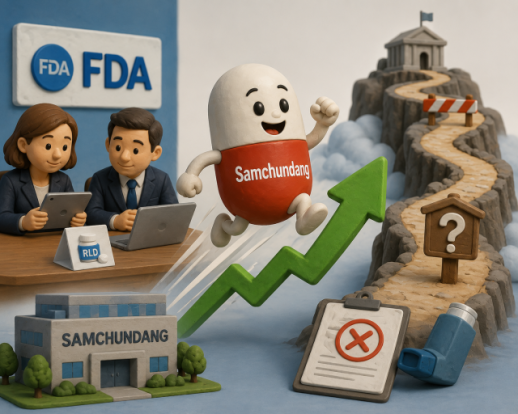 Samchundang Pharm shares surge on hopes for diabetes generic SEOUL, July 20 (AJP) - KOSDAQ-listed drugmaker Samchundang Pharm saw its shares soar on Monday amid expectations that its diabetes drug would move a step closer to entering the U.S. pharmaceutical market. Its shares surged 29.82 percent to close at the daily trading limit of 239,000 won after the drugmaker said it had received a written response from the U.S. Food and Drug Administration (FDA) regarding its oral semaglutide generic, a pill for Type 2 diabetes, although the approval process remains far from complete. The FDA feedback came before the filing of an abbreviated new drug application (ANDA), which is required to market generic medicines in the U.S. However, it is only part of the early process and does not involve an assessment of the drug itself. Samchundang has yet to file its ANDA, meaning regulators have not begun reviewing the application for approval and could still request additional studies or documentation, or reject the submission. The FDA identified Danish drugmaker Novo Nordisk's Rybelsus, an oral semaglutide treatment for Type 2 diabetes, as the reference listed drug (RLD) for Samchundang's generic version. Samchundang said the FDA's response itself marked an important step in the development of its drug and its future commercialization efforts. Investors seem overly excited, as the drug is still a long way from approval as Samchundang has yet to file its ANDA, and the FDA has not begun a formal review of the application. Another key question is whether Samchundang's existing bioequivalence (BE) data will be sufficient. BE studies determine whether a generic drug is absorbed by the body at a similar rate and to a similar extent as the reference medicine. Even after a formal review begins, regulators can still require additional clinical studies, potentially delaying approval. Jordan-based drugmaker Hikma Pharmaceuticals, for example, received an FDA Complete Response Letter (CRL) for its generic version of Advair Diskus, a widely used asthma medication, and had to conduct another clinical trial before resubmitting its application. 2026-07-20 17:49:48
-
Iran Confirms Receipt of Mediation Proposals Amid Ongoing Tensions with U.S. As military tensions escalate between the United States and Iran, both sides have not completely ruled out the possibility of a diplomatic resolution. However, Iran has expressed strong distrust towards U.S. diplomatic proposals while confirming receipt of mediation offers from other countries.On July 20, Esmail Baghaei, spokesperson for the Iranian Foreign Ministry, stated during a press briefing, "Sticking to a binary choice of negotiation or war does not benefit the nation," adding that Iran will sometimes utilize defense, sometimes diplomacy, and at times both to protect its national interests.In response to questions about Iranian Foreign Minister Abbas Araghchi's visit to Qatar and the mediation proposals from Qatar, Baghaei confirmed that "mediating countries have made several proposals, and Iran has received them." He noted, "I will not comment on the specifics, but it is clear that the mediating countries are working to prevent escalation of tensions."Baghaei emphasized, "Iran will spare no effort to halt U.S. attacks," asserting that the diplomatic authorities are aware of their roles and are continuing necessary efforts.However, he expressed caution regarding U.S. Secretary of State Marco Rubio's mention of the possibility for diplomatic resolution. He stated, "We have seen and tested this attitude from the U.S. multiple times," claiming that when the U.S. speaks of diplomacy, it means threats, intimidation, and coercion. He added that Iran's response to this will be to maintain its defensive posture as long as U.S. military pressure continues.Previously, on July 19, Rubio had stated that the U.S. remains open to diplomatic solutions even as it expands military operations against Iran.Nevertheless, military clashes between the two nations have intensified. Following the death of U.S. combat personnel in recent confrontations, the U.S. conducted airstrikes against Iran for nine consecutive days. President Donald Trump announced, "We struck Iran very hard again tonight."The U.S. Central Command (CENTCOM) reported that it targeted Iranian military command centers, air defense and coastal surveillance facilities, naval forces, missile and drone-related sites, and communication networks. Explosions were reported not only in southern Iran but also in the northwestern city of Tabriz, indicating an expansion of the U.S. attack range.Iran has also raised its response level, claiming attacks targeting U.S. military facilities in the region. The Islamic Revolutionary Guard Corps (IRGC) warned that as long as U.S. military operations continue, the transportation of oil and gas through the Strait of Hormuz will not be safe.* This article has been translated by AI. 2026-07-20 17:44:00
-
Yoon Ho-jung: 'Prioritizing Safety of Firefighters Amid Ongoing Fire Response' Yoon Ho-jung, the Minister of the Ministry of Interior and Safety, visited the Coupang logistics center fire site in Incheon on July 20, promising government support as the fire continues for a third day.During his visit, Yoon met with Incheon Mayor Park Chan-dae and received updates on the firefighting efforts from Choi Yong-cheol, head of the Central Emergency Rescue Control Headquarters. He conveyed President Lee Jae-myung's directive to focus on extinguishing the fire while ensuring the safety of personnel on the ground, stating, "Currently, rapid suppression is the top priority."He emphasized, "The safety of firefighters operating in hazardous conditions, such as toxic gases and extreme heat, is of utmost importance," adding that suppression efforts must occur only when safety is assured. He also noted the importance of supporting residents to restore their daily lives to prevent prolonged inconvenience due to evacuation orders issued in nearby areas due to concerns of building collapse.Yoon stated, "We are responding through a nationwide mobilization of firefighters, and the central government will spare no effort in providing necessary support." He pledged to work with local governments to prevent further damage and contain the fire's spread. Additionally, he mentioned plans to establish fire safety measures and enhancements for large logistics warehouses in the future.After inspecting the site, Yoon visited a temporary shelter set up at Shinhyeon Elementary School, where he met with affected residents. He urged city and district officials to ensure that relief supplies and meals are provided without interruption until residents can safely return to their daily routines.The fire broke out at the Coupang logistics center in Seongnam-dong, Incheon, at 6:54 a.m. on July 18, starting on the sixth floor and spreading to the seventh floor via the exterior walls. Fire authorities have mobilized over 800 personnel and more than 200 pieces of equipment, including pump trucks, to combat the blaze, but full suppression is expected to take more time.Meanwhile, the Seongnam district issued evacuation orders for businesses and factories within a 116-meter radius of the fire site the previous night due to increased risk of building collapse, and advised nearby daycare centers and elementary schools to suspend operations. Currently, nearly 100 households are staying at the temporary shelter.* This article has been translated by AI. 2026-07-20 17:44:00
-
Hyundai Union Expands Partial Strike to Four Hours as Suppliers Join The Hyundai Motor Union has escalated its strike amid ongoing difficulties in wage and collective bargaining negotiations. The participation of major parts suppliers in the strike has further exacerbated production disruptions.According to industry sources, the Metal Workers' Union of Hyundai Motor conducted a four-hour partial strike on July 20. This marks the fourth strike of the year, doubling the duration from the two-hour partial strike held last week.Morning shift production workers stopped work at 10:50 a.m. to either leave the factory or attend a rally within the plant. The afternoon shift is set to begin its strike at 7:30 p.m. The union plans to continue the four-hour partial strikes daily until July 22.Negotiations between the union and management have shown little progress. There have been no official talks since the 15th round of negotiations on July 8, and practical discussions have reportedly made no significant headway.Industry analysts believe that if an agreement is not reached by July 24, negotiations may extend into the summer vacation period, raising concerns about a prolonged strike.The union stated, "We will not be fixated on reaching an agreement before the summer vacation. If the company desires a confrontation, we will respond to the end."Production disruptions are expected to worsen as the strike at parts suppliers compounds the situation. The union at Motras, a key Hyundai parts supplier, joined a general strike on July 15, causing delays in the supply of essential components such as chassis modules needed for vehicle assembly.Hyundai management has expressed that the union is delaying negotiations by presenting demands that exceed the scope of discussions, including requests for extended retirement age, reinstatement of dismissed workers, and increased bonuses. The company has proposed a monthly base salary increase of 89,000 won, a performance bonus of 350%, and the distribution of 15 shares of company stock.* This article has been translated by AI. 2026-07-20 17:44:00
-
 KOSPI drops 4.5% as sell sidecars hit both markets SEOUL, July 20 (AJP) - Korean stocks closed sharply lower Monday, with the benchmark KOSPI losing more than 4 percent and the KOSDAQ falling more than 5 percent as sell-side sidecars were activated in both markets. The KOSPI dropped 304.33 points, or 4.46 percent, to close at 6,516.27. The index opened 2.60 percent lower at 6,643.58. It climbed as high as 6,814.86 during the session before falling to an intraday low of 6,472.80. The selloff followed a buildup of investor anxiety over the semiconductor sector during the Constitution Day holiday, compounded by escalating conflict in the Middle East. Leveraged exchange-traded funds tracking chip stocks were cited by market observers as amplifying the swings in both directions. A sell-side sidecar was activated in the main market at 11:21:26 a.m., temporarily suspending program sell orders for five minutes. Institutional investors sold a net 919.1 billion won worth of KOSPI shares. Foreign investors purchased a net 515.3 billion won, while retail investors bought 349.1 billion won. Samsung Electronics fell 4.31 percent to 244,000 won, while SK hynix dropped 4.23 percent to 1,764,000 won. Samsung Life Insurance plunged 8.91 percent and KB Financial Group lost 6.79 percent. Kia fell 6.48 percent, Hyundai Motor dropped 6.12 percent to 399,000 won and LG Energy Solution declined 4.94 percent. Samsung Biologics fell 3.65 percent, SK Square lost 2.89 percent, Samsung Electronics preferred shares declined 1.63 percent and Samsung Electro-Mechanics edged down 0.16 percent. Hanmi Semiconductor tumbled 8.5 percent to 222,000 won, while LG Innotek dropped 9.9 percent. Hanwha Ocean fell 4.0 percent to 83,200 won. Diversified telecommunications services gained 2.1 percent, led by a 2.8 percent rise in One4U and a 2.1 percent gain in KT. Card shares advanced 1.8 percent, with Samsung Card rising 1.8 percent. Diversified consumer services gained 1.5 percent, led by eSang Networks, which also rose 1.5 percent. The tech-heavy KOSDAQ fell 42.20 points, or 5.33 percent, to close at 749.64. The index opened 2.35 percent lower at 773.21 and traded between an intraday high of 783.74 and a low of 747.00. A sell-side sidecar was triggered in the KOSDAQ market at 10:52:54 a.m., about 29 minutes before the measure was activated in the KOSPI market. Program sell orders were suspended for five minutes. Retail investors purchased a net 190.8 billion won worth of KOSDAQ shares. Foreign investors sold 57.7 billion won, while institutions unloaded 134.8 billion won. Samchundang Pharm surged 29.82 percent to the daily limit at 239,000 won after receiving a response from the U.S. Food and Drug Administration regarding its Pre-ANDA consultation for a generic oral semaglutide product. ROKIT Healthcare jumped 27 percent to 61,400 won. Jinyoung rose 29.9 percent to 1,420 won, Zinitix gained 15.0 percent to 1,852 won and GigaLane climbed 15.1 percent to 12,990 won. Hanil Feed advanced 14.9 percent to 2,770 won, Hantop rose 13.8 percent to 2,765 won and JOLSE gained 9.5 percent to 1,309 won. Mirae Life Resources surged 29.8 percent and Selim B&G rose 9.7 percent as plastic-alternative and soybean-related shares ranked among the strongest themes. Semiconductor equipment shares were among the steepest decliners. Wonik IPS plunged 18.19 percent to 115,100 won, PSK dropped 12.59 percent and Jusung Engineering fell 10.64 percent to 167,900 won. Ecopro lost 8.13 percent and Ecopro BM declined 7.38 percent. Rainbow Robotics fell 5.54 percent, Rino Industrial dropped 4.43 percent, Alteogen declined 2.53 percent and Kolon TissueGene lost 1.45 percent. The Korean won strengthened slightly against the U.S. dollar, with the exchange rate falling 0.1 won to close at 1,478.4 won per dollar. Japan's stock market was closed for the Marine Day public holiday. China's Shanghai Composite Index rose 0.9 percent to 3,796.3, while Hong Kong's Hang Seng Index gained 2.0 percent to 25,059.9. Brent crude rose 2.3 percent to $90.1 a barrel, while West Texas Intermediate gained 2.0 percent to $84.1 a barrel. 2026-07-20 17:34:22
-
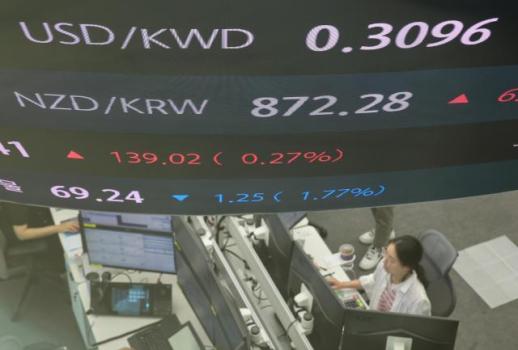 Won holds at 1,478 as strong dollar offsets BOK hike; bond yields climb SEOUL, July 20 (AJP) - The South Korean won ended nearly unchanged Monday as a strong dollar and renewed U.S.-Iran tensions offset support from the Bank of Korea’s interest-rate increase last week. Government bond yields rose as investors continued to price in the possibility of further monetary tightening. The won closed the daytime trading session at 1,478.4 per dollar, up 0.1 won from the previous session. The currency showed little reaction to the BOK’s decision Thursday to raise its benchmark interest rate by 25 basis points to 2.75 percent from 2.50 percent. The central bank cited stronger export- and investment-led growth, above-target inflation and persistent financial stability risks, while Gov. Shin Hyun-song left the door open to further rate increases depending on incoming data. The dollar index, which measures the greenback against a basket of six major currencies, remained above 100, limiting the won’s gains. Renewed military tensions between the United States and Iran also sustained safe-haven demand for the dollar. U.S. service members were killed in separate incidents involving Iranian missile and drone attacks in Jordan and Iraq, raising concerns that the conflict could spread across the region. The developments kept the won’s recovery limited even after the BOK delivered its first rate increase since November 2022. In the bond market, the yield on the three-year government bond rose 4.7 basis points to 3.895 percent, while the 10-year yield gained 3.9 basis points to 4.336 percent. The larger rise in the three-year yield, which is more sensitive to the policy outlook, reflected expectations that the BOK could raise rates again. The U.S. 10-year Treasury yield traded at around 4.57 percent Monday, roughly 23 basis points above the comparable Korean yield. Korean government bonds therefore continued to offer no nominal yield premium over U.S. Treasuries, potentially limiting their appeal to yield-seeking investors. The yield gap persisted despite foreign inflows linked to South Korea’s phased inclusion in the FTSE Russell World Government Bond Index. The country’s inclusion began in April and is scheduled to proceed in monthly stages through November. Foreign purchases linked to the index have so far failed to fully offset upward pressure on yields from expectations of further BOK tightening and renewed inflation risks stemming from the Middle East conflict. 2026-07-20 17:33:53