


Latest by
-
 Big Bang Confirms World Tour Title 'XX: Cosmos' as Goyang Tickets Sell Out 그룹 빅뱅의 고양 콘서트 추가 티켓이 매진됐다. 쿠팡플레이는 지난 13일 선예매, 14일 일반 예매를 통해 ‘쿠팡플레이와 함께하는 빅뱅 월드 투어 ‘엑스엑스 : 코스모스’ 인 고양(BIGBANG WORLD TOUR < XX : COSMOS > IN GOYANG)’ 추가 티켓 예매를 진행했다. 추가 티켓은 일반 예매 시작 7분 만에 전석 매진됐다. 이번 공연은 앞서 올해 국내 공연 최다 대기 인원인 21만명을 기록하며 예매 열기를 보인 바 있다. 월드투어 오프닝 공연에 대한 팬들의 관심이 이어지자 쿠팡플레이는 추가 티켓 오픈을 결정했다. 공연 공식 타이틀도 공개됐다. 공연명은 ‘쿠팡플레이와 함께하는 빅뱅 월드 투어 ‘엑스엑스 : 코스모스’ 인 고양’이다. 함께 공개된 포스터에는 깊은 우주 어딘가에서 포착한 미지의 신호를 연상시키는 이미지가 담겨 이번 투어의 콘셉트를 예고했다. 올해 데뷔 20주년을 맞은 빅뱅은 이번 공연을 통해 월드투어의 시작을 알린다. 특히 지드래곤, 태양, 대성이 함께하는 월드투어는 2017년 ‘라스트 댄스’ 투어 이후 9년 만이다. ‘쿠팡플레이와 함께하는 빅뱅 월드 투어 ‘엑스엑스 : 코스모스’ 인 고양’은 오는 8월 21일부터 23일까지 3일간 고양종합운동장에서 열린다. 쿠팡플레이는 추가 티켓 예매 이후에도 취소 좌석 시간차 오픈, 와우회원 계정 1개당 1대 디바이스 접속 허용, 공연 당일 유효 신분증 확인 후 입장 등 부정 거래 방지 정책을 시행한다. 부정 거래 정황 신고를 위한 전용 채널도 운영한다.* This article has been translated by AI. 2026-07-15 13:56:00
-
 Seoul, one of Asia's richest cities, leaves one village behind SEOUL, July 15 (AJP) - The journey takes barely two minutes. Yangjae-daero, a six-lane boulevard cutting through southern Seoul, is little more than another busy artery carrying commuters toward Gangnam's gleaming office towers and luxury apartment complexes. Thousands cross it every day without giving the road a second thought. Yet few roads in South Korea separate two different economic realities more starkly. On one side stand apartment towers where homes now sell for more than 200 million won per 3.3 square meters, their values climbing alongside an artificial intelligence boom that has turned semiconductor companies into the country's most valuable businesses and is expected to propel South Korea's nominal economic growth to its strongest pace in three decades. Cross the road, however, and another Seoul emerges. The pavement gives way to dirt paths almost immediately. Wooden shacks patched together with corrugated iron, plywood and plastic sheeting line narrow alleyways barely wide enough for one person to pass. Coal briquettes remain stacked beside homes waiting for another winter. Rainwater has stained roofs covered by tarpaulins and old blankets. Hand-sized spiders spin webs across footpaths while mosquitoes rise from knee-high weeds left untended through the humid summer. This is Guryong Village. It is Seoul's last remaining shantytown, a settlement that was never intended to survive into the twenty-first century but now stands as perhaps the clearest physical reminder that South Korea's extraordinary economic ascent has never been experienced equally. The contrast is all the more striking because it exists not hundreds of kilometers from the capital but within Gangnam itself, the district synonymous with wealth, private education and some of Asia's most expensive real estate. From almost every point inside the village, residents can see the apartment towers that symbolize modern Seoul's prosperity. They are close enough to dominate the skyline, yet distant enough to feel like another country. What appears at first to be a simple story about poverty gradually becomes something more complicated after spending several days walking the settlement. The village does not resemble an abandoned place so much as one waiting to disappear. The first thing newcomers notice is not the housing but the suspicion. "Reporter?" The question comes before any greeting. When the answer is yes, conversations often end immediately. "We've seen many reporters," one elderly resident says with a dismissive wave. "Nothing changes." The skepticism is understandable. Residents have watched journalists arrive after fires, politicians before elections and redevelopment officials carrying new master plans. Television crews have repeatedly filmed what they describe as Seoul's last slum before leaving a few hours later. The village remains exactly where it was. Only after returning repeatedly do doors begin to open. Residents who initially refused interviews begin offering greetings. Someone points toward another alley worth seeing. Others quietly explain which homes were destroyed in the latest fire, which residents have moved into public housing and which houses now stand permanently empty. Walking through Guryong Village becomes less like touring a neighborhood than reading layers of Seoul's history. Boarded-up homes bear handwritten notices warning against trespassing after their occupants moved away or died. Children's bicycles lean against walls beneath weeds that have grown tall enough to swallow them. A rusted swing stands almost invisible under wild grass, its empty frame marking the place where children once gathered before their families gradually left in search of better schools, stable jobs and ordinary apartments elsewhere. Further uphill, the smell changes with every turn. Damp timber mixes with household refuse, stagnant summer water and the lingering scent of coal briquettes. Homes assembled from recycled wood, corrugated iron and plastic sheets appear to lean against one another for support. Electricity reaches most houses, but many still rely on improvised repairs accumulated over decades because redevelopment has remained perpetually just over the horizon. The January fire that swept through District 4 remains visible months later. More than 100 pyeong of ground is still covered by blue tarpaulins, while one half-burned house stands open to the weather. Inside, scorched books, blackened appliances and even an old cassette tape remain exactly where the flames left them. Residents speak about fires almost matter-of-factly. The houses are packed too closely together, the roads too narrow and the building materials too combustible for anyone to believe the next blaze can be entirely prevented. Each disaster briefly returns the village to the evening news. When public attention fades, the burned houses remain. 2026-07-15 13:54:46
-
Debate Over Lowering Age for Juvenile Offenders in South Korea During a Cabinet meeting on July 14, President Lee Jae-myung expressed concerns over a proposal to lower the age threshold for juvenile offenders to under 13 years old, stating it was "too weak" and urging for a broader reduction, noting that many countries set the age at 12. The President's push for a lower age for juvenile offenders signals a potential shift in discussions regarding youth criminal punishment.Under current law, a "juvenile offender" refers to individuals aged 10 to under 14 who commit illegal acts but are deemed incapable of criminal responsibility. These individuals can commit heinous crimes such as murder or rape without facing criminal penalties, instead receiving protective measures like community service or placement in juvenile facilities.However, recent reports of youth crime have undermined the intent of these laws. Incidents include students kidnapping and assaulting classmates while filming the acts on smartphones, as well as cases of infants being brutally abused or stolen vehicles being driven recklessly, resulting in tragic outcomes for innocent citizens.More concerning is the manipulation of their status as juvenile offenders, with some taunting police officers by saying, "You can't punish me anyway, so go ahead and hit me," showcasing a troubling blend of cunning and cruelty. This brutality is not merely anecdotal; it is supported by objective data. According to a report from the Ministry of Gender Equality and Family, the number of juvenile offenders apprehended by police reached 21,095 last year, a staggering increase from 9,606 in 2020, representing a 2.2-fold rise in just five years. Not only has simple theft increased, but violent crimes such as assault (up 2.8 times) and sexual offenses have also surged, indicating a critical escalation in the severity and sophistication of youth crime.Political leaders, many media outlets, and outraged civic groups are calling for a significant reduction in the age of criminal responsibility and stronger legal repercussions, arguing that the times have changed and a strong legal warning is necessary. However, it is essential to consider whether simply lowering the age is a panacea for youth crime. Human rights organizations, legal experts, and educators caution that lowering the age of criminal responsibility may not provide a fundamental solution. They warn of the risk that young offenders could become stigmatized, leading to a cycle of criminality as they connect with adult crime organizations and fall deeper into serious offenses.In reality, with the current infrastructure of juvenile detention and correctional facilities being severely inadequate, merely increasing the number of incarcerated youth could turn these facilities into "crime schools" where criminal skills are learned and shared, rather than places of rehabilitation. The argument that simply increasing punitive measures will eradicate youth delinquency cannot be dismissed lightly. Adolescence is a formative period where values are not yet established, and individuals are easily influenced by their environment. Therefore, reliance solely on punitive measures is insufficient. Strategies addressing youth crime must hold individuals accountable in a manner commensurate with their actions while also fostering their reintegration as healthy members of society through a well-designed support system. 2026-07-15 13:52:00
-
 A very Korean dream hatched in the country's most unlikely place SEOUL, July 15 (AJP) - Before Cheon Young-hwan tells visitors about Guryong Village, he tells them about his sons. Forty years ago, he walked down the hill from the cluster of shacks where his family had settled after being displaced by Seoul's redevelopment drive and knocked on the door of a stranger living across Yangjae-daero. He was not asking for money. Nor was he asking for food. He was asking to borrow an address. Without one, his two boys could not enroll in school. "I begged them," the 74-year-old recalled quietly. "There were many families like us." The family agreed. His sons eventually left Guryong Village. They found work, raised children and built lives elsewhere. His grandchildren have never lived in the settlement. Cheon still does. Every evening, he returns to the same small shack where his mother and grandmother once lived before him, separated from one of Asia's wealthiest neighborhoods by little more than six lanes of traffic. Few places reveal the contradictions of modern South Korea more vividly than this stretch of Yangjae-daero. On one side stand luxury apartment towers where homes sell for more than $100,000 per 3.3 square meters, their owners watching wealth compound alongside an AI-driven semiconductor boom expected to deliver South Korea's strongest nominal economic growth in three decades. Across the road lies Guryong Village, Seoul's last remaining shantytown. Yet after days spent walking its narrow alleys, sharing meals with residents and listening to stories accumulated over four decades, it became clear that the village's defining characteristic was not poverty. It was education. Almost every elderly resident spoke of the same regret. Not that they had lived in cramped houses patched together from scrap wood and corrugated metal. Not that coal briquettes still warmed their homes in winter or that rain leaked through aging roofs during the summer monsoon. What haunted them instead was that they themselves had never been able to study enough. That regret became the greatest gift they could offer their children. Nearly every family eventually sent the next generation away from the village, believing education offered the only reliable route out. They knew too well what opportunities they had missed, and refused to let their children inherit the same limitations. For Cheon, borrowing another family's address was simply one expression of that determination. For wealthier parents living across Yangjae-daero, the pursuit took a different form. Some purchased apartments inside prestigious school districts. Others paid fortunes for private academies or elite private schools. Separated by only a few hundred meters, both sets of parents were trying to solve the same problem. How do you give your child a better future than your own? That realization surfaced repeatedly inside Guryong Village. One resident who had recently moved into public housing after falling ill left behind a room blackened by mold. What remained inside was not furniture or valuables. It was books. Books lined dusty shelves. Books covered the floor. Books were stacked on desks beside handwritten notes pinned across the walls. Cheon explained that his friend had spent years borrowing books from neighbors throughout the village, reading them one after another before passing them on again. Learning, he said, was never a hobby. It was how people here remained connected to a world that had largely moved on without them. Even today, books continue to circulate from house to house, quietly exchanged among neighbors who still read almost every day. The village may have lacked many things. It never lacked curiosity. Only after lunch, as bowls were cleared away and conversation drifted toward old memories, did Cheon quietly suggest taking another walk. A few minutes later he stopped beside an overgrown patch of grass. We had passed it several times without noticing. "There," he said. At first there appeared to be nothing. Then, beneath the weeds, the outline emerged. A rusted steel swing frame. Its seats had long since disappeared. The laughter had disappeared long before that. Children once gathered there after school, Cheon recalled. Now the frame stood alone, slowly disappearing beneath waist-high grass that revealed just how many years had passed since anyone had used it. The children had not vanished because the village had failed. They had left because their parents insisted they should. That rusted swing may be the clearest symbol of Guryong Village. It is not a monument to poverty. It is a monument to parents who quietly gave up the chance to leave themselves so that their children never again would have to borrow another family's address simply to go to school. In that sense, Guryong Village may not be as different from affluent Gangnam as it first appears. Across Yangjae-daero, wealthy parents spend extraordinary sums securing admission to elite schools, private academies and neighborhoods prized for their educational advantage. Inside the village, parents sacrificed everything they had for exactly the same reason. One side bought opportunity. The other borrowed it. The dream was identical. 2026-07-15 13:49:34
-
U.S. Coast Guard Deploys Ships to South China Sea Amid Rising Tensions with China The United States has deployed six Coast Guard vessels, previously stationed in the Middle East, to Singapore and the Philippines. This move comes as U.S. naval forces concentrate in the Middle East due to escalating tensions with Iran, prompting the Coast Guard's shift to the Western Pacific to counter China's pressure in the South China Sea.The Wall Street Journal reported on July 14 that "six 154-foot fast response cutters from the U.S. Coast Guard are operating in the Western Pacific, based in Singapore and the Philippines."These vessels were previously engaged in maritime security and drug and arms interdiction in the Middle East. However, as U.S.-Iran tensions intensified this year, the Coast Guard withdrew these non-missile defense ships from Bahrain and redirected them to the Western Pacific.The ships will operate from Singapore, receiving command and logistical support, while alternating operations in Subic Bay, Philippines. This deployment has been approved at least until September. It marks the first time the U.S. will operate small fast response cutters from Subic Bay.Subic Bay, a former U.S. military base, is strategically located near the South China Sea, allowing for rapid access to areas of conflict between China and the Philippines.The decision to deploy Coast Guard vessels instead of naval ships is linked to China's approach in the region. China has prioritized its Coast Guard over its navy in the South China Sea, employing tactics such as blocking supply and fishing operations of Philippine vessels and using water cannons, creating a situation just short of military conflict.By deploying the Coast Guard, the U.S. aims to curb Chinese Coast Guard activities while minimizing the risk of escalating military tensions. This strategy also facilitates cooperation with Southeast Asian and Pacific nations on non-military missions such as illegal fishing enforcement and search and rescue operations.However, the power gap with China remains significant. China continues to expand its Coast Guard capabilities with larger vessels and heavy armament, while also strengthening cooperation with its navy and maritime militia.* This article has been translated by AI. 2026-07-15 13:48:00
-
Semiconductor Contract Programs Must Open Up Beyond Corporate Ties The choice between medical school and semiconductor programs has become a fierce dilemma for top science students in South Korea. As the semiconductor industry gains prominence in the age of artificial intelligence (AI), more students are applying to both medical and semiconductor programs. This trend reflects a strong belief that semiconductors are a key future industry for South Korea.However, the talent development system is struggling to keep pace with the rapid changes in the industry. Many semiconductor programs at major universities in South Korea are structured as contract programs, which are designed to prepare students for employment at companies like Samsung Electronics and SK Hynix. These programs are seen as successful examples of industry-academia collaboration, thanks to benefits like tuition support and job placement.The problem is that this approach has clear limitations in the AI era. The semiconductor industry is evolving into a competitive ecosystem that encompasses AI semiconductors, system semiconductors, advanced packaging, fabless design, electronic design automation (EDA), and materials, components, and equipment. The demand for semiconductor talent extends beyond just Samsung and SK Hynix; hundreds of fabless and materials companies are also struggling to find qualified personnel. The very name 'contract program' implies a focus on employment with specific companies, which restricts the supply of talent across the entire industry ecosystem.South Korea is also lagging behind in workforce size compared to its competitors. China is nurturing semiconductors as a strategic national industry, producing hundreds of thousands of graduates in microelectronics and related fields each year. Taiwan, led by the government and TSMC, closely connects universities and research institutions to train over 50,000 engineering graduates annually. In contrast, despite having world-class memory competitiveness, South Korea's output of semiconductor talent does not meet industry demand, resulting in a distorted structure where factories are increasing while the workforce is insufficient.It is time for a national talent strategy. While continuing to nurture company-specific talent, there should be a focus on expanding formal semiconductor programs. New semiconductor programs should be actively established not only in the metropolitan area but also at regional national universities and innovation universities to broaden the talent pool. The curriculum also needs to shift from a memory-centric approach to encompass the entire field of AI semiconductors.Revisiting the name 'contract program,' which is often viewed as a recruitment channel for specific companies, should also be part of the discussion. Semiconductors are a future strategic industry, and semiconductor talent should be recognized as a public asset that supports the national industrial ecosystem. Ultimately, the competition for semiconductor supremacy in the AI era hinges on people. More important than the hundreds of trillions of won invested is the talent that can turn that investment into results. A shift from 'talent needed by companies' to 'semiconductor talent nurtured by the nation' is urgently needed.* This article has been translated by AI. 2026-07-15 13:48:00
-
Korean Air and Asiana Airlines May Operate Separate Mileage Programs Ahead of Merger Korean Air and Asiana Airlines may continue to operate separate mileage programs as they approach their merger at the end of the year.According to industry sources on July 15, Korean Air recently indicated in a revised securities filing that there could be delays in integrating mileage programs with Asiana Airlines.The filing stated, "If we do not receive approval from the Fair Trade Commission for the mileage integration plan before the merger date, we may need to maintain and operate the existing mileage programs of Korean Air and Asiana Airlines separately until that approval is granted, in order to avoid unfavorable changes compared to the end of 2019."Last December, the Fair Trade Commission issued a corrective order regarding Korean Air's mileage integration plan, aimed at minimizing the loss of expiring miles.Korean Air submitted a revised plan in January, but has yet to receive final approval after six months. If separate operations become a reality, the burden on Korean Air could be significant.The airline explained, "If we determine that unfavorable changes have occurred compared to 2019 while maintaining the mileage programs separately, we could face a daily penalty of approximately 925 million won under the Fair Trade Act."Additionally, Korean Air expressed concerns that the dual operation of the mileage programs would lead to increased costs due to the need for separate IT systems, staffing, and services, as well as delays in realizing synergies from member integration.* This article has been translated by AI. 2026-07-15 13:48:00
-
National Assembly's Judiciary Committee Discusses Abolishing Supplementary Investigation Rights The National Assembly's Judiciary Committee discussed a bill to abolish supplementary investigation rights on the 15th but failed to reach a conclusion. The committee plans to review a bill proposed by Democratic Party lawmaker Hong Gi-won on the 14th that seeks to retain some supplementary investigation rights.Kim Seung-won, the chair of the Judiciary Committee's subcommittee and a member of the Democratic Party, spoke to reporters after the meeting, stating, "Chairman Seo Young-kyu should decide on the direct referral of the bill proposed by Hong." He added, "I hope the People Power Party members will discuss this within the framework of the National Assembly rather than making noise outside of it."Meanwhile, there are differing opinions within the Democratic Party regarding the proposed abolition of supplementary investigation rights as part of judicial reform. Hardliners like lawmaker Kim Yong-min have proposed a complete abolition, while Hong argues that supplementary investigation rights should be retained for exceptional cases such as sexual violence.Additionally, the Judiciary Committee is currently reviewing a bill proposed by the Democratic Party's Criminal Procedure Law Task Force, which is being merged with a bill introduced by lawmaker Cha Gyu-geun of the Innovation Party. The Democratic Party aims to reach a conclusion through deliberation based on the task force's proposal.The task force is composed of lawmakers Kim Seung-won and Lee Hae-sik, along with Kim Han-kyu, the party's deputy floor leader, and Park Sang-hyuk, the deputy chair of the policy committee. The task force's bill is designed to replace supplementary investigation rights with a supplementary investigation request right.The abolition of supplementary investigation rights has been a long-standing demand of the Democratic Party, but the controversy has arisen following Hong's proposal to retain some rights.In a Facebook post, Hong warned, "If the complete abolition of supplementary investigation rights leads to more incidents like the Jang Yun-ki case during police investigations, the Democratic Party will lose the trust of the public and face severe consequences in the upcoming general and presidential elections."He also stated, "The goal is not simply to abolish the investigative powers of the prosecution; it is a means to eliminate political prosecution and protect the public. If there are ways to minimize public harm, we should consider them."Hong's proposal has sparked differing opinions among potential candidates for the Democratic Party leadership ahead of the upcoming party convention. Former leader Jung Cheong-rae expressed disappointment, saying, "I am saddened by the sudden shift in atmosphere."In contrast, lawmaker Ko Min-jeong remarked, "A public forum that cannot even raise issues is meaningless. It is a matter of conscience for me not to raise concerns when there are visible problems that could affect the public. I hope meaningful discussions will take place." Ko has also signed her name to Hong's proposal. 2026-07-15 13:44:00
-
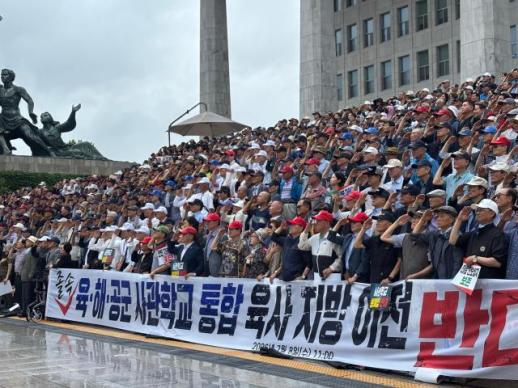 Seoul weighs Daejeon site for unified military academy SEOUL, July 15 (AJP) - South Korea’s Defense Ministry is strongly considering establishing a new integrated military academy at Jaundae in Daejeon, where cadets from the Army, Navy and Air Force academies would receive four years of joint education, military sources said Wednesday. According to military officials, the ministry is reviewing a plan to create a new Armed Forces Academy at Jaundae, a major military education and training complex in Daejeon, as part of its broader push to integrate the three service academies. The plan would mark a shift from an earlier “2+2” model, under which cadets would be jointly selected and receive common education during their first two years before moving to their respective service academies for specialized training in their third and fourth years. The ministry is now said to be giving greater weight to a four-year integrated program at Jaundae, citing the need to strengthen jointness among future officers. Under the proposal, cadets would live and study at Jaundae for all four years, while receiving service-specific major courses and professional education from their upper years to preserve the expertise required by each branch. Jaundae, located in Daejeon’s Yuseong District, is home to several key military education institutions, including the Army College, Naval College, Air Force College and Joint Forces Military University. The latest proposal comes amid growing debate over the government’s academy reform plan. The ministry has argued that an integrated academy would strengthen jointness, reduce overlapping education and better prepare officers for future warfare, while critics, including alumni groups, parents of cadets and retired officers, have warned that a rushed merger could weaken service-specific expertise and identity. Earlier this month, about 2,000 people gathered in heavy rain outside the National Assembly to protest the plan, saying the government should provide clearer explanations before changing the officer training system. The ministry is also reportedly considering a longer-term plan to expand the new academy into a comprehensive military university that would eventually include other institutions, such as the Armed Forces Nursing Academy and a planned defense advanced technology academy. The Defense Ministry is expected to announce the basic plan in the coming days, possibly as early as Thursday. “We will soon provide the public with a detailed explanation of the basic plan to establish a world-class Armed Forces Academy aimed at training elite officers capable of leading victory in future warfare,” a ministry official said. “The plan will be further developed through open consultations, including public hearings and policy briefings.” 2026-07-15 13:32:14
-
Daewoong Pharmaceutical Secures Liver Organoid Technology to Enhance Drug Development Daewoong Pharmaceutical has secured liver organoid technology from the Korea Research Institute of Bioscience and Biotechnology, aiming to enhance its drug development capabilities. The strategy focuses on improving the accuracy of non-clinical toxicity assessments to boost research and development (R&D) efficiency.On July 15, Daewoong Pharmaceutical announced that it signed a technology transfer agreement with the Korea Research Institute of Bioscience and Biotechnology for the 'Liver Organoid Production and Drug Evaluation Technology.' Organoids are three-dimensional artificial organs cultivated using stem cells, precisely mimicking the structure and function of human organs. This method allows for more accurate research while adhering to ethical standards compared to animal testing.The technology transfer signing ceremony took place at Daewoong's Magok Research Center, attended by Daewoong CEO Park Sung-soo and Korea Research Institute of Bioscience and Biotechnology President Kwon Seok-yun, along with key representatives from both sides.Daewoong has proactively adopted the '3D Human Liver Organoid Production and Toxicity Evaluation Platform' developed by Dr. Son Myung-jin's team. The company expects this technology, which boasts high completeness and extensive empirical data, to align with the growing trend of alternative testing methods to animal experiments, particularly those expanding under the U.S. Food and Drug Administration (FDA).Traditional two-dimensional liver cells have limitations in predicting drug toxicity due to structural differences from actual organs. In contrast, this new technology replicates human liver tissue and the intrahepatic bile duct structure, enhancing the accuracy of preclinical liver toxicity assessments, according to the company. Additionally, it is recognized for overcoming the limitations of large-scale production of organoids, as it maintains functionality even after continuous proliferation and freeze-thaw cycles.This technology has been adopted by the Organization for Economic Cooperation and Development (OECD) Test Guidelines Project (DRP) and a new project for international standards by the International Organization for Standardization (ISO), with international expert reviews currently underway.Through this technology adoption, Daewoong aims to elevate its non-clinical evaluation system to international standards and precisely assess the liver toxicity of drug candidates at the non-clinical stage, thereby increasing the success rate of research and development.Park Sung-soo, CEO of Daewoong Pharmaceutical, stated, "To enhance the speed and efficiency of drug development, a research platform capable of more precise evaluation of candidates is essential. We will leverage our collaboration with the Korea Research Institute of Bioscience and Biotechnology to advance liver organoid technology and achieve tangible results in drug development."* This article has been translated by AI. 2026-07-15 13:32:00