


Latest by
-
 First Labor-Management-Industry Council Established in Shipbuilding Sector The first labor-management-industry council in the shipbuilding sector has been established. This social dialogue platform aims to address industry issues such as workforce shortages, the dual structure of subcontracting, and industrial safety, signaling significant changes in labor relations within the shipbuilding industry.The Korean Metal Workers' Union announced the launch of the shipbuilding labor-management-industry council at a ceremony held at the Seoul Press Center on July 13.The council includes representatives from labor groups such as the Korean Confederation of Trade Unions, the Korean Metal Workers' Union, the Federation of Korean Trade Unions, and the Shipbuilding Industry Labor Union Alliance, as well as major shipbuilders like the Korea Offshore & Shipbuilding Association, HD Hyundai Heavy Industries, Samsung Heavy Industries, and Hanwha Ocean. Officials from the Ministry of Employment and Labor, the Ministry of Trade, Industry and Energy, and the Economic, Social and Labor Council are also participating. Additionally, over 20 shipbuilding experts recommended by labor, management, and government will serve on the operational and working committees.The council will focus on discussing key issues facing the shipbuilding industry, including workforce shortages, industrial safety, improvements to the subcontracting structure, and workforce training. Labor representatives emphasized the need for on-site opinions to be actively reflected in the council's operations.The shipbuilding labor-management-industry council plans to keep discussions open on the agendas that labor, management, and government are concerned about through its working committee. The Metal Workers' Union expressed its commitment to ensuring that pressing issues and problems arising in the field are addressed within the council.Park Sang-man, chairman of the Metal Workers' Union, stated, "I thank the government and employers for their future cooperation in resolving the widespread labor shortage in the shipbuilding industry, dismantling the subcontracting structure, and eliminating workplace safety risks. It is essential to emphasize that the development of the shipbuilding industry has been based on the experience and capabilities of skilled workers."He added, "It is crucial to incorporate the opinions of on-site workers into the government's ongoing MASGA project. I hope that discussions on measures to protect workers during economic downturns, policies for migrant workers, primary negotiations, and the regularization of safety-related jobs will take place within the council."Kim Jun-young, chairman of the Metal Workers' Federation, also stressed the need to improve the dual structure of subcontracting and establish effective safety measures to create a sustainable shipbuilding industry where workers can take pride in their jobs.Meanwhile, the Metal Workers' Union emphasized that the establishment of this shipbuilding council should lead to the formation of similar labor-management-industry councils in other manufacturing sectors, such as automotive, steel, and electronics. Previously, workers in the automotive, steel, and electronics sectors had conveyed their demands to the government.* This article has been translated by AI. 2026-07-13 10:32:00
-
 Strong chip demand keeps early July exports at another record high SEOUL, July 13 (AJP) - South Korea's exports in early July reached a record high for the period, as semiconductor exports nearly tripled from a year earlier. According to data released by the Korea Customs Service (KCS) on Monday, exports in the first 10 days of July rose 53.9 percent from a year earlier to a record US$29.84 billion for the period. The previous high was $28.6 billion, set last month. Average daily exports, adjusted for working days, rose 53.9 percent to $3.51 billion. There were 8.5 working days, unchanged from a year earlier. Semiconductors led the gains. Chip exports jumped 193 percent from a year earlier to a record $11.21 billion for the period, accounting for 37.6 percent of total exports, up 17.8 percentage points from a year earlier. Exports of computer peripherals surged 208.1 percent on strong demand and higher prices for semiconductor-based solid-state drives (SSDs) used in artificial intelligence (AI)-related servers. Exports of petroleum products rose 22.7 percent, while shipments of ships, steel products and passenger cars increased 75.1 percent, 12.9 percent and 5.7 percent, respectively. Exports of auto parts, however, fell 11.7 percent. By destination, exports to China rose 88.7 percent, those to the U.S. 43.2 percent and those to Viet Nam 92.8 percent. The three markets accounted for 51.7 percent of total exports. Imports during the same period rose 17.4 percent from a year earlier to $23.48 billion. Imports of semiconductors increased 49.6 percent, followed by gas at 24.8 percent, machinery at 7.8 percent and semiconductor manufacturing equipment at 49.5 percent. Energy imports including crude oil, gas and coal rose 23.4 percent. Crude oil imports rose 19 percent to $2.941 billion, as the lingering conflict in the Middle East and a weaker won pushed up import costs, according to KCS. Imports rose 25.1 percent from China, 4.7 percent from the U.S., 7.6 percent from Japan, and 57.6 percent from Taiwan, while imports from the EU fell 4.4 percent. With exports exceeding imports, South Korea posted a trade surplus of $6.36 billion. 2026-07-13 10:28:44
-
Monami Shares Surge 12% Amid Patriot Buying, Overcoming Delisting Threat Monami, a company previously facing delisting risks, has seen a significant rise in its stock price thanks to what investors are calling "patriot buying."As of 10:14 a.m. on July 13, Monami's shares were trading at 2,400 won, up 11.89% (255 won) from the previous trading day, according to the Korea Exchange.On July 10, Monami's stock price surged by more than 20% during trading hours. The increase follows the implementation of stricter delisting criteria for the KOSPI index, which began on July 1, prompting individual investors to buy shares of companies at risk of delisting.Monami's stock price jumped from 1,369 won on July 8 to a 24.69% increase on July 9, followed by a further rise of over 23% on July 10. Although there were no specific positive developments in the company's management, the so-called "patriot buying" appears to be a key factor behind the stock's rise.This trend coincides with the recent overhaul of the KOSPI delisting system. Under the revised rules, if a KOSPI-listed company's market capitalization falls below 30 billion won for 30 consecutive trading days, it will be designated as a management issue. If the company fails to recover its market cap during the improvement period, it will face delisting procedures.Previously, Monami's market capitalization dropped to 24.8 billion won on July 7 and 25.9 billion won on July 8. However, with the influx of individual investors, the market cap rebounded to 32.3 billion won by the close on July 9. Following further increases in stock price, the market cap reached approximately 45 billion won during trading on July 13.Online stock communities have been buzzing with comments like, "We must protect our national stationery company," further fueling the buying momentum.* This article has been translated by AI. 2026-07-13 10:28:00
-
Yulchon and OSBC Establish First Corporate AI Governance System in South Korea Law firm Yulchon announced on July 13 that it will provide open source AI governance consulting to 11 companies participating in the National IT Industry Promotion Agency's (NIPA) 'Open Source AI and Software Development and Utilization Support Project' in collaboration with OSBC.This initiative, with a total budget of 9.2 billion won, is a new project launched this year to support the development, utilization, and dissemination of open source AI and software led by domestic companies.As the use of AI coding tools and open source AI has surged, the legal risks for companies have also become more complex. There is a significant risk of violating licenses due to unrecognized open source dependencies or libraries included by developers. Open source AI models, in particular, combine data, code, and weights, making the boundaries of copyright and usage rights much less clear than with standard software. Furthermore, while the regulatory environment is tightening to demand transparency and accountability in AI, the governance systems to manage these issues have not yet kept pace with the speed of AI adoption by companies.In response, Yulchon and OSBC will integrate 'AI compliance' and 'open source governance' in their consulting services.In the area of AI compliance, the consulting will review obligations under the AI Basic Act, the classification of high-impact AI, and the requirements for prior notice and labeling related to generative AI that companies must fulfill during actual service operations. It will also examine copyright issues related to training data and AI outputs. The legal risks associated with the datasets used for model training will be assessed, and safe data usage and alternative data strategies will be suggested if necessary. This will enable participating companies to systematically check data sources and copyright risks during the development and distribution of AI models.In the area of open source governance, the consulting will support participating companies in checking the licensing conditions of the open source AI models and software they use and establishing compliance systems. Since the commercial use and distribution conditions of open source AI models vary by version, thorough analysis will be conducted to minimize risks. Additionally, support will be provided throughout the commercialization process, including service disclosure scope, community management, and business model design.Notably, this project will establish an 'open source AI profile' that reflects domestic laws and regulations, the EU AI Act, and global standards such as SPDX 3.0. The AI profile is a document that systematically organizes the model, data, software components, licenses, and risk factors of AI systems. It will be applied and validated with the 11 participating companies to continuously address issues in the field.Im Hyung-joo, head of Yulchon’s AI Data Center, stated, "This project is significant in that it aims to establish an AI governance system tailored to the domestic corporate environment and apply it in practice."He added, "With the participation of the law firm, we can now review complex legal issues such as the AI Basic Act, copyright law, and the EU AI Act in connection with the development and commercialization processes of companies. We will continue to support the establishment of a practical AI compliance system to ensure that domestic companies can safely utilize open source AI."Kim Taek-wan, CEO of OSBC, emphasized, "Recently, companies are facing a situation where they must manage not only the AI models themselves but also the open source components, training data, licensing conditions, and dependencies on external services. To ensure transparency and traceability in AI systems, it is crucial to establish a governance and management system based on open source governance and AI profiles from the development stage."OSBC, which is collaborating with Yulchon, is a consulting firm specializing in open source management in the software and AI sectors, established in 2006. It checks for potential legal license violations and security vulnerabilities that may arise during software development and supports the establishment of Software Bill of Materials (SBOM) in compliance with security regulations in the U.S. and Europe, as well as international standard (ISO) certification.* This article has been translated by AI. 2026-07-13 10:28:00
-
Europe Faces Record Heatwave with Over 10,000 Excess Deaths in a Week A record heatwave sweeping across Europe has resulted in over 10,000 excess deaths in the last week of June. The extreme temperatures have continued into July, leading to wildfires, disruptions in nuclear power operations, and changes to sports schedules.According to EuroMOMO, the European mortality monitoring organization, there were 10,650 excess deaths reported across 27 European countries from June 22 to June 28. Excess deaths indicate how many more people died compared to the average for that time of year.Of these, more than 9,000 were individuals aged 65 and older, accounting for over 85% of the total. The heatwave not only causes heatstroke but also exacerbates cardiovascular and respiratory conditions, posing significant risks to the elderly and those with pre-existing health issues.This figure does not only account for deaths directly attributed to the heatwave; it includes all deaths during that period. However, no other major factors, such as the COVID-19 pandemic, have been identified to explain the increase in mortality.Dr. Lasse Vestergaard, chief physician at the Danish National Serum Institute, which operates EuroMOMO, stated, "The scale of excess deaths during this period is highly unusual, and it is difficult to attribute it to anything other than the extreme heat." In France and Belgium, the excess death levels during the last week of June were classified as 'very high.' Belgium recorded its highest number of excess deaths during a heatwave since statistics began in 2000.Separate research estimates that approximately 2,700 people died in England and Wales due to the heatwave in May and June, with 42% of those deaths attributed to climate change intensifying the heat.As the heatwave persists, the impact of wildfires is also increasing. In France, a fire broke out in the Fontainebleau forest, located about 60 kilometers southeast of Paris, leading to partial closures of the A6 highway. Authorities have deployed firefighting aircraft, helicopters, and over 100 firefighters to combat the blaze.French Interior Minister Laurent Nunez reported that 17,000 hectares of forest have already been burned this year, with the total area affected expected to reach 25,000 hectares, double that of the same period last year.The Tour de France also adjusted its route, reducing the distance by about 30 kilometers due to temperatures nearing 40 degrees Celsius.Power generation has also been affected. Électricité de France (EDF) has halted operations at three nuclear plants and reduced output at eight others due to concerns that the water used for cooling could exceed environmental temperature standards when discharged.In southern Spain's Andalusia, a major wildfire has resulted in 12 deaths and eight injuries, with around 1,400 residents evacuated and the affected area estimated at about 6,600 hectares.In the UK, the wildfire risk in southern England and the Midlands has reached an 'exceptional' level.Scientists have analyzed that the heatwave in late June would have been virtually impossible without human-induced climate change.* This article has been translated by AI. 2026-07-13 10:24:00
-
Fire at Bangkok Bar Kills 27, Injures 63 A fire accompanied by an explosion at a bar in Bangkok, Thailand, has resulted in 27 deaths and 63 injuries. Among the injured, 22 are in critical condition.According to Reuters, the fire broke out at the 'Long Beer Na Lat Phrao' bar in the Chatuchak area at 11:57 p.m. on July 12.Thai Prime Minister Anutin Charnvirakul stated, "We have recovered 27 bodies, and other injured individuals are being transported to hospitals." Suriyachai Raweewan, head of the Bangkok Disaster Prevention and Mitigation Office, confirmed that the death toll stands at 27.The Bangkok Disaster Prevention and Mitigation Office reported that 63 people have been hospitalized due to the incident. Bangkok Mayor Chadchart Sittipunt noted that 22 of the injured are in critical condition.Suriyachai explained that when rescue teams arrived, the fire, which appeared to have started near the stage, had already engulfed the interior. "We need to wait for police investigations to determine the exact cause," he said.Body camera footage from rescuers, confirmed by Reuters, showed firefighters wearing oxygen masks searching the dark interior of the bar with flashlights. Several victims were found lying on the floor near the restroom, and rescuers were seen moving stretchers.Mayor Chadchart stated that the bar had the necessary permits and was equipped with emergency exits. However, he explained that the rapid spread of the flames and smoke may have made it difficult for patrons to escape.* This article has been translated by AI. 2026-07-13 10:24:00
-
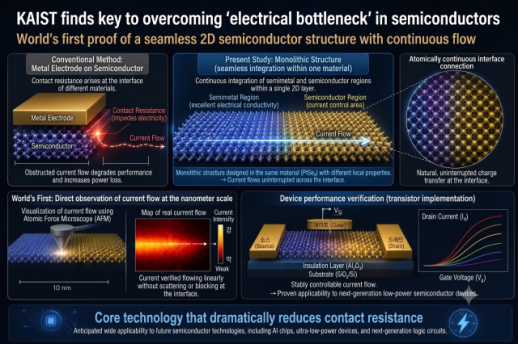 KAIST clears power-wasting bottleneck in chips SEOUL, July 13 (AJP) - South Korean researchers have found a way to remove one of the biggest hidden bottlenecks inside computer chips, a discovery that could make future artificial intelligence processors faster and far less power-hungry. Every chip loses energy at the point where metal wiring meets the semiconductor material that does the actual computing. This so-called contact resistance works like a tollgate on a highway: electricity slows down, heat builds up, and power is wasted. The smaller the chips become, the worse the problem gets, which is why the industry regards it as one of the hardest obstacles to building the next generation of processors. The Korea Advanced Institute of Science and Technology (KAIST) said Monday that a team led by materials science professor Hong Seung-bum, working with KAIST colleague Kang Ki-bum and Sungkyunkwan University professor Cho Sung-beom, had built a chip structure in which electricity flows across that troublesome boundary without any blockage, and observed it happening for the first time at the scale of a nanometer, one billionth of a meter. The trick was to get rid of the boundary altogether. Instead of attaching a metal electrode on top of a semiconductor, as chipmakers have always done, the team used a single sheet of platinum diselenide, a material only one or two atoms thick. Within that one sheet, they created a region that conducts like a metal and a region that behaves like a semiconductor, joined seamlessly with no gap, glue, or residue in between. Because both regions belong to the same continuous material, current passes from one to the other as if driving on an uninterrupted road. Using an atomic force microscope, an instrument that traces surfaces with a needle fine enough to map individual atoms, the researchers watched electric charge cross the junction. The current flowed straight through without stalling or bending, the first direct experimental proof that such a seamless interface does not resist the flow of electricity. The team then went a step further and tested whether the structure could do real work. By applying an electric field to the semiconductor region, they switched the current on and off in a stable way, the basic operation of a transistor, the building block of every processor and memory chip. The practical implications are significant. Contact resistance is a major reason data centers running AI models consume enormous amounts of electricity and generate so much heat. A chip architecture that eliminates the bottleneck could translate into AI processors that run faster on less power, longer battery life in phones and laptops, and ultra-low-power chips for sensors and wearable devices. The technique also gives chip designers a testing platform to evaluate electrode structures before committing them to production. The work remains laboratory science for now, and the team plans to extend the method to other ultrathin materials in the same family before it can move toward commercial use. "This is the first time anyone has directly observed current flowing across a two-dimensional semiconductor interface at the nanometer scale," Hong said. "Since we have experimentally proven that a seamless interface does not obstruct the flow of current, we expect it to serve as a core technology for solving contact resistance problems in a wide range of next-generation semiconductors." KAIST doctoral candidate Kim Yeon-gyu, KAIST researcher Gyeon Min-seung and Sungkyunkwan University doctoral candidate Hong Ji-hoon were co-first authors of the study, which was published in the July 2026 issue of the materials science journal Matter. (Reference Information) Journal/Source: Matter Title: Nanoscale imaging of charge transport across the semimetal-semiconductor interface in monolithic platinum diselenide Link/DOI: https://doi.org/10.1016/j.matt.2026.102873 2026-07-13 10:23:02
-
FIFA President Infantino Considers Expanding World Cup to 64 Teams The FIFA World Cup, which debuted with 48 teams, may expand to 64 teams. FIFA President Gianni Infantino mentioned in an interview with Swiss broadcaster Blue Sport on July 13 that he is considering a significant increase in the number of participating teams from the current 48 to 64. He stated, "This is definitely a matter to be discussed after the North American tournament concludes through the relevant committee." Infantino emphasized, "The World Cup should be for Europe and South America, but essentially for the whole world. Every country should be able to dream of participating in the World Cup. We see that the level of teams worldwide is very high and improving. If smaller nations do not get the opportunity to participate, they lose motivation for development." He particularly cited the success of African nations in the ongoing 2026 North American tournament, where nine out of ten participating African countries advanced past the group stage. Infantino remarked, "This is a tremendous success. In the previous tournament, only five African nations participated. This shows how important it is to include all teams and provide participation opportunities." If the number of World Cup participants increases to 64, the total number of matches would rise to 128, doubling the 64 matches played in the 32-team format. The idea of a 64-team World Cup is not new. Last March, the South American Football Confederation (CONMEBOL) proposed increasing the number of teams to 64 for the 2030 tournament, which will mark the centenary of the World Cup. The 2030 World Cup will be co-hosted by Spain, Portugal, and Morocco, with the opening matches taking place in Uruguay, Argentina, and Paraguay. However, there is significant pushback within the soccer community regarding the potential expansion. Following CONMEBOL's proposal, the European Football Association (UEFA), along with Asian and North American federations, expressed their concerns. UEFA President Aleksander Čeferin criticized the idea, stating, "It's a bad idea. I find it truly astonishing and unacceptable." Some speculate that FIFA may be considering expanding the number of teams to help countries like China, which failed to qualify despite an increased number of spots in the Asian qualifiers. AFC President Sheikh Salman bin Ibrahim Al Khalifa commented, "While the expansion to 64 teams may be a one-time event, it could lead to calls for 132 teams in the future. We should avoid the chaos that indiscriminate changes can bring." * This article has been translated by AI. 2026-07-13 10:20:00
-
Woori Bank Launches Fund Service for Small Investors Woori Bank has launched a fund service aimed at attracting the MZ generation and young professionals, allowing investments to start at the price of a cup of coffee.The bank announced on July 13 that it has introduced a small-amount savings investment service called 'Fund Gathering.' This service features a minimum investment amount of 5,000 won, enabling users to set their investment frequency freely on a daily, weekly, or monthly basis, allowing for consistent asset accumulation with small amounts.To help novice investors begin their journey with suitable high-quality products, Woori Bank has curated a tailored lineup. This includes 'Expert BEST' products aligned with market conditions, 'Fund Gathering BEST' featuring the most popular options, and 'Yield BEST' showcasing products with proven performance, thereby reducing the difficulty of product selection.The bank has also restructured the previously complex fund subscription process to shorten the perceived time for users. The service is designed with an intuitive and trendy user interface and user experience to enhance convenience.A Woori Bank representative stated, "The newly launched 'Fund Gathering' service is tailored to break the stereotype that investing requires a lot of money or is complicated and difficult. We aim to continuously enhance digital asset management services that meet our customers' needs."* This article has been translated by AI. 2026-07-13 10:20:00
-
Volkswagen Group Reports 6% Drop in Global Sales Amid Weakness in China Volkswagen Group delivered approximately 4.13 million vehicles globally in the first half of this year. While sales in the Chinese market struggled, an increase in orders for battery electric vehicles (BEVs) in Europe helped the company maintain a recovery trend.According to Volkswagen Group, global vehicle deliveries for the first half of the year (January to June) totaled 4,125,700, a 6.3% decrease from 4,405,400 during the same period last year.The overall decline in sales was primarily due to reduced deliveries in the Chinese market, where 973,000 vehicles were sold, marking a 25.9% drop from 1,313,800 units the previous year. Deliveries in the Asia-Pacific region, including China, fell 24% to 1,118,300 units compared to the same period last year.In contrast, deliveries in Europe increased by 3.5% to 2,041,000 units. Western Europe saw a 2.9% rise, while Central and Eastern Europe experienced a 7.2% increase. In South America, strong sales in Brazil contributed to an 8.3% increase, totaling 327,200 units.The electric vehicle market showed significant regional disparities. Global BEV deliveries in the first half of the year totaled 438,500, a 5.8% decrease from the previous year. However, in Europe, 377,000 BEVs were sold, representing an 8.4% growth. Consequently, Volkswagen Group's market share for BEVs in Western Europe expanded from 20% to 21%. In contrast, BEV deliveries in the United States and China fell by 68.8% and 47.9%, respectively.In the European market, the recent launch of urban electric vehicle models has driven sales. The Volkswagen ID. Polo, Skoda Epic, and Cupra Raval, all entry-level electric vehicles, have secured over 54,000 orders since their release. The volume of BEV orders in Europe has increased by more than 50% compared to the end of last year, with BEVs now accounting for over 30% of all new orders.Sales of plug-in hybrid electric vehicles (PHEVs) and extended-range electric vehicles (EREVs) also expanded. Global deliveries of PHEVs and EREVs in the first half of the year reached 246,000, a 27% increase from the same period last year. The first EREV model launched in the Chinese market, the ID. ERA 9X, recorded over 10,000 deliveries.Marco Schubert, a member of the Volkswagen Group's Sales Division Executive Management Committee, stated, "The situation in the Chinese market remains challenging, but the increase in pure electric vehicle orders in Europe, which have risen by over 50% since the end of last year, indicates a positive trend."* This article has been translated by AI. 2026-07-13 10:16:00