


Latest by
-
 Mirae Asset Acquires Korbit, Aims to Set New Standards in Global Asset Market Mirae Asset Group has completed the Fair Trade Commission's review of its acquisition of Korbit, South Korea's first virtual asset exchange, marking a significant step in expanding its digital asset business. The company aims to build a global investment platform that integrates traditional finance with digital assets, securing future growth drivers.On July 9, Mirae Asset announced that the Fair Trade Commission has concluded its review of the acquisition of Korbit. The company described this acquisition as a strategic investment aimed not only at securing an exchange but also at establishing a financial infrastructure that connects traditional and digital assets.Mirae Asset plans to combine its global investment capabilities in securities and asset management with Korbit's digital asset trading infrastructure, creating an environment where domestic and international clients can utilize both traditional and digital assets within a single investment ecosystem. Korbit will play a key role in Mirae Asset's global investment platform strategy.In June, Mirae Asset introduced its global investment platform, MAPS (Mirae Asset Portfolio Service), in Hong Kong. With this acquisition, the company has secured domestic digital asset trading infrastructure. Market analysts view this move as the realization of the 'Mirae Asset 3.0' strategy proposed by Park Hyun-joo, Mirae Asset Group's Global Strategist (GSO).The acquisition positions Mirae Asset to establish a business foundation that encompasses securities, asset management, and digital assets. Should regulatory frameworks for digital assets be refined in the future, the company plans to expand various services, including stablecoins, custody, real-world assets (RWA), and digital payment and storage, while providing comprehensive services such as research, investment information, asset custody, and management support to institutional and corporate clients.Investor protection will also be enhanced. Mirae Asset intends to apply internal controls and risk management systems at the level of regulated financial institutions to Korbit, while upgrading trading systems and security measures. The company plans to strengthen monitoring of unusual transactions and wallet key management to enhance transaction stability and asset protection. Additionally, it aims to develop Korbit's research center into a hub for investment information services and investor education content, fostering a knowledge-driven digital asset platform.A Mirae Asset representative stated, "Digital assets are establishing themselves as a new asset class in the global financial industry. By combining Korbit's digital asset infrastructure with Mirae Asset's risk management and investor protection capabilities, we aim to create a new standard in the global asset market and contribute to the development of the domestic digital asset industry."* This article has been translated by AI. 2026-07-09 14:44:00
-
NVIDIA Korea's CEO: AI is Not Just Chatbots, But an Industry Driven by AI Factories The competition in artificial intelligence (AI) semiconductors, led by Samsung Electronics and SK Hynix, is expected to expand into the realms of 'AI factories' and the physical AI era. This perspective suggests that AI should be viewed as a new industrial infrastructure, moving beyond generative AI and large language models (LLMs).Jung So-young, CEO of NVIDIA Korea, delivered a keynote speech on the topic of 'New Industrial Revolution driven by AI Factory' at the AI Ecosystem Innovation Forum, held on July 9 at The Plaza Hotel in Jung-gu, Seoul, to commemorate the launch of the ABC economic broadcasting channel by the Aju Media Group. He emphasized that "data centers are not just facilities that incur costs, but are transforming into AI factories that generate new revenue." Jung, a graduate of Seoul National University’s Department of Electrical Engineering, has held positions at IBM and Oracle Korea before becoming the CEO of NVIDIA Korea. He identified five key layers essential for driving AI: energy, semiconductors, infrastructure, AI models, and services. He stated, "When these five elements are organically connected without bottlenecks, AI can create new value. Currently, the biggest bottlenecks in the spread of AI are power, semiconductors, and data center supply." He proposed the concept of the 'AI factory' as the next evolution of AI. Unlike traditional factories that produce goods through capital and labor, AI factories utilize electricity and data to generate new intelligence and tokens. He noted, "While existing data centers have been heavily cost-oriented, AI factories are production facilities that generate new revenue on their own. As we transition from dozens to hundreds of megawatt data centers to gigawatt-level AI data centers, the design and operational methods must change completely." Jung also introduced NVIDIA's latest supercomputer platform, 'Vera Rubin,' highlighting how the competition in AI supercomputing platforms, which integrate GPUs, CPUs, networks, and interconnects, is changing the industrial paradigm.Looking ahead, he identified agentic AI and physical AI as the next stages of AI development. He remarked, "In the future, most enterprise software will transition to agentic AI, and we are already in an era where AI understands problems and designs solutions autonomously." He stressed that physical AI is not limited to humanoid robotics. "Physical AI encompasses all physical systems in the real world, from autonomous driving and smart factories to intelligent CCTV systems. Ultimately, the key to manufacturing innovation will be physical AI," he said.To achieve this, he argued that simulation technologies for validating production lines and equipment through digital twins must advance alongside vision AI technologies that analyze workers and equipment in actual manufacturing environments. NVIDIA is expanding its collaboration with manufacturers through its 'Omniverse' and 'Metropolis' platforms.Jung concluded by stating, "Korea is one of the few countries with competitive strengths in semiconductors, manufacturing, IT, and AI. The collaborative investment environment in AI between the government and private sector is also rare globally." He added, "Korea is one of the most important partners for NVIDIA in creating the physical AI era." 2026-07-09 14:44:00
-
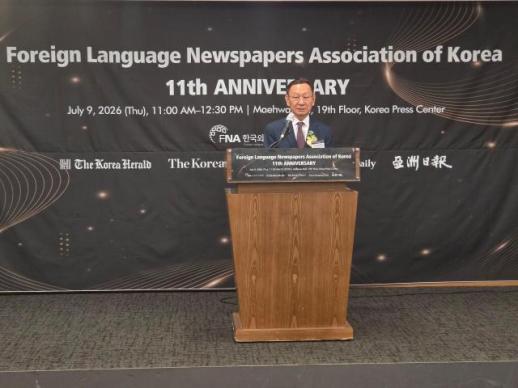 Foreign language press association marks 11 years in Seoul SEOUL, July 09 (AJP) - South Korea's foreign-language newspapers marked 11 years of working under a single banner on Thursday, with their association pledging to expand international exchanges and prepare member outlets for an era reshaped by artificial intelligence. The Foreign Language Newspapers Association of Korea held its 11th anniversary ceremony at the Korea Press Center in central Seoul, drawing guests including Chinese Ambassador Dai Bing, Reform Party floor leader Cheon Ha-ram, Seoul Vice Mayor for Political Affairs Park Chan-gu and James Kim, chairman and chief executive of the American Chamber of Commerce in Korea. The United States Embassy sent a spokesperson on behalf of the ambassador, who could not attend due to scheduling. Association chairman Yang Kyu-hyun, who also heads Aju Ilbo, addressed the contrast directly in his opening remarks, delivered in Korean. "The fact that both countries value our association and the role of foreign-language media is by no means a small thing," he said. Founded in 2015, the Foreign Language Newspapers Association of Korea (FLNAK) brings together the country's English-language and other foreign-language news outlets, including Aju Ilbo, The Korea Herald, The Korea Times and the Korea JoongAng Daily, whose representatives attended Thursday's ceremony. The group positions its members as a bridge between South Korea and international audiences. Yang said the past 11 years had tested member outlets through the decline of print, the digital transition and shifts in the international order. This year's event was deliberately smaller than last year's 10th anniversary celebration, prepared as a family-like occasion that put substance over scale. "The AI era is both a crisis and a new opportunity for journalism," Yang said. "The value of foreign-language media equipped with accuracy, trust and an international perspective will only grow larger." He said FLNAK would expand international exchanges, develop joint projects among member companies and work to secure policy support. In a congratulatory speech, Dai called China "the biggest victim" of disinformation and urged foreign-language media to report on the country objectively, saying "one important origin of fake news is ideological bias and political manipulation." He said the exchange of state visits between President Lee Jae Myung and Chinese President Xi Jinping had opened "a new chapter" in bilateral relations, and invited journalists to visit China and "tell the story of a real, multi-dimensional, and comprehensive China." Kim said artificial intelligence only reinforced the value of trusted journalism, telling the audience that "technology can generate content, but it cannot replace sound judgment, editorial integrity, or the credibility that professional journalists have built over many years." He noted that of the 14 companies worldwide valued at more than $1 trillion, two are Korean, a sign of South Korea's rising global profile. 2026-07-09 14:34:36
-
POSCO Union Votes 92.2% in Favor of Strike Action, Highest Approval Rate Ever The POSCO labor union, affiliated with the Korean Confederation of Trade Unions, announced on July 9 that its members voted in favor of strike action.During the strike vote held from July 8 to July 9, 97.1% of union members participated, with 92.2% voting in favor. Prior to this, POSCO management and the union had held three rounds of negotiations since their initial meeting on June 12.The union's key demands in the current wage negotiations include wage increases, performance bonuses, and an expansion of the employee stock ownership plan. They argue for a compensation system that allows for long-term sharing of the company's growth results, moving beyond a short-term reward structure.Following the vote, the union plans to pursue further negotiations and engage in mediation procedures with the Central Labor Relations Commission. Industry analysts believe the union will likely use its strike authorization to negotiate from a stronger position rather than immediately initiating a strike. A union representative stated, "We will consider a strike after assessing the proposals from management, which are expected to be presented on July 14."A company representative commented, "We will diligently engage in negotiations to reach a reasonable and amicable agreement between labor and management."* This article has been translated by AI. 2026-07-09 14:32:00
-
Fire at Sulfuric Acid Plant in Bonghwa County Raises Toxic Gas Exposure Risk A fire broke out at a sulfuric acid manufacturing plant in Bonghwa County, South Korea, increasing the risk of toxic gas exposure. While there have been no reported injuries, nearby residents have been advised to evacuate due to the heightened danger.According to fire authorities, the blaze started around 12:36 p.m. on July 9 at the sulfuric acid manufacturing facility within the Seokpo Refinery in Seokpo-myeon, Bonghwa County.The fire is believed to have originated from the dust collection system of the sulfuric acid production facility. Firefighters have declared a Level 1 response and are focused on controlling the flames.The operating company, Youngpoong, stated that the firefighting efforts are concentrated at the first plant of the refinery, where sulfur, a byproduct from the zinc refining process, is collected and converted into sulfuric acid.Sulfuric acid is a colorless, odorless, viscous liquid that is highly acidic and poses significant risks to human health upon contact.Fire authorities noted, “A Level 1 response was issued due to concerns about the fire spreading,” and they are currently investigating any potential injuries.* This article has been translated by AI. 2026-07-09 14:28:00
-
South Korea's Economic Growth Driven by Semiconductor Industry The International Monetary Fund (IMF) and the Asian Development Bank (ADB) have both raised their forecasts for South Korea's economic growth rate this year by 0.7 percentage points to 2.6%. This marks the largest positive adjustment among the world's 30 major economies. It is also encouraging news that South Korea is set to surpass the United States' growth rate of 2.3% for the first time in three years since 2023.As of May, the cumulative current account surplus reached $141.2 billion, already exceeding last year's record in just five months, which is also a positive sign.At the center of this turnaround is the semiconductor industry. The export boom in this single sector has significantly boosted the country's growth rate, acting as a lifeline for the South Korean economy.South Korea's status as a semiconductor powerhouse was not achieved by chance. In the 1980s, Samsung Electronics made a bold decision to enter the semiconductor business despite skepticism and pressure from its surroundings. The company's perseverance in overcoming technological limitations and massive capital demands has led to its current position as a global leader.The history of SK Hynix, which has emerged as a leading company in the high-bandwidth memory (HBM) market, is also noteworthy. The company has weathered numerous challenges, including the IMF financial crisis and the global financial crisis, through rigorous restructuring and resilience.Even when immediate profits were not visible, these companies made substantial investments amounting to trillions of won. Employees dedicated themselves to the belief that semiconductors would secure South Korea's future. The bold ventures into fields deemed impossible by others have created global standards, driving the current growth rate of 2.6%.Behind the current semiconductor boom lies a significant paradigm shift driven by AI. The IMF's recent report noted that while AI investments are enhancing productivity, a downturn in expectations could impose significant burdens on the overall economy and financial markets.If the semiconductor cycle declines or if our monopolistic position is shaken amid global power struggles, the risk of a 'one-point economy' plunging the entire South Korean economy into an uncontrollable crisis has increased.As we enter the AI era, it is time to consider and discover the 'second' and 'third' semiconductors. Just as we created a myth in memory semiconductors despite a harsh environment in the past, we must now plant new seeds in emerging industries with limitless potential, such as system semiconductors, biohealth, future mobility, next-generation nuclear power, and aerospace.As countries around the world prioritize their own interests and compete fiercely for future resources, sticking solely to existing success formulas will not ensure survival.The government, businesses, and academia must unite for disruptive innovation. We need to boldly remove tightly woven regulations and support corporate challenges through exceptional tax incentives and the cultivation of key talent. Businesses and academia should not be fixated on short-term results but should align their actions with a long-term national strategy and vision for South Korea's future, looking 10 to 20 years ahead.While we commend the semiconductor industry's remarkable achievements that have driven economic success, we must not forget the underlying risks. Just as our predecessors cultivated the fertile ground of semiconductors from barren land, we have an obligation to establish new economic pillars that future generations can harvest abundantly. Only through urgent and intense exploration and challenges toward the 'second' and 'third' semiconductors can we ensure a sustainable future for the South Korean economy.* This article has been translated by AI. 2026-07-09 14:28:00
-
Concerns Grow Over Impact of Abolishing Prosecutors' Supplementary Investigation Powers The Democratic Party of Korea has accelerated its legislative efforts by introducing a bill to completely abolish prosecutors' supplementary investigation powers on July 8. This move comes amid strong opposition from the main opposition party, People Power Party. The proposed amendment to the Criminal Procedure Act, led by the ruling party, seeks to strip prosecutors of both their direct investigation powers and supplementary investigation powers, consolidating the investigative authority solely with judicial police officers.As the judicial framework undergoes significant changes with the planned abolition of the prosecution office and the establishment of a public prosecution office in October, extreme confrontations between the ruling and opposition parties have emerged. There are also growing concerns within the ruling party about potential negative consequences. Currently, various sectors of society are sharply divided over the abolition of supplementary investigation powers. Proponents argue that separating investigation and prosecution is the final piece in completing the overarching principle of reform aimed at preventing the abuse of prosecutorial power. They contend that allowing prosecutors to exercise supplementary investigation powers while holding prosecutorial authority effectively keeps the door open for direct investigations, which must be closed to reform the omnipotent prosecutorial organization.Conversely, opponents warn of a vacuum in the investigative structure and a lack of judicial oversight. They express concerns that the complete elimination of supplementary investigation powers would remove a buffer zone to correct errors or deficiencies in police investigations before the court trial stage, thereby losing a means to check the expanding power of the police. Notably, within the ruling party, serious divisions and calls for caution have surfaced. Hardline members are pushing for rapid progress to demonstrate the 'clarity of reform' amid party leadership competition. However, some rational-minded lawmakers have repeatedly warned that “practical supplementary measures are needed to minimize unjust victimization.”The recent 'Jang Yoon-ki case' exemplifies that these concerns are not unfounded. Due to inadequate initial police investigations and allegations of organized evidence destruction, a case that could have been dismissed as simple murder was revealed as 'murder with sexual assault' through thorough supplementary investigations by the prosecution, leading to the arrest of the police investigation team leader. In light of the scrutiny over the fairness and capability of police investigations, if the supplementary investigation function of the prosecution is mechanically abolished, the consequences will inevitably fall on ordinary citizens. Nevertheless, it is regrettable that the political arena is hastily pushing the bill while being preoccupied with political gains.The ultimate goal of judicial reform should not be a power struggle among institutions but rather the protection of citizens' rights and the stabilization of their livelihoods. Following the previous adjustments to the investigative powers of the police and prosecution, the public has already experienced significant delays in handling complaints and accusations due to the police's workload. Particularly alarming is the absence of judicial oversight measures regarding the expanded police powers following the abolition of supplementary investigation powers. The Democratic Party must devise effective supplementary measures to check and control the growing police authority. Transferring power without judicial oversight will lead to another monopoly and corruption, resulting in inconveniences and security gaps for citizens, which will ultimately burden the common people.Lawmakers must not fall into the folly of focusing solely on stripping prosecutors of their powers while ignoring the tears and suffering of crime victims. There is a pressing need to establish thorough countermeasures to fill the gaps in judicial justice. Both ruling and opposition parties should collaborate to design practical supplementary measures that prevent delays in civil cases and ensure the judicial rights of ordinary citizens. Regardless of how compelling the justification for reform may be, it is crucial to remember that reforms that disrupt citizens' daily lives and create unjust victims cannot be deemed legitimate.* This article has been translated by AI. 2026-07-09 14:24:00
-
CU Opens 600th Store in Mongolia After 8 Years of Expansion Convenience store chain CU is accelerating its market penetration in Mongolia, having opened its 600th store after nearly eight years of operation.BGF Retail, which operates CU, announced on July 9 that it opened the Hotaqundur Som store, its 600th location in Mongolia, on June 26 in the Bulgan Aimag region. The opening ceremony was attended by Jin Young-ho, head of BGF Retail's product and overseas business division, Yoo Seon-woong, head of the overseas business office, and Adilbishi, chairman of the Premium Group.The Hotaqundur Som store is located approximately 600 kilometers west of Ulaanbaatar, the capital of Mongolia. Covering about 85 pyeong, it primarily serves tourists and long-distance truck drivers. In addition to standard convenience store offerings, it features shower facilities for long-distance travelers, a response to the lack of social infrastructure in Mongolia, where CU has received positive feedback for installing public restrooms in many of its stores.CU entered the Mongolian market in 2018 by signing a master franchise agreement with the Premium Nexus Group, becoming the first convenience store chain from South Korea to do so. Since then, the number of local stores has increased from 56 in 2019 to 541 last year, surpassing 600 last month.In Mongolia, CU is focusing on localization strategies and leveraging the popularity of K-Food. The store offers local delicacies such as buuz, a type of steamed dumpling, and khoshur, a traditional fried dumpling, while also exporting Korean snacks like cream bread and ramen to expand its consumer base. Recently, it has opened over 50 K-Beauty specialty stores where customers can experience and purchase Korean cosmetics.With the opening of its 600th store, BGF Retail plans to strengthen CU's position as a lifestyle platform in Mongolia. Jin Young-ho stated, "In the future, CU will lead the Mongolian retail market by embracing various social values, including food innovation, eco-friendly infrastructure, and community coexistence."Additionally, CU entered the U.S. convenience store market last November with its first store in Hawaii. The company plans to expand its presence in Hawaii, focusing on major tourist areas and upscale residential neighborhoods.* This article has been translated by AI. 2026-07-09 14:24:00
-
Bank of Korea Governor Shin Hyun-sung: Possibility of Won Strengthening Ahead Shin Hyun-sung, Governor of the Bank of Korea, stated on July 9 that "there is considerable potential for the won to strengthen in the future."During a session of the National Assembly's Finance and Economy Committee, he responded to a question from Democratic Party lawmaker Moon Jin-seok, noting that "the current account surplus is accumulating significantly."He added that while "currency swaps are always discussed within the framework of cooperation between governments and central banks," he emphasized that the purpose of such arrangements is to provide liquidity when it is depleted, and that "there is currently no lack of liquidity."Regarding recent factors contributing to the rise in exchange rates, he mentioned that "the potential changes in U.S. monetary policy are strengthening the dollar," and also pointed to factors such as "portfolio rebalancing by foreign investors" in the domestic market.Shin expressed optimism that the trend of foreign investors selling domestic stocks would ease. He explained, "Foreigners are continuing to sell as they reduce their holdings due to the significant rise in Korean stock prices," but he anticipates that "the selling pressure will subside somewhat in the latter half of this year."In response to a question from Democratic Party lawmaker Yoon Hoo-deok about whether there are plans to raise the benchmark interest rate by a large step (0.50 percentage points), Shin clarified that mentioning the need for an interest rate hike was simply to convey a general perspective.Yoon pointed out that the report indicated a need to raise the benchmark interest rate at an appropriate time, describing it as a "very proactive expression of an increase."In response, Shin noted, "I mentioned the same wording in the monetary policy direction meeting in May, and it was also included in my speech at the Bank of Korea's founding anniversary."* This article has been translated by AI. 2026-07-09 14:24:00
-
U.S.-Iran Tensions Halt Shipping Through Hormuz Strait As military clashes between the United States and Iran resume, shipping traffic through the Hormuz Strait, a critical route for global energy transport, has significantly decreased. Bloomberg reported on July 8, citing vessel tracking data, that "traffic through the Hormuz Strait has nearly come to a standstill." Most observed vessel movements occurred in Iranian-approved routes near the northern part of the strait, while the route supported by the U.S. toward Oman remained quiet. Only two large vessels were tracked: one supertanker subject to U.S. sanctions leaving the Persian Gulf and one Iranian-flagged container ship. However, some vessels may have passed through the strait with their location signals turned off. On the previous day, only 14 cargo ships traversed the Hormuz Strait in both directions, marking the lowest level since a temporary agreement was reached in mid-June. During the three weeks following that agreement, the average daily traffic of cargo ships was 34, peaking at 59 on June 24. Considering that traffic through the strait had mostly remained below 20 vessels on many days during the conflict, the situation has reverted to near wartime levels. The passage of liquefied natural gas (LNG) carriers also remains halted. Bloomberg noted, "However, two empty LNG carriers have recently entered the Gulf of Oman, heading toward the eastern entrance of the Hormuz Strait, raising questions about the potential resumption of traffic." Signs of electronic disruption have also reemerged. In waters southeast of Oman, some vessels were reported to be moving abnormally fast, at over 30 knots. Bloomberg explained that air defense and anti-drone systems could be affecting the location signals of the vessels.* This article has been translated by AI. 2026-07-09 14:24:00