


Latest by
-
 Government and Party Accelerate 'Mega Special Zone Law' Initiative The government and the Democratic Party of Korea have launched an accelerated effort to process the 'Mega Special Zone Law' by the end of the year, which aims to establish a regulatory framework for the development of non-capital regions. The party emphasized the need for the special law to include not only regulatory exemptions but also support measures for transportation and cultural infrastructure. They stated that they would seek a social consensus on easing labor regulations, including exceptions to the 52-hour workweek.On September 4, the Democratic Party and the government held a meeting of the Mega Growth Special Committee at the National Assembly. Attendees included Kim Min-seok, the committee chair and party leader, Lim Gi-geun, head of the Office for Government Policy Coordination, and Moon Sin-hak, Deputy Minister of Trade, Industry and Energy.Kim explained that the 'Mega Growth Special Committee' encompasses three major mega projects focused on relocating semiconductor production outside the capital region, promoting local-led growth through five key areas, and developing strategies for the capital region. He stressed that areas like northern Gyeonggi Province, Incheon, and the border regions of Gangwon, which have been overlooked due to their proximity to Seoul, should not be neglected again.He further noted that the existence of a special committee within the party is necessary to address governance, specialization, and the concerns of the private sector, stating, "In the era of local autonomy, it is difficult to achieve results solely through government leadership. The five pillars—central government, local governments, the National Assembly, local councils, and civil society—must work together on mega growth initiatives."Kim emphasized the importance of addressing transportation and education issues in newly developed areas, saying, "Often, after developing a new city, the transportation and education problems in that area remain unresolved over time. We must ensure that these aspects are carefully considered together." He cited the case of Gwangju-Jeonnam Integrated Special City, where the party has established a '30-Minute Commute Task Force' and a 'Cultural Infrastructure Big Deal Task Force.'He added that even with mega projects, if there are areas where semiconductor data centers are not established, it is crucial to simultaneously consider how to address these issues to maintain community acceptance.Kwon Chil-seung, the committee's vice chair, stated, "It is time to establish a regulatory framework that includes bold regulatory innovations and comprehensive support measures," expressing hope that the discussions would lead to a more refined Mega Special Zone Law.He acknowledged the various opinions within the party regarding labor-related exemptions and the concerns raised by labor groups, stating, "To harmonize regulatory innovation that enhances corporate competitiveness with the protection of workers' rights, a social consensus process that gathers the opinions of various stakeholders is necessary. We will work to build broad support at the National Assembly level."Lim Gi-geun, head of the Office for Government Policy Coordination, remarked, "Local-led growth and a national land transformation are not mere slogans but survival strategies that will determine the present and future of South Korea. The government will actively communicate with the National Assembly and the party to make every effort to enact the Mega Special Zone Law by the end of the year."* This article has been translated by AI. 2026-09-04 17:12:00
 -
 South Korea backs rules-based Arctic order at Japan research meeting SEOUL, September 04 (AJP) - Cooperation on the Arctic among South Korea, China and Japan matters more as the region warms and its politics harden, South Korea's ambassador for polar affairs told a research meeting in northern Japan this week. None of the three countries holds territory above the Arctic Circle. All three were admitted as observers to the Arctic Council, the main intergovernmental forum for the region, at a ministerial meeting in Kiruna, Sweden, in May 2013, alongside India, Italy and Singapore. Observers may attend meetings and contribute to working groups, but they do not vote. Lee Tae-woo attended the 12th meeting of the North Pacific Arctic Research Community, held in Monbetsu, Hokkaido, from Sept. 2 to 4, and delivered congratulatory remarks, South Korea's foreign ministry said. Lee credited the network with growing into a platform for concrete and practical cooperation across a range of fields. He also stressed that the South Korean government seeks a peaceful, sustainable and open Arctic, and said it would continue to contribute to international cooperation on the region grounded in international norms. This year's session of the North Pacific Arctic Research Community (NPARC) took up the state of Arctic cooperation by countries outside the region and where the three neighbors might work together next. Participants presented on Arctic policy, natural science, Arctic shipping routes and the participation of Indigenous peoples in decisions affecting the region. Those taking part included Japan's ambassador for Arctic affairs, the head of the Shanghai Institutes for International Studies, the president of the Korea Maritime Institute and experts drawn from industry, universities and research institutes. On the margins of the meeting, Lee met Takahashi Katsuhiko, Japan's ambassador for Arctic affairs, and the two discussed major Arctic issues and ways for the two countries to cooperate in the region. The ministry said South Korea would keep contributing to international cooperation on Arctic peace and sustainable development as a responsible Arctic Council observer. NPARC has been held every year since 2014, rotating among the three countries. The Korea Maritime Institute, the Hokkaido University Arctic Research Center and the Shanghai Institutes for International Studies serve as the national secretariats. AJP Takeaways - Lee Tae-woo, South Korea's ambassador for polar affairs, told the 12th North Pacific Arctic Research Community meeting in Monbetsu, Hokkaido, on Sept. 2 to 4 that Arctic cooperation among South Korea, China and Japan matters more as the region warms and its politics harden. - South Korea's foreign ministry said the government seeks a peaceful, sustainable and open Arctic and would keep contributing to cooperation grounded in international norms as an Arctic Council observer. - Takahashi Katsuhiko, Japan's ambassador for Arctic affairs, met Lee on the margins of the session, where the two discussed major Arctic issues and bilateral cooperation in the region. - The Arctic Council admitted South Korea, China and Japan as observers at its Kiruna ministerial in May 2013, alongside India, Italy and Singapore, giving them attendance and working-group roles but no vote. 2026-09-04 17:08:34
 -
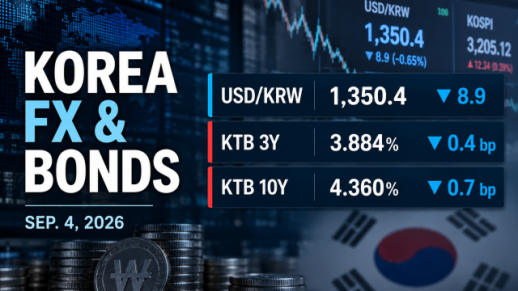 Won closes at 14-month high, bond yields little changed SEOUL, September 04 (AJP) - The South Korean won extended its rally to a 14-month high Friday, while government bonds ended little changed as investors stayed cautious ahead of U.S. employment data. The won strengthened 8.9 won from the previous session to close daytime trading at 1,350.4 per dollar, compared with Thursday's 1,359.3. The currency briefly entered the 1,340 range during the session, its strongest intraday level since early July 2025. Exporter dollar selling continued to support the won, while a firmer Japanese yen and reduced expectations for further Federal Reserve tightening added to the pressure on the dollar. The won has now gained for two straight sessions, falling 18.3 won against the dollar from Wednesday's daytime close. South Korean government bonds were largely steady after rebounding sharply in the previous session. The three-year government bond yield edged down 0.4 basis point to 3.884 percent, while the 10-year yield slipped 0.7 basis point to 4.360 percent. The five-year yield fell 1.7 basis points to 4.101 percent. At the longer end, the 20-year yield declined 2.0 basis points to 4.573 percent, while the 30-year yield edged up 0.1 basis point to 4.636 percent. The muted session followed Thursday's rally, when the three-year yield fell 4.2 basis points and the 10-year yield dropped 5.1 basis points as global bond yields retreated from recent highs. U.S. Treasury yields fell overnight after Federal Reserve Gov. Christopher Waller's comments eased expectations for an immediate rate hike, although investors avoided larger positions ahead of Friday's U.S. jobs report. The August employment report is expected to provide the next cue for U.S. rate expectations and global bond markets. 2026-09-04 17:08:18
 -
Supreme Court Chief Justice Cho Hee-dae Delays Announcement on Judicial Nomination Supreme Court Chief Justice Cho Hee-dae has postponed his announcement regarding the judicial nomination issue, which was expected this week.On September 4, the Supreme Court issued a statement saying, "We are currently reviewing the matter carefully, and there will be no official announcement today. We will inform you as soon as the review is completed."Previously, on August 28, Chief Justice Cho stated while leaving work that he was reviewing the request from the Blue House for a judicial nomination and would provide an official update if things were settled by the following week. However, he experienced a family bereavement and did not return to work until September 2, leading to the delay in his announcement.On his first day back at work after the bereavement, Chief Justice Cho told reporters, "I have not discussed any work-related matters due to the family loss," adding, "I will listen to the developments and speak officially afterward."Legal experts had anticipated that Chief Justice Cho would make an announcement by Sunday at the latest, but the Supreme Court's notice suggests that the announcement will likely come next week.The delay appears to stem from concerns about a potential conflict with the Blue House. According to the current Court Organization Act, the Chief Justice must form a Judicial Nomination Committee each time a judicial candidate is nominated. This has led to speculation that Chief Justice Cho may reconstitute the committee and restart the nomination process. However, this could lead to several months of conflict with the Blue House, from the nomination to the National Assembly's confirmation hearing.In fact, when then-judicial candidate Kim Byeong-hwa resigned in July 2012 due to various allegations, the Supreme Court had to form a new committee under the Court Organization Act, which took three months before the National Assembly approved the appointment.Meanwhile, the confirmation hearing for judicial candidate Kim Seong-soo is scheduled for September 14. Kim Do-eup, a member of the ruling People Power Party, has been appointed as the chair of the National Assembly's Special Committee on Judicial Appointments, and he, along with the committee's co-chairs, Joo Cheol-hyun of the Democratic Party and Kim Hyeong-dong of the People Power Party, have agreed on this date.To prepare for the hearing, the ruling and opposition parties will hold their first full committee meeting on September 8 to appoint the committee chair and co-chairs. After the hearing on the 14th, the committee will decide whether to adopt the report during a full meeting on the 16th.The National Assembly has selected members for the confirmation committee, including Kim Do-eup and the co-chairs, as well as Democratic Party members Kim Young-ho, Kim Han-kyu, Kwak Sang-eon, Park Ji-hye, Boo Seung-chan, and Chae Hyun-il, along with People Power Party members Kang Min-guk, Yoon Yong-geun, and Joo Jin-woo, and Choi Hyuk-jin from the Justice Reform Party.On August 18, Chief Justice Cho formally recommended judges Kim Seong-soo and Son Bong-ki to President Yoon Suk-yeol as successors to former Justices Roh Tae-ack and Lee Heung-gu. The Blue House submitted the appointment confirmation for Kim but requested a re-nomination for Son.* This article has been translated by AI. 2026-09-04 17:08:00
-
Yen Falls Sharply Against Dollar Amid Speculation of Currency Intervention In just two days, the yen-dollar exchange rate plummeted by more than 5 yen, dropping from the low 160s to the mid-155s per dollar. This decline is attributed to growing expectations of accelerated interest rate hikes by the Bank of Japan (BOJ) and the possibility of the U.S. Federal Reserve maintaining its current rates this month, which could narrow the interest rate gap between the U.S. and Japan. Additionally, speculators who suffered losses from the joint yen-buying intervention at the end of July rushed to close their yen short positions, further amplifying the downward trend in the exchange rate. Although no actual intervention has been confirmed this time, concerns about potential intervention have prompted yen buying, leading to a 'short squeeze' as the yen-dollar rate fell. Market sentiment suggests that the unwinding of yen carry trades has begun.According to the Nihon Keizai Shimbun (Nikkei), on September 3, the yen-dollar exchange rate fell to as low as 155.30 yen per dollar in the New York foreign exchange market, marking its lowest level in about a month. In the Tokyo market on September 4, the rate briefly dropped to 155.28 yen but rebounded to 156.10-156.12 yen by noon due to dollar buying from importers and other real demand. Compared to the previous day at 5 p.m., this represents a decrease of 0.93 yen.Nikkei identified the initial trigger for the sharp decline in the exchange rate as proactive dollar sales by investors anticipating intervention by Japanese authorities. A foreign exchange dealer from a Japanese bank noted that on September 2, there were reports that Japanese authorities had conducted a 'rate check' with financial institutions to inquire about the exchange rate levels. As this speculation spread, the yen-dollar rate fell by about 1 yen in a short time, entering the 158 yen range. The rate then remained stable for a while.Michael Ashley Shulman, a partner at Serity Partners, explained, "Many forex traders suffered losses from the joint U.S.-Japan intervention at the end of July. Because of that experience, when the rate rose to 160 yen per dollar this time, they bet on the possibility that authorities had already intervened and sold dollars." This proactive dollar selling led to further selling, and as the yen strengthened overnight in New York, yen buying intensified.The second critical point was the 158 yen level. On September 3, when the yen-dollar exchange rate fell below the 200-day moving average (MA) of 158.44 yen in the Tokyo market, the pace of decline accelerated. The 200-day moving average is a key indicator for investors assessing medium- to long-term market trends. A representative from a major European bank observed that leveraged investors who had built up yen short positions in anticipation of a weaker yen began to close their positions to mitigate losses after the breach of the 200-day line, leading to a significant 'short squeeze.'The yen carry trade involves borrowing yen at low interest rates to invest in higher-yielding currencies or assets to profit from the interest rate differential. When the value of the yen rises, currency losses can offset interest income, prompting investors to buy back yen to close their positions. Typically, as investors increase their investment size through borrowing, significant fluctuations in the exchange rate lead to preemptive selling to avoid larger losses. According to the Commodity Futures Trading Commission (CFTC), as of August 25, leveraged funds' net short positions in yen were more than double the average since 2020. Although these positions temporarily decreased right after the joint U.S.-Japan intervention at the end of July, they expanded again over the previous two weeks. A dealer from a Japanese bank in New York remarked, "Considering the exchange rate levels at which positions were built, some investors may be holding unrealized losses."Changes in U.S.-Japan Monetary Policy OutlookThe shift in monetary policy expectations has also contributed to the decline in the yen-dollar exchange rate. Hajime Takata, a member of the BOJ's Policy Board, emphasized during a press conference on September 2 that the situation has "changed this year," suggesting the need for flexibility in determining the timing and magnitude of rate hikes, rather than adhering to the previous pattern of raising rates every six months by 0.25 percentage points. He mentioned that consecutive rate hikes are generally possible. The market is even discussing scenarios where the BOJ could raise rates every three months. Bloomberg reported on September 3 that the BOJ is likely to raise its policy rate by 0.25 percentage points to 1.25% at its monetary policy meeting on September 17-18.In contrast, the Yomiuri Shimbun reported that Christopher Waller, a member of the U.S. Federal Reserve, stated during a lecture on September 3 that "recent indicators show signs of a slowdown in inflation," indicating that if this trend continues, there is no need to rush into rate hikes. Waller also expressed support for maintaining rates at the Federal Open Market Committee (FOMC) meeting on September 15-16 if inflation continues to ease. The probability of a rate hike in September, as reflected in the U.S. interest rate futures market, dropped from about 63% the previous day to around 50% on the morning of September 4 (Korean time). The expectation that the BOJ may raise rates while the Fed may delay its hikes has led investors to buy yen, anticipating a narrowing of the U.S.-Japan interest rate gap.Speculation that Japan may adjust its financial and fiscal policies under U.S. pressure has also spurred yen buying. The U.S. Treasury revealed on September 1 that Treasury Secretary Scott Vessen received a strong endorsement from BOJ Governor Kazuo Ueda on August 30 for Japan to take decisive market and monetary policy actions to address the significant undervaluation of the yen. Following this, there have been several comments from Ueda and BOJ officials hinting at potential rate hikes. The New York Times reported that during a meeting in Tokyo in May, Vessen expressed dissatisfaction for two hours with Prime Minister Sanae Takaichi's aggressive fiscal stance and the BOJ's insistence on maintaining low interest rates.It remains uncertain whether the recent sharp decline in the yen-dollar exchange rate will lead to a sustained strengthening of the yen. Hugo Monturiocchio, Chief Investment Officer at Schroders Multi-Asset, stated that recent interventions have only temporarily slowed the yen's depreciation, and the appeal of the yen carry trade still exists, leading him to maintain yen short positions. He added, "If the BOJ or the government sends a message indicating a desire for a stronger yen, it could lead to a trend reversal toward a stronger yen." Kit Jucks, a senior foreign exchange strategist at Societe Generale, noted, "While the yen carry strategy of selling yen to capture interest income has worked until now, it is becoming riskier. There is a possibility that this could mark a turning point for the yen to appreciate to 140 yen per dollar over the coming years."The next critical moment will be the release of the U.S. non-farm payroll data for August on the night of September 4. If the employment figures are weak, expectations for a September rate hike in the U.S. may diminish further, strengthening the yen. Conversely, if the figures are stronger than expected, expectations for a U.S. rate hike may revive, potentially halting the decline in the exchange rate. Nikkei reported, citing a foreign exchange dealer from a Japanese bank, that whether the yen-dollar exchange rate can remain below the psychological resistance level of 155 yen per dollar, which has not been breached despite two interventions this year, will be crucial.* This article has been translated by AI. 2026-09-04 17:04:00
-
Kim Sung-hwan Appointed Vice Chairman of Korea Financial Investment Association Kim Sung-hwan, CEO of Korea Investment & Securities, has been appointed as the Vice Chairman of the Korea Financial Investment Association (KFIA).The KFIA announced on September 4 that it held its first extraordinary general meeting for 2026, during which Kim was elected as Vice Chairman. His term will begin on September 5 and last until September 4, 2028.Born in 1969, Kim graduated from Korea University with a degree in economics and completed a doctoral program at Konkuk University’s Graduate School of Real Estate. He has held various positions at Korea Investment & Securities, including Group Head of Investment Banking (Executive Vice President) and Head of the Retail Customer Group (Senior Vice President), before becoming CEO. With extensive experience in corporate finance and retail sectors, he is expected to convey the voices of the investment industry to the association. His background in real estate project financing and investment banking will be crucial as he addresses pressing issues facing the securities industry.Currently, the financial investment sector is grappling with several key challenges, including the need for regulatory adjustments following the abolition of the financial investment income tax, the enhancement of the retirement pension market, and the activation of comprehensive investment accounts (IMA), which are seen as new revenue sources for large investment banks. Additionally, expanding venture capital supply and strengthening corporate finance competitiveness are also critical tasks for the industry.The KFIA board consists of the Chairman, Vice Chairman, Chair of the Self-Regulatory Committee, member directors, and public interest directors. As Vice Chairman representing Korea Investment & Securities, Kim will participate in discussions on major industry issues.The connection between Korea Investment & Securities and the KFIA's Vice Chairman position has lasted over a decade. Former CEO Yoo Sang-ho was appointed Vice Chairman in 2014. Yoo, who led Korea Investment & Securities from 2007 to 2018, is recognized as a prominent figure in the industry. Following him, Jeong Il-moon, another former CEO, also served as Vice Chairman in 2023.A source in the financial investment industry stated, "With three past and present CEOs of Korea Investment & Securities consecutively taking on the role of Vice Chairman at the KFIA, the firm has reaffirmed its presence in the industry. It will be interesting to see if Kim can serve as a bridge to convey the voices of the investment sector to policymakers and the market, leveraging his experience in investment banking and retail operations."* This article has been translated by AI. 2026-09-04 16:56:00
-
Five Years Ago: Kwon Mina Accuses Sister of Embezzlement Kwon Mina has announced plans for legal action, claiming her sister embezzled millions of won.The former AOA member took to social media on September 4 to allege that her sister took money from her, their mother, and a family friend.Kwon stated that she was aware of her sister taking money for some time. She expressed that if her sister had acknowledged the financial difficulties and apologized, she would have been willing to accept it.However, she claimed that about two years ago, she learned the severity of the situation after hearing specific details from her mother. Kwon revealed that money from her mother's assets, her own accounts, and funds she had given to her mother had disappeared.Claims regarding a vehicle also emerged. Kwon alleged that her sister had her sign for a vehicle worth over 100 million won. She mentioned documents worth approximately 150 million won that could be recognized as a loan agreement. Kwon asserted that the total amount taken from her, her mother, and the family friend exceeds 700 to 800 million won.This is not the first time Kwon Mina's financial disputes with her sister have come to light. In October 2021, Kwon revealed that she was experiencing conflicts over money with her sister. At that time, she claimed her sister had offered to handle taxes on her behalf, but the remaining funds after paying taxes did not return to her. Kwon expressed uncertainty about whether the money was used for business expenses but stated that a significant amount was taken without her permission.The vehicle issue was also mentioned back then. Kwon explained that while trying to provide a vehicle for their mother, her sister had looked for one, and the contract and related procedures were carried out in Kwon's name. She questioned why her sister used her name when she was not financially capable.At that time, Kwon also claimed her sister was attempting to raise tax evasion issues against her. Kwon refuted this by publicly addressing the tax and financial management processes.Kwon Mina stated that she has not yet initiated any legal procedures with the police or courts. While she expressed a desire for her sister to acknowledge her wrongdoing and apologize to their mother, she indicated that if this does not happen, she would pursue legal action for fraud, forgery, embezzlement, and threats.Kwon Mina debuted in the music industry as a member of AOA in 2012 and transitioned to acting after leaving the group in 2019. She later revealed that she had been bullied by fellow member Jimin for over ten years, which caused a significant stir. This incident also led to Jimin's departure from the group.* This article has been translated by AI. 2026-09-04 16:52:00
-
National Intelligence Service Law Amendment Passes, Calls for Stronger Oversight The amendment to the National Intelligence Service (NIS) Act passed the National Assembly on September 3. The revision expands the NIS's scope of duties to include 'economic security' and broadens its information-gathering activities in the field of cybersecurity to include cases where there is 'substantial reason to suspect' the involvement of international or state-sponsored hacking organizations based on hacking methods or damage patterns.This measure is necessary considering the changing times. The concept of security has already transcended military and diplomatic realms. Semiconductors, artificial intelligence (AI), batteries, biotechnology, space, quantum technology, critical minerals, and supply chains now play crucial roles in national security. Particularly, identifying the perpetrators behind state-sponsored cyberattacks can take considerable time. If the NIS can only act after the perpetrators are confirmed, its very existence may be undermined.The 'spy law amendment' passed in February also aligns with this context. This amendment expanded the application of the crime of espionage from 'enemy states' to 'foreign entities and equivalent organizations.' This change allows for the prosecution of espionage activities not only from North Korea but also from 'friendly nations,' thereby broadening the NIS's counterintelligence activities.However, recent allegations surrounding the NIS have brought to mind its 'dark history.' The second comprehensive special investigation indicted former NIS Director Jo Tae-yong and former First Deputy Director Hong Jang-won, among four other political appointees from the NIS at the time, on August 19, related to the 12·3 martial law. The special investigation confirmed that the NIS had prepared a list of 'security threat forces' numbering in the hundreds in response to requests from the presidential office during the martial law situation, indicating that the NIS actively supported the martial law.Allegations of civilian surveillance have also emerged. Democratic Party lawmaker Yoon Geon-young raised concerns on August 20 that the NIS had established a 'North Korean Influence Operations Response Task Force' during the Yoon Suk Yeol administration to monitor the activities of politicians and labor and civil society figures.In response, the NIS launched a large-scale internal investigation on August 25. However, this issue is too significant to be resolved through a 'self-investigation.' In 2020, the NIS removed 'domestic information' from its scope of duties to prevent political interference, yet incidents reminiscent of those that occurred during the days of the Korean Central Intelligence Agency and the National Security Planning Agency are happening again.Ultimately, there is no choice but to conclude that an 'external oversight system for the NIS' is necessary. First, the National Assembly's supervisory authority must be effectively strengthened. Although the National Assembly's Intelligence Committee currently oversees the NIS, it is limited by its reliance on the materials and explanations provided by the NIS. The Assembly should employ specialized personnel to continuously monitor intelligence agencies and directly verify the NIS's intelligence activities and budget under certain conditions.The role of civil society must also be expanded. This does not mean that all classified information handled by the NIS should be disclosed to civil society. Information that must be protected for national security should, of course, remain protected. Instead, a structure should be established that allows civil society to raise issues and verify the legality of the NIS's expanded powers, budget, and potential violations of fundamental rights.There is also a need to consider establishing an independent external oversight body. Civil society has been advocating for the introduction of an 'intelligence agency oversight body' and an 'intelligence inspector system' with the participation of experts, separate from the National Assembly's Intelligence Committee.There is no reason to oppose the strengthening of the NIS's powers itself. However, as its powers increase, so must oversight. The NIS is not the information agency of the regime but rather 'the information agency of the state.' Only strong external oversight can break the cycle of political interference by the NIS.* This article has been translated by AI. 2026-09-04 16:36:00
-
 Chip windfall finally arrives on the FX front SEOUL, September 04 (AJP) - The South Korean won is looking entirely different from the first half, closing at its strongest level in 14 months Friday as a swelling current-account surplus increasingly offsets heavy overseas equity investment and other capital outflows, giving authorities room to absorb a reported $20 billion in dollars from SK hynix's landmark U.S. share sale without reversing the currency's rally. The dollar fell 8.9 won to close Friday's daytime trading at 1,350.4 won at 3:30 p.m., after briefly entering the 1,340 range for the first time since early July 2025. The greenback has fallen about 13 percent from its July 1 close of 1,559.2 won, a sharp reversal from June, when it traded as high as 1,561 won. The won's strength also stands out against other major currencies. Over the period, the dollar index rose about 1.3 percent and the dollar gained 0.3 percent against the Japanese yen, suggesting Korea-specific forces have driven the won's rebound rather than a broad retreat in the U.S. currency. The turnaround is increasingly backed by Korea's external accounts. The country accumulated a current-account surplus of $233.09 billion in the first seven months of this year, nearly four times the $59.82 billion recorded in the same period of 2025, according to preliminary Bank of Korea data released Friday. The goods surplus alone widened to $234.28 billion from $69.35 billion a year earlier as booming semiconductor exports generated a growing stream of foreign-currency earnings. The scale is striking because the improvement has come despite powerful financial-account flows working in the opposite direction. Korean residents increased their holdings of overseas equities by $60.89 billion from January through July. At the same time, foreign investors reduced their holdings of Korean equities by a net $100.30 billion, according to the BOK. Taken together, the two equity flows represented roughly $161.2 billion of outward financial pressure — residents sending money into foreign stocks while overseas investors pulled money out of Korean shares. The figures do not translate mechanically into spot foreign-exchange demand because investments can be hedged and corporate export proceeds do not necessarily return immediately to Seoul. But they help illustrate how dramatically Korea's underlying foreign-currency balance has shifted. A current-account surplus approaching a quarter-trillion dollars has been large enough to coexist with exceptional portfolio outflows while the won has still appreciated sharply. Seoul policymakers spent much of the first half tapping foreign-exchange swaps with the National Pension Service and selling dollars to contain won weakness. The tide changed sharply in the second half. Exporter dollar selling remained heavy, while a softer U.S. currency and stronger Japanese yen provided additional support for the Korean currency. Rather than needing to supply dollars, authorities apparently gained room to absorb them. The Foreign Exchange Stabilization Fund, or FESF, bought about $20 billion of the $26.5 billion in dollar proceeds raised through SK hynix's American depositary receipt offering in July, Reuters reported Wednesday, citing a source with direct knowledge of the transaction. The reported purchases were conducted over the counter as SK hynix repatriated the proceeds, avoiding direct execution through the domestic spot foreign-exchange market. Neither the Ministry of Economy and Finance nor the Bank of Korea has confirmed the amount, timing, exchange rates or financial institutions involved. An off-market purchase allows SK hynix to obtain won without placing an equivalent dollar sell order in the Seoul spot market. The operation therefore removes potential dollar supply from the market and reduces appreciation pressure relative to a direct conversion rather than directly causing the won to weaken. Seen against Korea's broader external balance, however, the significance may be less about where the won would have traded on a particular day and more about authorities' increased capacity to absorb an unusually large dollar inflow without destabilizing the currency market. Friday's fall in the dollar-won rate, including its intraday move into the 1,340 range, shows that exporter supply and global currency forces can still dominate even after a transaction of this size. The reported $20 billion represents roughly three-quarters of SK hynix's ADR proceeds, about 4.5 percent of Korea's August-end foreign-exchange reserves and nearly 1.5 times the net $13.63 billion sold by authorities in the first quarter to limit won depreciation. The comparisons demonstrate the transaction's scale but do not establish that the entire amount was added to official reserves on a one-for-one basis. Foreign-exchange reserves rose by a record $14.33 billion in August to $442.28 billion, with the BOK citing increased foreign-currency deposits at financial institutions, investment income and valuation changes. Public data do not establish whether the reported SK hynix transaction contributed to the August increase or, if so, by how much. "The actual dollar-supply effect could continue through August or September," Kwon Ah-min, an FX analyst at NH Investment & Securities, told AJP in July. Kwon expected conversions to be staggered and said SK hynix would retain part of the proceeds in dollars to pay overseas equipment suppliers, making the flow more likely to cap rebounds in the dollar-won rate than produce a one-way won rally. "If the report is true, it would be difficult to say the large dollar-supply effect from the ADR has disappeared entirely," Lee Min-hyuk, an economist at KB Kookmin Bank, wrote in a report Friday. Lee said most of the funds would remain in government foreign-currency assets that could later be released for market stabilization, weakening the case for a dollar-won rebound caused by a supply gap after the ADR proceeds were exhausted. In short, the SK hynix dollar proceeds could become intervention firepower if the dollar-won rate reverses sharply higher. A larger stock of liquid dollars increases authorities' capacity to meet demand during renewed won weakness, although it cannot guarantee a particular exchange rate or offset persistent market forces. The BOK's balance-of-payments data also showed foreign equity investment in Korea increased by $5.98 billion in July, partly reflecting the ADR issuance. Korean residents, meanwhile, added $12.33 billion in overseas equities during the month. The reported transaction could offer a template for handling unusually large corporate inflows because an over-the-counter block trade can prevent a single conversion from disrupting a comparatively smaller spot market. The U.S. Treasury has said intervention should address excessive volatility or disorderly exchange-rate movements rather than maintain a preferred currency level. The exceptional size and one-off nature of the SK hynix proceeds would therefore be central to the policy rationale if authorities confirm the transaction. The AI chip windfall has become something close to an economic cure-all for Korea, powering growth despite geopolitical headwinds, swelling the country's fiscal buffers and finally giving the won long-delayed traction. AJP Takeaways - Korea's January-July current-account surplus surged to $233.09 billion, nearly four times a year earlier, creating a much stronger fundamental dollar buffer behind the won. - The won strengthened despite substantial equity outflows: residents added $60.89 billion in overseas stocks while foreign investors cut Korean equity holdings by $100.30 billion. - Authorities reportedly absorbed about $20 billion of SK hynix's ADR proceeds off market, preventing an unusually large corporate dollar sale from directly hitting Seoul's spot market. - The won's move to a 14-month high suggests Korea's swelling trade surplus, exporter dollar selling and global currency forces are outweighing both outbound investment demand and the removal of SK hynix's potential dollar supply. 2026-09-04 16:34:40
 -
 Chip stocks lead KOSPI rebound as bank trade unwinds SEOUL, September 04 (AJP) - A signal from the U.S. Federal Reserve unwound a week of rate-driven positioning in Seoul on Friday, pulling money out of the bank stocks that had thrived on surging yields and back into memory chips. The KOSPI closed 1.6 percent higher, adding 107.73 points to 6,687.21 for a second straight gain after Wednesday's near 4 percent collapse. Samsung Electronics rose 2.2 percent to 255,500 won ($189) and SK hynix gained 3.2 percent to 1,647,000 won ($1,219). SK square, whose main asset is its stake in SK hynix, climbed 6.1 percent to 1,041,000 won ($771). Bank shares moved the other way, with KB Financial falling 3.3 percent to 172,000 won ($127) and Shinhan Financial Group dropping 3.7 percent to 110,300 won ($82). The trigger came overnight, when Fed Governor Christopher Waller said he could back holding rates steady at the Sept. 15 to 16 meeting if August inflation data keeps cooling. U.S. Treasury yields fell for a second session, with the 10-year note down three basis points to 4.761 percent. Futures-implied odds of a September increase slipped to roughly even from about 63 percent a day earlier. The August consumer price index has not been published. Investors read Waller's remarks as reason to abandon the trade that had dominated the past week, when rising yields sent money into lenders and out of the two chipmakers that carry the index. Individual investors sold into the rebound, unloading a net 3.72 trillion won ($2.76 billion) after buying through Wednesday's rout. Foreign investors bought a net 479.3 billion won ($355 million) and institutions a net 1.67 trillion won ($1.24 billion), though foreign buying faded through the afternoon from more than 1 trillion won at midday. Advancers outnumbered decliners 549 to 309 on the main board. The KOSDAQ ran its own rally, closing 3.0 percent higher at 813.50 for its first gain of that size in five sessions, after the government lifted a threat that had been hanging over the junior market's smallest companies. The Ministry of Economy and Finance said Friday it would delay by six months a planned increase in the minimum market value a company must hold to keep its listing, and would let some firms facing removal transfer to KONEX, South Korea's third-tier board, without the liquidation trading period that normally guts their share price. Appetite for small caps was tested the same day. Sky Labs, which makes a ring-shaped cuffless blood pressure monitor, closed its KOSDAQ debut at 23,500 won ($17.40), more than double the 10,000 won ($7.40) offer price it had been forced to set below its indicative range after institutional demand came in at 63 to 1. Japan's Nikkei 225 closed 1.3 percent higher at 65,020.94, with SoftBank Group up 11.8 percent. The composite index in Shanghai edged lower. The won strengthened against the dollar, with Hana Bank quoting 1,350.80 won, down 7.70 won from the previous session. AJP Takeaways - The KOSPI closed 1.6 percent higher at 6,687.21 on Friday, a second straight gain after Wednesday's near 4 percent collapse, as money moved out of bank stocks and back into memory chips. - Fed Governor Christopher Waller said he could support holding rates steady at the Sept. 15 to 16 meeting if August inflation data keeps cooling, sending futures-implied odds of a September increase to roughly even from about 63 percent a day earlier. - The Ministry of Economy and Finance said it would delay by six months a planned increase in the minimum market value required to keep a KOSDAQ listing, and the junior index rose 3.0 percent to 813.50. - Sky Labs closed its KOSDAQ debut at 23,500 won ($17.40), more than double an offer price the company had been forced to set below its indicative range after institutional demand came in at 63 to 1. 2026-09-04 16:32:44