


Latest by
-
 KOSPI Stalls at 7,000 Points Amid Market Pressures The KOSPI index has been stuck in a prolonged sideways market. Since reaching a closing price of 7,096 points on July 23, the index has struggled to break through the '7,000 wall' for over a month. While forecasts suggest a potential rise above 9,000 points, many investors express frustration over the ongoing stagnation.KOSPI Stuck Below 7,000 PointsAccording to the Korea Exchange, the KOSPI closed at 6,562.72 points on September 2, down 273.08 points (3.99%) from the previous trading day. After attempting to breach the 7,000 mark for two consecutive days, the index reversed course due to renewed clashes between the U.S. and Iran, which negatively impacted U.S. stock markets.Since July 23, the KOSPI has failed to surpass the 7,000 mark for more than a month and a half. Although the volatility has decreased, the market has not shown signs of recovery. The KOSPI 200 volatility index (VKOSPI) recorded 43.37, a drop of about 46.3% compared to 80.78 on the first trading day of last month. The VKOSPI peaked at 82.05 on August 4 but has steadily declined, falling into the 40s for the first time since mid-April.90 Trillion Won Retail Investor Sell WallMarket analysts attribute the KOSPI's underperformance to various factors, including a significant sell wall created by retail investors. According to Kiwoom Securities, the net buying amount by individual investors above the 7,000-point level is estimated at approximately 87 trillion won. This includes 18.9 trillion won in the 7,000 to 7,500-point range, 30.2 trillion won in the 7,500 to 8,000-point range, and 28.3 trillion won in the 8,000 to 8,500-point range. The 8,500 to 9,000-point range has about 6.2 trillion won, while the 9,000 to 9,500-point range has around 3.4 trillion won.This large volume of sell orders has created a structure where selling pressure emerges each time the index rises, as investors seek to recover losses or recoup their principal. Han Ji-young, a researcher at Kiwoom Securities, stated, "The resistance at 7,000 points is the result of both multiple burdens and retail sell pressures rather than a simple fundamental deterioration. There is a need for foreign and institutional buying momentum to absorb the accumulated retail sell orders in this range."Foreign Investor Buying Power Reaches LimitsAnother analysis points to the limits of foreign investor buying power. As of September 1, foreign ownership of KOSPI stocks reached 19.70%, a record high during the reporting period. The foreign ownership ratio of market capitalization also approached 39.54%, nearing the 40% threshold. With the foreign ownership limits of major KOSPI stocks nearly exhausted, the influence of foreign investors on the market has effectively peaked.Market analysts interpret this as a depletion of available buying power. It suggests that foreign investors have filled their quotas, leaving little room for additional capital inflow. However, some view the stagnation at the 7,000 level as a natural adjustment process following a rapid rise, rather than a limitation of supply from specific entities like foreign investors. Choi Hyun-jae, head of the research center at Yuanta Securities, explained, "If the market rises too quickly, a price adjustment is necessary, and some consolidation is needed for a sustained upward trend. We are currently in a process of digesting sell orders."Impact of Rising U.S. Interest RatesThe rise in long-term U.S. Treasury yields is also cited as a contributing factor. Analysts suggest that increasing interest rates exert downward pressure on the stock market. Last month, the yield on 30-year U.S. Treasury bonds surpassed 5.2%, the highest level in 19 years, and long-term bond yields continue to soar.On the same day, the yield on 10-year U.S. Treasury bonds reached 4.788%, marking the highest level since January of last year. Japanese 10-year bond yields also rose to 3%, the highest in 30 years, while the yield on 30-year British bonds climbed to 5.919% during the day.A securities industry official noted, "Stability in U.S. interest rates is necessary for investor sentiment towards risk assets to recover. For the KOSPI to achieve further upward movement, a stable global interest rate environment must precede it."* This article has been translated by AI. 2026-09-02 18:12:10
 -
Weather Forecast: Rain Expected on East Coast and Jeju, Late Summer Heat Continues in the South 목요일인 3일은 전국에 구름이 많겠으며, 동해안과 제주도를 중심으로 비가 내리겠다. 남부지방과 제주도는 낮 기온이 30도를 웃돌고 최고 체감온도가 33도 안팎까지 오르는 등 늦더위가 이어질 전망이다. 2일 기상청에 따르면 3일 아침 최저기온은 19~26도, 낮 최고기온은 25~33도로 예보됐다. 주요 도시별 아침 최저기온은 △서울 22도 △인천 21도 △춘천 20도 △강릉 21도 △대전 21도 △대구 23도 △전주 23도 △광주 23도 △부산 24도 △제주 25도다. 낮 최고기온은 △서울 31도 △인천 30도 △춘천 29도 △강릉 25도 △대전 30도 △대구 29도 △전주 31도 △광주 33도 △부산 31도 △제주 31도까지 오르겠다. 특히 일부 전남권과 경남권, 제주도에서는 최고 체감온도가 33도 안팎까지 올라 무덥겠다. 낮 동안 오른 기온이 밤사이 충분히 떨어지지 않으면서 남부지방과 제주도를 중심으로 열대야가 나타나는 곳도 있겠다. 비는 강원 동해안·산지와 경북 동해안·북동산지, 제주도에서 오전부터 밤사이 이어지겠다. 부산·울산·경남 동부 내륙에는 오전부터 낮 사이 비가 내릴 것으로 예상된다. 예상 강수량은 강원도 5~10㎜, 경상권과 제주도 5~20㎜, 울릉도·독도 10~40㎜다. 내륙 곳곳에는 오후부터 저녁 사이 소나기가 내리겠다. 대상 지역은 충북 남부와 전라권, 경상권 내륙 등이다. 예상 강수량은 충북 남부 5~20㎜, 광주·전남 5~40㎜, 전북 동부 5~30㎜, 경남 내륙 5~40㎜, 대구·경북 내륙 5~30㎜다. 소나기가 내리는 지역에서는 시간당 20㎜ 안팎의 강한 비가 쏟아질 수 있다. 돌풍과 함께 천둥·번개가 치는 곳도 있어 시설물 관리와 안전사고에 유의해야 한다. 9월에 접어들었지만 늦더위는 당분간 이어질 것으로 보인다. 남부지방과 제주도를 중심으로 폭염특보가 이어지는 가운데 열대야가 나타날 가능성도 있어 야외활동과 온열질환에 대한 주의가 필요하다.* This article has been translated by AI. 2026-09-02 18:12:00
-
 Bad loans hit 8-year high, but banks can absorb losses, FSS says SEOUL, September 02 (AJP) - Corporate debt is souring at a faster pace in South Korea, but financial authorities say the increase in bad loans is unlikely to pose a broader financial risk as banks remain profitable and well capitalized. Business nonperforming loans, or NPLs, rose by 1 trillion won from three months earlier to 15.2 trillion won at the end of June, accounting for the bulk of the banking sector's 18.9 trillion won in bad loans, according to the Financial Supervisory Service on Wednesday. The NPL ratio for small and midsized businesses climbed to 0.92 percent from 0.88 percent. “The increase in bad loans largely reflects prolonged weakness in the economy,” a senior official at the FSS's Bank Risk Supervision Department told AJP. “Higher interest rates have made it harder for borrowers to repay their debts.” The official said, however, that it was premature to be alarmed. “For problems in the banking sector to spill over into other financial sectors, banks themselves would have to deteriorate to a much more serious level,” he said. “We don't think we are at that point yet.” The delinquency rate on won-denominated bank loans fell to 0.56 percent in June from 0.67 percent in May, according to FSS data released Aug. 21. The regulator said the decline largely reflected banks' clearing of overdue loans at the end of the quarter rather than a meaningful easing in borrower stress. The same pattern appeared in corporate lending. The corporate loan delinquency rate fell to 0.68 percent from 0.84 percent in May, while the rate for small and midsized businesses declined to 0.82 percent from 1.00 percent. “Banks are sufficiently capitalized,” the official said, adding that strong profitability gives them room to build reserves and absorb additional credit losses. South Korean banks posted a combined net profit of 13.8 trillion won in the first half of 2026. Interest income rose 8.3 percent from a year earlier to 32.2 trillion won, according to FSS data released Aug. 24. Banks also increased provisioning, with loan-loss expenses rising by 300 billion won to 3.5 trillion won. Loan-loss reserves stood at 26.9 trillion won at the end of June, up 200 billion won from three months earlier. The coverage ratio, however, fell to 142.9 percent from 150.4 percent at the end of March as bad loans increased faster than reserves. The official said the lower ratio was not an immediate concern. “Before 2020, a coverage ratio above 100 percent was generally considered healthy,” he said. “The ratio has fallen from unusually high levels in recent years, but the current level is still not a concern.” Capital ratios also strengthened. Banks' common equity Tier 1, or CET1, ratio — a key measure of their ability to absorb losses — rose to 13.62 percent at the end of June from 13.50 percent three months earlier, while the total capital ratio increased to 15.77 percent, according to FSS data released Monday. All domestic banks remained well above regulatory requirements. “Banks remain profitable, giving them room to absorb potential losses,” the official said. AJP Takeaways • South Korean banks' corporate NPLs rose by 1 trillion won to 15.2 trillion won at the end of June, while the NPL ratio for small and midsized businesses climbed to 0.92 percent. • The FSS sees limited risk of corporate loan stress spreading across the wider financial system, citing banks' strong profitability, reserves and capital buffers. • Banks held 26.9 trillion won in loan-loss reserves at the end of June, while their CET1 ratio rose to 13.62 percent, leaving them with substantial capacity to absorb additional losses. 2026-09-02 18:08:35
 -
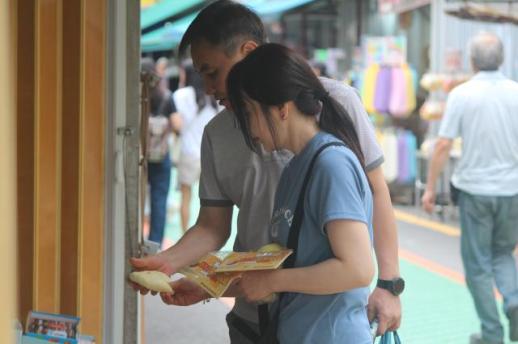 Korea's squishy toy craze puts 14+ labels under scrutiny SEOUL, September 02 (AJP) -South Korea's squishy-toy craze is getting a sober safety check. In Seoul's Dongdaemun toy district, the old staples of childhood are still everywhere. Children weave between shops packed floor to ceiling with transforming robots, Lego sets, dolls and BB guns. Wedged among them is a newer kind of toy, designed less to build or shoot than to squeeze, stretch and crack. There are croissant-shaped squishies, tubs of brightly colored slime, stretchy "slang-i" toys and wax-covered balls that split under pressure to reveal soft clay inside. AJP arrived in the district around 9 a.m. Wednesday and bought several tactile toys. Some cost as little as 1,500 won ($1). Most squishies were priced between 3,000 and 4,000 won, while large tubs of slime reached 12,000 won. The differences became obvious once the packages were opened. A croissant-shaped squishy released a surprisingly convincing smell of melted butter when squeezed. A dumpling-shaped toy concealed different colors inside, turning each pull into a small guessing game. Others were less inviting. Several gave off strong, unpleasant odors. One wax ball cracked under the fingers to expose a soft filling, but both its smell and texture were harsher than those of the sweeter-scented toys. The experience was tactile, not scientific. Smell, softness or stickiness alone cannot determine whether a toy is safe. What stood out before the packages were even opened was something else. The tactile products AJP examined were marked for ages 14 and older. AJP did not find KC safety marks on the packages it examined. That distinction matters because products marketed for ages 14 and older can fall outside mandatory children's-product KC safety requirements even when similar toys are widely used by much younger children. On Monday, the Seoul Metropolitan Government released safety tests of 20 products labeled for ages 14 and older but considered likely to be used by children. Seven raised chemical or physical safety concerns when measured against standards applied to children's products. Five were tactile products including squishies, slime and wax balls. A "slang-i" bought from a domestic stationery store contained phthalate plasticizers in some soft plastic parts at up to 1.8 times the children's benchmark. Its plastic zipper bag contained phthalates at 142.7 times the benchmark and cadmium at 1.5 times the level. A slime product contained formaldehyde at 2.3 times the children's benchmark and methanol at 1.3 times. One wax ball had phthalates in a plastic decoration at 51.8 times the benchmark, while boron in its clay-like filling reached up to 1.2 times the reference level. Another wax ball bought through AliExpress contained the preservatives CMIT and MIT, substances Seoul said can irritate skin or trigger allergic reactions. A separate squishy had phthalates on its surface at 164.2 times the children's benchmark. The findings did not amount to a legal determination that the products were unsafe. Seoul did not classify them as children's products or find them in violation of the Children's Products Safety Special Act. Instead, the city applied children's safety standards for comparison because younger consumers were considered likely to use the products despite their 14+ labels. It asked overseas platforms to halt sales of tested products that exceeded the comparison standards and distributed safety information to elementary schools and major toy-shopping areas. The issue therefore goes beyond what is printed on the package. Government guidelines say a product's function, intended age, packaging, advertising, consumer perception and place of sale can all be considered when determining whether it should be treated as a children's product. Products that could be mistaken for children's goods but are intended for older users should be clearly labeled and distributed separately from places that mainly sell children's products. In Dongdaemun, that line is harder to see. The 14+ tactile products examined by AJP were sold among robots, dolls and other toys that have drawn families to the district for decades. For Jannise Borger, a 42-year-old Australian visiting Korea with her children, the toy district was one of the family's first stops after arriving in the country. "They've been looking forward to it so much," Borger said. She said squishy toys are particularly popular among children ages 7 to 10 in Australia and estimated that some products cost roughly twice as much there. She was also struck by the district itself. In Australia, Borger said, families are more accustomed to buying toys from large retailers than walking through an entire neighborhood of small toy stores. Children are not the only customers. Ariel Kim, a woman in her 20s living in Seoul's Gangnam district, regularly buys slime, slang-i toys and wax balls. She recalled a previous visit to Dongdaemun as "chaos," with crowds making it difficult even to reach some stores. These days, she mostly orders the toys online. "They don't cost that much, so I don't think I really pay attention to whether something is an original product or not," Kim said. She said she often replaces slime and similar toys after one or two weeks. "I really like that chewy, stretchy feeling," she said. "When I'm playing with it, time goes faster than I expect." YouTube ASMR videos also lead her to try new products. Wax balls have less staying power. "The first time I tried one, it was really fascinating," Kim said. "But once you crack it, that's basically it." Reports about potentially harmful substances have not stopped her from buying tactile toys. "I'm also not at an age where I'm going to eat a wax ball," she said. "I try to be careful, but I don't worry about it that much." For younger children, exposure can be different. A 2022 study of 127 slime products sold in Seoul and four other Asian cities found that 70.1 percent exceeded the European Union boron migration limit used in the study. Researchers also detected CMIT and MIT in substantial shares of the samples and identified hand-to-mouth behavior as an important exposure route for younger children. Safety concerns around squishy toys are not new in Korea. The Korea Consumer Agency tested 12 squishy products in 2018 and found that all released dimethylformamide, or DMF. Six were assessed as posing a potential concern for children aged 3 or younger under the agency's exposure scenario. All 12 carried KC marks at the time, although most had shortcomings in other required labeling. The latest Seoul tests raise a different question. They focused on products marked 14+, placing them outside automatic KC requirements for children's goods even as children remain drawn to the same bright colors, playful shapes and tactile textures. That does not prove manufacturers are using age labels to evade safety rules. It does show how blurry the line can become when the age printed on a package does not neatly match the market around it. Back in Dongdaemun, the 14+ symbol occupies only a small corner of the brightly colored packaging. The label says 14 and older. The shelves tell a more complicated story. AJP Takeaways · Seoul's latest safety tests found concerns in 7 of 20 products labeled for ages 14 and older, including five tactile toys such as squishies, slime and wax balls. · Some tested products contained phthalates, formaldehyde, methanol, boron, CMIT or MIT above children's-product comparison benchmarks. · The products were not legally classified as unsafe children's goods, but their 14+ labels can place them outside mandatory children's-product KC requirements. · AJP found 14+ tactile toys being sold among children's toys in Dongdaemun, highlighting a gap between age labeling and real-world use. 2026-09-02 18:07:38
 -
 Uzbekistan looks to its Islamic golden age to build a new future SEOUL, September 02 (AJP) - The Center for Islamic Civilization, sprawling across a site roughly the size of 14 soccer fields, embodies in its glittering magnificence and grandeur what “New Uzbekistan” envisions: ushering a young, increasingly digital population into the AI age while keeping it firmly anchored in Islamic heritage and spirituality. The sprawling cultural and research complex cost about $161.8 million to build, according to a government construction directorate. Its three-story building offers more than 42,000 square meters of usable space beneath a 65-meter dome. Its exhibitions trace the territory's history from the pre-Islamic era through what Uzbekistan calls its First and Second Renaissances before culminating in a section titled “New Uzbekistan — the Foundation of the Third Renaissance.” At its heart sits the ancient Uthman Quran, surrounded by manuscripts, archaeological discoveries and artifacts documenting centuries of Islamic scholarship. In the official narrative, the First Renaissance refers roughly to the ninth through 12th centuries, when Central Asian scholars including Muhammad al-Khwarizmi, al-Biruni and Ibn Sina made foundational contributions to mathematics, astronomy, medicine and philosophy. The Second Renaissance is associated with the Timurid period and figures including astronomer and ruler Ulugh Beg. The Third, President Shavkat Mirziyoyev argues, should happen now. The Center for Islamic Civilization gives that ambition a physical home. It has also quickly become an international stage. Forums bringing scholars, journalists and cultural figures from around the world to Tashkent have put the building at the center of the government's effort to introduce Uzbekistan's Islamic heritage to a wider audience. Mirziyoyev elevated that message further during celebrations marking the country's 35th anniversary of independence. Some 6,000 people filled a vast open-air amphitheater in New Tashkent on Aug. 28, four days before Independence Day. Speaking before the crowd, Mirziyoyev moved through economic development, education and national identity before turning to the country's Islamic heritage. “We have built unique scientific and educational institutions such as the Center for Islamic Civilization and the Imam Bukhari and Burhaniddin Marginani memorial complexes,” Mirziyoyev said. The audience rose in sustained applause. The scene illustrated the role Islamic civilization has come to play in Mirziyoyev's vision of “New Uzbekistan”: not primarily as a story of religion, but of science, scholarship, enlightenment and modernization. A museum of the 'Third Renaissance' Mirziyoyev formally opened the Center for Islamic Civilization on March 17. Its galleries are arranged almost as a physical version of the historical narrative his government has promoted since he took power in 2016. Visitors move from ancient Uzbekistan into the Islamic golden age, through the Timurid period and eventually into modern independent Uzbekistan. The final destination is not the past at all, but the government's proposed future: the “Third Renaissance.” Mirziyoyev has described the center as one of its foundations while stressing that the institution should be scientific, secular and modern. The message is straightforward: the same land that produced scholars who transformed world knowledge should produce another generation capable of succeeding in science, technology and education. That connection was apparent in his Aug. 28 independence speech. After mentioning the Center for Islamic Civilization and the reconstructed Imam Bukhari complex, Mirziyoyev turned almost immediately to young people, education and the country's next decade of development. He described the coming 10 years as a period of “national rise” and said the first of seven planned national programs would seek to make knowledge and skills the country's principal capital. Al-Khwarizmi's mathematics, Ibn Sina's medicine, Ulugh Beg's astronomy and Imam Bukhari's religious scholarship are thus being assembled into a single civilizational inheritance that the government wants today's Uzbekistan to translate into universities, research, artificial intelligence and innovation. Recovering what independence restored Mirziyoyev also used the independence anniversary to place the center in a longer story of national recovery. He told the crowd that the roots of Uzbekistan's independence stretched back more than 3,000 years and invoked al-Khwarizmi, Ahmad al-Fergani, al-Biruni, Ibn Sina, Ulugh Beg and Alisher Navoi. “Independence, above all, returned to us our honor and dignity, our sacred religion, our mother tongue and our forgotten national values,” he said. That helps explain why a newly built institution occupies such a prominent place in the country's official story. Its layout advances an argument: Uzbekistan possessed a great civilization, independence allowed the country to reclaim that inheritance, and “New Uzbekistan” can use it as the foundation of another period of intellectual and economic development. The center had received about half a million domestic and international visitors by June 1, just two and a half months after opening, averaging around 6,000 visitors a day, according to the presidential office. From Tashkent to Samarkand The same philosophy is visible hundreds of kilometers away at the Imam Bukhari Memorial Complex near Samarkand, another institution Mirziyoyev singled out in his independence speech. Imam Bukhari, born near Bukhara in the ninth century, compiled Sahih al-Bukhari, regarded by Sunni Muslims as one of the most authoritative collections of sayings and actions of the Prophet Muhammad. Uzbekistan has rebuilt his burial site on a monumental scale. The 45-hectare complex now includes a grand mausoleum, a mosque for 10,000 worshippers, four 75-meter minarets, a museum and research and educational facilities. Its capacity has risen to as many as 65,000 visitors a day from around 12,000 previously. The government separately allocated 570 billion soums for hotels and trade and service facilities around the pilgrimage center. The development includes one four-star hotel, two three-star hotels and 22 family guesthouses. More than 1 million domestic and international visitors had passed through the complex by early May, according to the government. Like the Tashkent center, the Imam Bukhari project ties Islamic history to research, education and tourism rather than treating the site solely as a religious shrine. Defining the Islam Uzbekistan wants to promote The projects also reveal the boundaries of the government's approach. Uzbekistan is not simply encouraging a greater public role for Islam in every form. It is promoting a carefully defined interpretation centered on knowledge, tolerance, scholarship and peace. The government frequently summarizes that philosophy with the slogan “Enlightenment Against Ignorance.” In the first half of this year, Uzbekistan's Committee on Religious Affairs said more than 223,000 educational and preventive activities were conducted under that framework, including programs involving young people, vulnerable families and labor migrants. The idea stretches back to Mirziyoyev's address to the United Nations in 2017, when he argued that ignorance and intolerance could create conditions for extremism and called for education and the humanistic traditions of Islam to play a greater role in combating radicalization. The Center for Islamic Civilization grew out of that thinking. Mirziyoyev said when announcing the project at the United Nations that Islam should be associated with goodness, peace and enlightenment rather than violence. The center therefore represents a specific state-backed interpretation of Islamic civilization: scholarly rather than radical, educational rather than political and compatible with modernization. Islamic heritage inside a secular state Uzbekistan has sought international cooperation on manuscripts, digitization, historical research and cultural heritage, while opening an office of the Islamic World Educational, Scientific and Cultural Organization, or ICESCO, in Tashkent. Mirziyoyev has ordered officials to promote the center in 55 countries and organize presentations about it and scholars including Imam Bukhari, Imam Maturidi and Imam Tirmidhi at U.N. offices in New York and Geneva as well as UNESCO headquarters in Paris. International forums and press tours held at the center fit directly into that strategy. Rather than presenting Uzbekistan abroad primarily as an Islamic state, Tashkent is positioning it as a historic center of Islamic civilization whose claim to influence rests on scholars, manuscripts, scientific achievement and cultural heritage. That message can reach Muslim-majority countries while remaining compatible with secular international institutions. Uzbekistan's Constitution nevertheless draws a clear legal line. It defines the country as a “sovereign democratic, legal, social and secular state,” while Article 75 states that religious organizations are separated from the state. A religious-policy concept adopted under a 2025 law also reaffirmed both freedom of conscience and the country's secular character. The prominence of the Center for Islamic Civilization therefore does not necessarily signal an Islamization of the Uzbek state. Instead, it shows how Mirziyoyev's government is bringing Islamic civilization into the national story of a secular Uzbekistan — connecting a celebrated scholarly past with the technological and economic future it wants to build. AJP Takeaways Uzbekistan’s Center for Islamic Civilization is a flagship of President Shavkat Mirziyoyev’s “New Uzbekistan” vision, linking Islamic heritage with science, education, artificial intelligence and modernization. The Tashkent center presents Uzbekistan’s history as a progression from the First and Second Renaissances toward a state-backed “Third Renaissance,” drawing on scholars including al-Khwarizmi, al-Biruni, Ibn Sina and Ulugh Beg. Uzbekistan is investing heavily in Islamic cultural heritage, including the Center for Islamic Civilization and the expanded Imam Bukhari Memorial Complex near Samarkand, while promoting both sites internationally as centers of scholarship, research and tourism. Mirziyoyev’s government promotes a carefully defined vision of Islam centered on enlightenment, tolerance and knowledge while maintaining Uzbekistan’s constitutional identity as a secular state and keeping religious organizations formally separate from government. 2026-09-02 18:07:08
 -
 Korean planes are newer after Muan crash. Is flying safer? SEOUL, September 02 (AJP) - South Korea's airliners are spending a record 17.45 trillion won on safety this year, up more than 30 percent from 2025, in a clear sign of heightened investment following the Jeju Air disaster that killed 179 of the 181 people aboard nearly two years ago. Whether spending more alone can prevent another deadly accident is far less certain, experts say. The Ministry of Land, Infrastructure and Transport said Wednesday that 17 domestic airlines, Incheon International Airport Corp. and Korea Airports Corp. invested a combined 13.31 trillion won ($9.83 billion) in aviation safety in 2025. The figure rises to 17.45 trillion won in 2026, up 31.1 percent. The bulk went to aircraft purchases. Operators plan to spend 7.07 trillion won introducing 60 new aircraft this year, compared with 3.88 trillion won for 43 aircraft in 2025. The number means roughly three-quarters of the increase in overall safety investment between the two years can be explained by higher spending on new aircraft alone. The timing makes the 2026 figures particularly significant in assessing how the industry responded to the Muan disaster. Jeju Air Flight 7C2216 crashed at Muan International Airport on Dec. 29, 2024, killing 179 of the 181 people aboard after the aircraft belly-landed, overran the runway and struck a structure supporting the airport's localizer antenna. Much of the industry's 2025 spending, particularly aircraft purchases, maintenance programs and infrastructure projects, would have been planned before or around the time of the accident. The 2026 plans therefore offer a clearer indication of how operators adjusted investment priorities after the disaster, although the headline figure alone says little about how much additional money is being directed at specific safety weaknesses. Hwang Ho-won, president of the Korea Institute of Aviation Safety Technology, or KIAST, cautioned against treating the disclosure system itself as a response to the crash. "The safety investment disclosure system is not directly related to the Muan accident," Hwang told AJP. "Its purpose is to encourage airlines and other operators to invest more in safety by making public how much they are spending." The system was designed to make safety spending visible to passengers and encourage aviation businesses to maintain or increase investment. But what qualifies as "safety investment" is broad enough to complicate comparisons. "There is debate over whether everything included under the disclosure system represents pure safety investment or whether it also includes related expenditures," Hwang said. "If you define safety too broadly, the numbers can become inflated," he said. "We need to look at spending that actually and directly contributes to safety in order to determine whether real safety investment has increased." Hwang said the indicators are being reviewed to better distinguish expenditures with a direct impact on aviation safety. That distinction has become more important because the government expanded the categories included in the figures. The 13.31 trillion won reported for 2025 was 115.5 percent higher than the 6.18 trillion won recorded in 2024. Much of that apparent surge, however, reflected changes in accounting. The disclosure was expanded to include the cost of introducing new aircraft as well as broader personnel expenses covering pilots, cabin crew and other safety-related employees. Of the 2025 total, 3.88 trillion won went toward 43 new aircraft and 3.38 trillion won was attributed to safety-related personnel. Another 3.38 trillion won went toward aircraft maintenance, repair and modification, including preventive maintenance, while 1.88 trillion won was spent on engines and parts and 225 billion won on maintenance facilities and equipment. Preventive maintenance accounted for 92.7 percent of maintenance, repair and modification spending. The official definition extends across almost every major part of airline operations. It covers aircraft purchases, preventive maintenance, engines and spare parts, maintenance hangars and equipment, safety management systems and employee training. For airport operators, it also includes runways and taxiways, navigation systems, bird-strike prevention facilities and firefighting, rescue and snow-removal equipment. Several of those categories have drawn heightened scrutiny since the Muan disaster, particularly bird-strike risks, emergency response, airport infrastructure and the design of the localizer structure beyond the runway. Yet more than a year and a half after the crash, investigators have still not published a final report establishing its cause. The Aviation and Railway Accident Investigation Board's publicly available findings remain limited to its preliminary report issued in January 2025. Without a final determination, it remains difficult to say what additional investment could have prevented Flight 7C2216 or which measures would be most effective in preventing a similar disaster. Researchers at KIAST and Korea Aerospace University have also cautioned against judging airlines simply by the size of their safety budgets. "It is necessary to consider the characteristics of each operator as well as the scale when comparing safety investments," they said. Greater investment is generally expected to improve safety, but the relationship is not necessarily proportional, they noted. That makes measures such as safety investment per 10,000 flights and spending per aircraft potentially more revealing than the headline total. By total spending in 2025, full-service carriers Korean Air and Asiana Airlines invested 7.22 trillion won and 1.88 trillion won, respectively, together accounting for 68.4 percent of the industry's total. Among low-cost carriers, Trinity Air recorded the largest investment at 990.62 billion won, followed by Jeju Air at 977.57 billion won, Eastar Jet at 559.02 billion won and Jin Air at 407.99 billion won. Measured by safety investment per 10,000 flights, Parata Air ranked highest at 793.22 billion won, followed by Air Premia at 553.21 billion won and Korean Air at 490.73 billion won. On a per-aircraft basis, Korean Air led with 43.26 billion won, followed by Eastar Jet at 27.95 billion won and Asiana Airlines at 27.58 billion won. More detailed 2026 and 2027 investment plans for individual airlines and airport operators are scheduled to be disclosed Thursday. Those figures should provide a clearer picture of whether the industry's higher spending is concentrated mainly on fleet expansion and operating costs or whether more money is being directed toward maintenance, training, bird-strike prevention and airport infrastructure after the Muan disaster. For passengers and regulators, the more important question may ultimately be not how much the aviation industry labels as safety spending, but where the money goes — and whether it actually reduces the risks that lead to accidents. AJP Takeaways · South Korea’s aviation industry plans to raise safety spending by 31.1% to 17.45 trillion won in 2026. · Much of the increase comes from new aircraft purchases and broader accounting, making the direct link to the Muan Jeju Air crash unclear. · Detailed 2026 plans will show whether more money is going to maintenance, training, bird-strike prevention and airport infrastructure. 2026-09-02 18:03:40
 -
HD Hyundai Heavy Industries and Posco Face Labor Disputes Amid Wage Negotiations Labor negotiations at HD Hyundai Heavy Industries and Posco are facing significant challenges. The HD Hyundai Heavy Industries union initiated a partial strike on September 2, while Posco's labor and management are set to resume main negotiations on September 3. If the differences between the two sides remain unresolved, Posco could face its first strike since its founding, raising tensions in the industry.According to industry sources, the Metal Workers' Union of HD Hyundai Heavy Industries began a seven-hour partial strike on September 2, involving executive members, negotiators, and delegates. This marks the union's first strike of the year and the fourth consecutive year of labor disputes.The union plans to continue staggered partial strikes by organization until September 10. Operations will resume on September 3 and 7, with a four-hour strike involving all members scheduled for September 15. The union intends to maintain negotiations with management alongside the strikes.In a previous negotiation session on September 1, HD Hyundai Heavy Industries proposed a wage increase of 105,000 won and a bonus of 200% plus 10 million won. However, the union rejected this offer, stating it fell short of their expectations and demanded a second proposal. The union is seeking a monthly wage increase of 149,600 won (excluding seniority raises), a 100% increase in bonuses, and a minimum 30% share of operating profits.As HD Hyundai Heavy Industries enters actual strike action, Posco is also at a critical juncture regarding potential strikes. The two sides are scheduled to hold their 25th main negotiation session at 3 p.m. on September 3 in Pohang. This meeting comes 16 days after the Central Labor Relations Commission halted final mediation on August 18. The union currently holds legal strike rights.Posco's labor and management are also showing significant differences regarding wages and performance compensation. The union is demanding a 7.1% increase in base salary, a 600% bonus, 50 shares of employee stock ownership, and a 200% holiday bonus.In contrast, management has proposed a 1.5% increase in base salary, a bonus of 2.5 million won, and an additional 300,000 won in welfare points. The company argues that accepting all union demands would require approximately 1.4 trillion won, which is not feasible under current management conditions.The union has set September 9 as the effective deadline for negotiations. If the company does not present a revised proposal by then, the union plans to initiate a 48-hour partial strike at the Pohang and Gwangyang steelworks, with the possibility of escalating actions depending on the situation. In a strike vote conducted in July, 92.2% of members supported the strike.This week is expected to be a critical turning point for both companies' labor negotiations. If Posco and the union fail to reach an agreement, it would break the company's 58-year strike-free record since its establishment in 1968. The prolonged labor disputes in key production sites for shipbuilding and steel could significantly impact production schedules and related industries.An industry insider noted, "As performance bonuses at SK Hynix and Samsung Electronics gain attention, there is a growing atmosphere for unions in other sectors to demand similar bonuses. If strikes occur, production disruptions are inevitable, making it crucial for labor and management to find common ground through negotiations."* This article has been translated by AI. 2026-09-02 18:00:20
-
Hana Bank Launches Retirement Pension Consulting for CEOs and Executives Hana Bank announced on September 2 that it will implement a tailored comprehensive asset management solution called 'C-Level Retirement Pension Consulting' for corporate CEOs and executives. This service is designed to address the needs of affluent clients seeking comprehensive advice on retirement pension management, tax implications at retirement, and asset management after retirement. Hana Bank will offer services including tax and tax-saving consultations related to executive severance pay, retirement pension management and receipt consultations, customized corporate retirement pension consulting, and defined contribution (DC) retirement pension consulting for performance bonuses. English proposals will also be available for foreign CEOs and executives. For clients requiring comprehensive asset management, the bank will provide financial asset portfolio management tailored to the size and characteristics of their assets, high-net-worth consulting, real estate investment advice, inheritance and gift planning, business succession, and estate planning using trusts. The plan includes consulting on both individual retirement pensions and the retirement pension systems of their affiliated companies. A Hana Bank official stated, “Managing a CEO's retirement pension is a specialized area that requires consideration of systems, taxes, and post-retirement asset management. We will continue to provide differentiated pension consulting services.” Hana Bank is also enhancing its pension asset management system based on artificial intelligence (AI) and robo-advisory (RA) discretionary services, tailored to clients' life cycles and investment preferences.* This article has been translated by AI. 2026-09-02 18:00:10
-
Who Will Succeed Kim Yong-beom? Attention on Lee Hyung-il's Coordination with Economic Team Following the resignation of Kim Yong-beom, the former Chief of Policy at the Blue House, attention is turning to the appointment of his successor and the role division with Lee Hyung-il, the candidate for Economic Deputy Prime Minister and Minister of Finance. Lee has indicated plans to enhance the policy coordination function within the economic ministries, making the expertise of the new policy chief crucial for the operation of the second economic team.The Blue House is moving forward with the appointment process after accepting Kim's resignation on September 1. Officials have described this change as a way to invigorate the second economic and policy line and accelerate policy implementation, ensuring that there are no disruptions in governance.During a press briefing at the Government Sejong Center on September 2, Lee announced plans to strengthen the pre-review and coordination functions of the Economic Ministers' Meeting. He proposed that key policies be coordinated in advance with relevant ministries and the Blue House, and that contentious issues be discussed regularly in a so-called 'Economic Issues Meeting.'This indicates that the Economic Deputy Prime Minister will actively take on the role of coordinating policies across individual ministries. The collaboration framework between the policy chief, who supports the President's policy vision, and the Economic Deputy Prime Minister, who leads the Cabinet, will be intertwined with the upcoming appointment.Among current officials, Kim Jeong-kwan, the Minister of Trade, Industry and Energy, is being mentioned as a leading candidate. Kim has held various positions in the Ministry of Economy and Finance, including Director of Economic Analysis and Director of Comprehensive Policy, and has experience in corporate management at Doosan Enerbility. In the current administration, he has dealt with industrial and trade issues, including U.S.-Korea trade negotiations and major investment projects.If appointed, Kim could allow Lee to oversee macroeconomic policies, including inflation and taxation, while the policy chief supports industrial investment and large-scale project implementation. However, the need to reappoint the Minister of Industry and undergo a National Assembly confirmation hearing poses challenges, as does the continuity of ongoing trade issues.Yoon Chang-ryeol, the former head of the Office for Government Policy Coordination, is also considered a candidate who could complement economic policy with social policy. He has served as the social policy chief in the Blue House during the Moon Jae-in administration and as the first head of the current government's Office for Government Policy Coordination, addressing health, welfare, and labor issues. He also has experience working in the private sector as the head of LG's Global Strategy Development.Given Lee's emphasis on boosting potential growth and addressing polarization, Yoon's experience in social policy could enhance the economic team's expertise. His role would involve coordinating policies between economic and social ministries to connect the outcomes of growth with welfare, employment, and support for vulnerable groups.Lee Eok-won, the Chairman of the Financial Services Commission, is noted for his strong understanding of economic policy and financial markets. He has held various roles, including Director of Economic Policy at the Ministry of Economy and Finance and Deputy Minister of Finance, and now leads the Financial Services Commission. This combination could facilitate collaboration with financial authorities while sharing practical experience in economic policy with Lee.However, both candidates are from economic policy backgrounds, raising questions about how to supplement expertise in other areas such as industrial and social policy.Lee Han-joo, the Chairman of the Economic and Social Research Council and Special Policy Advisor to the President, is also mentioned as a candidate who understands the President's policy philosophy well. He has participated in designing key policies such as basic income and local currency and has chaired the National Planning Committee since the government’s inception, formulating national tasks. If appointed, the policy chief could focus on specifying national direction and tasks while the Economic Deputy Prime Minister coordinates implementation across ministries.Internally, the Blue House is also considering the promotion of Ha Jun-kyung, the Chief of Economic Growth, and Ryu Deok-hyun, the Advisor for Financial Planning. Both have been involved in growth and fiscal policy since the early days of the administration, which could ensure continuity in policy. However, as they are seen as maintaining the existing policy line, their ability to bring about renewal remains a variable.As the selection process unfolds, the choice of candidates will likely influence whether the new appointment will favor a bureaucrat familiar with the economic ministries or someone who can enhance experience in industrial, social policy, or national task design. It is also noted that the Deputy Prime Minister and the policy chief will need to work together to align policy directions and external communications.Meanwhile, during the briefing, Lee expressed his intention to ensure that key issues are discussed and coordinated in advance with the relevant ministers and Blue House officials, indicating a commitment to close collaboration once the new appointment is made.* This article has been translated by AI. 2026-09-02 18:00:00
-
Small Business Agency Appoints Six Honorary Directors to Boost Local Economies The Small Business Market Promotion Agency (SBMPA) announced on September 2 that it appointed six experts as honorary directors during a ceremony held on September 1 at Dream Square in Mapo-gu, Seoul.The honorary director system aims to incorporate diverse opinions from the private sector into the agency's management and policies by appointing external individuals with expertise and field experience related to small businesses and local economies.The newly appointed honorary directors include broadcaster Hong Seok-cheon, who has contributed to revitalizing the Itaewon alley economy; Ryu Eun-hye, a government-certified cultural interpreter from France; Kim Hyun-sung, an advisor to the National Artificial Intelligence Strategy Committee; Kim Eun-hee, a director of the Citizens' Alliance for Creating Walkable Cities; Yang Jun-ho, co-representative of the National Network for Local Circular Economy; and Shin Gyu-cheol, head of the Education Department at the Korea Federation of Micro Enterprises.These directors will serve as a bridge connecting small business policies with on-the-ground realities, leveraging their expertise and experience for various initiatives. The SBMPA plans to continue appointing experts from various fields as honorary directors to foster management innovation and policy outcomes that the public can feel.In a statement, SBMPA Chairman In Tae-yeon said, “We will listen more broadly to the voices from the field with our honorary directors and connect the expertise and experience from various fields to small business policies. We are committed to discovering the value of small businesses and creating vibrant local economies.”Meanwhile, the SBMPA is also focusing on revitalizing local economies alongside alleyway businesses. In a speech at the 2026 Summer Academic Conference of the Korean Association for Local Government Studies held on August 27, Chairman In emphasized, “Sustainable development in regions is possible when local communities leverage their unique resources and capabilities to solve on-the-ground issues together. The SBMPA will strengthen cooperation with local governments and communities to be a reliable ally for small businesses and traditional markets.”* This article has been translated by AI. 2026-09-02 17:56:20